In Memoriam, Dr. Ruven Levitan
Dr. Ruven Levitan
|
From: Daniel Singer <singer2cantor@gmail.com> Hello, I am researching my Singer family back to Lithuania and Latvia. A critical record I am working back from is found below. Do you have any information that could help me to learn more about Berl and Hindel Singer from Janowo? Yanora? Kovno? Riga? Any response would be greatly appreciated! Thank you! Cantor Daniel Singer “New York Passenger Lists”—List or Manifest of Alien Passengers for the United States Immigration Officer at Port of Arrival. New York, Dec 21, 1912, Page 14, Line 5: Singer Berl Occupation: [illegible]; Arrival date: 21 Dec 1912; Birth date: abt 1885; Birth location: Russia; Birth location other: yanora (?); Age: 27, male, Hebrew; Port of departure: Bremen; Port of arrival: New York, NY; Ship name: Bulow; Wife: HindelSinger, Jan owo Siedlce Russia; final destination: Brooklyn. (Source: Microfilm, National Archives, Washington, DC, Roll T715, 1897-1957 > 1001-2000 > Roll 1994. |
From: Barry Tarshis <cbt@tarshis.ca> I was interested in the Tarshish Family page, but unfortunately only one picture is visible. The links to the others don’t work. My great, great-grandparents came from Zasliai, possibly moving to Kaunas. My great-grandparents immigrated to the US in the 4th quarter of the 19th century. |
From: Anthony Giddings <anthonygiddings@btinter....com> Dear Sir/ Madam, |
From: Jake Lesser <jakelesser@veriz...net> Hi-- |
From: Sandra Levin Very sad to hear of the death of my relative, Dov Levin. When going A few years ago he invited me to attend a program at Yad Vashem in his Here is a link on JewishGen to an article he wrote about his life http://www.jewishgen.org/ yizkor/dovlevin1/dov001.html May his memory be for a blessing. |
From: pinchos fridberg <pfridberg@gmail.com> |
Dear Litvak Researches, So far this year we have added over 20,000 lines of information to our Ariogala (Kaunas) 1872-73 real estate owners If you are not yet a member of our group and would like information on With kindest regards, Ralph Salinger The database and discussion group of LitvakSIG LitvakSIG is a non-profit 501(c)3 corporation. Contributions to LitvakSIG |
From: Cyvann Shwartz <cs.shwartz@gmail.com> Good evening, I just saw your website, and saw that you have a great collection of Kaunas's children, early 1930. My grand-father born in Kaunas in 1928, he was in the "Schwabe" Gymnasium" school. His name was Shimshon SHWARTZ, do you have more picture of children during the 1936 - 1941 ? i'm looking for his family, seems to be killed during the war, thanks, regards Cyvann |
Sadly I inform the Litvak community throughout the world on the Joel Elkes z"l was a pioneer and renowned leader in May his soul be a blessed memory. Carol Hoffman In 1957, Dr. Joel Elkes built three major research centers for the Brain Sciences, and is also credited with being one of the founders of the American College of Neuropsychopharmacology. The Joel Elkes Research Award has been set up in his name to honor recipients with outstanding achievements in this field of medicine. Other career accomplishments include: Director of the Department of Psychiatry and Behavioral Sciences, Johns Hopkins University, and former Psychiatrist-in-Chief at the Johns Hopkins Hospital, Baltimore, Maryland. Joel Elkes is also an author and wrote "Dr. Elkhanan Elkes of the Kovo Ghetto, A Son's Holocaust Memoir." Painting has always been a passion, but Joel Elkes really started focusing on his watercolor paintings the past few years. Now in his 90's, he still paints. This website has been created to showcase all his Limited Editions which include very unique Holocaust Watercolor Tributes, Abstract Art, Contemporary Art, Contemporary Landscapes, and Contemporary Seascapes. Seeing nature and life, through the eyes of this psychiatrist is very intriguing, and we invite you to browse this site to see all the Limited Edition watercolor paintings available. Each one has a story to tell, and are filled with joy and sorrow, and light and darkness.
Dr. Joel Elkes and wife, Sarasota, FL USA. |
From: David Gordon <david@davidgeorgegordon.com> Hello— my grandfather Samuel Gordon left Vilnius for America in the 1890s. He met his wife-to-be Peshel (Bessie), who was also from a nearby village (Kovno) in Chicago. They were both active members of the Socialist party. Their parents were Haskel and Gitl Gordon. Alas I have bio information about them Do you have any ideas of how I can trace their family histories? Any advice would help. Regards, David George Gordon, Seattle |
My mother's much older first cousin Ida WEINTRAUB was born in Shavli, She was married in Lithuania to Meyer KUPERSHMIDT , born Aleksotas, Leib KUPERSMIDT changed his name to Larry KUPERSMITH or COOPERSMITH. I Thanks, |
Robert Birger <toronto4266@yahoo.com> Dear Lanzman. My name is Robert. I live in Toronto. I accidently found your vebsite Regards Robert |
From: A Cohen <childofalithuaniansurvivor@yahoo.com> I am a child of survivors from Lithuania. I am outrage that YIVO is sponsoring this event and feel that it should be boycotted for the following reasons: |
Dear Kovno Shtetlinks friends, For information about attending my readings, or to order the book, visit www.ellencassedy.com. |
I believe I have found some errors in your information. Yerachmiel Berman’s wife, Rachel, listed as an underground fighter in the Kovno Ghetto, did not die during the Holocaust. She was in a camp, and survived in very poor health. She and her husband were active in the Yiddish theatre in Munich in 1946-47. They immigrated to Milwaukee around 1951 and their son now lives in Richmond Virginia. I believe that Lawyer Oser Finkelstein is listed as dying in the Kovno Ghetto. It is a little confusing for me to read this page, but that’s what I understand. Actually, he died in the 30’s before the war. His daughter, Nina Finkelstein Anshell survived and was a very dear friend of mine. His wife Bertha Levin Finkelstein did die in the Kovno Ghetto. If you would like any more information, please feel free to contact me. Thanks, Jo Ann Goldwater |
The Kaunas 1922 census has now been purchased by the Kaunas District We are now in the process of raising funds for the translation of this Fortunately, it is very obvious which people were Jewish as there is If you are interested in this project and are not a part of the Kaunas Ralph Salinger |
From: shifra <shifra@kv-yavne.co.il> Hi there, I am Shifra Anixter of Kvutzat Yavne, Israel, daughter of The caption attached to her image, there was an error, the text was In addition, they indeed joined the partisans, but who led them was Esther and her two children (Hannah Berman - Savitsky, and Tzvi Is there in your hands some family information on Bremen family from Thank you |
On the Recent Amateur Treatments of the Role of the Provisional 29 June 2012 O P I N I O N by Shimon Alperovich Authorized translation from Lithuanian by Geoff Vasil of the 26 June ________________________________ Recently there has been an increasing number of internet articles by The Lithuanian Jewish Community earlier provided an assessment of the It is saddening that the authors of these texts choose to ignore the “… The antisemitic attitudes of the Provisional Government and (for the full conclusion by the commission in Lithuanian, see These amateur, biased authors distorting the facts keep popping up, “Lithuanian brothers and sisters! The final hour of reckoning with the Jews has arrived. Lithuania must 1. The ancient right of sanctuary extended to the Jews by Vytautas 2. Every Jew of Lithuania without exception is officially warned to 3. All those Jews who exceptionally distinguished themselves through The new state of Lithuania will be restored through the efforts of the Jews are eliminated from it [the nation] completely and forever. If, In this way strong foundations for the happy future and creative work The Lithuanian Activist Front ◊ Despite the work over many years of historians and of commissions they The Lithuanian Jewish Community condemns any and all attempts to We hope that the memory of Lithuania’s murdered Jews and Lithuanian |
Lita WWII 1941 Evacuees: Part 2: Part 2-1: Part 3: part 4: |
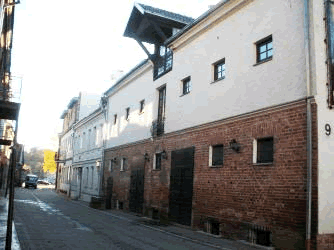
I found an amazing online site today that included a photograph of my great-great grandfather's house in Kaunas, Lithuania; which was built in 1866. http://www.northernjerusalem.com/objektai/locations/the-fvarshavchik-s-house-in-kaunas#about According to the site, "F. Varshavchik’s house was built for the Jewish merchant Faivuch Varshavchik. The design was drawn by Simon Gorskij. The construction work was never completed: once having started to build a large warehouse-barn the owner must have run short of funds to complete the residential premises. In 1990, the house was restored."
The daughter of Faivuch Varshavchik was Chaia/Golda/Ida Varshavchik, who married my great-grandfather Emanuel Markel/Merkel from Keidainiai, Lithuania. They immigrated to Boston in the 1890's. I would be interested in hearing from anyone else connected to this family. I'm especially interested in finding the family name of Faivuch's first wife, my great-great grandmother. Mark Strauss in NYC |
From: Joan Shrager <jshrager2@comcast.net> Hello, I live in Pennsylvania, USA. My grandfather and his family were from Berdichev. He came to America in 1907. His name was originally Meyer Litvok. He was the eldest son of the town’s kosher butcher, Aaron Litvok or Litwak. The family consisted of Yacob (Jack), Mottel (Max), Schmerel, Bassi (Bessie), and Ruchel (Rose). His mother was "Sossa Toube"? Spektor who died at an early age when her children were very small. Family lore has it that Rabbi Itzhak Elchanon Spektor was my grandfather's mother's father or possibly Uncle. I am very interested in learning if indeed we are related to Rabbi Spektor as my cousins(children and grandchildren of my grandfather's siblings) and I were told when we were little. Most of us are in our 60's and 70's now and the voices from Berdichev are only in our hearts. I am now past 75 and would love to pass this information on to my sons and grandsons. I'd be most appreciative if you could point me in a direction. Thanks,
Rabbi Yitzhak Elchanan Spector |
Ted Ashkenazy wrote: << In pre-War pre-Soviet occupation Jewish schools in Kaunas were separate. A "Jewish-Lithuanian Gymnasium" was established in Kovna in 1933, and its Ben-Tsion Klibansky |
...pre-1914, it seems unlikely I never heard her mention Lithuanian, nor did any of my cousins (from Kind regards, Saul Issroff |
My grandfather was Abraham NEVYAS or NEVIASKY. He left Lithuania alone I am also interested in the BARRON family and Jacob BARRON, Yette's Thank you, Judith Barrett |
LitaLita.com - A Week In Lithuania - Aug. 2009
http://litalita.com/m1/bank.shtml Preview
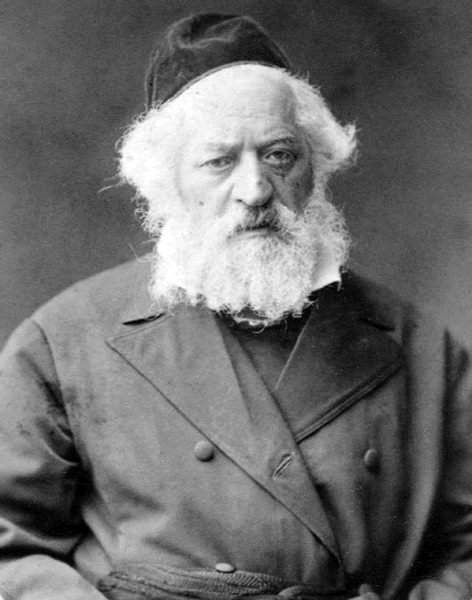
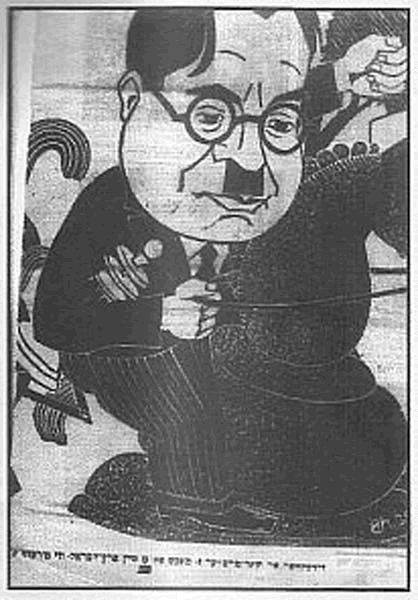
Aleksandras Ziselis Machtas
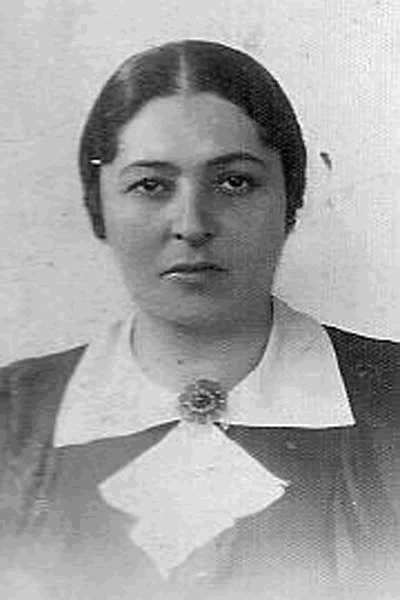
Ester Ente Kacaite
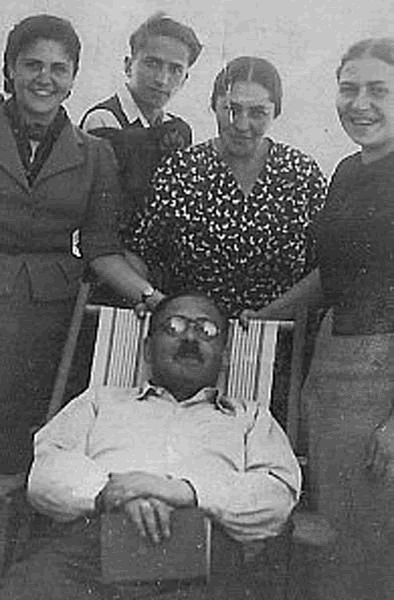
Standing from left to right : The Children
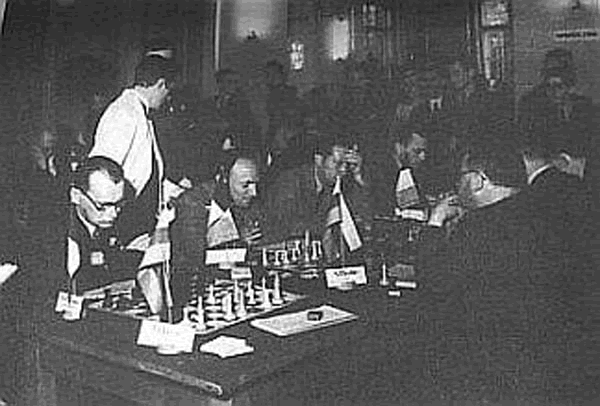
Aleksandras Ziselis Machtas Chess - Facts
Aleksandras Ziselis Machtas
Chess - Championships
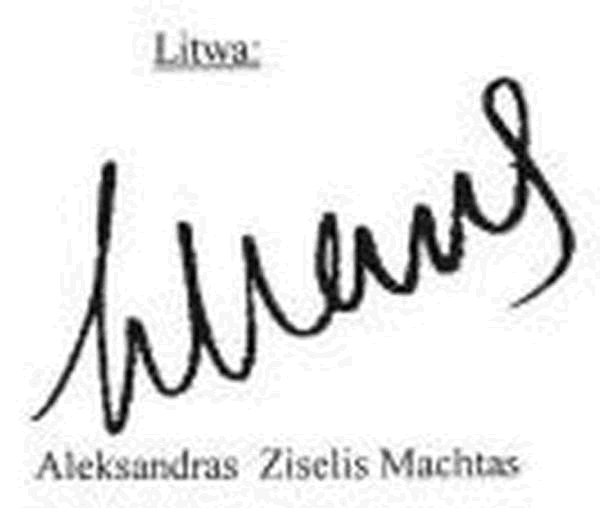
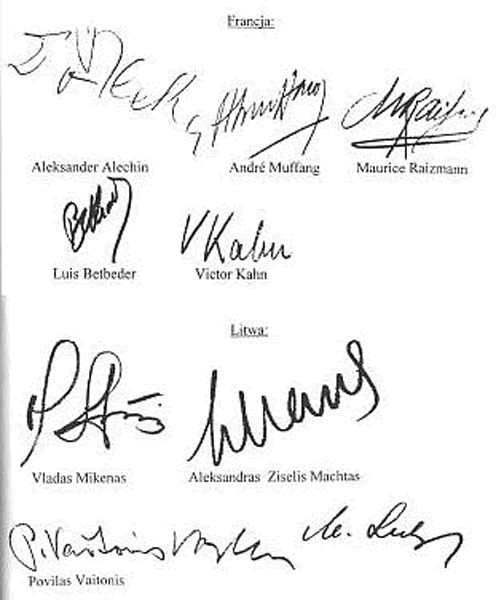
Aleksandras Ziselis Machtas Chess - Olympiad 1 You can also read a bit more The autographs of the players
Chess - Olympiad 2
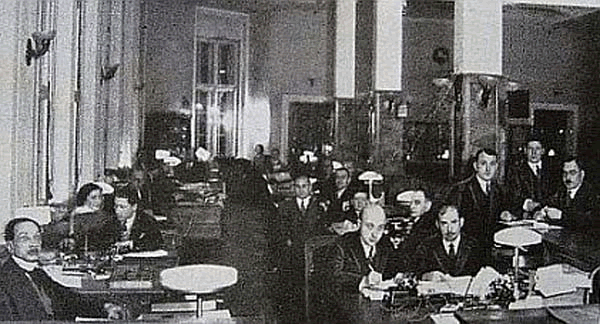
The Bank
Tel Aviv
The 8 Grandchildren Sara (Lala)'s
Yael Rivka (Riva)'s
Miriam Nini Yaakov (Yasha)'s
Mira The Grandchildren
The 21 Great Grandchildren Sara (Lala)'s
Maya Rivka (Riva)'s
Uri Yaakov (Yasha)'s
Ben
|
Kovno’s Past Alive At the Center for Jewish History on September 3, traumatic recall was the subtext of Solly Ganor’s remarks at the YIVO Institute for Jewish Research’s reception for his book, “Light One Candle: A Survivor’s Tale — From Lithuania to Jerusalem.” |
I have seen the 1913 list of business owners of course but I am If the lists exist but in Russian only, I would be willing to finance Thank you, LitvakSIG organizers, for all the work you do and thank you Judith Singer One link which may be of interest is: In addition, the main public libraries in Kaunas and Vilnius have http://datos.kvb.lt/en/index.php?q=factory&by=1&option=com_paieska&Itemid Ann Rabinowitz About half of my maternal grandfather's Charny relatives, born in or Since you seem knowledgeable in the area of industrial development, My grandfather and one of his brothers, as well as an ancestor on my Thank you for the help you've already provided; additional information Judith Singer (researching Charnys in Kavarskas, Vilkomir (Ukmerge), I can say with certainty that there were several soda-water factories My father's first cousin (sharp as a tack until her death at 96) who, All of us 'younger' cousins grew up hearing about our family's soda As an aside to your shoe business question - my father, who came to Danielle Weiner |
-- Ignas Slajus is one of our translators in Lithuania. He let us know that his Ignas wrote "The story, to put it in a few words, is such: my We are thankful to Ignas' great grandfather for the risks he took to help The honor passes down to Ignas who is also helping to save the memory of the A list of all recipients can be viewed on the Yad Vashem website. Eden Joachim |
Zvi Hirsch Geffen When Zvi Hirsch Gefen was born, Kovno was part of the Russian Empire. You could say he was born at the wrong place at the wrong time, as Zvi was born in 1864, right in the middle of the January Uprising (http://en.wikipedia.org/wiki/January_Uprising). To suppress the local population, the Russian military built fortifications throughout the town, which were being built just as Zvi must have been learning to crawl as a baby. |
| From: <saulmarg@g To: Cc: Brian Margolis Hi Eilat, Thanks very much for the information you have provided, it is fascinating. My brother managed to find my grandparents marriage on here, and I'm now going to look for my other set of grandparents. We're thinking of applying for Lithuanian (and thus EU) citizenship, but don't have any records to prove our heritage. What you have published may indeed be the records I'm looking for. Can I ask where you obtained this information, so I can see whether there might be an official Lithuanian government record of the marriage? Kind regards Saul |
From: Amanda Price <luv2dancenow@me.com> Hello Everyone! |
The following Lithuanian directories, sourced from the Lithuanian * Kovno Gubernia Commemorative Books for 1899, 1902, 1908, 1909, 1911, * Kaunas (City) Address Directories for 1930, 1932, 1933 * Kaunas (City) Medical Directories for 1928, 1929 * 1941 Lithuanian SSR Nationalized Businesses * 1930 Lithuanian Primary School Teachers Directory Apart from the all-Russian Empire directories announced last week The Kovno Gubernia directories are written in Russian, but you can Incidentally, www.epaveldas.lt has a full-text search option for some Logan Kleinwaks |

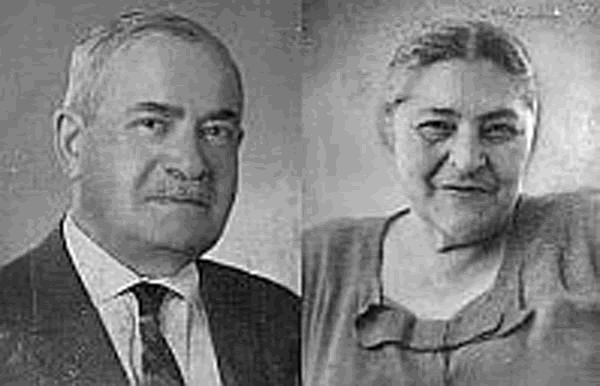
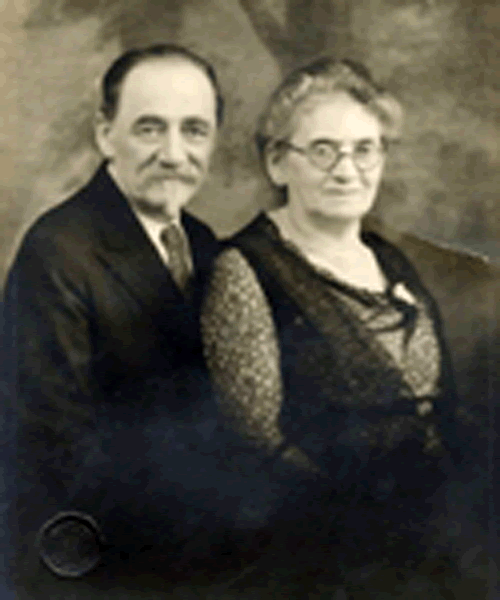
survivor from the Kovno Ghetto. Shalom wrote his memoir, Crossing the
River,
(Carmel and Yad Vashem, November 1999) and in May 2007, the English
translation of the book was approved for publication by The Alabama
University Press, slated for release in mid-2008.
Shalom is hoping to find other child survivors of his own age, born
circa
1933. He is making an attempt to document Lithuanian child survivors,
especially, but not only from Kovno, in order to add this information
to the
Yad Vashem archives. He asked me to help circulate this information on
this
list, as he is not very computer literate. I am happy to pass on any
responses generated by this message.
Varda Epstein
Efrat, Israel
--
Eilat Gordin Levitan
My question is: Have you ever heard of this phrase "The rabbis' act like someone is trying to steal their business?" Is this an old Yiddish saying that my Uncle was speaking in English? What would it sound like in Yiddish? Is it a template for other types of Yiddish sayings that are similar with a different pronoun; for example, "the butcher is afraid that someone is trying to steal his business" etc. etc.
The other part of the mystery is, many years after Shmuel died in 1966, I happened to become aware of Rabbi Joseph Soloveitchik's lecture, "The Lonely Man of Fatih" that was originally published in the journal "Tradition" and was eventually republished in book form. As I started reading Soloveitchik's words, I could hear Shmuel's voice in my mind. There was something about the way Soloveitchik expressed himself (conspectus of his writings by his students) and the way Shmuel expressed himself that was the same. This came as quite a shock to me and took me completely by surprise.
Is my experience too subjective to be able to analyze or explain or might there be some unifying linguistic influence that can be identified?
Thank You,
Ronald Subotnick
The following is from Vitalija Gircyte of the Kaunas Regional Archives
regarding an exhibition on Kaunas Guberniya Jews
~~~~~~~~~~~~~~~~~~~~~~~~~~~~~~~~~~~~~~~~~~~~~~~~~~~~~~~~~~~~~~~~
The Kaunas Regional Archive has opened an exhibition on Kaunas Guberniya
Jews. Mostly records - the thick old volumes are impressive. They are also
exhibiting photographs of army draftees and melameds that they have in
their holdings and also drawings of synagogues.
A few people from the Kaunas Jewish Community and Kaunas Religious Jewish
Community participated and seemed quite interested.
But the exhibition will be more interesting to Lithuanians and may serve to
dispel a few stereotypes about the Jews. Even some of my colleagues were
surprised that Jews used to be farmers and serve in the army. We used the
calligraphy of the Book of Esther in the shape of a bear by your (David Hoffman')
great-grandfather Shliomovich to decorate our exposition. Everyone
admired it.
Vitalija
Moshe Mones (Moshemones@gmail.com) on Monday, June 23, 2008
---------------------------------------------------------------------------
Message: Thank you for this great site
I am trying to find out if anyone knows more about my Paternal family 'Mones'.
I finally traced my great Grandfather Wolf Girsh Mones to his father Zelman
Chaim Mones in Kovna. I do know that Wolf Girsh married Lena Eliashevitz who
had a number of brothers and sisters. Wolf and Lena moved to the U.S. in the
early 1900's and gave birth to my grandfather (obm) Leon Eliezer Mones. I
also know Great Grandmother Lena's father's name was Joseph or Yosef and his
wife was Frieda.
thank you so much
kol tov
Moshe Mones
From Yad Vashem:
Mones Miriam and Emanuel
Miriam perished in Kowno, Lithuania at the age of 11. Emanuel perished at the age of 6. This information is based on a Page of Testimony submitted on 01-Jan-1970 by their mother; Chaja Bobkir ( nee Mones) , a survivor who lived in Canada.
You've done a great job here!
I would like to correct the spelling of the name "Lipec". The Lithuanian spelling is "Lipecas" in its masculine form, or "Lipeceite" in the Feminine form. Yet in order to preserve the original pronunciation, the spelling that was adopted by all the members of the family upon leaving Lithuania was "Lipetz". Dov Lipetz is my great uncle and he, his brothers and cousins all used the spelling Lipetz, I have even found a document in the UK national archives in which a cousin of Dov Lipetz requested to correct the official spelling of the surname.
Thanks, and all the best,
Allon Herman
Modi'in, Israel
Projector of domestic relation court. He was born in Vilkie, Poland,
1860 and died in New York, 1933. He was educated in Kovno for the rabbinate
and was for a time rabbi in Germany. He followed his parents to the U.S. and
was appointed rabbi in Keokuk, Ia. After serving in a number of western and
southern communities he came to New York and studied for the bar. The
funeral of Rabbi Joseph in 1903 was a turning point in his career. The
disturbance created at the funeral led to his taking charge of the Legal Aid
Bureau of the Educational Alliance, New York. His experience in the courts
suggested the Domestic Relations Court which was established by law in New
York in 1910
Looking for information on the following, who were living in Moscow as late
as 1959; all were originally from Kaunus (Kovno), Lithuania and were in Moscow
before the Bolshevik Revolution: Boris and Gregor KOTZIN, sons of my
fathers uncle
Isidor KOTZIN. Boris GINSBURG, son of Leon Ginsburg and Helena Kotzin, (she was
daughter of Isidors brother Jacob). Sophie Ginsburg KOTZIN, aunt of
Leon and widow
of Isidors brother Maxim Kotzin, who was professor of hygiene at Moscow
University, a founder of the Pasteur Institute of Moscow, and possibly involved
with construction of the Moscow water works. Anyone who has had good
results with
Moscow searches, please let me know how you did it.
Researching:
KOTZIN: Kovno/Kaunus; Moscow. KOCH/COOK:Kovno; Cincinnati. GINZBURG: Moscow.
SINGER: Lithuania; Los Angeles; Israel. FINKELHOR: Suvalki Gubernia;
Kovno area;
Pittsburgh; Cleveland. KATKISKY: Kovno; Suvalki area. GASSNER: Krakow; London.
NEUMANN/NEWMAN: Frankfurt; New York; North Carolina. BOAZ: Frankfurt; Atlanta.
CIMBERG/KIMBERG: Kremenets, Ukraine.WAGNER: Kremenets; New York.
Ted Kotzin
Boris KOTZIN (born 1887 in Kovno - passed away 1958 in Moscow [1])
was involved with Esperanto, a language introduced in 1887 by Dr. L.L.
Zamenhof;
Professor Boris Kotzin wrote "The History and Theory of Ido" in
which he demonstrated the ambiguities and difficulties created by
attempting to express even relatively simple concepts in Ido
http://rik.poreo.org/ido_con.doc
Information in Esperanto ( from the net):
estis Hebrew soveta esperantisto, kaj ?urnalisto-redaktoro, kaj nevo
of L.L. Zamenhof. Esperantisto of 1902. Kunlaboris in Lingvo
Internacia kaj aliaj Esperanto-gazetoj, tradukis multajn verkojn of
Anton ?e?ov, Maksim Gorky k.a. In 1910-15 Kotzin estis redaktanto of
the Ondo de Esperanto kaj in 1911-13 vicprezidanto of Moskva Societo
Esperantista. Kotzin verkis plej kompletan kritikon kontra? Gone:
Historio kaj teorio of Gone, 1913, kiu aperis anka? in Germanic
traduko, 1916. In 1920 Kotzin enkondukis Esperanton in Soveta
Sindikato de Artistoj kaj in ties body Rabbis. Estis membro of Centers
Komitato de Sovetrespublikara Esperantista Unio 1926-28.
Cemetery Office is:
KAPINIU PRIEZIUROS KONTORA
DONELAICIO G-VE 70
KAUNAS
You can view the pages from the book on my web site here.
http://www.mannbarry.net/Lithuania/Kaunas/Cemetery.html
Barry Mann
I found her name on the Internal Passports list.
The JGFF lists 20 researchers researching this surname in Lithuania, but no one is listed specifically as researching this family from Kaunas.
If you have any information about Tauba MOSKOVICH (nee KRUMRUTSKY) or about her family, I will appreciate it if you can contact me.
Thank you,
Rony Golan
Israel
Researching:
KRAMARUTSKY - KREMERUTSKY- KARIVOROUCHKA - Kaunas, Vandziogala
EISDORFER - Hungary
GOLDSTEIN/FRIEDMAN - North/east Hungary
SLOMOVITS - Sighet, Rozavlea, Strimtura
NAJMAN/NAYMAN - Bedevlia, Ukrain.
----------------------------------
Rony wrote;
My grandmother, Zlate Eugenia Kramarutsky was born in Slobodka in 1896 to Rivka Rachel, daughter of Melech Pakelchik, and Nachum son of Yudel Kramarutsky.
Her oldest sister was Sarah Liba who was born in December of 1893 and Yizhak born in December of 1901. at the end of The First World War Zlata met Moshe Leib SLOMOVITS from Sighet ( he arrived to Kovno as a POW)
They were married and moved to Sighet. They had 3 children. Zlate and her youngest daughter, Chana age 11, perished in the holocaust. No trace is found of Zlate sister Sarah Liba , brother Yizhak or their family from the Kovno area.
http://shorashim.blogli.co.il/archives/200
--------------------------------------
from yad vashem;
Slomovitz Zeny
Zeny Slomovitz was born in Kovna, Lithuania in 1900. Prior to WWII she lived in Sziget, Romania. During the war she was in Sziget, Romania. Zeny perished in Auschwitz May 21th, 1944 with her youngest daughter. This information is based on a Page of Testimony found in the Pages of Testimony by her daughter Karola Golan.
Slomovitz Hana
Hana Slomovitz was born in Maramures in 1932 to Moshe. She was single. Prior to WWII she lived in Maramures, Romania. During the war she was in Sziget, Romania. Hana perished in 1944 in Auschwitz, Camp. This information is based on a Page of Testimony (displayed on left) submitted on 02-Dec-1977 by her sister, a Shoah survivor
Slomovits Moshe
Moshe Slomovits was born in Slatina in 1896. He was married. Prior to WWII he lived in Marmaros sziget, Romania. During the war he was in Marmarossziget, Romania. Mose perished in 1944 in Auschwitz, Camp. This information is based on a Page of Testimony (displayed on left) submitted on 02-Dec-1977 by his daughter
Slomovits Meleh
Meleh Slomovits was born in Sziget in 1923 to Moshe. He was single. Prior to WWII he lived in Sziget, Romania. During the war he was taken by the army in 1944 and never found a trace of him. This information is based on a Page of Testimony (displayed on left) submitted on 02-Dec-1977 by his sister
----------------------------------------------------------------------------------
Moskovitz Tauba
Tauba Moskovitz was born in Kowno in 1905 to Avraham and Sara. She was a worker and married to Avraham. Prior to WWII she lived in Kowno, Lithuania. During the war she was in Kovno, Lithuania. Tauba perished in 1941 in Kaunas, Lithuania. This information is based on a Page of Testimony (displayed on left) submitted on 07-Jan-1957 by her friend.
Moskovitz Abraham
Abraham Moskovitz was born in Kowna in 1902. He was a carpenter. Prior to WWII he lived in Kowna, Lithuania. During the war he was in Kowna, Lithuania. Abraham perished in 1941 in Kowna, Ghetto. This information is based on a Page of Testimony (displayed on left) submitted on 07-Jan-1957 by his friend
Moshkowitc Taibl
Taibl Moshkowitc was born in Kowno in 1910. She was married to Avraam. Prior to WWII she lived in Kowno, Lithuania. During the war she was in Kowno, Lithuania. Taibl perished in 1944 in Kowno, Ghetto. This information is based on a Page of Testimony (displayed on left) submitted on 15-Jan-1974 by her sister-in-law
Submitter's Last Name BAKAS
Submitter's First Name ROZA
Relationship to victim SISTER-IN-LAW
Registration date 15/01/1974
Language Russian
Moshkowitc Awraam
Awraam Moshkowitc was born in Vilki in 1907 to Yosif and Sheina. He was married to Taibl. Prior to WWII he lived in Kaunas, Lithuania. During the war he was in Kaunas, Lithuania. Awraam perished in 1941 in Kaunas, Ghetto. This information is based on a Page of Testimony (displayed on left) submitted on 15-Jan-1974 by his sister
Submitter's Last Name BAKAS
Submitter's First Name ROSA
Moshkowitc Yosif
Yosif Moshkowitc was born in Vilna in 1884 to Artzik and Riwa. Prior to WWII he lived in Kovno, Lithuania. During the war he was in Kaunas, Lithuania. Yosif perished in 1944 in the Shoah. This information is based on a Page of Testimony (displayed on left) submitted on 10-Jan-1974 by his daughter
Since you seem to be related I am pasting here some of the notes which
I received from you.
allon wrote;
I have our ancestry for both Aharon Lipetz (Dov's father) and Zipora
Dolnitzki (Dov's mother) as far as the late 1700's and I will happily
provide you with further information as much as you are interested.
All the best,
Allon
David Lipetz (dlipetz@hotmail.com) on Thursday, December 04, 2008 at 22:46:27
---------------------------------------------------------------------------
I am a descendant of, and named after, David Lipa Lipetz from Kovno.
My father is Jacques Lipetz. His father is Abrasha Lipetz - one of David's
three sons who left Lithuania before the war. The text I found on this site
regarding my family's history is fascinating. Abrasha died in 1985 I've been
trying to fill in the blanks. I now know that my uncle Leon Lipetz (who died a
few years ago) was named after his uncle Leon who was murdered in the
holocaust.
probably Ona Simaite, a librarian in Vilnius University, took advantage
of her freedom of movement into the Jewish ghetto, ostensibly to retrieve
books loaned to Jews before the war, as a pretext to secure valuable
literary works by Jewish authors. She also looked after Jews in hiding
outside the ghetto. Arrested during an attempt to smuggle a Jewish girl
outside the ghetto, she was tortured and sent to a concentration camp.
She survived but suffered permanent damage to her health.
You will find a write-up on another Lithuanian Righteous among the
Nations at:
http://en.wikipedia.org/wiki/Kazys_Binkis
And a Wikipedia site has a whole list:
http://en.wikipedia.org/wiki/Lithuanian_Righteous_among_the_Nations
There is now also a book published by the State Jewish Museum in Vilnius
that lists more than 2,500 Lithuanians who helped save Jews during the
Holocaust (though whether all have been recognized by Yad Vashem I don't
know.) I had some correspondence a few years ago with Viktorija Sakaite,
who was working on this book. At the time, a book had come out by a
Lithuanian, Antanas Gurevicius, listing more than 10,000 Lithuanian
rescuers. Sakaite was attempting to verify as rescuers the people named in
Gurevicius' book. It's obvious that she was able to do so with only about
25% of those listed by Gurevicius. See:
http://www.ncsj.org/AuxPages/022602Rescuers.shtml
Marjorie Rosenfeld
in particular, several people wrote and asked about the location, etc.
A reference to Jewish institutions as of July 10, 1941 is found in
the document: "Memorandum submitted to the Lithuanian municipality of
Kovno by the Jewish committee in Kovno, concerning the suburb of
Slobodka-the planned area for the Ghetto."
The document is mentioned in the book "Surviving the Holocaust" by
Avraham Tory, Martine Gilbert, Dina Porat and Jerzy Michalowicz, Pages
15-16.
Here is the list:
Jewish Hospital, 3 Jakstu Street
Jewish Orphanage, 15 Fire Brigade Street
Jewish Home for the Aged, 15 Puskos Street
Well-known restaurant, 10 Mapu Street
Jewish Community Centers, 14 Rotuse Square and 12 Luksio Street
Mikvah, 3 Luksio Street
Hebrew Gymnasium, 25 Nieman Embankment
Talmud Torah School, 17 Ugnagesiu Street
Jewish Clinic, 7 Pilies Street
ORT School, 86 Jonavos Street
OZE Jewish Health Organization, 1 Misku Street
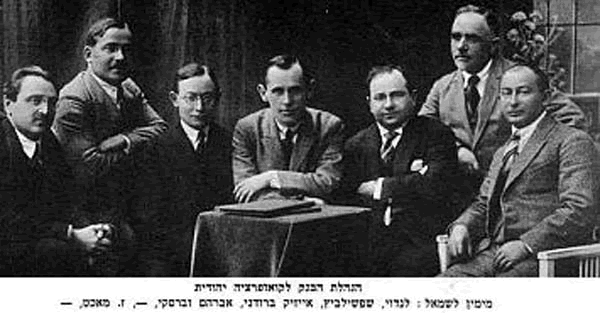
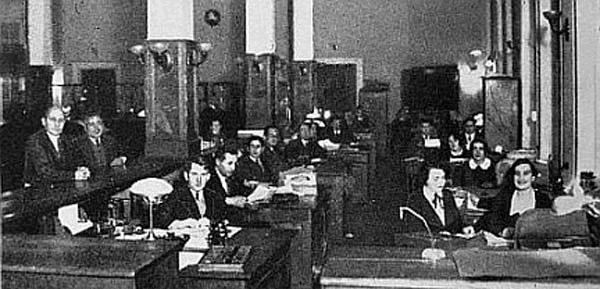
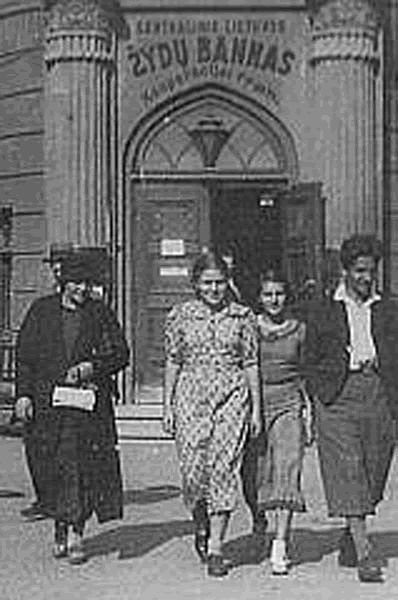
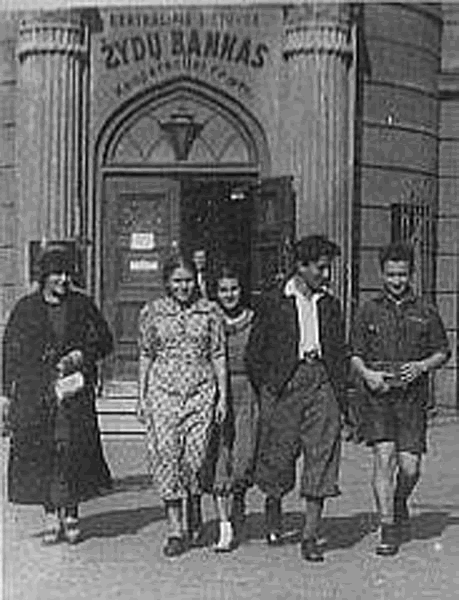
Jewish Central Bank for the Support of Cooperatives, 76 Laisves Boulevard
Ann Rabinowitz
The Internet is a rich resource for locating references for Jewish
orphanages which were established pre-World War I, during World War II
and post-World War II in Lithuania. Some of these references can be
found at YIVO in New York, others in various books and other resources
includng JewishGen. Sometimes, the orphanages were called kinder hois
or kinder heim and you can find them that way.
One reference I found some time ago and posted about then was for the
Kovner Yidisher Kinderheim. It was found in the records of the
Kupishok Benevolent Society in Cape Town, SA. Evidently, the Society
had sent money to the orphanage after World War II.
There was a listing of 108 children with the names of their parents,
where they were from originally and their year of birth. Of course,
not all of the information was provided for each child.
An example of what is found in this listing is the orphaned SAPLICKI
family of five children, all born in Kaunas, Lithuania, whose parents
were Sholom and Rose: Genie, born 1934, Malka, born 1935, Moshe and
Sheine (twins), who were born 1936, and Chone, born 1938.
Another family of children in the orphanage were the STOLIARSKI
family, no parents' names given, all born in Salakas, Lithuania:
Avrom, born 1935, Eda, born 1936, and Reise, born 1940.
Two other families were those of WAINER from Taurage, Lithuania, whose
parents were not listed: Yankel, born 1938 and Raine, born 1940; and
ZIMAN from Lazdijai, Lithuania. whose parents were not listed: Sheine
and Shmuel (twins), who were both born 1937.
There were even three children listed who had no first name at all,
but their parents names were provided: Zalman and Freda GITLIN's
child; Rachmiel and Dina LACHOWITZKY's child; and Dovid and Slave
SHNEIDER's child.
The shtets represented in this listing were the following: Dusetos,
Daugavpils, Janova, Kenigsberg, Klaipeda, Kaunas, Krekenava, Kretinga,
Lazdijai, Oriol, Panevezys, Prienai, Raiseniai, Riga, Salakas, Shantz,
Siauliai, Taurage, Vandziogale, Viesintos, Vilnius, Vilkaviskis,
Vitebsk, Ukmerge, and Utena.
All in all, these references can provide valuable clues to the
whereabouts of relatives.
Ann Rabinowitz
Back to Kovno
http://forward.com/articles/122195/
Exhibitions
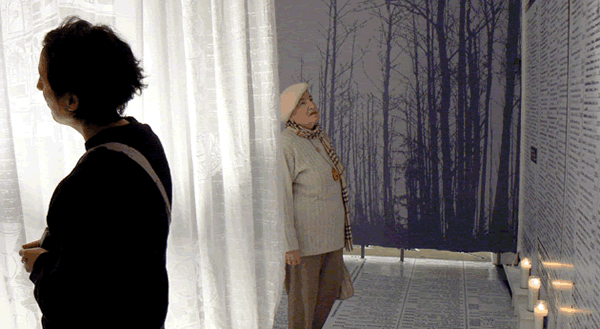
The ‘Where Is Konvo?’ Team
By Claudia B. Braude
Published December 30, 2009, issue of January 08, 2010.
This year, the first comprehensive collection of South African Nobel laureate Nadine Gordimer’s nonfiction works will be published. Consistent with a more pervasive silence of her generation, it is unlikely to include more than scant reference to her father’s Lithuanian background.
A younger generation of Jewish South African artists of Lithuanian descent, including textile designer Yda Walt and artist Cheryl Rumbak, is starting to fill in the gaps in memory and consciousness.
Exhibitors in Kaunas’s 2009 Textile Biennial, these artists attended the Kaunas Jewish community’s annual Holocaust memorial ceremony at the notorious Ninth Fort. The date specifically commemorates the Aktzion on October 28, 1941, when a third of the Kovno ghetto’s 30,000 Jewish residents were selected for death at the fort.
South African Jews Look for Support
How a Buttonhole Camera Kept Kovno’s Past Alive
The ‘Where Is Konvo?’ Team
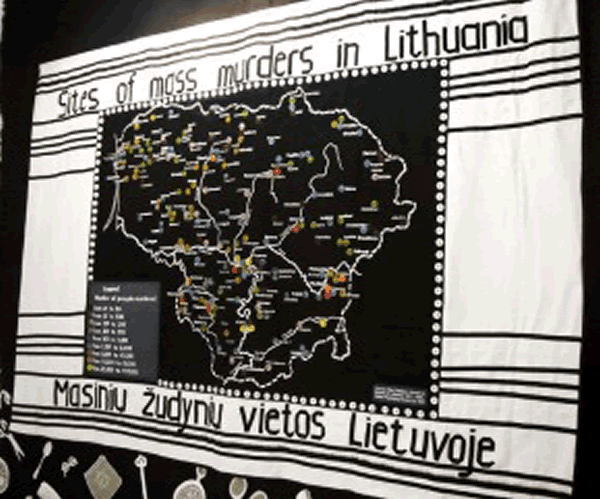
Murder Map: Lithuanian World War II history is rendered on this adapted tallit. (click for larger view)
Unlike many South African Jewish visitors to Lithuania
Standing between them at the ceremony, Fruma Vitkin Kucinskiene told Walt and Rumbak that she was a child witness of the selection, which left no family untouched. Only their emigration from Lithuania and relocation to South Africa in 1928 spared Rumbak’s grandparents and aunts, born in Kovno (as Kaunas was known to Jews), the same fate. Like Walt’s grandparents (and Gordimer’s father), they were among the 40,000 Litvak (Lithuanian) Jewish immigrants into South Africa between 1880 and 1920, with a further trickle arriving in the ’30s. Predominantly Litvak, South Africa’s Jewish community is uniquely homogenous in its Lithuanian origins. Largely erased in Lithuania, prewar Litvak culture was preserved in South Africa.
Vitkin Kucinskiene attended the opening of Where Is Kovno? the South Africans’ exhibition that explores the repressed memory of Kaunas’s Jewish life. The exhibition was born when Walt, part of a community of artists newly reflecting Johannesburg as a vibrant post-apartheid African city, accompanied her other work, which was included in a South African exhibition at Kaunas’s 2007 Biennial.
The ‘Where Is Konvo?’ TeamMurder Map: Lithuanian World War II history is rendered on this adapted tallit. (click for larger view)Unlike many South African Jewish visitors to Lithuania since the demise of the Soviet Union and apartheid, Walt was uninterested in “the rootsy thing.” The “emotional response” and “weird sense of discomfort and connection” she felt in Kaunas were unexpected.
Spending nights in her hotel room, Googling the city’s Jewish history, she learned that 40,000 of 240,000 Jews in Lithuania before the 1941 Nazi invasion had lived in Kovno, and that by 1945, only 4% of this community survived.
“I felt the community’s absence. I want to shout, where are the Jews?” she told fellow artists who encouraged her to bring related work to the next biennial.
Later, with a guide, she explored Kaunas’s previously Jewish buildings. “I felt angry: Why are none of these buildings marked?” she said.
Through its presidential historical commission assessing the legacy of the Nazi and Soviet occupations, Lithuania has officially acknowledged its devastating history. Freed from Soviet historical distortion, historians largely agree on the events of the Lithuanian Holocaust. “Integration of Lithuanian culture into that of the West is possible only through acknowledgement of the extent of the Holocaust,” said Emanuelis Zingeris, commission chair. But reshaping public memory is difficult. “On some very basic level, the history is totally unacknowledged,” Walt said.
In collaboration with Rumbak and composer Philip Miller, Walt submitted a proposal to the 2009 Biennial.
A decade after the South African Truth and Reconciliation Commission’s rewriting of apartheid history, the artists used their experience in Kaunas “to trigger memory” of prewar Jewish history in the city’s residents. They did so in collaboration with Goda Volbikaite, a Lithuanian doctoral student of Yiddish literature who was introduced to them by the biennial organizers.
At university, Volbikaite had chanced on a novel by the Russian-Jewish Grigorii Kanovich, representing Jewish life in Yanove. “He described a town I thought I knew,” said Volbikaite, who spent holidays visiting her grandparents there. She asked herself the Lithuanian version of Walt’s question: “Why do I know nothing about this? Where are the signs?”
Consulting with Simon Davidovich, Sugihara Museum director and Jewish tour guide, Volbikaite produced a map of Kovno’s Jewish buildings for visitors to the biennial.
In workshops with university art and music students, the South Africans used “Rewind,” Miller’s cantata on the TRC, which included recordings of apartheid victims’ testimonies, to discuss the artist’s role in facing difficult histories and representing traumatic histories.
The project’s heart, in the biennial’s main gallery, was the “Kaddish” installation, “a space to mourn [and] respect the murdered Jewish community of Kaunas and Lithuania.”
A black-and-white photograph of forest trees covered the back wall. Miller’s sound score, his recordings in forests where massacres occurred, transformed wind and forest sounds into an accompanying memorial of Jewish absence.
On the opposite wall hung a textile map of more than 200 Lithuanian sites of mass murder. Inspired by African textiles, Walt and Rumbak joined together five black-and-cream Xhosa blankets, traditionally used for funerals, to produce their template. Alluding to South Africa and also the Jewish tradition, it resembled the tallit, the prayer shawl in which Jewish men are traditionally buried.
Marking murder sites, buttons hand-dyed in colors that Walt imagined to be found in forests in summer provided the installation’s only color.
“I thought about red and orange flowers in the summertime. Those became the colors for the biggest graves,” Walt said. Red signified 5,000 to 10,000 Jewish victims, orange 10,000 to 25,000. In broken English, a woman survivor indicated where her parents were murdered. “My mutter there…”; “my vater there….”
Pinned beneath the installation were drawings of domestic and Jewish objects (combs, keys, candlesticks, tefillin). Some were exhibits at Kedeiania’s Old Synagogue and the Sugihara Museum (the heroic Japanese diplomat’s telephone and typewriter); others had been exhumed from mass graves. “House keys were among people’s last possessions — they thought they were going home,” Walt said.
The floor and remaining walls were covered with pages from Lithuania’s 1939 telephone directory, used by Davidovich to help his (often South African) clients locate people and places of origin.
Highlighting Jewish names, the pages confronted viewers with Kaunas’s strongly Jewish past. Triggering memory, the installation also reinforced nationalist denial: One viewer told Volbikaite that the directory was fabricated.
Dividing the room, a white curtain, the Kaddish prayer for the dead printed in white on white, signified ruptured domesticity, windows emptied of occupants.
Nine yizkor memorial candles burned along both walls, a total of 18 candles — representing and commemorating chai, 18 in Hebrew, life itself. Standing in the “Kaddish” space after the Holocaust commemoration, a survivor told Walt that he felt immersed in a world he didn’t want to leave.
The installation flowed between South Africa and Lithuania. Miller layered recordings of Lithuanian students singing “Afn Pripetshik,” the popular Yiddish song, with South African Litvaks, their voices now poignantly “connected back to Lithuania through their families.”
The poignancy relates to the generational silences not just in Miller’s family (“My parents wanted nothing to do with their parents’ history,” he said), but also, until recently, in the emigrant community more widely.
Miller’s primary collaboration has been with William Kentridge, composing the scores for the videos of this pre-eminent South African artist. Kentridge descends directly from a family of cantors in Lithuania’s town of Utian (Cantorowitch/Kentridge) before his great-grandfather’s immigration to South Africa. His otherwise intellectually acute body of work devoid of reference to this history, he questioned Miller’s involvement in the Kovno project: “Why are you writing music for a tablecloth?”
Alice Kentridge, William’s daughter, countered this dismissive relation to the Eastern European legacy of South African Jewry when she accompanied the team to Lithuania, documenting the project. (William Kentridge’s subsequent promotion of the project to a potential funder helped to secure half the team’s budget).
Building on the biennial’s receptivity, the South Africans intervened powerfully in Lithuanian history. By inserting survivors into a public space that triggered Lithuanian memory, rather than a specifically Jewish one, they bore witness to the survivors’ trauma and experiences in a different way. New Lithuanian historical consciousness converges in the exhibition with the vicissitudes of post-apartheid, post-TRC South African Jewish memory.
Walt, Rumbak and Miller know, however, that the installation is only the beginning of a broader project to join the dots between Lithuania and South Africa. They have glimpsed an answer to their question: Kovno’s culturally, spiritually and ethically rich Jewish life and consciousness endure in Cape Town and Johannesburg.
--------------------------------------------------------------------------------
When Claudia Braude was in Kovno to cover the Biennial she conducted a transcontinental interview with the South African artists and local Jewish specialists. With Braude in the Sugihara Museum in Kovno were Goda Volbikaite, a Lithuanian student of Yiddish literature and Simon Davidovich, the museum director. She also speaks with rtists Yda Walt and Philip Miller, who are were in the studio in Johannesburg, Braude’s report from Lithuania was broadcast on Johannesburg radio on November 15 and is reproduced here courtesy of Moshe Chaim Wegener, station manager of ChaiFM.
---------------------------------------------
At the Center for Jewish History on September 3, traumatic recall was the subtext of Solly Ganor’s remarks at the YIVO Institute for Jewish Research’s reception for his book, “Light One Candle: A Survivor’s Tale — From Lithuania to Jerusalem.”
“It took me 50 years to write my diary… I had nightmares,” said Ganor, who survived the Kovno ghetto and Dachau. His book inspired YIVO’s “Light One Candle” photo exhibit by Kovno ghetto photographer George Kadish, aka Zvi “Hirsh” Kadushin, whose images of children, taken through a buttonhole in his overcoat, include one of a young Ganor.
Postwar U.S. Army photos show Ganor in an Army uniform, as well as members of the U.S. Third Army’s Japanese-American 522nd Field Artillery Battalion of the 442nd Combat Team from Hawaii, which helped liberate Dachau.
An emotional Ganor recalled how “Clarence Matsumura rescued me during the death march from Dachau to the Tyrol.” Ganor learned English in the Kovno ghetto and became a translator for the U.S. Army. “Trailing around the D.P. camps…. I had the satisfaction of ferreting out Lithuanian Nazi collaborators…. It was easy. Those with the S.S. had a tattoo under their left armpit.”
“In 1948, when I was 18, I decided to go to Israel,” he continued. “It was important to have a state of our own…. I was told, ‘You’re going to another Holocaust.’ For me it was the single most important act of my life.” In Israel, Solly Genkind changed his last name to Ganor, which, he explains in his book, means “garden of light.”
Ganor and I first met in July 1994 on a mission to Japan for the dedication ceremony on the Hill of Humanity at Yoatsu that honors Chiune Sugihara, Japan’s consul in Kaunas who in 1940 issued 2,139 visas that saved 6,000 Jews, including my mother and me.
Led by Eric Saul and Lani Silver, the 1994 mission was sponsored by the Holocaust Oral History Project of San Francisco. The mission’s participants included members of the 522nd who helped liberate Dachau and Yukiko Sugihara, the consul’s still-vital widow.
For Ganor the trip to Japan had additional resonance. As a 10-year-old, Ganor had invited the Sugiharas to his home in Kovno for a Chanukah celebration. Unfortunately, he and his family missed getting those precious life-saving visas.
At the YIVO reception I was delighted to see Ganor’s wife, Pola Ganor; was introduced to George Mukai, a member of the 442nd and a new Ganor friend, and met author Allison Leslie Gold, who had interviewed me by phone and mail for “A Special Fate: Chiune, Sugihara — Hero of the Holocaust,” which showcases Ganor’s and my childhood recollections of the Vilna-Kovno-Sugihara saga.
* * *
Miriam Hoffman, a professor of Yiddish at Columbia University and a Forverts contributor, just back from teaching at the Vilna Summer Yiddish Program, where, along with teachers from Estonia, Argentina and Los Angeles, she taught 60 students from Italy, Belgium, Poland, Canada and the United States.
She told me of the demise of Jewish Vilna — the onetime “Jerusalem of Lithuania.” An embittered Hoffman recalled Ponar, the lush forest outside of Vilna, the eternal resting place for 40,000 slaughtered Vilna Jews. “It was like being in hell,” she said.
“The ground is so fertile…. the trees huge, and there are no markings around the gravesites,” she said. “The last signs of [Yiddish] letters on buildings [in Vilna] are being painted over. In two years, no one will know Jews ever lived here.”
Joshua Cohen’s “Litvak-less Birthday Bash,” a chronicle of Vilnius’s 750th birthday celebration (in the August 29 Forward) offered me painful “closure.” The only photo I have of my parents and me was taken in Vilna in 1940 at the Gaon’s gravesite. Cohen’s article reports: “The original site of the grave of Rabbi Elijah ben Solomon Zalman, better known as the Vilna Gaon, is now a sports complex.” Soon Vilna will become Lithuanian Jewry’s Ground Zero.
* * *
Roman Kaplan, owner of Manhattan’s Russian Samovar restaurant, was excited about the recent television shoot of co-owner Mikhail “Mischa” Baryshnikov and actress Sarah Jessica Parker for an episode of HBO’s “Sex and the City” (to air September 14).
What did they eat, I asked. “They chose what [late poet and a Samovar founder] Joseph Brodsky liked: kholodetz, veal in aspic vinaigrette, Russian beet salad and herring. Mischa drank water; she drank martini.”
* * *
Famous actress she may be, but I was appalled by Parker’s interview in the September 15 Newsweek “Newsmaker” column. Asked “in case of a fire in your home, which pair of shoes she would save — Manolos or Jimmy Choos?” Parker replied: “Oh well, it’s like ‘Sophie’s Choice.’ It’s an impossible situation.” How dare she compare the choice of a fashion accessory to a mother forced to choose which child will live or die in Auschwitz!
LitvakSIG is pleased to announce that the Kaunas Family List Project is now
complete. Eighteen files were translated resulting in nearly 23,000 lines
of data. The last of the eighteen files has been added to the Kaunas
Family List site at http://kaunasfamilylist.shutterfly.com/
Finding that files like these exist is just the beginning of a project. It
is the contributors who made it happen and because we were able to afford
two translators, it was possible to complete this project in less than two
years. Without the support of our contributors, the translation of this
list of almost 23,000 lines of data spanning a time frame from 1858-1915
could not have happened.
The entire project has now been given to the Kaunas District Research
Group . A surname list can be downloaded at http://kaunas.shutterfly.com/
Please scoll to the bottom of the page and select KFL surname list.
From the outset, it was obvious that this was a very important list for
researchers. Quite a few brick walls were breached for those fortunate
enough to find their families listed. The information originally recorded
was gleaned from all sorts of documents which were presented to
the authorities.
Many links to former shtetls of residence were found as well as details
of extended families. For some, it provided the confirmation that a family
they thought might be theirs did indeed move to Kaunas or left Kaunas for
other places.
Dorothy Leivers
Co-ordinator
Dorfleiv@googlemail.com
LitvakSIG (litvaksig@lyris.jewishgen.org) is hosted by JewishGen
The program can be heard @ http://www.bbc.co.uk/programmes/b00vc51h
Here begins an extraordinary journey to Lithuania and Belarus for
broadcaster and writer Michael Freedland and his son, Guardian
journalist and best-selling author, Jonathan.
These two countries once thronged with Jewish life, a life that was
all but extinguished by successive regimes- Russian Czarists, Soviets
and then the Nazis who, with the help of some Lithuanians, managed to
totally decimate many towns and villages, or shtetls. Knowing that
their forebears settled in the UK in the late 19th century they set
off to try to find any trace of the Freedlands who came from Baisogala
in Lithuania and the Mindels from Dunilovichy in Belarus. As the
journey progresses, it becomes a broader search- a search for Jewish
life. They are taken to Janova and Kedainiai, both once busy shtetls,
alive with Jewish businesses, shops and culture. Sadly in such places
where there was once a high proportion of Jews, few now remain and
synagogues have disappeared or fallen into disrepair.
In Kaunas, an interview with Professor Egidius Aleksandrovicius lays
out the entire history of Jewry in Lithuania. In Vilnius, the family
focus is re-established as they visit the National Archives where they
learn a lot about the Freedlands and the Mindels, discovering
crumbling nineteenth century archives that refer to what could be
Michael's ancestors. The trail now points clearly to Baisogala, what
was once a tiny shtetl in the Lithuanian countryside. Simon the guide
knows of a Jewish cemetery on the outskirts, but it's a cemetery he
hasn't seen for ten years, as it's been flooded for a reservoir, but
by an amazing stroke of luck, the team tries a wooded hillside
and...there it is, remnants of old and mostly illegible Jewish tombs,
where, no doubt, Michael and Jonathan's ancestors are buried."
(Producer: Neil Rosser //A Ladbroke Production for BBC Radio 4).
Stacye Mehard
Virginia
Studying the Families of
Alperovich of Kurenets; Ipp of Kaunas; Krokin / Krokinovsky /
Crockin of Crockin of Kaunas and Baltimore and Norfolk, Va;
Lewitan of Kobylnik, Dokshits-Dokkshytsy, Lithuania and Belarus;
Luloff / Lulow / Lulove of Dokshits-Dokkshytsy and Minsk;
Piastunovich of Kurenets & Dokshits-Dokkshytsy;
Rapoport of Kaunas; Rosenthal / Roszental of Dokshits-Dokkshytsy;
Sass / Zess of Lithuania and Poland; Smigelsky of Grodno and
Shenandoah, Pennsylvania
Dear Kaunas Researchers !
Once again I am delighted to announce that we have added new material to our site http://kaunas.shutterfly.com/
Now completed are the 1922 – 1940 Prisoner Lists and at our site you can check the Surname Frequency List to see if your family appears.
Recently added are also the 1901 Draftee Lists – these lists again hold a "mine" of information.
Our continued research projects are dependent on your support so if you are researching your family in the Kaunas area this is certainly the time to join our group.
Looking forward to hearing from you,
Ralph Salinger
Coordinator Kaunas District Research Group
The database and discussion group of LitvakSIG (litvaksig@lyris.jewishgen.org) are hosted by JewishGen
From: Ari Goldberger <ari@esqwire.com>
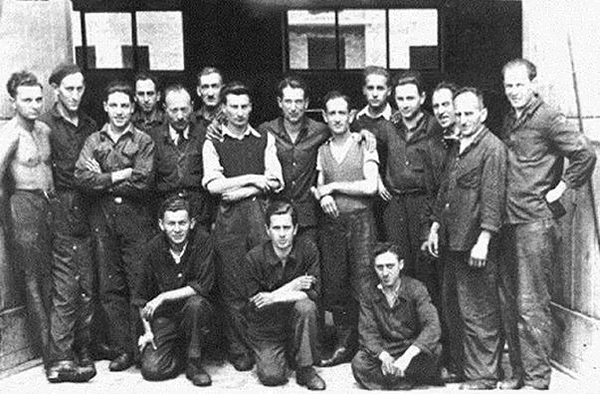
My Dad is the 3rd standing from the left in the below picture. He is
86. Here is another picture taken the same day. My father said an
SS Officer shot it. It seems the timing on the pictures is more than
just a minute since one picture has a motorcycle (maybe the SS man’s).
Maybe this pic shot by someone else. My father also wrote a book:
Prisoner of the Gestapo.
Image number 62
http://www.eilatgordinlevitan.com/krakow/krkw_pages/krkw_ghetto.html
-------
My grandfather, Leon Lefkowitz, (mom’s dad) was a well known Cracow
artist. His pics and documents and photos are at
http://esqwire.com/leon
He was a Kovno member.
William Epstein.
We have no information and about Rose or Rosie my great grandmother.
My grandparents are bth gone. My Dad told me nothing about the Epstein side of my family.
he died in 1973 at age 45.
I am looking to see if I have any relatives.
I was told many Kovno wives are not buried near their spouses.
Thanks,
Madlyn Epstein-Steinhart
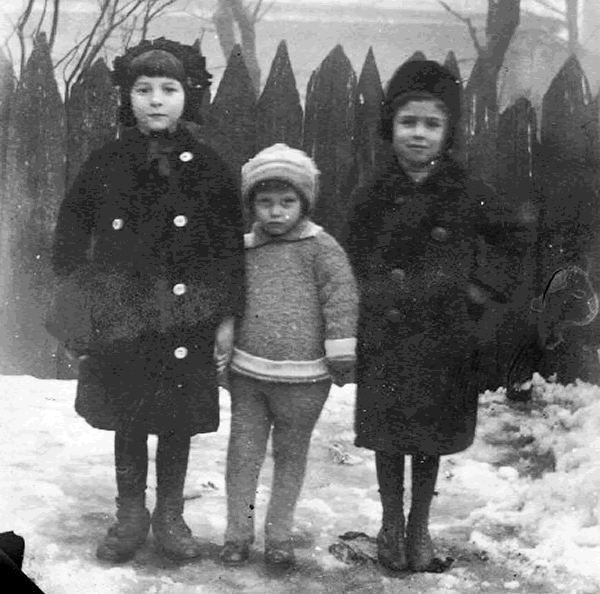
From left
to right, Sara, Yitzhak, and Beyla Peshkin. It must have
been taken around in the mid-1920's, as the boy, the youngest, was
born in 1920. Beyla Peshkin (Beile Feinberg nee Peshkin was born in
Kowno in 1919 to Hirsh and Sheine. She was married to Yosef. Prior to
WWII she lived in Kowno, Lithuania. During the
war she was in Germany.
Beile was murdered in 1945 in Sonnenberg, Germany report by her brother), Sara
Peshkin
Stolbov and Yitzhak Peshkin ( who was in Siberia during the war)
emigrated to Israel
( Yitzhak lived in Beer Sheva) in the 1970's.
Adrienne Baxt Lasky
Granddaughter of Ethel Chesler Baxt, aunt of the Peshkin kids
|
PESKINAS / [PESHKIN], Itskhok |
son of
Hirsh |
|
born in
1920 Kaunas |
3270/48606 |
pupil |
Internal Passport Card KRA/66/1/3270 |
|
PESKINAITE / [PESHKIN], Beyla |
daughter
of Hirsh |
|
born in
1918 Kaunas |
1606/8041 |
pupil |
Internal Passport Card KRA/66/1/1606 |
|
PESKINAS / [PESHKIN], Hirsh |
|
|
born in
1889 Kaunas |
1021/55621 |
merchant |
Internal Passport Card KR |
|
PESKINIENE / [PESHKIN], Sheyna |
|
|
27 in
1920 Kaunas |
15886/456983 |
housewife |
Internal Passport Card KRA/66/1/15886 |
|
|
||||||

|
PESKYN, Girsh |
son of
Yosel, grandson of Itska son of
Freide, |
born
4/7/1889 17 Tammuz |
Vilijampole Kaunas Kaunas |
Family
origin from Slonim, Grodno guberniya |
Vilijampole 18 |
|
Vilijampole 20/1/1884 |
BEKER, Freida |
Itsko Giirsh |
23 21 |
|
BORKER YOSELOVICH MONES |
Vilijampole 1884 Marriage 3 |
2291674 / 3 |
|
Yosel ber
Peskin |
born in
1861 in Slonim his wife BEKER, Freida |
born in
1863 in Vilkija ,
Vilna |
|
|
|
|
|
Lithuania. During the war she was in Germany.
Beile was murdered in 1945 in Sonnenberg, Germany
report by her brother), Sara Peshkin
Stolbov and Yitzhak Peshkin ( who was in Siberia
during the war) emigrated to Israel
( Yitzhak lived in Beer Sheva) in the 1970's.
Adrienne Baxt Lasky
Granddaughter of Ethel Chesler Baxt, aunt of the Peshkin kids
|
PESKINAS / [PESHKIN], Itskhok |
son of
Hirsh |
|
born in
1920 Kaunas |
3270/48606 |
pupil |
Internal Passport Card KRA/66/1/3270 |
|
PESKINAITE / [PESHKIN], Beyla |
daughter
of Hirsh |
|
born in
1918 Kaunas |
1606/8041 |
pupil |
Internal Passport Card KRA/66/1/1606 |
|
PESKINAS / [PESHKIN], Hirsh |
|
|
born in
1889 Kaunas |
1021/55621 |
merchant |
Internal Passport Card KR |
|
PESKINIENE / [PESHKIN], Sheyna |
|
|
27 in
1920 Kaunas |
15886/456983 |
housewife |
Internal Passport Card KRA/66/1/15886 |
|
|
||||||
|
PESKYN, Girsh |
son of
Yosel, grandson of Itska son of
Freide, |
born
4/7/1889 17 Tammuz |
Vilijampole Kaunas Kaunas |
Family
origin from Slonim, Grodno guberniya |
Vilijampole 18 |
|
Vilijampole 20/1/1884 |
BEKER, Freida |
Itsko Giirsh |
23 21 |
|
BORKER YOSELOVICH MONES |
Vilijampole 1884 Marriage 3 |
2291674 / 3 |
|
Yosel ber
Peskin |
born in
1861 in Slonim his wife BEKER, Freida |
born in
1863 in Vilkija ,
Vilna |
|
|
|
|
|