http://www.lasalle.edu/academ/fine_art/music/gersh/early.htm
George
Gershwin (Jacob Gershowitz) was born in September 26,1898, in Brooklyn,
New York to Russian Jewish parents (Morris/Moshe and Rose) of modest
means. He lived most of his childhood and youth in New YorkÕs East Side.
George did not like studying. In school, he failed to do his homework,
misbehaved in class, and was involved in fighting. Music had little
meaning to Gershwin as a youngster. His first memory of music was when
he was six years old. Anton RubinsteinÕs Melody in F had made strong
impression on him. However, the most significant of his musical adventures
was in his tenth year. He was profoundly moved by DvorakÕs Humoresque
played as school entertainment at P.S. 25 by a fellow student, who was
an eight year old violin prodigy named Maxie Rosenzweig. In 1910 the
Gershwins bought a piano. As soon as the piano was in place, George
amazed his family by playing tunes he had already picked up on his friendÕs
piano. George began his formal piano study with several neighborhood
teachers. His last neighborhood teacher was Mr. Goldfarb. After six
months with Goldfarb, he had advanced as far as the William Tell Overture.
In 1912, Jack Miller, who played in the Beethoven Symphony, brought
George to the studio of Charles Hambitzer, a composer/pianist whom he
regarded highly. Hambitzer was impressed with GershwinÕs seriousness
and offered to teach him for free. Hambitzer was the most important
person in GeorgeÕs musical development. In 1912 at the High School of
Commerce, George played in the school assembly. In the summer of 1913
he found a job as a pianist for $5.00 a week at the Concord Resort in
the Catskill Mountains of New York. In 1913 he wrote his first song
Since I Found You, which was never published. GershwinÕs first public
appearance was on March 21, 1914, playing a tango of his own at a social
given by the Finlety Club. GershwinÕs unpublished tango was listed on
the program as a "Piano Solo." Since George was not interested
in studying, in May, 1914 at the age of fifteen, he left school to work
at RemickÕs, where he had the distinction of being the youngest pianist
employed on Tin Pan Alley.
http://classicalmus.hispeed.com/gershwin/
George
Gershwin, named Jacob Gershovitz at his birth on September 26, 1898,
was the second of four children born to Morris and Rose Gershovitz,
Russian immigrants who had married in America. George's brother Ira
(older by two years) was expected to become the musician in the family,
but George surprised his parents when he appropriated the piano his
mother purchased for Ira when he was twelve, and George was given piano
lessons as well as his brother. In 1912 he began studying piano with
Charles Hambitzer who was undoubtedly Gershwin's strongest musical influence
and who introduced him to the music of Chopin, Debussy, and Ravel, along
with the early works of Arnold Schoenberg, and a broad spectrum of other
classical piano literature. Hambitzer turned George over to Edward Kilenyi
for additional lessons in theory and composition. Both Hambitzer and
Kilenyi encouraged George to pursue musical experimentation. This is
when Gershwin wrote his first ragtime songs within classical forms,
entitled Since I Found You and Ragging the Traumerei. These were rough
in style but demonstrated a merge between the two forms. Gershwin greatly
admired the songs of Irving Berlin, and among his earliest musical heroes
were Franz Liszt and the great pianists who were then appearing in New
York, such as Josef Lhevinne, Josef Hoffmann, and composer-pianist Ferrucio
Busoni.
But
in 1914, Gershwin struck out on his own musically, dropping out of high
school, and he turned to the practical musical world close to his home
when he went to work for Jerome H. Remick & Co., a music publishing
firm on Tin Pan Alley, for a salary of $15.00 per week, while he continued
living with his parents and his brother Ira. Until March 1917, Gershwin
worked for the Remick Company as a song plugger: a salesman who promoted
the firmÕs songs by playing and singing them for performers. As a result
of many hours each day spent at the keyboard, his playing improved greatly,
and he cut his first piano rolls in 1915. By 1926, Gershwin had made
more than 100 piano rolls, and he became a highly skilled vocal accompanist.
He also began to compose songs and piano pieces of his own, but without
any encouragement from his employers. So he eventually decided to move
from Tin Pan Alley, with its emphasis on songs written to commercial
formulas, to the Broadway musical stage, where men like Jerome Kern
were applying a more highly developed musical artistry, writing musical
scores for entire shows.
In
July 1917, Gershwin began working as the rehearsal pianist for a Broadway
show by Jerome Kern and Victor Herbert: Miss 1917. After the show opened
in November at the Century Theater, Gershwin stayed on as the organizer
of and accompanist for a series of popular concerts held there on Sunday
evenings. His talent as a composer began to be noticed by influential
people. Although he had previously published little, in early 1918 Max
Dreyfus, the head of Harms Publishing Company, offered him a weekly
salary for the rights to any songs he might compose in the future. Before
the year was out, three Broadway shows carried songs by Gershwin. Soon
afterwards, in collaboration with Arthur L. Jackson and Buddy De Sylva,
Gershwin composed his first full Broadway score: La La Lucille, which
opened on Broadway in May 1919. Before he had reached his 21st birthday,
Gershwin was known, not only as an outstanding pianist, but he could
also claim the composition of a Broadway show to his credit, several
songs in print, and a steady income from a well-known publisher for
his future works.
During
the 1920s, Gershwin's fledgling career as a Broadway composer flourished.
His popular song, Swanee, recorded in 1920 by the popular singer Al
Jolson, was his first hit song, yielding him some $10,000 in composerÕs
royalties in that year alone. He signed a contract with the producer
George White, under which he composed the music for five annual Broadway
reviews from 1920-1924. And under separate agreements with other producers,
he composed the scores for three Broadway shows and two shows in London.
Primrose, his second London show, produced in 1924, was a great success,
and it was followed in the same year by Lady Be Good!, starring Fred
and Adele Astaire. This was the first of his shows for which his brother
Ira Gershwin wrote all the lyrics. The latter included the songs Fascinating
Rhythm and Oh, lady, be good!, both of which became and remain today
standards in the American song repertory.
One
day in early January of 1924, Ira Gershwin noticed a small newspaper
ad announcing that his brother George had agreed to write a "Jazz
Concerto" to be performed by Paul Whiteman's Orchestra at New York's
Aeolian Hall the following month. To his horror, Ira realized that George
had not started working on the composition, and the work was already
receiving attention from the press. The next day, George sat on a train
on his way to Boston, and he began to listen to the steady rhythms of
the train wheels and the movements of the cars. This helped him start
his composition. He continued to write at an upright piano at home.
Later, at a party, he was seated at a piano when suddenly his fingers
moved into a broad, almost hymn-like melody that came mysteriously from
somewhere inside him, the very theme for which he had been searching.
The night of the concert arrived, and Gershwin was nervous because he
felt that he might not have anything of lasting merit to offer the audience.
On
February 12, 1924, Rhapsody in Blue was placed near the end of Whiteman's
concert program. Gershwin appeared onstage, took his place at the piano
and started. As the clarinet player let out the now famous, slowly ascending
wail which begins the Rhapsody, the excitement in the audience could
be sensed. Gershwin played on, improvising the notes he left out in
haste during his previous weeks of composition. The band stayed with
him. "Somewhere in the middle of the score I began crying,"
he recalled later. "When I came to myself, I was eleven pages along,
and to this day I cannot tell you how I conducted that far." The
audience rose to its feet and gave him a wild ovation. The Rhapsody
had been billed as "An Experiment in Modern Music" in which
Jazz was elevated by the "symphonic" arrangements in which
WhitemanÕs band specialized. The audience included such notables as
Jascha Heifitz, Fritz Kreisler, Leopold Stokowski, Serge Rachmaninov,
and Igor Stravinsky. GershwinÕs performance of his own work won both
the audienceÕs approval and the criticsÕ attention. Generally, music
critics were at a loss as to where to place Gershwin's Classical music
in the standard repertoire, some dismissing his work as banal and tiresome,
but these negative voices were trumped by the fact that his music always
found favor with the general public. Performed and recorded repeatedly,
the work won renown for its composer, labelling Gershwin as the man
who had brought Jazz into the concert hall.
To
most casual observers, Rhapsody in Blue was viewed as a new departure
for the young songwriter, but in reality, it was a new manifestation
of Gershwin's continued involvement with Classical music genres. In
1915 he had begun to study harmony, counterpoint, orchestration, and
musical form with Kilenyi, and these lessons continued at least until
1921. His first Classical piece, Lullaby for string quartet, written
around 1919, was likely composed as a harmony exercise for Kilenyi.
His second such work, a brief opera called Blue Monday, opened the second
act of George WhiteÕs Scandals for 1922, but it was withdrawn after
its first performance. Previously, on November 1, 1923, Gershwin performed
in a recital at Aeolian Hall given by the Canadian mezzo-soprano, Eva
Gauthier. This recital helped to set the stage for WhitemanÕs concert
less than three months later. In a program that ranged from songs by
Purcell and Bellini to works by Schoenberg and Bart—k, Gauthier included
compositions by Gershwin, Kern, Irving Berlin and Walter Donaldson.
Gershwin accompanied the singer in the latter song group. Therefore,
Rhapsody in Blue stemmed from an aesthetic sensibility that never fully
accepted a separation between popular and Classical genres, and Gershwin
continued to create works in both musical spheres.
In
1925, as a result of his newly gained affluence from the artistic and
financial success of Rhapsody in Blue, Gershwin moved his family to
a townhouse in a fashionable neighborhood on New YorkÕs upper West Side.
About the same time he began to develop a strong interest in the visual
arts, collecting paintings, sculptures, and drawings and taking up painting
himself. He also became known as a figure in New York theatrical and
literary circles, often dominating parties with his piano playing. New
patterns emerged in GershwinÕs compositions, as he continued to write
scores for the musical theatre, though at a somewhat slower rate. He
gave more and more attention to concert music, studying with a succession
of teachers including Rubin Goldmark, Riegger, and Cowell. Much of the
summer of 1925 was devoted to the composition of the Concerto in F for
piano and orchestra, commissioned by Walter Damrosch and the New York
Symphony Orchestra.
The
(now famous) Preludes for Piano were first performed by the composer
in December of 1926 as part of a recital in which Gershwin accompanied
the contralto Marguerite dÕAlvarez. During most of 1928, Gershwin was
occupied with the composition of the tone poem, An American in Paris,
which he began to create during a trip to Europe from March to June
of that year. Traveling with his family, Gershwin was welcomed as a
musical celebrity, and he met many outstanding composers during this
holiday, such as Prokofiev, Milhaud, Poulenc, Ravel, Walton, and Berg.
Additionally, as part of this memorable time abroad, he heard both Rhapsody
in Blue and the Concerto in F played in his honor by French musicians.
The
following summer (1929), Gershwin made his dŽbut as a conductor in an
outdoor concert at Lewisohn Stadium in New York where conducted the
New York Philharmonic Orchestra in An American in Paris and Rhapsody
in Blue, playing the piano part of the latter himself before an audience
of more than fifteen thousand people. During October 1929, he signed
a contract to compose a "Jewish opera," to be called The Dybbuk,
for the Metropolitan Opera, but that operatic work was never completed.
While in Hollywood from November 1930 to February 1931, Gershwin maintained
his commitment to concert music, as he and Ira wrote the musical score
for the film Delicious, and they began work on the Broadway musical
Of Thee I Sing. Gershwin also composed most of his Rhapsody No. 2 for
piano and orchestra during this period.
Unlike
any American composer before him, Gershwin managed to broaden the musical
scope of his craft without sacrificing his popularity, and by the early
1930s, the range of his works caused him to be viewed as a major figure
in modern music. Thus established as a composer of considerable talent,
he maintained his place on Broadway by writing some of his most successful
musicals, including Strike up the Band, premiered in 1927 and revised
in 1930, Girl Crazy from 1930, and the afore-mentioned Of Thee I Sing
from 1931, which won the Pulitzer Prize for drama. Gershwin also continued
his concerts and tours, and from 1934Ð1935, he hosted and played on
a radio program broadcast by CBS, entitled "Music by Gershwin."
In
June of 1936, George and Ira signed a contract with RKO Film Studios,
and by August they had moved to Hollywood. The songs they supplied for
such films as Shall we Dance? and A Damsel in Distress in 1937 and The
Goldwyn Follies, released in 1938, were among their best collaborative
works. In between these projects, Gershwin maintained his study of harmony
and composition, and while taking lessons with Joseph Schillinger from
1932Ð1936, he wrote the Cuban Overture (1932), a set of Variations for
piano and orchestra on the song I Got Rhythm, and his magnum opus, the
opera Porgy and Bess.
Since
1926, when he first read the novel, Gershwin had considered the idea
of composing a full-length opera based on DuBose HeywardÕs Porgy, a
story about life among the black inhabitants of "Catfish Row"
in Charleston, South Carolina. After many delays, Dubose Heyward and
the Gershwin brothers signed a production contract in October of 1933
with the Theatre Guild of New York, and their collaboration on this
project was under way. Gershwin began the score in February of 1934,
and during the next summer he stayed in South Carolina, composing and
absorbing local influences at Folly Beach, located on a barrier island
about ten miles from Charleston. From this location, the Gershwins could
observe the Gullahs, an isolated group living on adjacent James Island,
who became the prototypes of the Catfish Row residents. It was a happy
collaboration as DuBose Heyward wrote the libretto, and Ira Gershwin
and Heyward wrote the lyrics. Heyward's contributions included the lyrics
to Summertime and My Man's Gone Now.
By
mid-August the Gershwins left Charleston, and George applied himself
to finishing the recitatives and orchestrating the opera. When it was
finally completed in July, 1935, the 700 pages of music represented
Gershwin's most ambitious creation and his favorite composition. According
to David Ewen, he "never quite ceased to wonder at the miracle
that he had been its composer. He never stopped loving each and every
bar, and he never wavered in the conviction that he had produced a work
of art." Billed as "an American folk opera," Porgy and
Bess opened in New York in October of 1935 in a Broadway theatre and
not an opera house. The opera ran for 124 performances, and it closed
without earning enough to recover the original investment, and therefore
it was considered a financial failure.
Today,
Porgy and Bess is revered by many as one of the finest examples of grand
opera ever penned by an American composer. Gershwin was obviously influenced
by black spirituals, gospel music, and African-American dance rhythms,
which pervade this intriguing story of love, murder, and longing in
a manner unparalleled in opera history. Although criticized in some
quarters as presenting a negative view of African-American life, Gershwin
succeeded in giving a musical voice, an operatic voice, to African-Americans
for the first time. The sublime beauty of his melodies bestows a great
nobility upon his black characters in a uniquely American operatic setting,
resonating universal human themes. Among all of his works, Porgy and
Bess is undoubtedly his greatest musical achievement, frequently performed
in opera houses around the world and regarded as a masterpiece of Twentieth
Century opera. George Gershwin and Dubose Heyward talked of collaborating
on a second opera to be entitled Porgy in New York, but sadly, within
two years and before the project could materialize, both men died unexpectedly.
GershwinÕs
untimely death was a truly shocking and unexpected event, since he was
seemingly on the threshold of even greater musical achievements. At
the beginning of 1937, Gershwin complained of intermittent dizzy spells
and feelings of emotional despondency, but he continued to perform in
public and to compose. On July 9, 1937, he fell suddenly into a coma.
A brain tumor was diagnosed and emergency surgery performed. However,
on the morning of July 11, 1937, Gershwin died at the age of thirty-eight.
Four days later, after memorial services in New York and Hollywood,
he was buried in Mount Hope Cemetery, Hastings-on-Hudson, New York.
On
the surface, Gershwin is often remembered primarily as a songwriter,
composing hundreds of songs for Tin Pan Alley, the Broadway stage, and
Hollywood films. But it must be stated that Gershwin was not content
to compose only in the medium of popular music. With each successive
Classical composition, he further honed his skills as an accomplished
composer of serious music. In Gershwin's view these two musical worlds
were not mutually exclusive, and he achieved his greatest personal satisfaction
by composing music for audiences in both spheres. During his lifetime
European composers were far more sympathetic to Gershwin than were his
American contemporaries. Maurice Ravel and Kurt Weill paid him the highest
compliment: large-scale imitation. Ravel quoted Rhapsody in Blue in
his Piano Concerto in G, and Weill, who after Gershwin's death collaborated
with Ira Gershwin, modeled his opera Street Scene on Porgy and Bess.
Prokofiev and Berg also expressed admiration, and Schoenberg, who played
tennis with Gershwin in Hollywood, defended him as a "man who lives
in music and expresses everything, serious or not, sound or superficial,
by means of music, because it is his native language."
http://www.afamilyquilt.com/meredith/gershwin.htm
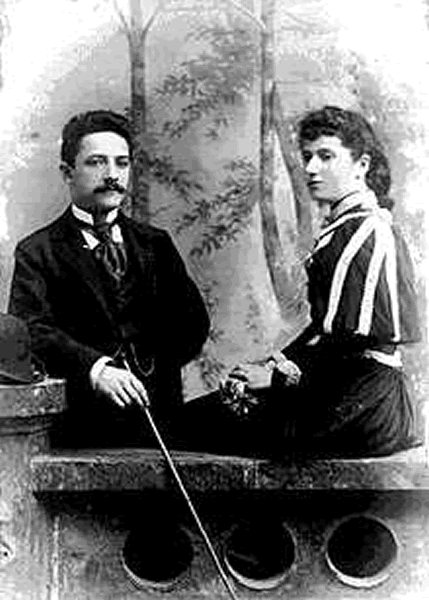
George's parents were Jewish-Russian immigrants. His father's name was Morris Gershovitz, and his mother's was originally Rose Bruskin. They were married in 1895, and Americanized their name to Gershwin. They had four children. Ira was born on December 6, 1896. George was their second son, born on September 26, 1898. Arthur and Francis were next in line in 1900 and 1906 (Rowley 1). George's birthplace was Brooklyn, New York. His father was a somewhat unsuccessful entrepreneur, and the family had moved twenty-eight times by the time George was eighteen (Penumbra 1).
George's childhood was different from what many might think. He was out-going and energetic, but a trouble maker at school. He showed no interest in music. The family went bankrupt in 1914 and moved to Coney Island, where George became known as a fighter. He stole fruit, pretzels, and bagels from the local shops (Rowley 1). He was an outdoors boy, who didn't care for indoor activities (Penumbra 1).
Even though he didn't seem to care for it, music had a profound effect on George. Once, while passing an arcade, he heard a mechanical piano playing Rubinstein's "Melody in F." He seemed to be put in a trance. A few years later, when he heard Maxie Rosenzweig playing the violin, he waited outside the school for an hour in the rain just to meet the older boy. Eventually, the two became the best of friends, and Maxie taught George everything he knew about music (Rowley 1). Unfortunately, he also told George that he didn't have any musical aptitude, but he didn't let that stop him. George's love of music grew from that point on (Penumbra 1-2).
In 1910, the Gershwin's bought a piano for Ira. As soon as the piano came through the door, George sat down and played a pop tune of the day. It soon became evident that it was George's piano, not Ira's, and he started receiving lessons from a neighborhood lady (Rowley 2). When she couldn't teach him anymore, he became a student of Charles Hambitzer. Hambitzer was so impressed by George's skill that he would not accept payment for the lessons (Penumbra 2). George's technique improved greatly, and he learned the basics of classical music. George also started lessons with Mr. Kilenyi for theory. Between the two teachers, he became a very good pianist. It was during this time that George wrote his very first songs. They were ragtime with a classical form, and were called "Since I Found You" and "Ragging at the Traumerei" (Rowley 2).
George spent long hours working at his father's restaurant for four dollars a week (Rowley 2). He also held a summer job playing the piano at a mountain resort in the Catskills in 1913 (Penumbra 2). He attended the High School of Commerce, but he hated it, and dropped out. He began a job as a song plugger for fifteen dollars a week at Remick's, a publishing house. A song plugger is a pianist who performs new songs in hopes of selling sheet music. He and his mother argued about it for a long while-she wanted him to be a lawyer or accountant-but eventually she gave in (Rowley 2).
George was the best at his job at Remick's. He quickly became skilled at transposing into different keys easily. He saw much of New York while traveling across the city for his job, and started writing music. He would write late into the night in his notebook labeled "GT," which stood for good tunes. Remick's refused to publish his music, but he continued to write. He was influenced greatly by Irving Berlin and Jerome Kern (Rowley 2). In 1917, George quit his job at Remick's and worked as a vaudeville circuit pianist. He was then hired to write music for the publishing house T. B. Harms. He also toured as Nora Bayes' accompanist (Erb 1).
Five songs written by George were included in the musical Half Past Eight, but it was unsuccessful. George wrote the entire score to La La Lucille, which premiered on May 26, 1919 (Penumbra 2). In 1920 (Jolley: The Works 1), Al Jolson incorporated "Swanee" into his show, Sinbad. It became a big hit, selling over two million copies. Gershwin also wrote the score for George White's Scandals from 1920-1924 (Penumbra 2).
In 1924, George agreed to write a jazz concerto for Paul Whiteman's program. He began work on it less than one month before the performance (Rowley 2). On February 12 (Penumbra 2), it was second to last on the program, and the audience was bored. They gave "Rhapsody in Blue" a standing ovation, and this piece has gone on to become a standard in American music literature (Rowley 2).
George went on to write for the musicals Primrose, TipToes, Song of the Flame, Lady Be Good!, Oh, Kay!, Strike Up the Band, Funny Face, Rosalie, and Treasure Girl from 1924-1928. He wrote "Concerto in F" in 1925 (Jolley: The Works 2). When he took a trip to Paris, an idea for a symphonic dance grew. In 1927, it eventually turned out to be "An American In Paris," which even used four French car horns in the score (Jolley 1)!
George's first experience in conducting was in Lewishon Stadium, in Brooklyn. In 1930, he conducted for his musical Girl Crazy, where the orchestra included Benny Goodman, Glen Miller, and Jimmy Dorsey (Penumbra 5). In Girl Crazy, Ethel Merman introduced the famous song, "I Got Rhythm" (Erb, pg. 1).
George went to Hollywood for a contract with Fox Studios. He was to write the score for Delicious. He wrote another rhapsody, but they used only a small portion of it in the film. George continued to work on it after a move back to New York, and it debuted as the "Second Rhapsody" on January 1, 1932. George and his brother Ira collaborated on Of Thee I Sing, which was a smash hit. It won multiple Pulitzer prizes. When George took a Cuban vacation in 1932, he was inspired to write Cuban Overture. Later, he wrote two sequels to Of Thee I Sing, which both flopped (Penumbra 5-6). The ideas for Porgy and Bess had first originated in George's mind in 1926; he began writing the score in 1934. It finally opened in 1935, but closed after only one hundred thirty-four performances (Penumbra 6)! It had little success at its opening, but it later became more popular (Jolley 1).
During the Great Depression, theater business slowed, but the movie-making industry in California was booming. George moved to Hollywood in 1936 to write the score for Shall We Dance. He enjoyed a leisurely life there, playing golf, tennis, and swimming (Penumbra 6). While there, he wrote songs with his brother and lyricist Ira. Fred Astaire, Ginger Rodgers, and other famous stars of the day performed them. Some of his most famous songs during this time were "S'Wonderful," "Someone to Watch Over Me," and "Our Love is Here to Stay" (Jolley 1).
On February 10, 1937, George suffered a blackout while performing onstage. He saw a doctor, but was diagnosed perfectly healthy. By early June, he suffered from headaches, but dismissed them as from overwork. He had another doctor's exam, but didn't want a spinal tap because it was too painful. From then on, he lost his health rapidly. He played the piano the morning of July 9, 1937, and by the end of the day, he was in a coma. Doctors discovered a brain tumor from a spinal tap on July 10 (Penumbra 7). It was decided he needed immediate surgery, but the country's top surgeon, Dr. Dandy, was vacationing on his yacht. President Roosevelt sent two navy destroyers to get him, but he returned too late. Local surgeons had to begin the surgery before he could get there. George never woke up from the coma. He died on July 11, 1937, at the young age of thirty-eight. John O'Hara, an author, said of his death, "I don't have to believe it if I don't want to" (Erb 2).
George Gershwin was well known by the time of his early death, but concert pianists didn't start playing his works until the 1950s and 60s (Sylvester 2). The centennial of his birth was celebrated on September 26, 1999 (Mason 1). A twenty-four hour tribute on National Public Radio, Turner Classics Movie features, and tribute concerts by Linda Ronstadt and Rosemary Clooney were given to honor this great man (Sylvester 1-2).
His works were loved yesterday and today, and many of them have become great American standards. "When I'm in my normal mood, the tunes come dripping off my fingers," he said. Immortal songs flowed out of George Gershwin, and he will be forevermore remembered for that.
.
 |
|||
|
|||
1930; Gershwin
Morris
Gershwin Age;58 BirthYear;1871 Russia Head White Manhattan, New
York, NY owned his home, valued; $10,000 had a radio. Married at 21
came to the country in 1891. Retired from the Restaurant Business?
Rose
Gershwin Age; 53 BirthYear;1876 Wife Manhattan, New York, NY

married at age 16
Otto
Gershwin (might say Arthur not Otto) Age;30 BirthYear;1899 Son Manhattan,
New York, NY
born in New York.
Francis
Gershwin Age;23 BirthYear;1906 Daughter Manhattan, New York, NY
the lived in District 485
; MANHATTAN BOROUGH, ASSEMBLY DIST. 11 (PART), BOUNDED BY (N) W. 106TH;
(E) W. END AVE.; (S) W. 102D; (W) HUDSON RIVER.
They had a live in maid from Ireland by the last name of Francis she
was 23 years old. I am pasting a part of the original senses;
---------------------------------Image Source: Year: 1930; Census
Place: Manhattan, New York, New York; Roll: T626_1559;
Page: 4B; Enumeration District: 485; Image: 0753.
George
Gershwin Age; 31 BirthYear; 1898 New York Head White Manhattan,
New York, NY. Russian/Yiddish speaking parents. it is written that he
is single and a music composer. Lived in District 403, MANHATTAN BOROUGH,
ASSEMBLY DIST. 7 (PART), APTS. AT 33 RIVERSIDE DR. Next to his brother;
Ira and his wife. both brothers rented their places. Ira paid $300 a
month I cant read the amount for George.
He had a cook living with him. She was from Austria, age 41 and married
since age 27.
next door lived
Ira
Gershwin Age;33 BirthYear;1896 New York Head White Manhattan, New
York, NY
married at age 29. Yiddish
speaking parents.Writter of Music.
Leonore
Gershwin Age';29 BirthYear;1900 Wife Manhattan, New York, NY
married at age 25. She was born in New York to Russian/Yiddish speaking
parents.
They had a servant from Germany living with them.
Image Source: Year: 1930; Census Place: Manhattan, New York, New York; Roll: T626_1553; Page: 1A;
Enumeration District: 403; Image: 1092.
Philip Gershwin Age;37 BirthYear;1892 Russia Head White Boston, Suffolk,
MA
Jennie
Gershwin Age;33 BirthYear(1896 Wife Boston, Suffolk, MA
Sylvia
Gershwin Age;15 BirthYear1914 Daughter Boston, Suffolk,
MA
Florence
Gershwin Age;13 BirthYear;1916 Daughter Boston, Suffolk,
MA
Arthur
Gershwin Age;11 BirthYear;1918 Son Boston, Suffolk, MA
Edward
Gershwin Age;8 BirthYear(;1921 Son Boston, Suffolk, MA
Max
Gershwin Age;43 BirthYear;1886 Poland Head White Manhattan, New York,
NY
Anna
Gershwin Age;40 BirthYear(;1889 Wife Manhattan, New York,
NY
Samuel
Gershwin Age;14 BirthYear;1915 Son Manhattan, New York,
NY
Rose
Gershwin Age; 9 BirthYear;1920 Daughter Manhattan, New
York, NY
Gertrude
Gershwin Age; 7 BirthYear(;1922 Daughter Manhattan, New
York, NY
in
1920 Census
Gershwin,
Nabis 46 BirthYear(1920, '46');1873 Connecticut White Hartford, Hartford,
Connecticut
Gershwin,
Frances 13 BirthYear(1920, '13');1906 New York White Manhattan, New
York, New York
Gershwin,
Morris 47 BirthYear(1920, '47');1872 Russia White Manhattan, New York,
New York here they wrote that he came to the country in 1893 and was
naturalized in 1898 Yiddish speaking
Gershwin
Rose, Wife age 39 came to the country from Russia in 1893 and was naturalized
in 1898 Yiddish speaking. In resturant business
Gershwin
Isadore, Son age 23 born in New York, lyric writer
Gershwin
George, son age 21 born in New York, composer
Gershwin
Arthur, son age 19 born in New York, salesman
Ellis
Island;
Gershwin,
George
New York City, N.Y.
September 23, 1924
26y
M
S
Majestic
Cherbourg, Manche, France
Address;
501,
W. 110th Street, New York City
Gershovitch,Annie
London, England 1914 10 Passenger Record Text Manifest
Scanned Manifest Ship Image
340
Gershovitch,Dora London, England 1914 49 Passenger Record
Text Manifest Scanned Manifest Ship Image
341
Gershovitch,Esther London, England 1914 18 Passenger Record
Text Manifest Scanned Manifest Ship Image
342
Gershovitch,Gertrude London, England 1920 10 Passenger Record
Text Manifest Scanned Manifest Ship Image
343
Gershovitch,Lily London, England 1920 11 Passenger Record
Text Manifest Scanned Manifest Ship Image
344
Gershovitch,Max London, England 1914 13 Passenger Record
Text Manifest Scanned Manifest Ship Image
345
Gershovitch,Rebecca London, England 1920 38 Passenger Record
Text Manifest Scanned Manifest Ship Image
346
Gershovitch,Rose London, England 1914 16 Passenger Record
Text Manifest Scanned Manifest Ship Image
347
Gershovitch,Samuel London, England 1914 7 Passenger Record
Text Manifest Scanned Manifest Ship Image
348
Gershovitch,Solomon London, England 1920 26 Passenger Record
Text Manifest Scanned Manifest Ship Image
349
Gershovitz,Binin Rossau 1910 31 Passenger Record
Text Manifest Scanned Manifest Ship Image
350
Gershovitz,Tamarc 1903 17 Passenger Record
Text Manifest Scanned Manifest Ship Image
351
Gershovitz,Zalmen Minsk 1905 21 Passenger Record
Text Manifest Scanned Manifest Ship Image
352
Gershowiak,Stanslun Maditza Kalish 1907 17 Passenger Record
Text Manifest Scanned Manifest Ship Image
353
Gershowicz,Kinde ..., Russia 1908 20 Passenger Record
Text Manifest Scanned Manifest Ship Image
354
Gershowitz,Abram Kamenek 1906 22 Passenger Record
Text Manifest Scanned Manifest Ship Image
355
Gershowitz,Hannah London 1903 20 Passenger Record
Text Manifest Scanned Manifest Ship Image
356
Gershowitz,Luba Simferopol, Russia 1922 18 Passenger Record
Text Manifest Scanned Manifest Ship Image
357
Gershowitz,Naum Goao Bucarest, Roumania 1922 17 Passenger Record
Text Manifest Scanned Manifest Ship Image
358
Gershowitz,Silpe London 1904 20 Passenger Record
Text Manifest Scanned Manifest Ship Image
359
Gershowitz,Slate London 1905 25 Passenger Record
Text Manifest Scanned Manifest Ship Image
360
Gershowrotz,Charley Govna 1905 0 Passenger Record
Text Manifest Scanned Manifest Ship Image
361
Gershowrotz,Hanna Roche Govna 1905 45 Passenger Record
Text Manifest Scanned Manifest Ship Image
362
Gershowrotz,Israel Govna 1905 10
40
Gershbowitz,Hyman London, England 1907 0 Passenger Record
Text Manifest Scanned Manifest Ship Image
41
Gershbowitz,Jennie London, England 1907 23 Passenger Record
Text Manifest Scanned Manifest Ship Image
42
Gershbowitz,Louis London, England 1907 2
46
Gershcoivst,Henry New york USA 1912 26 Passenger Record
99
Gershenanitz,Beile Alexano, Russia 1913 5 Passenger Record
Text Manifest Scanned Manifest Ship Image
100
Gershenanitz,Moishe Alexano, Russia 1913 28
101
Gershenanitz,Schmil Alexano, Russia 1913 7 Passenger Record
Text Manifest Scanned Manifest Ship Image
102
Gershenanitz,Siheie Alexano, Russia 1913 8 P
131
Gershenovitz,Guti Wilna 1905 20 Passenger Record
Text Manifest Scanned Manifest Ship Image
132
Gershenowitz,Cha...e Garadeie 1905 7 Passenger Record
Text Manifest Scanned Manifest Ship Image
133
Gershenowitz,Feige Garadeie 1905 41 Passenger Record
Text Manifest Scanned Manifest Ship Image
134
Gershenowitz,Gaoriel Minsk 1904 11 Passenger Record
Text Manifest Scanned Manifest Ship Image
135
Gershenowitz,Inie Plis 1904 24 Passenger Record
Text Manifest Scanned Manifest Ship Image
136
Gershenowitz,Jonah Minsk 1904 10 Passenger Record
Text Manifest Scanned Manifest Ship Image
137
Gershenowitz,Leib Lida, Russia 1908 14 Passenger Record
Text Manifest Scanned Manifest Ship Image
138
Gershenowitz,Leie Garadeie 1905 11 Passenger Record
Text Manifest Scanned Manifest Ship Image
139
Gershenowitz,Morris London 1904 20 Passenger Record
Text Manifest Scanned Manifest Ship Image
140
Gershenowitz,Mowshe Lida, Russia 1908 13 Passenger Record
Text Manifest Scanned Manifest Ship Image
141
Gershenowitz,Roche Lida, Russia 1908 56 Passenger Record
Text Manifest Scanned Manifest Ship Image
142
Gershenowitz,Wolf Plis 1904 0 Passenger Record
Text Manifest Scanned Manifest Ship Image
143
Gershenowsky,Gubel London 1898 48 Passenger Record
Text Manifest Scanned Manifest Ship Image
163
Gershenzvit,Uwach Kamenetz, Russia 1910 22
188
Gershkovics,Haim Kishinew, Bessarabia 1923 25 Passenger Record
Text Manifest Scanned Manifest Ship Image
189
Gershkovitz,Abe Newport, Ken. 1916 9 Passenger Record
Text Manifest Scanned Manifest Ship Image
190
Gershkovitz,Abraham Newport, Ken. 1916 7 Passenger Record
Text Manifest Scanned Manifest Ship Image
191
Gershkovitz,Isider Newport, Ken. 1916 8 Passenger Record
Text Manifest Scanned Manifest Ship Image
192
Gershkovitz,Rosa Newport, Ken. 1916 28 Passenger Record
Text Manifest Scanned Manifest Ship Image
193
Gershkovitz,Rubin 1893 21 Passenger Record
Text Manifest Scanned Manifest Ship Image
194
Gershkowich,Sam London, Eng. 1907 26 Passenger Record
Text Manifest Scanned Manifest Ship Image
195
Gershkowich,Sophia London, Eng. 1907 19 Passenger Record
Text Manifest Scanned Manifest Ship Image
196
Gershkowitsch,Judel Bobrusk, Russia 1923 41 Passenger Record
Text Manifest Scanned Manifest Ship Image
197
Gershkowitsch,Roza Bobrusk, Russia 1923 9 Passenger Record
Text Manifest Scanned Manifest Ship Image
198
Gershkowitsch,Vecha Bobrusk, Russia 1923 41 Passenger Record
Text Manifest Scanned Manifest Ship Image
199
Gershkowitz,Berel Orgiew, Rssia 1912 40 Passenger Record
Text Manifest Scanned Manifest Ship Image
200
Gershkowitz,Berl Kiszeniew, Russia 1913 56 Passenger Record
Text Manifest Scanned Manifest Ship Image
201
Gershkowitz,Bruche Orgiew, Rssia 1912 36 Passenger Record
Text Manifest Scanned Manifest Ship Image
202
Gershkowitz,Chaim Hotin, Roumania 1921 15 Passenger Record
Text Manifest Scanned Manifest Ship Image
203
Gershkowitz,Gershe Bershird, Russia 1914 38 Passenger Record
Text Manifest Scanned Manifest Ship Image
204
Gershkowitz,Hanna Medias, Romania 1921 31 Passenger Record
Text Manifest Scanned Manifest Ship Image
205
Gershkowitz,Isaac Medias, Romania 1921 6 Passenger Record
Text Manifest Scanned Manifest Ship Image
206
Gershkowitz,Itzik Snitkew, Russia 1913 28 Passenger Record
Text Manifest Scanned Manifest Ship Image
207
Gershkowitz,Joib Hotin, Roumania 1921 16 Passenger Record
Text Manifest Scanned Manifest Ship Image
208
Gershkowitz,Schlime Orgiew, Rssia 1912 11 Passenger Record
Text Manifest Scanned Manifest Ship Image
209
Gershkowitz,Schlojme Orgiew, Rssia 1912 3 Passenger Record
Text Manifest Scanned Manifest Ship Image
210
Gershkowitz,Shulim Medias, Romania 1921 31 Passenger Record
Text Manifest Scanned Manifest Ship Image
211
Gershkowitz,Taube Orgiew, Rssia 1912 8 Passenger Record
Text Manifest Scanned Manifest Ship Image
212
Gershkowitz,Wolf Medias, Romania 1921 8
256
Gershnovitz,Abraham Manchester 1903 26
Gershonitz,Chane
Obrzin, Russia 1914 17
322
Gershonovitz,Broche 1895 19 Passenger Record
Text Manifest Scanned Manifest Ship Image
323
Gershonovitz,Jankel 1895 7 Passenger Record
Text Manifest Scanned Manifest Ship Image
324
Gershonow,Barnett Manchester 1905 23 Passenger Record
Text Manifest Scanned Manifest Ship Image
325
Gershonow,Lilly Manchester 1905 0 Passenger Record
Text Manifest Scanned Manifest Ship Image
326
Gershonow,Rebecca Manchester 1905 22 Passenger Record
Text Manifest Scanned Manifest Ship Image
327
Gershonowicz,M...eo Minsk 1904 22 Passenger Record
Text Manifest Scanned Manifest Ship Image
328
Gershonowitch,Leah Manchester, England 1916 22 Passenger Record
Text Manifest Scanned Manifest Ship Image
329
Gershonowitz,Mordehc Neustadt, Russia 1911 20 Passenger Record
Text Manifest Scanned Manifest Ship Image
33
Name Residence Arrived Age View View View View
1 Gershowitz,Abram Kamenek 1906 22 Passenger Record Text Manifest Scanned Manifest Ship Image
2 Gershowitz,Hannah London 1903 20 Passenger Record Text Manifest Scanned Manifest Ship Image
3 Gershowitz,Luba Simferopol, Russia 1922 18 Passenger Record Text Manifest Scanned Manifest Ship Image
4 Gershowitz,Naum Goao Bucarest, Roumania 1922 17 Passenger Record Text Manifest Scanned Manifest Ship Image
5 Gershowitz,Silpe London 1904 20 Passenger Record Text Manifest Scanned Manifest Ship Image
6 Gershowitz,Slate London 1905 25 Passenger Record Text Manifest Scanned Manifest Ship Image
6
Girshovich,Myer
Manchester, England
1915 22 Passenger Record
Text Manifest Scanned Manifest Ship Image
7
Girshovitch,Esther-Feiga
Alexandrovsk, Russia
1923 2 Passenger Record Text Manifest Scanned Manifest Ship Image
8
Girshovitch,Motia
Alexandrovsk, Russian 1923 26
Passenger Record
Text Manifest Scanned Manifest Ship Image
9
Girshovitch,Sonia Alexandrovsk,
Russia 1923 23 Passenger Record
Text Manifest Scanned Manifest Ship Image
10 Girshovitz,Lewis
Wagielon
1905 30 Passenger Record
Text Manifest Scanned Manifest Ship Image
11 Girshowicz,Leia
Reczica, Russia
1913 25 Passenger Record
Text Manifest Scanned Manifest Ship Image
12 Girshowitz,Berka
Slutzky, Russia 1908 30
Passenger Record
Text Manifest Scanned Manifest Ship Image
13 Girshowitz,Chiene Pam... 1905 0
Passenger Record Text Manifest
Scanned Manifest Ship Image
14 Girshowitz,Taube Pam... 1905 21
Passenger Record Text Manifest
Scanned Manifest Ship Image
15 Girshowzen,Marie U
1895 32 Passenger Record Text Manifest
Scanned Manifest Ship Image
Girschawitz,Chaje Holbyn,
Russia 1909 40
Passenger Record Text Manifest
Scanned Manifest Ship Image
94 Girschawitz,Feige Holbyn,
Russia 1909 9
Passenger Record
Text Manifest Scanned Manifest Ship Image
95 Girschawitz,Moische Holbyn, Russia 1909
10 Passenger Record
Text Manifest Scanned Manifest Ship Image
96 Girschawitz,Rive
Holbyn, Russia 1909 8
Girschkouritz,Brandel Odessa, Russia
1906 18 Passenger Record
Text Manifest Scanned Manifest Ship Image
232 Girschkovitz,Israel Reval,
Estonia 1922 29 Passenger Record
Text Manifest Scanned Manifest Ship Image
233 Girschkowitz,Borris
1893 20 Passenger
253 Girschonitz,Feige Wilna 1905 28 Passenger Record Text Manifest
Scanned Manifest Ship Image
254 Girschonitz,Leibe Wilna 1905 5 Passenger Record Text Manifest
Scanned Manifest Ship Image
255 Girschonitz,Nicke
Wilna 1905 0 Passenger Record Text Manifest
Scanned Manifest Ship Image
256 Girschonitz,Sore
Wilna 1905 4 Passenger Record Text Manifest
Scanned Manifest Ship Image
257 Girschovicz,Berl
Sluck 1898 2 Passenger Record Text Manifest
Scanned Manifest Ship Image
258 Girschovicz,Isser
Sluck 1898 4 Passenger Record Text Manifest
Scanned Manifest Ship Image
259 Girschovicz,Libe
R.
Sluck 1898 29
253 Girschonitz,Feige Wilna 1905 28 Passenger Record Text Manifest
Scanned Manifest Ship Image
254 Girschonitz,Leibe Wilna 1905 5 Passenger Record Text Manifest
Scanned Manifest Ship Image
255 Girschonitz,Nicke
Wilna 1905 0 Passenger Record Text Manifest
Scanned Manifest Ship Image
256 Girschonitz,Sore
Wilna 1905 4 Passenger Record Text Manifest
Scanned Manifest Ship Image
257 Girschovicz,Berl
Sluck 1898 2 Passenger Record Text Manifest
Scanned Manifest Ship Image
258 Girschovicz,Isser
Sluck 1898 4 Passenger Record Text Manifest
Scanned Manifest Ship Image
259 Girschovicz,Libe
R.
Sluck 1898 29
468 Girsovic,Chane Radpilishki, Lithuania 1921 27 Passenger Record
Text Manifest Scanned Manifest Ship Image
469 Girsovic,Govsa Radpilishki, Lithuania 1921 69 Passenger Record
Text Manifest Scanned Manifest Ship Image
470 Girsovic,Malke Radpilishki, Lithuania 1921 23
Passenger Record
Text Manifest Scanned Manifest Ship Image
471 Girsovic,Roche Radpilishki, Lithuania 1921 58 Passenger Record
Text Manifest Scanned Manifest Ship Image
472 Girsovic,Scheinl
Radpilishki, Lithuania
1921 25 Passenger Record
Text Manifest Scanned Manifest Ship Image
473 Girsowic,Anna Seduwa, Lithuan. 1922 19 Passenger Record
Text Manifest Scanned Manifest Ship Image
474 Girsowic,Minucha Seduwa,
Lithuan.
1922 60 Passenger Record
Text Manifest Scanned Manifest Ship Image
475 Girsowic,Olga Seduwa, Lithuan. 1922 16 Passenger Record
Text Manifest Scanned Manifest Ship Image
476 Girsowicz,Moses
Seduwa, Lithuan
565 Girszowick,Golda
U
1921 0 Passenger Record Text Manifest
Scanned Manifest Ship Image
566 Girszowicz,Arje Twje, Poland
1922 65 Passenger Record Text Manifest
Scanned Manifest Ship Image
567 Girszowicz,Beila
Ostrow, Poland 1921 21
Passenger Record
Text Manifest Scanned Manifest Ship Image
568 Girszowicz,Chaim Twje,
Poland 1922 8 Passenger Record
Text Manifest Scanned Manifest Ship Image
569 Girszowicz,Chajie Ostrow,
Poland 1921 55
Passenger Record
Text Manifest Scanned Manifest Ship Image
570 Girszowicz,Chasza Pinsk, Poland
1922 43 Passenger Record
Text Manifest Scanned Manifest Ship Image
571 Girszowicz,Golda
Mir, Poland
1921 36 Passenger Record
Text Manifest Scanned Manifest Ship Image
572 Girszowicz,Josel
Berko Mir, Poland 1921 8 Passenger Record
Text Manifest Scanned Manifest Ship Image
573 Girszowicz,Lejie
Ostrow, Poland 1921 27
Passenger Record
Text Manifest Scanned Manifest Ship Image
574 Girszowicz,Lejzer
Wolf Mir, Poland 1921 11 Passenger Record
Text Manifest Scanned Manifest Ship Image
575 Girszowicz,Mina
Pinsk, Poland 1922 13 Passenger Record
Text Manifest Scanned Manifest Ship Image
576 Girszowicz,Mojsze Twje,
Poland 1922 8 Passenger Record
Text Manifest Scanned Manifest Ship Image
577 Girszowicz,Musia
Mir, Poland
1921 13 Passenger Record
Text Manifest Scanned Manifest Ship Image
578 Girszowicz,Nechama Snow, Poland 1921 20
Passenger Record
Text Manifest Scanned Manifest Ship Image
579 Girszowicz,Perla
Pinsk, Poland 1922 19 Passenger Record
Text Manifest Scanned Manifest Ship Image
580 Girszowicz,Samuel Ostrow, Poland
1921 18
Passenger Record
Text Manifest Scanned Manifest Ship Image
581 Girszowicz,Sara
Ruchoa
Ostrow, Poland 1921 21
Passenger Record
Text Manifest Scanned Manifest Ship Image
582 Girszowicz,Zalman Twje,
Poland 1922 16 Passenger Record
Text Manifest Scanned Manifest Ship Image
583 Girszowska,Borok Turgiel,
Russia 1922 6
Passenger Record
Text Manifest Scanned Manifest Ship Image
584 Girszowska,Jonto Turgiel,
Russia
203 Gerchowitz,Chune Odessa,
Russia
1908 19 Passenger Record
Text Manifest Scanned Manifest Ship Image
204 Gerchowitz,Gerson
1894 24 Passenger Record Text Manifest
Scanned Manifest Ship Image
205 Gerchowitz,Gittel
Russia 1913 33
Passenger Record Text Manifest
Scanned Manifest Ship Image
206 Gerchowitz,Leiser Russia 1913 7
Passenger Record Text Manifest
Scanned Manifest Ship Image
207 Gerchowitz,Man
Russia 1913 9
Passenger Record Text Manifest
Scanned Manifest Ship Image
208 Gerchowitz,Sure
Russia 1913 3
Passenger Record Text Manifest
Scanned Manifest Ship Image
209 Gerchowitz,Zulke
Russia 1913 5
Passenger Record Text Manifest
Scanned Manifest Ship Image
210 Gerchowsky,Fraac
1892 29 Passenger Record Text Manifest
Scanned Manifest Ship Image
211 Gerchowsky,Sarah
1892 25 Passenger
Gercovici,Marcus
1895 28 Passenger Record Text Manifest
Scanned Manifest Ship Image
376 Gercovitch,Fanny London
1905 13 Passenger Record
Text Manifest Scanned Manifest Ship Image
377 Gercovitch,Harry
London
1905 4 Passenger Record
Text Manifest Scanned Manifest Ship Image
378 Gercovitch,Isaac
London
1905 7 Passenger Record
Text Manifest Scanned Manifest Ship Image
379 Gercovitch,Rebecca London
1905 28 Passenger Record
Text Manifest Scanned Manifest Ship Image
380 Gercovskaya,Malka Odessa, Russia
1923 55 Passenger Record
Text Manifest Scanned Manifest Ship Image
381 Gercowasky,Abram Morezic , Russia
1913 36 Passenger Record
Text Manifest Scanned Manifest Ship Image
382 Gercowich,Christian Lussin 1901 7
Passenger Record Text Manifest
Scanned Manifest Ship Image
383 Gercowitz,Ronia
1912 0 Passenger Record Text Manifest
Scanned Manifest Ship Image
384 Gercowitz,Sose
Derazne, Russia
1907 18
540 Gerczewicz,Casemir Suvalki 1902
28
Eisiskes
Lida
Vilnius
GIRSHOVICH Pinkhus Movsha
Head of Household
38
Died 1853
26
May
1858
6706760
Revision
List
LVIA/515/25/89
GIRSHOVICH Ester Evna
Wife
41
Eisiskes
Lida
Vilnius
GIRSHOVICH Antsel
38 30
26
May
1858
686121130
Revision
List
LVIA/515/25/89
GIRSHOVICH Beila Yankel
38
Eisiskes
Lida
Vilnius
GIRSHOVICH Antsel
38 30
26
May
1858
686121130
Revision
List
LVIA/515/25/89
GIRSHOVICH Beila Yankel
38
VIRSHUBSKI Aron Yosel
Son
12
Absent 1856
TownUyezdGuberniya Surname
Given Name
Father Relationship Age ThisAge Last Reason LeftYear Comments Date PageRegistrationFormer
Registration
Publication TypeArchive / Fond etc
Eisiskes
Lida
Vilnius
GERSHOVICH Nakhemia
Yudel Head of Household
20
26
May
1858
711216
Revision
List
Eisiskes
Lida
Vilnius
GIRSHOVICH Khaim Yankel Head of Household
24
26
May
1858
7161
Revision
List
LVIA/515/25/89
GIRSHOVICH Malka Leiba Wife
23
Lida
Lida
Vilnius
GIRSHOVICH Berko Mordukh
Head of Household
26 18
27
May
1858
167131501
Revision
List
LVIA/515/25/89
GIRSHOVICH Leiba Berko Son
Newborn
Absent 1857
GIRSHOVICH Ita Leia Meer Wife
25
Lida
Lida
Vilnius
GIRSHOVICH David Leiba Head
of Household
41
Absent 1856
27
May
1858
170144464
Revision
List
LVIA/515/25/89
GIRSHOVICH Pinkhus David Son
Newborn
Absent 1856
GIRSHOVICH Meer David Son
Newborn
Absent 1856
TownUyezdGuberniya Surname
Given Name
Father Relationship Age ThisAge Last Reason LeftYear Comments Date PageRegistrationFormer
Registration
Publication TypeArchive / Fond etc
Ostrynia
Lida
Vilnius
GIRSHOVICH Shmuilo Leizer Head of Household
30
Absent 1857
Added 16 March 1852, no. 12
15
May
1858
73125
Revision
List
LVIA/515/25/89
Radun
Lida
Vilnius
ABRAMOVICH Yosel
Leiba Head of Household
58 50
May
5952523
Revision
List
LVIA/515/25/89
ABRAMOVICH Malka
Zarukh Wife
Lida
Vilnius
ABRAMOVICH Yosel
Leiba Head of Household
58 50
May
5952523
Revision
List
LVIA/515/25/89
ABRAMOVICH Malka
Zarukh Wife
60
GIRSHOVICH Leiba Shlioma
Nephew
40
GIRSHOVICH Pesia Mordukh
Niece-in-law
35
Leiba's wife
GIRSHOVICH Dvora Leiba Grandniece
15
GIRSHOVICH Feiga Leiba Grandniece
7
Radun
Lida
Vilnius
GIRSHOVICH David Menail Head
of Household
Absent 1843
May
5962927
Revision
List
LVIA/515/25/89
GIRSHOVICH Leizer David Son
Absent 1843
TownUyezdGuberniya Surname
Given Name
Father Relationship Age ThisAge Last Reason LeftYear Comments Date PageRegistrationFormer
Registration
Publication TypeArchive / Fond etc
Zhaludok
Lida
Vilnius
GIRSHOVICH Yankel
Head of Household
Absent 1846
29
May
1858
4691341
Revision
List
LVIA/515/25/89
SKLIAROVSKI Leiba
Aron Br
Zhaludok
Lida
Vilnius
GIRSHOVICH Yosel
Head of Household
Absent 1850
29
May
1858
Baisogala
Siauliai
Kaunas
GILELZON Lozer Fayvush
20 Missing
26
May
1858
4403427
Revision
List
LVIA/1262/1/99
GIRSHEVICH Orel Abram
Head of Household
24 16
GIRSHEVICH Rashe Mere Yankel Wife
2_?
GIRSHEVICH Rochel Orel Daughter
5 (?)
TownUyezdGuberniya Surname
Given Name
Father Relationship Age ThisAge Last Reason LeftYear Comments Date PageRegistrationFormer
Registration
Publication TypeArchive / Fond etc
Leckava
Siauliai
Kaunas
GIRSHOVICH Mendel Ekel
14
Unknown 1856
28
May
1858
195178140
Revision
List
LVIA/1262/1/99
Lygumai
Siauliai
Kaunas
GIRSHOVICH Sore Leyba
12
28
April
1866
213
Additional
Revision List
LVIA/1262/1/124
GIRSHOVICH Eyde Leyba
12
Sore's Sister
|
Name |
Birth Date |
Death Date |
Last
Residence |
Issued |
SSN |
|
|||||
|
|
|
||||||||||
|
14 Mar 1900 |
Nov 1981 |
New York, New York, NY |
NY (Before 1951 ) |
109-01-9342 |
|
|
|
|
|
|
|
|
10 Aug 1906 |
Mar 1971 |
|
NY (1953 And 1955 ) |
054-30-5386 |
|
|
|
|
|
|
|
|
28 Apr 1922 |
18 Jul 1999 |
Danbury, Fairfield, CT |
NY (Before 1951 ) |
100-12-3195 |
|
|
|
|
|
|
|
|
5 Feb 1907 |
Oct 1975 |
Brooklyn, Kings, NY |
NY (1964 ) |
064-40-6224 |
|
|
|
|
|
|
|
|
5 Jan 1921 |
4 Oct 1992 |
San Francisco, San Francisco, CA |
NY (Before 1951 ) |
069-12-8822 |
|
|
|
|
|
|
|
|
3 Apr 1913 |
Jul 1985 |
Suffern, Rockland, NY |
NY (Before 1951 ) |
102-10-2562 |
|
|
|
|
|
|
|
|
29 Dec 1917 |
11 Apr 2003 |
Valley Cottage, Rockland, NY |
NY (Before 1951 ) |
124-10-2016 |
|
|
|
|
|
|
|
|
14 Sep 1907 |
5 Aug 1993 |
Henderson, Clark, NV |
CA (1958 ) |
547-58-7577 |
|
|
|
|
|
|
|
|
5 Jan 1909 |
26 Sep 2000 |
Las Vegas, Clark, NV |
NY (Before 1951 ) |
067-03-7512 |
|
|
|
|
|
|
|
|
6 Dec 1896 |
Aug 1983 |
Beverly Hills, Los Angeles, CA |
CA (Before 1951 ) |
568-01-3279 |
|
|
|
|
|
|
|
|
15 Oct 1923 |
14 Jan 2003 |
Danbury, Fairfield, CT |
NY (Before 1951 ) |
132-16-5238 |
|
|
|
|
|
|
|
|
20 Apr 1926 |
17 Sep 1997 |
Beverly Hills, Los Angeles, CA |
CA (Before 1951 ) |
555-22-8190 |
|
|
|
|
|
|
|
|
25 Aug 1918 |
Dec 1984 |
Los Angeles, Los Angeles, CA |
CA (1951 ) |
563-44-3857 |
|
|
|
|
|
|
|
|
8 Aug 1913 |
Dec 1960 |
|
NY (Before 1951 ) |
056-07-0787 |
|
|
|
|
|
|
|
|
3 Oct 1900 |
20 Aug 1991 |
|
CA (1962 ) |
559-68-6798 |
|
|
|
|
|
|
|
|
24 Feb 1914 |
Jul 1986 |
Fort Lauderdale, Broward, FL |
NY (Before 1951 ) |
066-05-9750 |
|
|
|
|
|
|
|
|
20 Nov 1906 |
25 Nov 1995 |
Springfield, Union, NJ |
NY (Before 1951 ) |
075-26-8711 |
|
|
|
|
|
|
|
|
10 Apr 1913 |
19 May 1998 |
Roswell, Fulton, GA |
NY (1952 And 1954 ) |
104-28-9096 |
|
|
|
|
|
|
|
|
2 Feb 1916 |
15 Feb 1999 |
New York, New York, NY |
NY (Before 1951 ) |
108-07-9388 |
|
|
|
|
|
|
|
|
Connecticut Marriage Index, 1959-2001
Bride Place of Marriage Marriage Date Groom ALAN GERSHWIN EDITH K SADOYAMA Greenwich, Fairfield, CT 15 October , 1960 Name: George James Gershwin Certificate: 70927 Death Place: Palm Beach Race: W Death Date: 24 Jul 1985 Birth Date: 03 Apr 1913 View Full Context
Name: Nathan Gershwin Certificate: 66031 Death Place: Broward Race: W Death Date: 09 Jul 1986 Birth Date: 24 Feb 1914
|
|||||||||||
204 Gerchowitz,Gerson 1894 24 Passenger Record Text Manifest Scanned Manifest Ship Image
205 Gerchowitz,Gittel Russia 1913 33 Passenger Record Text Manifest Scanned Manifest Ship Image
206 Gerchowitz,Leiser Russia 1913 7 Passenger Record Text Manifest Scanned Manifest Ship Image
207 Gerchowitz,Man Russia 1913 9 Passenger Record Text Manifest Scanned Manifest Ship Image
208 Gerchowitz,Sure Russia 1913 3 Passenger Record Text Manifest Scanned Manifest Ship Image
209 Gerchowitz,Zulke Russia 1913 5 Passenger Record Text Manifest Scanned Manifest Ship Image
210 Gerchowsky,Fraac 1892 29 Passenger Record Text Manifest Scanned Manifest Ship Image
211 Gerchowsky,Sarah 1892 25 Passenger
Gercovici,Marcus 1895 28 Passenger Record Text Manifest Scanned Manifest Ship Image
376 Gercovitch,Fanny London 1905 13 Passenger Record Text Manifest Scanned Manifest Ship Image
377 Gercovitch,Harry London 1905 4 Passenger Record Text Manifest Scanned Manifest Ship Image
378 Gercovitch,Isaac London 1905 7 Passenger Record Text Manifest Scanned Manifest Ship Image
379 Gercovitch,Rebecca London 1905 28 Passenger Record Text Manifest Scanned Manifest Ship Image
380 Gercovskaya,Malka Odessa, Russia 1923 55 Passenger Record Text Manifest Scanned Manifest Ship Image
381 Gercowasky,Abram Morezic , Russia 1913 36 Passenger Record Text Manifest Scanned Manifest Ship Image
382 Gercowich,Christian Lussin 1901 7 Passenger Record Text Manifest Scanned Manifest Ship Image
383 Gercowitz,Ronia 1912 0 Passenger Record Text Manifest Scanned Manifest Ship Image
384 Gercowitz,Sose Derazne, Russia 1907 18
540 Gerczewicz,Casemir Suvalki 1902 28
Eisiskes
Lida
Vilnius
GIRSHOVICH Pinkhus Movsha Head of Household
38
Died 1853
26
May
1858
6706760
Revision List
LVIA/515/25/89GIRSHOVICH Ester Evna Wife
41
Eisiskes
Lida
Vilnius
GIRSHOVICH Antsel
38 30
26
May
1858
686121130
Revision List
LVIA/515/25/89GIRSHOVICH Beila Yankel 38
Eisiskes
Lida
Vilnius
GIRSHOVICH Antsel
38 30
26
May
1858
686121130
Revision List
LVIA/515/25/89GIRSHOVICH Beila Yankel 38
VIRSHUBSKI Aron Yosel Son
12
Absent 1856
TownUyezdGuberniya Surname
Given Name Father Relationship Age ThisAge Last Reason LeftYear Comments
Date PageRegistrationFormer Registration Publication TypeArchive / Fond
etc Eisiskes
Lida
Vilnius
GERSHOVICH Nakhemia Yudel Head of Household
20
26
May
1858
711216
Revision List
Eisiskes
Lida
Vilnius
GIRSHOVICH Khaim Yankel Head of Household
24
26
May
1858
7161
Revision List
LVIA/515/25/89GIRSHOVICH Malka Leiba Wife
23
Lida
Lida
Vilnius
GIRSHOVICH Berko Mordukh Head of Household
26 18
27
May
1858
167131501
Revision List
LVIA/515/25/89GIRSHOVICH Leiba Berko Son
Newborn
Absent 1857 GIRSHOVICH Ita Leia Meer Wife
25
Lida
Lida
Vilnius
GIRSHOVICH David Leiba Head of Household
41
Absent 1856 27
May
1858
170144464
Revision List
LVIA/515/25/89GIRSHOVICH Pinkhus David Son
Newborn
Absent 1856 GIRSHOVICH Meer David Son
Newborn
Absent 1856 TownUyezdGuberniya Surname Given Name Father Relationship
Age ThisAge Last Reason LeftYear Comments Date PageRegistrationFormer
Registration Publication TypeArchive / Fond etc
Ostrynia
Lida
Vilnius
GIRSHOVICH Shmuilo Leizer Head of Household
30
Absent 1857
Added 16 March 1852, no. 12
15
May
1858
73125
Revision List
LVIA/515/25/89
Radun
Lida
Vilnius
ABRAMOVICH Yosel Leiba Head of Household
58 50
May5952523
Revision List
LVIA/515/25/89ABRAMOVICH Malka Zarukh Wife
Lida
Vilnius
ABRAMOVICH Yosel Leiba Head of Household
58 50
May5952523
Revision List
LVIA/515/25/89ABRAMOVICH Malka Zarukh Wife
60
GIRSHOVICH Leiba Shlioma Nephew
40
GIRSHOVICH Pesia Mordukh Niece-in-law
35
Leiba's wife
GIRSHOVICH Dvora Leiba Grandniece
15
GIRSHOVICH Feiga Leiba Grandniece
7
Radun
Lida
Vilnius
GIRSHOVICH David Menail Head of Household
Absent 1843
May5962927
Revision List
LVIA/515/25/89GIRSHOVICH Leizer David Son
Absent 1843 TownUyezdGuberniya Surname Given Name Father Relationship
Age ThisAge Last Reason LeftYear Comments Date PageRegistrationFormer
Registration Publication TypeArchive / Fond etc
Zhaludok
Lida
Vilnius
GIRSHOVICH Yankel
Head of Household
Absent 1846 29
May
1858
4691341
Revision List
LVIA/515/25/89SKLIAROVSKI Leiba Aron Br Zhaludok
Lida
Vilnius
GIRSHOVICH Yosel
Head of Household
Absent 1850 29
May
1858
Baisogala
Siauliai
Kaunas
GILELZON Lozer Fayvush
20 Missing
26
May
1858
4403427
Revision List
LVIA/1262/1/99GIRSHEVICH Orel Abram Head of Household
24 16
GIRSHEVICH Rashe Mere Yankel Wife
2_?
GIRSHEVICH Rochel Orel Daughter
5 (?)
TownUyezdGuberniya Surname Given Name Father Relationship Age ThisAge
Last Reason LeftYear Comments Date PageRegistrationFormer Registration
Publication TypeArchive / Fond etc
Leckava
Siauliai
Kaunas
GIRSHOVICH Mendel Ekel 14
Unknown 1856 28
May
1858
195178140
Revision List
LVIA/1262/1/99
Lygumai
Siauliai
Kaunas
GIRSHOVICH Sore Leyba
12
28
April
1866
213
Additional Revision List
LVIA/1262/1/124GIRSHOVICH Eyde Leyba
12
Sore's Sister
Gershowitz relatives from SLONIM...'Polish Russia'
Author: Emanuel Grove Date: 17 Nov 2003 1:31 AM GMT
Classification: Query
My paternal grandparents, Aaron and Anna (Brooker) Gershowitz came to NY about 1905-06 from Slonim, now in Belarus. They had 5 sons: Joseph, Charles, Hyman, Teddy, and Nathan. The family lived on the lower east side and Brooklyn. I would like to hear from any relatives.
Zei gezunt.
Re: Gershowitz relatives from SLONIM...'Polish Russia'
Author: Alan Gershowitz Date: 19 Dec 2003 3:03 AM GMT
Classification: Query
In Reply to: Gershowitz relatives from SLONIM...'Polish Russia' by: Emanuel Grove
Alan, son of Nathan is still alive and doing OK.
How are you and how is Carol?
Alan,
Glad you are ok. We lost touch with you and your mom, Bernice, after your dad died.
Carol and Andrew are offspring of Teddy. I have not spoken to them for quite a while. Tried to meet with Carol on recent trip to NY but got no response to e-mail. Carol lives in Manhattan, and Andy in NJ.
I am in Austin, TX. What about you? My e-mail is: ~~~~~~~~~~~~~~~~~~~
Happy Channukah...............Manny
your email didnt show up on the reply. iMine is whtaft172@yahoo.com If the email doesn't post I'm in Rockville, Md. easy to get my phone # with a last name of Gershowitz.
alan
Author: Edward Gershowitz Date: 14 May 2002 4:53 PM GMT
Classification: Query
Post Reply |
Great grandfather Abraham Gershowitz emigrated to the US early 1900's and died at the age of 29.
His son, my grandfather Charles born in Russia-Poland in 1900 and died in 1969. Had a brother who died in the 1920's.
Any info would be helpful and appreciated
Author: Eric Date: 6 Jan 2004 9:17 PM GMT
Classification: Query
In Reply to: Interested in info by: Edward Gershowitz
Post Reply |
Your grandfather Charles was born in Pinsk I believe, his bother was shot & killed in the 20's. My daughter is named after him...your cousin Eric
Gershowitz family from Kelme, Lithuania
Author: Joseph Herson Date: 28 Mar 2001 7:05 AM GMT
Post Reply |
My grandfather was Joseph Gershowitz of Kelme. His father was Nechemiah,
his older brother Lezer Ber. Does anyone have information about this branch
of the Gershowitz family?
PAuthor: Sam Gershowitz Date: 10 Oct 1999 7:43 AM GMT
Post Reply |
We are looking for anyone who is reseaching the Gershowitz family. My
grandfather was Sam Gershowitz who came from Russia around 1910 and lived
in NY and then moved to Long Branch, NJ until his death in 1976. Interested
in hearing from anyone researching this name or similar names.
Gershowitz
Author: Aaron Gershowitz Date: 2 Dec 1999 12:39 PM GMT
In Reply to: Beginning Research by: Sam Gershowitz
My grandfather, Philip Gershowitz, was born in 1906 in Baltimore. His
father, Louis Gershowitz, emigrated from Russia some years before that.
I would be interested in tracing connections to other branches of the
family here in the U.S.
Author: Sharon Gershowitz Date: 16 Jul 2000 9:11 AM GMT
In Reply to: Beginning Research by: Sam Gershowitz
Post Reply |
My grandparents, Issac Laba and Esther Riva Nisenbaum Gershowitz, came
from Russia around 1910. They lived in Windsor, New Jersey for many years.
They are listed on Panel 159 of the American Immigrant Wall of Honor (on
Ellis Island) along with a Samuel Gershowitz. Is this your grandfather?
I want to find the Gershowitz relatives who came from Russia with my grandparents,
and also the name of the village in which they lived
Gershowitz kin
Author: Ellen Koppelman Date: 29 Mar 2001 7:57 AM GMT
In Reply to: looking for close relatives by: Sharon Gershowitz
Post Reply |
I am researching Riva Pohostkin Leshinsky
Gershowitz (second marriage to Aron
Gershowitz). Riva was from near Slutsk.
She and Aron had 6 children (all born
around 1885-1900'ish): Leya, Harry, Libbe,
Golde, Benny and Morris. They lived in
Brooklyn.
Author: Scott Gershowitz Date: 26 Sep 2000 11:26 AM GMT
In Reply to: Beginning Research by: Sam Gershowitz
Post Reply
I have always wanted to learn more about my relatives.
Re: Beginning Research - some details
Author: Richard Gerson Date: 9 Dec 2001 5:16 PM GMT
Classification: Query
In Reply to: Beginning Research by: Sam Gershowitz
Post Reply |
I believe my grandfather, Isadore, was his older brother.
Isadore emigrated to NYC about turn of century, paid off czar's 300 ruble
fee for non service in army and paid for younger brother Sam to come to
US.
Sam was brilliant business man. Not very literate but good with numbers.
Owned a series of businesses and restaruants. Sagers Restaurant (composed
of first letters of name) was most upscale. It was across from Rockefeller
Center. Family members held other restaurants in Smith's bar and grill
format.
My father mentioned the Gershwins were second cousins. Other related names:
Feiman, Fischer, Kaplan (all from earlier generations)
Family members now dispersed all over north america.
Happy Chanuka and good health to all.
Richard Gerson
Author: Greg Wittenbrook Date: 11 Jan 2000 2:06 PM GMT
In Reply to: Beginning Research by: Sam Gershowitz
Post Reply
I have also just started researching Gershowitz.
My ggrandfather was born a Gershowitz from Slutsk (Minsk) Russia.
Upon arriving in this country, he and his brothers changed their
last name to Gerdy.
The three are Harry, Joe, and Meyer Gershowitz.
Supposedly there were several sister who were killed in Russia.
Greg
Author: FELICE WILSON Date: 10 Dec 2002 8:36 PM GMT
Classification: Query
In Reply to: MY GRANDFATHER WAS ABE GERSHOWITZ AND HE WAS BORN IN THE
SAME TOWN IN RUSSIA by: M TASMAN
Post Reply |
MY GRANDFATHER WAS PHILIP GERSHOWITZ AND MY FATHER WAS JOSEPH GERSHOWITZ
(GERSHON). PHILIP WAS BORN IN RUSSIA AND JOSEPH IN NEW YORK. THEY HAD
A PICKLE BUSINESS. ANY RELATION? Re: Beginning Research
Author: strom patricia Date: 2 Jun 2003 11:43 PM GMT
Classification: Query
In Reply to: Beginning Research by: Sam Gershowitz
Post Reply |
My father's name was Louis Gershowitz and he came to this country from
Odessa, Russia in 1909. I cannot seem to locate his name on the Ellis
Island Manifest or any other place. What part of Russia did your grandfather
come from? Other than Odessa, my Dad never mentioned what Shtetl he came
from. I would like to learn about my Russian relative and whether or not
any of them are still there.
I'm sending this email to you from a friend's computer. If you have any
info that would be helpful please email me at:
frugalfrannie@webtv.net.
Thanks a million!
Fran Gershowitz Paolini
I'm looking for anyone who has heard about YOUDA-RUBIN GERSHOVICH SHEMPLINER,
and his two brothers YANKEL and MONIK-RUBIN GERSOVICH SHEMPLINER.
They might have dropped the 2nd last name (Shempliner). The were Polish-Jews
who were alive during WWII. Their enitre fimaily was burned, except for
the above three brothers, however, after the war they couldn't find each
other. I know that Yankel and Youda(my grandpa) already passed away....
I'm still looking for any information on MONIK-RUBIN GERSHOVICH SHEMPLINER