Department Head, Senior Scientist
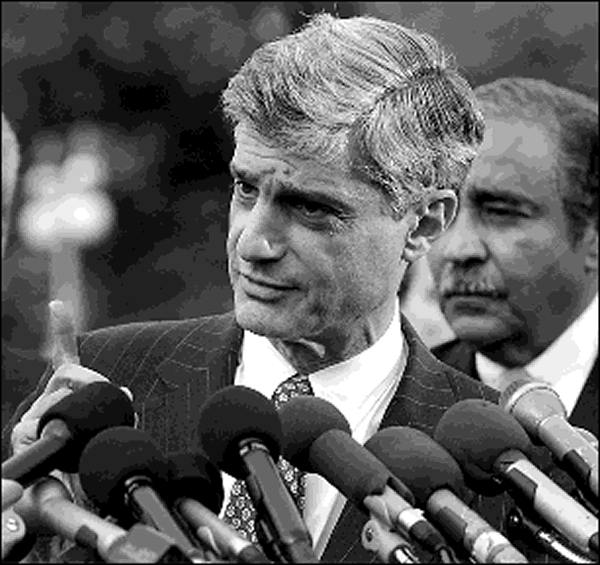
Rubin, Reuven (1893-1974)
Artist
Although born in Rumania and trained in art in Paris and Rumania, Reuven Rubin in many ways is a distinctly and distinctively Israeli artist. He studied briefly at the Bezalel School of Art in Jerusalem, and he exhibited in the first art exhibitions in Jerusalem in 1922. His exhibit of 1924 was the first one-man show in the Jerusalem exhibits, and his one-man show in 1932 launched the Tel Aviv Art Museum. He designed scenery for Habimah, Israel's National Theater, and Rubin was one of the first Israeli artists to achieve international recognition.
Most important, though, was Rubin's attempt to create an indigenous style of art. Influenced heavily by the work of Henri Rousseau, he sought to fuse this style with Eastern nuances. Hence his custom of signing his first name in Hebrew and his surname in Roman letters. Among Rubin's most memorable works are his paintings of the Yishuv, particularly his landscapes and his paintings of the Israeli worker. Biblical themes also occur frequently in his work. His work was extremely popular both at home and abroad, and if his later work was less complex and profound than his earlier productions, it did not lessen his popularity.
Rubin served as Israel's first ambassador to Rumania, from 1948-1950. His autobiography, My Life--My Art, was published in 1969, and he received the Israel Prize in 1973 for his artistic achievement.
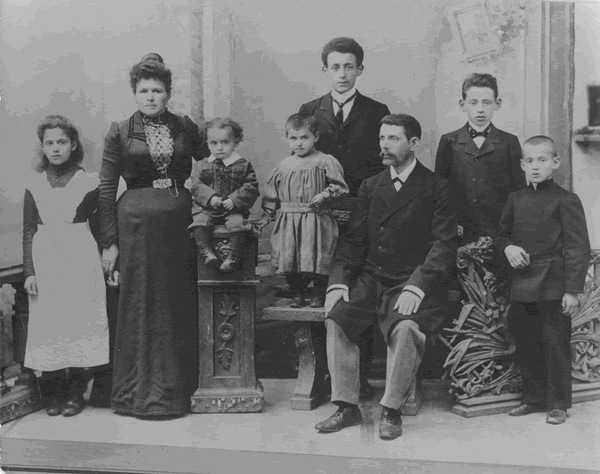
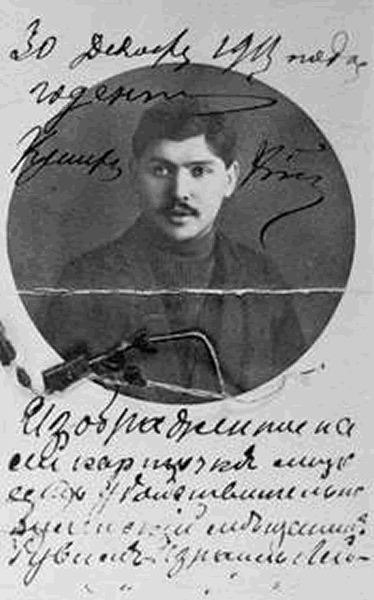
http://home.nycap.rr.com/wrwebsite/) As you list Bialystok under your heading (are these Rubins all related?), I naturally wonder if any of them fit into our tree. Do you have any additional info?
Sincerely,
Lena Einhorn
Stockholm, Sweden
#rub-11:
From: lia ivanova <dorina-7878@mail.ru>
Date: Wed, Oct 1, 2014 at 6:05 PM
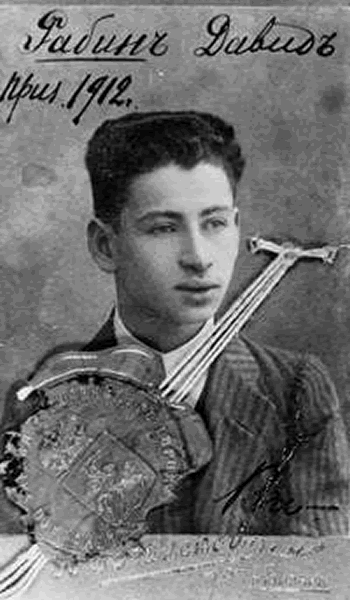
1912
My grandmother has the same picture of David Rubin son of Nisan -why?i know that Nisan was an uncle of my grandfather
15, 1889-January 30, 1933) of Dolghinov was the son of
Haim Shimon RUBIN and Faiga Rivka HEIFETZ RUBIN. He
had a sister Chay Doba RUBIN PERLMUTTER (1906-1942)
who, with her entire family, was killed in 1942.
Yirimayahu Yakov emigrated to America in 1908. I am
trying to find the two brothers of Y.Y. but
unfortunately I do not know their first names.
I am told that one of them emigrated to
Birobidjan in the early 1930s. Does anyone have any
information on specific Jews in Birobidjan or children
of Haim Shimon and Faiga Rivka RUBIN. I have used all
JewishGen and Yad va-Shem materials to no avail.
It was announced in 2005 that there would be a
Jewish Research Center established there but it does
not seem to exist.
Barry Rubin,
profbarryrubin@yahoo.com
Tel Aviv.
From: Barry Rubin <profbarryrubin@yahoo.com>
I have been doing extensive research into the history of
Dolhinov's Jews and especially into that of the , and Hefetz families.
In cooperation with Harold Rhode and Leon Rubin, who has done so much
for the Dolhinov community, we are setting up a Dolhinov Research
Project and invite you to participate and to share your information.
This includes the following efforts:
--A survey of documents on Dolhinov in Vilna, Vileika, and
Minsk with the aim of copying as many as possible.
--Recording the inscriptions of the 400 gravestones in the
Jewish cemetery.
--Creating an email list of Dolhinov descendants to exchange
information. Please send me your email if you would like to be
included..
--Trying to build a Rubin and Grossbein family trees which will
obviously include a lot of other people as well.
--DNA testing of Rubin family members.
I hope that we can report to you on progress and to get your help.
Let me start with the DNA testing which is still going on.
Evidence from a few tests seems to indicate the following:
1. All Dolhinov Rubins come from a single family, taking that
name in the early 1700s.
2. The original location of the family was in eastern Anatolia
which coincides with the origins of Abraham's tribe in Ur.
We will know more as additional people are tested and more detailed
tests are done.
Please feel free to write me at profbarryrubin@yahoo.com.
Here is my family tree of Rubins as best as I can reconstruct it:
Yermiya Rubin born before 1743 (the first known Rubin)
\
Gabriel Rubin (1763- )
\
Yankel Rubin (1791-1833)
+Sora ? (1805- )
\
Zalman Rubin (1820s?-after 1870)
\
Yankel (1838-1889 or after) and Chaya Rubin (1837 or
1839-1889 or after) (daughter of Itzko ____). They had three sons:
1.Leib (March 15, 1865-January 10, 1949)
Married Sarah ((November 25, 1872-November 9, 1944)
A. Philip 1890
B. David 1895
C. Bessie 1897
D. Anna 1899
E. Alexander 1901
F. Ida 1903
G. Evelyn 1909
2. Haim Shimon (1867- 1920 or after?)
Ma: Faiga Rivka Heifetz (daughter of Tankhel Heifetz; sister of Natan
Heifetz). They had two children:
A. Yaakov Yeramiyahu (1890-1933)
Ma. Chaya Grossbein
David (1913-1974) married Helene: Barry Rubin
Lillian: (1921- ) married Melvin Kramer: Joan, Richard, Susan,
B.
C. Chaya Doba (1906-1942)
Ma: Aharon Perlmutter
Haim
Yaakov
C and D: there were two other sons but I cannot find their names. I
would be grateful for help here.
3.. Zalman-Ber Rubin (1860-?), drafted into the Czarist army in 1879,
fate unknown.