Guestbook for www.eilatgordinlevitan.com
Archived entries from February28, 2007 to August 31, 2008
Thank you for visiting our pages. You may ADD to this guestbook. Please submit related comments. Spam cannot be posted.
Entries dated February 28, 2007 and before have been archived HERE .
This site is dedicated to the memory of the Jewish population who perished during the Holocaust.
eilatgordinlevitan.com HOME PAGE
I have found some interesting names: Nathan Funt ( a partisan whom I
met ), Zalman Toker (I have Toker family in Grodno, but no Zalman),
Kosowski (I am interested in Kosowski from KAMENKA, that's my parents'
shtetle, not too far from Grodno. Kosakowski is my father's surname
and Sidranski my mothers'), Eliashberg (of Ruth marcus from Luna with
whom I am in touch about our research since her ancestors are from
Kamenka)
ze'ev sharon <zeevsharon@013.ne->
Looking for information as I am trying to flesh out my family tree and finally
made a connection back to Latvia. It looks like they were on the Dvinsk list
of 1875. I am decendent of Scholom Jacobs who was married to an Esta Golda.
Janekl Kwasnik Unkown DOB father of
Scholom Kwasnik 1841 approx DOB Scholom immigrated around 1906
with his five of his children. Scholom son Harry Benjamin was my Grand father.
He died in early 1960's.
Arbram Kwasnik 1846 approx DOB
Isorel Kwasnik 1830 approx DOB
Wulff Kwasnik 1850 approx DOB
Sorry don't have much else to go on as we are just starting out. It took a
while to find the original Name Kwasnik, Which was changed to Jacobs when they
immigrated.
Thank you
harry jacobs
yenkin2001 at yahoo
The 1912 through 1914 issues of the Vilna city directory "Vsia Vilna" are
available to Vilna researchers. Vilna researchers interested in accessing
these city directories can receive the links to the files by joining the
JewishVilna GoogleGroup. An e-mail addressed to me indicating your interest
in joining JewishVilna will get you an invitation to join as well as the
links necessary to access the city directories. These directories are
pre-1917 and are therefore in Cyrillic.
Joel Ratner
Dear Eilat!
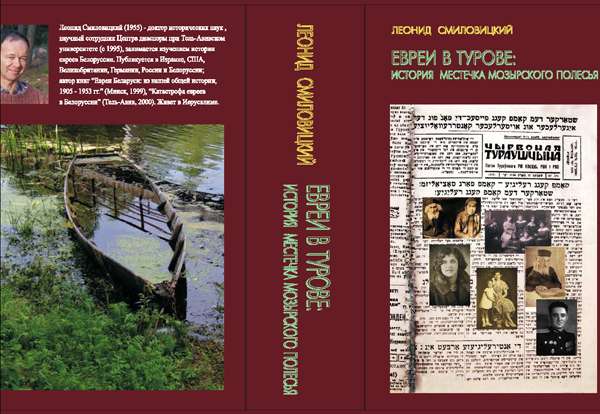
Turov monograph was successfully published in July 2008. It's full title is "Jews in Turov. History of a shtetl in Mozyr Polesye region", Jerusalem, 2008. The volume is in Russian, but with a Table of contents and Introduction in English. It is excellent illustrated, has a large Name and Geographical indexes, 200 pictures of old and modern Turov, rare maps and plans of Turov, Mozyr district, Minsk gubernia as well as Turov residents, its rabbis, synagogues, believers, victims of pogroms, list of Turovers killed by Nazis.
Please, note about Turov book to all your colleagues and friends interested in Belarus shtetl history.
My additional papers in English dedicated to Belarus Jewish history is possible to see at:
http://www.jewishgen.org/Belarus/newsletter/authors.htm
Faithfully yours,
Leonid Smilovitsky, Ph.D.
smilov@zahav.net.il
Jews in Turov (download a .pdf file)
The outbreak of WWI cause Russia to forcibly evacuate the population
of much area on the front lines into the interior of Russia. This
exodus included what is now Belarus, Latvia and Lithuania. Millions
of civilians became refugees. The Russian Revolution following WWI
resulted in many of these refugees not returning home for several
more years. If they were not able to immigrate to the US before 1920,
their departure was further delayed by the US's 1920 anti-Semitic
Immigration Law which established meager quotas for Eastern European
countries.
In my own family, my mother and sisters and their mother could not
rejoin my grandfather in America until 1928, when their quota assignment
was reached, even though my grandfather had been here since 1913.
For those wishing to read the details of this era there is a fine scholarly
book: A Whole Empire Walking -Refugees in Russia During World War I by Peter
Gatrell.
Joe Hirschfield
MINOWICKI, MINOWITZKI, MINOFF, TOBIASZ-Brest Litovsk, Wysokae, BELARUS
HIRSCHFELD, HERSZFELD, BUXBAUM, BUCHSBAUM, TOPPERMANN, LINDENBAUM-Skwarzawa
(Skavaryava), Seliec Bienkow (Selets), Glinyany, Jarzczow, GALICIA
In a message dated 7/18/2008 10:54:11 P.M. Eastern Daylight Time,
tracie ....Family lore has it that they came to attend my gm's
wedding in N.J. and intended to return to Russia after
the wedding, but that they were unable to return due to
political unrest in Russia. At the same time, my ggf
and the remaining children were apparently "stuck" in
Russia and could not join my ggm in the U.S. until 1923 --
9 years later.
Does anyone know whether there were travel restrictions --
in either direction -- during this time period?
I believe that Russia /Germany war started
in August 1914, which might corroborate family stories
about my ggm not being able to return, but would that have
prevented my ggf from leaving Russia?
I am a genealogist researching the "KATZ" family of Brooklyn NY. The
oldest info
I have is the burial of Joseph Katz in the Mt Carmel Cemetery. He is in the
Lieder Brueder Society Section. My research indicates he was a member of a
group that came from "Lida, Byel". Currently in Belerus. I see from this web
site there are a number of Katz families in Lida. Joseph (Yosef) came to the
USA in 1898 and from his death certificate his father was Harry Katz and his
mother was Shanie Cohan. Both parents were born around 1848 and did not come to
the USA. Joseph was born in DEC 1867 in Russia. His wife's name was Mary.
Any information and/or corrections would be greatly appreciated.
Bob Lofquist (robert.p.lofquist@snet.net) Connecticut, USA
Agatha phiri (Agthaphiri@gmail.com)
I saw your page when i was browsing pictures of my good friend ariel
salati who visted malawi in africa last year.
Amir Dekel (adekel@bellsouth.net) on Saturday, August 23, 2008
Home Page: http://dream-of-genea.blogspot.com
I came across your wonderful site while doing a google search for my ancestors.
My grandmother, Zipora Smorgonski was from Dolhinov as were her sisters Hanna
and Pesia and her half brother Shlomo (Shamgar). From what I can figure out the
rest of the family died in the Dolhinov ghetto*. I pieced most of it together
from the Yizkor Books, Yad Vashem site and family stories.
While looking through your site I think I spotted my grandmother in the two
'Hachalutz' pictures. I know she was a member of 'Hachalutz' and later went to
Kibbutz Lida and then to Israel.
Any other information would be terrific.
Thanks for the great site!
Amir Dekel
-------------------------------
Amir,
Your grandmother' half brother: Shlomo Shamgar ( nee Smorgonski), a survivor
gave reports:
Smorgonski Chaia
Chaia Smorgonski was born in Dolhinov in 1925 to Avraham and Henia nee Sigalchik. She was a pupil and single. Prior to WWII she lived in Dolhinov, Poland. Chaia perished in 1942 in Dolhinov, Poland at the age of 17. This information is based on a Page of Testimony (displayed on left) submitted on 20-Jul-1999 by her brother, a Shoah survivor
Smorgonski Henia
Henia Smorgonski nee Segalchik was born in Dolhinov in 1892 to Yaakov and Ita. She was a housewife and married to Avraham. Prior to WWII she lived in Dolhinov, Poland. Henia perished in 1942 in Dolhinov, Poland at the age of 50. This information is based on a Page of Testimony (displayed on left) submitted by her son, a Shoah survivor
Smorgonski Yosef
Yosef Smorgonski was born in Dolhinov in 1928 to Avraham and Henia nee Sigalchik. He was a pupil and single. Prior to WWII he lived in Dolhinov, Poland. Yosef perished in 1942 in Dolhinov, Poland at the age of 14. This information is based on a Page of Testimony (displayed on left) submitted on 20-Jul-1999 by his brother, a Shoah survivor.
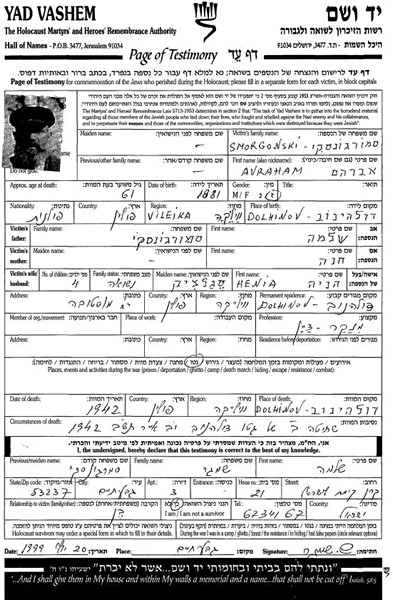
Smorgonski Abraham
Abraham Smorgonski was born in Poland in 1880. He was married. Prior to WWII he lived in Dolhinow, Poland. During the war he was in Dolhinow, Poland. Abraham perished in Dolhinow, Poland. This information is based on a Page of Testimony (displayed on left) submitted on 22-Nov-1957 by his daughter
Smorgonski Esther
Esther Smorgonski was born in Poland in 1879 to Yaakov and Ita. She was married. Prior to WWII she lived in Dolhinow, Poland. During the war she was in Dolhinow, Poland. Esther perished in Dolhinow, Poland. This information is based on a Page of Testimony (displayed on left) submitted on 22-Jan-1957 by her daughter
Smorgonski Yta
Yta Smorgonski was born in Poland in 1920 to Avraham. She was single. Prior to WWII she lived in Dolhinow, Poland. During the war she was in Dolhinow, Poland. Yta perished in Dolhinow, Poland. This information is based on a Page of Testimony (displayed on left) submitted on 22-Jan-1957 by her sister
Lenkin Leduscha
Leduscha Lenkin nee Sigalchik was born in Dolhinow to Yaakov and Ita. She was married. Prior to WWII she lived in Dolhinow, Poland. During the war she was in Dolhinow, Poland. Leduscha perished in Dolhinow, Poland. This information is based on a Page of Testimony (displayed on left) submitted on 22-Jan-1957 by her cousin. More Details...
Lenkin Ita
Ita Lenkin was born in Poland to Yosef and Lidia. She was married. Prior to WWII she lived in Dolhinow, Poland. Ita perished in Dolhinow, Poland. This information is based on a Page of Testimony (displayed on left) submitted on 22-Jan-1957 by her cousin. More Details...
Smargonski Chaia
Chaia Smargonski was born in Poland to Avraham. She was married. Prior to WWII she lived in Dolhinow, Poland. During the war she was in Dolhinov, Poland. Chaia perished in Dolhinow, Poland. This information is based on a Page of Testimony (displayed on left) submitted on 22-Jan-1957 by her sister
*Some others from the family survived and gave Yad Vashem repots.
Levi Kotton
Kotton Mina
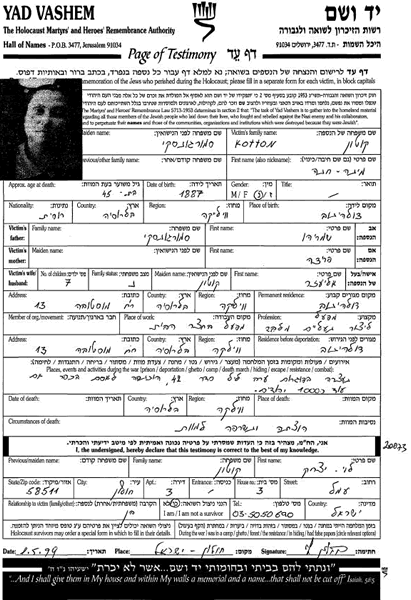
Mina Kotton nee Smorgonski was born in Dolhinow in 1887 to Shmariahu and Frida. She was a owner of a shoe factory and married to Eliezer. Prior to WWII she lived in Dolhinow, Poland. During the war she was in Dolhinow, Poland. Mina perished in 1942 in Dolhinow, Poland at the age of 45. This information is based on a Page of Testimony (displayed on left) submitted on 01-May-1999 by her son, a Shoah survivor
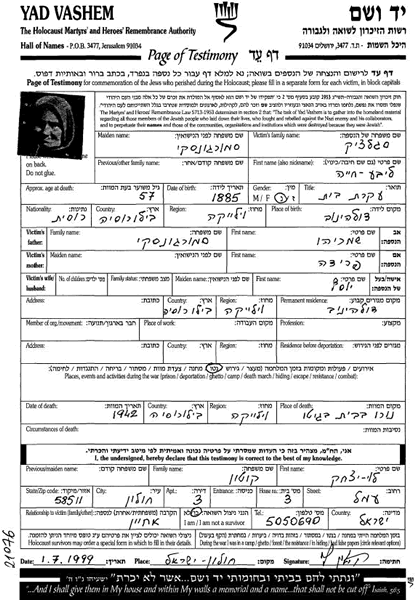
Liba Chaia Sagalchik nee Smorgonski was born in Dolhinow in 1885 to Shmariahu and Frida. She was a housewife and married to Yosef. Prior to WWII she lived in Dolhinow, Poland. She perished in 1942 in Dolhinow, Poland at the age of 57. This information is based on a Page of Testimony (displayed on left) submitted on 01-Jul-1999 by her nephew, a Shoah survivor
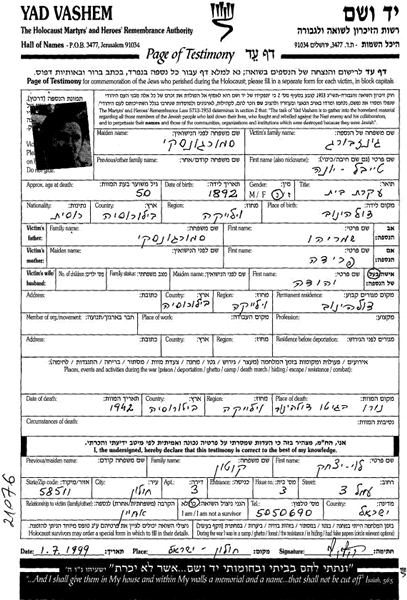
Tebel Yonah Ginsburg nee Smorgonski was born in Dolhinov in 1892 to Shmariahu and Frida. She was married to Yehuda. Prior to WWII she lived in Dolhinov, Poland. She perished in 1942 in Dolhinov, Poland at the age of 50. This information is based on a Page of Testimony (displayed on left) submitted on 01-Jul-1999 by her nephew, a Shoah survivor.
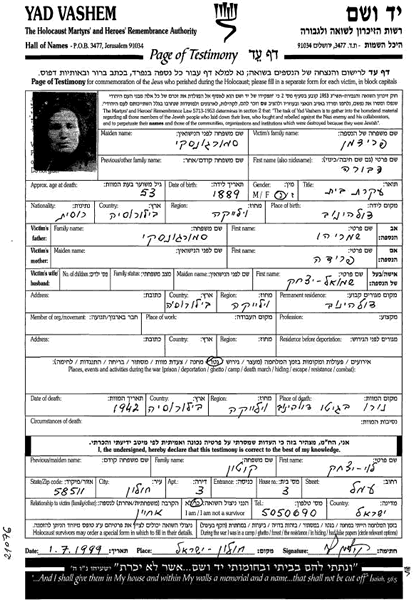
Fridman Dvora
Dvora Fridman nee Smorgonski was born in Dolhinow in 1889 to Shmariahu and Frida. She was married to Shmuel. Prior to WWII she lived in Dolhinow, Poland. Dvora perished in 1942 in Dolhinow, Ghetto at the age of 53. This information is based on a Page of Testimony (displayed on left) submitted on 01-Jul-1999 by her nephew, a Shoah survivor. More Details...
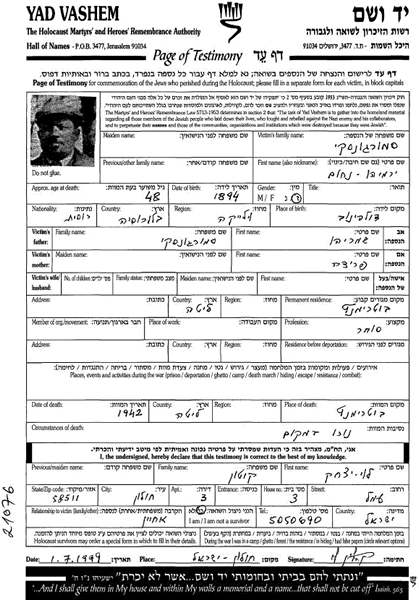
Smorgonski Yermiyahu
Yermiyahu Smorgonski was born in Dolhinow in 1894 to Shmariahu and Frida. He was a merchant. Prior to WWII he lived in Butrimonys, Lithuania. Yermiyahu perished in 1942 in Butrimonys, Lithuania at the age of 48. This information is based on a Page of Testimony (displayed on left) submitted on 01-Jul-1999 by his nephew, a Shoah survivor. More Details...
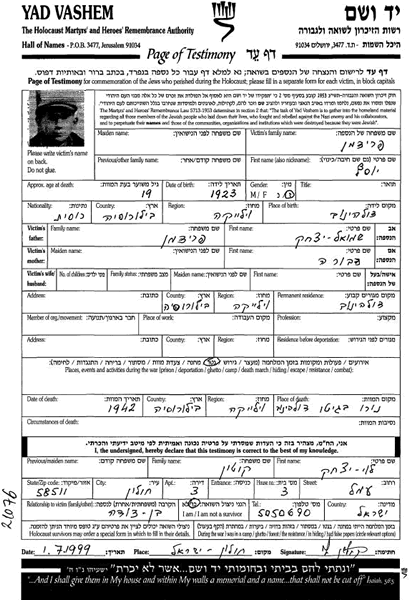
Fridman
Yosef Fridman was born in Dolhinov in 1923 to Shmuel and Dvora Fridman nee Smorgonski . Prior to WWII he lived in Dolhinov, Poland. Yosef perished in 1942 in Dolhinov, Poland at the age of 19. This information is based on a Page of Testimony (displayed on left) submitted on 01-Jul-1999 by his cousin, a Shoah survivor
The DNA Shoah Project
Elaine, thank you for your contribution and your enthusiastic support of our project. I really appreciate you encouraging your friends to participate.
My correct email address is: lkdavis@email.arizona.edu, or people can simply write to info@dnashoah.org.
All the best,
Lynn Davis
Information Specialist
The DNA Shoah Project
P. O. Box 210240
Tucson, AZ 85721
(520) 626-6203
toll-free: (866) 897-1150
-------------------------
August 21, 2008
... on my own brother Allan's 70th birthday--i gave a GIFT to the Holocaust survivors-
-it did not cost me anything to do this--& during the 30 seconds i did this, i realized how important this gift was, and how vital it is for each one of us to do this--whether or not we are Jewish, and whether or not we had holocaust victims in our families
the gift i gave was a sample of my own DNA, it took just 30 seconds for a painless cheek swab from my mouth--there was NO COST TO PARTICIPATE
and it will never be publicly published by the DNA SHOAH PROJECT--the data is protected by a multi-level security system and federal laws--the UNIVERSITY of ARIZONIA is trying to build a genetic database
which when established can assist European governments with forensic identifications, can reunite families,
& can help people who are still searching for lost family members,
you can order a FREE DNA TEST KIT by e-mailing Lynn Davis [i met her yesterday] at lkdavis@mail.arizona.edu or call her at 1-866 897 1150
this foundation was begun by Syd Mandelbaum, a scientist & philanthropist, the son of two Holocaust survivors, Dr. Michael Hammer U of Ariz staff geneticist, & Howard Cash founder of Gene Code Forsensics
my DNA will be matched with survivors, & i will get an e-mail from the DNA SHOAH PROJECT each time they find a match,
it is important to notify them if the e-mail address is changed
you will need the address, phone number and email address of another person who can represent your family in case you die--i gave information for my daughter and u will have to sign a release form that it is ok to use your DNA for the project--i signed the form--i felt this was very important--i felt that if i never in my life did anything to help anyone that this was the most important thing that i could do--i might never meet any of these people who are matches--but for the
survivors who are a match, for each of them who lived through those terrible terrible times, or for their decendants just having a relative,
even if it is a very remote cousin, is so psychologically comforting to know,
that somewhere in the world they have a "FAMILY"
Elaine
From: Barry Rubin <profbarryrubin@yahoo.com>
I have been doing extensive research into the history of
Dolhinov's Jews and especially into that of the , and Hefetz families.
In cooperation with Harold Rhode and Leon Rubin, who has done so much
for the Dolhinov community, we are setting up a Dolhinov Research
Project and invite you to participate and to share your information.
This includes the following efforts:
--A survey of documents on Dolhinov in Vilna, Vileika, and
Minsk with the aim of copying as many as possible.
--Recording the inscriptions of the 400 gravestones in the
Jewish cemetery.
--Creating an email list of Dolhinov descendants to exchange
information. Please send me your email if you would like to be
included..
--Trying to build a Rubin and Grossbein family trees which will
obviously include a lot of other people as well.
--DNA testing of Rubin family members.
I hope that we can report to you on progress and to get your help.
Let me start with the DNA testing which is still going on.
Evidence from a few tests seems to indicate the following:
1. All Dolhinov Rubins come from a single family, taking that
name in the early 1700s.
2. The original location of the family was in eastern Anatolia
which coincides with the origins of Abraham's tribe in Ur.
We will know more as additional people are tested and more detailed
tests are done.
Please feel free to write me at profbarryrubin@yahoo.com.
Here is my family tree of Rubins as best as I can reconstruct it:
Yermiya Rubin born before 1743 (the first known Rubin)
\
Gabriel Rubin (1763- )
\
Yankel Rubin (1791-1833)
+Sora ? (1805- )
\
Zalman Rubin (1820s?-after 1870)
\
Yankel (1838-1889 or after) and Chaya Rubin (1837 or
1839-1889 or after) (daughter of Itzko ____). They had three sons:
1.Leib (March 15, 1865-January 10, 1949)
Married Sarah ((November 25, 1872-November 9, 1944)
A. Philip 1890
B. David 1895
C. Bessie 1897
D. Anna 1899
E. Alexander 1901
F. Ida 1903
G. Evelyn 1909
2. Haim Shimon (1867- 1920 or after?)
Ma: Faiga Rivka Heifetz (daughter of Tankhel Heifetz; sister of Natan
Heifetz). They had two children:
A. Yaakov Yeramiyahu (1890-1933)
Ma. Chaya Grossbein
David (1913-1974) married Helene: Barry Rubin
Lillian: (1921- ) married Melvin Kramer: Joan, Richard, Susan,
B.
C. Chaya Doba (1906-1942)
Ma: Aharon Perlmutter
Haim
Yaakov
C and D: there were two other sons but I cannot find their names. I
would be grateful for help here.
3.. Zalman-Ber Rubin (1860-?), drafted into the Czarist army in 1879,
fate unknown.
The following pre-WWII directories are newly searchable on my site
kalter.org/search. Some have been previously discussed on JewishGen and SIG
mailing lists, while I believe others are not well known, and would benefit
from analysis by those with relevant geographic and linguistic expertise.
1894 Commercial Directory of the Jews of the United Kingdom (Harfield)
1904 Poland Manufacturers' Directory
1938 Economic Directory of Kielce, Krakow, Silesia Provinces
1914 Upper Silesia Trade Directory
1924 Poznan Telephone and Business Directory
1930 Poznan (City) Address Directory
1826 Warsaw Directory
1932 Bialystok Address Directory
1914/1915 Krakow War Refugees Address Directory
1914/1915 Lwow War Refugees Address Directory
1913 Lwow Address Directory
1910 Lwow Address Directory
1902 Lwow Address and Business Directory
Because of the large number of directories now searchable on the site, and
the large number that will be added in the near future, I will soon be
reorganizing the site and making other improvements. Stay tuned, and please
continue to tell me about online directories you think should be added.
(Note that I am now including even directories with name indices, because of
the benefits of making them full-text and soundex searchable.)
As usual, the result of a search will include a list of numbers,
corresponding to the images where matches to the search term can be found.
If you have never used the site and do not know how to view those images,
read the answer to the first frequently asked question at
kalter.org/searchfaq.html (or click the FAQ link on the site, just above the
search area).
If you find information useful to your research with this tool, please tell
me.
Best regards,
Logan Kleinwaks
http://www.dbhd.org/search.php
Message: I need information about TROP family from Skidel, and Kolinski
family from Warsaw who perished by the Nazis. I could´not find information
about them. My grandfather Avraham Kolinski came in 1931 to Argentina, from Warsaw,
with his wife, Jana and Sara, Perla (my aunts) and Chana, my mother. My father
Izaak and Iosef came from Skidel, but many perished from this family. Please,
help me with information. Are there any archives from Skidel, Province of Grodno?
Thanks,
José Trop from Rosario, Argentina
From Yad Vashem:
Trop Nachum
Nachum Trop was born in Skidel in 1910 to Yakow and Lyuba nee Tarlovski. He was a clerk working at his father ' factory and married to Khaia nee Rosenthal. Prior to WWII he lived in Skidel, Poland. During the war he was in Skidel, Poland. Nachum perished in the Shoah. This information is based on a Page of Testimony (displayed on left) submitted on 01-Jan-1997 by his spouse Chaia Myberger of Hedera/ Beit Eliezer, Israel
Trop Jacob
Jacob Trop was born in Skidel. He was a manager of a turpentine factory and married to Lyuba. Prior to WWII he lived in Skidel, Poland. During the war he was in Skidel, Poland. Jacob perished in Grodno, Poland. This information is based on a Page of Testimony (displayed on left) submitted by his daughter-in-law. Chaia Myberger of Hedera/ Beit Eliezer, Israel
Lyuba Trop nee Tarlovski was born in Grodno. She was a shop owner and married to Yakov. Prior to WWII she lived in Skidel, Poland. During the war she was in Skidel, Poland. Lyuba perished in Grodno, Poland. This information is based on a Page of Testimony (displayed on left) submitted on 01-Jan-1997 by her daughter in law; Chaia Myberger of Hedera/ Beit Eliezer, Israel
Kotok Roza
Roza Kotok nee Trup was born in Skidel in 1920 to Yakow and Lyuba nee Tarlovski. She was married. Prior to WWII she lived in Skidel, Poland. During the war she was in Skidel, Poland. Roza perished in Grodno, Poland. This information is based on a Page of Testimony (displayed on left) submitted on 01-Jan-1997 by her sister-in-law. More Details... Chaia Myberger of Hedera/ Beit Eliezer, Israel
Pnina Pylevsky nee Trop was born in Skidal in 1899 to Shmuel and Nekha. She was a housewife and married to Shalom and had children; Zila ( perished at age 17) and (Yosef (perished at age 15). Prior to WWII she lived in Skidal, Poland. During the war she was in Skidal, Poland. Pnina perished in Skidal, Poland. This information is based on a Page of Testimony (displayed on left) submitted on 10-Jun-1956 by her sister Rivka Pesel? of Kiryat Bialik
Trop Necha
Necha Trop nee Kaplan was born in Grodno to Yosef and Rivka. She was a housewife and married to Shmuel. Prior to WWII she lived in Skidal, Poland. During the war she was in Skidal, Poland. Necha perished in Skidal, Poland at the age of 65 Shmuel Trop perished at age 70. This information is based on a Page of Testimony (displayed on left) submitted on 10-Jun-1956 by her daughter
Varnovsky Ester
Ester Varnovsky nee Trup was born in Skidal in 1897 to Shmuel and Nekha. She was a housewife and married to Efraim and had Moshe age 18, Yosef age 12 and Chaim age 15 . Prior to WWII she lived in Skidal, Poland. During the war she was in Skidal, Poland. Ester perished in the Shoah. This information is based on a Page of Testimony (displayed on left) submitted on 10-Jun-1956 by her sister. More Details
Trop Jhoshua
Jhoshua Trop was born in Skidel in 1905 to Shmuel and Nekhama. He was a merchant and married and had children: Ida age 18 , Rachel age 15 and Yocheved age 12. Prior to WWII he lived in Skidel, Poland. During the war he was in Skidel, Poland. Jhoshua perished in the Shoah. This information is based on a Page of Testimony (displayed on left) submitted on 10-Jun-1956 by his sister
Tropp Ber
Ber Tropp was born in Skidel to Yaakov and Khaia. He was married and had a leather factory. Prior to WWII he lived in Skidel, Poland. During the war he was in Skidel, Ghetto. Ber perished in the Shoah at the age of 62. This information is based on a Page of Testimony (displayed on left) submitted by his daughter in law; Regina Trop nee Weinberger
Tropp Yitzkhak
Yitzkhak Tropp was born in Skidel in 1914 to Bela and Ber/ Berko . He was an accountant and single. Prior to WWII he lived in Skidel, Poland. During the war he was in Skidel, Poland. Yitzkhak perished in Grodno, Ghetto. This information is based on a Page of Testimony (displayed on left) submitted by his sister-in-law Regina Trop nee Weinberger
Tropp Bela
Bela Tropp nee Jerzewska was born in Oran ( Lithuania) . She was a housewife and married to Ber. Prior to WWII she lived in Skidel, Poland. During the war she was in Skidel, Poland. Bela perished in Grodno, Ghetto at the age of 60. This information is based on a Page of Testimony (displayed on left) submitted by her daughter-in-law Regina Trop nee Weinberger
Rabinowicz Pola
Pola Rabinowicz nee Tropp was born in Skidel in 1909 to Bela and Berko. She was a housewife and married with a baby girl born in 1939. Prior to WWII she lived in Skidel, Poland. During the war she was in Skidel, Poland. Pola perished in Grodno, Ghetto. This information is based on a Page of Testimony (displayed on left) submitted by her sister-in-law Regina Trop nee Weinberger
---------------------------------------------------
-
Results of search for victims whose family name (including synonyms) is 'Kolinski' , and whose location (including synonyms) is 'Warsaw' :
Displaying 1 - 15 of 62
Kolinski Lisa
Lisa Kolinski was born to Leizer and Khana. She was married. Prior to WWII she lived in Warsaw, Poland. During the war she was in Warsaw, Poland. Lisa perished in the Shoah at the age of 26. This information is based on a Page of Testimony (displayed on left) submitted on 20-Mar-1957 by her relative
Place of Residence (or Place of Birth)
Name Town District Region Country Birth Date
Source
Name Town District Region Country Birth Date Source
Kolinski Shlomo PSHASNISH PRZASNYSZ WARSZAWA POLAND 1900 Page of Testimony
Kolinski Sheindl PRZASNYSZ PRZASNYSZ WARSZAWA POLAND 1904 Page of Testimony
Heller Hela
WARSZAWA WARSZAWA WARSZAWA POLAND Page of Testimony
Kolinska Emilie
WARSZAWA WARSZAWA
1856 List of Theresienstadt camp inmates
Kolinska Helena 1879 List of Theresienstadt camp inmates
Kolinsky Ern
Name Town District Region Country Birth Date Source
Kolinski Jakov PRZASNYSZ PRZASNYSZ WARSZAWA POLAND Page of Testimony
Kolinski Shlomo PRZASNYSZ PRZASNYSZ WARSZAWA POLAND Page of Testimony
Kolinski Josef PRZASNYSZ PRZASNYSZ WARSZAWA POLAND Page of Testimony
Kolinski Meir PRZASNYSZ PRZASNYSZ WARSZAWA POLAND Page of Testimony
Kolinski Hana PRZASNYSZ PRZASNYSZ WARSZAWA POLAND Page of Testimony
Kolinski Shajndl PRZASNYSZ PRZASNYSZ WARSZAWA POLAND Page of Testimony
Kolinski Gitel PRZASNYSZ PRZASNYSZ WARSZAWA POLAND 1903 Page of Testimony
Kolinski Majer PRZASNYSZ PRZASNYSZ WARSZAWA POLAND 1900 Page of Testimony
Kolinski Chana PRZASNYSZ PRZASNYSZ WARSZAWA POLAND 1900 Page of Testimony
Kolinski Meir PRZASNYSZ PRZASNYSZ WARSZAWA POLAND Page of Testimony
Kolinski Hersz PRZASNYSZ PRZASNYSZ WARSZAWA POLAND 1872 Page of Testimony
Kolinski Majer PRZASNYSZ PRZASNYSZ WARSZAWA POLAND 1903 Page of Testimony
Kolinski Chana PRZASNYSZ PRZASNYSZ WARSZAWA POLAND 1924 Page of Testimony
Kolinski Lisa WARSAW WARSZAWA WARSZAWA POLAND Page of Testimony
Kolinski Moshe PRZASNYSZ PRZASNYSZ WARSZAWA POLAND 1900 Page of Testimony
st PRAHA
PRAHA HLAVNI MESTO
BOHEMIA CZECHOSLOVAKIA 1879 Page of Testimony
Kolinsky Ernst PRAGUE PRAHA HLAVNI MESTO BOHEMIA CZECHOSLOVAKIA 1879 Page of Testimony
Kolinsky Robert PRAGUE PRAHA HLAVNI MESTO BOHEMIA CZECHOSLOVAKIA 1905 Page of Testimony
Kolinsky Oskar PRAG PRAHA HLAVNI MESTO BOHEMIA CZECHOSLOVAKIA 1883 Page of Testimony
Kolinsky Arnost 1879 List of Theresienstadt camp inmates
Kolinsky Josef 1909 List of Theresienstadt camp inmates
Kolinsky Helene PRAGUE PRAHA HLAVNI MESTO BOHEMIA CZECHOSLOVAKIA 1879 Page of Testimony
Kolinsky Helene PRAGUE PRAHA HLAVNI MESTO BOHEMIA CZECHOSLOVAKIA 1879 Page of Testimony
Kolinsky Robert PRAHA PRAHA HLAVNI MESTO BOHEMIA CZECHOSLOVAKIA 1905 Page of Testimony
Kollinska Gertruda 1901 List of Lodz ghetto inmates
Kollinska Greta 1892 List of Theresienstadt camp inmates
Kollinska Marie 1913 List of Theresienstadt camp inmates
Go to Previous message | Go to Next message | Back to Messages
ASCII (ASCII)Greek (ISO-8859-7)Greek (Windows-1253)Latin-10 (ISO-8859-16)Latin-3 (ISO-8859-3)Latin-6 (ISO-8859-10)Latin-7 (ISO-8859-13)Latin-8 (ISO-8859-14)Latin-9 (ISO-8859-15)W. European (850)W. European (CP858)W. European (HPROMAN8)W. European (MACROMAN8)W. European (Windows-1252)Armenia (ARMSCII-8)Baltic Rim (ISO-8859-4)Baltic Rim (WINDOWS-1257)Cyrillic (866)Cyrillic (ISO-8859-5)Cyrillic (KOI8-R)Cyrillic (KOI8-RU)Cyrillic (KOI8-T)Cyrillic (KOI8-U)Cyrillic (WINDOWS-1251)Latin-2 (852)Latin-2 (ISO-8859-2)Latin-2 (WINDOWS-1250)Turkish (ISO-8859-9)Turkish (WINDOWS-1254)Arabic (ISO-8859-6, ASMO-708)Arabic (WINDOWS-1256)Hebrew (856)Hebrew (862)Hebrew (WINDOWS-1255)Chinese Simplified (GB-2312-80)Chinese Simplified (GB18030)Chinese Simplified (HZ-GB-2312)Chinese Simplified (ISO-2022-CN)Chinese Simplified (WINDOWS-936)Chinese Trad.-Hong Kong (BIG5-HKSCS)Chinese Traditional (BIG5)Chinese Traditional (EUC-TW)Japanese (SHIFT_JIS)Japanese (EUC-JP)Japanese (ISO-2022-JP)Korean (ISO-2022-KR)Korean (EUC-KR)Thai (TIS-620-2533)Thai (WINDOWS-874)Vietnamese (TCVN-5712)Vietnamese (VISCII)Vietnamese (WINDOWS-1258)Unicode (UTF-7)Unicode (UTF-8)Unicode (UTF-16)Unicode (UTF-32)
Moshe Mones (Moshemones@gmail.com) on Monday, June 23, 2008
---------------------------------------------------------------------------
Message: Thank you for this great site
I am trying to find out if anyone knows more about my Paternal family 'Mones'.
I finally traced my great Grandfather Wolf Girsh Mones to his father Zelman
Chaim Mones in Kovna. I do know that Wolf Girsh married Lena Eliashevitz who
had a number of brothers and sisters. Wolf and Lena moved to the U.S. in the
early 1900's and gave birth to my grandfather (obm) Leon Eliezer Mones. I
also know Great Grandmother Lena's father's name was Joseph or Yosef and his
wife was Frieda.
thank you so much
kol tov
Moshe Mones
From Yad Vashem:
Mones Miriam and Emanuel
Miriam perished in Kowno, Lithuania at the age of 11. Emanuel perished at the age of 6. This information is based on a Page of Testimony submitted on 01-Jan-1970 by their mother; Chaja Bobkir ( nee Mones) , a survivor who lived in Canada.
Leon Rubin (rubinlj@netvision.net.il) on Tuesday, June 24, 2008 ---------------------------------------------------------------------------
Dear Eilat,
As it was advertised, the Dolhinov annual Memorial Meeting "Askara" took place
in Tel-Aviv on the 17.06.08. More than 150 people attended this year special
event.
A documentary film devoted to Nikolay Kiselov was shown. Nikolay Kiselov was
the partisan commander who led us, the Dolhinov Ghetto survivors, over the
occupied territory and eventual crossing the frontier of the German-Russian
lines in November 1942. It was a long and very exousting, dangerous 2 month
march, and many people died in the German attacks on the way. The Memorial
meeting lasted over 3 hours. We had guests from abroad. It was a very moving,
and very successful event.
Leon Rubin,
rubinlj@netvision.net.il
Message: Dear Lewitan family,
My father's sister, (Sala) was married to a man named Avraham Lewitan. He was
born in Warsaw, Poland.
Avraham's father, named Yeshayahu was born in Siaului, Lithuania (if I'm not
mistaken) and settled in Warsaw. Avraham is the only member of the family,to
have survived(he survived the Warsaw ghetto uprising together with his wife and
daughter, only to be caught in a burning building (Aprill 1943), to be sent to
Treblinka(he survived this camp and several others) this is how we know who and
how they perished. Avraham had a sister who emigrated to Israel(early 1930's),
and they were in the construction business. Avraham settled in Eretz Yisrael
after the war and remarried.
Would Avraham Lewitan be any relation?
He passed away only a couple of years ago. I recently was told this story and
I'm sorry I never met him.
Geri Levine (geri@levinecorp.com)
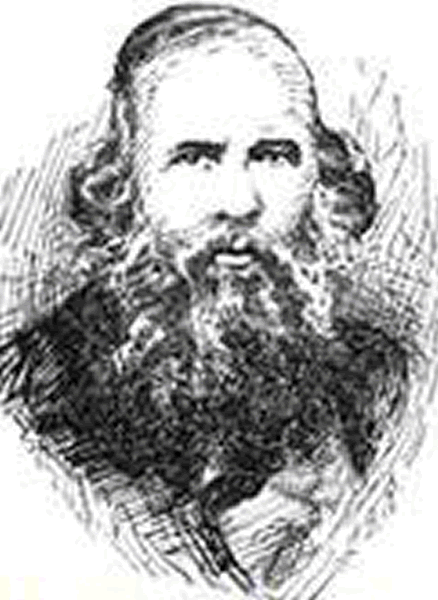
(Mathias (Mattityahu) Strashun, picture from the Jewish Encyclopedia
Message: My grandmother was from a family that was permitted to live in St.
Petersburg during the czarist time or so I have been told. One of her ancestors
was involved in some capacity with building or financing the Trans-Siberian
Railroad. She was also a Strashun of the Strashun Library in Vilna. Do you know
any resources for me to look at that might help me figure out my family's
connection to the building of the Railroad?
Thanks,
Marilyn Tebor Shaw
Marilyn Tebor Shaw (matshaw1@mac.com) on Thursday, June 12, 2008 at 18:07:32
---------------------------------------------------------------------------
Strashun family;
Samuel ben Joseph Strashun (1794–March 21, 1872) (Hebrew: ????? ??????? ??????), known also as Rashash (??"?) was a Russian Talmudist born in Zaskevich, government of Wilna. He was educated by his father, and became known as a proficient Talmudist. He married at an early age, and settled with his wife's parents in the village of Streszyn, commonly called Strashun (near Wilna), and assumed the latter name. The distillery owned by his father-in-law was wrecked by the invading French army in 1812, and the family removed to Wilna, where Samuel established another distillery and became one of the most prominent members of the community. His wife conducted the business, as was usual in Wilna, and he devoted the greater part of his time to studying the Talmud and to teaching, gratuitously, the disciples who gathered about him. The Talmud lectures which for many years he delivered daily at the synagogue on Poplaves street were well attended, and from the discussions held there resulted his annotations, which are now incorporated in every recent edition of the Babylonian Talmud (Hagahot v'Chiddushei HaRashash). His fame as a rabbinical scholar spread throughout Russia, and he conducted a correspondence with several well-known rabbis.
Strashun was offered the rabbinate of Suwalki, but he refused it, preferring to retain his independence. His piety did not prevent him from sympathizing with the progressive element in Russian Jewry, and he was one of the few Orthodox leaders who accepted in good faith the decree of the government that only graduates of the rabbinical schools of Wilna and Jitomir should be elected as rabbis. He wrote good modern Hebrew, spoke the Polish language fluently, was conspicuously kind and benevolent, and was highly esteemed even among the Christian inhabitants of Wilna. Besides the above-mentioned annotations, he wrote others to the Midrash Rabbot, which first appeared in the Wilna editions of 1843-45 and 1855. Some of his novellæ, emendations, etc., were incorporated in the works of other authorities. He died in Wilna on March 21, 1872.
Mattityahu, son of Rabbi Samuel Strashun was born in 1817 and passed away in 1886. He had a brother: Eliyahu.
Mattityahu' books and house were bequeathed to the Vilna Kehilah to become a public library.
Shmuel Strashun (( 1840- 1895) son of Eliezer, brother of Mattityahu, took over the running of the library- after he passed away his son Isaac took over and headed the library for 35 years. ( from Yahadut Lita)
Mattityahu (Mathias) Strashun (1817-1885):
Scholar, Leader and Book Collector
http://www.yivoinstitute.org/exhibits/strashun/strashunlibrary.htm
Introduction
Mattityahu Strashun's Biography
A Brief History of the Strashun Library
The Story of Hebrew Printing
Samuel and Mattityahu Strashun: Between Tradition and Innovation
By Dr. Mordechai Zalkin
Mattityahu Strashun's Biography
Excerpted and translated from Ir Vilna by Hillel Noah Maggid
Steinschneider (Vilna 1900)
Mattityahu, son of Rabbi Samuel Strashun was born on Hoshana Rabbah
Day of the year 578 (1817). Since childhood he showed evidence of
exceptional memory and great talent in the study of Talmud. His father
employed an excellent tutor, Rabbi Yeshaya David of Lebedev,for him
and his older brother Eliyahu. One day the great Gaon, Rabbi Menashe
of Ilya, a relative, visited the Strashun family. All the dignitaries
of Vilna came to meet Rabbi Menashe and hear his Torah learning. Rabbi
Menashe examined young Mattityahu about his studies in the presence of
this large crowd, and he replied correctly and accurately to every
question.
At age sixteen, he started to study science and mathematics on his
own. Soon he began to correspond with several maskilim, such as the
writer Isaac Ber Lebensohn and Samuel Joseph Fuenn, who quoted him in
their articles. Strashun, often writing under a pseudonym, also became
a regular contributor to several scholarly Hebrew periodicals that
began publication in the 1850s.
When he was 14 years old, Mattityahu married Sarah Hanah, daughter of
the wealthy Yosef Eliyahu Eliasberg (1798-1881). The couple had two
daughters, Gita and Itta, who both died at a very young age. With the
help of his father-in-law, Strashun started a business, which was
mostly managed by his wife and her brother. The Russian Census report
of 1851 lists Strashun's capital as at least 8000 rubles.
Strashun's economic success enabled him to purchase thousands of
books, which he read avidly and memorized. His house became a
destination for scholars, who flocked to hear his erudition and to
consult his books. In 1848, he was appointed head of the Burial
Society, whose records were in disarray. Strashun hired someone to
take care of the account books and record the names of the deceased. A
few years later, he became the head of the Charity Committee of the
Vilna Community, Tsedakah Gedolah, which was in charge of all
community affairs. In 1868, he was appointed member of the Vilna
branch of the State Bank, and was honored ten years later for his
exemplary service with a gold medal (17 February 1878). In addition,
he served in the Vilna City Council (Duma). Mattityahu died childless
in December 1885, and his wife died a few months after him.
In his will, Strashun left 5000 rubles to the Tsedakah Gedolah, 1500
to the Old Age Home, 1000 to the Yeshiva in the Butchers' Kloyz, and
500 rubles each to four Talmudic schools. His books and house were
bequeathed to the Vilna Kehilah to become a public library. He also
left an endowment to pay the salaries of a librarian and an assistant.
Following are a few excerpts from the introduction by his nephew and
executor, David Strashun to Likute Shoshanim, Being the catalogue of
books collected by Mathias Strashun of Vilna, published in Berlin,
1889:
[The Title] Likute Shoshanim [Selections of Roses] was chosen by my
late uncle while he was still alive...the numerical value for Likute
Shoshanim is 861; the numerical value of Mattityahu is also 861, as is
the value of Strashun. This is the reason why I called this catalogue
Likute Shoshanim, and this will be the title of all his collected
writings, which, with the help of God we will begin to publish...
[My uncle] strived throughout his life to bring honor to God and to
his people and share with them his learning and his fortune... Such
people are great not only during their lifetime, but also in their
death, when they leave their lifelong legacy and the fruit their
learning to the entire community. These are the heroes whose memory is
a blessing for ever and ever. My uncle, the genius Rabbi Mathias
Strashun was one of these great sages.
A unique man, who had the two-fold privilege of being both a great
Torah scholar and a great communal leader. He chose to leave his great
book collection, comprising of thousands of volumes, full to the brim
with delicious food for mind. In addition, blessed be he who had the
privilege to see the commentaries and annotations to 63 books that he
wrote during his lifetime. His wisdom shines like stars and his memory
and good name will be of glory and blessing forever and ever.
I promised my dear uncle that after his death I would take good care
of his books and see that they serve the entire House of Israel. When
I made my promise, I thought that this would be an easy assignment.
But soon I learned that, in addition to there being difficulties
involved in obtaining a license to open a library, my uncle had left
his library unorganized and uncataloged. It took us many months to
prepare this catalogue. Since cataloging is a skill rather than a
wisdom, the people who did this work asked me not to mention their
names... I pray that my genius uncle's memory will enable us to open
the library as soon as possible...
-------------------------
In the shulhoyf [courtyard] of the Great Synagogue of Vilna stood a
two-story building. The sign on its door read: "The Library of Rabbi
Mattityahu son of Rabbi Samuel Strashun." For forty years before the
Holocaust (1901-1941), this building served as one of the most
important cultural institutions of Jewish Vilna. The library was
established through the generosity of Rabbi Mattityahu Strashun
(1817-1885), a renowned Vilna philanthropist, communal leader,
scholar, and bibliophile. It included many rare Hebrew books and
manuscripts, which Strashun had painstakingly collected over a period
of 50 years, beginning with his bar mitzvah. By the time he died in
1885, the magnificent library had amassed 5739 books and manuscripts.
In his will, Strashun, who was childless, bequeathed his books and his
home to the Vilna Kehilah [Community] and appointed his nephew David
Strashun as the executor. David Strashun hired scholars to catalog
this collection. The catalogue was published in 1889 under the title
Likute Shoshanim [A Gathering of Roses]. In 1892, the Strashun library
was opened to the public in Mattityahu's former home. However, it soon
became clear that the building was too small for its purpose, and, in
1899, the trustees of the library decided to erect a new building
inside the synagogue courtyard. The document authorizing construction
of the new building is displayed in this exhibition.
In 1901, the library moved to its new building in the shulhoyf. The
original Strashun collection of rare books was housed in a special
room, while the main reading room served the general public. The Vilna
Community assumed responsibility for the property in perpetuity. The
Strashun Library immediately became a popular place for study and
leisure reading. The average daily number of readers was more than
200, mostly high school and seminary students, and there was always a
line of readers outside the door. In the evenings the Library served
as a Jewish cultural center.
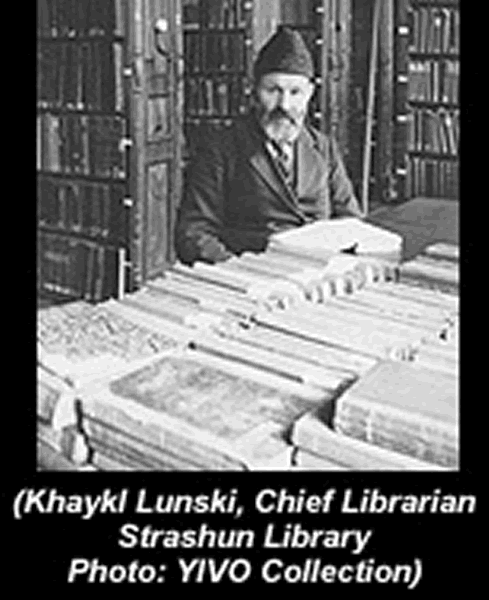
The Library directors were Samuel Strashun and, later, Isaac Strashun.
The chief librarian was Khaykl Lunski, who served in this post until
the demise of the Library under the Nazis in 1941.
The collection continued to grow, primarily through gifts and bequests, since there
was little or no budget for new acquisitions. Beginning in 1928, the
Library received from the Vilna University Library all Hebrew and
Yiddish books published in Poland. In the 1930s, the number of books
was reported to be 35,000.
The Nazis occupied Vilna on June 23, 1941 and, soon thereafter,
ordered the Jews to move into a ghetto. Both the YIVO Library and the
Strashun Library were taken over by the Einsatzstab Rosenberg, a Nazi
task force assigned to systematic looting of Jewish cultural
treasures. The Nazis forced the librarian and a few others to select
and crate hundreds of thousands of Jewish books and archives. The
wooden crates were shipped to Frankfurt-am-Main, where they were
stored in a huge warehouse, waiting to be incorporated into the future
"Library of the Extinct Race." In 1945, the American army discovered
three million Jewish books in the Offenbach warehouse, among them
25,000 books from the Strashun Library collection and 15,000 books
from the YIVO Library collection. These volumes were rescued from the
ruins of Europe and brought back to YIVO in New York in 1947.
In the 1970s, the YIVO Library hired the well-known bibliographer,
Rabbi Chaim Lieberman, to catalog the rabbinical portion of the
Strashun collection, while the secular portion remained to be done. In
early 1999 YIVO moved to its new home at the Center for Jewish
history. Later that year it received a generous grant form the
descendants of Mattityahu Strashun in the United States, that enabled
the YIVO Library staff to computerize Lieberman's catalog cards, as
well as catalog the books which were never cataloged before. We are
very pleased to offer greater access to this important historical
collection and to display some of its treasures for the first time.
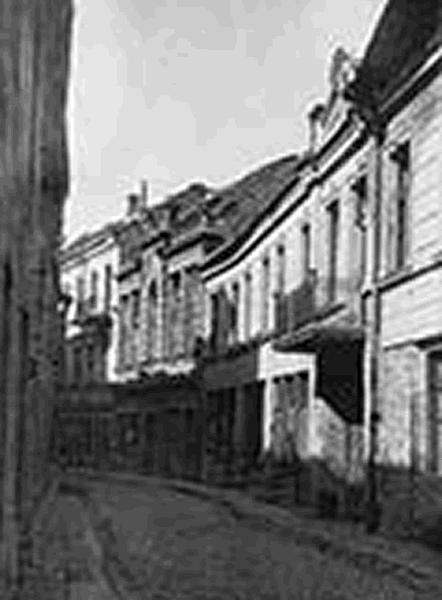
Strashun Street
Sharon Alexander (dreyfalex@aol.com) on Thursday, June 12, 2008 at 12:08:44
---------------------------------------------------------------------------
Message: Thank you for this site. All of my grandparents were born in the US
around 1900 and I cannot manage to track my family back in any direction. My
grandmother's parents came from Vilna. Their names were Moshe Rosenblum and
Ruchel Silberman (or Silberstein). My grandmother's American name was Belle
(Scheyne?) She was born in upstate NY in 1900 and had 5 younger siblings: Jack,
Lou, Dorothy, Sarah, and (?) I saw that there are listings for the Reosenblums
in Zarki. I also saw a Silverman listing in Riga with a grandmother called
Scheine. If my grandmother's family story seems to jibe with yours, please get
in touch.
Sharon Alexander
dreyfalex@aol.com
Dear Genners,
Four months ago, a French Jewish genner asked me:
"it is said that Sam Marx, father of the Marx Brothers was born in
Strasbourg, France. But nobody didn't proof it. What do you think?"
Here the result of my query, pointing out that that searching was only
possible when it admitted that the father of the Marx brothers was not
educated, as his parents were peddlers...
During all the search, a Jewish genner was also my patient listener ...
The 1885 certificate of marriage of the parents of the MARX Brothers,
Simon MARX (declared Samuel MARKS) married Miny SCHONBERG ( Minnie
SCHOENBERG) :
they were joined in marriage in the City of New York on "Sondog day of 18
Jaen. 1885", by "Rev Dr. G.Londsberg".
The witnesses were related with the bridegroom.
The husband, 24, was born in Elsas, Frank, (i.e.Alsace, France).
His parents were said MARKS Mark and Honne ( Hanna) - only a surname !
The wife was Mini SCHONBERG (Minnie SCHOENBERG), born in Prusye (i.e;
Prussia),
Her parents were Lewi Schonberg and Fanny Schonberg.
1°) Simon MARX, father of the Marx brothers:
was born on Oct. 23, 1859, in Mertzweiller (in French: Mertzwiller), Alsace.
(Mertzwiller-Pechelbronn is interesting because oil sands were mined there
from 1745 ).
He died in Los Angeles, CA, on May 11, 1933, and was interred in New Mount
Carmel, New York. "The only other interment is that of Minnie MARX, interred
September 15, 1929".(ref. Mount Carmel Cemetery Assoc./Mrs V.S. Goldfinger)
2°) the parents of Simon MARX were "hawkers", (in german:"Hausierer")
His father, Simon MARX , was born in Hochfelden (Alsace ) on 1830 and, his
mother, Adel LEVI, 24, (in 1859), both living in Hochfelden.
Adel, not Adele, was probably born in Prussia, as i didn't find her birth
and marriage records, as supposedly not registered in France...
Later, she appears as Haennchen, Johanna ISAAK, born on 1839 in Lorsch
(Hesse), Prussia.
She died on July 10, 1910, as her husband and one of their sons, Heinrich,
1866-1898, at the jewish hospital from Strasbourg.
They were buried in Strasbourg. Pictures of the tombstones.
3°)
The grandfather was also named Simon MARX , married to Babet WEIL, both 26,
on 1830, and lived in Hochfelden.
Simon, the father of the Marx brothers, had 7 siblings born in different
Alsatian villages. I established a family tree. In addition, perhaps
another son, Moritz.
As the family tree chart of Minnie was established in the States, i didn't
search it again.
In conclusion,
Simon MARX, alias Samuel MARKS 1859-1933 was the father of the Marx Brothers
Simon MARX 1830-1901 was their grandfather
Simon MARX 1804-? was their ggfather
for establishing the life of Simon MARX, alias Samuel MARKS, 1859-1933, it
is necessary to try to imagine his life in accordance with the conditions
prevailing in Europe at that time, where poorest Jews among the poorest
population were living as peddlers, beggars, ragmen, having large families.
They were illiterated, persecuted...
In those circumstances, not astonishing that Simon MARX was not well up in
his registrations ....
At the municipal buildings when registering the birth of his children, it
was written: "cannot read nor write"!
For that motive, the names and surnames were whimsical...
A last exemple:
one of their children was born Henriette in 1862 but died as Jeannette in
1870.
When reading the domiciliary record of the different moves of Simon, father
of the Marx brothers, and his family:
Adel LEVI was alias Haennchen, Johanna ISAAK, born in Prussia.
An other proof, one of their children was declared son of Simon MARX and
Anna ISAAK, not of Adele or Haennchen and that registration wasn't the first
or the last of their children!
Simon born Marx in Alsace became Samuel Marks in the States and why not ,
without identification papers, declaring that the father was MARKS MARK?
Settling in the States after 1878, before becoming theatrical manager,
Simon, Samuel was tailor, making clothes without taking measures....
"Honne," mother of Simon, as named at the 1885 wedding was certainly Adel,
then Haennchen (little Hanna), Anna.
I hope this story is as interesting to you as it was exciting to me - in
hope that my demonstration is correct. My wish would be that more people
would be interested in the restoration of the XIX Century Jewish cemetery of
Strasbourg-Koenigshoffen, devasted by WWII, bad weather, neglected.
Numerous descendants were deported, numerous heirs settled to New World.
Sad to see that a part of that Jewish heritage is abandonned.
A timely chance for having discovered again the place where the parents of
Simon, father of the Marx Brothers, were buried.
Pierre Kogan
THE MARX FAMILY
Groucho, Gummo, Minnie (nee Schönberg), Zeppo, Frenchie ( Sam's affectionate family nickname) , Chico and Harpo (originally named Adolph after his famous uncle Abraham Elieser Adolph "Al" Shean, Al Shean, born Adolph Schönberg and younger brother of the Marx Brothers' mother Minnie, was together with Edward Gallagher one of most famous male teams in Vaudeville.
Claims Conference to compile database of Holocaust memories
By Shlomo Shamir, Haaretz Correspondent
The Conference on Jewish Material Claims Against Germany is soliciting
Holocaust survivors to write memoirs and donate their personal diaries
to a new digital database, the group announced during a press
conference in New York on Tuesday.
The project was planned in part by Professor Shaul Friedlander, a
renowned Israeli historian and researcher who won a Pulitzer this year
for his book "The Years of Extermination: Nazi Germany and the Jews
1939-1945."
Friedlander said Tuesday that "the worldwide Shoah memories collection
will rescue and preserve a first hand account of the genocide that
claimed 6,000,000 Jews in World War Two. It will be vital to future
generations' understanding of the Holocaust when there are no
survivors left to tell of their experiences in concentration camps,
ghettos and hiding from Nazis."
Advertisement
Elie Wiesel is the honorary chairman of the program. He has said of it
that, "I repeat now what Dubnov said to his companions when they went
to their deaths. Write, write, write. And I am saying it to you now,
please write. This is the last chance. Thirty years from now, who will
still be here?"
Holocaust survivors from former Soviet Union awarded NIS 19 million
By Hila Raz
A Tel Aviv District Court on Sunday awarded NIS 19 million to 1,365
Holocaust survivors who had escaped to the former Soviet Union before
emigrating to Israel.
Judge Oded Modrik ruled that the Claims Conference - which negotiates
compensation and is responsible for transferring funds from Germany to
Holocaust victims - neglected to inform survivors from the former
Soviet Union that they were entitled to a one-time restitution payment
upon their arrival in Israel.
The lawsuit was filed in 2002 by the organization Children of War,
which represented 1,915 Holocaust victims who sued the Claims
Conference. The claimants argued that the committee, operating in
Israel, set additional criteria for compensation that did not appear
in the German government's original decision.
Advertisement
The committee argued that the claimants were not entitled to sue
because they did not meet the criteria and hadn't proven that they had
been persecuted. As a result, their claims expired.
Judge Modrik rejected three of the committee's claims and ruled that
550 out of the 1,915 plaintiffs' claims had expired.
Attorney Yoram Sheftel, who represented the Holocaust survivors, said
"I am satisfied with the ruling that applies to two-thirds of the
claimants." But Sheftel said he was shocked that the court accepted
that the argument that the other 550 claims had expired and is
planning to appeal to the Supreme Court on behalf of those whose
claims were denied.
The committee's attorney Uri Keidar also intends to appeal the ruling,
and has requested that the decision be delayed until the court renders
its final rulings
Gunter Kremtz (gunni-k@web.de)
Message: this sites are always interesting. I`m looking for my family
name "Kremtz". one of them married Benjamin Alpert (Meier-Kremtz) and
came from Vilnius. In 1906 she`s traveled by ship to the united states and was living in New
York.
Do you have photos from Benjamin Alpert and this wife?
greetings from Germany
Gunter Kremtz
for Alperovitz/ some who changed to Alpert family go to http://www.eilatgordinlevitan.com/kurenets/k_pages/alperovitz.html
from Lili Haber <lili@lyhaber.com>
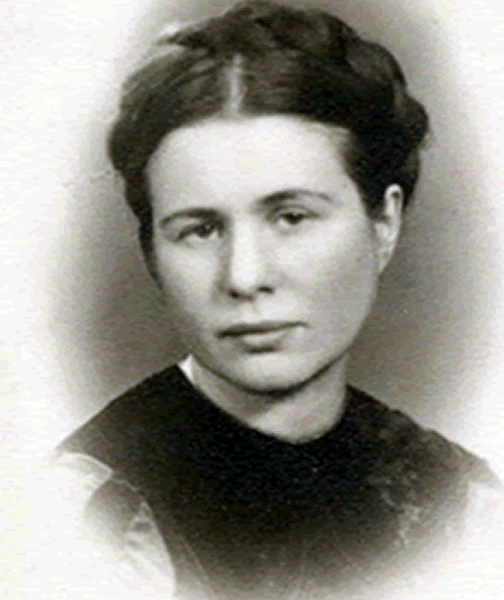
Irena Sendler, Warsaw, February 2007, aged 97
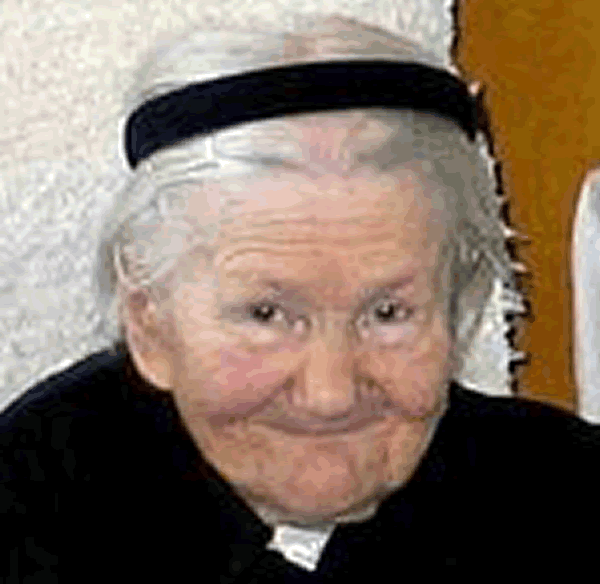
IRENA SENDLEROWA
has passed away
Today (12.05.2008) Irena Sendler died at 8:45 in a Warsaw hospital on P?ocka
The hero of the time of the Holocaust is gone.
In extreme conditions, her attitude, conduct,
and actions became an unattainable model
of humanity, courage, and people's solidarity.
She saved 2500 Jewish children from the Warsaw Ghetto.
May She rest in peace
During World War II she was an activist in the Polish Underground and the ?egota Polish anti-Holocaust resistance in Warsaw. She helped save some 2,500 Jewish children from the Warsaw Ghetto by providing them false documents and sheltering them in individual and group children's homes outside the Ghetto
During the World War II German occupation of Poland, Sendler lived in Warsaw (before that she lived in Tarczyn) while working for the city's Social Welfare Department. She started helping Jews a long time before the Warsaw Ghetto was established. Helping Jews was very risky — in German-occupied Poland, all household members were punished by death if a hidden Jew was found in their house. This was the most severe punishment compared to those applied in other occupied European countries.
In December 1942, the newly created Children's Section of the ?egota Council for Assistance to the Jews, a council to aid Jews, nominated her (under her cover name Jolanta[3]) to head its children's department. As an employee of the Social Welfare Department, she had a special permit to enter the Warsaw Ghetto, to check for signs of typhus, something the Nazis feared would spread beyond the ghetto.[4] During the visits, she wore a Star of David as a sign of solidarity with the Jewish people and so as not to call attention to herself.
She cooperated with the Children's Section of the Municipal Administration, linked with the RGO (Central Welfare Council), a Polish Relief Organization tolerated under German supervision. She organized the smuggling of Jewish children from the Ghetto, carrying them out in boxes, suitcases and trolleys.[2] The children were placed with Polish families, the Warsaw orphanage of the Sisters of the Family of Mary or Roman Catholic convents such as the Sisters Little Servants of the Immaculate Conception of the Blessed Mary[5] at Turkowice and Chotomów. Some were smuggled to priests in parish rectories where they could be further hidden. She kept lists of the names, hidden in jars, in order to keep track of their original and new identities.
Arrested in 1943 by the Gestapo, she was severely tortured and sentenced to death. The ?egota saved her by bribing the German guards on the way to her execution. She was left in woods, unconcious and with broken arms and limbs.[2] Officially, she was listed on public bulletin boards as among those executed. Even in hiding, she continued her work for the Jewish children.
Postwar awards
In 1965, she was recognized by Yad Vashem as a Righteous Among the Nations, which was confirmed in 1983 by the Israeli Supreme Court. She also was awarded the Commanders Cross by the Israeli Institute.
In 2003, Pope John Paul II sent a personal letter to Sendler, praising her altruistic wartime efforts.
On 10 October 2003, Irena Sendler received the Order of the White Eagle, Poland's highest civilian decoration. Sendler was also awarded the Jan Karski Award "For Courage and Heart", which is given by the American Center of Polish Culture in Washington.
On 14 March 2007, Sendler was honoured by Poland's Senate. Polish President Lech Kaczynski stated that she "can be justly named for the Nobel Peace Prize" (nominations are supposed to be kept secret, though). At age 97, she was unable to leave her nursing home to receive the honour, but she sent a statement through Elzbieta Ficowska, whom Sendler saved as a baby.
Sendler was the last survivor from the Children's Section of the ?egota Council for Assistance to the Jews, which she headed from January 1943 until the end of World War II.
Nobel nominee
Sendler was a nominee for the Nobel Peace Prize in 2007, but lost out to Al Gore, former Vice President of the United States.
Life in a Jar
In 1999, Norm Conard, a high school teacher from Pittsburg, Kansas, encouraged four students at the Uniontown, Kansas, school where he taught to investigate the life of Irena Sendler.
Based on their findings, the students created a play, Life in a Jar (after her hiding place for documents), which re-enacted Sendler's heroic acts. As of March 2008, there had been over 240 performances: first in Kansas, then all around the United States, in Canada, and finally in Europe.
In 2006, in Kansas, March 10 was declared Irena Sendler Day.
Marlene Mlawski (m.mlawski@rogers.com) on Saturday, May 10, 2008 at 16:50:57
---------------------------------------------------------------------------
Message: I am interested in information about Mlawski from Warsaw, ciepla 26
and Grossman from Belz
Julio Hochberg (drhamburger@gmail.com) on Monday, April 28, 2008 at 20:29:32
---------------------------------------------------------------------------
Message: I am loocking for my family in Kiev. My cousin Ienta Fitermam her
single name was Hochberg. She had a sister ,a brother in law and a niece and a
nephew living in the city of Kiev. During WWII they run from the city of
Sterdyn Poland. If you have any information about them write to me
Julio Hochberg E-mail Drhamburger@gmail.com
I have just had researchers based in Russia comb through all the
archives in to look for any Mendelson's in hope of inding more
information on my great-great-grandfather Morduhk MENDELSON who was
born in Shklov about 1852. I have had research done previously which
only focused on him and his children of which I have names of 11. With
the new research I now have the name of his father and siblings.
Hopefully through this new information I find more connections.
If I have read the researh report correctly Mosvha-Shlema born about
(1825-1826) also listed as Shlema-Movsha in the records that were
found is Morduhk's father. In later records of Morduhk's children it
lists his father as Movsha-Leiba and I am not sure of how that came
about or why. Anyways, Mosvha-Shlema was the son of Itzka Mendelson
who was born about 1806. Itzka was married twice. the first wife is
unknown, but the second wife's first name was Enta. Through that
second marriage Itzka had a son Israel.
I have been in contact with a another person who was also reserching
his Mendelson roots which stem from Israel. We already thought that we
had to have a connection somewhere down the line. Now, that I have
this information I can most definately confirm that connection. Movsha-
Shlema & Israel were brothers and any children they had would have
been first cousins.
I am excited to have all this information. I would to talk with anyone
who feels they may also have Mendelson roots from Shklov & Mogilev. I
will most gladyly share my information and hopefully find more
connections.
Sarah Greenberg(USA-CT
The following is from Vitalija Gircyte of the Kaunas Regional Archives
regarding an exhibition on Kaunas Guberniya Jews
~~~~~~~~~~~~~~~~~~~~~~~~~~~~~~~~~~~~~~~~~~~~~~~~~~~~~~~~~~~~~~~~
The Kaunas Regional Archive has opened an exhibition on Kaunas Guberniya
Jews. Mostly records - the thick old volumes are impressive. They are also
exhibiting photographs of army draftees and melameds that they have in
their holdings and also drawings of synagogues.
A few people from the Kaunas Jewish Community and Kaunas Religious Jewish
Community participated and seemed quite interested.
But the exhibition will be more interesting to Lithuanians and may serve to
dispel a few stereotypes about the Jews. Even some of my colleagues were
surprised that Jews used to be farmers and serve in the army. We used the
calligraphy of the Book of Esther in the shape of a bear by your (David Hoffman')
great-grandfather Shliomovich to decorate our exposition. Everyone
admired it.
Vitalija
Julio Hochberg (drhamburger@gmail.com) on Monday, April 28, 2008 at 20:29:32
---------------------------------------------------------------------------
Message: I am loocking for my family in Kiev. My cousin Ienta Fitermam her
single name was Hochberg. She had a sister ,a brother in law and a niece and a
nephew leaving in the city of Kiev. During WWII they run from the city of
Sterdyn Poland. If you have any information about them write to me
Julio Hochberg E-mail Drhamburger@gmail.com
Michael Perlin (mlperlin@g on Sunday, April 27, 2008 at 22:15:44
---------------------------------------------------------------------------
Message: I stumbled on this website tonight, and I am staggered. I knew
NOTHING
about almost all of these Perlins... I was in Vilnius nearly three
years ago..
had I only known then!
I saw no mention of my paternal grandfather, Max Perlin, who died in
Perth
Amboy, NJ, in about 1922. His brother was the father of Marshall Perlin
who is
discussed extensively on the first Perlin webpage (I am Michael Perlin,
listed
a few under Marshall [whose daughter, Jan, is a friend of mine]).
\Thank you for making this wonderful resource available
From: claudia libo clavedesol53@hotmail.com
is possible to you, to give me some information about family
LEIBOWICZ, from VOLKOVYSK, bielorrussia? When my grandfather came to
argentina, his last name was changed to LIBOVICH, so that is now my
last name. but I am trying to find some members of the family, in
somewhere. thank you very much and greetings, from Córoba, Argentina.
Claudia Libovich
-----------------------
from Yad Vashem;
Lwowicz Zyla
Zyla Lwowicz was born in Wolkowysk in 1914 to Arie and Beila. She was
a seamstress and single. Prior to WWII she lived in Wolkowysk, Poland.
During the war she was in Wolkowysk, Poland. Zyla perished in the
Shoah. This information is based on a Page of Testimony (displayed on
left) submitted on 15-Jan-1956 by her sister Batia BOROVIK of Givaat
Rambam, Israel
Lwowicz Bejla
Bejla Lwowicz nee Goldberg was born in Pruzana to Shlomo and Batia.
She was a housewife and widow of Arie. Prior to WWII she lived in
Wolkowysk, Poland. During the war she was in Wolkowisk, Poland. Bejla
perished in the Shoah at the age of 67. This information is based on a
Page of Testimony (displayed on left) submitted on 15-Jan-1956 by her
daughter Batia BOROVIK of Givaat Rambam, Israel
Lwowicz Mowsza
Mowsza Lwowicz was born in Wolkowysk in 1912 to Arie and Beila. He
was a clerk and married to Khaia and had a boy Arie who was born in
1939. Prior to WWII he lived in Wolkowysk, Poland. During the war he
was in Wolkowysk, Poland. Mowsza perished in the Shoah with his
family. This information is based on a Page of Testimony (displayed on
left) submitted on 15-Jan-1956 by his sister Batia BOROVIK of Givaat
Rambam, Israel
Lwowicz Hirsz
Hirsz Lwowicz was born in Wolkowysk in 1916 to Arie. He was a clerk
and single. Prior to WWII he lived in Wolkowysk, Poland. During the
war he was in Wolkowysk, Poland. Hirsz perished in the Shoah. This
information is based on a Page of Testimony (displayed on left)
submitted on 15-Jan-1956 by his sister Batia BOROVIK of Givaat Rambam,
Israel.
Shelkovitz Ester
Ester Shelkovitz nee Libovitz was born in Wolkowisk to Mordekhai Zvi
and Tzipora Feiga.. Prior to WWII she lived in Zelwa, Poland. During
the war she was in Zelwa, Poland. Ester perished in the Shoah at the
age of 50. This information is based on a Page of Testimony (displayed
on left) submitted on 10-Aug-1999 by her nephew Arie Borkovski of
Rishon Lezion ( he is the son of her sister: Rivka nee Libovitz).
Borkovski Mnashem
Mnashem Borkovski was born in Wolkowysk in 1926 to Yeshua Borkovski
and Rivka nee Leibovitz. He was a pupil and a child. During the war he
was in Wolkowysk, Poland. Mnashem perished in 1942 in Treblinka,
Poland at the age of 16. This information is based on a Page of
Testimony (displayed on left) submitted by his brother Arie Borkovski
of Rishon Lezion
Borkovski Avraham
Avraham Borkovski was born in Wolkowysk in 1922 to Yehoshua and
Ester. He was a worker. Prior to WWII he lived in Wolkowysk, Poland.
During the war he was in Wolkowysk, Poland. Avraham perished in 1942
in Treblinka, Poland at the age of 20. This information is based on a
Page of Testimony submitted by his brother Arie Borkovski of Rishon
Lezion
.
Leybovich Isak
Isak Leybovich. Prior to WWII he lived in Volkovysk, Poland. During
the war he was in Volkovysk, Poland. Isak perished in the Shoah. This
information is based on a List of Persecuted
Leibowicz Pesach
Pesach Leibowicz was born in Ruzany in 1889 to Isar and Jenta. He
was a teacher and married. Prior to WWII he lived in Zelwa, Poland.
During the war he was in Zelwa, Poland. Pesach perished in 1942 in
Zelwa, Poland. This information is based on a Page of Testimony
(displayed on left) submitted on 12-Nov-1956 by his niece ( daughter
of his brother) Leah Leibowicz of Nachlat Yizhak, Israel.
Boris Feldblyum (boris@bfcollection.net)
Home Page: http://www.bfcollection.net
Message: Eilat,
you are using broken links to my web site. The web site has long been updated.
PLease use home page address only.
Thanks,
Boris Feldblyum
Your own site is amazing
Nissan (Nathan) EVIAN/Evens (or possibly some other similar spelling,
born c 1859 and died c. 1904, married Sora (Sadie/Hassa) FARB, born c.
1864 and died c. 1918 possible in Crimea from the plague. As far as I
know they were from Panevezys, Kovno, Lithuania.
They had at least 6 children:
Samuel (Shumel ben Nissan) Evens born c. 1897 (my Zeida) married Pearl
Kramer in Krugersdorp
Yossel/Joseph Evans who married Alka Katz
Hescel/Hessel Evian/Evans who married Henna. He died in Krugersdorp
Hinda Ruchel Evens born c 1892 who married Karpel Gulin,
Yockel/Jockel/Jokkel Evans born c. 1889 who married Sarah/Sora
Morris/Maurice b. c 1891 who died during WW1. It is possible that his
wife and 2 of his children were shot dead while running away from the
front line
All, except for Hinda and possibly Maurice, emigrated to South Africa.
Hinda emigrated to USA and I have her family history. I am missing
information on her son Nissan who was at Odessa in a Yeshiva when the
rest of the family emigrated to America. He later emigrated to
Argentina
I have a full history of my Zeida's line and some information on his
sibilings. But I know nothing about his parents.
Hoping someone can help me with information or suggestions on this
family
Michelle
EVIAN/EVENS/EVANS/EWAN (Lithuania, South Africa, UK, America, Israel)
FARB (Lithuania, South Africa, UK, America, Israel)
KRAMER (Lithuania, South Africa, UK, America, Israel)
GREEN (Lithuania, South Africa, UK, America, Israel)
JACOBSON (Lithuania, South Africa, UK, America, Israel)
I am searching for the family of Luisa TORBE, of
Krakow, who submitted Pages of Testimony in the 1950s.
At the time she was living in Kiryat Ono, Israel. She
was related to the GRUN and WETSHTEIN families of
Krakow.
Please reply privately.
Sincerely
Ben Weinstock
Message: This is a great site!
I am researching LAPIDES - any additional information would be appreciated.
Louis Lapides
birth: Riga, Latvia
died: abt 1936 Manhattan, NY, USA
wife: Sarah (no birth info, also died in Manhattan, NY)
One of Louis & Sarah's children is Samuel Lapides ...
Samuel Lapides
Born: 15 Jun 1885
Place: Dolhinov, Russia
Immigrated to USA: 1902
Married: 1 April 1907 in Manhattan, NY to Molly Hebenstreit
died: 7 Sep 1957
Place: Manhattan, NY, USA
Molly Hebenstreit
Born: 1 Jan 1885
Place: Belz, Austria
Died: Dec 1978
Place: Brooklyn, Kings, NY, USA
One of Samuel & Molly's children is Maurice Lapides ...
Maurice Lapides
born: 4 Jan 1917
Place: Manhattan, NY, USA
Died: 14 Dec 1977
Place: Queens, NY, USA
Thank you in advance for any additional information.
Janis (janis_3kids@charter.net)
Laura Miner (finemine2000@Hotmail.com) on Friday, March 14, 2008 at 14:58:15
Message: I made a typo in the spelling of the family name on the description of
Fanny Scolnik Stein. I must have been tired when I wrote it. The whole point
of spelling the name Scolnik when they arrived in America was so that they/we
could find each other again. For example, the Lewiston, Maine Scolniks and I
are all cousins through my late grandmother Fanny Scolnik Stein, daughter of
Wolf Gdaly Scolnik.
Alan Barasch (olim@barasch.com) Home Page: http://www.barasch.com
Message: I am pretty sure we are related. The Kantorovich from Utena, Ukmerge,
Lithuania is probably my gr-gr-grandfather. That side of MY family immigrated
to Scotland, South Africa, and Alabama.
Kim Shuck Cowan (lkstar@roadrunner.com) March 11, 2008 at 13:54:24
---------------------------------------------------------------------------
Message: My son and I are researching our family roots. My mother Linda Wayne
Shuck is the descendant of Laizor Weinzweig. His son Behr immigrated to the US
(NY then PA) in 1899. His wife Lea (Sugarman) Weinzweig (also shown as
Wainzug) immigrated with 3 of her children from England in 1902, although they
were married and lived in Lebedows (Lebedevo) before Behr emigrated from there.
Behr ultimately came to be named Barnet Weinsweig in the United States in
Uniontown PA. He is my great grandfather. Laizor, his father, is the last
known relative. I don't know Behr's mother's name or even the proper spelling
of Laizor's name (first and last since these things change so much). Is there
any information out there on these people? I do know that Behr was born around
1975 and Leah (called Elizabeth in the US) Sugarman was born around the same
time. Thank you.
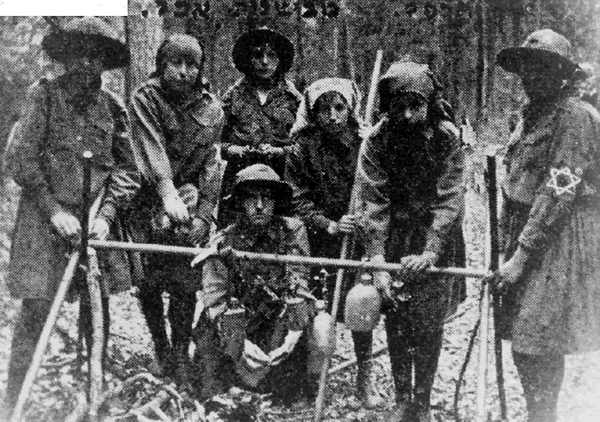
I am very happy to find your page, I am from Argentina, my name is Claudia Libovich Kunitza, and for some time i am trying to look for information about the family of my grandparents, and to know if i still have some relatives in Slonim or other parts of the world.
when saw all these photos I cried a lot, I discovered my grandmother in one of them, when she was young, in the Ha shomer ha tsair number- slnm28-, there are a few girls standing, and one sitting . I have the original photo with my boby who is sitting!!!!
i also have few more photos she gave me to keep. I loved her as my best friend, not only as a grandmother. so I am trying to keep her memories alive.
so, when you want I can send you the photos for your page, and if you have some information for me I will be very grateful.
Greetings Claudia Libovich
Your LitvakSIG Online Journal is pleased to announce the e-publication of
"The Life and Times of Ellen and Jacob Cohen: 1871-1950" by Marvin L.
Simner, Ph.D.
Ellen Slasovitch Cohen was born in 1871 in Veisiejai, Lithuania, and her
husband Jacob Cohen was born in 1871 in Vilnius. In the 1890s, they
emigrated to America, where "Between the time of his arrival in 1896 and
his death in 1940, Jacob served as chazzan, mohel, and/or schochet in at
least five synagogues."
Mr. Cohen's first American appointment was in Plymouth, PA. He also
worked in Shamokin, PA, Lynchburg, VA, Charleston, SC, and Scranton, PA.
This article delves into Jewish life in Veisiejai, Lithuania, as well as
in various places in Pennsylvania and Virginia.
To read this new article, please visit
http://www.jewishgen.org/Litvak/HTML/OnlineJournals/lifeandtimes_cohen5.htm
And to read the wealth of additional articles available to you via the
LitvakSIG Online Journal, including "What's in a Name? The Problem of
Name Changes in the Search for Family Roots," "Memorials for Lithuania
Shtetls in Cholon, Israel," "Another Surinamer Surfaces," "Box-Tax
Paperwork Records" and more, please consult the Table of Contents at
http://www.jewishgen.org/Litvak/HTML/OnlineJournals/Journal.htm
Shalom,
Judi Langer-Surnamer Caplan
Editor, LitvakSIG Online Journal
Joan Lidestri (kajajuel@frontiernet.net) on Wednesday, March 05, 2008
at
19:24:16
My mother's family was from Kossov, and my grandparents belonged to
the Kossover Society in New York.. I have been told that Kossov is in
Austria,
Poland and Russia, at various times. I had maternal DNA analysis done
last
year, and the DNA report stated that I was predominantly ashkanazi
Polish and
Russian. Does anyone have any further information regarding Kossov,
and/or the
Kossover Society? My grandmother passed away in 1964, and my
grandfather died
in the flu epidemic of 1919, so there's no one to ask any longer. My
mom
passed away 7 years ago and was not particularly interested in her
ancestry.
My grandmother was Pauline Drucker Buchner and my grandfather was Max
Buchner,
and settled in the Bronx around 1910. Thanks for listening...
Below are some of the Email List-serve groups I have created to bring people together. Perhaps one of them is relavant for people in our group. The groups all archive. One can post or send around pictures and emails are hidden. You can pass them around or post to sites.
Best,
Raanan S. Isseroff - New York City
http://groups.yahoo.com/group/EishyshokFamilyHistory/ Eisyshok Lithuania Families
http://lists.topica.com/lists/scolnikfamilycircular/ Scolnik Family History Group
http://lists.topica.com/lists/Baalshemtovfamily Baal Shem Tov Families Group
http://lists.topica.com/lists/mezibuzfamilies/ Mesibuz (Belarus) Families Group
http://groups.yahoo.com/group/YaninaFamlyHistory/ Yanina (Greece) Family History
http://lists.topica.com/lists/dauberfamilyhistorycircular Dauber Family History Group
(Chernowitz)
http://lists.topica.com/lists/kalishfamilyhistory/ Kalish / Kalushiner Family History Group
http://lists.topica.com/lists/pushinskyfamilyhistorygroup/ Pushinsky Family History Group
(Also: Pusinsky)
http://lists.topica.com/lists/reiflerfamilyemailcircular/ Reifler Family History Group
(Bukovina / Chernowitz / Romania)
http://lists.topica.com/lists/sonisonfamilyhistoryemailgroup/ Sonison Family History Group
sam (samigalbabe@hotmail.co.uk) on Tuesday, February 26, 2008 at 17:07:48
---------------------------------------------------------------------------
Message: hello
I wonder if you can help me?
My family name in England is Alperovitch. I do not know if this has been spelt
incorrectly because of maybe a language barrier?
I have been told that a David or Davis Alperovitch came from Kiev and his wife
Rachel Milchenson came from Minsk. I do not know this for sure. I think they
left Russia to come to England at the end of the 1800's. Their marriage is
recorded in England 1899.
Is this any relation to the alperovich or alperovitz please?
You have saved this record to My Ancestry (Shoebox).
You have saved this record to My Ancestry (People I'm Looking For).
This record has been added to your shoebox.
England & Wales, FreeBMD Marriage Index: 1837-1983
about Davis Alperovitch
Name: Davis Alperovitch
Year of Registration: 1899
Quarter of Registration: Oct-Nov-Dec
District: Mile End Old Town
County: London, Middlesex
Volume: 1c
Name: Rachel Miltsensohn
Year of Registration: 1899
Quarter of Registration: Oct-Nov-Dec
District: Mile End Old Town
County: London, Middlesex
Volume: 1c
Hello! I am looking for any information about the GORDIN family.
This is what is known:
Morduch (Mark) GORDIN - the head of the family
Esther GORDIN (nee SCHEPSCHELEVITCH) - his wife. Children:
1. Nikolai (b. 1888) probably in Liepaja, Latvia, killed by Nazis in 1941
in Tallinn, Estonia
2. Anna (b. 1892) probably in Liepaja, Latvia, lived in Tallinn, Estonia.
Probably killed by nazis in 1941/2
3. Leopold (b. 1893) probably in Liepaja, Latvia, lived in Estonia and in
UK
4. Dora (b. probably 1895 in Liepaja, d. 1991 in London) - the famous
sculptor
Would appreciate any additional information.
Mark Rybak, Israel
http://eja.pri.ee/
-------------------------------------------------------------------------------
Dora Gordine: self-taught sculptor, designer, collector and society figure, provides a worthy foil to Epstein. Beginning her career in Paris, where she was encouraged by Maillol, she travelled widely, concentrating from the outset on models of non-European origin. Her bronze bust, The Chinese Philosopher (1926, Dorich House), won her instant acclaim when exhibited in Paris in 1926, and was followed by The Mongolian Head (1927), now in the Tate collection. Her first solo exhibition at the Leicester Galleries in London in 1928, included heads of Indian, Chinese, Cingalese [sic], Javanese, Malay, Iranian and Greek models, and was a complete sell out. Between 1929-35 she lived and worked in the Far East, carrying out a commission from the city of Singapore in 1930 to sculpt six heads representing its constituent races. Dorich House, Kingston Vale, the home she designed in 1936 with her husband Richard Hare, an aristocratic academic, shows her awareness of European Modernsim, but her work, unlike Epstein's, remains classically-inspired.
The exhibition will explore the sculptors shared contacts and interests: both regular exhibitors at the Leicester Galleries, London, and founder-members of the Society of Portrait Sculptors, they also both attracted patronage from the prominent collector Michael Sadler.
Loans will be drawn from the Ben Uri permanent collection and both private and public sources, including the Tate. Particular support has come from the Garman Ryan Collection at the New Art Gallery, Walsall, and from Dorich House, now part of Kingston University, and home to the Gordine/Hare collection of Russian art and the Gordine archive. Many of Gordine's works have remained unseen for more than fifty years.
The exhibition will be accompanied by a fully-illustrated, colour catalogue with contributions from scholars including Dr. Jonathan Black and Brenda Martin of Kingston University.
Curators: Sarah MacDougall and Rachel Dickson
The Hon Richard Hare (1907-1966) and Dora Gordine (1895-1991)
Dora Gordine at Exhibition in 1949
Richard Hare
Dora Gordine at Exhibition Richard Hare
The newly married Hon Richard Hare and his Latvian born wife, the sculptor Dora Gordine, moved in to Dorich House when it was barely finished in November 1936. The couple designed it themselves and built it with the help of a surveyor/builder, Henry Ivor Cole. It is listed Grade II. The studios, gallery and living spaces they created were unique, providing the perfect environment for a lifestyle devoted to making and collecting art. Achieving a First at Baillol College,Oxford, Richard Hare started a career as a diplomat, but in the mid 1940s he embarked on an ambitious project to built a collection of the then unfashionable art from old Imperial Russia for public ownership. Encouraged by Dora, the collection and study of Russian art and culture became a lifelong passion as he turned to academia, lecturing for the School of Slavonic and Eastern European Studies at the University of London and writing five books and numerous articles on the subject.
Head of a Chinaman (1926)
Trained in Paris in the 1920s, Dora Gordine achieved overnight fame with a Head of a Chinaman exhibited at the Salon des Tuileries in 1926. The cultures of China and South East Asia were she worked from 1930 – 1935 were constant inspirations for Dora Gordine, influencing both the decoration of her home and her work. Her studies of the human form and portraits in bronze subsequently gained her international fame. She was made a Fellow of the Royal British Society of Sculptors in 1949 and has four heads in the Tate Gallery collection. Following Gordine's death in 1991, Dorich House has become a showcase for Dora Gordine's work and their collection of Russian Imperial Art.
Dora Gordine, was a noted Russian-British sculptress, born in St. Petersburg, Russia (she was never prepared to reveal her year of birth).
She came to Paris to study music and art. Then, surrounded by galleries and salons, she "instinctively felt a correlation between the rhythms of music and sculpture" and developed her sculptural vision.
In 1925 Gordine worked as a painter on a mural for the British Pavilion at the Decorative Arts Exhibition. It provided the means to cast a bronze for exhibition at the Beaux Arts Society. The following year she was invited to exhibit at the Salon des Tuileries where a Torso and head of a Chinese Philosopher received enthusiastic reviews; The Straits Times in 1932 wrote that: - "Like Byron, one morning Dora Gordine woke up famous".
The Leicester Galleries in London presented Gordine's sculpture in a solo show in 1928. It was a huge success and all her work was sold, amongst which Javanese Head was bought by Samuel Courtauld for the Tate Gallery collection.
She married Richard Gilbert Hare (5 September 1907 - 1966), son of Richard Granville Hare, 4th Earl of Listowel and Freda Vanden-Bempde-Johnstone on 21 November 1936. They lived at Dorich House, London. Her husband introduced her to London society figures, many of whom sat for her, Dame Edith Evans, Dame Beryl Grey, Dorothy Tutin, Sian Phillips, Emlyn Williams, Sir Kenneth Clark, John Pope-Hennessy and Professor F. Brown, Head of the Slade School of Art. Each portrait head had its own patina according to Gordine's vision of her sitter. The sculptor commented when interviewed by the BBC in 1972 (Gordine commented that "[w]hen you do portrait busts of somebody you do their noses and mouth - but it is nothing. You have to imagine what they are like inside and bring out their inner feeling and then put it in a form").
During the 40's and 50's Gordine's work was exhibited regularly at the Royal Academy, the Society of Portrait Sculptors and elsewhere. Bronzes from this time have ironic or humorous titles, relating to the pose, such as Great Expectations or Mischief and, of an RAF Officer, Above Cloud. She was elected a Fellow of the Royal Society of British Sculptors in 1949. She occasionally did exotic or "adult" pieces (e.g. for Elizabeth Choy).
In 1960 Esso commissioned a 7' x 5' bas-relief - Power - for their new Milford Haven Refinery, which was unveiled by the Duke of Edinburgh. Gordine's last public commission, the 8' long Mother and Child was made for the entrance hall of the Royal Marsden Hospital, Surrey, in 1963.
Richard Hare's sudden death in 1966 from a heart attack left Gordine to live out her life alone in Dorich House. They had had no children. She never fully recovered emotionally and her career ended in the 1970s. She died in Dorich House in December 1991.
[1] Ben Uri Gallery
Nationality and
Naturalisation
HO 144/12019 1930 Nationality and Naturalisation:
Gordin, Leopold, from Latvia.
Resident in London. Certificate
19025 issued 25 November 1930
EMBRACING THE EXOTIC: JACOB EPSTEIN & DORA GORDINE. Ben Uri Gallery, London Jewish Museum of Art, 2006. Published in association with Papadakis Publisher, London. Distributed in the U.S.A. by Antique Collectors' Club, Easthampton. 80 pp. with 83 ills. (56 col.). 30 x 22 cm. ISBN 1901092631. In English.
Artist(s): Epstein, Jacob; Gordine, Dora
Indexing: _Western_ _Europe_ _Great Britain_ _1900-1945_ _Sculpture_ _Drawing/Watercolor_ _Women Artists_
Plans: 73 75
Worldwide Number 067523
As Dora Gordine and Richard Hare died without an heir,the executors of their estate entrusted the house and its contents to Kingston University to provide a permanent home for the sculpture of Dora Gordine and the Russian art collection of Richard Hare.
From Yad Vashem all "Gordins" from "Estonia":
Gordin Yaakov
Yaakov Gordin was born in Kuldiga in 1930 to Jeschajahu and Jetty. Prior to WWII he lived in Tallin, Estonia. During the war he was in Tallin, Estonia. Yaakov perished in 1941 in Tallinn, Estonia. This information is based on a Page of Testimony (displayed on left) submitted on 12-Sep-1999 by his cousin
Gordin Yetty
Yetty Gordin nee Lemchen was born in Kuldiga to Baruch and Raina. She was a housewife and married to Jesajahu. Prior to WWII she lived in Tallin, Estonia. During the war she was in Tallin, Estonia. Yetty perished in 1941 in the Shoah at the age of 32. This information is based on a Page of Testimony (displayed on left) submitted on 13-Sep-1999 by her relative, a Shoah survivor who lives in Berlin;
Submitter's Last Name RAGOLSKY
Submitter's First Name BETTY
Gordin Sheva
Sheva Gordin nee Goldberg was born in Parnu, Estonia in 1893 to Zusman and Rokhl. She was a housewife and married to Iakov. Prior to WWII she lived in Parnu, Estonia. During the war she was in Novosibirsk, Russia (USSR). Sheva perished in 1944 in Novosibirsk, Russia (USSR) at the age of 51. This information is based on a Page of Testimony (displayed on left) submitted by her daughter Chaia GORDINA
Results of search for victims whose family name (including synonyms) is 'Gordin' , and whose location (including synonyms) is 'Latvia' :
Displaying 1 - 82
Place of Residence
Name Town District Region Country Birth Date Source
Gordin Aharon DAGDE DAUGAVPILS LATGALE LATVIA 1870 Page of Testimony
Gordin Mikhael RIGA RIGAS VIDZEME LATVIA 1918 Page of Testimony
Gordin Zeev RIGA RIGAS VIDZEME LATVIA 1894 Page of Testimony
Gordon Keila DVINSK DAUGAVPILS LATGALE LATVIA 1935 Page of Testimony
Gordin Zalman DAUGAVPILS DAUGAVPILS LATGALE LATVIA 1915 Page of Testimony
Gordin Nadja RIGA RIGAS VIDZEME LATVIA 1911 Page of Testimony
Gordin Rakhel RIGA RIGAS VIDZEME LATVIA 1895 Page of Testimony
Gordin Khana RIGA RIGAS VIDZEME LATVIA 1877 Page of Testimony
Gordin Ester DAGDA DAUGAVPILS LATGALE LATVIA 1880 List of Persecuted
Gordin Raiza DAGDA DAUGAVPILS LATGALE LATVIA 1902 List of Persecuted
Gordins Elle RIGA RIGAS VIDZEME LATVIA List of Persecuted
Gordins Rakhile RIGA RIGAS VIDZEME LATVIA 1884 List of Persecuted
Gordins Khayme RIGA RIGAS VIDZEME LATVIA 1888 List of Persecuted
Gordins Zara RIGA RIGAS VIDZEME LATVIA 1912 List of Persecuted
Gordins Yudits RIGA RIGAS VIDZEME LATVIA 1926 List of Persecuted
Shlyakhter Yudif REZEKNE REZEKNES LATGALE LATVIA Page of Testimony
Gordin Bunia RIGA RIGAS VIDZEME LATVIA 1926 Page of Testimony
Gordin Dina RIGA RIGAS VIDZEME LATVIA 1910 Page of Testimony
Gordin Zeev RIGA RIGAS VIDZEME LATVIA Page of Testimony
Gordin Sonya RIGA RIGAS VIDZEME LATVIA Page of Testimony
Gordin DVINSK DAUGAVPILS LATGALE LATVIA 1938 Page of Testimony
Janowski Roza RIGA RIGAS VIDZEME LATVIA Page of Testimony
Gordin Hirsh DVINSK DAUGAVPILS LATGALE LATVIA 1934 Page of Testimony
Gordin Zelda DVINSK DAUGAVPILS LATGALE LATVIA Page of Testimony
Gordin Yudel RIGA RIGAS VIDZEME LATVIA 1913 Page of Testimony
Gordin Yaakov RIGA RIGAS VIDZEME LATVIA 1879 Page of Testimony
Gordin Gershon DVINSK DAUGAVPILS LATGALE LATVIA 1900 Page of Testimony
Gordin Yaakov TALLIN HARJUMAA ESTONIA 1930 Page of Testimony
Gordin Yetty KULDIGA KULDIGAS KURZEME LATVIA Page of Testimony
Gordin Aron DAGDA DAUGAVPILS LATGALE LATVIA 1881 List of Persecuted
Gordin Solomon RIGA RIGAS VIDZEME LATVIA 1909 Page of Testimony
Gordin Tzera REZEKNE REZEKNES LATGALE LATVIA Page of Testimony
Gordin Wolf RIGA RIGAS VIDZEME LATVIA 1888 Page of Testimony
Gordin Bertha RIGA RIGAS VIDZEME LATVIA 1881 Page of Testimony
Gordin Ela DVINSK DAUGAVPILS LATGALE LATVIA Page of Testimony
Gordin Gershon DVINSK DAUGAVPILS LATGALE LATVIA Page of Testimony
Gordin Jacob RIGA RIGAS VIDZEME LATVIA 1879 Page of Testimony
Gordin Sara RIGA RIGAS VIDZEME LATVIA 1910 Page of Testimony
Gordin RIGA RIGAS VIDZEME LATVIA Page of Testimony
Gordin Khaia DVINSK DAUGAVPILS LATGALE LATVIA Page of Testimony
Gordin Esther DAGDE DAUGAVPILS LATGALE LATVIA 1870 Page of Testimony
Gordin Judith RIGA RIGAS VIDZEME LATVIA 1925 Page of Testimony
Gordin Matl RIGA RIGAS VIDZEME LATVIA Page of Testimony
Gordin Shmuel DVINSK DAUGAVPILS LATGALE LATVIA Page of Testimony
Gordin Chajim DVINSK DAUGAVPILS LATGALE LATVIA Page of Testimony
Gordin Tzila KRASLAVA DAUGAVPILS LATGALE LATVIA 1929 Page of Testimony
Gordin Yaakov RIGA RIGAS VIDZEME LATVIA 1871 Page of Testimony
Rich Rakhel RIGA RIGAS VIDZEME LATVIA 1912 Page of Testimony
Gordin Genadia RIGA RIGAS VIDZEME LATVIA 1910 Page of Testimony
Gordin Khaia KRASLAVA DAUGAVPILS LATGALE LATVIA 1902 Page of Testimony
Gordin Sara VARAKLANI REZEKNES LATGALE LATVIA 1902 Page of Testimony
Blekhman Sara RIGA RIGAS VIDZEME LATVIA 1878 Page of Testimony
Gordin Ela DAUGAVPILS DAUGAVPILS LATGALE LATVIA 1903 Page of Testimony
Gordin Ida DAUGAVPILS DAUGAVPILS LATGALE LATVIA 1920 Page of Testimony
Gordin Nissel RIGA RIGAS VIDZEME LATVIA 1881 Page of Testimony
Gordin Golda VILANI REZEKNES LATGALE LATVIA Page of Testimony
Gordin Monja LATVIA Page of Testimony
Gordin Penekh KRASLAVA DAUGAVPILS LATGALE LATVIA 1932 Page of Testimony
Gepshtein Slava REZEKNE REZEKNES LATGALE LATVIA 1907 Page of Testimony
Gordin Pesia VARAKLANI REZEKNES LATGALE LATVIA 1926 Page of Testimony
Gordin Sara VARAKLANI REZEKNES LATGALE LATVIA 1896 Page of Testimony
Gordin Kopel VARAKLANI REZEKNES LATGALE LATVIA 1930 Page of Testimony
Gordin Kopel VARAKLANI REZEKNES LATGALE LATVIA 1930 Page of Testimony
Gordin Moshe VARAKLANI REZEKNES LATGALE LATVIA 1901 Page of Testimony
Gordin Moshe VARAKLANI REZEKNES LATGALE LATVIA 1896 Page of Testimony
Gordin Shimen KRASLAVA DAUGAVPILS LATGALE LATVIA 1926 Page of Testimony
Gordin Hessa VARAKLANI REZEKNES LATGALE LATVIA 1928 Page of Testimony
Gordin Rakhmiel LATVIA 1918 Page of Testimony
Gordin Zevulun KRASLAVA DAUGAVPILS LATGALE LATVIA 1936 Page of Testimony
Aronowicz Henia RIGA RIGAS VIDZEME LATVIA 1870 Page of Testimony
Gordin David LENINGRAD LENINGRAD LENINGRAD RUSSIA (USSR) 1887 Page of Testimony by daughter; Submitter's Name; GORDIN DINA
Gordin Hesa VARAKLANI REZEKNES LATGALE LATVIA 1928 Page of Testimony
Gordin Motl KRASLAVA DAUGAVPILS LATGALE LATVIA 1900 Page of Testimony
Gordin Pesia VARAKLANI REZEKNES LATGALE LATVIA 1926 Page of Testimony
Gordin Tzalel REZEKNE REZEKNES LATGALE LATVIA Page of Testimony
Monica Starkman Schteingart (starkman@umich.edu)
I am writing here because my roots lie in Kossow. My mother was born there,
to Zundel Asher Rawicz and his wife Malka Weinstock. Zundel Asher's mother was
Gute Malkeh Karelitz (a relative of the Chazon Ish). Sadly, both Zundel Asher
and Malka died when my mother was 5 years old, she first of cholera, and he
the next year of pneumonia (likely related to the influenza of 1918.) The 6
children moved to Brisk (Brest-Litovsk) to live with the mother's parents. So
I know little of the Rawicz family and of Kossow.
Please include me in any emails for descendents of Kossow. And if anyone has
any information about the people I mention, I would appreciate your sending it
to me. Thanks, and I look forward to checking this website.
Sincerely, Monica
In the Ellis Island site you find;
First Name: Zundel
Last Name: Rawicz
Ethnicity: Russian, Hebrew
Last Place of Residence: Kossowa
Date of Arrival: Nov 07, 1906
Age at Arrival: 40y Gender: M Marital Status: S
Ship of Travel: Kowno
Port of Departure: Liban
Manifest Line Number:
0026
going with family of;
Dereczinsky, Zawel M 36y M Russian, Hebrew Kossowa
0021. Dereczinsky, Chache F 38y M Russian, Hebrew Kossowa
0022. Dereczinsky, Todre M 10y S Russian, Hebrew Kossowa
0023. Dereczinsky, Schlema M 2y S Russian, Hebrew Kossowa
0024. Dereczinsky, Jenta F 11y S Russian, Hebrew Kossowa
0025. Dereczinsky, Sora F 7y S Russian, Hebrew Kossowa
to their brother in law and his cousin; A. Korelitz 91 River street, Hoverhill, Mass.
last name- first- place of origin- year- age
Rawicz, Zundel Kossowa 1906 40
Rawicz, Keile Kassowo1897 19
30 Rawitz, Beile Kosewe, Russia 1912 11
31 Rawitz, Berel Kosewe, Russia 1912 6
32 Rawitz, Elke Kosewe, Russia 1912 9
33 Rawitz, Freide Kosewe, Russia 1912 35
34 Rawitz, Matche Kosewe, Russia 1912 10
Rawicz, Manuse Ruzana 1902 21
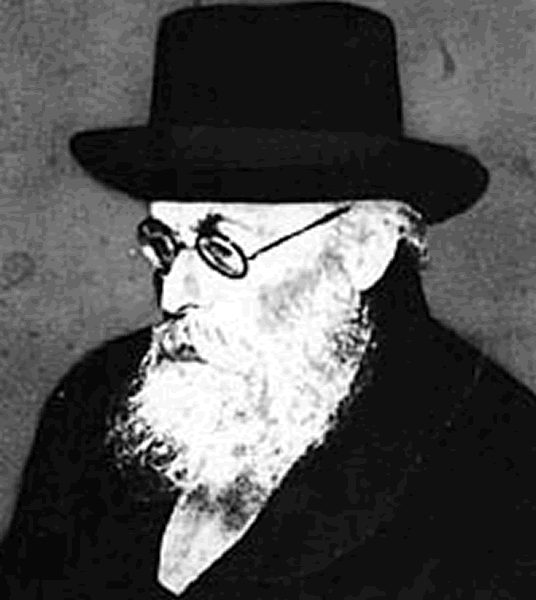
Avrohom Yeshaya Karelitz (popularly known by the name of his magnum opus Chazon Ish),was born in Kosavo in 1878.
Karelitz received his education from his father who was head of the local Beth din.He moved to Vilna in about 1920, and became close to Rabbi Chaim Ozer Grodzinski, consulting with him in all religious and communal matters. Encouraged by Grodzinski and with Rabbi Abraham Isaac Kook's help, the Chazon Ish settled in the Palestine in 1933. His house in Bnei Brak became the address for thousands who sought his guidance. Karelitz manifested unusual talent and diligence from an early age. He devoted his life to the study of the Torah and Talmud, although also learning such sciences as astronomy, anatomy, mathematics, and botany, since he felt that knowledge of these subjects was necessary for a full understanding of various aspects of Jewish law and practice. After his marriage, he continued to lead an extremely modest life, his wife providing for their needs while he spent day and night in deep Talmudic study. He did not have any children. The reputation of the Chazon Ish for saintliness and knowledge was widespread and people from all walks of life would frequent his home, for scholarly discussions or to seek advice on religious, business, or personal problems, or simply to receive his blessing
Holding no official position, the Chazon Ish nevertheless became a recognized worldwide authority on all matters relating to Jewish law and life. He was not appointed as communal leader, yet he exerted an enormous influence on the life and institutions of religious Jewry, especially in Israel. He did not publish many responsa, but became a supreme authority on halakha.
He had an immense influence on Haredi Judaism in Israel, whose formative period coincided with his leadership.
David Ben-Gurion, the prime minister of Israel, visited him once to discuss political-religious issues. The Chazon Ish argued that the secular community's needs should defer to those of the religious community. He used the Talmudic discussion (Sanhedrin 32b) of two camels which meet on a narrow mountain pass as a metaphor. A camel without goods was expected to defer to a camel laden with goods; similarly, the Chazon Ish expected secular society to defer to religious society, which bore the "goods" of tradition. [1]
(To this Ben-Gurion responded that the "secular" camel was not in fact "without goods", since secular Zionism had led to the establishment of a state and the physical protection of Israelis. The Chazon Ish replied that this was unimportant, when combined with widespread rejection of Jewish tradition. The story is often misquoted to be about two wagons not two camels; however, the Talmud mentions camels, and witnesses at the meeting have said that the Chazon Ish quoted the Talmud correctly.)
In 1911 he published his first work on Orach Chayim and other parts of the Shulchan Aruch in Vilna, anonymously under the title Chazon Ish, meaning "Vision of Man", the name by which he became almost exclusively known.
Although essentially an academic scholar, he applied himself to practical problems, devoting much effort to the strengthening of religious life and institutions. His rulings on the use of the milking machine on Shabbat and on cultivation by hydroponics during the sabbatical year are two illustrations of his practical approach. A model of modesty and kindness, the Chazon Ish wrote over 40 books in clear Hebrew, in polished and precise style, which are models of lucidity and brilliance.
In contrast to other great Achronim such as R' Chaim Soloveitchik, the Chazon Ish is known for avoiding formulaic or methodical analysis of Talmudic passages, instead preferring a more varied and intuitive approach similar to that of the Rishonim.
The true legacy of the Chazon Ish is the promotion of clarity in Talmud study, devotion in the worship of God, and loving-kindness in human interactions.
A powerfully moving portrait of Chazon Ish by his onetime disciple, the Yiddish poet and novelist Chaim Grade, is to be found in Grade's epic novel "Tsemakh Atlas: Di Yeshive" (New York & Los Angeles: Yiddish Natzyonaln Arbeiter Farband, 1967-1968); translated in English as "The Yeshiva" [Curt Leviant, tr.] (Indianapolis: Bobbs-Merrill, 1976-1977). Chazon Ish appears there as "Rav Yeshayahu Kossover."
Retrieved from "http://en.wikipedia.org/wiki/Avrohom_Yeshaya_Karelitz"
Avrohom Yeshaya Karelitz (better known as his magnum opus, Chazon Ish) was Born in Kosavo in 1878. Karelitz received his education from his father who was head of the local Beth din.
He moved to Vilna in about 1920, and became close to Rabbi Chaim Ozer Grodzinski, consulting with him in all religious and communal matters. Encouraged by Grodzinski and with Rabbi Abraham Isaac Kook's help, the Chazon Ish settled in Palestine in 1933. His house in Bnei Brak became the address for thousands who sought his guidance.
Karelitz manifested unusual talent and diligence from an early age. He devoted his life to the study of the Torah and Talmud, although also learning such sciences as astronomy, anatomy, mathematics, and botany, since he felt that knowledge of these subjects was necessary for a full understanding of various aspects of Jewish law and practice. After his marriage, he continued to lead an extremely modest life, his wife providing for their needs while he spent day and night in deep Talmudic study. He did not have any children.
The reputation of the Chazon Ish for saintliness and knowledge was widespread and people from all walks of life would frequent his home, for scholarly discussions or to seek advice on religious, business, or personal problems, or simply to receive his blessing
Holding no official position, the Chazon Ish nevertheless became a recognized worldwide authority on all matters relating to Jewish law and life. He was not appointed as communal leader, yet he exerted an enormous influence on the life and institutions of religious Jewry, especially in Israel. He did not publish many responsa, but became a supreme authority on halakha.
He had an immense influence on Haredi Judaism in Israel, whose formative period coincided with his leadership.
David Ben-Gurion, the prime minister of Israel, visited him once to discuss political-religious issues. The Chazon Ish argued that the secular community's needs should defer to those of the religious community. He used the Talmudic discussion (Sanhedrin 32b) of two camels which meet on a narrow mountain pass as a metaphor. A camel without goods was expected to defer to a camel laden with goods; similarly, the Chazon Ish expected secular society to defer to religious society, which bore the "goods" of tradition. [1]
(To this Ben-Gurion responded that the "secular" camel was not in fact "without goods", since secular Zionism had led to the establishment of a state and the physical protection of Israelis. The Chazon Ish replied that this was unimportant, when combined with widespread rejection of Jewish tradition. The story is often misquoted to be about two wagons not two camels; however, the Talmud mentions camels, and witnesses at the meeting have said that the Chazon Ish quoted the Talmud correctly.)
In 1911 he published his first work on Orach Chayim and other parts of the Shulchan Aruch in Vilna, anonymously under the title Chazon Ish, meaning "Vision of Man", the name by which he became almost exclusively known.
Although essentially an academic scholar, he applied himself to practical problems, devoting much effort to the strengthening of religious life and institutions. His rulings on the use of the milking machine on Shabbat and on cultivation by hydroponics during the sabbatical year are two illustrations of his practical approach. A model of modesty and kindness, the Chazon Ish wrote over 40 books in clear Hebrew, in polished and precise style, which are models of lucidity and brilliance.
In contrast to other great Achronim such as R' Chaim Soloveitchik, the Chazon Ish is known for avoiding formulaic or methodical analysis of Talmudic passages, instead preferring a more varied and intuitive approach similar to that of the Rishonim.
The true legacy of the Chazon Ish is the promotion of clarity in Talmud study, devotion in the worship of God, and loving-kindness in human interactions.
A powerfully moving portrait of Chazon Ish by his onetime disciple, the Yiddish poet and novelist Chaim Grade, is to be found in Grade's epic novel "Tsemakh Atlas: Di Yeshive" (New York & Los Angeles: Yiddish Natzyonaln Arbeiter Farband, 1967-1968); translated in English as "The Yeshiva" [Curt Leviant, tr.] (Indianapolis: Bobbs-Merrill, 1976-1977). Chazon Ish appears there as "Rav Yeshayahu Kossover."
Retrieved from "http://en.wikipedia.org/wiki/Avrohom_Yeshaya_Karelitz"
You have indicated an interest in receiving information about anything
that could benefit your research. This is just such a notice and is
coming from JewishGen because of the potential and interest in this
project.
A documentary film featuring a South-African / English family with
roots in Lithuania, Latvia and Belarus is being produced by
Wall-to-Wall Television for the British Broadcasting Corporation for
its series "Who Do You Think You Are?" and will be broadcast later
this Year.
We believe that most researchers would want to contribute to the
success of this documentary if they had the chance and so we are
writing to you on behalf of the producers.
Some of you may have already received an individual message from Alex
Lowe who is researching the SUCHEDOWITZ / SHOKHET family and related
families from Kretinga and elsewhere for this documentary. She would
like to hear from anyone who has additional information that could
contribute to telling this story.
The information known thus far is as follows:
Arnold JARCHY , born 4th June 1858 in Dunabourg, Russia (Dvinsk- now
Daugavpils in Latvia), son of Lippmann JARCHY and Mathilde TOUROFF ,
both parents living in Dunabourg in 1883. Arnold emigrated to Paris
at some point before this.
Amelie SOLOMON , born 15th Jan 1860 in Grodno, Russia (now Hrodna,
Belarus), daughter of Miles/Meyer SOLOMON (died 15th May 1867 in
Grodno) and Rebecca LEVINSCHTEIN, living in Grodno in 1883. Amelie
also moved to Paris at some point before this date, possibly with her
brother the Rabbi Moise SOLOMON (25th Aug 1852 in Grodno) who moved to
London in 1877 and then on to Paris in 1879.
The SUCHEDOWITZ family (originally named SHOKHET), including
first-names Isidor, Joseph, Benjamin, Hoda Feiga, Pera, Beila and
Jacob, sons born in Kretinga in the 1870s, and family living in Memel
(now Klaipeda, Lithuania) around the turn of the century. The family
were possibly from elsewhere in the surrounding area. They emigrated
in various groups to South Africa around the turn of the century.
The GELFER / HELFER family, living in Zidikai (or a village sounding
similar to "Zadik") near Klaipeda in the 1880s and 1890s.
The following individuals married into the SUCHEDOWITZ family, so
family groups with these names that occur near Kretinga and Klaipeda
are of interest too:
Abel KLUGMAN , born in Ratova in 1876.
Uriah HURWITZ
Ms. Lowe would also be interested in hearing from anyone who has
visited any of these towns in the last 10 years.
If you have any information you would like to contribute please
contact Alex at alex.lowe@walltowall.co.uk
Many thanks,
Susan
Susan E. King
Founder/President
JewishGen, Inc.
We have begun a Latvia DNA Project with Family Tree DNA (FTDNA;
http://www.familytreedna.com/).
The Latvia Project is a dual Y-DNA / mtDNA project created for
individuals descended from families that have their earliest-known
origins in what is now Latvia. The Project will allow those who have
a family geographic origin in Latvia to compare their DNA with that
of their geographic neighbours and, possibly, find family matches.
After discussion with FTDNA advisors, we decided to create a
geographic group rather than a surname-specific group mainly because
we have already documented many of the descendents of our earliest
ancestor, Elia TRUPIN, born before 1800 in or around Daugavpils. Our
surname is rare, and a Y-DNA surname project would only duplicate the
links we have already found within solid documentary evidence held by
the Latvian State Historical Archive. The Latvia Project will give
a broader latitude by permitting both Y-DNA and mtDNA matching and
will permit anyone with family origins in what is now Latvia to
participate.
We hope that LatviaSIG members will consider joining the Latvia DNA
Project.
Please get in touch with us if you have any questions.
Donna Dinberg
Ottawa, Ontario, Canada
blacknus at rogers dot com
Michael Dinberg
Scottsdale, Arizona, USA
85260md at gmail dot com
From: Shirley Lee sabl@sbcglobal.n
I am looking for information re: Leah and Chaim Yudel Matzkin, born
around 1840 possibly in Lintep or Swensiony. Thank you.
Shirley Lee
Barney Ross
From Wikipedia, the free encyclopedia
Barney Ross, born Dov-Ber Rasofsky (December 23, 1909–
January 17, 1967), was a Jewish American three-time world boxing champion and a war hero during World War II.
Dov-Ber (or Beryl) Rasofsky was born in New York City to Isidore "Itchik" Rasofsky and Sarah Epstein Rasofsky. His father was a Talmudic scholar who had emigrated to America from his native Brest-Litovsk after barely surviving a pogrom. In America, Isidore became a rabbi and store owner.
The Rasofsky family later moved from New York to Chicago, living on its west side, which at the time was a Jewish ghetto. The young Beryl Rasofsky grew up on Chicago's mean streets, ignoring his beloved father's admonition that Jews do not fight back.
"'Let the atheists be the fighters,'" Ross later recalled being told by his father. "'The trumbeniks, the murderers - we are the scholars.'" Ross' ambition in life was to become a Jewish teacher and a Talmudic scholar, but his life was changed forever when, at the age of 13, his father was shot dead resisting a robbery at his small grocery. Prostrate from grief, his mother Sarah suffered a nervous breakdown and his younger siblings -- Ida, Sam and George -- were placed in an orphanage or farmed out to other members of the extended family. Barney and his brothers Maurice and Benjamin were left to their own devices.
In the wake of the tragedy, Beryl became vindictive towards everything and turned his back on the orthodox religion of his father. He began running around with local toughs (including another wayward Jewish ghetto kid, the future Jack Ruby), developing into a street brawler, thief and money runner; for a time he was even employed by Al Capone. Image:Barney Ross.jpg
Thinking that he would need good money to try to get his family back together, the young Rasofsky became an amateur boxer. He pawned a series of awards and set the money aside for his family. Before he turned professional, his mother had returned to her senses and, as she deeply opposed boxing, he started using the name of "Barney Ross" as an alias. Strong, fast and possessed of a powerful will, Ross was soon a Golden Gloves championship and went on to dominate the lighter divisions as a pro.
Boxing career
His first paid fight was on September 1, 1929, when he beat Ramon Lugo by a decision in six rounds. After ten wins in a row, he lost for the first time, to Carlos Garcia, on a decision in ten.
Over the next 35 bouts, his record was 32–1–2, including a win over former world champion Bat Battalino, and, interestingly enough, one over a boxer named Babe Ruth, like the legendary baseball player. Another legendary bout included former world champion Cameron Welter. Then, in March 26, 1933, Ross was given his first shot at a world title, when he faced world Lightweight and Jr. Welterweight champion and fellow three divisions world champions club member Tony Canzoneri in Chicago. In only one night, Ross became a two division world champion when he beat Canzoneri by a decision in ten rounds. It should be pointed out that Ross campaigned heavily in the city of Chicago. After two more wins, including a knockout in six over Johnny Farr, Ross and Canzoneri boxed again, and Ross won again by decision, but this time in 15.
Ross was known as a smart fighter with great stamina. He retained his title by decision against Sammy Fuller to finish 1933, and against Peter Nebo to begin 1934. Then he defended against former world champion Frankie Klick, against whom he drew in ten. Then came the first of three bouts versus Jimmy McLarnin. Ross vacated the Jr. Welter title to go after McLarnin's belt and won by a 15 round decision, joining the three division world champions club. However, in a rematch a few weeks later, McLarnin beat Ross by a decision recovering the title, and after that, Ross went back down to the Jr. Weterweights and reclamed his title in a fight for the belt left vacant by himself, with a 12 round decision over Bobby Pacho. After beating Klick and Henry Woods by decision to retain that title, he went back up in weight for the last fight in his trilogy with McLarnin, and recovered the title by outpointing McLarnin again over 15 rounds. He won 16 bouts in a row after that, including three over future world Middleweight champion Ceferino Garcia, and one against Al Manfredo. His only two defenses, however, on that stretch were against Garcia and against Izzy Jannazzo beaten on points in 15.
In his last fight, Ross defended his title, on May 31, 1938, against the fellow member of the three division world champions' club Henry Armstrong who beat him by a decision in 15.
Ross retired with a record of 72 wins, 4 losses, 3 draws and 2 no-contests, with 22 wins by way of knockout.
U.S. Marine
Barney Ross
Allegiance United States of America
Service/branch United States Marine Corps
Battles/wars World War II — Battle of Guadalcanal
Awards Silver Star
In retirement in his early thirties, Ross decided to fight in World War II and joined the United States Marine Corps. However, the Marines wanted to keep him stateside, because they wanted him to teach boxing to the trainees. He waived off the licensing, however, choosing to go to training instead, and, upon graduation, he was sent to fight overseas. He was sent to Guadalcanal, where one night, he and three other comrades were trapped under enemy fire. All three of his fellow Marines were wounded, as was Ross, but he withstood the attack, shooting about 400 bullets and throwing 22 grenades at his attackers, killing 20 of the enemy. Two of the Marines with him had died in the battle, but he carried the remaining man on his shoulders to safety; the other man weighed 230 lb (104 kg) compared to Ross' 140 lb (64 kg). Because of his heroism, Ross was awarded America's third highest military honor, the Silver Star.
[ Drug addiction and recovery
During his recovery at the hospital from his wounds suffered in that battle, Ross developed a habit for the morphine administered for pain. This habit became so bad he would sometimes spend $500 a day on the drug. Ross went to a recovery center and beat his addiction. He gave lectures to high school students about the dangers of drug addiction. In 1957, Ross' life and battle with addiction were depicted in the film Monkey on My Back, directed by André De Toth and starring Cameron Mitchell as Ross.
Final days
Ross spent his last days doing a few things outside boxing. He was happy he reached the two goals he had set to reach: reunite his family and become a world champion in boxing. He wrote an autobiography titled No Man Stands Alone, and he had a role as an actor in the movie Requiem for a Heavyweight. He was also a strong advocate for the creation and survival of the State of Israel.
Ross died in his hometown Chicago when he was 57 years old. He is a member of the International Boxing Hall Of Fame
Barney Ross nee Razofsky
http://209.85.165.104/search?q=cache:S5GaguoBEykJ:goliath.ecnext.com/coms2/gi_0199-6153094/Barney-Ross-of-body-and.html+Razofsky&hl=en&ct=clnk&cd=1&gl=us
Reb Yitzchok and Sarah Razofsky immigrated from Brest-Litovsk, a city near the Russian-Polish border ( today in Belarus), to the Lower East Side of Manhattan. Reb Yitzchok studied the Bible and Talmud. Unable, despite his erudition and piety, to find steady employment as a Hebrew teacher, "Reb Itchik," as he was known, earned his livelihood by selling fruits, vegetables, and eggs from a pushcart. On December 23, 1909 Barney was born. Some two years after Barney's birth, the family--father, mother, and his older brothers--moved to the Maxwell Street ghetto of Chicago, where they took up residence on 1310 Jefferson Street. To feed his family, Reb Itchik slaved nineteen hours a day, rarely sleeping except on Friday nights and Saturday afternoons, when his store always closed for any business on Shabbat.
The Razofsky home was strictly Orthodox, as Douglas Century describes it in his carefully researched study. On Thursdays, Sarah prepared flour for baking the Sabbath challahs, or loaves, in addition to "peeling and pounding out potatoes for the cholent," a concocted delicacy of meats, beans, and barley, for the luncheon following Sabbath morning services. No less significant were the moral lessons the father, in his "black Sabbath caftan, reddish-brown beard and sideburns," would convey to Barney and his siblings at those sumptuous meals. Among them, ironically, was his frequent admonition: "A devout Jew should never raise his fists against a stranger, even in self-defense; to act that way is sinful and shameful." Furthermore, he would reiterate that, as born members of the priestly Aharonic tribe, the most physical act they could ever perform nobly was to bless the congregation during the Festival holidays.
Barney, called Beryl (the diminutive of his Yiddish name, Ber) a good student in Hebrew school, would participate in Saturday afternoon study classes in Talmud at the local synagogue, to a point where his father actually believed that he might one day become a Hebrew teacher. But, as so often happens, the proverbial "street" interfered, so that despite his father's vehement disapproval, Beryl engaged in the usual street fisticuffs, resulting in some beatings at home, which at times surpassed those of the street. Beryl learned quickly that despite such lopsided experiences, he was "fast on his feet and very agile." He adjusted well to ghetto life.
All those frivolous escapades changed on December 13, 1923, ten days short of his fourteenth birthday, when two bums entered Reb Itchik's store to rob him of his money but, instead, shot him in cold blood. Told by a friend of the noise coming from the store, Beryl ran in and saw the gun and his father's skullcap lying on the floor, the result of a botched holdup. The gunmen escaped. In the hospital he heard his father recite the Sh'ma--the sacred Hebrew prayer affirming the unity of God--for the last time, just before his soul left him.
After the traditional week of formal mourning, Uncle Sam, his mother's brother, placed Beryl and now, in addition, his three...
--
In the summer of 2007, my 41 year-old sister, Arielle Hart Cohen, and
my father, Sylvan Hart, were diagnosed with lung cancer. The
diagnosis came as a shock to all of us as neither of them had ever
smoked.
My sister has a loving husband, three young children ages ten, nine
and seven, and an extended family that loves her deeply. She has a
full life ahead of her. My father also has a loving family and
desperately wants to see his grandchildren grow up. I was determined
to do something to try to help them battle this disease but the
question was what?
I made the decision to raise money to support lung cancer research.
So that is what I will be doing this April when I run the 2008 Boston
Marathon.
The money I raise will go directly into a research foundation that has
been set up in my sister's name at M.D. Anderson Cancer Center in
Houston, TX. The goal of the foundation is to find a cure for the
types of lung cancer that my sister and father have. (Arielle was
diagnosed with adenocarcinoma and my father was diagnosed with a rare
type of lung lymphoma.)
The research will focus on identifying bio-marker targets. "Silver
bullet" chemo-therapies will then be developed against these targets
with the goal of destroying the cancer. M.D. Anderson is already
doing cutting-edge research on all types of cancers and was ranked #1
in cancer care by U.S. News & World Report in the January 24, 2008
issue. We are extremely hopeful that they will succeed in this quest.
Any contribution to this effort will be greatly appreciated. Please
click on this link to find my fund raising page and additional
information: http://www.firstgiving.com/irahart
Please feel free to forward this page on to anyone whom you think
might be interested in donating as well.
My family and I thank you.
Ira Hart
-- Deborah Horwitz Harrison Kuperman (kupedeb@yahoo.com)
Message: Does anyone have any memories of Razofsky and Gabrilowitsch families
of Russia (Ossip was married to Clara Clemens) and do you have a family tree of
Solomon Gabrilowitsch, as well as Benjamin and Morris Horwitz who came in the
1890s to Lee Avenue, Brooklyn, NY and then to Jersey City. Also, what about
Gershon Davis and Segals of Belarus? They came to Bayonne, NJ and are part of
the family of Frank, Grodberg, and Wein.
Deborah Horwitz Harrison Kuperman
---------------------------------------- Ossip Gabrilowitsch ca. 1906
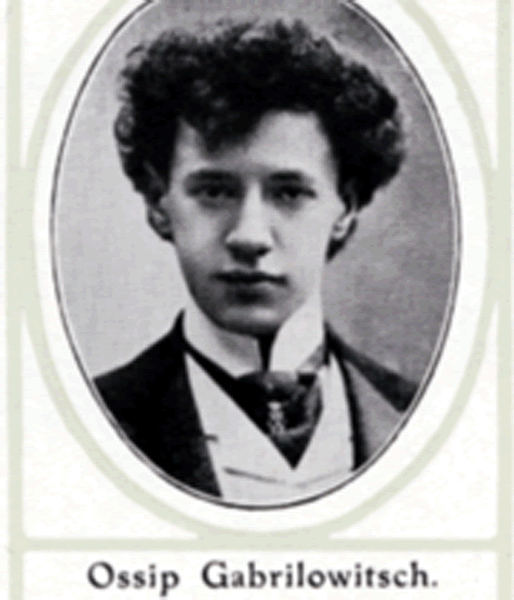
Ossip Gabrilowitsch (§°§ã§Ú§á §³a§Ý§à§Þ§à§ß§à§Ó§Ú§é §¤§Ñ§Ò§â§Ú§Ý§à§Ó§Ú§é, Osip Salomonovich Gabrilovich; he used the German transliteration Gabrilowitsch in the West) (o.s. 26 January/n.s 7 February 1878 ¨C 14 September 1936) was a Russian-born American pianist and conductor.
He was born in St Petersburg. He studied the piano and composition at the St Petersburg Conservatory, with Anton Rubinstein, Anatoly Lyadov, Alexander Glazunov and Nikolai Medtner among others. After graduating in 1894, he spent two years studying piano with Teodor Leszetycki in Vienna.
In July 1905 he recorded 10 pieces for the reproducing piano Welte-Mignon, one of the first pianists to do so.
From 1910 to 1914 he was conductor of the Munich Konzertverein. He settled in the USA, and in 1918 was appointed the founding director of the Detroit Symphony Orchestra, while maintaining his life as a concert pianist. Before accepting the conductor's position, he demanded a new auditorium be built, and this was the impetus for the building of Orchestra Hall.
In 1909, he married Mark Twain's daughter Clara Clemens, a singer who appeared with him in recital. He composed a few works, primarily short piano pieces for his own use. He died in Detroit in 1936 and, along with Clara and her father, is buried in the Langdon plot of the Woodlawn Cemetery in Elmira, New York.
The New York Times, October 7, 1909
MISS CLEMENS WEDS MR. GABRILOWITSCH
Mark Twain, in Scarlet Cap and Gown, Sees His Daughter Married to Russian Pianist.
AVOIDS "CEREMONY DELAYS"
Humorist in Prepared Interview Says a Happy Marriage is One of the Tragically Solemn Things of Life.
WEST REDDING, Conn., Oct. 6. - Miss Clara L. Clemens, daughter of Samuel L. Clemens, (Mark Twain,) was married at noon today to Ossip Gabrilowitsch, the Russian pianist. The wedding took place in the drawing room at Stormfield, Mr. Clemens's country home, with the Rev. Dr. Joseph H. Twitchell of Hartford, a close friend of Mr. Clemens, as officiating clergyman. The bride was attended only by her sister, Miss Jean Clemens, but her cousins, Jervis Langdon of Elmira, N. Y., and Mrs. Julia Loomis, wife of Edward Loomis, Vice President of the Delaware Lackawanna & Western Railroad, were present.
Miss Ethel Newcomb of New York City played a wedding march as the bridal party entered the drawing room. This room was prettily decorated with evergreens. Autumn leaves, and roses, and the bride and bridegroom stood beneath a bower of white roses and smilax.
While the ceremony was being performed Mr. Clemens was attired in he scarlet cap and gown which he wore when the Degree of Doctor of Literature was conferred upon him by Oxford University. After the wedding he wore a white flannel suit.
Forty guests from New York City were present and attended a wedding breakfast which followed the marriage.
Mr. and Mrs. Gabrilowitsch left for New York this afternoon. After remaining that city about a week they will go to Berlin, where Mr. Gabrilowitsch has taken a house. Later Mr. Gabrilowitsch will make a tour of Germany in concerts.
The New York Times, January 19, 1966
Nina Clemens Gabrilowitsch, 55, Twain's Last Direct Heir, Dies
LOS ANGELES, Jan. 18 (AP) - The county Coroner's office reported today that Miss Nina Clemens Gabrilowitsch, the last direct descendant of Mark Twain, had died Sunday. She was 55 years old.
Miss Clemens was found dead in her room at a Los Angeles motel where she often stayed. Several bottles of pills and alcohol were found in the room, the police said. An autopsy was planned.
A Los Angeles bartender said today that Miss Clemens had quipped to him on Saturday night: "When I die, I want artificial flowers, jitterbug music and a bottle of vodka at my grave."
She was the granddaughter of Twain, whose real name was Samuel Langhorne Clemens. She preferred to use the writer's family name rather than her own.
Miss Clemens, who was born four months after her grandfather died, once said that although she had never known him she knew his works "backwards and forwards."
Miss Clemens was the daughter of Twain's daughter, Mrs. Clara Langhorne Clemens Samoussoud, and Clara's first husband, Ossip Gabrilowitsch. Mr. Gabrilowitsch was conductor of the Detroit Symphony Orchestra from 1919 until his death in 1936. Miss Clemens's mother died in San Diego on Nov. 19, 1962.
A family attorney, Al Matthews, said Miss Clemens had lived on the income of Twain's estate, which he estimated at about $2-million. He said Miss Clemens had an income of $1,500 a month after taxes.
The body is to be sent for burial to Elmira, N. Y., where Twain lived for many years.
David Peltin (libby.nisenbaum@gmail.com) on Tuesday, January 29, 2008
Message: My Name is David Peltin, son of Basya Genya (Abramzon) and Zalman. I
was born in Druya in December of 1931. My father and I survived the Holocaust. I
know that 2 of my aunts immigrated to USA before World War II. Their names are
Dvoira and Sora. One of them became Cooper after marriage. My family moved to
Chicago area in December of 1993. I was very happy to see pictures of the
survivors reunion. Thank you.
David Peltin
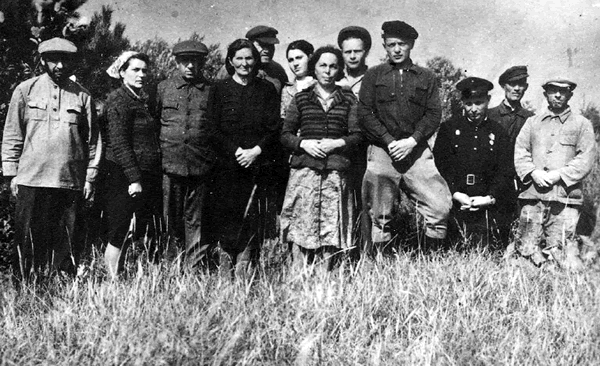
Survivors at the Druya killing field (grave) after the war Amongst
them; Chaim Peltin, Korin Leib, Kissin Arje - Lejb Rybak Jakow - Lejb
Peltin Basya
Basya Peltin was born in 1900 to Leyb. She was a housewife. Prior to WWII she lived in Druya, Poland. During the war she was in Druya, Poland. Basya perished in Druya, Poland. This information is based on a List of Persecuted
Peltin Yankel
Yankel Peltin was born in 1878 to Leyb. Prior to WWII he lived in Druya, Poland. During the war he was in Druya, Poland. Yankel perished in Druya, Poland. This information is based on a List of Persecuted
Peltin Meer
Meer Peltin was born in 1906 to Yakov. He was a worker. Prior to WWII he lived in Druya, Poland. During the war he was in Druya, Poland. Meer perished in Druya, Poland. This information is based on a List of Persecuted
Peltin Brayna
Brayna Peltin was born in 1934 to Yankel. She was a school pupil. Prior to WWII she lived in Druya, Poland. During the war she was in Druya, Poland. Brayna perished in Druya, Poland. This information is based on a List of Persecuted
Peltin Khaya
Khaya Peltin was born in 1905 to Naum. She was a housewife. Prior to WWII she lived in Druya, Poland. During the war she was in Druya, Poland. Khaya perished in Druya, Poland. This information is based on a List of Persecuted. More Details...
I am doing research on my grandfather, Jake (Yankel) Maskileison which
became "Bender" when he immigrated to the U.S. Jake was born in Ivye in the
1880s. His father was Kalman Maskileison. If anyone reading this comment is a
descendant of the Maskileison family, I would appreciate hearing from you.
Thanks to the creator of this web site for their hard work in putting it
together
--
from Yad Vashem;
Maskilejson ( Maskil Leitan) Ludwika
Ludwika Maskilejson nee Przysuskier was born in Warsaw in 1890 to Mendel and Yehudit. She was married. Prior to WWII she lived in Warsaw, Poland. During the war she was in Warsaw, Poland. Ludwika perished in 1942 in Warsaw, Ghetto. This information is based on a Page of Testimony (displayed on left) submitted on 06-Jul-1955 by her daughter
Submitter's Last Name MONDLAK
Submitter's First Name KHANA
Maskileison Leib
Leib MEIR Maskileison was born in Novozybkov. Was a svyashchennosluzhitel and married. Prior to WWII lived in Kursk, Russia (USSR). During the war was in Kursk, Russia (USSR). Leib perished in 1943 in Kursk, Russia (USSR) at the age of 70. This information is based on a Page of Testimony (displayed on left) submitted on 05-Feb-2007 by the victim's grandson ALEKSANDR KALININ
Maskileison Ahuva
Ahuva Maskileison nee Przysuskier was born in Warsaw to Menakhem. She was a housewife and married to Nison. Prior to WWII she lived in Warsaw, Poland. During the war she was in Warsaw, Poland. Ahuva perished in 1943 in Warszawa, Ghetto. Her husband survived ( went to Israel before the war- daughter survivor of the ShoahThis information is based on a Page of Testimony (displayed on left) submitted on 17-May-1999 by her family friend, a Shoah survivor
Dr. Bender Avraham
Dr. Avraham Bender was born in Iwje to Kalman. He was a lawyer and married. Prior to WWII he lived in Lido, Poland. During the war he was in Iwje, Poland.Dr. Bender perished in Iwje, Poland at the age of 55. This information is based on a Page of Testimony (displayed on left) submitted by his relative
Bender Yitzkhak
Yitzkhak Bender was born in Iwje to Kalman and Pua. He was a hairdresser and married to Ester nee Zlobinski. Prior to WWII he lived in Iwje, Poland. During the war he was in Iwje, Poland. Yitzkhak perished in the Shoah at the age of 45. This information is based on a Page of Testimony (displayed on left) submitted by his relative
Ludwika Maskilejson nee Przysuskier was born in Warsaw in 1890 to Mendel and Yehudit. She was married. Prior to WWII she lived in Warsaw, Poland. During the war she was in Warsaw, Poland. Ludwika perished in 1942 in Warsaw, Ghetto. This information is based on a Page of Testimony (displayed on left) submitted on 06-Jul-1955 by her daughter
From: Michael Shteiman mishteiman@yahoo.com
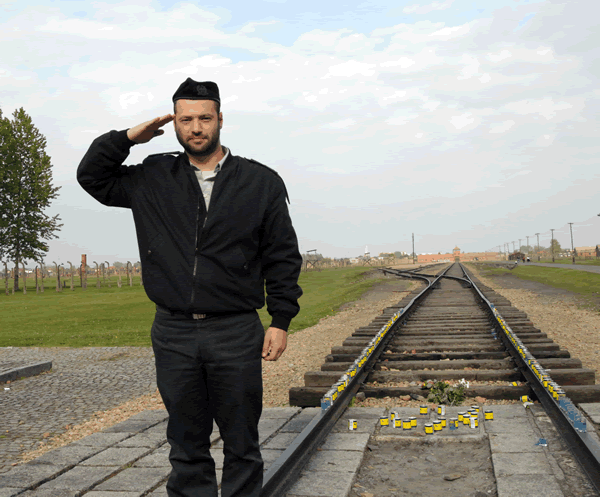
Shalom,
My name is Michael Shteiman. i am a grandson of Yosel Baksht and Badana Gordon - Dolhinov natives.
They passed away before i started the search of our family herritage.
Today i am IDF officer and after i visited Poland sights of holocaust i started to search my familys history. I took part in Heritage Tour to Dolhinov and surroundings-2007 .
Now i am looking for my granfather brother; Alter Baksht.
After Shifra Shapiro (Gordon) death he is last who may remember something.
I know only that he was living in USA in 1975-1977 (my gf visited him).
May be you may help me?
Thank you in advance.
I`ll be glad to get any information about my family.
I have stumbled upon a small, but seemingly valuable piece of
genealogical information and was hoping the readers could advise me
how to best make us of it.
It is the document listing the division of the possesions of ancestor
who died in 1785. The deceased died in France and had 3 sons. One son,
himself deceased lived in Slonim, Grodno, Belarus.
This is what is mentioned about his family:
Wolf LION, deceased before 1785, whose descent lives in Slonima (area
of Grodno, Belarus). His younger sons Hayem WOLF and Cerf WOLF, and
grand-daughter Selda (Zelda?), daughter of the elder son, the late
Ezechiel WOLF, all represented in by Isaac Moyse, envoy of the
rabbinical court of Slonima.
It seems clear that the family adpoted the name WOLF, after their father.
As well, i had always heard of decendancy from the great rabbi of
Prague, Ezechial Landau. The name popping up here is exciting.
Is there somthing i could do to follow this up? Who are all these
people and what happened to them? Their children Etc? Who is Issiac
Moyse?
Any advice or help greatly appreciated,
Thanks
Robert Rover
Baltimore, USA.
LEVY, BLOCH, WOLF (of slonim).
Name: Philip Feigelson
Home in 1930: Brooklyn, Kings, New York
Birthplace: Russia
Relation to Head of House: Head
Spouse's Name: Zelda
Race: White
Occupation:
Education:
Military service:
home value:own home $4,000
Age at first marriage:
Parents' birthplace:
Household Members:
Name Age
Philip Feigelson married at age 21 came to the country in 1906 55
Zelda Feigelson wife married at age 19 came to the country in 1911 52
Saddie Feigelson daughter 18
Murray Feigelson son 14
Mary Krialsko lodger
Torontonians help reclaim cemetery in Belarus
By ANDY LEVY-AJZENKOPF, Staff Reporter
Thursday, 17 January 2008
http://www.cjnews.com/index.php?option=com_content&task=view&id=13867&Itemid=86
A town that was once home to little more than 3,000 Jews in prewar Russia now has its shtetl's cemetery back.
Celia Siegerman Denov contemplates the new monument she helped erect at the Sharashova cemetery [Robert Bell photo]
Thanks to the efforts of Toronto couple Celia Siegerman Denov and Robert Bell, the Jewish descendants of families from Sharashova, Belarus, now have a physical reminder of what was once the town's Jewish minority.
Siegerman Denov, a retired social worker, told The CJN her father and his family immigrated to Canada from Sharashova in 1905.
The restoration of the cemetery was officially completed in September 2007 at a ceremony that was attended by Sharashovans, local politicians and dignitaries.
Siegerman Denov first became interested in restoring the cemetery after a cousin, who was working in Moscow in 1990, visited Sharashova in the early days of glasnost – when Russia opened up for renewed tourism – and discovered there were still some Jews living in the town.
At the time, she said, "the cemetery had been completely abandoned and was in very poor condition. In fact, it was so overgrown the [headstones] had fallen into the ground."
But it was still not as desecrated as other Jewish cemeteries of the region had been, she said.
Siegerman Denov visited her ancestral home for the first time in 2000, while on a trip with her cousins.
"When I first got to the cemetery area, I couldn't find it. I was actually standing on it, but cows were grazing on it," she said.
On a return visit in 2005, Siegerman Denov had the good fortune to befriend Franklin Swartz, an American Jew living in Minsk, Belarus, who also happened to be the executive director of Voluntas: The East European Jewish Heritage Project – a charity that negotiates with the Belarus government to allow Jewish cemeteries to be listed as protected historic sites.
According to Siegerman Denov, Swartz quickly became an essential guide and interpreter and helped to obtain permits for the eventual restoration.
She also acknowledged the help and guidance of Michael Lozman, head of the charitable Eastern European Jewish Cemeteries Project Inc. in Albany, N.Y. (www.restorejcem.org ), who also travelled to Sharashova with her.
The project, funded by the United Jewish Federation of Northeastern New York, collects contributions from the community to help "restore cemeteries… destroyed by the Nazis."
However, the cost of restoring the cemetery proved prohibitive until recently, when the Siegerman family was able to put nearly $20,000 together to privately finance the construction of a new metal gate and perimeter fence – about 1,500 metres long – and the erection of a cenotaph commemorating the Jews buried there and those lost to the atrocities of the Holocaust.
Its inscription reads: "In loving memory of the once vibrant Jewish community, with fervent hopes for a peaceful and just world for all. In memory of those who were deported to Auschwitz January 30 - February 2, 1943."
Though Bell and Siegerman Denov had to run all their wording and construction plans by a municipal "ideology monitor," they managed to get the work done by enlisting the help of the local townspeople.
Bell noted that Sharashova is still a small village in which many buildings are still without modern plumbing and people continue to use outhouses as the norm.
As such, the townsfolk relied on horse-drawn carriages to transport segments of the new fence to and fro and used scythes to clear the cemetery grounds of weeds.
"The local authorities advised us against using wood for the fence," Siegerman Denov said. "Because it could be taken down and used for fuel."
for the rest got to; http://www.cjnews.com/index.php?option=com_content&task=view&id=13867&Itemid=86
Fred FRENKEL (genfred@arcor.de) on Friday, January 18, 2008 at 16:58:28
---------------------------------------------------------------------------
,
on your HELBERG family page I read:
"Leibel Rakower was the son of Rabbi Eliakim Getzel Rakower/ Rakowski 1759-
1838 and Hinda bat rabbi Shimon Pesach (consul of Krakow) 1763- 1840"
According to Dan HIRSCHBERG's Krakow page Getzel RAKOWER was married to Hinda
Samsonowicz. This is based on the Krakow census 1795 information. Samson
Herszlowicz was ancestor of my family. After his death in c1810 his given name
reappeared in the RAKOWER family as well as in other Krakow families rooting
from Samson.
This is why I am rather interested where you have the information on Hinda
which looks controversial to the facts listed on Dan's pages.
Looking forward to your gentle reply
Fred FRENKEL
The archive is not machine searchable. Researchers from the Registry of
Holocaust Survivors will assist persons seeking information from this file.
Requests may be made by email, regular mail, or fax. Researchers can also
visit the Museum to access the material.
Information on the collection is available at < www.ushmm.org/its> or by
calling 866-912-4385.
Joyce Field
JewishGen VP, Data Acquisition
For any of you who are researching WALDMAN from Panevezys, I happened to
find an 1891 British Census record for:
Naxkem (Nachem?) WALDMAN, age 31, born Panevezys, his wife Sarah, age 26,
born Swansa, Glamorgan, Wales, and daughter Hilda, age 2, born Swansea,
Glamorgan, Wales, and son David, age 11 months, born Swansea, Glamorgan,
Wales. He was a picture frame maker.
I am NOT related this family and have no further information on them.
Subject: VINER families from Riga
Dear All,
I recently discovered many families of VINER "cousins" in Leeds, Yorkshire, UK, my
birthplace.
1) My maternal grandfather Joseph (Joe) Viner born 1869-died 1938 (buried in Leeds)
married to Betsy BESINSKY (BERSHANSKY)
2) John (Yona,Zalman) Viner born 1858-died 1938 (buried Leeds) married to Rachel
(Rochel,Basyah bat Aryeh) These men were probably cousins. They both had fathers
bearing the same name Binyomin: I have no proof that they were brothers as of yet.
Both men raised families in Leeds. Over the past month I have managed to contact and
"bring together" by e-mail, grandchildren and great-grandchildren from Leeds,
Liverpool, London, Middlesborough and Rhode Island, US, this is, obviously "the
researchers dream" ! The question that nobody knows, from where did the VINER
families originate? Now I hear, it could have been RIGA.
Here is a list of names of siblings who were possibly named after their ancestors:
Children of Joseph Viner: Annie (Channa): Dinah: Sam/Solomon/Shmuel: Rebecca(Rivka)
Children of John (Yona) and Rachel Viner: Fanny:Amelia:Edith(Etel): Leah/Lily :Rosa (Raisel)
Maurice (Moshe Yosef): Louis (Aryeh)
Anyone with Viner families recognising these names are invited to write to contact
me.
Brenda Habshush, Kibbutz Sde Boker,Israel
brentsi@sde-boker.org.
I am pleased to announce that the Belarus SIG has launched a significant
effort to translate and index birth, marriage, divorce, and death records of
the Minsk Guberia contained on the FHL CDs (see the lower right hand corner
of the Belarus SIG home page). The first phase of this project focuses on
the Minsk Uyezd, the area immediately around "The Mother City." Subsequent
phases of the indexing effort will focus on the remaining uyezds in the
Minsk Gubernia. This multi-year effort will result in the addition of
hundreds of thousands of new records to the existing consolidated Belarus
database. David Price, who added a million Polish records for JRI, is
responsible for the translation and indexing effort. The Belarus SIG is
extremely fortunate in having David's services; I expect that within a short
time, we will be able to make a significant number of records available to
those of you who trace your ancestry to the Minsk area. I will periodically
report to you on our progress.
At this time I also want each of you who have roots in the Minsk Gubernia to
join us in this effort by making a tax deductible donation to JewishGen's
fund for the "Minsk Gubernia Revision Lists and Metrical Records." Your
contributions, as little as $10, are absolutely vital to translating and
indexing existing records, recovering new records, and expanding
genealogical research in the Minsk Gubernia.
Please contact me if you have any questions.
Michael Kaltman
Minsk Gubernia Coordinator
mkaltman1940@msn.com
Researching KALTMAN, ARONOFF, and KRAVITZ in Belarus
From the Latvia sig;
...My grandfather, Stephan KOSSMAN, had a business -- it was a firm
that had international clientele but it was based in Riga.
Besides, my impression, from various memoirs I read, was that many
Jews had businesses in Riga.
Nina Kossman
Original message:
-----------------
> From: "Bea"
> Date: Wed, 9 Jan 2008 07:46:37 -0000
> I was told recently that the area outside of Riga called Slokas, was
the
> only part of Latvia where Jews of Riga were allowed to have/run their
own
> businesses, and that any Jews living in Riga never mind how long were
not
> allowed to run businesses there, for the period of 1920-1939.
--
From: Alan Tapper <sabaalan@comcast.net>
I am looking for any descendants of Gabriel MENDELOVICH from either
Slonim or Byten. Gabrile was born between 1850 to 1870. I am told
that some of his descendants may have survived Shoah and that they
may have emigrated either to the US or Israel. I do know that some
of them stayed in Byten and are listed in the Byten Yizkor Book.
Gabriel had four brothers, one of which is my wife's great
grandfather. His father was Schmuel Meyer MENDELOVICH
(MENDELEWICZ). His youngest brother was Naphtali who lived in
Slonim. Some of Naphtali's family, when they emigrated to Israel,
changed the name to BEN MENACHEM. This may have been true for
Gabriel as well.Any help would be greatly appreciated.Alan Tapper
Ashburn, VAResearching
MENDELOVICH, MENDELEWICZ, MENDELOWITZ , MENDELOVITZ from Slonim and
Byten; MENDOZA from Kobryn, Livorno and Seville
GORMAN from Vilna and Baranovichi
HOCHBERG and KATZ from Iasi; TAPPER from Snitkov and Kishinev
BURDMAN , STUCKELMAN and FAHRER from Tulchin
NEMIROVSKY from Lipovets and Argentina
Re: Druya Yizkor books and much information
Dear Mama Levitan!
Yes, my father and I saw all references which were in your email.
When we first joined facebook we saw the pictures ( of the Druya site) but the other references were new for us.
We found 3 striking coincidence in the Libe Levitanus' story http://www.jewishgen.org/Y izkor/Druya/dru201.html
.
The first, my father remembers Libe Levitanus a little.
The second, my father remembers the brothers Galperin. Some time they were in the same partisan detachment.
The third, Libe Levitanus says that after the war "...I married Shlomo Ziadlin, who had also survived with two of his sons. At the end of 1945, we left Druya for the land of Israel...."
Shlomo Ziadlin was a man whom we were looking for. He was my grandmother's cousin. I wrote in my message http://www.facebook.com/topic.php?uid=5582068363&topic=3302 that he and his two sons left after the war for Israel.
If I understood the situation true he was Meir Levitanus' stepfather and his sons were Meir's brothers.
Please write me if I understood this true - then Meir might know something about our relatives. In fact he is our relative too.
It's curious for me but I found many my grandfather's relatives in Yad Vashem but no one grandmother's relatives. She had many brothers and sisters and almost all of them were killed in the Shoah. Their surname was Leviman (reading about Levitan's family which had beginning from Avrohom Leviyan I thought that we could have common roots). If you meet such surname please tell me about it.
If you have some questions for my father we'll try to help you.
If our pictures are useful for you we'll be happy.
As I understood it true he is one of a few alive people who lived in Druya before and during the war.
Sorry for my English.
Thank You and best regards.
Julia
--------------------
Julia has shared a link with you. To view it or to reply to the message, follow this link:
http://www.facebook.com/n/?inbox/readmessage.php&t=8146201699
you could read the story of Libe ( mother of Meir who belongs to the group) who survived with her son http://www.jewishgen.org/Yizkor/Druya/dru201.html
___
Druya survivors of the Shoah near the place were others were perished and buried.
1946, April.
-- Added by Julia Sherman
to the group "We are from Druya" Teachers of the Jewish school, 1931
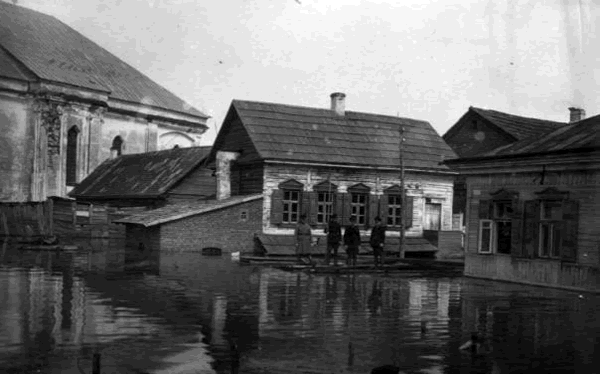
David Suurland (david@synthex.net) on Thursday, November 29, 2007 at
10:05:56
: My family originated in Globokie, their orignal surname was
VAKSMAKHER but after their flight to England they had it changed to
WARMAN. I
am looking for people who have any information regarding this family or
are
just looking to get in touch with others who can trace their ancestry
back to
this shtetl.
Yad Vashem reports;
-- Vaksmakher Leiba
Leiba Vaksmakher was born in Poland in 1863 to Ester. He was married
to Nikhama. Prior to WWII he lived in Glubokoye, Poland. During the
war he was in Glubokoye, Poland. Leiba perished in 1941 in Glubokoye,
Poland at the age of 78. This information is based on a Page of
Testimony (displayed on left) submitted by his grandaughter; ESTER
ROMANOVSKI
Vaksmakher Chaim Meer
Chaim Meer Vaksmakher was born in Glubokie to Leibe and Nikhama.
Prior to WWII he lived in Glubokie, Poland. During the war he was in
Glubokie, Poland. Meer perished in 1941 in Glubokie, Poland at the age
of 45. This information is based on a Page of Testimony (submitted on
01-Jan-1990 by his niece Submitter's Last Name ROMANOVSKI
Submitter's First Name ESTER
Vaksmakher Shmuel
Shmuel Vaksmakher was born in Glubokoye in 1893 to Leibe and
Nikhama. Prior to WWII he lived in Glubokoye, Poland. During the war
he was in Glubokoye, Poland. Shmuel perished in 1941 in Glubokoye,
Poland at the age of 48. This information is based on a Page of
Testimony (displayed on left) submitted by his niece; ESTER ROMANOVSKI
Vaksmakher Velvul
Velvul Vaksmakher was born in Glubokoye in 1897 to Leibe and
Nikhama. Prior to WWII he lived in Glubokoye, Poland. During the war
he was in Glubokoye, Poland. Velvul perished in 1941 in Glubokoye,
Poland at the age of 44. This information is based on a Page of
Testimony (displayed on left) submitted by his niece; ESTER
ROMANOVSKI
Vaksmakher Nikhama
Nikhama Vaksmakher was born to Reizl. She was married to Leibe.
Prior to WWII she lived in Glubokoye, Poland. During the war she was
in Glubokoye, Poland. Nikhama perished in 1941 in Glubokoye, Poland.
This information is based on a Page of Testimony (displayed on left)
submitted by her granddaughter ESTER ROMANOVSKI
Vaksmakher Sarah Dyna
Sarah Dyna Vaksmakher was born in 1906 to Leibe and Nikhama. She was
a seamstress. Prior to WWII she lived in Glubokoye, Poland. During the
war she was in Glubokoye, Poland. Dyne perished in 1941 in Glubokoye,
Poland at the age of 35. This information is based on a Page of
Testimony (displayed on left) submitted by her niece ESTER ROMANOVSKI
Vaksmakher Tishe
Tishe Vaksmakher was born in Glubokoye in 1909 to Leibe and Nikhama.
Prior to WWII he lived in Glubokoye, Poland. During the war he was in
Glubokoye, Poland. Tishe perished in 1941 in Glubokoye, Poland at the
age of 32. This information is based on a Page of Testimony (displayed
on left) submitted by his niece ESTER ROMANOVSKI
Waxmacher Chaya
Chaya Waxmacher was born in Glubokie in 1895 to Tzvi and Rivka Glas.
She was married to Yoel. Prior to WWII she lived in Glubokie, Poland.
During the war she was in Glebokie, Poland. Chaya perished in 1943 in
Glubokie, Poland. This information is based on a Page of Testimony
(displayed on left) submitted on 09-Dec-1956 by her sisters'
daughter;Ester Michelson
Waxmacher Walf
Walf Waxmacher was born in Glebokie in 1893. He was a grocer and
married to Khaia nee Glas. Prior to WWII he lived in Glebokie, Poland.
During the war he was in Glebokie, Poland. Walf perished in 1943 in
Glebokie, Ghetto. This information is based on a Page of Testimony
(displayed on left) submitted on 09-Dec-1956 by his niece
Vaksmakher Zakhar
Zakhar Vaksmakher was born in Disna in 1897 to Ytzkhak. He was a
dentist and married to Ida. Prior to WWII he lived in Odessa, Ukraine
(USSR). During the war he was in Odessa, Ukraine (USSR). Zakhar
perished in 1941 in Odessa, Ukraine (USSR) at the age of 44. This
information is based on a Page of Testimony (displayed on left)
submitted by his nephew
Vilnius year 1851 revision list for Glubokie;
VAKSMAKHER Meyer son of Noson Head of Household 30 3 387 Revision
List
Disna January LVIA/515/15/878
14 173
VAKSMAKHER Rocha Riva Meyer' Daughter age 3
Vaksmakher, Moris (translator)
Vaksmakher, Moris Nikolayevich (1926-1994), literary translator from
French. Had a Ph.D. in contemporary French Literature from the Moscow
Pedagogical Institute. His best known translations include
Saint-Exupery'sNight Flight , Alain Furnier'sThe Big Molne , novels by
Andre Robert, Margarite Jussenar, Robert Merly, and many others. He
introduced to the Russian reader such poets as Louis Aragon, Guilliome
Appolinaire, Paul Elluar, Egen Guelvik, Jean Brelle. Vaksmacher also
translated poetry from Belgium, Germany, Greece, Jugoslavia, Africa,
and Latin America. In 1995, a prize for the best translation from
French was named after him.
Gustavo Lumer Rakower (gustavolumer@gmail.com)
Message: My mother's family was Rakower from Poland, then they
emigrated to
Argentina and now I am in the US, how do I get in touch with them? To
see if
there is a connection
The Rakowers from Krakow;
-http://www.eilatgordinlevitan.com/kurenets/k_pages/rakower.html -
I'm searching for a RABINOWITZ family from or near Siauliai (Shavel, Shavli)
Lithuania. Father was Rabbi Boruch Mordechai RABINOWITZ, and his wife was
named Sarah (she was born ~1835). According to the 1910 Census, Sarah was
a widow and living in Washington, D.C. with her daughter Mary LEVITAN (nee
Miriam Bracha RABINOWITZ, 1864-1937) and the LEVITAN family. These
LEVITANs came to the States around 1885-1890. Also according to the 1910
Census, Boruch Mordechai RABINOWITZ and his wife Sarah had 8 children. In
the 1910 Census, Sarah was going by the name ROBBINS. I have not yet found
Sarah in the 1900 or 1920 censuses.
I am not directly related to this RABINOWITZ family, but am related to the
LEVITANs. I cannot find "my" LEVITANS before 1900, so am hoping
I can find a lead by following the wife, Mary nee RABINOWITZ.
Anyone have this family on their tree? I've looked for info online, but
can't find anything that I can definitively trace back to this particular
RABINOWITZ/ROBBINS family.
Thanks for any help,
Joe Lonstein
East Lansing, MI
Lisa Leja Mankita (lisamanakitafay@yahoo.com) on Friday, December 07,
2007
http://
Message: If anyone reading this note knows anything about a family by
the last
name of Mankita, and more specifically about Josel Mankita who was
married to
Leja or Lega (we are not sure of the spelling) Pimtova, please be kind
enough
to give me the info. This was my grandfather and grandmother. My
father's
name was Rachmiel Mankita.
My father's family, from the little bit I know, came from Czezawo (not
sure of
spelling), Poland.
My parents, my brother and I came to the US in 1962.
Many thanks. Lisa (Leja-named for my grandmother).
I spoke today with Dr. Shalom Eilati (formerly KAPLAN), who is a child
survivor from the Kovno Ghetto. Shalom wrote his memoir, Crossing the
River,
(Carmel and Yad Vashem, November 1999) and in May 2007, the English
translation of the book was approved for publication by The Alabama
University Press, slated for release in mid-2008.
Shalom is hoping to find other child survivors of his own age, born
circa
1933. He is making an attempt to document Lithuanian child survivors,
especially, but not only from Kovno, in order to add this information
to the
Yad Vashem archives. He asked me to help circulate this information on
this
list, as he is not very computer literate. I am happy to pass on any
responses generated by this message.
Varda Epstein
Efrat, Israel
--
Eilat Gordin Levitan
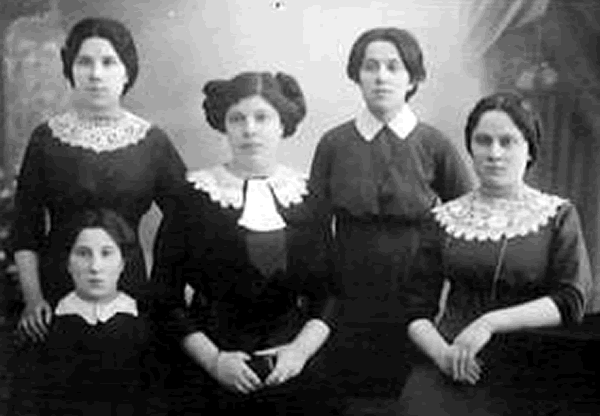
I want to compliment you on your attractive and very informative website. I am particularly interested in postcard 11, "the four Ceitel sisters and a cousin". They are my grandmother Rebecca's four younger sisters, Zelda (Zhenia), Miriam (Mania), Braine (Berta) and little Chana (Ania). When this picture was taken in 1913, my grandmother had already immigrated to the United States with her husband and youngest son, my father. She never again had contact with her sisters who remained in Poland (Russia), but after the fall of Soviet Russia, her descendents renewed contact with her sisters' descendents. I sent copies of the pictures to Vava, Miriam's son, who now lives in New Jersey, to Leah, Chana's daughter, who now lives in Israel and to Max Gutkin, the cousin's nephew,who has lived in Israel since the establishment of the State. Since none of my relatives know the source of this picture, I wonder if you could provide some information as to how this picture got on your website. Looking forward to hearing from you - Janice Kaufman (I was born in New York but made aliya in 1970 with my husband and four sons)
Gail Shneyer Nussbaum (grsn@prodigy.net) on Monday, December 17, 2007 at
13:52:06
---------------------------------------------------------------------------
Message: I found your site very interesting. My son-in-law translated the
correct spelling of my family name as Shneer and thus gave me another way to
search for relatives. When I searched this way I found your web-site which
included the names of other families I knew I was related to but could never
determine so...Gordin, Judah Leib and Katler ( my grandmother was Irene Kotler)
all appeared together on the same page with Shneer.
Salomon Tawrycky and Sara Rosansky had four
children, between 1895 and 1904 in Minsk.
The children emigrated: Jacobo was born in 1902 en
Minsk, arrives at Chile in 1923 from Argentina, his
wife Chassya Mayzel, born Wilna, arrives at Chile in
1927.
Daniel was born in 1898 emigrated to Chile in 1938,
with his wife Jaie Yudelevich Trichimisky born in
Gorodische in 1892.
Other two children Moshe was born 1904 y Harry
emigrated to the United States.
I need to ratify the genealogy information of
Salomon Tawrycky family and of his children, he lived
in the zone of Lyakhovichi, Baranovichi,
Gorodysche and of I novate Mysh. I do not speak
English, only Spanish.
I hope to have luck and to find more antecedents.
Marietta Jimenez
Chile
mariettajimenez@yahoo.com
mariettajimenezbrumelle@gmail.com
MODERATOR'S NOTE: Please reply privately
--
To post to the Belarus SIG discussion group, send your message to:
< belarus@lyris.jewishgen.org>
Remember to send your message in PLAIN TEXT and sign
with your full name and location
Belarus SIG Webpage: <http://www.jewishgen.org/Belarus >
Online Newsletter: <http://www.jewishgen.org/Belarus/newsletter/bnl_index.htm>
Join the Research Trip to Belarus < http://www.jewishgen.org/shtetlschleppers/>
***************************************************
This SIG ( belarus@lyris.jewishgen.org) is hosted by
JewishGen: The Home of Jewish Genealogy
Visit our home page at http://www.jewishgen.org
Sign up now for value-added services!
http://www.jewishgen.org/JewishGen/ValueAdded.asp
***************************************************
Thinking of visiting your ancestral shtetls?
Let JewishGen ShtetlSchleppers® take you there!
http://www.jewishgen.org/shtetlschleppers/
***************************************************
You are currently subscribed to belarus as: [eilat.gordinlevitan@gmail.com]
To change the format of our mailings, to stop/resume delivery (vacation),
or to unsubscribe, please go to http://lyris.jewishgen.org/ListManager
LAJA RIFKA THOMAS writes:
>
> (mikolayla@hotmail.com)
---------------------------------------------------------------------------
> How could anybody find out if there is family left in Polen that may
belong to me? My cousin found somebody from her family side. I am still
hoping that maybe there is somebosy that survived in Czenstochau or
Rakow that maybe my flesh and blood. MOSHE GOLDMAN and RIFKA from Rakow,
and ABRAHAM and LAJA LEWKOWICZ from Czenstochau. I have submitted many
letters to the jewish gen finder but nothing was ever found. thank you
> Laja R Thomas
> Germany
According to history.com the late Jack Benny (d. in 1974) was a
litvak. His
name was Benjamin Kubelsky. Does anyone know more about his roots?
From Jack Benny' Passport Applications, ..the name was Ben Kubelsky
[Jack Benny]
Birth Date:14 Feb 1894
Birth Place:Chicago, Illinois
Residence:Hotel Hargrave, New York
Passport Issue Date:12 Jul 1923
Father Name:Meyer Kubelsky
Father's Birth Location:Russia
Father's Residence:Lake Forest, Illinois
Passport Includes a Photo
From other information;
Father: Mayer Kubelsky born abt 1864 Lithuania Home in 1930: Lake
Forest, Lake, Illinois ( 1930 census)
Mother: Emma Sachs, died before 1930
sister; Florence Fenchel born 1901 her husband; Leonard L Fenchel
born abt 1893
Wife: Mary Livingstone (Stage name , related to the Marx brothers,
married 24-Feb-1927 )
Daughter: Joan Naomi (adopted)
There was another Kubelsky family in Chicago that is most likely
related. Most Kubelsky family members came from Lithuania.
Name Residence Age Born* Arrived
1 Kubelskas, Petras Czarna Krinetza, Russia 21 1891 1912
2 Kubelskay, Anna Kawarws 23 1883 1906
3 Kubelskay, Michalina Kawarws 3 1903 1906
4 Kubelskay, Wincenty Kawarws 1 1905 1906
5 Kubelski, Benjamin Meroslav, Lithuania 18 1903 1921
6 Kubelski, Dine Lodzieje, Russia 18 1890 1908
7 Kubelski, Dweira Meroslav, Lithuania 48 1873 1921
8 Kubelski, Freide Balbirischki, Russia 17 1896 1913
9 Kubelski, Jonas Kranica, Russia 32 1880 1912
10 Kubelski, Owsey Lodzieje, Russia 17 1891 1908
11 Kubelski, Piotr Nowawies 31 1874 1905
12 Kubelski, Sara Meroslav, Lithuania 17 1904 1921
13 Kubelski, Stanislaw Wezdrzymby, Russia 19 1888 1907
14 Kubelski, Tony 26 1895 1921
15 Kubelski, Tony 24 1896 1920
16 Kubelski, Tony 28 1896 1924
17 Kubelski, Tony 28 1896 1924
18 Kubelski, Vinc. 20 1872 1892
19 Kubelski, Wladyslaw Bakalaszewo, Russia 18 1892 1910
20 Kubelskis, Adolpas Talnisge, Russia 19 1888 1907
21 Kubelskis, Yurgis Blantyre, Scotland 21 1890 1911
22 Kubelsky, Josef Czerona Kranica, Russia 22 1890 1912
23 Kubelsky, Mathias Kawarws 19 1887 1906
24 Kubelsky, Miholy Suwalk 31 1870 1901
25 Kubelsky, Tong 28 1895 1923
26 Kubelsky, Tony 24 1897 1921
27 Kubelsky, Tony 24 1897 1921
28 Kubelsky, Tony 29 1895 1924
29 Kubelsky, Tony 28 1896 1924
30 Kubelsky, Wincenty Palnica 28 1876 1904
Yad Vashem list;
Results of search for victims whose family name (including synonyms)
is 'Kubelsky ' , and whose location (including synonyms) is
'Lithuania' :
Displaying 1 - 15 of 87
Place of Residence
Name Town District Region Country Birth Date Source
Kovalski Gershon ALYTUS ALYTUS LITHUANIA 1924 Page of Testimony
Kovalski Israel LAZDEI SEINIAI - LAZDIJAI LITHUANIA Page of
Testimony
Saalkind Khana KOENIGSBERG GERMANY 1904 Page of Testimony
Kabalski Avraham VISHAY SEINIAI - LAZDIJAI LITHUANIA 1924 Page
of Testimony
Kovalski Ester ALYTUS ALYTUS LITHUANIA 1920 Page of Testimony
Kovalski Arie ALITTUS ALYTUS LITHUANIA 1917 Page of Testimony
Kovalski Khaim ALYTUS ALYTUS LITHUANIA 1926 Page of Testimony
Kovalski Yaakov ALYTUS ALYTUS LITHUANIA 1926 Page of Testimony
Kowalsky Khana MARKINE ALYTUS LITHUANIA 1911 Page of Testimony
Kovalski Khaia ALYTUS ALYTUS LITHUANIA 1930 Page of Testimony
Kowalski David PRENI KAUNAS LITHUANIA 1885 Page of Testimony
Kowalsky David MERKINE ALYTUS LITHUANIA 1911 Page of Testimony
Kabalski Zalman VISHAY SEINIAI - LAZDIJAI LITHUANIA 1890 Page
of Testimony
Kowalska Liba MARIAMPOL MARIJAMPOLE LITHUANIA 1890 Page of
Testimony
Kowalski KOVNO KAUNAS LITHUANIA Page of Testimony
Place of Residence
Name Town District Region Country Birth Date Source
Kovalski Dov UTENA UTENA LITHUANIA 1907 Page of Testimony
Kowalski Dow SEJNI SUWALKI BIALYSTOK POLAND 1918 Page of
Testimony
Kowalski Pesach MARIAMPOLE MARIJAMPOLE LITHUANIA 1890 Page of
Testimony
Kovalski Golda UTENA UTENA LITHUANIA 1883 Page of Testimony
Kovalski Dvora UTENA UTENA LITHUANIA Page of Testimony
Kovalski Ahuva KUPISHKI PANEVEZYS LITHUANIA 1890 Page of
Testimony
Kovalski Moshe KUPISHOK PANEVEZYS LITHUANIA 1890 Page of
Testimony
Kovalski Khaim KUPISHKIS PANEVEZYS LITHUANIA 1919 Page of
Testimony
Ester ALITTUS ALYTUS LITHUANIA 1916 Page of Testimony
Kovalski Avraham ALITTUS ALYTUS LITHUANIA 1889 Page of Testimony
Kobelski Bilha STOKLISHKI ALYTUS LITHUANIA 1891 Page of
Testimony
Kovalski Etel MARIAMPOL MARIJAMPOLE LITHUANIA 1918 Page of
Testimony
Kowalski Rachel MARIAMPOL MARIJAMPOLE LITHUANIA 1919 Page of
Testimony
Sheine KOVNO KAUNAS LITHUANIA 1908 Page of Testimony
Kovalski Schraga KOWNO KAUNAS LITHUANIA 1924 Page of Testimony
Place of Residence
Name Town District Region Country Birth Date Source
Kovalski Yaakov KAUNAS KAUNAS LITHUANIA Page of Testimony
Gafanovitz Feiga RAKISHIK ROKISKIS LITHUANIA 1904 Page of
Testimony
Kowalski Mordekhai BUTRIMONYS ALYTUS LITHUANIA 1910 Page of
Testimony
Kowalsky Nachum LITHUANIA Page of Testimony
Kubelski LAZDEI SEINIAI - LAZDIJAI LITHUANIA Page of Testimony
Kovalski Avraham KAUNAS KAUNAS LITHUANIA Page of Testimony
Berenshtein Pesl KOVARSK UKMERGE LITHUANIA Page of Testimony
Katzovitz Ester ALITUS ALYTUS LITHUANIA 1910 Page of Testimony
Kowalski Roza SEJNI SUWALKI BIALYSTOK POLAND 1915 Page of
Testimony
Kovalski KOVNO KAUNAS LITHUANIA Page of Testimony
Kovalski Batseva VIZUN KAZANKA NIKOLAYEV UKRAINE (USSR) 1895
Page of Testimony
Kovalsky Roza ANYKSCIAI UTENA LITHUANIA Page of Testimony
Kowalski Fradl VISHAY SEINIAI - LAZDIJAI LITHUANIA Page of
Testimony
Kowalski Moshe SEJNI SUWALKI BIALYSTOK POLAND Page of Testimony
Kovalski Aizik STAKLISKES ALYTUS LITHUANIA 1914 Page of
Testimony
Kowalski Khaia PRENAI KAUNAS LITHUANIA Page of Testimony
Kowalski Yaakov BUTRIMONYS ALYTUS LITHUANIA 1917 Page of
Testimony
Kovalskis Arie LITHUANIA 1901 Page of Testimony
Kovalsky Ichak VIZHUN UTENA LITHUANIA Page of Testimony
Kowalski Faigie KOWNO KAUNAS LITHUANIA 1865 Page of Testimony
Kowalski Isaac KOWNO KAUNAS LITHUANIA 1900 Page of Testimony
Kovalsky Rakhel KOWNO KAUNAS LITHUANIA 1903 Page of Testimony
Kowalsky Apke POMPIAN BIRZAI LITHUANIA 1917 Page of Testimony
Kovalski Ester SEJNI SUWALKI BIALYSTOK POLAND Page of Testimony
Kovalsky Sheina KOWNO KAUNAS LITHUANIA Page of Testimony
Kovalskys Arie KUPISKIS PANEVEZYS LITHUANIA 1910 Page of
Testimony
Kowalska Sara PUNIA ALYTUS LITHUANIA 1887 Page of Testimony
Kowalski Arie PRENI KAUNAS LITHUANIA Page of Testimony
Kovalskaite Pese PRIENAI KAUNAS LITHUANIA 1905 Page of Testimony
Kovalski Arie BUTRIMONYS ALYTUS LITHUANIA 1900 Page of Testimony
Kowalski Paltiel BUTRIMONYS ALYTUS LITHUANIA 1890 Page of
Testimony
Kovalski Chlone VYZUONOS UTENA LITHUANIA 1889 Page of Testimony
Kovalskis Ester ANYKSCIAI UTENA LITHUANIA 1918 Page of Testimony
Kubelski LAZDEI SEINIAI - LAZDIJAI LITHUANIA Page of Testimony
Kowalski Ester BUTRIMONYS ALYTUS LITHUANIA 1916 Page of
Testimony
Kovalski Sara LITHUANIA Page of Testimony
Kovalski Khaia KURTUVENAI SIAULIAI LITHUANIA 1909 Page of
Testimony
Kovalski Yekutiel UTENA UTENA LITHUANIA Page of Testimony
Kovalsky Mendel POMPIAN BIRZAI LITHUANIA Page of Testimony
Kovalskis Rachmiel PREN KAUNAS LITHUANIA 1904 Page of Testimony
Kovalskys Esel LITHUANIA Page of Testimony
Kovalski Shalom KAUNAS KAUNAS LITHUANIA 1925 Page of Testimony
Kowalsky Yaakov KOWNO KAUNAS LITHUANIA 1860 Page of Testimony
Kovalis Faive KOWNO KAUNAS LITHUANIA Page of Testimony
Kovalskis Zalman ANIKSCAI UTENA LITHUANIA 1878 Page of Testimony
Katz Rivka UTENA UTENA LITHUANIA Page of Testimony
Kowalski Yaakov ALITUS ALYTUS LITHUANIA Page of Testimony
Kovalski Ahuva KOVNA KAUNAS LITHUANIA Page of Testimony
Kowalsky David ALITUS ALYTUS LITHUANIA Page of Testimony
Kowalsky Gershon ALITUS ALYTUS LITHUANIA Page of Testimony
Kowalsky Leib ALITUS ALYTUS LITHUANIA Page of Testimony
Kovalski KOVNO KAUNAS LITHUANIA Page of Testimony
Kowalsky Bela STOKLISHOK ALYTUS LITHUANIA Page of Testimony
Kowalsky Shlomo ALITUS ALYTUS LITHUANIA Page of Testimony
Pelz Ita SHUBITZ ILUKSTES ZEMGALE LATVIA 1907 Page of Testimony
Kovalski Shlomo KAUNAS KAUNAS LITHUANIA 1925 Page of Testimony
Kowalsky Khaia ALITUS ALYTUS LITHUANIA Page of Testimony
http://www.obd-memorial.ru/
.... an invaluable source of data on Russian (USSR) soldiers died or
disappeared during WW II compiled by Russian Defense Department.
Search is VERY slow now, their server is overloaded since they just
recently
announced that database on TV.
I already checked it and found what I have been looking for.
Search by name works well. Also they show original documents as well.
Search in Russian but transliteration of names is not so
difficult......
Vladimir Salita
Bowie, MD
For Russian translation you could use http://www.rustran.com/
My grandfather Harry Benjamin ROSE (ROSINSKY)was born (I think) in
Minsk,
Belarus 2/15/1870. He came to the US about 1877 settling in Rochester,
NY
with his mother, father, & siblings. His father was Simon ROSE, a
tanner,
mother Fannie ROSE, sister Rose & brother David. Recently I found the
last
name to have been ROSINSKY. Harry belonged to the Genesee Falls Lodge
#507
in Rochester, NY. He married Alma LAZARUS 12/26/1906 in Louisville, KY,
moved to Brooklyn, NY & had 2 children, Dorothy & Seymour. Alma died
3/29/1920. Harry remarried Esther E LAVINE from Rochester, NY & lived
in
Brooklyn, NY, they had 1 daughter Florence. In the 1930's Harry &
David had
a men's furnishing store in NYC. I would like to know if David ROSE
married
& had any family. Harry & Alma are buried in Mt. Carmel Cemetery in
Queens,
NY. My mother was Dorothy ROSE MEYER.
Carol M Jaffe
Delete Reply Forward
Dear Eilat
I am trying to get some information relating to the origins of the Wittert Family. Best I can establish is that the Family came from Pasvalys (Posvol) and for the most part left in the late 1800's. The original name appears to have been Vitert and the earliest patriarch was Reb Zundel, I think Children we Lemach and Sheinah although there may have been others. It seems Lemach was my great great Grand Father and had Herschel (Harris) who was my great grandfather. He emigrated to South Africa late in the 1800's.
What confuses me a bit is that there is an Israel Wittert listed as arriving at Ellis Island in about 1907 or so, but he is listed as coming from Zignny – no such place can be found.
I hope that you can help
: <Nowkarz@aol.com>
Date: Nov 24, 2007 9:10 AM
Subject: Re: Warsaw pictures
To: eilat.gordinlevitan@gmail.com
I'd like to write more about the page I sent you
(www.stalus.iq.pl/show.php). ... I chose a few streets which were
inhabited by Jews in the pre-war period, and am going to translate
their captions.
Nalewki Street - (Today Ghetto's Heroes) Beadecker, from 1893, says
that it was inhabited by Jewish merchants which turned all the
apartments & yards into shops and wholesale firms.
Gesia Street - (Today, Anielewicza) This street leads from Nalweki to
Okopow to the Jewish cemetery. All the Jewish funeral processions were
led along this street.
Grainiczna Street - Mostly inhabited by the Jewish population. Between
the wars, it was one of the busiest streets in Warsaw.
Dluga Street - Pasaz Simonsa (Simons Passage). This passage is the
origin of Nalewki Street and it is the beginning of the Jewish
district.
Plac Zelaznej Bramy - The biggest market place in Warsaw. Beadecker,
from 1904, says that the Lubomirski Palace, which is located in the
Plac Zelaznej Bramy, belonged to the Jewish merchant and it was a
place where Jewish weddings were hosted. Under its pillars there were
Jewish market stalls.
Tlomackie Street - postcards of the Great Synagogue.
Plac Grzybowski - Popular market place.
The caption under all these postcards reads "dzis" - today, and you
can see how it all looks today. There is also "wyslij pocztowke" which
means send as a postcard.
On this page there is also another theme.
Ludzie miasta - Faces of the inhabitants.
One of the displayed postcards shows an old Jew sitting on Grzybowska
Street.
Another theme, Obiekty Sakralne (Sacred places).
One of the postcards shows an old synagogue in Praga district.
There is also one interesting link, under the #12 : this is a website
of Piotr Orlik, containing also old postcards (it has an English
version).
I don't have much information about the other website
(www.warszawa.przedwojenna.prv.pl) . It won't be updated, there is no
place on the server.
Zdjecia - Photos
Linki - Links
Poczta - Mail
The third site; www.warszawa1939.pl displays many interesting facts
about the capital. Click on MUZEUM and then on the right side ALBUM.
Then after clicking on ZOBACZ you can see an interesting album with
rare pictures of streets of Warsaw during the German occupation; the
album includes a chapter "ghetto is burning." On the photos you can
see the wall on the crossing on Sienna and Zielna street and Sienna
and Wielka street.
I have tried to translate everything which might be interesting for
you, best wishes and if you have any questions you can always contact
me.
Katarzyna
How did the surname Heilprin turn into Alperovich?
The email below is from a world expert in Jewish surnames, in response
to a
question by me.
KR, Andi Alpert Ziegelman
----- Original Message -----
From: "Alexandre Beider" <albeider@yahoo.fr>
Hello,
The chain of transformations is:
Step 1. From Heilbronn to Heilpern.
Area: Western (Germany) or Central (Czech lands)
Europe.
Time: before the 18th century (note that the form
Heilpern is known in Prague in the 17th-18th
centuries)
Reasons:
(a) in southern Germany /b/ and /p/ are equivalent and
actually in older documents the town name was
Heilprunn, not Heilbronn
(b) the second syllable is not stressed, so the
unstressed vowel turns to /e/ (this phenomenon is
standard to both German and Yiddish)
(c) Yiddish /r/ is a very special sound and it can
easily exchange place with neighboring vowels.
Step 2. From Heilpern to Halpern
This seems to be limited to Eastern Europe. It
certainly occurred well before the end of the 18th
century because when surnames were adopted at the turn
of the 18th-19th centuries, the form Halpern was
commonly assigned in a large area covering all of
former Polish-Lithuanian Commonwealth (Galicia,
Russia, Poland). To obtain such coverage the change
was to occur decades before.
Reason: most likely, we deal here with a
Slavonization: the combination "eilp", normal for
German, can not exist in any Slavic language and for
this reason the diphthong "ei" (pronounced as "i" in
English "wine") was simplified to plain /a/.
Unfotunately, I have no Hebrew sources to check at
home, but Neil Rosenstein certainly has necessary
materials permitting to check when and where Jewish
sources start to spell this name without any letter
between the initial "he" and "lamed" (this would be
Halpern) and not with "yod" between them (this would
be Heilpern).
Step 3. From Halpern to Alper
Here we clearly deal with late Slavonization that
occurred, most likely, during the mass surname
adoption period (turn of the 18-19th centuries).
In Slavic languages final "rn" is impossible. There
are two ways to obtain a word that can be pronounced
by Slavic people:
(a) to drop the final "n" (this gave rise to Halper)
(b) to introduce a vowel between /r/ and /n/. This
gave rise to Halperin and Halperen.
The sound /h/ is not present in Russian. To obtain a
Russian word from Halper(n), there are also two ways:
(a) to replace the initial /h/ with /g/, a different
sound, but close enough to /h/. This transliteration
method is traditionally used in Russian to render
foreign words with /h/. For example, in Russian Victor
Hugo turns to Viktor Gyugo, while Hitler becomes
Gitler. This method gave rise to Galper/Galper(i)n.
(b) to drop the initial aspirate /h/ (with a weak
articulation) altogether. This gave rise to
Alper/Alper(i)n. In Polish, the sound /h/ is not known
either, but at least the letter "h" is present in the
alphabet (though it is pronounced as "ch" in Chaim).
For this reason, in Poland and Galicia the forms with
the initial "h" dropped exist but they are
significantly less frequent than in Russia.
Step 4. From Alper to Alperovich.
This occurred during the first half of the 19th
century in Lithuania/Belorussia. As explained above,
the surname Alper was assigned at the beginning of the
19th century. It was common in the same area. Since the newly
acquired surnames were not fixed immediately, in some branches of the
Alper families
the ending -ovich (Polish -owicz) was added one-two
generations later, to create a name meaning "son of
(someone called) Alper". The addition of this suffix
was influenced by the fact that the pattern of a
surname ending in -ovich was commonly used in the same
area and thus Alperovich is a kind of "standardized"
form of Alper. In this area, the suffix -ovich was
added not only to given names as it was the case in
other cases (Abramovich, Berkovich etc.). In the Troki
and Vileyka districts (where most numerous Alperovich
lived) we find a large number of names ending in
-ovich drawn from occupations (Reznikovich,
Drukarovich, Glezerovich, Kantorovich etc.); also note
the presence of Kaganovich ( = Cohen + ovich) and
Segalovich in the same area.
Cordially,
Alexander Beider
>>
>> Gal'pern [German spelling: Halpern] (Courland,
>> Rezhitsa, Kovno, common in
>> Vilna, Belostok, Grodno; Pruzhany, Volkovysk, Brest,
>> Slutsk, Igumen) RT:
>> from the town of Heilbronn in Württemberg (Germany)
>> {Gal'perin (Khal'perin),
>> Gal'peren Gajl'perin, Gal'perin-Al'pri, Gal'prin,
>> Gal'bern, Gal'fern,
>> Gal'fron, Galperin, Gejl'pern, Gejl'prin, Gejlpern,
>> Gel'berin, Gel'bern,
>> Gel'fern, Gel'prin, Gel'peren, Gel'peron, Gel'perin,
>> Gel'pern, Gol'perin,
>> Gol'pern, Vol'perin, Vol'pern, Fal'pern, El'perin,
>> El'pern, ÄŒl'per-ÄŒl'perin,
>> ÄŒl'per-Gal'perin, ÄŒl'peren, ÄŒl'perin, ÄŒl'pern,
>> ÄŒlpern, Al'berin, Al'perin,
>> Al'pern; Gal'ber (Gal'bir, Galbir, Khal'ber),
>> Al'ber, Gal'bert, Gal'berman,
>> Al'berman, Gal'berson, Al'berson; Gal'per (Val'per),
>> Gel'per, Gol'per,
>> ÄŒl'per, Al'per, Gal'perov, Al'perov, Gal'perovich,
>> Galperovich, Alperovich,
>> Al'perovich (Ol'perovich), Gel'perovich, ÄŒl'perovich
>> (El'perovich),
>> Gal'person (Al'person, Gol'person), Gal'perzon,
>> Al'perzon, Al'perman,
>> ÄŒl'perman, Al'pers, Alpers; Gal'pert, ÄŒl'pert,
>> Al'pert, Alpert;
>> Gal'bershtejn (Gel'bershtejn, ÄŒl'bershtejn,
>> Gol'bershtejn, Al'bershtejn,
>> Al'bertshtejn, Gal'pershtejn, Al'pershtejn,
>> ÄŒl'pershtejn; Al'bershtrom}. The
>> surname Heilbronn or Heilpern (Heilprin)
>> (traditional Roman alphabet
>> spellings of this name) appears in the 16th century.
>> The progenitor of the
>> oldest branch was Zebulun Eliezer Heilprin (JE
>> 6:322). Jehiel ben Solomon
>> Heilprin (1660-1746), Talmudist, historian, was head
>> of the yeshivah in
>> Minsk from 1711.
>> Gary Mokotoff
>>
>> Avotaynu
Thanks to the amazing efforts over the last two years of Deborah
Glassman,
the Lyakhovichi webmaster, it is my pleasure to announce that the
Lyakhovichi, Belarus Shtetlinks website has been totally re-vamped and
now
re-launched at
www.shtetlinks.jewishgen.org/Lyakhovichi/lyakhovichi.html.
Started in 1994, the Lyakhovichi Special Interest Group (SIG) has
amassed
over 20,000 records, hundreds of pages of documents and more than 600
images, all which are now available for viewing and research on the
site.
"The website is a resource for collaborative research on the history of
the
Jewish community in what is today Lyakhovichi, Belarus" says Deborah.
She
invites anyone who can contribute to the site, to do so.
Lyakhovichi is located about 130 km south-west of Minsk. If you have
family
originating from anywhere nearby - which means in places like
Strolovich,
Nesvizh, Klesk, Novo Myzh, Baranovich, Siniavka, to mention but a few -
the
expanded site is an absolute "must" to visit and check out. Given the
influence of Lyakhovichi on the surrounding area, the chances are that
you
will find references to your family in the over 200 years worth of
documents
available.
For additional information about the site or to join the special
interest
group, please contact Gary Palgon at Expert@FamilyTreeExpert.com
Thanks,
Gary Palgon
Atlanta, GA
www.shtetlinks.jewishgen.org/Lyakhovichi/lyakhovichi.html.
Rina Katif (katif1@bezeqint.net) on Monday, November 19, 2007 at
10:55:52
---------------------------------------------------------------------------
Message: I would like to correct some details about Ben Zion Kapit (Kovno partisans)
I am his daughter. He died in israel , 1997 . Rina Katif
LitvakSIG translated the 1858 Oshmiany District
Revision List which included the town of Krevo. We are getting
ready to translate another major Oshmiany District list and have two
choices: the 1834 Revision List or the 1859-1908 Additional
Revision Lists, a string of lists of inhabitants who were not
included in the 1858 Revision List. These additional lists were made
during various years, but not consecutive years during the period
covered.
For the town of Krevo itself, it is included in revision lists of 1784,
1811, 1816, 1834, and 1858--nothing later in the Lithuanian archives. A
search on the Routes to Roots Foundation website will display the
details:
www.rtrfoundation.org
The rtr site also refers to an 1875 list for the town of Oshmiany.
We shall look into this further to determine what sort of list it is.
You may wish to join the LitvakSIG Oshmiany District Research Group in
order to receive all translations to date as well as the list in the
translation queue and any others we may translate as long as funds are
available. A minimum donation of $100 is required. For contribution
details,
please go to:
http://www.litvaksig.org/HTML/donate.htm
Please contact me if you have further questions.
Olga Zabludoff, Coordinator
District Research Groups
ozabludoff@verizon.net
Long ago, I accessed the 1858 Revision Lists at
JewishGen and found a LEMELMAN family in Krevo,
Oshmiany Uyzed, Vilnius Gubernia.
My LEMELMAN family came from the very same area, but
without further (i.e. later) records, I'm unable to
match the family that I found in the 1858 RL with my
own family, although I *know* they are related
(mostly because LEMELMAN is a rather uncommon surname,
but also because 2 members of the family in the 1858 RL
have the same first names as my LEMELMAN family).
I've recently re-opened this line of research and am
again frustrated at the missing pieces.
I am aware that this town is now within the boundaries
of Belarus, but I'm hoping that someone in the Litvak
SIG can advise me of whether the Jewish genealogical
community has access to later Revision Lists from this
area, or if there are plans to acquire such a thing in
the near future.
Dayna Chalif
California, USA
I created a homepage for my mother and the rest of the Schwarcer family from Krakow , I would like to spread the information in hope to trace other family members .
I would be pleased if you add it to those other Krakow stories. www.adelaschwarzer.com
Greetings
Jan In Sweden
 |
 |
Adela Schwarzer, 1923 - 2005.The picture was taken in 1940 |
Amalia Schwarzer born 1930 |
 |
 |
Gusta Schwarzer born 1921 |
Helena Schwarzer born 1925 |
 |
 |
Izak Schwarzer born 1919 |
Malka Beila Tennenbaum born 1890 |
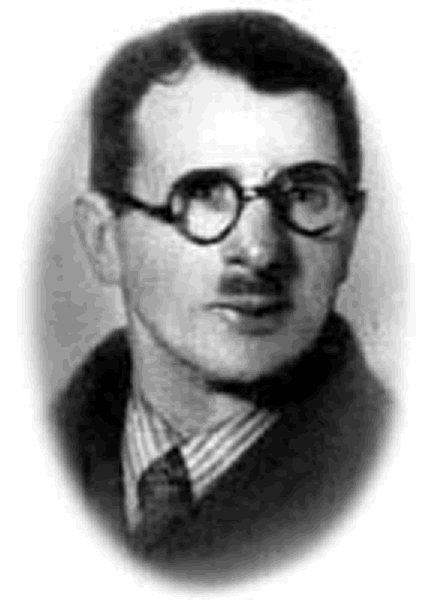 |
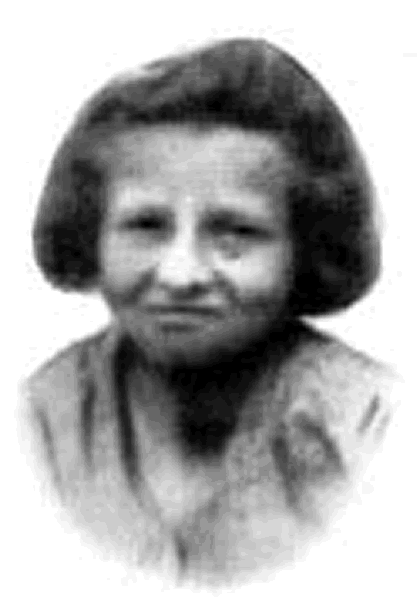 |
Mechel Schwarzer born 1888 |
Regina Schwarzer born 1926 |
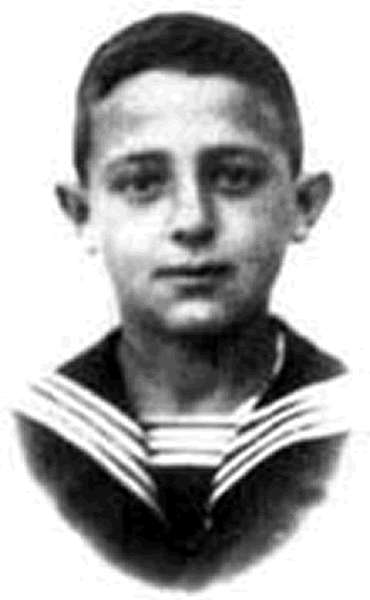 |
|
Samuel Schwarzer born 1928 |
Mechel Schwarzer was a tradesman and cooperated in business with Chaim Abend, a trade agent, who lived in the 11 Marquet Square at the centre of Kraków. They had a shop with furniture and antiques at 2 Mostowa in the Jewish District Kazimierz (also located at this address was the society Nossei Massu for support of orphans and widows, their seat and a prayer place). The business was also to restore old furniture. Chaim and Mechel employed three persons: a cabinet-maker, an upholsterer and sales' woman, who was Adela's eldest sister; Gusta Schwarzer, . Mechel often went for business trips to Katowice and Jaroslaw. Chaim Abend and wife Mania (both from Jaroslaw) often stayed with the Schwarzers' family in Wielicka as they liked children but had none of their own.
Malka Beila Tennenbaum-Schwarzer was daughter to Adela Feder, third wife of Mendel Tennenbaum. Mechel Schwarzer was son to Izak and Gitla and he had a sister Bronia and a brother of unknown name. Mendel died in September 1939 and was buried at the Jewish cemetery in Podgórze (in 1942 to be completely profaned and destroyed and by the Nazis who used the ground as Plaszow forced labour camp territory, and all the matsevots as building material for it).
As for the parents' family: Mechel Schwarzer had still another brother who was said to have migrated to the USA. Adela does not remember his name, but in the face of no other eligible entries in the Ellis Island Database, who knows if this was not Juda Swarccher who (as we read there), after leaving Kraków, arrived with his family – Chane, Elka, Ester, Motel, Sosche and Laser - on the ship "Finland" in New York in 1905 (with the destination point in Toronto, Canada)?
Mechel's sister, Bronia Schwarzer (herself a match-maker) married one Liebermann. One of their sons was Henryk Liebermann who married Lusia. They settled in Israel. One of Mendel Tennenbaum's grandsons, son to Malka Beila's half-brother, cousin to Adela, was Leibek (Leon) Eres-Tennenbaum. Leibek Tennenbaum was boss at Fromowic – big delicatessen store near Kazimierz which imported goods from all over the world. In 1972 he was still alive – living in Israel. His wife was Bina, his sons are Gershon and Mordechaj. His brother Izak Tennenbaum married before the WW II and left for the USA, where he had a chocolate factory (he soon died, however).
For the rest go to; www.adelaschwarzer.com
Dear Friends,
>
> Everybody, who is receiving this letter, should have
> ancestors from shtetl Druya, which is located at the
> border zone between Belorussia and Lithuania, on
> Belarusian side.
> Recently with the help of Druya descendants who
> currently live in US and Israel, 17th century Jewish
> cemetery was restored. Also at the place of execution
> Druya's Jewish residents during the WW2, new Holocaust
> memorial was constructed. Although currently there is
> no Jewish population in Druya, local authorities and
> students are taking care of restored Jewish heritage
> objects.
> In Druya there is a 19th century building of former
> synagogue, which survived WW2. After the war the
> synagogue's building was converted into a bath-house.
> For the past 9 years the building is abandoned. Time
> and lack of maintenance did the job. Today this
> building in the center of Druya is crying for help.
> In June, when I was visiting Druya, I had a meeting
> with Mr. Alexander Belun- Mayer of this town. He told
> me that prime-minister of Belarus is scheduled to
> visit Druya in the summer of 2008. By that time all
> towns' buildings need to be restored and painted, or
> demolished. It means that we can lose a part of our
> heritage, which connects us with previous generations,
> who used to live in Druya more than for 400 years.
> Local administration is asking for $7,000 to repair
> the front of the building and the roof.
> Our Jewish Heritage Research group is ready to
> coordinate and supervise the project, which will begin
> in the spring of 2008.
> We urge you not to pass on the opportunity to preserve
> the 19th century building of synagogue in Druya, which
> serves us as a reminder of our Jewish heritage.
> For American residents all contributions are tax
> deductible.
> Best regards,
>
> Yuri Dorn
> Coordinator of Jewish Heritage
> Research Group in Belarus
> 220002 Minsk
> 13B Daumana St.
> tel/375-173-345612
> fax/375-173-343360
> www.jhrgbelarus.org
 |
 |
David Brown (dab5152@optonline.net) on Sunday, November 11, 2007 at
20:52:26
---------------------------------------------------------------------------
Subject: Comment
Home Page: http://
Message: Good day:
I was eager to see if any one was familiar with a family named Keusch
from a
small village located near Vilna named Pizchinizan(pronounced:
pitch-in-nitchen). I am certain I have spelled it incorrectly.
They left this village approximately 1900-1910.
I look forward to sharing any information I can as well as to recieve
any
information available.
I hope to hear something soon.
<gleckman@mindspring.com>
Date: Nov 7, 2007
Subject: [belarus] Lifshitz family from Zaslavl, Rakow, Ivenets, Horodok, and Volozyn
Three different groups of LIFSHITZ family members have learned
recently that we are related. So we have decided to hold a small Lifshitz
family gathering later in November to say hello to each other. From prior
work on the Lifshitz family name there seems to be over 65 groups of
Lifshitz families (see www.benchpost.com/lifshitz).Most of these Lifshitz
family had roots in and around Minsk. Yet, when this website was put
together in 2002, it seems that all these groups of Lifshitz did have clear
links between them .
We have posted the structure of 'our' Lifshitz family at
http://www.kslrfamily.com/LifshitzFamily.htm. The research by Ruth Wilnai
has established a line back to the mid 1700s The central shtetls for this
Lifshtiz group is Zaslavl, Rakow, Ivenets, Horodok, and Volozyn.
Please take a look at the extended tree on the web and see if you can
determine any clear links to your Lifshitz family group.
We would love to add you to the guest list for the event in NY.
Harris; grandson of Sarah Lifshitz Tarr, daughter of Hoshea Lifshitz and Sore
(Axelrad) Lifshitz
From: <guyelitzur@gmail.com>
Date: Nov 4, 2007 9:16 PM
Subject: [belarus] Memorial monument in Slobodka, Belarus
To: Belarus SIG <belarus@lyris.jewishgen.org>
I am glad to share with you the fact that a new memorial monument was
established for the memory of the Jewish Community in Slobodka
(located north-east from Minsk in Belarus).
The monument was established with the great help of the Jewish Heritage
Research Group in Belarus
For any question, please send an e-mail to guyelitzur@hotmail.com
Regards,
Guy Elitzur
Ra'anana, Israel
Abigail Stein (abby_stein@hotmail.com) on Thursday, November 01, 2007
Message: Hi, While cleaning out the old lab at Lincoln High School in
Brooklyn, I rescued several nature paintings of birds by Raymond Wainer-Dykaar,
son of Moses Wainer Dyker and some biographical information, which was framed
and saved by a faculty member. He was a gifted science student with
artistic ability he channeled into his work. Unfortunately, after serving in the
war and entering medical school, he was killed , at age 23, in a motorcycle
accident. I am looking for any relatives who might appreciate these. It says in the
obituary that he was survived by his mother; no mention was made of any
siblings, but perhaps he had cousins. Please reply to me at
abby_stein@hotmail.com.
Subject: Krakow Jewish Community
From: Marianna <mariannah@epf.pl>
Date: Mon, 29 Oct 2007 17:32:33 +0100
X-Message-Number: 1
Hello,
I'm happy to inform you that the Jewish Community of Krakow has
finally established its website: http://krakow.jewish.org.pl
It's available both in Polish and English.
The website includes actual information on the Community activities,
a gallery of Jewish sites in Krakow, and tourist information on kosher
hostels and restaurants.
Regards,
Marianna Hoszowska
Warsaw, Poland
My grandmother, Chaya Alperovitch Clionsky, who was born and lived in
Dolginovo until 1907, was the proprietor of a china ware shop in the
town. Dolginovo was originally in Vilna Gubernia, and in the early 1900's was
shifted to Minsk Gubernia. Her husband Wulf Clionsky came to Dolginovo
from Borisov. He was a scholar who studied in a yeshiva in Vilna. Later he
made several trips to America before sending for his family. First he worked
a presser in a New York garment factory, and eventually became proprietor
of general stores, first in Steelton and finally in York Haven in Central
Pennsylvania.
Bill Yoffee,
kidsbks@erols.com
Researching Iofe (Jofe, Jaffe Joffe ) in Pakruojis and Birzai,
Bernstein and
Kretchmer in Birzai, Alperovitch in Dolginovo and Klionsky in Borisov
Ammatzia peled (peled@geo.haifa.ac.il) on Friday, October 26, 2007
Home Page: http://geo.haifa.ac.il/~peled/
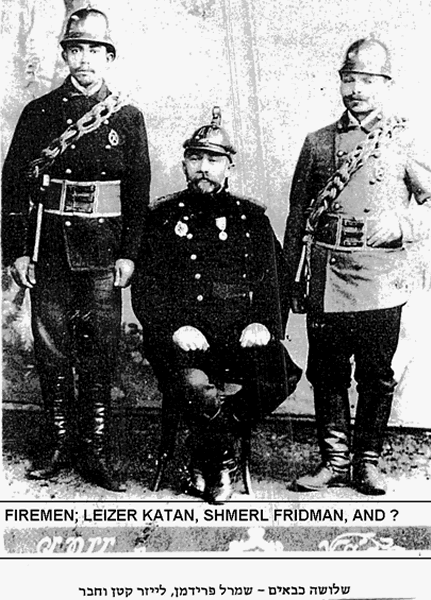
Message: I was amazed to learn about your magnificent effort through which I
had the pleasure not only to find an old picture of my grandfather Eliezer
katan but also a picture of my late mother, Tamar, with her friends of the
"äúàçãåú".
This picture is quite new to me.
Best regards
Ammatzia Peled
Haifa, Israel
--
It was suprising to see a photo posted on this website that I have in
my home photo album.
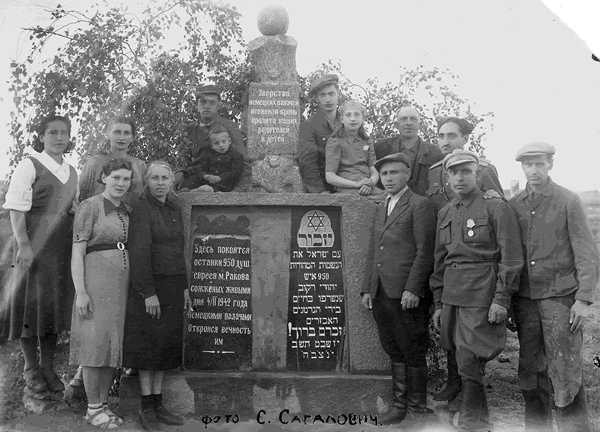
The photo is of the Rakov monument # rv-39 My father Hilel Ejdelman (born in
Rakov) is the men wearing a uniform. There is also my Mother and my older
brother ( sitting on the monument in the background)
I would be interested knowing who posted this photo and if I could get in touch
with this person. There must be someone who is still alive among these people.
Please write or call.
Anna Kampelmacher - Ejdelman
kampelclan@sympatico.ca
Subject: Film about "The Grynszpan's affair" on the channel TV entitled Planète (Canal Sat) - Thursday, November 01, 2007 21H40
To: eilat.gordinlevitan@gmail.com
Dear Eilat Gordin Levitan,
There will be a Film about my family in Thursday, November 01,
2007 9H40 PM on the channel TV entitled : Planète in France (Canal
Satellite).
My grand-father (David Kalma Zolty) had a first cousin who was
Herschel Feibel Grynszpan' uncle. Herschel Feibel Grynszpan killed Ernst Wom
Rath in October 1938 in Paris. This murder gives birth to Cristal's Night in
October 08 - 09 , 1938.
All the best,
Franck d'Almeida-Zolty
Saint-Quentin, France
Cher Monsieur,
Le documentaire « L'affaire Grynszpan » sera diffusé sur Planète le 1er
novembre à 21h40 (puis rediffusé par la suite). Nous allons organiser une
petite projection d'ici là. Je vous tiens au courant dès que le lieu et la
date seront fixés.
Bien à vous.
Emmanuel Migeot
Kilaohm Productions
128 bis, boulevard de Charonne
75020 Paris
01-44-93-53-42
JEWISH CULTURE AND INFORMATION CENTRE OPENED THE DOORS IN VILNIUS
On 24 September 2007 the Jewish Culture and Information Centre opened the
doors to the public in the Vilnius Old town. The inauguration ceremony was
attended by the Lithuanian governmental officials, Vilnius mayor, foreign
ambassadors and guests. Israeli side was represented by the Israeli
ambassador to Lithuania Chen Ivry and the Tel Aviv-Yafo municipality's
delegation headed by the First Deputy Mayor Nathan Wolloch.
Vilnius and Tel Aviv-Yafo are currently developing the joint ambitious
cultural project targeting the year 2009 when Tel Aviv-Yafo will celebrate
100 year anniversary while Vilnius will be declared the European Capital of
Culture and Lithuania in general will mark the 1000 year jubilee. >>
submitted by
Sylvia Furshman Nusinov
President Emerita
JGSPBCI, FL., USA
Surnames were a new concept to Jews in the early 19th century in Lithuania.
We had no history of inherited surnames and there was no strong attachment
to them. The requirement for them was imposed by local authorities to make
it easier to tax and conscript Jews and to track them for those purposes.
Thus, if the wife had a more "prestigious" lineage, men could and did adopt
her surname. In any case, although it would be spelled the same in Yiddish,
names written in Russian or English script varied in spelling by whomever
did the writing, adding a layer of complexity to studying records for clues.
In the Austro-Hungarian Empire, Jews were forbidden to marry in various
locales and times. Thus, the children of a marriage considered perfectly
legal under Jewish law, were considered illegitimate by the authorities and
given the mother's surname when they were registered. Although this did not
happen in Lithuania or other parts of the Russian Empire on a large scale,
it points up the unreliability of tracing families through surnames alone.
Chuck Weinstein
Dear Friends,
Recently there was discovered a mass grave of
Holocaust victims by village Voronka, Belarus. This
village is located near a town called Sharkovchina in
Vitebsk region. click for pictures of the town;
http://www.eilatgordinlevitan.com/sharkovshchyzna/sharkovshchyzna.html
According to local resident's words the victims were
70-100 Jewish men, who were transported to Voronka
from Braslav region by two Nazi's tracks in
August-September of 1941.
If anybody has any information regarding this matter
please contact me directly at belshtetl@yahoo.com.
Best regards,
Yuri Dorn
Coordinator of Jewish Heritage
Research Group in Belarus
220002 Minsk
13B Daumana St.
tel/375-173-345612
fax/375-173-343360
www.jhrgbelarus.org
--
To post to the Belarus SIG discussion group, send your message to:
< belarus@lyris.jewishgen.org>
Remember to send your message in PLAIN TEXT and sign
with your full name and location
Belarus SIG Webpage: <http://www.jewishgen.org/Belarus >
Online Newsletter: <http://www.jewishgen.org/Belarus/newsletter/bnl_index.htm>
Join the Research Trip to Belarus < http://www.jewishgen.org/shtetlschleppers/>
***************************************************
This SIG (belarus@lyris.jewishgen.org) is hosted by
JewishGen: The Home of Jewish Genealogy
Visit our home page at http://www.jewishgen.org
Sign up now for value-added services!
http://www.jewishgen.org/JewishGen/ValueAdded.asp
***************************************************
Thinking of visiting your ancestral shtetls?
Let JewishGen ShtetlSchleppers® take you there!
http://www.jewishgen.org/shtetlschleppers/
***************************************************
--
Eilat Gordin Levitan
Neal Ulevich, a distinguished photographer, has created a website
with fascinating photographs of the shtetls Lenin and Lachava from his recent visit. Today you find the Shtetls in Belarus, They were in Poland between the wars;
http://www.watermargin.com/lenin/lenin1.html
For the next pictures Press
Michael Kotin Palma (palmam35@yahoo.com) on Saturday, October 13, 2007
Message: Thank you for the wonderful work you are doing. I remember my
GrandMother speaking of the Holocaust of which we will never forget
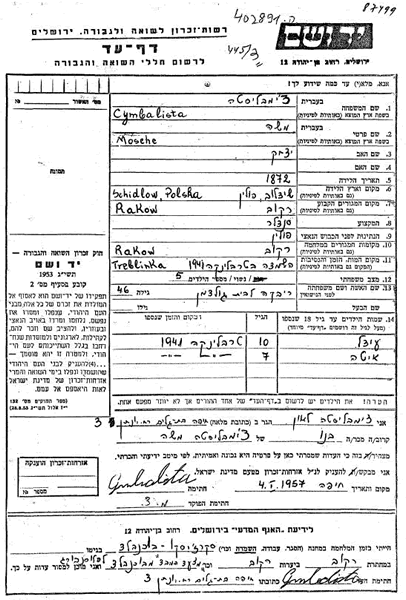
Rakow-Polen
Layla thomas asked; My mother Blima Cymbalista was born on may 1922,
Parents Moshe and Rifka Cymbalista) . I just wish I could find
anything on my
mother's family or anything on Rakow Polen....
Dear Layla,
Leon Cymbalista of Haifa gave a report to Yad Vashem for
his parents; Moshe Cymbalista ( born in 1872, a shoemaker) son of
Yizhak and Rivka nee Goldman ( born in 1895) who lived in Rakow and
two of their five children; Eidel who was age 10 and Eita age 7 . They
all perished in Trablinka in 1941. There is a full address of Leon of
Haifa in the report.
Cymbalista Rivka
Rivka Cymbalista nee Goldman was born in Rakow in 1895 to Mordechai
Goldman. She was a housewife and married to Moshe. Prior to WWII she
lived in Rakow, Poland. During the war she was in Rakow, Poland. Rivka
perished in 1941 in Treblinka, Poland at the age of 46. This
information is based on a Page of Testimony (displayed on left)
submitted on 04-Jan-1957 by her son Leon, a Shoah survivor
Cymbalista Mosche
Mosche Cymbalista was born in Szydlow in 1872 to Yitzkhak. He was a
shoemaker and married to Rivka nee Goldman. Prior to WWII he lived in
Rakow, Poland. During the war he was in Rakow, Poland. Mosche perished
in 1941 in Treblinka, Poland. This information is based on a Page of
Testimony (displayed on left) submitted on 04-Jan-1957 by his son Leon
Cymbalista of Haifa, a Shoah survivor ( Leon wrote that he was in the
Rakow underground and hid in the forest and later in Buchenvald camp
and survived the long walk.)
Leon address in 1957; 3 Yonatan Street, Bat Galim, Haifa
Eilat Gordin Levitan
Los Angeles
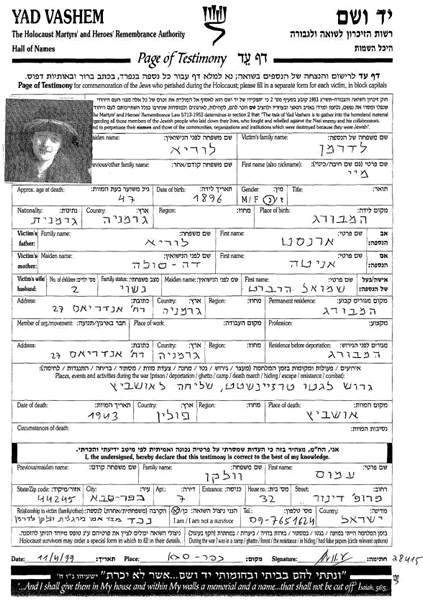
A note that was posted in Jewishgen; Subject: Seeking: Margarita LEDERMANN
From: esther morag <marriana@netvision.net.il >
Date: Mon, 01 Oct 2007 09:54:33 +0200
X-Message-Number: 5
Dear Sir, Ms.
I am looking for the where about of a relative of mine.
Her name is Margarita LEDERMANN born in Hamburg ,Germany on the
13.07.1920. In 24.03.1943 she was sent to Theresienstadt together
with her father Herbert Ledermann,mother Lea May geb. Luria,and sister
Anita.They were all sent to Aushwitz.
Margarita was the only survivor and according to German sources she came
to Israel after the war. I do not know whether she got married and changed
her name, or where she leaved in Israel,or whether she is not alive
anymore ???
Please can you help ?
Much obliged,
Esther Morag
Beer-Sheva 84730
ISRAEL
Dear Ester;
Amos Wulkan, the son of Margarita nee LEDERMANN ( changed in Israel to
Margalit), gave reprts to Yad Vashem about his grandfather who he
called "Shmuel Herbert LEDERMAN ( nee Braun?) " and his mothers'
sister; Annita
When you check the Yad Vashem list for "Herbert LEDERMAN" it wrongly
gives you a "Braun Herbert "( not a Lederman) I checked it and The
reports says;
Shmuel Herbert Lederman ( nee Braun?) was born in Hamburg in 1895
to Max. He was a merchant and married to Maia nee Lurie. Prior to WWII
he lived in Hamburg, Germany. During the war he was in Hamburg,
Germany. Shmuel perished in 1943 in Auschwitz, Camp at the age of 48.
This information is based on a Page of Testimony (displayed on left)
submitted on 11-Apr-1999 by his grandson ( it has a picture of the
perished and a full address and phone number of the submitter)
He also gave a report for his grandmother; May Lederman nee Lurie was born in Hamburg in 1896 to Ernest and Anita De Sola. She was married to Herbert. Prior to WWII she lived in Hamburg, Germany. During the war she was in Hamburg, Germany. She perished in 1943 in Auschwitz, Camp at the age of 47. This information is based on a Page of Testimony (displayed on left) submitted on 11-Apr-1999 by her grandson.
I see that you also gave a report to Yad Vashem for Lea Minni Ascher the sister of your father Dr. Otto Ascher, son of Esther nee Luria. You must be related to him (Amos) from the Luria side,
Yad Vashem report by ester;
Lea Ascher was born in Hamburg in 1888 to August and Esther nee
Luria. She was a clerk. Prior to WWII she lived in Hamburg, Germany.
During the war she was in Hamburg, Germany. Lea perished in Auschwitz,
Camp at the age of 54. This information is based on a Page of
Testimony (displayed on left) submitted by her niece Ester
Morg/Marriana of Beer Sheva.
Holocaust Survivors Reunited After 67 Years
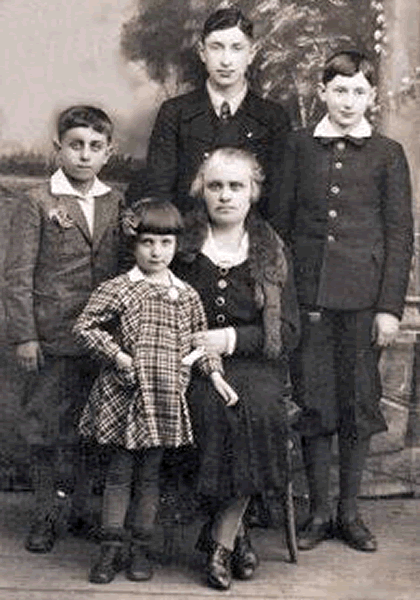
For the first time since 1940, Moniek Garber of Glasgow, Scotland and Moshe Porat-Perelman of Kfar Saba, Israel spoke on the phone August 29, 2007 due to the efforts of Michael Tobias of Glasgow, Scotland, Joyce Field of West Lafayette, Indiana, USA and Eilat Gordin Levitan of Los Angeles, USA.
Garber and Porat, first cousins and best friends, grew up in Volozhyn, Belarus ( then Poland). Separated during World War II, each believed the other had not survived the Holocaust. Garber was thought to have died in battle fighting the Germans at Monte Cassino, Italy, in 1944. Garber has been in Israel three times searching for relatives, but never found any.
Porat has been very active in the Volozhyn Committee in Israel. He is the head of the Volozhin society in Israel and did much to preserve the Jewish sites in Volozhin, Belarus. Moshe Porat was a friend of Eilat' aunt, Bela Salitarnik Z"L. Bela intrduced Eilat and Moshe, since Eilat created a page for Volozhin, Moshe sent her some translations. Eilat submited Moshe's first translations to JewishGen's Yizkor Book Project, managed by Joyce Field. Moshe translated the yizkor book for Volozhyn from Hebrew, Yiddish and Russian into English. http://www.jewishgen.org/Yizkor/volozhin/volozhin.html >
Garber, a member of the Association of Jewish Refugees http://www.ajr.org.uk/, was planning to attend their September 2 meeting and in the evening of August 28, he contacted the speaker, Tobias, to give him some background on the Garber / Perelman families. Tobias started to research the families on the JewishGen website, studied the translations from the Volozhyn Yizkor Book, and recognized the family connection. Excited, he immediately emailed Field for contact information on Porat, but soon discovered that he had moved. Field recalled that Eilat was close to Porat and gave Tobias her phone number so he could get Porat's new contact information. Eilat managed to contact Porat's family for his new phone number.
Porat had moved from Tel Aviv to Kfar Saba. Early in the morning of August 29, the two cousins spoke to each other after 67 years of separation. They hope to meet in Israel in November and Garber also plans to meet his other cousin, Sonia, Porat's sister, who lives in Paris.
The cousins are direct descendents of one of the most famous rabbinical families in modern times. They descend from Rabbi Chaim of Volozhyn (the principal disciple of the Vilna Gaon) who founded the 'mother of yeshivas' (Torah study Institution) there in 1803.
Additional details and a chronology of events follow. Photographs are also attached.
Moniek Garber – the War Years
• He was arrested in March 1941 and sent to the Soviet Gulag camps. He was sent to the Baltic White Sea Canal, but the Finns attacked in 1941 to regain their territory. They walked around the White Sea for a couple of months, all the way to a Gulag called Plesieck (famous later for the first Sputnik launches).
• He did not do heavy work. He was befriended by a geologist who ensured that Moniek did not have to go out to work as he was only 18. His feet were badly frozen in any case from walking without shoes
• He was released from the Gulag in January or February 1942. They walked from the camp to the nearest station - about a two-day walk.. They then travelled by open trains, scrounging for food. He was supposed to go to the Urals to work in the copper mines but he then learned that a Polish army was forming.
• In that severe winter the Polish army first was stationed at the foot of the Ural mountains, which was the passageway between the Caspian Sea and the Urals. From there they went to Tashkent and from there over the Caspian to Teheran to the port of Pahlavi (named after the then Shah of Persia, but now called something different). They stayed some time in Persia , starving and looking skeletal. From there they stopped off in the desert for several weeks, near Baghdad. Eventually they were taken by Sikh drivers to Palestine, where the Polish Army had their distribution / enrolment centre.
• They were stationed somewhere near Tel Aviv. There he met a Jewish driver and Moniek explained that he had a grandfather PERELMAN, Rabbi in Jericho. (According to Moshe Porat this Rabbi changed his name to MARGOLIS, Hebrew for "Pearls.") The driver said the Rabbi had died the previous year (1941).
• Moniek was part of a group of the Polish army who were to head to the UK. Their task was to transfer prisoners of war.. They went to Suez to pick up Italian prisoners for transport to South Africa, where they dropped them off. They spent a few months in Pietermaritzburg, South Africa [now KwaZulu Natal] . Then they took on board German prisoners because the German prisoners had been disappearing among the Boers and were hard to trace and, therefore, they wanted to move them from South Africa to Canada. The journey to Halifax, Canada took several weeks. They dropped off the German prisoners and took onboard a large number of American soldiers. They sailed in convoy to Gourock, Scotland. This was still 1942 and Moniek was just 19 years old.
• Because of Moniek's age, one of the officers arranged lessons for him and three others. One of the others was a Polish soldier called DOMBROWSKI, who was descended from a famous Polish General . Another was a Jew called LAX, who went to Israel eventually. Moniek joined a Polish unit in Dalkieth near Edinburgh—the First Reconnaissance Regiment armoured cars). All this time the officer gave lessons. He was then sent for eight months to Glasgow, staying in the Dalbeth convent at the top of London Road, where he had more lessons there. While there they were visited by a famous local politician called DOLAN.
• He was still in Glasgow early in 1944. From Glasgow he went for War training in the Yorkshire Moors in England. He then went to Normandy, landing five days after the initial landings, as a tank gunner, a job he describes as horrible: hot, poor ventilation, lots of smoke when the guns were reloaded. In winter 1944 they were on the Ems river (an estuary of the Rhine).
• He ended up in North-Western Germany, just south of Bremen, where he started meeting people from concentration camps. Moniek had known how bad the War had been but he had not been aware of the scale of the atrocities. The first people he met were Polish girls from the Warsaw rising. One of them, a girl from a prominent family, had been operated on by Mengele.
• Unknown to Moniek at this time, while he was in North Western Germany in the Polish Army, his cousin Moniek PERELMAN was in North Eastern Germany in the Red army.
Moshe Porat–Perelman – the War Years
• On 13 April 1940 Moshe (15), his sister Sonia (10) and mother Etl (43) were deported from Volozhyn. His father was in the Volozhyn NKVD prison (sharing a cell with Moniek Garber). He never saw his father again. [NKVD = Narodny Komissariat Vnutrennikh Del , the Soviet Secret Police, a forerunner of the KGB.]
• They were taken by horse-drawn cart to Horod'k train station where they boarded a freight car, travelling East for two weeks. Through the window grill and cracks in the gate they saw the rivers Dniepr and Volga and the towns Minsk, Smolensk, Kazan, the Ural mountains. They travelled on the Trans Siberian Railway to Omsk and the Irtish river. At Tatarskaya they turned south and saw people with Mongolian faces. Their destination was Pavlodar on the east bank of the Irtish river. They were given a choice of working in gold mines, coal mines ,or on farms. They choose farming.
• They travelled upstream on the Irtish river 100 km to Krasnokutsk and then a further 100km to Novotroitsk Sovhoz, their final destination, arriving 1 May 1940. They were housed in the camel's stables. Sonia went to school, Etl worked in the vegetable fields, and Moshe worked in construction. Eventually their house was ready, which they shared with two other families. They corresponded with his grandmother in Moscow and his cousin Dania Garber in Stalinabad.
• In the Spring of 1943 Moshe was mobilized into the work army – "Trud Armia." He was sent back to Pavlodar and he worked on railroad construction between Stalinsk to Magnitogorsk in the Urals. His section (the 8th) was constructing a railroad bridge over the Irtish river, transferring coal, steel rails, wood, and nails by hand.
• The Polish Anders army was created and Polish Gulag prisoners were released. Many of the Volozhyners returned to Pavlodar, including his mother and Sonia. Moshe was still working on the railroad. In the Spring of 1944 the bridge construction stopped and Moshe Perelman was transferred from Karaganda to Aksakarovka. He befriended an official and got a clerk's job in the small Andreyevka station. He used to transport sacks of bread from Aksakarovka to Andreyevka, travelling on the outside of the trains and throwing the sacks onto the platform. Then in the autumn of 1944 Moshe was mobilized into the Red Army.
• Moshe made the long journey from Karaganda to Alma Ata, a large military training unit. This journey is about 1000km as the crow flies, but by train they travelled 4000 km. From Karaganda north to Petropavlosk, then east to Novosibirsk, then south to Alma Ata. After two months of training his squad was sent to escort a penal company to the front. The journey took a month, with little sleep or food. Through the Urals, the Volga, Ukraine, they crossed the Black Sea on a ship. From Odessa to Constanza, through Romania to Hotvan and from there to Slovakia. The penal company was left with the 4th Ukrainian Front and Moshe and his squad returned to Alma Ata via Hotvan, Kishinev, Kiyev, Moscow and Kooybishev. In Moscow he managed to see his grandmother Malka and aunt Fania.
• In Alma Ata they trained for the battle front and in February 1945, were issued new equipment and travelled by train to a special destination on the 2nd Belarussian Front. They passed Smolensk and Minsk to Lida. Moshe knew they would pass through Horod'k, the Volozhyn station, but the train did not stop. At the next stop, Bogdanovo, the station for Vishnievo, he stopped at the station office and was told all the Jews of Volozhyn had been killed. The train eventually stopped in Eastern Prussia and they left the train because the bridge over the Wisla river near Grudziądz was down.
• They then travelled by foot, marching over Pomerania and Prussia, passing Chojnice on the old German-Polish border where the World War II had started. They crossed the Oder and after a long hard walk arrived in the Greyswald forest between Barth on the Baltic Sea and Rostock on the south. They became part of an Infantry Unit, 2nd Belarussian Front. In June 1945 they moved east to Szczecin, then south to Silesia. They stayed in that vicinity until May 1946 when he was liberated from the army, leaving as a sergeant.
• Moshe returned to Szczecin in Poland where his mother and Sonia had settled after they left Pavlodar. Some of his Malkin cousins had survived and were living in Palestine. They urged Moshe and his family to join them. Moshe decided to go, heading first for France. Moshe travelled to Berlin and then he crossed from the Soviet zone into the British zone. A few days later he crossed into the American zone. >From there to Munich, and then Landsberg. A few months later he crossed into the French zone. He arrived in Reutlingen and with the help of Yuta Plavner, he was given identity papers as an officer in UNRA (United Nations Relief and Rehabilitation Administration). He crossed the French border and arrived in Metz.
• Moshe lived in France for 21 months until June 1948. He went to the ORT school. His mother and sister joined him in July 1947. He made aliya to Israel on 11 June 1948 on the ship Altalena, arriving 20 June 1948.
• Moshe served in the Israeli army, participating in operations "Nizana" and "Eylat". His war came to an end in 1949.
Moshe Porat wrote the story of M. Garbers father;
www.eilatgordinlevitan.com/ volozhin/vol_pages/stories_yani.html - 8k -
if you scroll down www.jewishgen.org/yizkor/volozhin/vol490.html
Here is what he wrote about is cousin; Monia, Yani's younger son, carried out a prank during the Russians' rule. He tore Stalin's mustache from a wall journal at the Volozhin high school. The Soviet NKVD did not like such pranks. Monia Garber was arrested in March 1941 and was sent to the Soviet Gulag camps. After the Stalin-Sikorski agreement in 1942, he joined the Polish Anders army. With this army he reached Israel via Teheran. He could not remain in the Land and was obliged to go to Italy with his Polish unit.
Monia (Moshe) Garber was killed in the Monte Cassino battle against the Germans as a soldier of the Polish army
**************************************************************************************************************************************************************************
Michael Tobias and the Association of Jewish Refugees (AJR)
• Michael Tobias is Vice President, Programming, of JewishGen, Inc, < http://www.jewishgen.org>, and lives in Glasgow, Scotland.
• In March 2007 he was asked to give a talk at the Northern Group meeting of the AJR (Association of Jewish Refugees < http://www.ajr.org.uk/>. Michael's presentation was about how he had used the JewishGen website to research two families and eventually enable a young couple to get married in an orthodox synagogue in London. The presentation was well-received and Michael was asked to return on September 2nd to demonstrate the JewishGen website. He asked those attending to contact him beforehand if they had any particular research interests or families they wanted to try to trace.
• On Tuesday, 28 August 2007, at around 7pm Michael was called by Moniek Garber, who lives a few miles away. They had met briefly at the previous AJR meeting. Moniek wanted to talk about his family from Volozhyn who had an interesting history, being descended from the famous Volozyner Rabbis and associated with the Gaon of Vilna. Michael began to check the JewishGen website but found little about the families in the various searchable databases on the site. No other researchers appeared to be working on the families.
• He then turned his attention to the town of Volozhyn and found that about half of the Yizkor Book on Volozhyn (memorial book of destroyed communities) had been translated for JewishGen by its coordinator/translator Moshe Porat. He found the genealogy of the Garber and Perelman families, articles about Moniek Garber's family (including photographs of his family), and realized that Moshe Porat was the same man as Moshe Perelman, Moniek Garber's cousin. Moshe Porat-Perelman had visited Volozhyn in 1998 and was still writing in 2001. He had done no further translations since.
• Michael broke the news to Moniek Garber and said he was going to try to trace his cousin. Michael then contacted his colleague Joyce Field, JewishGen Vice President, Data Acquisition, who is in overall charge of the JewishGen Yizkor Book Project, and lives in West Lafayette, Indiana, USA . Joyce had an email address and postal address for Moshe Porat but had not heard from him for some time. The addresses were out of date. Michael found other references to Moshe Porat on the Internet, including postings he had made on other Holocaust-related sites in 2002, then 2003, 2004, 2005, and finally in September 2006. Many of those postings were on sites maintained by Eilat Gordin Levitan. Joyce Field knew Eilat from the Yizkor Book Project and gave Michael her telephone number and email address.
• Around 1:30am UK time Michael called Eilat in California and explained the situation. She was thrilled as she knew Moshe Porat well and knew the story of his Perelman and Garber families and of Moniek Garber, who had supposedly died in battle in Italy. She had not spoken with Moshe Porat for a few months. She was sure she could contact him, through family in the USA or her cousins in Israel.
• At 5:50 am UK time Michael received an email from Eilat saying she had spoken with Moshe Porat's 14 year-old granddaughter. Moshe was alive and well and living in Kfar Saba, having moved from Tel-Aviv to be closer to his family.
• At 8:00 am UK time Michael called Moshe Porat-Perelman and confirmed the news. He gave him Moniek Garber's postal address and telephone number. He then called Moniek Garber and gave him Moshe Porat-Perelman's details. Later that morning the two cousins spoke for the first time in 67 years.
************************************************************************************************************

Dear Eilat,
The names of the kids from Minsk who where participating in Kurenetz project:
Sergei Lebedev, Maxim Yudin, Artem Moroz, Vladimir Kishkurno, Tatiana Sherbak,
Vera Sivakova, Nadia Vasilenok, Aleksandra Shedekova, Egor Strelkov, Dmitriy Rusakov
Arseniy Nikitenko. The young members of the Sochnut took a trip to Kurenetz to clean the
yard of you ancestors house. They've collected garbage, cut some trees and bushes, washed the windows and floor inside the house, fixed 2 door locks.
Mr.Viktor Ulitsky ( the mayor of Kurenets) provided them with a horse with a
buggy to collect the garbage bags. He visited the kids and thanked them
for taking care of the house. In addition to the clean up they also fixed the fence!
They agreed to go back to Kurenetz next year to paint the house.
Best regards,
Yuri Dorn
Coordinator of Jewish Heritage
Research Group in Belarus
220002 Minsk
13B Daumana St.
tel/375-172-345612
fax/375-172-343360
www.jhrgbelarus.org

(more pictures- #2sn54 - #2sn58)
The pictures were taken in Kurenetz
during the recent clean up action. A group of young
members of the Sochnut took a trip to Kurenetz to clean the
yard of you ancestors house. They've collected
garbage, cut some trees and bushes, washed the
windows and floor inside the house, fixed 2 door
locks.
Mr. Ulitsky ( the mayor of Kurenets) provided them with a horse with a
buggy to collect
the garbage bags. He visited the kids and thanked them
for taking care of the house.
In addition to the clean up they also fixed the fence!
Yuri Dorn
Coordinator of Jewish Heritage
Research Group in Belarus
220002 Minsk
13B Daumana St.
tel/375-173-345612
fax/375-173-343360
www.jhrgbelarus.org
Tracing family from Warsaw in the States
<malcolm.courtney@btinternet....
I am trying to trace family who emigrated to USA,
probably both to New York and also New Jersey, from
Poland in the late 1800s to early 1900s. They lived
originally in Warsaw and, with the exception of my
Grandpa Joseph Stone, all went to America as far as I
know. Their names were Harry (Hersh/Gersh), Feige
(Fanny), Isidore, Max, Wolf, Eva and Anna Sztejnchauer
(Steinhauer).I believe they changed their surname to
Stein in the States. Harry and Fanny were my Grandpa's
parents and the others were his siblings. I was in
correspondence for many years with a daughter of Eva
named Helen Gratt (nee Frederics, I believe) but sadly
she died and I have since been unable to get any
further information concerning the family. Helen had a
son and a daughter who are both still alive, but was
predeceased by her husband Phillip. Helen had a
brother Harry, a neurologist, but he died in the late
60s. As far as I know Helen's mother, Eva, lived with
her.This is really all the information I have, apart
from finding an entry via Ellis Island for my
great-grandparents and one daughter, shown as Chawa.
On this entry they are shown as heading for a son's
address, given as: Lou Max Steinhouwer of 810 (or 310)
20 Ave NY. They left the home in Warschau of another
listed as a 'son' David (who I assume must have
changed his first name) living at Schlosse 26. They
sailed on the SS Noordam out of Rotterdam arriving on
January 13th, 1917. Initially they were refused entry
because of some problem (I'm unable to read what it
says on the manifest), but obviously were subsequently
allowed to take up residency in the US. I also have a
copy of a birth certificate for a Gerszon Mendel
Sztejnchauer born to what is quite clearly my
great-grandparents in Warsaw in 1884, and I am
assuming this to be the child's Hebrew name as it does
not correspond with any of the names I have already
given.
If anyone recognises any of these names, or can give
me help by suggesting further avenues of research, I
would be immensely grateful. Thank you very much.
Geraldine Courtney
England
Researching SZTEJNCHAUER, STEINHOUWER, HAUSZA/GAUSER
all from Poland
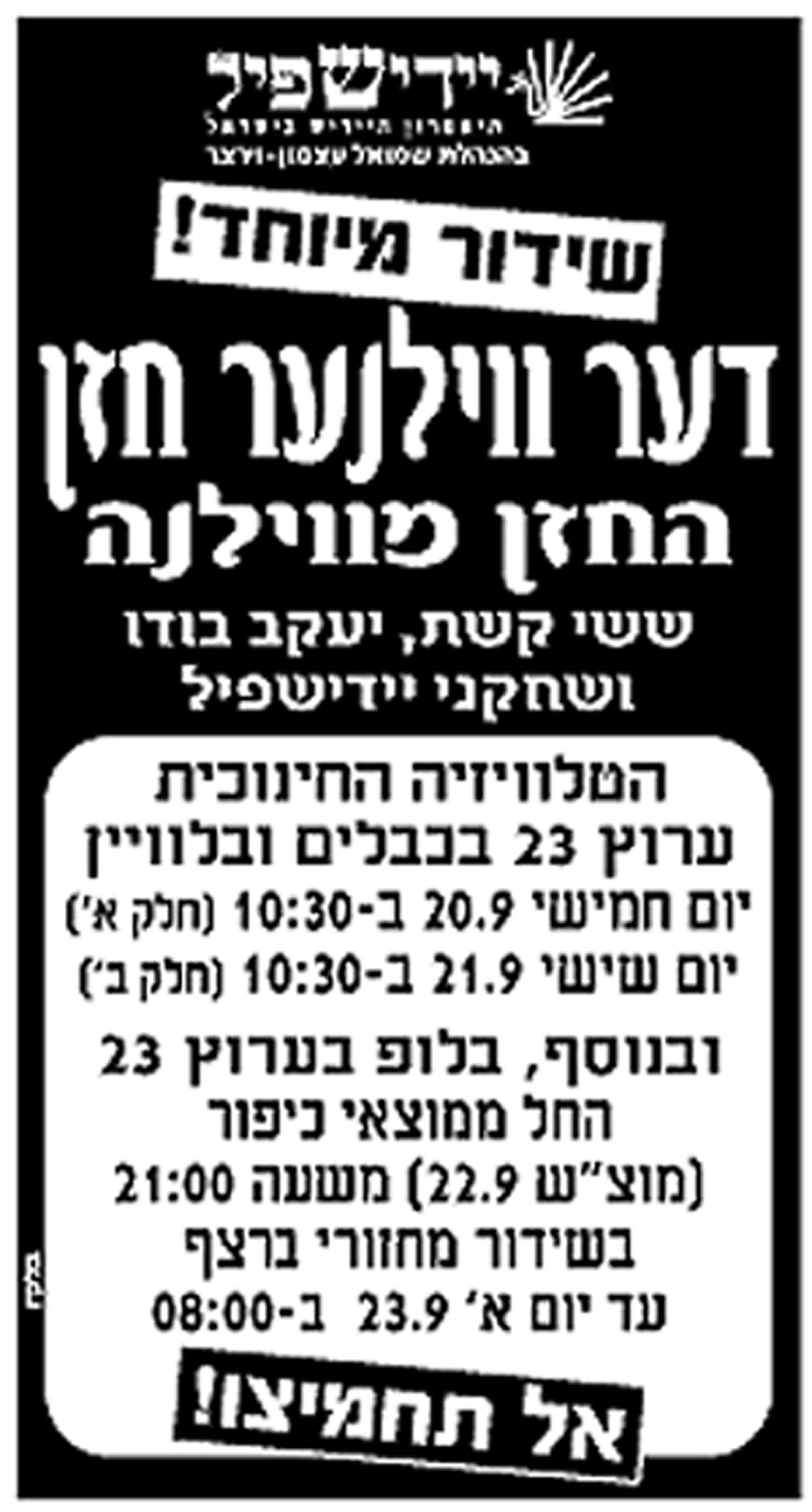
ANNETTE BONDAREK () on Thursday, August 30, 2007 at 18:30:27
---------------------------------------------------------------------------
DOES ANYONE KNOW OF ANY SURVIVORS OF THE VILLAGE STAJKI NEAR
BRASLAW,
I HAVE BEEN SERCHING MY FATHER'S RELATIVES FOR YEARS BUT TO NO AVAIL.
I WOULD
BE SO GRATEFUL FOR ANY INFORMATION.
These lists are contained in a file accessible from the GoogleGroups
JewishVilna group which Eden Joachim and I co-coordinate. I am distributing
this limited data to Vilna researchers in the hope those of you who have been
unable to find records for your family in Vilna proper may come to find
ancestors elsewhere in the Vilna County.
The raw translations are being proofed and will be distributed to the $100
donors for the Vilna County, as well as Moletai and Shirvint donors who
funded most of this work.
These translations represent the first surname data to appear for many of
the towns. I look forward to some discussion of this data. Specifically, we
would like to hear from researchers who have found their surnames of
interest among these records.
Please contact me if you are a Vilna researcher interested in this data.
Joel Ratner
Coordinator, LitvakSIG Vital Records Translation Project
I did a little checking and his name does not appear in Yad Vashem's Pages of
Testimony nor in the Austrian database (DOEW). Of course, he may have died in the
war but he was not documented.
There is an entry for a Gerson PRAIS in Vienna's list of unclaimed assets, which
we will follow up on.
If you are familiar with this name, or can help me to help her, I would greatly
appreciate it.
Ben Weinstock
The real question is whether anyone who has Stern or Jonas ancestors that might
connect into these two lines from Grodno has any additional information
I'd be willing to pass on the information I have as well.
One other fact should make this research easier and that is that the Sterns were in Grodno for a long time and were, prior to Bezalel Itzchak Stern, a line of rabbis.
Sincerely,
Justin Loe
Reb Betzalel Stern, author of Betzel Hachochma
Steve Bloom (sbloom@hsc.ed.) on Thursday, August 23, 2007 at 11:50:02
---------------------------------------------------------------------------
Message: Regarding the R. Yehoshua Issac Shapira of Glovenka and Slonim, etc.,
was
he supposed to have been the GREAT GRANDSON of Jehiel Heilperin ("Seder
Hadorot") or GREAT-GREAT GRANDSON via his father Yechiel? The way I have seen
it spelled out before is that his father's mother was a grandchild of R.
Jehiel, through Jehiel's son Isaac.
This isn't meant to be a complaint, but a true question, since I don't really
have access to the primary sources that would spell this out.
Thanks!
--------------------------------------------------
Rabbi Heilprin (1660-1746) published Seder HaDorot, which contains a chronology of events and personalities from creation until 1696. He was the first of the rabbi-genealogists to record rabbinical family origins.(now in very fine print)
From the Minsk Yizkor book;
The Gaon Yechiel Halpern, known from his historical work "Seder Hadorot" [The Order of the Generations], served as the Rabbi of Minsk in the 18 th century, and headed a famous yeshiva. At that time, the great one of the Gaonim of that generation and the following generations arrived in Minsk: Reb Aryeh Leib, the author of "Shaagat Aryeh" who also founded a large yeshiva ( he was connected to Volozhin). However, something took place between these two yeshivas and they became hostile to each other. The people of Minsk defended the author of " Seder Hadorot", and sent the author of the "Shaagat Aryeh" away from the city on a Friday. The monument of the grave of the " Seder Hadorot" stands to this day, intact and fenced off, in the old cemetery, which was completely ploughed and paved over. All of its monuments and graves were willfully desecrated.
Subject: Family of Solomon Zelman GLOBUS
From: Steven Bloom
I am looking for information on the family and descendants of
Solomon Zelman GLOBUS, who apparently married a great great
grandchild of R. Yechiel HEILPERIN ("Seder Hadorot"), as noted in
Neil Rosenstein's _Lurie Legacy_.
I don't have much more information, though he (GLOBUS) was son of
Eliezer, and died in 1831. If I counted generations right, he was
likely born around 1760. I don't know where, though possibly Vilna,
since it looks like earlier in this line, an ancestor (of GLOBUS'
wife) was "Yechiel of Vilna" , son-in-law to R. Yechiel HEILPERIN.
Going on this theory, I do notice in the Lithuanian Revision Lists a
"Berko GLOBUS", son of Zelman, born in 1791, and living in Vilnius
proper. His wife was Miriam, and his children were Chaim Ovsey,
Israel Movsha, and Peysakh. Given location, timing, and name of
father, I think this is potentially the correct family.
Since I am looking to compile a documented genealogy of Yechiel
HEILPERIN (I know, I know--good luck!), down to the present day (I
had previous postings regarding my own potential direct descent from
him), I'd appreciate additional information on the aforementioned
Solomon Zelman GLOBUS and whether or not he was in Vilnius, and
whether this family in the Revision Lists is his.
Thanks!
I am Carlos Occhiuzzi (carzzy2003@hotmail.com) and writing to you for
the following reason:
I am looking for a person in Belarus that can help me with the search
of the town Horki, Zaostrowiecze party, district of Nieswiez( Nesvizh)
or administration of Kletsk place of my great-grandfather's residence,
his name was Wladyslaw Suszczewicz .
he was born in Zaostrowiecze
I am looking for to send a postal mail to these administrations or
parishes or chuches in kletsk, zaostrowiecze, horki, nieswiez
Notes by Liz Ruderman Miller ;
Does anyone know how I could find someone to check the cemetery in
Kraisk/Kraysk,Belarus for a tombstone? ( also some pictures of Kraisk)
Kraisk is about 9 miles from Dolgovino.
I am hoping to find anyone in my Ruderman family who lived in Kraisk
until
about 1915.
My great grandfather was Itzsack Ruderman, married to Ruchel (Rachel)
Jacobs or
Axelrod or Areclad. The children who immigrated where born between
1875-1885.
My grandfather was Moshe Ruderman, born @ 1878. Other siblings were
Ester (who married Joseph KASDEN before immigrating in 1912), Sophie
(who married Louis CHEFEITZ before immigrating @1911), Abraham, Harry.
all born approx. 1878 - 1898. all immigrated to U.S.
I have no additional pictures or information on previous generations
for either.
I would be very grateful if someone has Ruchel Axelrad or Itzchack in
their tree. I beieve they may be buried in the cemetery near
KRAISK/KRAYSK.
Sadly, NARA has no immigration records for my grandparents, Moshe
(Morris) RUDERMAN (RUDORMAN) 1900 and Eske (Sarah) COHEN
(KOHEN,KAGEN)1898. I know that they were
married in August, 1903 in New York City. My ggrandmother's surname
is listed on LDS marriage record (of Morris &
Sarah Cohen Ruderman ) as Rachel ARELCAD. On all other records, she is
called
Rachel Jacobs. I know that she and her husband, Itzchack Ruderman
lived in
Kraisk/Kraysk. I can not find Jacobs or Arelcad in Kraisk/Kraysk. I
also tried
Dolgovino - no luck. Does anyone have any ideas on what this means?
Itzchack Ruderman served in the Russian Army before immigrating to
US in
1900. He would have been about 20 in 1900. I wrote to RGVIA quite
some
time ago and have had no response. My family always said Itzchack had
been
in the military. Is there any other way I can find any Russian
military information
(@ 1898- 1900, I assume.)Itzchack Ruderman lived in Kraisk/Kraysk
before
immigrating.
Does anyone have any other ideas regarding how I can confirm their
immigration? I believe that they, or at least the RUDERMAN family
came from Kraisk
I would be extremely grateful for any help.
I have found the Declaration of Intention for Naturalization for my
great-grandfather, Morris Ruderman dated February 8, 1916. It states
that
"I emigrated to the United States of America from Kovno Russia on the
vessel Bulgaria....I arrived at the port of New York on or about the 20
day of April, 1900."
I have been unable to find any ships records or immigration records
around
that date for Moshe or Morris Ruderman. There are two ships with
similar
names, the Belgravia and the Bulgaria. Is it possible that my
grandfather
departed from Kovno (Kaunus) but sailed from one of the main Port of
Departure
for New York?
A few of the ships manifest records for my RUDERMAN family indicated
that they
came to a relative living at 39 Jackson Street, New York City, NY.
Is there a way of finding that address between 1904-1910 and who lived
there?
I am looking for information on Jacob COHEN, who immigrated with his
sister,
Eske (Sarah) in 1898. In the 1910 New York Census, Jacob was living
in Haven, New
York on a farm along with his sister, Sarah Cohen RUDERMAN, her
husband, Morris
Ruderman and their children, Rachel, Ceil and my dad, Henry. Members
of my family
said he went by Jack Cohen, but do not know where he was living.
Jacob and Sarah (who lived in Port Jervis, NY until her death from
cancer in 1948)
had a sister, Eleanor Cohen who never married, lived in the Brighton
Beach area of
Brooklyn, and was struck down while trying to cross the street sometime
in the
early 1960s
Sincerely,
Liz Ruderman Miller
Kalman Taicz wrote on Friday, June 15, 2007;
On the list of families of Druja i found missing the Rivosh name
a brother of this Rivosh lived in Dagda, in latvia, then in Riga b.1904
still
living in Israel. ...
From Yad Vashm
Riwosz Zalman
Zalman Riwosz was born in Dagda, Latvia in 1876 to Yosel Israel. He
was married to Rivka nee Baskin. Prior to WWII he lived in Druja,
Poland. During the war was in Braslaw, Poland. Zalman perished in
Braslaw ghetto, Poland. This information is based on a Page of
Testimony (displayed to the left) submitted by his son Joseph Riwash
from Canada
Ribash Rivka
Rivka Ribash nee Baskin was born in Russia (USSR) in 1886. She was
married to Zalman. Prior to WWII she lived in Wilno, Poland. During
the war was in Braslaw, Poland. Rivka perished in 1942 in Braslaw,
Poland at the age of 56. This information is based on a Page of
Testimony (displayed to the left) submitted by her son Joseph Riwash
from Canada
Osaia Riwash was born in Riga, Latvia in 1913 to Rachel and Nachum. He
was single. Prior to WWII he lived in Wilno, Poland. During the war
was in Grenoble, France. He perished in the Shoah. This information is
based on a Page of Testimony (displayed to the left) submitted by his
cousin from Canada
Riwosz Nachum
Nachum Riwosz was born in Druja, Poland in 1879. He was a merchant
and married to Rakhel nee Shenker. Prior to WWII he lived in Wilno,
Poland. Nachum perished in 1942 in Wilno. This information is based on
a Page of Testimony (displayed to the left) submitted on 10/04/1957 by
his daughter Luba KURTZVEIL
of Bat Yam
Chaia Rivosh nee Tzlaf was born in Druya, Poland in 1881 to Abram.
She was married. Prior to WWII she lived in Riga, Latvia. During the
war was in Riga. she perished in 1941 in Rumbula, Latvia. This
information is based on a Page of Testimony (displayed to the left)
submitted on 12/09/1995 by her sister-in-law TZLAF KHANNA
in Beer Sheva
Tzlaf Reveka
Reveka Tzlaf was born in Druya, Poland in 1886 to Abram. She was
single. Prior to WWII she lived in Riga, Latvia. During the war was in
Riga. Reveka perished in 1941 in Rumbuli, Latvia. This information is
based on a Page of Testimony (displayed to the left) submitted on
12/09/1957 by her sister-in-law TZLAF KHANNA in Beer Sheva
Rajvisz David
David Rajvisz was born in Druja, Poland in 1914 to Zalman and Dvora.
He was single. Prior to WWII he lived in Druja, Poland. During the war
was in Druja, Poland. David perished in 1941 in Majdanek. This
information is based on a Page of Testimony (displayed to the left)
submitted on 14/05/1957 by his relative Chana Ilish, a Shoah survivor
from Kiryat Gat
Smuel Rojwisz was born in Druja, Poland in 1916 to Zalman and Dvora.
He was single. Prior to WWII he lived in Druja, Poland. During the war
was in Druja, Poland. Smuel perished in 1941 in Majdanek. This
information is based on a Page of Testimony (displayed to the left)
submitted on 14/05/1957 by Khana Ilish, a Shoah survivor
Rejwisz Itla
Itla Rejwisz was born in Druja, Poland in 1918 to Zalman and Dvora.
She was single. Prior to WWII she lived in Druja, Poland. During the
war was in Druja, Poland. Itla perished in 1941 in Majdanek. This
information is based on a Page of Testimony (displayed to the left)
submitted on 14/05/1957 by her relative, a Shoah survivor
Rajvisz David
David Rajvisz was born in Druja, Poland in 1914 to Zalman and Dvora.
He was single. Prior to WWII he lived in Druja, Poland. During the war
was in Druja, Poland. David perished in 1941 in Majdanek. This
information is based on a Page of Testimony (displayed to the left)
submitted on 14/05/1957 by his relative, a Shoah survivor
Pawel Ceitel (pawcei@op.pl) on Sunday, June 10, 2007
---------------------------------------------------------------------------
Message: hello, im very interested about picture #glu_11 from
glubokoye (Studio portrait of the four Ceitel sisters with a cousin in
the year 1913- picture from Yivo). . . could
anybody tell me somthing more about this picture? My second name is
Ceitel, so i
thing this is my lost family... Thanks a lot for any hellp! Pawel
Ceitel
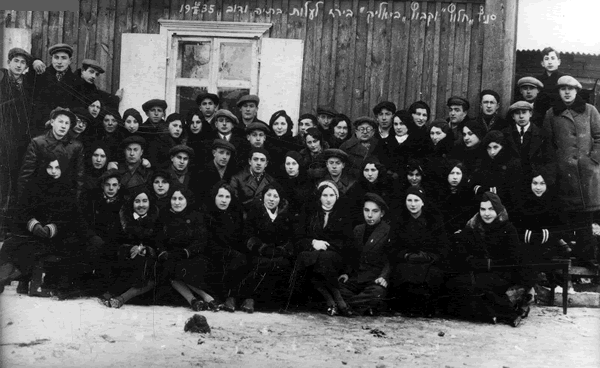
Picture of Batia and Dov in 1935
Today I spoke to Batia nee Fridman who was born in Birze in 1913. She
was not feeling well ( she is 94 years old) and said that it would be
much better to visit her in person in Kibbutz Yagur. She said that she
studied in the Tarbut school in Birze for four grades ( it only had 4
grades). The rest of her schooling she did in Ponevitzes were she
attended High school in Hebrew. The Zionist youth of Birze belonged to
3 different branches; HaChalutz, HaShomer Hatzair and Bitar. Batia was
a member of Hachlutz. another member was Dov Lifshitz. They were the
only members from Birze who were able to get certificates and make
Aliyah to Israel. They came to Israel in March of 1935. There is a
picture of them with the other members of Hachalutz of Birze , dated
February 10th, 1935. Sadly no other members were able to receive
certificates ( some were able to come to Israel later not as members
of hachlutz). From the members of hashomer hatzair there was Yoel (nee
Boyer) Banai. Yoel who is about 93 years old lives in Kibbutz haniv
and Batia urged me to call him since he is much better then her about
remembering Birze and in her words "He loves such things ..."
Here is what she told me she heard from her brother Israel about Birze
after she left. When the Soviets took control of the area in 1940 all
was well between the jewish and the Lithuanian citizens. In June of
1941 when Germany attacked Russia, Her brother Israel was able to
escape deep into the Soviet Union. Some of the local Lithuanias blamed
the Jews for hard times during the Soviet regime. They killed the
entire jewish population in 1941. The Jews who survived were in
another town at the start of the war. Some survived Kovno ghetto and
the Shavli ghetto and German camps. Her entire family who stayed in
Birze perished in 1941. Her brother Israel survived in the Soviet
Union and later came to Israel to join his sisters and brother;
Benjamin who left Birze before the war. She said that she knew her
second cousins; Yitzhak Chait and his brother Lova well.She knew of
Zhenia and Lola but at that moment she could not recall other Chaits.
Chananya Berzon (cmb@bezeqint.net)
Message: I am researching Chaya Temkin of Glubokae who married Yitzhak Sorkin
and moved to his town Plissa. Their daughter Shaina Sara, married Avraham
Yehuda Berzon from Germanovich and moved to Plissa. They had 4 children, one
being my father Rabbi Bernard ( BeryLeib ) Berzon and they moved to Akron Ohio.
I was wondering if there are any readable gravestones still existing in
Globukae, Plissa and Germanovich. Perhaps, they are organized in lists; so
stones can be readily found and read.BTW these three shtetlich are within 30 km
of one another.
WE can be emailed at : cmb@bezeqint.net
Thanks,
Rabbi Chananya Berzon
15/07/2007
Shimon Peres' speech on the occasion of his inauguration as President
of Israel
I stand here today moved and appreciative of the trust you have placed
in me on behalf of our people. Your trust is of value to me, it places
a great duty on me, one which I, as President of the State, will carry
with reverence and a deep feeling of mission.
I shall be committed to nurture unceasingly those fine threads of
fabric, which weave us together as a nation, when among us there are
people with various opinions who fiercely fight for them. It must
always be remembered that we are the sons and daughters of one Land of
Israel. We do not have, and we are not looking for, another country.
You, here in the Knesset, will continue to maintain the existential
polemics, as this must be so in a democratic parliament, while I will
devote myself to the unifying, in order for it not be harmed in the
fervor of the storm.
In my heart, today, there dwell together joy, facing the challenge you
have placed on me, but also sadness at the hour of parting.
I am leaving this house - the beating heart of Israeli democracy,
after having saddled its benches for forty-eight years, more than half
of my life.
I loved its deafening volume, the great debates, the soul reaching
tumults and the unexpected reconciliations. I know that this house is
able to take historical decisions even when democracy is storming.
I know that I am now moving from the executive arm to the unifying
shoulder. I am no longer the messenger of a party but a trustee of the
nation, of all the citizens of the state. From this moment I will be
the voices and the address for every citizen of the State of Israel,
for every baby and child, for woman and man, for the poor and the
elderly. My home will be open to all - my hands will be extended to
each and every one.
I arrived in Israel as a young man and I was greatly privileged to
serve the nation. A man ages but faith does not grow old. It renews
itself all the time. As in the words of prophet Joel: "Your old men
shall dream dreams - your young men shall see visions." (Joel 2:28)
Fifteen years ago I went to Vishniova, near Volozhyn, my birthplace,
an Israeli cradle on foreign soil. The entire village was destroyed by
fire. I stood with tears in my eyes next to the pile stones which
covered the mass grave of the last Jews who were led to the synagogue
built of wood and were burnt alive with their prayer shawls on their
shoulders and at their head, Rabbi Zvi Meltzer, my grandfather of
blessed memory.
My grandfather studied in the Volozin Yeshiva together with Chaim
Nahman Bialik. He formed my life as a child. He taught me the daily
page of Gemarrah.
He played sad Jewish songs on the violin. On the Day of Atonement he
led the service and in his beautiful voice he read the "Kol Nidrei"
prayer. To this day the prayer echoes in my ears and moves my heart.
From Vishniova I continued to Volozin to see the building of the
Yeshiva, which was established in 1804. On the outside on the stones
of the wall the ten commandments are still engraved. Inside there is
now a confectionary, of course, not kosher. I went to examine the
gravestones, which have remained in the cemetery. They were scattered
and some of them were broken. On one of them I identified the name,
"Szymon Perski," a member of the family, after whom, it seems, I was
named.
I stood silently and shaken opposite these childhood stones. The
village in which I was born was entirely destroyed. The house in which
I was born went up in flames. Only the well has remained. I tasted its
water. It has not changed. But the fire completely destroyed all that
was.
It seemed to me as if I heard a scream from the mouths of my
grandfather, grandmother and their only son who had remained to
support them. I wished that I could I whisper into their ears about
our independence and tell them about the great army, about Dimona,
about Entebbe. About the outstanding privilege given to their grandson
to participate in the restoration of the ruins of our people, to cast
true content to the oath, "Never again."
When I came to Israel, I studied agriculture in Ben Shemen. My public
activities were focused on Hano'ar Ha'Oved (youth movement). I married
my wife Sonya in Kibbutz Alumot.
In 1947, a year before the War of Independence, I was enlisted by
David Ben-Gurion and Levi Eshkol to serve in the headquarters of the
Haganah. I had the privilege, second to none, of serving under the
greatest Jew I have never known, David Ben-Gurion.
From him I learnt that from great destitution there is decreed great
salvation. That there is nothing wiser in life than giving preference
to the moral call. Also, I learnt from him that in war there is no
choice. One must triumph. And for victory, courageous people and
appropriate tools are necessary. However, when the opportunity for
peace is created, it must not be missed.
I did not know why Ben-Gurion chose me. But I knew what he expects of
me: To dare and not to regret, not to yield to difficulties, not to be
alarmed by vision, not to be afraid of the tomorrow, not to be false
to myself nor to my colleagues.
It was difficult to envision then that from 650,000 inhabitants we
would grow to a state of 7.2 million citizens, 1,200,000 of them
non-Jews: Arabs, Druzes, Bedouins, Circassians, a fascinating web of
human society. I knew then, as I know today, that if they do not enjoy
complete equality, we will not be at peace with ourselves and with our
fellow man.
It was difficult then to envision that we would have to fight for our
lives, in seven wars, two intifadas, and innumerable battles. To stand
alone. With inferior numbers, and in international isolation. We never
despaired. We did not lose a war. And every time we rose up again.
We revived our ancient language, we established advanced social cells,
such as kibbutzim and moshavim. We discovered a unique ability to make
the desert bloom. And a brilliant aptitude for defense capability. We
were innovative in industry and we progressed and were farsighted in
science.
Even Israel's staunchest critics will not succeed in hiding her
extraordinary achievements, her peaks, which rise above the skyline of
history.
Almost sixty years of the State. And my heart is proud of what we have
all achieved together. And of what we, as one, are dreaming of: To
live in faith, to seek peace, to build a better future.
But it was a heavy price: Those who fell in battle, the bereaved
families, the disabled. Without the self-sacrifice shown by the
Israeli forces, we would not have reached this stage. Even today, at
the top of our agenda is the release of the three kidnapped soldiers:
Gilad Shalit, Udi Goldwasser and Eldad Regev. They are our sons and we
will not rest until we see them and all other soldiers again at home,
in their homes, our home.
Also, on this festive occasion, I mourn in my heart the murder of
Yitzhak Rabin. They killed a great leader for us, they hurt our
hearts. And on this festive occasion, I pray for the well being of
Arik Sharon, the great fighter and the courageous leader.
I did not dream of becoming president. My dream as a boy was to be a
shepherd or a poet of stars. Having been elected, it is a great honor
for me and I do not disparage it, to express the secret yearning and
the overt goals of the nation to perform justice. To express the
unifying and to respect the unique.
I know that the president is not a governor, is not a judge, is not a
lawmaker, but he is permitted to dream, to set values, to lead with
honesty and with compassion, with courage and with kindness.
There is nothing prohibiting the president from performing good deeds.
He is entitled, and even obligated, to serve his nation, that is his
people, to nurture love of the people, of the state, of all creatures,
to draw closer those who are far away, to look to the far distance. To
help the weak, to comfort the bereaved, to bring people together, to
increase equality, to bridge differences, to support spiritual and
scientific creativity.
The president must courageously view the entire picture and see that a
price was paid for the building of the country and its vigorous
growth: depletion of natural resources, ecological damage to the
landscape. And like the rest of the world, we have to move to a clean,
responsible and fair economy. The most fascinating journey in the 21st
century will be to return to nature its equilibrium. It is a unique
opportunity for us, to harness the Israeli creativity and knowledge,
in cooperation with our neighbors, so to create a new region and a new
landscape for our country and in our environment. To return to
courtesy, to the love of the book.
Israel's literary achievements are no less than its scientific
achievements and, similarly, they warrant assistance and elevation. To
increase the interest in culture, to be considerate of your fellow
men.
It is the duty of the president to remind the generation, which is
represented here in the Knesset, that it is morally responsible to
those still in the cradle of their youth. To enable them to the build
their own lives, properly established, nursed from the great heritage
of our people and driven by the discovery of new worlds.
In fact, wisdom does not regress, and responsibility must not age.
Despair has no role, and corruption can be erased. Wars are not
ideals, in them the victor pays a heavy price, just as the vanquished
does. Peace is maintained by living people who respect life.
I see the need to encourage the young generation to enter political
life and the hierarchies of leadership in order to begin again. Its
enthusiasm is essential for our future.
There is no place for depression. In fact, it is the Jewish people,
that invented dissatisfaction. We are a people, which have never and
will never reconcile ourselves to murder, to falsehood, to mastery, to
slavery, to discrimination, to exploitation, to surrendering or to
stand still. Since we established the state, we must maintain these
principles in our country.
The 169 words of the 10 Commandments are, even today, the basis of the
entire western civilization. And the social vision of Amos and the
political vision of Isaiah are the compass of our path.
Yes. I believe in enlightening the world, in raising light for both
people and nations. We recall that the first sentence in the genesis
was, "Let there be light."
Einstein said that our motto was "chutzpah" (audacity). The "chutzpah"
to undermine conventions, the "chutzpah" to renew, to create, to
contribute, to rise above the existing. The creative "chutzpah" of the
Jewish people.
I am aware that there are norms. The President has to be state like.
Adhere to the law, strengthen justice, help the executive arm fulfill
its duties while respecting the minority. But he is entitled to deal
with the desirable. The lacking. The vision.
He must encourage peace processes. Within the house. With our
neighbors. In the whole region. The new era, in any case, lowers
territorial borders and reduces discrimination among people. It is
built more on creativity than on governing.
Israel must, not only be an asset but a value. A moral, cultural and
scientific call for the promotion of man, every man. It must be a good
and warm home for Jews who are not Israelis, as well as for Israelis,
who are not Jews. And it must create equal opportunities for all
segments of the population without differentiating between religion,
nationality community or sex.
The President must call on the religious and secular public to find,
that which is common between them. He must call on the Palestinians
and on the Arab countries, without blurring their heritage, to
participate in the great journey across a world built on intellect,
not only on land. To provide supremacy to education.
On the future map of Israel four priorities must be marked: Jerusalem,
the Negev, the Galilee and the Valley of Peace.
Jerusalem is yearning for momentum and is thirsty for renewal. To be
the city, promised to us and holy to all believers. To be the
spiritual and political center for the Jewish people and a nest of
prayer for seekers of peace of all believers.
To be a universal center for science and an intellectual challenge to
all who come to her gates. The uniqueness of Jerusalem is also its
destiny.
The Negev has begun to awaken. It must never be allowed to sleep
again. The Negev makes it possible to double the settled area of
Israel. We will combat the barrenness in it, just as we fought the
hostility outside it. Missiles are now able to reach distant ranges,
which blur the difference between the front and the hinterland.
The Negev enables us to harness the sun's energy and to create clean
electricity for the state and to desalinate water from the sea and
underground ancient water. It enables a common ground of economic
relations to be formed with the three neighbors: the Jordanians, the
Egyptians and the Palestinians.
The Galilee: its charm is renowned. It possesses overwhelming beauty.
Half of the people living there are Jews and half are Arabs. This is
an opportunity to create true equality for all. The Galilee invites
the young generation to enrich the Galilee with intellectual energy
and to establish in it clean industries, to cover it with vines and to
host tourists in it. The day will come when Lebanon will be freed of
its destroyers and Syria will free it of its ropes, and from the north
peace will come.
The Valley of Peace extends along the border between us, the Hashemite
Kingdom and the Palestinians. It may become a haven of cooperation
between Israel, Jordan and the Palestinians. All three have already
given their agreement. The Arava will be an amazing tourist area. A
number of artificial lakes in it are likely to make it alive and
attractive. Along its length a water conduit will be built to the Dead
Sea to compensate it for the loss of its water. Along the valley
industrial parks will be established which will offer many
opportunities of work for all the partners. In the Valley of Peace we
will see how, for the first time, it will be possible to harness the
economy as a bulldozer for peace. A partnership between organized
Jordan and modern Israel will help the Palestinians overcome their
destitution and establish their country.
I believe that politics deals with borders and the economy in
relations. Good relations are likely to make possible the marking of
secure and agreed borders.
The Valley of Peace is a challenge which is likely to create
enthusiasm among our brethren in the Diaspora to participate in the
path of a broad vision aimed at creating life and peace. It may also
bring support from the Gulf Countries. It is likely to enthuse the
young people, as it binds science, development and peace into one
sheaf.
I intend to devote myself to promoting the relations between Israel
and the Diaspora by adding an intellectual and creative dimension.
And, this, alongside the encouragement of modern relations with Arab
countries.
Within us there are hidden enormous creative powers in the spiritual,
philosophical, scientific and cultural fields.
And deep in us is the obligation to attend to human distress in every
place, the place of the poor of your people and the place of the
deprived in your area.
My friends, members of the Knesset, dear guests: I was a youth and
have also aged. My eyes have seen Israel in its most difficult hours
and also in moments of achievement and spiritual uplifting.
My years place me at an observation point from which the scene of our
life as a reviving nation is seen, spread out in all its glory. It is
true that in the picture stains also appear. It is true that we have
flawed and have erred - but please believe me - there is no room for
melancholy. The outstanding achievements of Israel in its 60 years
together with the courage, wisdom and creativity of our young
generation give birth to one clear conclusion: Israel has the strength
to reach great prosperity and to become an exemplary state as
commanded us by our prophets:
Permit me to remain an optimist. Permit me to be a dreamer of his
people. Permit me to present the sunny side of our state. And also, if
sometimes the atmosphere is autumnal, and also if today, the day seems
suddenly gray, the president whom you have chosen, will never tire of
encouraging, awakening and reminding - because spring is waiting for
us at the threshold. The spring will definitely come!
And, in conclusion, I want to express my thanks and my love to my two
great-grandchildren, to my eight grandchildren, to my three children
and to my wife Sonia, who joined all of us in quiet bonds of love and
in heart conquering modesty.
Dear friends, I say to you today both "shalom" and see you soon. My
residence will be open to you and to all the people of Israel, already
from tomorrow morning and the phone number will be available to all. I
wish you, from the bottom of my heart, continued faithful service on
behalf of the State of Israel and its wonderful future. I am going to
serve this nation in a somewhat different way but with no less faith.
I thank the Creator of the Universe, my people and you for giving me
such a great privilege. A thousand thanks.
Shalom to you, and again, see you soon.
Long live the Israel Defense Forces and the State of Israel.
--
Eilat Gordin Levitan
Subject: Warsaw Cemetery Data added to Jewish Records Indexing-Poland
database
Last week, Jewish Records Indexing-Poland added to our searchable
database information on an additional 7,400 burials from the Warsaw
Jewish Cemetery.
(This information is from the file also known as Warsaw Cemetery
Database "C").
The historic Warsaw Jewish Cemetery on Okopowa Street has been in
continuous use since late in the 18th century and contains an estimated
250,000 individual graves as well as mass graves of thousands of
residents
of the Warsaw Ghetto. While most of the gravestones have survived, the
cemetery burial records were destroyed by Nazi forces during the WW II
occupation of Warsaw.
Starting in October 2003, Przemyslaw Isroel Szpilman, the new Cemetery
Manager, commenced an aggressive project with a goal of documenting all
the gravestones and their locations in the shortest possible time.
Using
a digital camera provided by JRI-Poland, work has proceeded at a brisk
pace and with the recent update to the JRI-Poland database we now have
more than 41,000 burials listed. Information on this database and how
to obtain photographs of tombstones can be found at the following link
http://www.jri-poland.org/cemetery/warsaw_beisolam.htm
The Warsaw Cemetery also has a new website with a surname searchable
database that is complementary to the JRI-Poland database. The search
results sometimes include the photograph of the tombstone.
The url for their new website is http://www.cemetery.jewish.org.pl/
Besides the data currently being compiled by Przemyslaw Isroel
Szpilman,
JRI-Poland's database has two additional Warszawa Cemetery data sets.
1) Warsaw Cemetery Database-"A" contains data compiled by the former
Warsaw Cemetery Director, Boleslaw Szenicer.
2) Warsaw Cemetery Database-"B" contains 3832 indices from an unusual
source. In the late 1960s, the City of Warsaw drew up plans to extend
Anielewicza Street (formerly Gesia Street) to connect with Mlynarska
Street
through the southern section of the cemetery. Gravesites in sections
1, 2, 3, 3a, 4b, 91, 92, 97, 99 and 99a were to have been removed, and
in preparation the stones were photographed, and inscriptions were
deciphered and recorded. This work was carried out by Warsaw University
students. However after strong opposition to the street extension the
plans were cancelled. Ultimately, the photos and documentation were
turned over to the Jewish Historical Institute in Warsaw.
Please note there are overlaps between the three data sets. Data set C
(Mr.Szpilman's data) is the only active database that is continually
being updated.
Hadassah Lipsius
Jewish Records Indexing-Poland
Associate Director
Raphael Blumberg (rdb1000@actcom.net.il)
Dear all,
I have just published, through Urim Publishers, a 270 page book
about Rabbi Boruch Milikowsky, son of Shmuel Milikowsky and Malke Dickenstein, who
was born and raised in Vishnevo. The Book is called, "They called him Rebbe: The
Life and Good Works of Rabbi Boruch Milikowsky."
The first sixty pages are about his life in Europe -- his childhood
in Vishnevo, his experiences in the yeshivot of Radin, Baranovitz and the
Mir, the arrival in Vishnevo of the Russians, the arrival of the Nazis, and
finally, his escape, with the Mir Yeshiva to Shanghai, China.
The remaining 200 pages are about his success as an educator of
American students over the course of a forty year career in the Talmudical
Academy of Baltimore, Maryland.
Some of my source material necessarily came from this and other
relevant Internet sites, but some of it came from long interviews with members
of Rabbi Milikowsky's family, including Mrs. Minna Podeberesky, wife of Noah and
sister of Rabbi Milikowsky.
The book is for sale already in the Pomerantz bookstore in
Jerusalem. In a few weeks it will be reaching the shores (and stores) of the United
States and other English speaking countries, wherever "Urim" books are sold.
Thank you,
Raphael Blumberg
Israel
rdb1000@actcom.net.il
Further to all the emails on Volozhin from April 2007 -please see the
article in this week's Forward on the Volozhin Yeshiva
Here is the latest on Volozhin:
As you will recall - a few months ago government officials demanded
that UJRC repair the exterior of the building or they would confiscate
it - on the grounds that UJRC could not maintain this "landmark"
(which the government itself previously neglected for years!). It
will cost about $20,000 for the cosmetic facade repairs on the
Volozhin Yeshiva needed at this stage in order to deter the
authorities from taking back the building. In May JDC advanced
$10,000 to UJRC to begin this work, which is expected to be finished
by August and thus far seems to have satisfied the government, which
appears to have backed off its confiscation threats for now. JDC will
send the additional $10,000 when work is completed and we now have
donors who we believe will cover the renovation costs in this phase.
Beyond this "emergency" stage, no further investment will be made in
the Volozhin Yeshiva by UJRC or JDC without a long-term plan for its
future use. JDC has discussed this with UJRC and with other Jewish
organizations. The consensus seems to be that one good solution might
be some sort of future use as an informal Jewish study center and
small museum for both visiting students and tourists. This would not
mean housing students in Volozhin for any period of time. Rather, a
place where visiting groups (of any Jewish denomination or sect) could
have a study session or class in the yeshiva building and view an
exhibit. However, this would require additional fundraising in the
future for a full renovation of the building (which would cost several
hundred thousand dollars), as well as an operational and "business
plan" and it would have to be organized by UJRC, or and international
Jewish committee of some sort, and not by JDC.
There has also been discussion with UJRC of having and RFP or "tender"
in the Jewish world and media for concepts and ideas of what to do
with the building. It is also possible that if there are not
sufficient funds or interest in the future in a study center in
Volozhin then the best option may be for UJRC to lease the building
for some sort of appropriate commercial purpose, with a small museum
room for tourists.
Anyone who wants to contribute to the current phase of work can send a
US tax-deductible donation, earmarked for the Volozhin Yeshiva
project, to the American Jewish Joint Distribution Committee (JDC).
Please make the check out to the "Joint Distribution Committee" and
send it to my attention, with a note that it is for Volozhin. We will
transfer the funds for this project to Mr. Yuri Dorn at the Union of
Jewish Religious Congregations in Belarus.
Thank you.
The address is:
Herbert Block
Assistant Executive Vice President
American Jewish Joint Distribution Committee
711 Third Avenue
New York< NY 10017
phone: (212) 885-0815
fax: (212) 370-5467
email: Herbert.Block@jdcny.org
website: www.jdc.org
Subject: MIRVIS family story
Date: Sun, 8 Jul 2007
This was a story that has been passed down through our family
concerning my great grandparents David Mirvis and Rose nee Saranovitz
(Mirvis). Maybe this information might help someone that might know
anything additional concerning the names listed etc.... My great
grandmother, Rose Harriet Saranovitz, was born in 1889 in Kovno,
Lithuania.
Because her mother died when she was three and her father died when she
was ten
years old, she was brought up by her cousins, the Kosson Family. My
great
grandmother had an older brother, Joseph, and two younger sisters
Lena and Sara.
Lena moved to New Jersey in 1912 and worked as a domestic.
Approximately five years later she married a man named Mannie Handler.
Mannie started working by sewing buttons on coats for coat
manufacturers later he opened Handler Brothers in New York City. He
went on to become a large and successful manufacturer in the garment
industry. My great grandmothers youngest sister, Sara, lived in New
York City and worked in Mr. Handlers factory. My great grandmother's
brother, Joseph, emigrated to the Union of South Africa. He moved to
Africa because of his interest in diamonds. In 1930 he purchased a
diamond mine. He was in this business until the last time my father
heard from him in 1960.
My great grandfather, David Mirvis, was born in 1888 and brought up in
a very small
town in Lithuania called Shavel. My great great grandfather, Morris
Mirvis, born in
Shavel in 1838 made a living peddaling kosher meat products. My great
grandfather
was very interested in civil rights for minorities, especially Jews and
public
issues for Jews. Religion and Tradition played a major role in his
upbringing. At
fourteen, my great grandfather David Paul Mirvis, became a member of a
revolutionary organization against the Czar. He traveled throughout
Lithuania and
parts of Russia by foot and train to distribute what they called
"Proclamatzos".
They spoke against the government. They exposed the evils of the
Russian leaders
such as taxing people to death, slave labor, no justice, no civil
rights.
nofreedoms, illegal search and seizure, etc... My great grandfather
recounted many
times to my great Uncle how he had to leave trains in a hurry, how he
hid under
seats, for hours while they were being inspected by Russian soldiers
because of his illegal activities. During one of these trips through
the countryside he was
spotted by soldiers. He jumped under a bridge and the soldiers fired at
him. The
bullet went through both his ankles and was left there for dead. A
farmer found him
and he and his wife nursed my great grandfather back to health. He was
about
seventeen years old when this occured. He had two fears facing him.
One, being
involved in revolutionary activities and second, being draffter in the
"notorious
Russian Army". It was at this time when my great great grandfather
decided my
great grandfather had to leave the country, and he made secret plans to
send him
to America. As was the custom then, my great great grandfather wanted
my great
grandfather to get married before he left home. They were married the
fall of 1905.
They were smuggled to France by train where the boarded a boat to the
United
States. They disembarked in New York and were taken to Ellis Island. It
was here
that my great grandfather's older brother Myer who came to the US in
1904, came to pick them up and take him to his home in Passaic, New
Jersey. Myer got a one room apartment for my great grandparents on
Hope Avenue in passaic, NJ.
Thank you
Esther Ouellette
MIRVIS/SARANOWITZ/GOLDMAN/HANDLER/
Abraham Gabrilowitz, my maternal grandfather, and his family
immigrated to the US in the early 1900s from Novogrudok.
I have been unable to find him in the Ellis Island records; however, I
did find
immigration records for my grandmother and 6 children in 1908. Ossip
AKA Josef Gabrilowitz was a paternal uncle of Abraham G as well as
the grandfather of Ossip Solomonovich Gabrilowitsch. The younger
Ossip, b. 1878, was an 1894 graduate of the St. Petersburg
Conservatory as a pianist and composer who then studied with
Leschetizky in Vienna for an additional two years.
He made his debut in Germany at age 18, later married Clara Clemens,
a daughter of Samuel, whose pen name was Mark Twain. Still later he
became conductor of the Detroit Symphony. This Ossip kept the German
spelling of Gabrilowitz and used the Russian patronymic
Ossip AKA Josef was the father of Eugene (Evgeny?) and Solomon G,
both who were born and died in St, Petersburg. I assume that Ossip
AKA Josef was born in Novogrudok and died in St. Petersburg. I also
assume that Ossip AKA Josef died before his namesake and grandson was
born, basing this on the Ashkenazi Jewish superstition that it was
bad luck to name a baby after a living relative.
Another assumption is that Ossip AKA Josef must have been wealthy or
had some special talent which afforded him and his children the right
to live outside the Pale of Settlement in the capital of Czarist
Russia.
Can any Genners provide me with information on the progenitors of
Ossip the younger or sources where this information might be found?
Lester Chafetz
Emigrated from Dolginovo + Kurenitz (1904+1906) died in New Haven, CT
Joseph WEINER - tombstone reads "Yehoshua the son of Yirmiyahu"
Rachel SKOLNICK - tombstone reads "Rachel,daughter of Reb Ari n
Aryeh."
Emigrated from Svir + Kurenitz (1888+1890) died in New Haven,CT
Nathan RABINOWITZ - tombstone reads "Reb Natan Note David,son of
Sholomo Ze'ev"
Jennie Rabinowitz - tombstone reads "Zlata Disa,daughter of Moshe
Michoel"
Thanks for your time
A Rabinowitz
Robin Merman-Dvorkin (rgd9@cornell.edu)
I was amazed to find this page. I see the Mirman name, which was my
father's family name before coming to Ellis Island. My grandfather
Moshe came
to USA in 1906 or so, and so did my grandmother Minke Berson. They
were both
from Globokie. I was wondering why there is no mention of the
Berson's, or
Berzon, although I saw that so many emigrated. Maybe you have more
records of
my family than Ellis Island?
Thanks
"....Recounting the various murders, they told about the bloody deeds
of the Folk-German woman, Ida Aditska from Psuye, who took very active
part in the Killing action in Glubokie. On her own she searched for
hidden Jews in the city, and brought them to the Sports Plaza. "Thanks
to her", Gershon Mirman and Lea nee Drutzs' son ( Yosef or Faybush)
and daughter Henia, among others, were killed. She found them hiding.
When Mirman's daughter tore herself out of Aditska's hands, and ran
into the Judenrat to hide, this German woman ran in and threatened
that if the girl did not give herself up, she would kill 50 Jews in
her place. She found the Mirman girl (Henia from yad vashem report by
her cousin, Yizhak Mirman of Kibbutz Shfaim) and dragged her to the
Plaza..."
"...summer of 1939. Before the German attack on Poland, numerous fires
broke out in Glubokie and the surrounding region, seemingly for
reasons that no one could fathom. A huge fire started in the home of
Moshe Mirman and Dr. Britanishske on Vilna Street, which spread to
Dubrove...."
--
From Yad Vashem;
Mirman Lejba
Lejba Mirman was born in Glebokie, Poland to Feibush and Lea. He was
a merchant and married. Prior to WWII he lived in Glebokie, Poland.
During the war was in Glebokie, Poland. Lejba perished in Glebokie,
Poland. This information is based on a Page of Testimony (displayed to
the left) submitted on 31/07/1956 by his son Yizhak Mirman of Kibbutz
Shfaim
Mirman Michla
Michla Mirman was born in Dzisna, Poland. She was a housewife and
married and had 3 children- son Faibush perished with her at age 10.
Prior to WWII she lived in Glebokie, Poland. During the war was in
Glebokie, Poland. Michla perished in Glebokie, Poland. This
information is based on a Page of Testimony (displayed to the left)
submitted on 31/07/1956 by her son
Mirman Estera
Estera Mirman was born in Glebokie, Poland in 1918 to Leiba/ Arie
and Rakhel. She was a pupil and single. Prior to WWII she lived in
Glebokie, Poland. Estera perished in the Shoah. This information is
based on a Page of Testimony (displayed to the left) submitted on
31/07/1956 by her brother
Gershon Mirman was born in Glebokie, Poland to Feibish and Lea. He
was a liberal profession and married to Toiba nee Drutz. Prior to WWII
he lived in Glebokie, Poland. During the war was in Glebokie, Poland.
He perished in Glebokie, Poland with children;Feibush, Henia and Yosef
. This information is based on a Page of Testimony (displayed to the
left) submitted on 31/07/1956 by his cousin
Sosnowik Chaja nee Mirman
Chaja Sosnowik was born in Glebokie, Poland in 1916 to Arie/ Leiba
and Rakhel Mirman . She was a housewife and married to Rafael. Prior
to WWII she lived in Glebokie, Poland. During the war was in
Krolewszczyzna, Poland. Chaja perished in Krolewszczyzna, Poland. This
information is based on a Page of Testimony (displayed to the left)
submitted on 31/07/1956 by her brother
Mirman Dwora
Dwora Mirman nee Sheindlin was born in Glebokie, Poland in 1905 to
Leib and Liba. She was a housewife and married to Hirsh. Prior to WWII
she lived in Glebokie, Poland. During the war was in Glebokie, Poland.
Dwora perished in 1943 in Glebokie. This information is based on a
Page of Testimony (displayed to the left) submitted on 04/04/1956 by
her brother-in-law Efraim Gindin of Haifa.
Mirman Hirsch
Hirsch Mirman was born in Swieciany, Poland in 1908 to Berl. He was
a butcher and married to Dvora nee Schindlin. Prior to WWII he lived
in Glebokie, Poland. During the war was in Glebokie, Poland. Hirsch
perished in 1943 in Glebokie. This information is based on a Page of
Testimony (displayed to the left) submitted on 04/04/1956 by his
brother-in-law
Mirman Hirsh
Hirsh Mirman was born in Sniaczyn, Poland. He was a butcher and
married to Dvora nee Sheindlin. Prior to WWII he lived in Glebokie,
Poland. Hirsh perished in 1943 in Glebokie at the age of 38. This
information is based on a Page of Testimony (displayed to the left)
submitted on 12/05/1999 by his nephew from Israel, a Shoah survivor
Moshe Gindin of Rishon Lezion
Mirman Berl
Berl Mirman was born in Gleboka, Poland to Hirsh and Dvora. Prior to
WWII he lived in Gleboka, Poland. Berl perished in 1943 in Gleboka at
the age of 5. This information is based on a Page of Testimony
(displayed to the left) submitted on 12/05/1999 by his cousin from
Israel, a Shoah survivor
Yad Vashem reports for Berson from the area of Glubokie;
Name Town District Region Country Birth Date Source
Berzon Gita DISNA GLEBOKIE WILNO POLAND 1870 Page of Testimony
Gildin Ruchama DISNA GLEBOKIE WILNO POLAND 1887 Page of Testimony
Berzon Zivia DISNA GLEBOKIE WILNO POLAND Page of Testimony
Rositzan Doba DISNA GLEBOKIE WILNO POLAND 1892 Page of Testimony
Berzon Avsei DISNA GLEBOKIE WILNO POLAND 1895 Page of Testimony
Berzon Isaak MOSKVA MOSKVA CITY MOSKVA RUSSIA (USSR) 1900 Page
of Testimony
Berzon Dow LUZKI GLEBOKIE WILNO POLAND 1908 Page of Testimony
Berzon Czerna DISNA GLEBOKIE WILNO POLAND 1912 Page of Testimony
Berzon Nachum LUZKI GLEBOKIE WILNO POLAND Page of Testimony
Berzon Libke DISNA GLEBOKIE WILNO POLAND 1910 Page of Testimony
Berzon Aron DISNA GLEBOKIE WILNO POLAND 1920 Page of Testimony
Berzon Lejbka DISNA GLEBOKIE WILNO POLAND 1915 Page of Testimony
Berzon Mordehai DISNA GLEBOKIE WILNO POLAND 1932 Page of
Testimony
Riher Gita DISNA GLEBOKIE WILNO POLAND Page of Testimony
Berzon LUZKI GLEBOKIE WILNO POLAND 1910 Page of Testimony
Name Town District Region Country Birth Date Source
Berzon Isaak MOSCOW MOSKVA CITY MOSKVA RUSSIA (USSR) 1900 Page
of Testimony
Berzon Mordehai DISNA GLEBOKIE WILNO POLAND 1932 Page of
Testimony
Berzon Chaia DISNA GLEBOKIE WILNO POLAND 1898 Page of Testimony
Berzon Ester LUZKI GLEBOKIE WILNO POLAND 1917 Page of Testimony
Rosican Dora DISNA GLEBOKIE WILNO POLAND 1893 Page of Testimony
Beck Sura GERMANOVICHI GLEBOKIE WILNO POLAND Page of Testimony
Berson Chana GERMANOVICHI GLEBOKIE WILNO POLAND Page of
Testimony
Berson Liba GERMANOVICHI GLEBOKIE WILNO POLAND Page of Testimony
Berzon Zalman DISNA GLEBOKIE WILNO POLAND 1898 Page of Testimony
Berzon Sima LUZKI GLEBOKIE WILNO POLAND 1907 Page of Testimony
Mindlin Henia GERMANOWICHI GLEBOKIE WILNO POLAND 1902 Page of
Testimony
Berzon Musia DISNA GLEBOKIE WILNO POLAND 1885 Page of Testimony
Berzon Zalman DISNA GLEBOKIE WILNO POLAND 1904 Page of Testimony
Iafe Zelda* LUSHKI GLEBOKIE WILNO POLAND 1903 Page of Testimony
Berzon Khaia DISNE GLEBOKIE WILNO POLAND Page of Testimony
Berzon Josef DISNA GLEBOKIE WILNO POLAND 1899 Page of Testimony
Berzon David WARSZAWA WARSZAWA WARSZAWA POLAND 1901 Page of
Testimony
Dr. Palin Bruno
Dr. Bruno Palin was born in Krakow in 1902 to Sigmund (son of Samuel PUFELES and Rajzla nee SPIRA) and Helena ( daughter of Getzel RAKOWER and Sara nee ZUCKER) He was a physician and married to Clara nee STROHLICHT Prior to WWII he lived in Krakow, Poland. During the war he was in Krakow, Ghetto.Dr. Palin perished in 1943 in Krakow, Ghetto at the age of 41. This information is based on a Page of Testimony (displayed on left) submitted on 28-May-1999 by his relative, a Shoah survivor
Pufeles Helena
Helena Pufeles nee Rakower was born in Krakow to Getzel and Sara nee Zucker. She was married to Zigmund. Prior to WWII she lived in Krakow, Poland. During the war she was in Krakow, Poland. Helena perished in the Shoah. This information is based on a Page of Testimony (displayed on left) submitted on 01-Jan-1985 by her
nephew
My great grandfather Moses ROSENTHAL was probably born 1848.
He was a non commissioned officer, older musician in the Russian army
in Finland.
He was registered in Siauliai, Kaunas, Lithuania.
His father Binyamin was born about 1820.
I am grateful for additional information.
Meliza Amity, Neve Monosson, Israel
Site: http://www.amitys.com/phpGedView
Researching:
Finland - all
Belarus - WAPRINSKY/KATZMAN (Mogilev)
Poland - RUBINSTEIN/RUDZEWICZ (Szczuczyn/Chludnie, Lomza)
Poland - MORDUCH/GRYNBLAT (Suwalki); ROSENTHAL (Lodz)
Lithuania - MAIZEL/PILOVSKY/STEIN (Vilnius/Salakas)
Lithuania - ROSENTHAL/JANKELOFF (Siauliai)
Ukraine - TCHICHELNITZKY/ZASLAVSKY (Yagotin/Pryluki)
denise dogon (dogon@iafrica.com) on Thursday, July 26, 2007
Message: On page 155 of the Deretchin Memorial Book is a picture of my
mother
Alice Leps nee Agulnik with her father Smerel Agulnik who lived in
Deretchin.
She later emigrated to South Africa where she lived until 2001 and died
in Cape
Town at the age of 90.
She is the pretty little girl in a white dress standing next to her
father (my
grandfather} who is a tall man with a beard and a cap on. The two of
them are
standing in the front row on the left hand side of the picture. My
mother told
me that they were at a family wedding.
Home Page: http://dogon group properties
Lester Solnin (lsolnin@nyc.rr.com) on Monday, July 23, 2007
Home Page: http://lesterssite.wetpaint.com/
Message: Hello Eilat- This has become a wonderful site to visit. Is
this why I
have not heard from you? My ancestry name "Sosensky," as you have
listed, is
the "Americanized" version of "Sosenski." Thank you and I really
appreciate
what you have accomplished here.
Lester Solnin
click for the family;
http://www.eilatgordinlevitan.com/kurenets/k_pages/sosensky.html
Click for Lesters' site;
http://lesterssite.wetpaint.com/
Fred Mindlin (fmindlin@gmail.com) on Thursday, July 26, 2007
Message: I am the son of Eugene Pumpian-Mindlin, born in 18 July 1906
in
Yonkers, NY. Our family just recovered from his papers a family history
which
shows both his mother Bessie Levitz (b. 5 May 1875) and father Herman
Pumpian
(b. 8 May 1874) as being from Kovno. I wonder if anyone has information
about
either family. Thanks for any help you can give.
Home Page: http://fmindlin.wordpress.com/
Sherri Haberman Tarr (sherritarr@jewishnola.com)
Thank you very much for your extensive information about the Shoolman
family. The story of my grandmother, Kate Shoolman/Spektor (later
Haberman),
and her family is wonderfully documented on this site.
To read the story go to;
http://eilatgordinlevitan.com/kurenets/k_pages/stories_shoolman.htm
Alexander Levitan (levit008@comcast.net)
Message: I would be interested in the Levitan family history as relates
to my father Sacha, who was born in Lvov, and his father Aaron who lived in
Vilna.
Lois Temkin (@aol.com) on Monday, June 25, 2007
Message: To Chaim Shapiro:
You did a very nice article on Reb Shraga Frank
http://www.eilatgordinlevitan.com/kovno/kovno_pages/kovno_stories_frank.html
. Could you not have added
the names of his daughters as well as his sons-in-law?
As an aside my husband David
Mann Temkin is the grandson of Ephraim Esptein, brother of Moshe Mordechai.
He is named after his uncle (Moshe Mordechai's nephew Aaron David) who
perished as a
martyr at age 19 in Chevron, 1929.
Thank you
Lois Temkin
to read it go to;
http://www.eilatgordinlevitan.com/kovno/kovno_pages/kovno_stories_frank.html
If you are interested in the events in Vilna in 1919, or any other
years from 1899 to the present, pay a visit to www.ajcarchives , the archives
of the American Jewish Committee. On this site, you will find the American
Jewish Year Book, published annually by the AJC since 1899. If you
refer to the editions for 5680 [1919 - 1920] and 5681 [1920 - 1921], you will
find day to day accounts of the events that took place in Vilna. You can
download each issue, and using Adobe Reader, search for the term "Vilna". This
can be done in Adobe by using the button which looks like a pair of
binoculars.
Adobe will search the document for every instance of the word Vilna.
http://www.ajcarchives.org/
Joel Ratner
Kalman Taicz (colma) Polish Spelling
on Friday, June 15, 2007
On the list of families of Druja i found missing the Rivosh name
a brother of this Rivosh lived in Dagda, in latvia, then in Riga b.1904
still
living in Israel. He told me that in the whole region the Jews were
extremely devoted to the holy ark of Druja
http://www.eilatgordinlevitan.com/druya/druya.html
Robin Cantor (rcantor@starcryo.com) on Sunday, June 24, 2007
I am researching my grandfather, Chlavno Sandler, born 1860 or so, who
was a shochet and lived many years in Gruzdiai, Lithuania. His father's
name was Nachum Yehuda. My grandfather and his family emigrated to the US in
1907. I do not know if he had any brothers or sisters, but assume there must
have been other relatives in the area. I would appreciate hearing about any
possible connections.
I was searching for something else and happened upon an interesting
article regarding an "alleged" large-scale pogrom in Vilna, Lithuania, during
aftermath of WWI. It appeared in the August 1, 1919 issue of the
Jewish Chronicle (London).
Apparently, the German propaganda machine spread the rumor that the
Poles had perpetrated a pogrom through Dr. Boris Bogen of the Jewish Welfare
Society, Col. Walter C. Bradley of the American Red Cross and Mr.
Gibson, the American Ambassador to Poland. In fact, these and other
individuals had
been duped and nothing further from the truth had occurred. It was the
German mission in Kovno that had sent out a message to the world via
the Konigsberg wireless that a large-scale pogrom had taken place.
In actual fact, when fighting had broken out in Vilna between the
Bolsheviks
and the Poles, there were some 64 Jews who had been killed due to the
following reasons:
1. Some were killed in street fighting which ensued for several hours
and
both Jewish and non-Jewish combatents were victims.
2. Others were killed by Polish troups entering the city who were
fired
upon by snippers from houses and the troups fired back.
3. Yet others were killed as convicted Bolshivik spies for telephoning
information to the remaining Russian troups in the City.
When the German myth of the pogrom had been exposed, it was Dr. Bogen
who
was a victim and forced to give up his important work in Vilna.
Ann Rabinowitz
Ann Rabinowitz writes about coverage of the April,
1919 pogrom in Vilna in the Jewish Chronicle of
London. The articles she cites tend to minimize the
attacks on Jews in Vilna, but the evidence collected
later that year shows that the damage to Jews in Vilna
was significant and real.
The Morgenthau Mission to Poland, sent later in 1919
by US President Woodrow Wilson, conducted an
investigation of pogroms and other excesses against
Jews in several dozen towns, including Vilna. Elements
of this investigation became highly "political", with
charges and countercharges about responsibility for the
attacks.
A comprehensive report presented to the Polish
government and the Morgenthau Mission by the Jewish
Community Council of Wilno included the names of 53
Jews who were murdered, 233 whose stores were
plundered, 89 whose apartments were robbed and 17 who
were robbed on the streets. The report included the
amount of money or goods taken from those who were
robbed.
Additional testimony and lists from the Vilna pogrom
were also presented to the Morgenthau Mission and are
in the microfilm reels at the National Archives
containing evidence and testimony collected by the
Mission.
I will be discussing the Morgenthau Mission (including
the material from Vilna and Lida) on Wednesday, July
18 at 9:45 a.m. at the IAJGS conference in Salt Lake
City. My presentation will also include material from
the investigation earlier that year by Israel Cohen, a
British journalist and Zionist leader, whose main
emphasis was on towns in Galicia.
Judy Baston
Rav Yehoshua- Rav Moshe Yehoshua and Rav Moshe HOROWITZ: These 3
HOROWITZ rabonim lived in the beginning 1700s in Cracow.
My ancestor is Rav Yehoshua, father, of Rav Avrohom who had a
yeshiva in Cracow, and grandfather to Rav Shraga Feivel.
Rav Moshe Yehoshua became the Rav in Gradno.
Rav Moshe was the secretary-treasurer of the Vad in Cracow. I think
he was the son of Rav Shmelka from his second marriage.
My question is are they one and the same?
N Dreyfuss
I am looking for anyone who might have information on Abraham Shlomo
Shub,
The Magid of Pinsk. He must have been born early to mid 1800's.
Michael Goldstein
Our esteemed cousin, deceased rabbi Y D Goldman (Kosovsky family),
had a great uncle named Zissel R Tzemach aka R. Alexander Ziskind who
was the son of Nisha Chana and rabbi Tzemach Goldman of Khomsk/Chomsk
This great uncle in the Goldman/Rubenstein Kosovsky family was named
after "the author of the great scholar from Grodno" who wrote YESOD
SHORESH HA'ANODAH and had the name of Alexander Ziskind
Rabbi YD Goldman himself was as student of rabbi Baruch Ber Leibovitz
his father in law was a colleague of rabbi Moshe Mordechai Epstein
mentioned on your website
What i want to know is which rabbi Alexander Ziskind is on your
website?
the scholar author from Grodno?
or the great uncle in the Goldman family?
Thanks
Elaine Biblin Spiegel
Dear Mrs. Dobrin,
My name is Benny Shiloh and I am the son in law of Batia ( nee
Fridman, born in Birzai). Batia is now
93 years old and she is unable to answer your letter ( Batia is
pictured in the Birzai site- picture number 3
http://www.eilatgordinlevitan.com/birz/birz.html )
On her behalf I shall try to answer you and give you some
information. We doubt if this is Hana in the photograph you have sent
with your letter. Her name was
indeed Hana Slavin. Among the family names you have mentioned we had
contacts during the years with Krechmer and Segal.
We keep constant connection with Jeffrey who lives in USA and comes to
visit us every year. He had moved to Florida recently so we are waiting
to get his new address and telephone number.
Her father's name was Yehuda Leib and her mother was Asna. They had
two sons and three daughters. Rachel, who married Boris was murdered by
the Lithuanians during the holocaust with her husband, her little
daughter and her parents. Israel, who married Sonya and had a daughter
named Esther. Yonathan married Shoshana and had a daughter name Asnat.
Hana married Peer and had Jeffrey and Lesley. Batia married Ben Zion
and have Esther (my wife), Yizhak and Asnat.
Yours sincerely,
Benny Shiloh
Kibutz Yagur - 30065
Israel
__________________________________________________
Looking forward to making new family discoveries.
Marlene Kempner Dobrin
Family names Kempner, PoKempner, PaKempner, Mirvis, Rief, Westerman,
Melman, Zox, Sachs, Krechmer, Litt, Luntz, Meyerson, Marovich, Shanken,
Herzog, Hillman, Fleischman, Segall, Friedman, Dobrin, Schuman, Fuxman
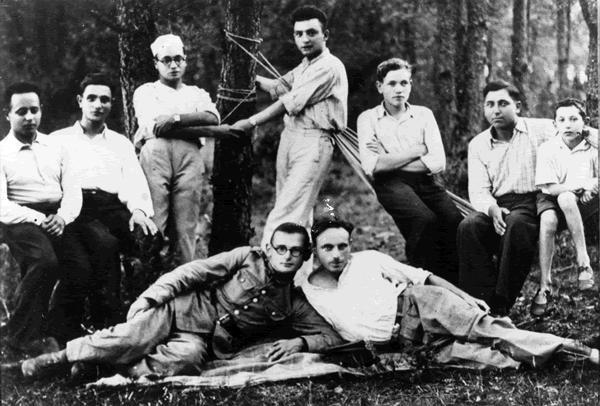
I'm Jakob Ejdelman' grandson from Israel. I'm very sorry to tell you
that my dear grandfather passed away two months ago. He was a very
special person. Very brave, a true hero- yet unpretentious...his story
could be found on the Horodok site....Weeks before he died he asked
me to send you one more picture with a name list ( in my next email),
Thank you very much for everything that you are doing.
Yaniv Rozensveig <rozyaniv@012.net.il> Jun 17, 2007
Pawel Ceitel (pawcei@op.pl) on Sunday, June 10, 2007
---------------------------------------------------------------------------
Message: hello, im very interested about picture #glu_11 from
glubokoye (Studio portrait of the four Ceitel sisters with a cousin in
the year 1913- picture from Yivo). . . could
anybody tell me somthing more about this picture? My second name is
Ceitel, so i
thing this is my lost family... Thanks a lot for any hellp! Pawel
Ceitel
Emily Raphael (emilyschulman@verizon.net)
Message: Very fascinating site. My grandfather came from Ivye in about
1911--his name on the ship's manifest was Leib Raffel or Roffel. We're
not
sure what the name was in Russia: we went with Raphael in this country
but
wonder if it was Raphalowitz or some cognate. Supposedly his father's
first
name was Mayer and his mother's name was Kashenka--they came to America
in the
teens.
Does this sound remotely familiar to anyone?
Sue Gitlin-Phillips (suephil2ca52@hotmail.com) Subject: Question
I am trying to find other people who are researching the GITLIN
family. I think that this family came from LYAKHOVICHI in part of the
old
Russian Empire which is BELARUS today.
MORRIS GITLIN, born circa 1865, emmigrated to Detroit, Michigan around
1900.
He is listed as a rabbi in Windsor, Ontario, Canada in 1906. He died in
in 1931
and is buried at Beth Olam Cemetary in Detroit, Michigan.
BRINA (BARMIS) GITLIN, was born about 1865, is listed as his wife.
According to the information I have found the children of this marriage
were:
Joseph
Eva
Lena
Florence
The son, JOSEPH GITLIN, moved to Windsor, Ontario, Canada and raised
his family
I would appreciate any information on this GITLIN family and the town
of
LYAKHOVICHI.
Eileen Spiegel (eitalk58@aol.com) on Monday, June 04, 2007 at 00:43:58
---------------------------------------------------------------------------
I am trying to find information on relatives on both sides of my
family. I was told that the Rumack family came from Braslav but I don't
see
their names listed. I am not sure if all of them emmigrated to the US
before
WWII. I know that there were Rabbis in the family if that helps at
all. Also Looking for family name: "Spiegel" May have been
"Spiegelansky".
Came from Vilna.
I was mistaken, I believe that the Spiegels or Spiegelansky family was
from Kaunas. If you have any information I would appreciate it. Thanks,
Eileen
Spiegel
I am looking for any information about the GITLIN family that came to
the Detroit, Michigan area circa 1904. Some members of the family
moved to
Windsor, Ontario, Canada directly across the Detroit River boundary. A
Rabbi
Morris Gitlin came to Windsor for the opening of a new synagogue in
Windsor in
1906. I believe that the family came from the town of Lyakhovichi in
the
Russian Empire ( now in Belarus). I would appreciate any contact with
Gitlin family members.
Suan Gitlin - Phillips
Shaarey Zedek synagogue opened in 1906 at the corner of Brant and
Mercer Streets with Morris Gitlin as Rabbi
If anyone is related to the families of Zydel or Manel
from Belarus, please contact me
Thanks and God bless
Rose Zydel
ThankGod
@optonline.net
One of the joys of having records translated under the auspices of the
Litvak SIG or JewishGen is that all sorts of unexpected hidden
treasures
emerge.
An example is a marriage record from Panevezys. The bride Khaia
Strashun
from Vilnius is the great niece of Mattityahu Strashun, the founder of
the
Strashun Library in Vilnius. Her father David Strashun was the
executor of
his uncle's will who made sure that the 5,739 books and manuscripts had
a
permanent public home.
Who would have thought to search for her marriage record in Panevezys
since
she was resident in Vilnius? Not only that, her groom, a widower, was
originally from Prussia. Evidently, the groom, Kopel Mikhaelis, was
living
in Panevezys, but how and why they came to be married in Panevezys
would
probably make a good tale.
This type of find is an example of what can come out of supporting the
translation efforts which have been underway for some time on not only
Panevezys, but many other shtetls as well. It is well-worth the
effort.
Ann Rabinowitz
My GGmother was Liba REICHEL from
Danilovitz. Liba had 2 brothers; Lieb and Nachman and one sister, Riva
*Rebecca*. Other relatives were SCHNEIDER, CEPLOWITZ and GITLITZ. My
question is: to what archives would I write to try and find BMD records
for Danilovitz? I have never used FHL records and do not know where
to begin. Any suggestions greatly appreciated!
Holly Cohen, Brewster NY
REICHEL, SCHNEIDER, GITLITZ, CEPLOWITZ from Danilovitz, Belarus, (? was
this formerly Vilna Gubernia Lithuania?)
also Nathan SCHNEIDER m Sadie WEINER from Lithuania, maybe Hevnia, near
Kovno
KURITSKYand YUMOLOFSKY from Minsk, Lithuania
FALITZ from Zhitomir
Holly Cohen, Brewster NY
Reb Dovid (son of Reb. Moshe of Kletsk) of Novarodok who had
been the Rabbi of this city some 200 years ago, authored the
"Galya Masechta"
..anyone knows of a connection between Reb Dovid and the HUREWITZ
family, a
member of which was Rabbi Isaac Simcha HUREWITZ who was a (the?)
Rabbi of Hartford, Ct. (USA) during the last decades of the 19th
cent. and early decades of the 20th? I haven't found any record of
Dovid's family name presuming that he did not have a family name
other than Reb Dovid Novarodiker (of Novarodok).
As I received several replies regarding both in the past but as two
different families, I am wondering if anyone know if the above
HUREWITZs and Reb Dovid were somehow related.
My interest stems from my research into a very strong possibility
of our family relations with the HUREWITZs and almost definite
connection to Reb Dovid, supposedly the brother of my ggggrand-
father, ABRAMOWITZ, who also left Europe from Novarodok.
Yoni Ben-Ari
Bonnie Altman (harnof@bellsouth.net)
Message: Great Site.
I have tried in vain to find out anything about our family from Vilna.
They came to the US around 1899. Are there no records?
I am interested in contacting members of the Ben-Menachem family that
emigrated to Israel in the 1930's from Slonim. They would be
descendants of Yeheskel or Nachum Ben-Menachem.
I recently found out that my wife's grandmother, Dvosha Mendelovich,
was their cousin.
Another part of that same family emigrated to the US and changed
their surname to Mandell. They would be descendants of Daniel
Mandell. Daniel had a son named Paul who married Florence Silverman
Any help would be greatly appreciated
Alan Tapper
Researching,
MENDELOVITZ,MENDELOVICH and MENDELEWICZ from Slonim, Byten and
Baranovichi
TAPPER from Snitkov
FARERH and BURDMAN from Tulchin
NEMIROVSKY from Lipovitz
HOCHBERG from Iasi
Arie Pelta, MD (ariepelta@yahoo.com)
Subject: Question
I noticed someone was related to a Pelta.
My family has a very unique name from Koinsk - Poland.
My grandfather Leon Pelta survived the war and went from Samarkand to Poland to
Sweden then to San Francisco. My grandmother was from Tomachov (spelling?)
maiden name Jeurkowitz (spelling?) from Tomaschov.
Does anyone know who the Pelta person is listed in the family tree.
My grandmother used to tell us about her brother in law who became a
lubavitcher - Mordechai Gurevich - is this the same one?
Dear Gordins:
My book "Finding the Jewish Shakespeare: the Life and Legacy of Jacob Gordin" has just been published in a very handsome edition by Syracuse University Press. Information about the book is available on my website; the book itself can be found at Amazon.com. Anything you can do to publicise the book would be a great help. I hope you enjoy it.
best
Beth Kaplan
Previously, over 12,000 City of Kaunas Internal Passport Records -1919-1940,
covering the surnames beginning with A - G and T - Z, were distributed to
the Kaunas Uyezd Group (KUG) at no cost to the contributors to the KUG. The
funds to pay for the translation of these records were raised elsewhere.
The Internal Passport Records for the City of Kaunas, covering the surnames
beginning with H through N, have been received. The list includes 9,016
records at a cost of $2,650.00. The KUG contributed $2,000.00 but another
$650.00 is needed. Rabbi Saydman, KUG Coordinator, issued a call for
donations on the LitvakSIG Digest. Unfortunately, only $100.00 was
contributed, leaving a shortfall of $550.00. The records cannot be
released until sufficient contributions have been received with which
to pay the translators.
The final group of Kaunas Internal Passport Records, covering the surnames
beginning with O - SH, will be received in the near future. 6,580 records
are included. Another $1,943.00 will be needed in order to pay the
translators. These records will not be able to be distributed to KUG
contributors until this amount is contributed. We very much dislike
delaying the transfer of these records to you but, since the translators
have to be paid, we have no other choice.
There are 1,756 researchers listed researching 2,931 surnames. I would
venture to guess that a very large percentage of those surnames are included
in the internal passport records. Even though your immediate family may have
left Lithuania prior to 1919, some family members as well as close relatives
probably were left behind. These records could add a whole new dimension to
your family tree. Hopefully, enough of the 1,756 researchers will find a way
to contribute to the KUG, specified for the internal passports, to enable us
to send out all of the records. If you have contributed previously, perhaps
you can find room in your budget to contribute again. Your help at this time
will be greatly appreciated.
Even though all of internal passport applicants applied in Kaunas, a great
many of them were born elsewhere. Their place of birth is included. It would
be too great a task to list all of the towns, together with the surnames, but
if you would like to support the project, your contribution would be
appreciated.
Your contribution can be made online, using your credit card. Just go to
the LitvakSIG secure Internet site and follow the simple instructions. If
you prefer to mail in your check or your credit card information,
instructions are there to enable you to do that also.
Just go to www.litvaksig.org and click on BECOME A CONTRIBUTOR.
Howard Margol
Coordinator, Internal Passport Records
President, LitvakSIG
LitvakSIG (litvaksig@lyris.jewishgen.org) is hosted by JewishGen
LitvakSIG is a non-profit 501(c)3 corporation. Contributions to LitvakSIG
may be made online at http://www.jewishgen.org/Litvak/HTML/donate.htm and
are tax-deductible as provided by law. Contributions may also be mailed
to LitvakSIG, Inc., c/o Aaron Roetenberg, 711 N. Franklin Street, York PA
17403. Contribution forms may be faxed to 717/815-0082. Please specify town
(for vital records) or district research group (and town of interest) for
other types of records, and include your e-mail address with your
contribution.
---
My paternal grandmother Celia SILVERMAN was born abt. 1883 in Riga,
Latvia. She was the daughter of Mendel Leib SILVERMAN and
Scheine/Yettie BERELOWITZ or KOTIN.Yettie and Mendel had several
children besides Celia. Among them were Ida, Nathan, Abraham and
Rachel. Mendel's parents were Israel Baruch SILVERMAN and Sarah BEILE.
Mendel died 10/9/1906 and is buried in Washington Cemetery, Brooklyn NY.
The EIDB shows Sheine KOTIN and her daughter Rachel, 6 years old
traveling on the ship Thingvalla 9/9/1897 leaving Copenhagen, Denmark
to join her children in NYC. Mendel COTTIN followed 7/9/1899 on the
ship S.S.Palatia from Hamburg, Germany with children Abram 9, and Zipe
18, to join his wife Schune in NYC. He was a butcher and from Skudy,
Kowno, Lithuania [now Skuodas, Kaunas].
The KOTIN/SILVERMAN family was sponsored by the BERLOWITZ family. They
all lived on Henry Street and they worked at the BERLOWITZ shirt and
dress factory. The owner was a brother of Scheine/Yettie. In the 1897
all Russia Census there is a BERLOWITSCH and KOTON family living
together in Jacobstadt from Schaulen, Kovno that I might be related to.
I have not been able to find an Israel Baruch SILVERMAN/SILBERMAN with
a son named Mendel Leib.
I have not been able to find any living members of my SILVERMAN / KOTIN
/ BERELOWITZ families. I'm hoping that this posting will help me locate them.
Best Regards,
Fran Meng
Walnut Creek, CA
We are going with Howard Margol's group to Kovna and Vilna in
June. I know my mother's family is from there. However, the
research is not finding them. Any suggestions that can be tried for
PELOFSKY, TABOLITSKY, TABOLSKY, TABALSKY, TABOLKY. Pelofsky is the
name that was used in the United States.
========================================================================
Bobby and Howard Jacobs
Highland Park, IL
Researching JACOBS, FANTL, FREUND, SAMSON, SALOMON, PELOFSKY,
TABOLITSKY, SPIEGELGLASS, FAINBERG, WEYENBERG, TOARELLO, KRUEGER,
LOCKE, TURTON, CORONA, EXSTEIN BLOND, ZUK, GATZ, MULNIK, PORTER, MEADOW, BORYS
Seeking any information on the related families of Kalman and Isaac
GORDON from Kovno Guberniya (probably but not definitely from the
town of Kovno/Kaunas itself). Both families emigrated to New York in
the 1890s, the husbands (arrived ca 1893-95) preceding the wives and
children (arrived 15 Sept. 1897). Isaac & Blume (or Bechie) GORDON
(both born ca 1863-64) brought two children from Lithuania, Sam and
Chaie (Ida). Kalman and Reise (Rose) GORDON (both b. ca 1865-66)
brought three children, Chone (Heiman), Chaie (Ida) and Chane
(Anna). The families each had several more children and together
operated a woolens business, which at one point was known as I.
Gordon & Son, at 103 Hester Street, NYC.
Kalman's parents were Leib and Chane GORDON. Reise's mother was
Sarah _____. That is all I know of either family in Lithuania,
except that someone in the family is said to have operated a
restaurant there. Kalman was my great-grandfather, and I have
detailed information on all his and Reise's descendants in the U.S.
I would appreciate any information concerning either family in
Lithuania, their relation to each other, or anything about Isaac and
Blume's descendants in the U.S., of which I know nothing past the
first generation.
Many thanks in advance for any light you may be able to shed!
Don Gordon
dgordon@calarts....ed
Have you ever wanted to contact the submitter of a Page of Testimony?
Have you ever wanted to find relatives of a victim documented on a Page of
Testimony?
If you answered "yes" to either of these questions, then there is a new tool
that can help you. My free website www.ShoahConnect.org makes it possible
to associate email addresses with Pages of Testimony, and automatically
matches people associated with the same Pages, facilitating semi-private
contact between them. "Semi-private" means that your email address is only
revealed to matches who contact you through the site, and only if you choose
to respond to them. None of this functionality is provided by Yad Vashem's
website (www.yadvashem.org), where Pages of Testimony can be viewed.
Example uses of this new tool:
Searching Yad Vashem's website, you found a Page of Testimony about a
relative of yours, submitted by his daughter. You would like to contact
her, but have not found her current contact information -- perhaps, she no
longer lives at the address on the Page, has since died, or has married and
changed her name. You can associate your email address with this Page, and,
if she or a close relative of hers does the same, you will receive a
notification email and be able to write to her through ShoahConnect. If she
chooses to respond, you will be in contact normally via email.
You found a Page of Testimony about a relative of yours, and you wonder
whether any other relatives of yours have also been looking at that Page.
If so, you would like to contact them. When you associate your email
address with the Page, you can choose to be notified not only when the
submitter associates himself with the Page, but also when other relatives,
like yourself, do.
A relative of yours disappeared from a small town. Nobody submitted a Page
of Testimony about him and nobody seems to know what happened to him.
However, you notice that a Page was submitted about someone else, unrelated,
from the same small town. You would like to ask the submitter whether he
also knows about your relative from that town. There is an option on
ShoahConnect for indicating your interest in the town, and you will be
notified of a match, if the submitter also uses ShoahConnect and chooses to
allow contact from unrelated "town researchers."
You submitted a Page of Testimony, or your parent, sibling, uncle, or other
close relative did. You have heard that there are sometimes dramatic
reunions of siblings who find each other through Pages of Testimony. You
would like to give yourself the chance to find lost relatives in the same
way. You can associate yourself as a submitter, and, if any relatives
associate themselves with the same Page, ShoahConnect will allow them to
write to you -- without your email address being revealed. If you choose to
respond, you will be in regular email contact.
You know someone who submitted a Page of Testimony, but does not have
Internet access. If he gives you permission, you can associate yourself as
"submitter" for the Page, and, if a match is eventually made, share the
email you receive with the submitter.
Since ShoahConnect is brand new, you should not expect a match to be made
immediately. However, your Page associations will remain (unless you choose
to remove them), and, if there is ever a match -- it could be weeks, months,
or years from now -- you will be notified. You can even help increase the
odds of there being a match by spreading the word to other genealogists,
Page of Testimony submitters, Holocaust researchers, etc.
Please let me know of any successful matches you make through the site!
Best regards,
Logan Kleinwaks
logan@ShoahConnect.org / kleinwaks@alumni.princeton.edu
near Washington, D.C.
LitvakSIG (litvaksig@lyris.jewishgen.org) is hosted by JewishGen
LitvakSIG is a non-profit 501(c)3 corporation. Contributions to LitvakSIG
may be made online at http://www.jewishgen.org/Litvak/HTML/donate.htm and
are tax-deductible as provided by law. Contributions may also be mailed
to LitvakSIG, Inc., c/o Aaron Roetenberg, 711 N. Franklin Street, York PA
17403. Contribution forms may be faxed to 717/815-0082. Please specify town
(for vital records) or district research group (and town of interest) for
other types of records, and include your e-mail address with your
contribution.
To all Sutzkever, Suckewer, Suskauer, Suskower and relatives,
I've just received translated records for Shutskever and and
Siutskever families registered in the revision lists 1816, 1834 and
1850 of Smorgon Jewish community.
Those who are interested, please contact me privately.
Ester De Paz
Herzelya, Israel
I am searching for information on my Great
Grandfather: ISRAEL BROSEN. his father was AVRUM (ABRAHAM) CHAIM
ha'COHEN and his mother's name was SARAH.
I know his father died very young @ 30 yrs old and his
mother remarried a man name Baker. ISRAEL may have
been raised by his grandparents.
I have been told he was from Kovna/Kaunas and also
lived in Riga.
SARAH immigrated to Evansville,Indiana.
ISRAEL immigrated @ 1901 or so. He came to America
using the name BROSEN/BROZEN and changed it to BAKER in
1914.
Judy Wexler
There are two Kossowsky (sic) families descended from the Vilna Gaon:
1) Descended from part of the Donchin (Don Yechia) family which is descended
from the Gaon's daughter Peisa Bassia the wife of Rabbi Tzvi Hersh Donchin
of Dissna.
.
2) Descended from the Gaon's granddaughter Hinda, wife of Rabbi Yosef Cohen,
parents of Luba who married Yisrael Yonah Kossowsky of Bialystok
(1830-1903). They have many deescendants in the USA.
See details in my book "Eliyahu's Branches - The Descendants of the Vilna
Gaon and His Family"
http://www.avotaynu.com/gaonbook.html
Sincerely
Chaim Freedman
Petah Tikvah, Israel
http://chfreedman.blogspot.com
Aviva Kempner conceived of producing a film on Jewish resistance
against the Nazis at the end of 1979. In 1980, she enlisted Josh
Waletzky, who had made "Image Before my Eyes", to be the
co-researcher, co-writer, director and editor of this World War II
film. Major funding for scripting and production was provided by the
National Endowment for the Humanities. Additional funding was given by
numerous individuals, including Ed Asner, Martin Brest, Joan Rivers,
and Barbra Streisand, Diane von Furstenberg, and various foundations.
The film was shot in Israel, the United States, Canada, and Lithuania.
An Israeli film crew was used for all the interviews, except in
Lithuania. Denied access to film in Lithuania, which was under the
rule of the Soviet Union in the early 80's, Aviva Kempner and Josh
Waltetzky were able to access footage from two survivors who
clandestinely filmed the scenes in Vilna and in the nearby woods. The
film was completed in 1985, and released by European Classics in 1986.
PARTISANS OF VILNA had its world premiere at the Berlin Film Festival
in 1986. The film went on to be shown at the San Francisco Jewish Film
Festival, Toronto Film Festival, London Film Festival, Chicago Jewish
Film Festival, Haifa Film Festival, Troia Film Festival, Moscow Jewish
Film Festival, Australian Jewish Film Festival, and the Palm Beach
Jewish Film Festival. A critical success, the film had a 1986
theatrical release in New York, Washington DC, Los Angeles, Tel Aviv
and other major cities. The film was also shown at the U.S. Holocaust
Memorial Museum and the New York Film Society at Lincoln Center.
The film won a CINE Golden Eagle, first prize at the Anthropos Film
Festival and honorable mention at the American Film Festival. The film
aired on numerous television stations, including BRAVO, the PBS series
Point of View, Channel 4 in England, WDR in Germany, Second Station in
Israel and Spanish television.
The film's accompanying record, "Partisans of Vilna: The Songs of
World War II Jewish Resistance", was nominated for a Grammy(r) award
in the folk category in 1991. The film is presently distributed by
National Center for Jewish Film.
Poet Abba Kovner is featured in the film and served as a principal
consultant. After the war, Kovner settled on a kibbutz in Israel. In a
literary career that spans more than 40 years, Kovner has published 11
volumes of poetry, a novel and a volume of essays that earned
international recognition and established him as one of Israel's
finest poets. In 1970, Abba Kovner won Israel's highest literary
award, the Israel Prize in literature. In addition, to his work as a
writer, Kovner was also the spiritual creator of Bet Hatefutsoth, the
Museum of Diaspora in Tel Aviv
Rokiskis had 194 marriages between the years 1874-1896,
and these ranged from ages 16-50. The marriages in that shtetl
predominantly occurred when the couples were in their 20's.
jewishgen digest: April 21, 2007
Drogicin is located in Belarus at 52° 11´ lattitude and 25° 09´
longitude. It is 155 miles (250 KM) SW of Minsk.On a good detailed map
of the region one can find it on the road between Brest and Pinsk,
about 70 km west of Pinsk. It was located in the Grodno Gubernia. .
The entire Yizkor book (Published in Chicago, 1958 )
could be found online in English
you could read about rabbi Yossel/Yosef Goldman
son of Tzemach/Tsemakh Goldman ;
http://www.jewishgen.org/Yizkor/Drohichyn/dro125.html#goldman
I am pasting some about your family here;
RABBI YOSEF GOLDMAN
(Rabbi Yossel, the Dayan [Rabbinical Judge])
by his grandson; Rabbi Yehuda David Goldman (Chicago)
.... My grandfather, R. Yossel, was one of the first
students in the newly established Mir Yeshiva, and was known as the
Genius of Khomsk. When he got older he became the son-in-law of R.
Yudel David Kosovsky of Drohitchin, who I am actually named after, and
who was the rabbinical judge of Drohitchin and one of the leaders of
the community.
When the great scholar and rabbi of Drohitchin, Rabbi Zvi Eliyahu,
died, two camps developed in town. One group wanted Rabbi Zvi
Eliyahu's son, R. Menachem Reichman, to become the rabbi in town. The
other group wanted my grandfather, R. Yossel, to occupy that position.
After a rabbinical court case, and the judges ruled in favor of R.
Menachem, who became the rabbi of Drohitchin......
Also in the book; Chava Leah Skolnick, wife of R. Moshe Velvel, was
born in approximately 1864 on the Zasinov estate near Bereza. Her
father, R. Aharon Kosovsky, was the estate broker. Besides her
domestic tasks, he found the time to help others as well. She would
frequently go door-to-door to collect money for charitable causes,
help out widows and orphans, and take interest in the plight of the
poor. In the United States she continued this work. Chava Leah passed
away on 6 Nisan [March 24], 1931 in Chicago.
SHLOMO ZELIG GOLDMAN
Shlomo Zelig Goldman, a son of Shimshon and Henya Chaya
Goldman, was born on June 30, 1896 in Drohitchin, and studied in the
yeshiva of Rabbi Mordechai Minkovich. At the same time he studied
general studies, Hebrew and Russian privately.
After he married Rachel Goldman, a daughter of R. Eliyahu
Goldman of Brisk (a sister of Rabbi Yehuda David Goldman of Chicago),
R. Shlomo Zelig opened a haberdashery and confectionary in Drohitchin.
At the same time he was active in community affairs, serving for many
years as a member of the local municipality. He served as a director
of the Folks Bank; director of the charity fund; vice-chairman of the
Jewish community council; treasurer and director of the firefighter's
association; president of the General Zionist Organization; president
of the Tarbut School, president of the Keren Hayesod, and member of
the Jewish National Fund.
In June 1941, Shlomo Zelig and his wife were sent to Siberia
(Upper Berezovka, Altaic District) by the Soviet regime, and they
worked in the forest. Following the Soviet-Polish (Shikorsky)
Agreement, they were released from Siberia and worked in Sarakino,
Russia as senior accountants.
When they returned to Poland in April 1946, Shlomo Zelig
worked in Waldburg (Wolbzhich) as secretary of the Zionist
Organization Ichud [Unity] and Breicha (an organization involved in
helping Jews leave Poland).
In August 1946 he was smuggled into Munich, Germany, and from
there, through refugee camps to Leifheim, near Olm. In the beginning
he was employed in Leifheim as the director of the historical
commission involved in collecting material pertaining to German
cruelty and murder. Thereafter he was elected to the camp
administration and worked there as senior accountant. Shlomo Zelig was
also the chairman of the General Zionist Organization, Jewish National
Fund Commission and representative of the Jewish Agency.
In April 1948, the Goldmans left Leifheim for Bergen-Belsen,
where they obtained a certificate from the British occupation
authorities, and reached the shores of Israel via Marseilles in June,
1948. The settled in Kiryat Motzkin.
Shlomo Zelig was the co-founder and chairman of the Drohitchin
Association in Israel, as well as first treasurer of the large
synagogue in Kiryat Motzkin
Table of Contents of Drohitchin Yizkor Book
http://www.jewishgen.org/Yizkor/Drohichyn/dro001.html
-----------------------------------------------------------------
My father, my self: A son's memoir of his father, Rabbi Yehudah D.
Goldman, America's oldest practicing rabbi (Doris Minsky Memorial Fund
publication) (Unknown Binding)
by Alex J Goldman (Author)
--------------------------------------------------------------------------------
Rabbi Emeritus Alex J. Goldman, z"l
Rabbi Goldman was Beth El's spiritual leader from 1966 to 1992 and
passed away in late 2004. One of his greatest contributions to the
synagogue is the Rabbi Alex Goldman Heritage Museum, a magnificent
collection of Judaica found in our sanctuary lobby. And our beautiful
sanctuary itself, with its walk-in ark and unique windows, remains as
a tribute to his leadership and vision.
The son of one of America's most respected rabbinic leaders, Rabbi
Yehuda D. Goldman, he was ordained at the Hebrew Theological College
of Chicago and served Hillel foundations and congregations in
Tallahassee, Florida, and Philadelphia before coming to Stamford. He
has published twelve books, including a novel, and his latest
children's book, "I Am A Holocaust Torah," will be published by Gefen
Publishers, Israel.
Rabbi Goldman held advanced degrees in law and marriage counseling and
was president of the Hew Family Service. He was married to Edith,
father to Robert and Pam, and grandfather of two.
Thank you so much,
Eilat
On 4/21/07, El529@aol.com <El529@aol.com> wrote:
>
> i wrote to you many years ago--i am still searching for my mom's
family of
> kosovsky relatives and family of the dayann of drochitchen/drohitchyn
> his name was
> rabbi yudel dovid kosovsky and his wife [and mother were possibly
goldman
> girls]--i don't know when he was born, but one of his sons was born
in
> 1840--i am from that line
> his oldest daughter esther married rabbi yossel/yosef goldman
son of
> tzemach/tsemakh goldman also possibly a rabbi[f rom the town of
chomsk]
> yosef became a dayann in drochitchen too
> one of yudel dovid's grandaughters chavey/chavay or eva leah
married a
> rabbi meishavalla after marrying the kosovsky girl, lived in
drohitchyn
> kobryner ooyezd grodner goobenic beyeh rossia
> DO YOU HAVE ANY INFORMATION ON THEM?
> thanks--elaine biblin spiegel on behalf of
> kosovske/kosovski/kosofsky/kossovksy/kosovsky family
> also i am searching for Biblin relatives--they come
from
> Grodno as far as i know
> thank you
> elaine biblin spiegel
> 1444 orchard lane
> northbrook illinois
> 60062-5432
>
> 847-564-4611
Anne Rachel Ruderman (annerachell@ao
Message: I was born in Rochester NY. My father was Herman. His brother
is
Irving and his father was Isadore. I was named after my grandmother -
Anna.
Name: Isadore I Ruderman
Home in 1930: Rochester, Monroe, New York
Age: 55
Estimated birth year: abt 1875
Birthplace: Russia came to the country in 1904
Relation to Head of House: Head
Spouse's name: Anna A born in Poland
Race: White
Occupation:Merchant, retail dry goods store
home value:owns his home $13.000
Age at first marriage:he 36 she 26
Parents' birthplace: Russia
Household Members: Name Age
Isadore I Ruderman 55
Anna A Ruderman 45 Came to the country in 1904
Erwin H Ruderman 13 born in New York
Herman D Ruderman 9 born in New York
Lena Bernstein 29 boarder from Poland
Marian Umof 26 boarder from Poland
-------------------------------------------------------------
Name: Herman D Ruderman
Birth Year: 1920
Race: White, citizen (White)
Nativity State or Country: New York
State: New York
County or City: Monroe
Enlistment Date: 18 May 1943
Enlistment State: New York
Enlistment City: Rochester
Branch: No branch assignment
Branch Code: No branch assignment
Grade: Private
Grade Code: Private
Term of Enlistment: Enlistment for the duration of the War or other
emergency, plus six months, subject to the discretion of the President
or otherwise according to law
Component: Selectees (Enlisted Men)
Source: Civil Life
Education: 4 years of high school
Civil Occupation: Ship Fitter or Boring Mill Operator or Engine Lathe
Operator* (Lathe operator, heavy. ) An asterisk (*) appearing after a
job title indicates that a trade test for the particular occupation
will be found in the United States Employment Service Manual, Ora
Marital Status: Single, without dependents
---------------------------------------------------------------
Name: Herman D Ruderman
Arrival Date: 1 Jan 1946
Port of Departure: Marseille, France
Ship Name: Monticello
Port of Arrival: New York, New York
Line: 12
Microfilm Serial: T715
Microfilm Roll: T715_7046
Page Number: 190
1920 census;
Name: Isaac Ruderman; dry good store proprietor
wife; Anna A Ruderman
Home in 1920: Rochester Ward 7, Monroe, New York
Age: 40 years
Estimated birth year: abt 1880
Birthplace: Russia
Relation to Head of House: head
Father's Birth Place: Russia
Mother's Birth Place: Russia
Marital Status: Married
Race: White
Sex: Female
Year of Immigration: Un
Able to read: Yes
Able to Write: Yes Household Members: Name Age
Isaac Ruderman 40 came to the country in 1905 na 1911
Anna Ruderman 35
Henry Ruderman 3 6/12
Edward S Leibert 30 Cousin from New York- Artist
1850 Dolhinov (Dolginovo), Vilna Guberniia
Jewish Community Revision Lists (Census)
pp. 261v-262
Entry # 219
Yankel (Jacob) son of Gabriel RUBIN Age 59 (i.e.,
born in 1791)
his wife Chaya daughter of Abraham Age
30 (i.e., born in 1820)
his sons:
1. Gabriel Age 12 in 1834
(missing since 1849)
2. Khatzkel Age 8 in 1834 (died in
1846)
3. Leiba Age 12 in 1850 (born
in 1838)
Entry # 220
Itzko (Isaac) son of Shimon AXELROD Age 34 in 1834
(born 1800) - died in 1835
Itko's wife Lea daughter of Yiekem Age 52 in
1850 (i.e., born 1798)
Itko's daughter Dvoiya? Age 18
in 1850 (i.e. born in 1832)
Itko's sons
1. Yokel Age 30 in 1850
(i.e., born 1820)
2. Yosel Age 24 in
1850 (i.e., born in 1826)
Yosel's wife Sora daughter of Rubin Age 23 in
1850 (i.e., born in 1827)
Yosel's daughter Dveira Age 1 in
1850 (i.e., born in 1849)
The Axelrod and Rubin families intermarried frequently.
1. Dveira daughter of Yosel AXELROD (listed here as age 1 later
married Yehoshua (Harris) RUBIN.
2. Abba son of Itztik (brother of the Dveira) married Dvora
daughter of Yaacov (Yankel) RUBIN.
Moreover, the fact that these RUBIN and AXELROD families are listed
next to each other in the 1850 census means that there is an excellent
chance that they were related.
Schneur, check this out
http://chabad.info/bm/index.php?...=goto_id& id=132
Turns out Rav Landa z'l is you landsman.
berl, crown heights | 04.13.05 - 7:29 pm | #
--------------------------------------------------------------------------------
Berl.
Thank you. i saw this several weeks ago. And I later contacted him.
Berger also wrote an article on Kurnitz the town in BM .Footnote no. 1
is about my uncle Reb Zalman Kurnitzer (Alperowitz) of Kurenitz, Nevel
and Leningrad.
Schneur | 04.13.05 - 8:10 pm | #
--------------------------------------------------------------------------------
My late father as a post bar mitzva bachur studied with Hillke Landa ,
- gemora mit rashi- as a private student for 3-4 years .
Hillke was the younger brother of R. Yankev. He did not become the rav
because he was an alter bachur and the eylem would not hear of it. An
illuy atzum !
So Anash brought rav Uszpol, a opuster hasid, (Reb Berel's father) and
the eylem brought rav Feldman . Later everyone was killed .
My father said Hillke looked like YIBlechaim tovim aruchim Rav Moshe
leib.
My father had dozens of stories about Hillke, R. Yankev and the
original R. Moshe leib . I recorded many of them .
But who knows if they will ever be printed.
It was reb Yankev who sent my uncle to Tomche Tmimmim , which my
father remembered as a little boy and never saw his brother again.
So now they are all in alma deKeshot.Chaside kurnitz .
Schneur | 04.13.05 - 8:18 pm | #
--------------------------------------------------------------------------------
Since my father was born in Chodesh Nisan and as such named after the
Zemach Zedek, I will note the following in his memory.(Actually the
memory of all Kurenitzer and the zemach Zedek)
Kurnitz had a large chabad community with chassidishe shochetim a rav
even a more horahe Reb Ureh ,Hayad.
2 Kurnitzer became roshe yeshiva in TTL my uncle Reb Zalman and Rabbi
Berel Gorfinkel.
The original Malach rabbi Levine spent lots of time in K, even though
he was a native of Ilya.
Reb Moshe layzer Kramer considered Kurnitz his home town .
The Zemach Zedek visited Kurenitz .
The landau family was meshadech with the zemach Zedek.
My father was zoche to have 2 yechidusen with the Rayaatz in the
1930's and described them in a very special manner which I again
recorded.
Not bad for a small town of under 1,000 Yideen. hashem Yinkom damam
bimhero
Schneur | 04.13.05 - 8:27 pm | #
Dear Eilat,
Probably the way to go about finding out how to trace Asne Kriger and
Yehuda Chait is through Irina Veinberga or Rita Bogdonova with whom I
dealt initially.
irinwein@latnet.lvThe other possibility is to write to the Latvian Archives of the
Registry Department at the following address: Kalku Street 24, Riga
for the archives of the birth, marriage and death records for the time
period up to for the time period for 1906-1921, because the Latvian
National Archives is only until 1905, for birth, marriage, death
certificates.Both my grandparents died before WW2 and were buried in Riga, but as
you may know the cemetery was destroyed by the Lats and turned into a
public park. Zila, the sister of my father eventually made it to
Israel in 1972 and died in Jerusalem in 1998. Leo, the brother of my
father was picked up by the Germans after their invasion of Riga
probably somewhere towards 1942 and shot in the back outside his home
in the street.In 1973 I put a trace on this uncle of mine Leo Krieger while I was in
Switzerland. He was known as the pride of the family and as the
genius of the family. As a child he was only interested in the
sciences and was known to spend hours in solitude locked away in his
room doing chemical experiments and solving mathematical problems.
While kids were out scraping their knees climbing trees and buying
chocolates with their pocket money, he was only buying chemicals,
scales and Bunsen burners. Somewhere towards 1920 my late
grandfather Oscher, received a letter from Albert Einstein in Berlin
to say that he had received a very interesting thesis from Leo and
asked him to please bring his son to Berlin for an interview.
Together they travelled from Riga to Berlin. Einstein interviewed
him for a few hours in his living room while my grandfather waited
outside. Upon completion of this meeting he told my grandfather that
his son was exceptionally gifted and that he wanted him to go to a
colleague of his at the University of Jena in East Germany to continue
his studies. Einstein apologised that he could not take him on
himself since he was shortly leaving Germany for Japan since he was a
dissident. My Uncle Leo then went to the University of Jena. He
then had to leave the University of Jena for discrediting a theory of
a certain professor and the professor told the Dean of the University
that he would leave if my uncle stayed, He then went on to the
University of Basle in Switzerland where he remained for a few years
completing two faculties of applied mathematics and chemistry. He
wrote many papers and was on his way to an important career when the
Swiss expelled all the foreign nationals in 1940., Being a Latvian
national he had to return to Riga and there he was eventually picked
up by the Germans. As I said in 1973 I was in Basle, Switzerland,
and I was fortunate to find his papers at the University and City
Archives. I have photocopies of all of these.My late father, Behr or Bernard and his Hebrew name Dov, died in
Johannesburg in 1992 and is buried there. My late sister, Genevieve
Kirson nee Kruger died in Johannesburg in 1993. She is survived by
two daughers, Saskia and Gabrielle, both living in Australia and I
have two sons, Omri and Oz Matan both in Israel.That is the story in a nutshell. Going to Riga was a very special
and moving experience and I remember the day I was in the Archives and
was given the ID book of my grandparents to hold. I remember their
fingerprints in the books and I cried to think that this was the
closest I would ever get to touch them. The grandparents I never
knew.Please let me know if you have any luck getting the information you
need,Hag Sameach again.
Roberta
Hello!
Thanks for your remarkable site. I have casually found it and have been
simply amazed, having read through the information about my relatives
and
having seen their photos. A question about my great-grandfather, Rabbi
of
Rakov, Hirsh -Slomo Finkel and his children, writer Uri Finkel, Libsha
and
Yitskhok . They were the brothers and the sister to my grandmother, mum
of my
father, Tzilya Finkel, died at sorts in 1930 and Aunt Sonya (Sheina)
which has
grown up and has brought up my daddy and his sister after the death of
mother. My
father often told me about these people, in the house their photos
always
hung, therefore I without effort could find them out on your site. Here
there
is a story about Hirsh - Shlomo Finkel and that he send the Pinkas of
Rakov to
his son Uri Finkel . What is Pinkas mean?
http://www.eilatgordinlevitan.com/kurenets/k_pages/pupkin.html
Thanks
Yours faithfully
Liza Berzon
Oak Park ,MI
Pinkas= a note book with all names and the information about the
people of Rakov and their social activities and so on...
Steve Rosen' grandmother was a very involved member of the Dinerstein/
Shepsenwol family from Ilya and Radoshkovichi. Steve uncovered much of
the history of those families, as well as the history of many of the
shtetles in the area.
From The Jewish Daily Forward;
http://www.forward.com/articles/fbi-affair-costs-lobby-dynamic-director-rosen/
FBI Affair Costs Lobby Dynamic Director Rosen
.... Steve Rosen, 62, grew up a red-diaper baby in New York. His
parents, Rosen tells his friends, were too caught up in issues of the
left — such as the Spanish Civil War, organizing unions and
McCarthyism — to think about Israel. His passion for the Jewish state
emerged when, as a young university professor, he studied Israel's
wars with its Arab neighbors.
He joined Aipac in 1982, after a short career in academia and a stint
as an analyst at the California-based RAND Corporation. At the time,
Rosen championed the notion that Israel was a first-rate strategic
asset to America in the Cold War. That notion, he told his Aipac
colleagues, would be most effectively pushed in the White House, the
Pentagon and the State Department rather than on Capitol Hill. Soon
Rosen turned Aipac's department of information and research, which he
headed, from a branch aimed at serving the lobby's legislative
department to an independent entity, which mainly lobbied the
executive branch.Rosen pushed for the formation of an independent think tank that would
be funded by many of Aipac's donors: That body, the Washington
Institute for Near East Policy is America's most active and
influential Mideast think tank today."He's a very talented person," said Malcolm Hoenlein, executive vice
chairman of the Conference of Presidents of Major American Jewish
Organizations. "I don't think anybody is happy to see him go."
A picture of Steves' family;
http://www.eilatgordinlevitan.com/kurenets/k_pix/dinnerstein/1din_b.gif
Thank you.
Peter Hills
London UK
Searching
VELONSKY (Jurbarkas and London))
PRUZ(H)AN (Vilna London and Seattle)
RAYMOND/RAYMAN (Vilna and London)
From: Eilat Gordin Levitan <eilat.gordinlevitan@gmail.com>
Date: Apr 14, 2007 3:01 PM
Subject: Chaits- Carl, I FouCarlos@aol.comnd your grandparents marriage
To:
Cc: Baruch Sendler <sendlerb@bezeqint.net>
Dear Carl,
You said that your grandparents were Meyer and Leya Chait. They had 3
children; Morris ( Moshe?) born in 1892- he lived with you in Boston
since before your birth in 1926. Your mother ; Rose (Reizele) blackman
was born in 1895 and came to the U.S c 1908 and Sarah Rivka who
perished with
your grandparents in Pasvalys.
Here are the details of Meir and Leyas' marriage;
Marriages date; 23 -12- 1890 (24 Tevet) Groom; KHAIT Meer son of Icyk
age 30 married FURMAN Eta Leya daughter of Meer age; 24
Pasvalys Panevezhys Kaunas Rabbi; Mortkhel Rabinovich witnesses; Icyk
MONESH Mortkhel Meer was registered in Birzhay.
The sister of Eta Leya nee Fruman also married a Khait;
. 1874 marriage - 12- 9 -1874 (23 Elul) Vabalninkai KHAIT Zundel son
of Mortkhel age; 25 FURMAN Dveira daughter of Meer age 21
Pasvalys Panevezh
--------------------------------
Some others who I am working on...
1. Yankel son of Avraham chait married 4- 9- 1859 (17 Elul) age 21
married Taiba Rakha daughter of Yankel age 20 Pasvalys Panevezhys
Kaunas rabbi; Ovsei Zvulun Movshovich SHAPIRA witnesses; Meer Yankel
GERSHENOVICH Mortkhel Shliomovich SHULMAN Yankel is a musician
(many in our family are musicians)
------------------------------------------------------------------
2
----------------------------------------------------------------------------------------------------
3. marriage 28- 12 -1882 (1 Shvat) Birzhay KHAIT Borukh son of Abram
age 23 married KLINKPKO Fruma Dina daughter of Aizyk age 24
Pasvalys Panevezhys Kaunas BenaBenyamin DIMANT ys Kaunas Girsh
Shmuelovich Abaram
-----------------------------------------------------------------------------------
4. 12 -8 -1884 (3 Elul) KHAIT Meer Nison son of Faivish age 23
Birzhay married Khava daughter of Yankel age 25 Pasvalys
Panevezhys Kaunas Yankel LEVI Sh.1886
-------------------------------------------------------------------------------------
5. marriage 8- 8- 1886 (19 Av) Vabalninkai KHAIT Yankel Leib son of
Girsh age 23 married Sory daughter of Leizer age 22 Pasvalys
Panevezhys Kaunas Mortkhel Rabinovich Icyk MONESH Meer Nison
Faiveshovich Idelovich
------------------------------------------------------------------------------
6. 1890 (1 Sivan) Pasvalys KHAIT Abram son of Yankel age 28
married Mushka daughter of Nakhum age 22 Pasvalys Panevezhys Kaunas
Mortkhel Ra
---------------------------------------------------------------------------------------------
7.
--------------------------------------------------------------------------------------
8. 3 -1891- 24 (Adar 2) Pasvalys KHAIT Shulosh son of Shloma age
23 married KLACES Sora Cerna daughter of Yankel age 24 Pasvalys
Panevezhys Kaunas Ravvin FLEISHMAN,Mortkhel Rabinovich Mortkhel Leizer
Shmueliovich Yankeliovich Icyk
MONES Mogilev identity prove given Mogilev 10-03-1890, number 951,
groom is choir musician
----------------------------------------------------------------------------------------------------
9. 2- 7 -1891 (8 Tammuz) Birzhay KHAIT Khaim son of David 26
AKHBER Gene daughter of Borukh 22 Pasvalys Panevezhys Kaunas
Ravvin FLEISHMAN, Mortkhel Rabinovich Icyk MONES Mortkhel Leizer
Shmueliovich Yankeliovich
------------------------------------------------------------------------------------------------------------My
relatives (changed their last name to Highstein);
10. 28 -8 -1898 (22 Elul) groom from Birzhay name; KHAIT Mendel son
of Icyk David age 25 Krekenava married KRIGER Civiye daughter of
Zusman age 24 Pasvalys Panevezhys Kaunas rabbi Abram GAFENBERG/
Hofenberg
Gershon David KIMEL (from Vashki) Vulf VOLMAN all from Vashki bride
side.
----------------------------------------------------------------------------------------------------------
11. 15 -1 -1899 (16 Shvat) Birzhay KHAIT- Lip Yudel-son of Faivish
age 23 Shiauliai
SHEROV Yudel Izrail 25 Pasvalys Panevezhys Kaunas Ravvi assistant
Icyk FLEISHMAN, Mortkhel Ravinovich IcykMONES Mortkhel Leizer BEDER
-------------------------------------------------------------------------------------------------------
second marriage; 12. 26- 4 -1899 (28 Iyya)r Pasvalys KHAIT Shulom
Shlioma age 34 Pasvalys
KLACES Khaya Mirla Berel 26 Pasvalys Panevezhys Kaunas Movsha
Ravinovich, Ravvi assistant Icyk FLEISMAN Leizer Mortkhel BEDER Icyk
MONES
-----------------------------------------------------------------------------
13. 23- 1 -1901 16 Shvat Kibursk AKHBER Martkhel Peisakh 23
Kibursk KHAIT Dveira Pera daughter of Khaim Zyk 23 Pasvalys
Panevezhys Kaunas Khaim Soul LEVITAN H
--------------------------------------------------------------------------------
14. 18-2-1900 1 Adar 2 Bogorodick SHEVEL Osher Icyk
son of Movsha age
29 Pasvalys KHAIT Sara Khashe daughter of Abram Berel
age
23 Pasvalys Panevezhys Kaunas I. FLEISHMAN, Movsha
Ravinovich Icyk
MONES Mortkhel Leizer BEDER
Births;
1. Pasvalys 1883 M58 KHAIT Ber Leizer son of Eliya and Ita 30 12
1883 13 Tevet Pasvalys Panevezys Kaunas Kiburksk husband is from
Kiburksk
------------------------------------------------------------------------------
2. 1884 M45 KHAIT Abram Abel David Girsh Reiza 27 11 1884 21
Kislev Pasvalys Panevezys Kaunas Pasvalys husband is from Pasvalys
1886 F26 KHAIT Nekhama David Girsh Reizy 17 9 1886 29 Elul
Pasvalys Panevezys Kaunas Pasvalys husband is from Pasvalys
---------------------------------------------
Pasvalys 1888 F6 KHAIT Sora Khana David Movsha Reize 26 2 1888 26
Adar Pasvalys Panevezys Kaunas Pasvalys husband is from Pasvalys
-----------------------------
3. Pasvalys 1884 M61 KHAIT Ber son of Aron Mendel son of Berel Sheina
22 12 1884 16 Tevet Pasvalys Panevezys Kaunas Birzhai husband is
from Birzhai LVIA/1226/1/1311/69
-------------------------------------------------------------------------
4. Pasvalys 1884 M62 KHAIT Vulf son of Khaim Zusman son of Shlioma
Mikhla 23 12 1884 17 Tevet Pasvalys Panevezys Kaunas Pasvalys
husband is from Pasvalys
--------------------------------------------------------------------------------
5. 1885 M51 KHAIT Shebshel Yankel Abram Mussa 28 11 1885 2 Tevet
Pasvalys Panevezys Kaunas Pasvalys husband is from Pasvalys
1887 F17 KHAIT Mere Riska Yankel Abram Musla 3 9 1887 26 Elul
Pasvalys Panevezys Kaunas Pasvalys husband is from Pasvalys
------------------------------------------------------------------
I will check the rest of the birth list later.
Shirley Bruk (formerly Temkin) (shirley@bruk.co.za) writes:
My father came from Posval (Pasvalys) to South Africa in 1929 and his
parents and all but one sister (who went to Israel) remained in
Lithuania. Unfortunately they were victims of the Holocaust. I was
named after his mother (i.e. my grandmother) Sheina Temkin who is on
your Yad Vashem list. Do you have any other information on the Temkin
family from Pasvalys. Sheina was married to Chaikel (Chaim) who is
also on the list.
Thank you.
It is wonderful that you work on this website.
Shirley Bruk.
-----------------------------
From Yad Vashem reports by Dvora Kaplan ( Chaim and Sheinas' daughter
in Israel) in 1956 and her daughter Ruth Shamir in 1999; Chaim Temkin
was born in 1884 to Akiva and Chaia his wife; Sheina nee Mer was born
in 1886 to Israel and Miryam. They perished in 1941 with their
Daughters;
Ita ( or Etka) born in 1916 she was a clerk
Mikhal born in 1918, she was a clerk.
Miryam age 15. There are pictures of the daughters with the reports
by Ruth Shamir (nee Kaplan) the daughter of their sister; Dvora
There is also another family Temkin who must be related;
The head of the family is Hirsh Temkin and his wife is Ida nee
Halperin. Ida was born in Smorgon in 1896, but they lived in Pasvalys.
They had a son Akiva ( the same name as the father of Chaim Temkin),
age 10 and another son age 8- They also had a daughter Leah born in
1924
the reports are by the sister of Ida; Chana Fishbin.
There is also a report about Nechama of Vablonik, who was married to
Yizhak Temkin of Pasvalys. The report is by her cousin; Meirson
On 4/4/07, aaronrb@comcast.net wrote:> The LitvakSIG vital records
We have Pasvalys birth and marriage records..... other towns listed:
Pumpenai, Krekenava, Linkuva, Birzai and many others. Pasvalys was the
rabbinate for the area for a while..
I am so happy that I donated the $100 for the project!
I found records of birth for 5 of my grandmothers' brothers and sisters
including a sister; Chana Khait who died at a young age. Even my
grandmother did not know her first name. It is very easy to know that
it is her sister since the report includes full names of the Fathers(
Yudel Khait), Mother ( Asne Kriger) and grandfathers ( Avraham Khait
and Zusman Kriger). In the reports there are also the towns of origin.
For Asne Kriger it is listed; Krekenava. Krekenava was the town were
the Kriger family was registered but Asne and her parents lived in
Vashki. Yudel Khait was listed in Vabalinks( sp?) for the older
children and in Pasvalys for the younger.
for a picture of the family;
http://www.eilatgordinlevitan.com/vashki/vas_images/30101_1_b.gif
and also;
http://www.eilatgordinlevitan.com/vashki/vas_pages/vas_fam_chaits.html
The most important information I found (for my extended family) is the
origin of the Highstein family (the family of Asne sister; Civia nee
Kriger).
Their grandchildren in Baltimore did not know!!!
I found the record of the wedding in 1898 of Civia, daughter of Zusman
Kriger from Krekenava to Mendel Khait, son of Itcyk David of Birzai.
So all the Highsteins ( named for Highstreet in Baltimore!) are Khaits
from Birzai
and most likely related to us twice!!!
For pictures of Highstein family
http://www.eilatgordinlevitan.com/vashki/vas_pages/vas_fam_highstein.html
Also found records of wedding Of Asne brother; Leib Kriger son of
Zusman Kriger and Sheine Levin (nee Luria) daughter of Yosel Levin as
well as records of weddings of Sheines' brothers. All my relatives had
the same
rabbi and witnesses; Rabbi Avraham Chaim Hofenberg of Vashki ( I know
his grandson- Shraga Hofenberg of Tel Aviv) the witnesses were names I
found on the Vashki list of homeowners c 1900.
Found marriages record of cousins of my great grandmother; Most
important; Shaie Feldman son of Zavel to Dina Beila Kriger daughter of
Yechel ( the brother of my Great great grandfather). They perished in
the holocaust but some of their children ( Sara, Meir and ?) came to
South Africa before
the war. No one gave a report about them to Yad Vashem. Now I am able
to give a report to Yad vashem with much information about them. they
are pictured here (the top, with their daughter; Sara) the bottom is
my great grandmother sister Rivka (nee Kriger) Segal who perished with
her husband and daughter; Metuka Zisa
in 1941. Son Arye came to Israel in 1939. He is pictures here with his
wife and daughter Ronit nee Segal.
http://www.eilatgordinlevitan.com/vashki/vas_images/41901_2_b.gif
Thank you (The LitvakSIG) so much for the list!
If anyone would like me to check the list for their family write me
eilat.gordinlevitan@gmail.com
Eilat Gordin Levitan
I ask you to read this letter till the end! Don't treat my words with
indifference. On Your charity depends the fate of my child!
I am Oleg Byalik , date of birth 1964 , passports No 313690364
A repatriated from Ukraine (Kiev) to Israel in March of 1999 with my
family
However; My wife Alla Bialik left our child and I on 28 of September
2000
and went to be with another man in Kiev.
She robbed me and my child , took money from personal
savings , left us with our debts and went out of Israel.
Ten years I have suffered from diabetes (diabetes mellitus
type II) , I get three injection of insulin per day . After
the endured stress I find myself in hospital with diagnosis
: diabetic ketoacidosis (hiperlipidemia). I am 65%
Physically Unable.
I found myself In situation I was never imagined. We have no
relatives and friends in Israel.
I shall struggle for our surviving with my child till my last breath.
But at present moment I am not imagining how I and my child can go out
of this financial bankruptcy.
My money that I get from Bituah Leumi were cut to 2163
shekels for month. Now it's even not enough to buy food and
pay taxes. Because of my Physical inability I can not work.
My son is an Israeli soldier MAGAV IRUSALAEM in a year can
not be hungry.
Therefore I apply to you , asking to help as you can.
I can send you my documents that can proof personal information with
your request.
Contact telephone from the U.S.A; 011 972 5 28788899
from Israel; 0528788899
Our address is Bialik family.
TVERIA 4, Haifa, 33062 Israel,
With respect
Oleg Bialik
unkal1@netvision.net.il
Sad, Jewish people who scam;
I checked the phone number with google and found many adds in Russian-
I am pasting 2 here;
For people with low social status (Beneficiaries Hapoalim Fee, health
problems), being on the social service.)I prepare
individual programmes in order to get the money from Jewish charitable
funds.Externalize and
consulting on this issueй.I have vast experience of the Jewish
philanthropy.
. 0528788899Oleg is 0528788899
E-mail: volyer@rambler.ru E-mail : volyer@rambler.ru
-----------------------------------
January 16, 2006, 9:48:57
!!!FOR PERSONS
RECEIVING AID BITWAH LEUMI, LIVING IN ACCOUNTING FOR SOCIAL SERVICE OF
PROBLEMS WITH HEALTH! ! !.SOSTOVLU PERSONLONA PROGRAMME FOR CASH FLOWS FROM
JEWISH
BLAGOTVORITIONAH FUNDS.KURIRUU PROVOJU
AND CONSULTATIONS ON THESE FORWARD.HUGE EXPERIENCE.
0528788899 , 0546504203OLEG
0528788899, 0546504203
E-mail: byalikfemily@mail.ruE-mail : byalikfemily@mail.ru
Has anyone ever heard of the Yiddish first name of Nevel
for a man? Would it be equivalent to Noah/Noach? I saw
Nevel on a transcribed JewishGen database, and am hoping
to match him with a person whose English name was Noah
and whose Hebrew name was Noach.
I have looked on the JewishGen databases and on the
internet generally, but found nothing. Thank you for
any suggestions that anyone might have.
Dave Berg
Boston, MA
Researching:
BOR (Rokiskis, Lithuania), EPSTEIN (Kaunas, Lithuania),
JACOBOVITCH (Chisinau, Moldova), KOPELIOVICH
(Eisiskes, Lithuania), OSIPOVICH (Daugavpils, Latvia
and Rokiskis, Lithuania), PINCUS (Roman, Romania),
SHREIBERMAN (Vilnius, Lithuania), SZCZUCZYNSKI
(Eisiskes, Lithuania), TISCHLERMAN (Latvia)
I really like the site as well. They actually posted a picture of the
street where my great-grandmother lived in Kosovo-Poleski, Belarus
before she left for the United States. The picture can be seen here:
http:// www.eilatgordinlevitan.co...050804_8c_b.gif
A Simple Jew
http://asimplejew.blogspot.com/
michael ben drosai comments: My family hails from Ivye - next town to
Lida (which is due south of Vilna) the Lomzer Rav, R Moshe Shatzkes
was the Rav in Ivye and ended up at YU (BTW Rav Chaim Ozer was born in
Ivye]....
Dear Genners,
The Israeli radio has a daily segment called "The department for
searching lost relatives".
This program was originally aired after the 2nd World War to help
Israelis
who survived, find lost relatives.
It has now been reinstated and has over 150 daily requests for
searches. only
4-5 are aired every day.
You can listen to this program live on the Israeli radio website for
Reshet Bet
http://bet.iba.org.il/ click top left "bet live". The program is aired
Sun-Thurs at 2:45 PM Israel time.
On today's program a woman called in and said she is looking for her
brother.
Rosa Kagan is looking for her brother Vigdor who was seen by neighbors
after the
War.
Vigdor should be about 85 today and has a burn scar on one cheek from
childhood.
The parents were Sara and Shia (Shee'ah), they were killed in the war,
as was
the
youngest brother Hirschl Gedalia.
There was also an older brother Moshe.
Rosa is now 80. She has tried to find Vigdor, even through Yad VaShem
but no
luck.
If anyone has heard of Vigdor or any of his family they can contact the
program
at mador2@gmail.com .
Or snail mail:
Finding Lost Relatives
POB 33069 Jerusalem
Israel
Phone: 972-25313315
I have no more information. Everything I heard I put above.
Merav Schejtman
Jerusalem Israel
"Announcement:
The 'HAZKARA" meeting for all the Jews of Dolhinov
brutally murdered by the Nazis and their collaborators during the
Holocaust
will take place on the 5th of June 2007
in Tel-Aviv, at Beit Vilna, Sderot Yehudit 30, at 6 o'clock in the
evening.
All concerned are cordially invited to attend.
Leon Rubin
Re: Locating Israeli Telephone Directories
The on-line telephone book for Israel at http://www.b144.co.il/ does
give
addresses. It looks up cell phones as well as land lines
You need to read Hebrew, obviously. A tip for those who don't have
Hebrew
keyboards. Windows includes a Character Map accessory that allows you
to
peck at a virtual keyboard with your mouse, then copy the text to the
search
form.
Zvi Rabbie
You could also use; http://www.mechon-mamre.org/searchfh.htm
click for the English if you need help. after you copy the Hebrew names
go to http://www.b144.co.il/ and paste the name you search
Searching for a Rabbi Mordechai who served in the Rabbinate of Pinsk
and/or Karlin during the early or mid 19th cent. Preferably one
known to have been related to the family of Reb Chaim of Volozhin,
and also having served or coming from Ruzhin.
Some of the possible names I've come across are: R' Mordechai
ZACKHEIM - was also in Ruzhin but I don't know of a family
connection to Reb Chaim though I believe he studied in Volozhin.
Other names that came up in my research were:
The Lomza Rov.
A certain Mordechai SOLOVEITCHIK (I believe he was a son-in-law to a
Rav who served in Pinsk, the connection between the SOLOVEITCHIKs
and Reb Chaim is known but I don't know how this Mordechai fits in).
I'd be happy to hear of details about the above and any other
Mordechai who fit the description in the opening paragraph.
Thank you,
Yoni Ben-Ari, Efrat, Israel
The books about the Jews of Lodz Volumes I-IV are
now translated into English on-line. See
<http://www.lodzjews.com/index_en.htm> . Prominent and even not
so prominent Jews are listed. Several are listed
who were from surrounding towns or spent only some
time in Lodz during their lifetimes. Therefore,
it is worth looking for your family surnames. You
are also invited to submit entries.
Chag Semeach!
Roni Seibel Liebowitz
New York
Lodz ShtetLinks
http://www.shtetlinks.jewishgen.org/Lodz/index.htm
Lodz Area Research Group (LARG)
http://www.shtetlinks.jewishgen.org/Lodz/LARG.htm
Subject: To 'ar Pnei Shlomo
According the informations I have gathered, this book (1870) seems
to be an autobiography and a genealogy by Shlomo Zelman POSNER about
his family, including rabbis of Landsberg and the KALAHORA family in
Cracow. I have noted also that this work was translated in German
with corrections and new material by the grandson of R' POSNER, in
1904, under the title "Mein Lebensbild".
While I was shtetl co-op for the town of Lubraniec (Lubrantz), I
found some records related to Shlomo Zelman POSNER and discovered
that his wife Hinde, daughter of Itzig Laski, was the grand-daughter
of an ancestor of mine, Rabbi Meir HENDELS from Lask.
I was wondering if the above mentionned book, in German or in the
Hebrew version, contains informations about the family or the
genelogy of this Hinde.
Any information would be welcomed.
Thanks in advance.
Gilbert Hendlisz (Brussels)
Cirulnik Rivka
Rivka Cirulnik was born in Ilja, Poland in 1890 to Nakhum and Khana
Sosensky. She was a housewife and married to Yitzkhak and had sons
Shimon and Avraham. Prior to WWII she lived in Kurenets, Poland.
During the war was in Kurenets, Poland. Rivka perished in 1942 in
Kurenets, Poland. This information is based on a Page of Testimony
(displayed to the left) submitted on 07/05/1957 by her cousin Tuvia
Sosensky
---------------------
Shaye Shmukler was born in Korenetz, Poland in 1914 to Vulfke Shmukler
and Nekhama nee Tzimerman. He was an argriculturist. Prior to WWII he
lived in Korenetz, Poland. During the war was in Korenetz, Poland. He
perished in 1942 in Korenetz, Poland at the age of 28. This
information is based on a Page of Testimony (displayed to the left)
submitted on 25/04/1999 by his cousin Shimon Tzimerman from Israel, a
Shoah survivor
-----------------------------------
Garfinkel Dov
Dov Garfinkel was born in Kuriniec, Poland in 1905 to Beniamin and
Feiga. Prior to WWII he lived in Kuriniec, Poland. During the war was
in Kuriniec, Poland. Dov perished in 1943 in Kuriniec, Poland at the
age of 68. This information is based on a Page of Testimony (displayed
to the left) submitted on 26/07/1999 by his brother, Yizhak Gurfinkel
of Kibbutz Ein Shemer
-----------------------------------------
Batia Garfinkel was born in Kurnic, Poland in 1903 to Beniamin and
Feiga. She was single. Prior to WWII she lived in Kurnic, Poland.
During the war was in Kurnic, Poland. Batia perished in 1943 in
Kurnic, Poland at the age of 51. This information is based on a Page
of Testimony (displayed to the left) submitted on 26/07/1999 by her
brother Yizhak Gurfinkel of Kibbutz Ein Shemer
------------------------------
Michael Gurfinkel born in 1908 to Beniamin and Feiga
Malka Gurfinkel born 1898 to Beniamin and Feiga married Chaim Kremer
son of Dvora had 2 children ( Sima was killed at age 15)
Looking for anything on family with the unusual surname DRONZNIK.
Sometimes spelled DROZNIK, DRONZIK, beginning with Nachman DRONZIK,
born 1770 Vilna. Other first names: Gutl, Mikhel, Israel, Tsippe.
Thank you
Isabel Cymerman
isabelcym@ao....
Three Russian Droznik family members gave reports to Yad Vashem.
Ina Droznik of KHARKOV gave reports in the 1990s of her grandparents;
Name Town District Region Country Birth Date Source
Droznik Yelena KHARKOV KHARKOV KHARKOV UKRAINE (USSR) Page of
Testimony
Droznik Yakov KHARKOV KHARKOV KHARKOV UKRAINE (USSR) Page of
Testimony
Mikhail Droznik also gave reports of his grandfather and aunt;
Droznik Naum RUDNYA BELORUSSIA (USSR) 1870 Page of Testimony
Droznik Beilya RUDNIA GORODOK VITEBSK BELORUSSIA (USSR) 1925
Page of Testimony
Yevgeny Droznik gave a report about his father;
Droznik Zalman
Zalman Droznik was born in Rudnya, Russia (USSR) in 1904 to Abram
and Gena. He was a pharmacist and married to Sofia. Prior to WWII he
lived in Bryansk, Russia (USSR). Zalman perished in 1943 in Tyagayevo,
Russia (USSR). This information is based on a Page of Testimony
(displayed to the left) submitted on 14/04/2001 by his son
Sima Grachov gave a report for her friend;
Drozdnik Genokh ORSHA ORSHA CITY VITEBSK BELORUSSIA (USSR) 1924
Page of Testimony
from Ellis Island data; 4 names
Looking for anything on family with the unusual surname DRONZNIK.
Sometimes spelled DROZNIK, DRONZIK, beginning with Nachman DRONZIK,
born 1770 Vilna. Other first names: Gutl, Mikhel, Israel, Tsippe.
Thank you
Isabel Cymerman
isabelcym@....
DROZNIK in yad vashem;
INA DROZNIK of KHARKOV gave a few reports ( amongst them of her
grandparents)
MIKHAIL Droznik alsogave reports in Russian on 30/10/1998
Name Town District Region Country Birth Date Source
Droznik Yelena KHARKOV KHARKOV KHARKOV UKRAINE (USSR) Page of
Testimony
Drozdnik Genokh ORSHA ORSHA CITY VITEBSK BELORUSSIA (USSR) 1924
Page of Testimony
Droznik RUDNYA BELORUSSIA (USSR) 1870 Page of Testimony
Droznik Beilya RUDNIA GORODOK VITEBSK BELORUSSIA (USSR) 1925
Page of Testimony
Droznik Zalman BRYANSK BRYANSK OREL RUSSIA (USSR) 1904 Page of
Testimony
Droznik Yakov KHARKOV KHARKOV KHARKOV UKRAINE (USSR) Page of
Testimony
Drozdnik Yokhen GOLOVANEVSK GOLOVANEVSK ODESSA UKRAINE (USSR)
Records of the Soviet Extraordinary Commission
Drozdnik Godda GOLOVANEVSK GOLOVANEVSK ODESSA UKRAINE (USSR)
Records of the Soviet Extraordinary Commission
Drozdnik Dora GOLOVANEVSK GOLOVANEVSK ODESSA UKRAINE (USSR)
Records of the Soviet Extraordinary Commission
Drozdnik Naum GOLOVANEVSK GOLOVANEVSK ODESSA UKRAINE (USSR)
Records of the Soviet Extraordinary Commission
Drozdnik Khaya GOLOVANEVSK GOLOVANEVSK ODESSA UKRAINE (USSR)
Records of the Soviet Extraordinary Commission
Thjere are also 4 reports of Drozniks in the Ellis Island data
I am seeking any information on these ansecteors of mine. The family
name is Rakovchick/Rakowschik. My great-grandfather was david and his
brother was Isadore. My great-grandfather was born about 1880-1883 and
his brother was born in 1887. They were both born in Minsk. I have
never been able to determine if they had any other siblings or what
happened to their parents.
Both were going by the shorter name of Rakoff when they were in
america. My great-grandfather David supposedly immigrated to canada
first in 1907 before coming to the states-NY on a train in June of
1917. I believe though that he may have first landed in England around
1904 and then went to Canada in 1907. I came across a 1904 ship
manifest from Hamburg that list s him as Feiwel Rakowschik from Minsk,
but have been unable to find the counter part in the canadian
manifests.
The brother Isadore immigrated to Canada in 1914 and I have found him
on the canadian manifests. Isadore then also arrived by train in NY in
1916. According to death records their parents were Moshe Aron &
Bertha/Becca Rakovchick. I have no information on what befell them or
any other children born to them. I am seeking any contacts with anyone
researching the same surname from Minsk, in hopes of finding new
information. Both brothers settled in Brooklyn, NY and went by
Rakoff.
Sarah Greenberg(USA-CT)
sacredsisters3@
My grandmother came from Kurenitz or Kurenetz which was in Vilna
Gubernia. She had a cousin named Morris L. Kramer or Moses Eliezar
Kramer. I
have a book about his life. His sons were Hyman S., Abraham H. and
Samuel.
His daughters were Beckie L. Kaplan, Sadie Weisbard and Bertha Kramer.
Morris had a clothing store in New York City located at 687-89
Broadway. I
wonder if the Kramer family is related to me.
(h-greenberg@comcast.net)
------
Yes, there is much information about the family on the site; a chapter
from the book of Moshe Eliezer is on the site
http://www.eilatgordinlevitan.com/kurenets/k_pages/kremer.html
most of the pictures of Kremers/ Kramers on the site are of your
relatives. Morris Stillman, the great grandson of Moshe Eliezer , also
has a site for the family. I would like very much to include pictures
and details of your family on the site.
Eilat Gordin Levitan
eilat.gordinlevitan@gmail.com
Project of Hope /By Syd Mandelbaum
http://www.jewishmag.com/112mag/dna-shoah/dna-shoah.htm
Jewish families long separated by the Holocaust could one day be
reunited by new DNA matching techniques, say scientists who are
building a genetic database of holocaust survivors. The new methods
were initially developed to identify victims of the World Trade Center
attacks.
My parents, Joseph and Lena Mandelbaum survived the tortures of Nazi
concentration camps and the murders of their parents, siblings and
loved ones. Sixty-five years after the Holocaust, they know exactly
who they are still searching for: those gassed but not incinerated;
Joseph's two brothers and Lena's father.
"We have nobody in the cemeteries, because our aunts and uncles and
grandparents and brothers and sisters, everybody went," says Lena
Mandelbaum, who is now 80 years old.
"We hope to find them and then be able to make a Jewish burial and I
will be able to say kaddish," the Jewish prayer for the dead, says
Joseph, who is 84. "I do say kaddish after them anyway," he adds.
I am trying to bring my parents and other Holocaust orphans a gift of
hope that their missing may one day be found. We has set out to sample
cheek cells from the thousands of still-living holocaust survivors,
their children and grandchildren to create a lasting DNA database.
University of Arizona geneticist Michael Hammer and I co-founded the
project have named the project "DNA Shoah" after the Hebrew word for
the Holocaust and analyze the samples, which are gathered through
mail-in kits.
"Of the six million Jews that were killed during the Holocaust, two
million were cremated and their remains are lost forever. But four
million, their remains were placed in the ground in mass graves or
small graves distributed throughout Europe," explains Hammer. "So
today, as roads are being developed and shopping malls are being
built, some of these bones are turning up today accidentally by people
doing the construction and they don't know what to do with these
bones."
He says identifying those remains is now possible, using DNA matching
techniques developed in the aftermath of recent catastrophes. The
devastation of 9/11 forced scientists to innovate ways to identify
victims from badly damaged DNA. "These are people who died between
1933 and 1945, so their remains have been in the ground for a long
time," says Hammer.
Then, the Indian Ocean Tsunami and hurricane Katrina necessitated
"non-self" matching -- using the DNA of living family members to
identify victims -- since personal items like toothbrushes and hair
brushes were washed away.
Everybody in their DNA has something called genetic markers which are
places in the DNA that are known to be different, or variable, between
individuals," explains Hammer. "So if we type enough of those markers
in your DNA, you will have a unique profile."
"Every individual is unique, but you're more closely related to your
family members because you inherit your DNA from your mom and dad. So
if we're able to get DNA from different members of the family, we can
reconstruct the genetic profile of a missing person who's part of your
family," he says.
"The other thing that's aiding us ... is improvements in technology to
understand massive amount of information has improved greatly," Hammer
says. "Computer software has been developed to help people match
survivors with lost ones in cases where many, many families are
involved and many, many victims are involved
.....for the rest go to;
http://www.jewishmag.com/112mag/dna-shoah/dna-shoah.htm
Subject: Rivlin Family Gathering - Jerusalem -Summer 2009
from <jfeldman@yizrael.org.il>
We are planning a gathering of the Rivlin tribe in Jerusalem in the
summer of 2009.
Our previous gathering was in 1980 with over 2500 present. We are
expecting more this time. All Rivlins and Rivlin descendants are
welcome to contact me and I will
ensure that they will be kept informed as to the dates and the
program.
Jules Feldman
Yizreel, Israel
My uncle KATRIEL KLEIN the son of SHELOMO was born in
ZDUNSKA-WOLA-POLAND and lives in ISRAEL.
All these years he belived that his brother, MORDEKHAY KLEIN, was
killed in
the holocaust.
In these days, i found a document in YAD-VASHEM from October 1946. The
document,
which is written in polish, contain a list of 49 jewish that were born
in
ZDUNSKA-WOLA-POLAND and survived the holocaust.
Among them, appears MORDEKHAY KLEIN who was born in 1926 and registed
in
WALBRZYCH-POLAND.
If anyone hears or knows details about MORDEKHAY KLEIN i would
appreciate if
he will contact me.
ILAN-KLEIN
GANNY-TIQWA
ISRAEL
e-mail : ilan1944@walla.co.il
You can subscribe to the JewishGen Discussion Group mailing list by
completing the webform at http://lyris.jewishgen.org/ListManager.
---------------------------------------------------------------------------
From LitvakSIG...
...The connection between Yiddish dialects
and geography is fascinating, and also potentially
helpful in genealogical detective work, e.g. whether
your zeyde said "zayt gezint" or "zayt gezunt".
The great scholar of Yiddish linguistic geography Max
Weinreich was famous for saying: "A language is a
dialect with an army and navy" (a shprakh iz a dialekt
mit an armey un flot).
I highly recommend Dovid Katz's recently published
book _Words on Fire: The Unfinished Story of Yiddish_.
Cultural history of this kind is important for anyone
truly interested in Jewish genealogy. Yiddish opens a
door into the world our Litvak families came from that
can't be opened any other way.
Sonia Kovitz
LitvakSIG
You can subscribe to the JewishGen Discussion Group mailing list by
completing the webform at http://lyris.jewishgen.org/ListManager.
The Town Yanow near Pinsk
I know that a few years ago it was impossible to get any information
about the town of Yanow near Pinsk, as is written in the Yizkor Book
of Yanova/Ivanova,
Belarus. I was told that the records are in Grodno.
Has anything changed since then? Is it now possible to get information
from
this town?
Thanking you,
Rita Friedman,
Israel
researching: FRIEDMAN Rokiskis and Dokshitzi, RUDAZSEWSKI Nemencine,
Lithuania, SINGER Lipniskis, Lithuania and Chicago, USA, BINSTOCK and
WOLF
Sokal, Ukriane, SPINDLER Ukraine
http://resources.ushmm.org/uzbekrefugees/name_list.php#top
Database ; Card file of Jewish Refugees in Tashkent
During WWII more than one million Jews from the former Soviet Union,
including the recently annexed territories of Eastern Poland, Baltic
countries, Bessarabia and Northern Bukovina, were evacuated by the
Soviet authorities or managed to escape on their own into the Soviet
interior before German troops marched into their towns and villages.
A significant group of evacuees, including many Jewish families,
arrived in Central Asia (Uzbekistan, Kazakhstan, Kyrgyzstan,
Tadzhikistan and Turkmenistan) in 1941-1942. The database of the
Jewish evacuees and refugees is the first attempt to draw together
archival information concerning the fate of Jews in Central Asia
during WWII. This database is based on the card catalogue of evacuees
stored in the Central State Archives of the Republic of Uzbekistan in
Tashkent (RG- P-864, Registration and Reference bureau of the
Commissariat of Internal Affairs (NKVD) of the Uzbek SSR). The
original card catalogue consists of more than 250,000 cards stored in
193 catalogue boxes with a total number of ca. 339,250 evacuees who
were registered by the Soviet authorities in February 1942.
In 2004-2006 a group of local researchers of the Central Asia Research
Project lead by Professor Saidjon Kurbanov selected and digitized 152,
000 registration cards of Jewish evacuees and refugees available
within this collection. With the funding provided by USHMM, Professor
Saidjon Kurbanov and his colleagues in Tashkent compiled database
consisting of 152, 000 names of Jewish evacuees along with their
digital images of registration cards.
According to the information provided by Professor Kurbanov
registration cards list only those who came directly to Tashkent and
then went to different localities in Uzbekistan. The card catalogue
and database does not include those who arrived at other localities
within the Uzbek Republic as well as significant number of Jews and
non-Jews who came to Tashkent after February 1942 - including people
joining their family in Uzbekistan from other parts of Soviet
Union....
To search the data go to;
http://resources.ushmm.org/uzbekrefugees/name_list.php#top
My mother's family, CHEPELEVSKYs from Slonim, mostly left Slonim
in the early 1900s, going mainly to the US (New York, Denver) and
Palestine.
Family lore has it that some family members emigrated to South
Africa. I'm interested in contacting descendants of this
family that moved to South Africa.
Known names that Chepelevskys have adopted are: Chappell,
Sapir, Cipel, Sepel, etc.
Please reply privately.
Ray Stone
Santa Barbara, CA
Rivka Halperin of Ramat Gan ( sister of Leybl Palant)
gave reports to yad vashem in 1999- I have some pictures of the
family of her sister; Rachel Kopershtoch in Kurenets who all perished
http://www.eilatgordinlevitan.com/kurenets/k_pix/mementos/mem3_big.jpg
children 1. Avraham Kupershtoch and 2. Rayzale Kupershtoch ( The
children of Yosefs' son of Mota Leib Kupershtoch and Rachel nee
Palant)
Her reports;
Kopershtoch Rachel
Rachel Kopershtoch nee Palant was born in Dolinow, Poland in 1903 to
Elyahu and Disha. She was an accountant and married to Yosef. Prior to
WWII she lived in Kurenets, Poland. During the war was in Kurenets,
Poland. Rachel perished in 1939 in Kurenets, Poland. This information
is based on a Page of Testimony (displayed to the left) submitted on
26/04/1999 by her sister from Israel
Submitter's Last Name HALPERIN
Submitter's First Name RIVKA Elimelech 16 Ramat Gan
Kupershtoch Avraham
Avraham Kupershtoch was born in Kurenets, Poland in 1926 to Yosef
and Rachel. Prior to WWII he lived in Kurenets, Poland. During the war
was in Kurenets, Poland. Avraham perished in 1939 in the Shoah. This
information is based on a Page of Testimony (displayed to the left)
submitted on 26/04/1999
Rayzale Kupershtoch was born in Kurzeniec, Poland in 1930 to Yosef
and Rachel. She was a child. Prior to WWII she lived in Kurzeniec,
Poland. During the war was in Kurzeniec, Poland. Rayzale perished in
1939 in the Shoah. This information is based on a Page of Testimony
(displayed to the left) submitted on 26/04/1999 by her aunt from
Israel, a Shoah survivo
Palant Fania
Fania Palant nee Gitelzon was born in Dolhinov, Poland in 1906 to
Shmuel and Shaine. She was a housewife and married. Prior to WWII she
lived in Dolhinov, Poland. During the war was in Dolhinov, Poland.
Fania perished in 1941 in Dolhinov, Poland. This information is based
on a Page of Testimony (displayed to the left) submitted on 26/04/1999
by her sister-in-law from Israel
Submitter's Last Name HALPERIN
Submitter's First Name RIVKA Elimelech 16 Ramat Gan
Haya Palant was born in Dolhinow, Poland in 1935 to Fania and Leibl.
Prior to WWII she lived in Dolhinow, Poland. During the war was in
Dolhinow, Poland. Haya perished in Dolhinow, Poland. This information
is based on a Page of Testimony (displayed to the left) submitted on
26/04/1999
Dear Eilat,
I don't know Rivka Halperin personally, I think she is still here and
you might get her by phone number I have
At the time I met her brothers; the late Gutman Palant,
and Leybl Palant.
I know Gutman Palant's son Ami and have forwarded your e-mail to him.
There is a written mistake, the murder in Dolginovo took place in 1942
and not 1939.
By the way, I am leading a Heritage Tour to Dolhinov and the
surrounding well known places this summer.
The one week tour will start on the 24th till the 31st of July.
All the best,
"Leon Rubin" <rubinlj@netvision.net.il>,
My mother was born in Dolginovo (Dalhinif) in 1902 and her family
emigrated
in 1907. At the time she was born, it appears that the town was in
Vilna
Gubernia. Shortly thereafter, the boundary was relocated to incorporate
the
town in Minsk Gubernia, which she always claimed as the area from which
she
came. Where would I most likely find their birth and family records?
William M (Bill) Yoffee
kidsbks@erols.com
This year marks the 60th year of the sailing of the Ship Exodus 1947
from Europe
to Eretz Yisrael and their heroic battle against the British. (Just ask
Paul
Newman)
A group of people headed by Prof. Meir Schwartz, are looking for first
hand
accounts of the events on the Exodus 1947.
They are compiling a book and minting a medal which will be given out
at the
commemoration events this summer.
They have a web site in which the English is very limited
http://www.exodus1947.org/eindex.html
The Hebrew site is much fuller. http://www.exodus1947.org/index.html
If you have anything that can contribute to this project you can write
the
organization at: info@exodus1947.org or send snail mail to:
Exodus1947
POB 7440
Jerusalem 91073
Israel
Arnon is the founder of "Family Roots" forum and its manager, initiator
of
JGeneWiki (a Wiki-based genealogy knowledge-base) and
"Mishpachtoblogia" (a
genealogy blog). Researching his families (mainly from Eastern Europe,
some
with deep roots in Israel) since 1999, and has a vast experience of
using
Internet sources for the genealogical research. In his other life, a
PhD
student (Science Teaching, School of Education, Tel Aviv University),
holds
an MA in Mathematics (Technion, Haifa).
The meeting will take place on Monday Feb. 12, 2007 at Beit Hatanach,
16
Rothschild Blvd. Tel-Aviv. New members and visitors are invited to come
early to ask our members for help and guidance and to use our library
which
is open from 18:00-19:00. The entrance is via the stairs on the right
side
of the building. The meeting will be in Hebrew. The lecture will begin
at
19:00. There is a 20 shekel entrance fee for non-members.
For further information you can contact: Rose Feldman at:
rosef@post.tau.ac.il or at: 03- 641 3856 in the evenings.
The 'Leica Freedom Train'
As soon as Adolf Hitler was named chancellor of Germany in 1933, Ernst
Leitz II began receiving frantic calls from Jewish associates, asking
for his help in getting them and their families out of the country.
As Christians, Leitz and his family were immune to Nazi Germany's
Nuremberg laws, which restricted the movement of Jews and limited
their professional activities.
To help his Jewish workers and colleagues, Leitz quietly established
what has become known among historians of the Holocaust as "the Leica
Freedom Train," a covert means of allowing Jews to leave Germany in
the guise of Leitz employees being assigned overseas.
Employees, retailers, family members, even friends of family members
were "assigned" to Leitz sales offices in France, Britain, Hong Kong
and the United States.
Before long, German "employees" were disembarking from the ocean liner
Bremen at a New York pier and making their way to the Manhattan office
of Leitz Inc., where executives quickly found them jobs in the
photographic industry.
Each new arrival had around his or her neck the symbol of freedom - a
new Leica.
The refugees were paid a stipend until they could find work. Out of
this migration came designers, repair technicians, salespeople,
marketers and writers for the photographic press.
The "Leica Freedom Train" was at its height in 1938 and early 1939,
delivering groups of refugees to New York every few weeks. Then, with
the invasion of Poland on Sept. 1, 1939, Germany closed its borders.
Leitz Inc. was an internationally recognized brand that reflected
credit on the newly resurgent Reich. The company produced
range-finders and other optical systems for the German military. Also,
the Nazi government desperately needed hard currency from abroad, and
Leitz's single biggest market for optical goods was the United States.
Even so, members of the Leitz family and firm suffered for their good
works. A top executive, Alfred Turk, was jailed for working to help
Jews and freed only after the payment of a large bribe.
Leitz's daughter, Elsie Kuhn-Leitz, was imprisoned by the Gestapo
after she was caught at the border, helping Jewish women cross into
Switzerland. She eventually was freed but endured rough treatment in
the course of questioning.
She also fell under suspicion when she attempted to improve the living
conditions of 700 to 800 Ukrainian slave laborers, all of them women,
who had been assigned to work in the plant during the 1940s.
(After the war, Kuhn-Leitz received numerous honors for her
humanitarian efforts, among them the Officier d'honneur des Palms
Academic from France in 1965 and the Aristide Briand Medal from the
European Academy in the 1970s.)
It is now the subject of a book, "The Greatest Invention of the Leitz
Family: The Leica Freedom Train," by Frank Dabba Smith, a
California-born rabbi currently living in England.
The book ($5 plus postage) is available from the American Photographic
Historical Society, 1150 Avenue of the Americas, New York, NY 10036.
Subject: Dr. Adolf STERNSCHUSS BRILLANT, STRUMLAUF WALLACH and
Jaroslaw,
My name is Avigdor (Avi) Brillant. We are doing a thorough research
about our
family roots and links. We are of Levy Status even though our family
name is Brillant.
My grandparents; Wiktor Brillant and Laura Brillant-Sturmlauf.
Wiktor Brillant (The Levi) was the son of Karol (Karl) Brillant and
Henrietta Rapaport-Brillant. He was born in Tarnopol in 1877. Viktor
was Ms.C. in Pharmaceutical and had a drag store in Jaroslaw at 16
Lisa Grunwaldzka Street. The family lived in 3 of May Street in
Jaroslaw. Their house became the Gestapo Head Quarters during the war.
My father's Edmond Wilhelm BRILLANT was the youngest brother among
four
bothers;
1. Karol Ludwig BRILLANT, Pharmacist, Born in 1905 was killed by the
Nazis.
2. Maximillian Brillant Electrical Engineer Born in 1906 immigrated to
Palestine in 1934 died in 2005.
3. Yohanan (Yan) Brillant came to Palestine in 1942 with the Anders
Army. He died in 2000.
4. Edmond Wilhelm BRILLANT (Our father) was born in Jaroslaw Galicia
Poland at 30-11-1916 and died in 2004. He immigrated to Israel from
Constantza Port in 1936 on the board of SS-Polonya on the certificate
of Technion. Our father was a Hagana member an officer and among the
founders of Israeli Navy and Royal Navy Volunteers in WW2.
My grandfather; Wiktor had a sister Dora Brillant. She was born in
Tarnopol in 1881.
Wiktor grandfather name was Wiktor so Karol father's name is Wiktor.
Wiktor had cousin at the border of Rumania at the city of Cuceva his
name
was Wiktor (also grandson of Wiktor).
Wiktor from Cuceva had a son Otto who was a pharmacist. He survived the
holocaust and with his wife Mallicia and daughter Victoria (Tory –
Merdeller)
came to Israel and lived in Holon. Wiktor had First kin or second kin
cousins
from the Sternschuss family. They lived in Krakow and their names were:
Dr. Adolf STERNSCHUSS (1873-1915) PhD in Law, Arts collector an officer
at
the Austro – Hungarian army that volunteered to fight for the war of
independence of Poland and was killed in battle. He was born in
Dytkowce
(Ditkovce) near Tarnopol. For his memory his two brothers and sister
donated
large arts collection to the National Krakow Museum. Part of it is
still there.
The brothers and sister of Dr. Strenschuss converted to Catholic church
and
changed their names to Dr. Jan Strenschuss - Staniewski and Dr Micha
Strenschuss - Staniewski and one sister - Elbieta. They would visit
the Brillant Family and Wiktor in Jaroslaw and one of them had a medal
from the Vatican prior WW2. We are trying to contact their descendants
since here in Israel our uncles and my father were told that they died
in the war though it was found not correct recently.
Laura Sturmlauf, my grandmother and the wife of Wiktor was born in 1884
at
Radimno to Markus and Malka Sturmlauf. She married Wiktor at 28 – 8
– 1904 at
Jaroslaw and registered in Pezmils Record 14/10 No 646/04 page 28, 77
vol.
xxx Lwow district Jarosaw province.
The Brillant family had cousins from the Family of WALLACH due to
Wallach
Sturmlauf marriage.
The Israeli WALLACH branch that used to visit my uncles Yohanan, Max
and my
Dad was of Israel Wallach Deputy mayor of the City of Netanyah and
Knesset
member from the Zionim Klallim party. Israell Wallach passed away 2
years ago and has a son Zvi (Steve Wallach) that lived in the USA for
almost 40
years. Now he came back to Israel.
One more branch of the Wallach related to Strumlauf we met while we
lived in
the USA.
They are Henry and Rochell Wallach from Oak Park California.
The STRUMLAUF family had a branch in Berlin. They were furs dealers
some how
related to Gold Family. One of the stories I heard is they were forced
to provide the furs for Heman-Guring's coat. Other branch of the
STRUMLAUF immigrated to the USA. (Gold??) they were assisted
by my grandfather Wiktor who transferred them all their money and
jewelries
and diamonds is was at the last few years before war started. They were
corresponding with my uncle Maximillian, contact was disconnected. We
are
trying to find that lead now.
Wiktor was at the top of the hostages list of prominent Jews of
Jaroslaw (we
have the list). After the family was deported from Jaroslaw to the
Russian side
they lived in Tarnopol. The address was of Laura's sister Bronislava
Hefter
(Sturmlauf) See Yad Vashem testimony of my late uncle Max.
Additional branch of Brillant family was in Italy. They had the same
name
Brillant. The Brillant in Italy was Austro – Hungarian Naval officer.
Bronislava had a son Max who was in banking and a lawyer.He was married
to Dora
or Donna (Dvora) Address Tarnopol Sobieski Square 9 or
may be 60 r 9 They all were executed BY Nazis and collaborators in 1942
in
Zlozow.
I have 3 kids and 2 brothers. Ilan Karol my second brother. Amir
Ya'akov my youngest brother. Yohanan had Lea and Erella.
So after this long lasting review you are invited to contact me if this
sounds
familiar. We have photos and documents as well as 200 letters of
correspondence
between Jaroslaw to Palestine.
With kind regards
Avi Brillant
Zichron Ya'akov
Subject: Gustav LANDAUER
My name is Judy Landauer. I am researching the LANDAUER surname in
Germany, specifically, Gerabronn in Wurttemburg. In the course of
studying my Landauers, I come across references to a Gustav
Landauer,Gustav Landauer (7 April 1870 in Karlsruhe, Germany — 2 May
1919 in Munich, Germany) was a German anarchist. Landauer is also
known for his study and translation of William Shakespeare's works
into German.
The son of Jewish parents, Landauer studied Philosophy, German
studies, and the history of art at Heidelberg, Strasbourg, and Berlin.
After breaking off his studies in 1893, he worked as a freelance
journalist and public speaker.
His second wife, Hedwig Lachmann, was an accomplished translator, and
they worked together to translate Oscar Wilde, Walt Whitman, and other
works into German.
Landauer spent much of his life involved in anarchist and socialist
political groups, newspapers, and journals.
In 1919, he was one of the initial leaders of the Bavarian Soviet
Republic, serving as its Commissioner of Enlightenment and Public
Instruction in April of 1919, until the soviet republic was taken over
by Communists under Eugen Leviné. After Munich was reconquered by the
German army and Freikorps, Landauer was arrested and slain in prison.
I have found this information for him online:
Can anyone tell me who his parents were? (He looks amazingly like my
husband's grandfather.)
Thank you for your time,
Judy Landauer
From Yad Vashem;
Landauer Klara nee Frilikh was born in Rexingen, Germany in 1852 to
Abraham and Klara. She was a widow. Prior to WWII she lived in
Rexingen, Germany with 7 children. During the war was in
Teresienstadt. Klara perished in 1942 in Teresienstadt. This
information is based on a Page of Testimony (displayed to the left)
submitted on 03/10/1955 by her son Yosef Landauer Kfar Shmaryhu
Fanny Pressburger was born in Rexingen, Germany in 1901 to Louis and
Klara Landauer. She was married and had a son 18 who also perished.
Prior to WWII she lived in Rexingen, Germany. Fanny perished in 1942
in Poland. This information is based on a Page of Testimony (displayed
to the left) submitted on 03/10/1955 by her brother
Therese Friedberger nee Landauer was born in 1864. She was married
to Max. Prior to WWII she lived in Laupheim, Germany. During the war
was in. Therese perished in 1942 in Theresienstadt, Czechoslovakia at
the age of 76. This information is based on a Page of Testimony
(displayed to the left) submitted on 01/01/1992 by Jacqueline Einstein
from United states
Landauer Paul
Paul Landauer was born in Stuttgart, Germany in 1897. Prior to WWII
he lived in Markgroeningen, Germany. During the war was in
Markgroeningen, Germany. Paul perished in 1940 in Grafenek, Germany.
This information is based on a Page of Testimony (displayed to the
left) submitted on 16/03/2000 by Maier.
Ruth Cohn was born in Zug, Switzerland in 1917 to Harry Landauer and
Rebecka. Prior to WWII she lived in Zwiefalten, Germany. Ruth perished
in the Shoah. This information is based on a Page of Testimony
(displayed to the left) submitted on 01/12/1978 by her twin sister;
Asta Magid.
Finsterholzl Elsa
Elsa Finsterholzl nee Landauer was born in Buchau, Germany in 1880
to Maier and Sara nee Hechinger. She was married to Raimund. Prior to
WWII she lived in Ravensburg, Germany. During the war was in
Ravensburg, Germany. Elsa perished in 1942 in Izbica, Poland at the
age of 62. This information is based on a Page of Testimony (displayed
to the left) submitted by her granddaughter Michelle (lives In Ramat
Hasharon and Paris)
Ida Hopfer nee Landauer was born in 1886. Prior to WWII lived in
Rexingen, Germany. This information is based on a list of victims from
Germany (displayed to the left) found in the Gedenkbuch - Opfer der
Verfolgung der Juden unter der nationalsozialistischen
Gewaltherrschaft in Deutschland 1933-1945, Bundesarchiv (German
National Archives), Koblenz 1986
Friedrich Landauer was born in Buchau Federsee, Germany in 1872. Prior
to WWII he lived in Berlin, Germany. Deported with Transport I/45 from
Berlin to Terezin on 14/08/1942. Friedrich perished in Riga, Latvia.
This information is based on a list of deportation from Berlin
(displayed to the left) found in the Gedenkbuch Berlins der juedischen
Opfer des Nazionalsozialismus, Freie Universitaet Berlin,
Zentralinstitut fuer sozialwissenschaftliche Forschung, Edition
Hentrich, Berlin 1995. More Details...
Theres Friedberger nee Landauer was born in Binswangen, Germany in
1864. She was a housewife and married to Marcus. Prior to WWII she
lived in Laupheim, Germany. Theres perished in 1942 in Theresienstadt,
Czechoslovakia at the age of 78. This information is based on a Page
of Testimony (displayed to the left) submitted on 01/01/1989 by her
great nephew from United states Fred Einstein
Erna Solmsen nee Landauer was born in Stuttgart, Germany in 1890 to
Julius Landauer . She was married to Hugo. Prior to WWII she lived in
Berlin, Germany. During the war was in Berlin, Germany. Erna perished
in 1942 in Lwow, Poland at the age of 52. This information is based on
a Page of Testimony (displayed to the left) submitted on 15/08/1957 by
her son Z/Solmsen in Jerusalem .
Emanuel Selma nee Landauer
Selma Emanuel was born in Horb, Germany in 1895 to Edmund and Anna.
She was a housewife and married to Theodor. Prior to WWII she lived in
Horb, Germany. During the war was in Rexingen, Germany. Selma perished
in Germany at the age of 45. This information is based on a Page of
Testimony (displayed to the left) submitted on 11/04/1999 by her son
Eliezer Erich Emanuel
in Moshav Sde Chemed, Israel
Landauer Elise
Elise Landauer nee Zivi was born in 1868. Prior to WWII she lived in
Stuttgart, Germany. This information is based on a list of victims
from Germany (displayed to the left) found in the Gedenkbuch - Opfer
der Verfolgung der Juden unter der nationalsozialistischen
Gewaltherrschaft in Deutschland 1933-1945, Bundesarchiv (German
National Archives), Koblenz 1986. More Details...
Do you have a family photograph and want to identify the family
grouping
you see in the picture?
If the pictures are informal snapshots of the children, chances are
they
were probablytaken after 1900 when the Brownie camera came on the
market. Before this, home based photography was complicated and could
be expensive.Because the Brownie sold for only $1 ($20 in today's
dollars)
home based photography became affordable for the common man and it was
also very easy to use.Almost all snapshots from the first three or four
decades of the 20th century were taken with a Brownie.
You don't have to be a rocket scientist to get the most from your
genealogical materials. Colleen Fitzpatrick, author of Forensic
Genealogy,
will talk about the techniques of forensic genealogy, focusing on how
to
draw information out of old photos.
You can learn about this interesting topic on Monday, March 19 at 7
p.m.
at the Stroum Jewish Community Center, Mercer Island WA. The event is
sponsoredby the Jewish Genealogical Society of Washington State.
For more information, go to www.jgsws.org
The Israel Genealogical Society [IGS] is very pleased to announce
the topic of our Third Annual One Day Seminar, which will take place
in November. Although this is not a call for papers, you might want
to think about and work on a proposal to submit when the call goes
out after Pessach in April. The central idea for this year's seminar
will be: "The Wandering Jew: Jewish Migration Between The 18th and
20th Centuries." We expect this seminar to provide food for thought
on several aspects of our ancestors' history, such as reasons for
migration and possible destinations from specific areas;
documentation on Jewish wanderings; local histories including
sweeping illnesses [cholera, etc.], inter- and intra-community
commercial and other rivalry; crown laws regarding Jewish settlement;
and whatever else might be of interest to us within our central
theme. We are looking forward to some really well thought out and
interesting proposals when the call goes out! Stay tuned for more
news!
Billie Stein
Givatayim, Israel
for the Organising Committee
I am looking for guidance on how to find living relatives in the
Bobruisk
area. I'm happy to hire researchers but I'm not aware of what more
recent
resources exist for the area.
I am hoping to find the descendents of my grandmother's aunt. When I
started
my research over 15 years ago, all I knew was that her first name was
Nesya
and that she had children.
After many years finding only scraps of information, I had a
breakthrough
thanks to the American Red Cross, the Belorussian Red Cross, and the
Bobruisk archives.
They found a 1976 will for my grandmother's aunt Nesya SLEPAK nee
KOLTOFF/KOLTUV. She died in Feb 1976 and her daughter Maria "Masha"
Ilinichna SHAPIRO nee SLEPAK inherited property from her at 11 Raskova
Lane,
Bobruisk.
Masha sold this property in May 1976 at which time she lived at 39
Bakharov
St, Apt 2, Bobruisk. However, the people at this address now do not
know of
her.
I know Masha had a daughter Ira SHAPIRO and I think Ira had a son Edick
(last name unknown).
Any advice on how to find these people or their descendents would be
appreciated.
Deena Berton
deenahome@....com
Ps - The property was sold to Izia Samuilovich KHAIKIN who lived at 73
October St, [Bobruisk]. To the best of my knowledge he is not related
and I
have no other information on him.
Here's what I could find on my great-grandfather, who died with the
name Isidore
Kabran:
-He pronounced his name (with a Russian accent)Kay-brin -- the
phonetic spelling.
-He was born in about 1883 in Eastern Europe.
-He left Vilna, Lithuania in 1903.
-He left Hamburg, Germany on a boat to England on July 23, 1904 under
the name
Itzke Kabran originally from Wilna on a boat called the Vesta.
-He sailed from Southampton, United Kingdom to Ellis Island on the S.S.
Philadelphia. He left Southampton on July 29 and arrived in New York on
Aug. 6,
1904.When he arrived at Ellis Island, they recorded his name as Kobran.
-After a few years, he moved to Scranton, PA, where he lived most of
his life.
-He has at least two brothers (David and Larry) who arrived at Ellis
Island after
he did. He might have more brothers and a sister in Vilna. My great
uncle and
Isadore's youngest child, Stanley Kabran, documented Isadore's life.
However, some
facts are unclear and contradictory with what I've found.
I'd like to know:
-What was Isadore's original last name in Vilna and how it was spelled.
Stanley
wrote it was Kabron. The Ellis Island log reads Kobran. Now we spell
it Kabran. It
might be named after a shtetl called Kabru, Kabrin,or Kabrn. -What
happened to
Isadore's parents and family? -Any other details about the name Kabran
(Kabron,
Kobrn, or however it was originally spelled).
I really have no more older relatives so my own history seems to stop
with my
grandfather. Any help would be appreciated. Thanks.
Sincerely,
M. Kabran
My name is Mariusz Bondarczuk. I am journalist. I live in Poland in
town named
Przasnysz. I am looking for information about family of Irving FINEMAN
(1893-1976),
American writer, the son of Joseph (a hat manufacturer) and Rebecca
Rachel (BLANC) Fineman (she was born in Myszyniec).
Especially I am looking for informations about sisters and brothers of
Irving
Fineman and about his parents. The name of one of his sister was
Dorothy. She was married to an advertising agent named Ben WAXELBAUM,
and they lived in New York City.
His father Joseph was born in Przasnysz about 1863 and died in New York
in 1936.
His last name in Przasnysz was probably MONKA/MONCARZ. He changed it
in to Fineman
after his arrival to USA.
I found in http://www.italiangen.org informations about him: Fineman
Joseph 73 y
June 11 1936 12952 Kings F555
May be is it possible to find the death certificate of Joseph Fineman
and the
cemetery where is his grave? I hope that in USA there are living the
children of
brothers and sisters of Irving Fineman and their families.
I would be very thankfully for any help in my research.
Best regards
Mariusz Bondarczuk
mariuszbondarczuk@przasnysz.com
Name: Irving Fineman
Home in 1930: Manhattan, New York, New York
Age: 37
Estimated birth year: abt 1893
Birthplace: New York
Relation to Head of House: Lodger
Race: White
Occupation: magazine writer
parents' birthplace: Poland
Household Members: Name Age
Milton K Rigby 35
Ida E Rigby 26
Samuel Johnston 24
Irving Fineman 37
Russell Potter 29
Samuel Worthington 22
J Francis Dement 32
Adella Frankel 27
Arthur Prent 36
Robert Landingham 30
Alfred Lucas 29
Edward Clark 32
Arthur J Smith 39
Crowell Bowen 42
------------------------------------------
Name: Irving Fineman
Birth : April 9th,1893 New York
Age: 36
Gender: Male
Port of Departure: Hamilton, Bermuda
Ship Name: Arcadian
Search Ship Database: View the Arcadian in the 'Passenger Ships and
Images' database
Port of Arrival: New York, New York
Address 139 East 45 street, New York
Name: Irving Fineman
Arrival Date: 15 Feb 1937
Birth;April 9th,1893 New York
Gender: Male
Port of Departure: San Juan, Puerto Rico
Ship Name: Borinquen
address; Shaftsbury, Vermont
Wife; Helen Fineman
Birth; Jan 28,1908, Arlington, Iowa
-------------------------
Name: Irving Fineman
SSN: 545-24-5706
Last Residence: 05257 North Bennington, Bennington, Vermont, United
States of America
Born: 9 Apr 1892
Died: Apr 1976
State (Year) SSN issued: California (Before 1951
--------------------------------------
Name: Irving Fineman
City: Brooklyn
County: Kings
State: New York
Birthplace: New York;United States of America
Birth Date: 9 Apr 1892
Race: Caucasian (White)
Roll: 1754498
DraftBoard: 59
Medium hight and build, Brown eyes and dark brown hair
-----------------------------------
Name: Irving Fineman
Arrival Date: 5 Feb 1938
Age: 45
Birth Date: 9 Apr 1893
Birthplace: New York, New York, United States
Gender: Male
Ship Name: Virginia
Port of Arrival: Los Angeles, California
Port of Departure: New York, New York
with wife Helen and son Joseph; 3 months old
most likely;Name: Joseph C Fineman
Birth Date: 28 Oct 1937
address: 495 Pleasant St.... State: Massachusetts
---------------------------------------
Name: Benj Waxelbaum
Home in 1930: Brooklyn, Kings, New York
Age: 39
Estimated birth year: abt 1891
Birthplace: Austria
Relation to Head of House: Head
Spouse's name: Dorothy
Household Members: Name Age
Benj Waxelbaum 39
Dorothy Waxelbaum 39
Roselind Waxelbaum 18
I am researching the FINKELHOR family. According to my mother's
notes, they (or at
least her father) came from a place called Anuhim or something like
that. She says
that it was "on Lake Neman near Kovno". In tsarist times this probably
was in
Suvalki Gubernia in Russian Poland; Kovno was on the border in Kovno
Gubernia. One
suggestion was a placed called Panemune, a short distance from Kovno.
Other
possibilities, farther away, are Yoneve (Jonava), Aran (Varena), and
even Alytus.
I have checked ShtetLinks and Where Once We Walked with no better
results. Any more
ideas or suggestions?
Researching:
KOTZIN: Kovno/Kaunus; Moscow. KOCH/COOK:Kovno; Cincinnati. GINZBURG:
Moscow.
SINGER: Lithuania; Los Angeles; Israel. FINKELHOR: Suvalki Gubernia;
Pittsburgh;
Cleveland. KATKISKY: Kovno; Suvalki area. GASSNER: Krakow; London.
NEUMANN/NEWMAN:
Frankfurt; New York; North Carolina. BOAZ: Frankfurt; Atlanta. WAGNER:
Kremenets;
New York CIMBERG/KIMBERG: Kremenets, Ukraine.
Ted Kotzin
I am seeking details of the family of Blnema ZHERDIN b. c. 1870 in
Latgale region of Latvia, daughter of Jankel ZHERDIN.
She married Boruch KWIN b. 9 Dec 1871 in Dvinsk, Latvia
and they had a son Jacob KWIN born 15 May 1903 in Dvinsk.
Keith Zerdin
Subject: Henrik OSTROVITZ in Israel
From: tina <tsl553@yahoo.com>
I am trying to contact Henrik OSTROVITZ, who lives in
Israel and supplied a page of Testimony for Yad Vashem
in 1999. The POT was for:
his mother, Ida OSTROVITZ, nee ZOLONDEK, from Warsaw,
who died in 1943 in Kosov-Laski.
The address listed for Henrik Ostrovitz on the 1999
POT is 25 Eli Cohen,in Bat Yam. ( there is also a phone number)
Can someone please check to see if there is still a
listing for Henrik Ostrovitz and if the address is the
same?
My maternal grandfather had 8 siblings, family did
move to Warsaw from Wawolnica.
Thank you for all assistance.
Tina
NYC
Searching: PACHTER-Simeiatycze, KIRZNER-Nesvizh,
ZOLONDEK/ROSENBERG-Wawolnica
Ostrovitz Yehudit*
Yehudit Ostrovitz was born to Nakhum. Prior to WWII she lived in
Praga ( Warsaw), Poland. During the war was in Praga, Poland. Yehudit
perished in 1943 in Kosow Lacki, Poland. This information is based on
a Page of Testimony submitted on 26/04/1999 by her son, a Shoah
survivor
LitvakSIG has thousands of vital records, and internal passport
records,
already translated, being translated, and in line to be translated for
the city of Panevezys. Unfortunately, the contributions from those
researching Panevezys have been comparatively slim.
If the interest in obtaining Panevezys records does not increase, with
an
accompanying influx of donations, we will be forced to discontinue
obtaining
Panevezys records and use our present resources to obtain records of
other
towns and villages. We want to spend our time and efforts obtaining
records
for those individuals who really want records and are willing to help
us
obtain records for their town.
A $100 donation for the Panevezys vital records and a $100 donation
for the
Panevezys internal passport records will bring thousands of records to
your
computer. In both cases, records from 1919-1940 will be included. None
of
these records were filmed and are not available from the Mormons.
To make a contribution to LitvakSIG, and obtain records, please go to
LitvakSIGs secure website. You can either use your credit card online
or
mail in your check or credit card information.
http://www.jewishgen.org/Litvak/HTML/donate.htm
Howard Margol
President, LitvakSIG
I'm trying to find out the ancestral town of the KATZ family, father
Dov
Ber, sons Isaac and Avraham, and daughter Frieda/Fruma Lea. I have an
old
letter saying that they were from VILNA, there was a rustic countryside
surrounding area, and that the Czar had a summer home there. I want to
know
if this was the CITY Vilna, or somewhere in the surrounding
administrative
area.
The Katz famiy immigrated to the US 1900-1905.
Abraham settled in New Haven, CT ~1900, had a wife Taube, maybe an
uncle
Solomon and lots of children (Matilde, Ruth, Sara, Fannie, Jacob,
Harry,
Frieda, Hannah, Florence) and died in New Haven in 1964. I haven't
been
able to track down the descendents of his large family.
Isaac ended up down in Roanoke Virginia ~1905-1910, had a wife Esther,
and
their descendents don't know where they're from originally.
And I'm descended from Frieda/Fruma Lea, who married Aryeh Leib (Louis)
Cantor (Kanterovich, from Lida) and settled in Petersburg Virginia
~1905,
and died in 1958.
Any help would be most apreciated.
Thanks!
Eric Friedman
Washington DC
Date: Feb 19, 2007
Subject: Sarita Baskind
Hello Eilat,
I have found some information about Sarita Baskin, that said
Menasseh Ben Porat of Ilja was her ancestor.
Still not quite sure how she fits in. She could actually be another
sister of my great grandfather, Michel. Or possibly his aunt, sister
of his father.
If she is another sister she is 1 year older than his oldest
brother Charles. Which is very possible. Just I have no reference to
her.
She was born Dec. 1866 Vilno, and died Nov. 22 1955, in
Cleveland. Her husband "Hirschel" Baskin actually went by the names
Harris & Harry. He was born Dec 25 1867, (The web site you sent me
said was 1866.) died Feb 20, 1940.
Her death records show her maiden name as Bonaparte. Which is
interesting because Bonaparte also appears on the death certificate of
a family member? The daughter of one of Michel's sisters (Elsie,
daughter of Rachel). I will send for the birth certificate of one of
2nd child Minnie. Who was the first born in the US in 1894. To see
what her mother's maiden name is listed as.
Sarita had 6 children 5 who were born in Cleveland. They owned a
grocery store there. She came here in 1893 with her oldest child
Dinah, who was born in Odessa. Her husband came the year before, 1892.
So the ben Porat branch seems to be growing.
Thnks again,
Evan
I am searching the decendants of Osher OSCHEROWITZ (1803 - 1880) in
Lithuania , he married twice . 1st wife Mira Yeta FEINBERG ( born in
Jarburg Lithuania) and 2nd wife Hanna KOTLER.
With the 1st wife the siblings are as follows : Meir Oscherowitz ,
Tsippora
Oscherowitz , Chaya Oscherowitz (+-1822 - 1896) , Joseph Oscherowitz ,
Baruch Oscherowitz (born abt.1826) , Leah Oscherowitz , Meyer Tzemach
Oscherowitz , Isaac Oscherowitz , Fruma Rosa Oscherowitz , Mira Rose
Oscherowitz .
He had the following children during his 2nd marraige : David
Oscherowitz ,
Abraham Oscherowitz , Eliahu Oscherowitz (1840 - Oct 1903) , Gershon
Oscherowitz (1844 - 1880) , Israel Oscherowitz . Gershon Oscherowitz
was my
great - great - grandfather .
Thanking everyone in advance
Jeff Osrin
Cape Town
South Africa
UNTERSCHLAG - Osvej, Pskov ,Drissa, Copenhagen
RAPPAPORT - Grodno , London, Cape Town
SUSSEL - Bialystock , Hawaii , Cape Town
OSCHEROWITZ - Lithuania , Delyatichi , Novogrudock , Cape Town
I am trying to located a RUBIN family that lived in Milwaukee around
1920's.
This is what I know about them from Ellis Island records and 1920
census
record. If anyone knows anyone that are descendants from this family
please
let me know, or anything about this family.
Mor Rubin came to the USA in 1903 from Sarospatak, Hungary followed by
his
wife Morne (38) and their children Ignars (11), Samu (8), Malvin (7),
Regina
(4), Lina (3) and Roza (0) in 1905.
I found in the 1920 census record the following
Frank Nussdorfer (47) Husband
Celia (38) Wife
Fanny (12) daughter
Blanch (8) daughter
Milton (6) Son
Jack (1 1/2) Son
Joseph (1 1/2) Son
Morris Rubin(61) Father-law
Mary (55) Mother-in-Law
Rosa (17) Sister-in-Law
I also found Celia Nussdorfer grave site she is buried in Spring Hill
she
died on 2/11/1968 her maiden name was RUBIN.
Thank You
Henry Schwartz
At the present time, I have two translators working on the Internal
Passport files for the Siauliai District which includes Kursenai. The
total
number of Jewish files for the Siauliai District could number as many
as
8,000 - 10,000. The files are not divided by individual towns but all
towns in the
district are included. Receiving an Excel spreadsheet, containing all
of the
Internal Passport files for the entire Siauliai District gives one an
opportunity
to find ancestors in more than one town in the district including a
town you
did not think to even look in.
All contributors donating a minimum of $200, and specified for the
Siauliai
District Internal Passports, will receive Excel spreadsheets
containing all
of the translated files. >>
Carol Baker, Coordinator of the Siauliai District Research Group, has
very
graciously offered to help finance the translation of the Siauliai
District
internal passports, 1919-1940, from the district funds. In view of
that, a
$100 donation instead of a $200 donation, will qualify you as a
contributor.
Your contribution of $100 or more should be sent to the Siauliai
District
Research Group. In return, you will receive the translated records as
they are received by Carol.
If you have already sent in your $200 contribution, in response to my
message of the other day, please contact me.
Your donation can be made online using a credit card, by going to
LitvakSIG's secure website. It can also be done by mail either by
sending
your credit card information or a personal check. Please go to -
http://www.jewishgen.org/Litvak/HTML/donate.htm
Be sure and designate your donation is for the Intenal Passports -
Siauliai
District.
Howard Margol
homargol@aol.com
Coordinator, Internal Passport Project
My wife's grandmother has proved to be a big puzzle in regard to
locating
the shtetl where she was born as well as finding a ship manifest
showing her
arrival in the US. Here is some of the information I have:
Connecticut State Department of Health Certificate of Birth H243, dated
17
April, 1919 says that the maiden name of Louis Beck's mother is
Florence
YACHNEWICH. The marriage license of Louis Beck, dated 20 May 1940
lists
maiden name as Florence WACHNOFSKY. A photograph of the tombstone of
Florence's parents, Isidore and Celia, shows the last name as
YACHNOVSKY.
Based on the above, the correct last name appears to be YACHNOVSKY.
However, her Petition for Naturalization states that she traveled to
the USA
under the name of Toume JACHNOWICZ. Her marriage license in the US
shows
the name as YAKNOWICH. Her death certificate gives her father's name
as
YACHNOFSKY. Date of Birth: Death certificate gives YOB 1893. All
naturalization documents give date of birth as July 15, 1892, which is
probably more correct and place of birth as Cheshella, Poland.
Family oral history indicates that "Cheshella" was near Baranavichy,
Baranowitschi, Baranowicze, Baranovichi, Baranoviche . I have checked
the
revised JewishGen ShtetlSeeker for Cheshella and could not find
anything
closely resembling this shtetl. I then search Baranavichy and checked
all
sthetls within 10 miles. Again no luck. While the family left Europe
when
Baranavichy was in Poland, the area is now in western Belarus. Anybody
have
an idea if Cheshella ( I suspect this is a Yiddish name for the shtetl)
is
really a place?
I have checked the JGFF, Ellis Island DB, Ancestry.com, and other
databases
for YACHNEWICH, JACHNOWICZ, WACHNOFSKY. YAKNOWICH and have been unable
to
locate my wife's grandmother.
David Fox
Arnold, MD USA
davefox73@comcast.net
A very recent BBC TV programme by Simon Schama on Mark ROTHKO,
1903-1970,
told me that he was born in Dvinsk as Marcus ben Jacob ROTHKOWITZ. I
was
quite excited as a number of branches of my family run through Dvinsk.
Could we be related?
So I did what any sensible genner would do and searched for him and
his
family.
But I failed to find any ROTHKOWITZ in Dvinsk.
His mother was, I learned, "Anna GOLDIN" (later Kate ROTHKOWITZ) and
there
was clearly a solidly Dvinsker GOLDIN family - see the excellent
"Jewish
Families of Dvinsk" database
http://www.jewishgen.org/databases/latvia/DvinskFamilies.htm
Family
Name Maiden
Name Given Name Father Age
(in year) Died Comment Residence Origin Type Fond
GOLDIN
Etka
55-1876
Wife of Jesel Daugavpils Daugavpils Family List 4936
GOLDIN
Faiwis Josel 12-1876 1914
Daugavpils Daugavpils Family List 4936
GOLDIN
Goldina Sora
35-1882
Wife of Itzik Daugavpils Daugavpils Family List 4936
GOLDIN
Gutel
29-1889
Wife of Tewel Daugavpils Daugavpils Family List 4936
GOLDIN
Henuch Josel 16-1876 1913
Daugavpils Daugavpils Family List 4936
GOLDIN
Ita Rocha
38-1886
Wife of Mendel Daugavpils Daugavpils Family List 4936
GOLDIN
Itzik Itzik 32-1882
Daugavpils Daugavpils Family List 4936
GOLDIN
Jesel Abram 53-1876
Uncle of Josel Daugavpils Daugavpils Family List 4936
GOLDIN
Josel Henuch b. 1890
Daugavpils Daugavpils Family List 4936
GOLDIN
Josel Hirsch 59-1876
Nephew of Jesel Daugavpils Daugavpils Family List 4936
GOLDIN
Josel Tewel b. 1889
Daugavpils Daugavpils Family List 4936
GOLDIN
Mendel Aisik 39-1886
Daugavpils Daugavpils Family List 4936
GOLDIN
Reisa
1903 Wife of Faiwis Daugavpils Daugavpils Family List 4936
GOLDIN
Reisa Mina
35-1896
Wife of Henuch Daugavpils Daugavpils Family List 4936
GOLDIN GOLDIN Scheina Tewel 23-1914
Wife of Josel Daugavpils Daugavpils Family List 4936
GOLDIN
Tauba
50-1876
Wife of Josel Daugavpils Daugavpils Family List 4936
GOLDIN
Tewel Josel 14-1876
Daugavpils Daugavpils Family List 4936
- although there is no Chana or Anna. There are
also GOLDINs all over the north east Lithuania area in the Revision
lists
(inclsuing Salakas).
There is general agreement that the family was from Dvinsk - for
example on
the National Gallery of Art website
http://www.nga.gov/feature/rothko/early1.shtm
and one can see his brother Albert's 1917 draft card on a well known
website which states place of birth as Dvinsk.
( Name: Albert Rothkowitz
City: Portland (538 2nd St.
County: Multnomah
State: Oregon
Birthplace: Russia
Birth Date: 19 Dec 1895
Race: Caucasian (White)
Roll: 1852141
DraftBoard: 3
Occupation:clerk at N.S. Weinstein 5and 7 First Street
Nearest Relative:mother- he was single
Height/Build:medum
Color of Eyes; brown/Hair: black
Signature: )
There are a great many ROTKOWITZ in Vilna in the 1897 Census of the
Russian
Empire - and some in Slutsk and Novogrodok.
From the pattern of my family's wanderings around the Russian empire
at the
time it would be a reasonable supposition that the ROTHKOWITZ came
from
Vilna, or possibly elsewhere, and married into Dvinsk.
The riddles are: were the ROTHKOWITZ family in Dvinsk before 1886 when
Jacob
married Anna? Was Anna GOLDIN a Dvinsk GOLDIN or from somewhere else?
Did
the ROTKOWITZ make the very common error in thinking they were from
the last
town they'd stayed in for a few years?
,
Paul K. Hattori
London UK
Researching SHADUR, SADUR, SCHADUR Salakas SZADUR Bialystok MINDEL
Vyzuonos, Utena FELLER Pabrade
1930 United States Federal Census
Name: Marcus Rothkowitz
Home in 1930: 364 19th Street, Manhattan, New York, New York
Age: 26
Estimated birth year: abt 1904
Birthplace: Russia - came to the country in 1913
Relation to Head of House: Head
Race: White - Jewish
Occupation:free lance Com. artist
Education:
Military Service:
Rent/home value:$ 20
Age at first marriage: single
Parents' birthplace: Russia
1920 United States Federal Census;
Name: Kate Rothkowitz
Home in 1920: Portland, Multnomah, Oregon
Age: 49 years
Estimated birth year: abt 1871
Birthplace: Russia
Relation to Head of House: Head
Father's Birth Place: Russia
Mother's Birth Place: Russia
Marital Status: Widow
Race: White
Sex: Female
Home owned: Rent
Year of Immigration: 1913
Able to read: Yes
Able to Write: Yes
Image: 544
Household Members: Name Age
Kate Rothkowitz 49 - she did not have a job
Albert Rothkowitz age 24 ( in 1920) son, married- came to the country
in 1912 druggist in a drug store
Bella Rothkowitz age 21 daughter in law- came to the country in 1914
from Russia
Marcus Rothkowitz age 16 (in 1920) son, single- came to the country
in 1913, a news paper carrier.
;
1930 United States Federal Census
about Katharine Rothkowitz
Name: Katharine Rothkowitz
Home in 1930: Portland, Multnomah, Oregon
Age: 58
Estimated birth year: abt 1872
Birthplace: Russia
Relation to Head of House: Mother
Race: White
Occupation:
Education:
Military Service:
Rent/home value:$ 30.
Age at first marriage:19
Parents' birthplace: Russia
Jacob Rabinowitz, head of house; age 41 born in Russia came to the
country in 1912 salesman
Sonia Rabinowitz, wife; age 39 born in Russia married at age 25 came
to the country in 1913
Beatrice Rabinowitz, son 12 born in Oregon
Milton Rabinowitz 8, son born in Oregon
Kenneth Rabinowitz 5, son born in Oregon
Katharine Rothkowitz 58, mother ( should say mother in law- look next
data) born in Russia came to the country in 1913
Oregon Marriages, 1906-20
about Sonia Rothkowitz
Name: Sonia Rothkowitz
County: Multnomah
Marriage Date: 15 Mar 1916
Oregon Death Index, 1903-98
about Kate Rothkowitz
Name: Rothkowitz, Kate
County: Portland
Death Date: 11 /1948
Certificate: 10715
New York Passenger Lists, 1820-1957
Name: Marcus Rothkowitz
Estimated birth year: abt 1903
Age: 47
Gender: Male
Port of Departure: Southampton, England
Ship Name: Mauretania
Port of Arrival: New York, New York
Nativity: Russia
Line: 7
Microfilm Serial: T715
Microfilm Roll: T715_7874
Birth Location: Russia
Page Number: 220
Address;1288 sixth Ave. New York
Traveling with wife ; Mary A., born in Ohio.
Library and Archives Canada is pleased to announce the completion of
the database of the Likacheff-Ragosine-Mathers (LI-RA-MA) collection.
Created between 1898 and 1922 by the consular offices of the Tsarist
Russian Empire in Canada, the approximately 11,400 files pertain to
Jewish, Ukrainian and Finnish immigrants who came to Canada from many
locations within the Russian Empire. The files include passport
applications, identity papers and questionnaires containing general
information. Since the initial release of the database in October
2006, 35,000 digitized images have been added, bringing the total
number of images to 55,000.
The LI-RA-MA collection is located at:
http://www.collectionscanada.ca/archivianet/li-ra-ma/index-e.html
Click the "Search" link on the left to search the database.
The LI-RA-MA database is one of several launched recently as part of
LAC's "Moving Here, Staying Here" project. You are invited to visit
the site at: http://www.collectionscanada.ca/immigrants.
The contributions of many LAC staff were instrumental in the success of
this project, and their efforts are much appreciated. For more
information, please contact the Project Manager, Alain, at
webservices@lac-bac.gc.ca
Posted on behalf of Library and Archives Canada by:
Donna Dinberg
Librarian, JGS of Ottawa
Ottawa, Ontario, Canada