The Photo: How a Family Portrait Finally Unlocked Long-Buried Family Secrets from the Holocaust
By Howard Wolinsky, Gary Wolinsky, and Zoey Wolinsky
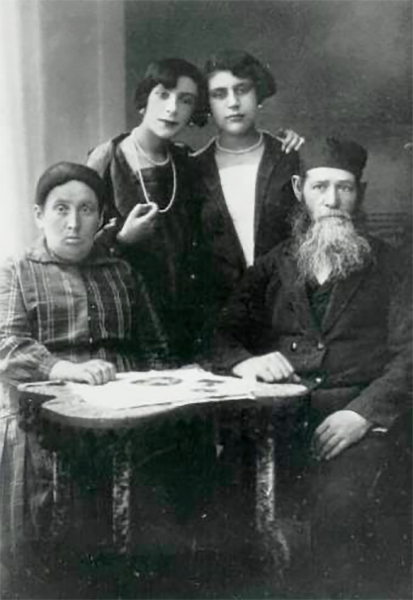
Our great grandparents Toibe FeigeTuman Israel (left) and Avrom Ayzik Israel (right). Who were the mystery women? Read on
For about 40 years, we puzzled over a haunting family photo. Our aunt Sarah Weinstock shared it with Howard who made copies and, in turn, shared it with the rest of the family.
The photo showed an older couple and two very modern-looking young women. Sarah identified the couple as Avrom Ayzik Israel, her mother Bessie’s father, and his wife, Toibe-Feige Tuman Israel.
The photo probably had been in the family’s possession since the 1930s when the elder Israels lived in Slobodka, an area outside Kaunas, or Kovno, once the capital of Lithuania.
Toibe-Feige and Avrom Ayzik looked very traditional and otherworldly. They came, in a very real sense, from another place and time.
She was a modest Jewish woman wearing a sheitel, a wig worn by Orthodox women to comply with Jewish law requiring that married women cover their hair. Toibe-Feiga seemed to gaze at us with a tired and stern demeanor.
Avrom Ayzik, listed in the All-Russia census, or revision list, as a shoemaker but looking like a rabbi, wore a “high” skullcap and a long flowing beard. Jewish law dictates that men not use a razor on their beards.
The women were a complete mystery. Were they daughters? Were they granddaughters? We were shocked to see the contrast between them and the older couple. The women looked like flappers.
Flappers, in the United States and Great Britain, were young women in the 1920s who wore short skirts (at the knee), bobbed their hair, listened to jazz, and disdained “acceptable behavior.”
We could only guess what a flapper in Lithuania believed. The women appeared to be close to the seniors.
The photo looked like a studio image, but there were no clues about who took the photo and where.
It was an interesting curio, but we never figured we’d know anything more about the who, what, when, where, and why of this family image from Lithuania.
This would all change in the COVID-19 pandemic of 2020 when the curtain was lifted on our family’s untold stories of the Holocaust.
Generations
Each generation has different priorities. Immigrants from The Pale left behind hardships and found new ones when they arrived in America. It wasn’t Die Goldene Medina (The Golden Land, where dreams of prosperity come true) they’d expected, but perhaps they hoped it might be for future generations.
Their children were driven by assimilation, the Depression, World War II, and living the American dream, and they didn’t necessarily look backward and suffered their own hardships.
The second-generation reaped post-war rewards and found themselves in shifting political currents and rapid technological change. The third generation grew up tech-savvy and searching for their own place in the world.
Our immigrant, first-generation, and second-generation family never talked about what happened to the family in the Shoah in Lithuania and Latvia. It’s possible they didn’t know about or chose not to dwell on it or its effects on their family in the Old Country. We found the same was true for our relations in the U.S. and our close cousins who led very different lives in Uruguay and later Israel.
For the second generation, the Eichmann trial in Israel caught Howard’s attention when he was in high school, and Gary recalls newsreels shown in Hebrew school of Nazi concentration camps that seemed like ancient history though in fact the camps had only been liberated a little more than a decade before he was born.
We descend from Eastern Europeans who left The Pale a full generation ahead of the Shoah, as early as the 1890s and 19-teens. Howard and Gary really only knew their twice-widowed grandmother Chana “Bessie” Israel Geskin Weiner. Both of our grandfathers were already dead by 1947 when the first of us (Howard) was born. Our other bubbe, our father Sidney’s mom (Fannie Sukenik Fleishman Wolinsky), lived in distant Boston.
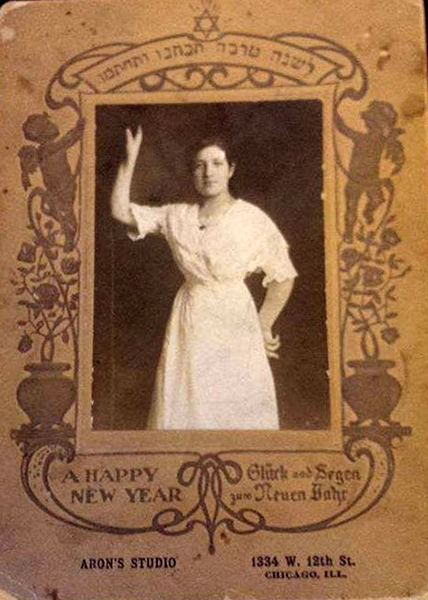
Grandmother Bessie Israel vamping it up in Chicago.
Bessie landed in Chicago in 1911 joining her previously arrived brother Harry who sponsored her. We learned this based on information previously gathered from census records found on JewishGen, LitvakSIG, Ancestry.com, Bessie’s naturalization documents, and family stories.
She was not the stereotypical warm bubbe. She was cold, distant, and seemingly lost back in her Litvak shtetl.
Two other sisters, Anna and Minnie also settled in Chicago.
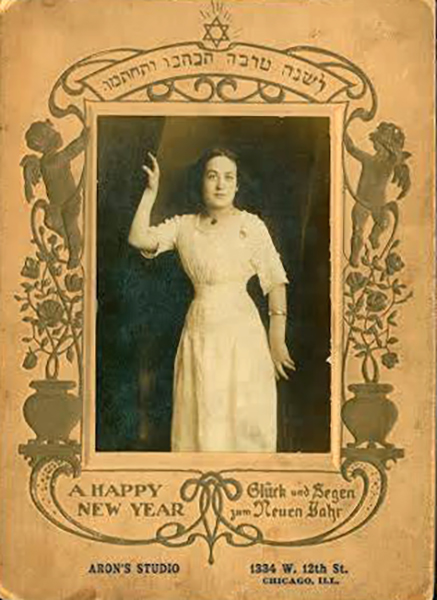
Anna Israel died in the flu pandemic, She was our grandmother’s sister.
Bessie had a hard life. Her sister Anna died in the 1918 flu pandemic. Bessie and her husband Sam Geskin had a baby in 1919, naming her Annie after her aunt. Annie only lived a month and a half, according to Illinois vital statistics.
The 1920s brought three more daughters Lillian, Sarah, and Edith (Howard and Gary’s mother). Sam who emigrated from Latvia scratched it out on Chicago’s West Side as a junk dealer.
Sam died in 1930 from an accident in his junkyard, leaving Bessie to fend for herself and three young daughters.
Family lore was that Bessie had a “nervous breakdown” following Sam’s death. Decades later, when Howard and Gary knew her, Bessie seemed lost and still showed the signs of depression, which we recognize now, but didn’t know about as kids. She was a stranger in a strange land.
She seemed to have secrets she wouldn’t share; certainly not when Howard interviewed her for family history in the late 1970s. She took them to her grave in 1991 at age 99.
Her daughter, Edith (Eudice) Wolinsky was a cold character, too, with a loose grip on facts and a tendency for hyperbole. As a result, her children learned to check facts.
Our mom
Edith came off as tough. There were reasons.
She was remote from her mother who she claimed sent her to the Angel Guardian Orphanage on Chicago’s North Side at six years old when her father died in 1930. A Yiddish-speaking Jewish girl, separated from her family and placed in a Roman Catholic orphanage, seemed to be in an unimaginable situation. Gary and Howard could never document her time in an orphanage.
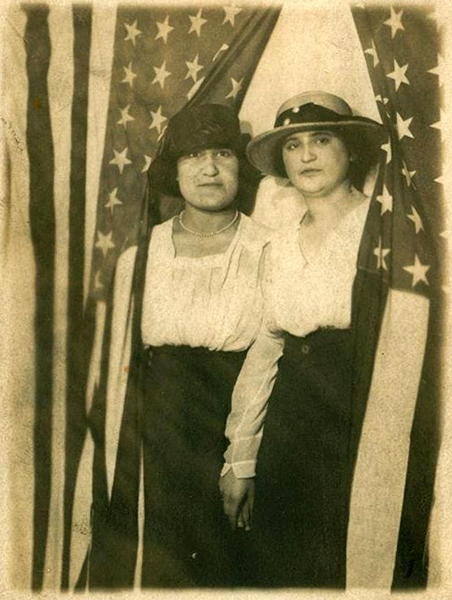
Minnie Israel (on left) our grandmother’s sister in Chicago.
Edith focused on being an American and didn’t know or say much about the Shoah. But after World War II, she tried, on behalf of her mother, to track down two of her mother’s siblings, Moshe and Sora-Rokha, in Uruguay. She later searched for them in Israel to no avail.
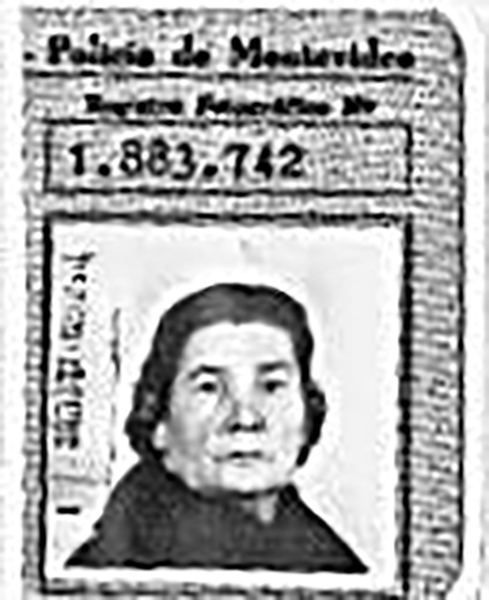
Sora Rochel Israel, our great aunt who went to Uruguay. Her family moved to Israel.
Howard eventually — with the help of Avi Lishower, a cousin from the other side of the family — tracked down a part of our South American family in Israel.
We naively thought that our close family remaining in The Pale died before the Holocaust.
Eyes opened
Howard went to Lithuania in 2013 with his family and sister.
His guide, the late Simon Dovidavicius, curator of the Sugahara House in Kaunas, took some of us to the Ninth Fort and its museum north of the city, where many Jews were shot to death and to other Holocaust sites.
Howard had been researching our families inspired by Alex Haley’s “Roots: The Saga of an American Family” in 1976. In the 1990s, he went through all records available in archives in Lithuania and from JewishGen.
He looked at the All Russia census from 1904 and found our great-grandparents, Avrom Ayzik, 48, and Toibe-Feiga, 42, and their brood of six daughters and two sons. Bessie, listed there as Chana, was the third oldest daughter. The Israels seemed to produce new offspring in two-year intervals.
We can account for most of them. Four came to Chicago. Bessie landed in Baltimore on May 25, 1911, aboard the SS Chemnitz from Bremen, Germany, according to ship arrival records on microfilm in the National Archives regional office in Chicago and from the U.S. Citizenship and Immigration Services, Genealogy Section www.uscis.gov/genealogy. She then boarded a train for Chicago.
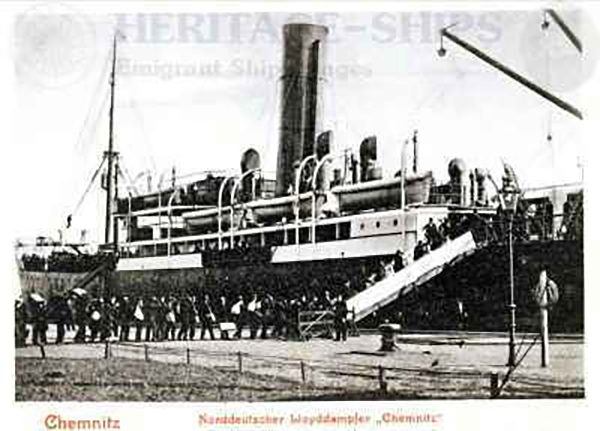
North German Lloyd steamer, SS Chemnitz http://www.norwayheritage.com/p_ship.asp?sh=chemo
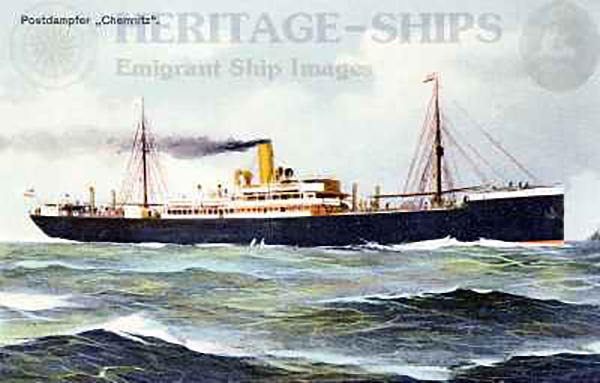
SS Chemnitz brought Bessie Israel to Baltimore in 1911 http://www.norwayheritage.com/p_ship.asp?sh=chemo
No sheitels, Sherlock
We hired Ava “Sherlock” Cohn, of North Barrington, Illinois, “The Photo Genealogist,” to analyze the image. She concluded based on facial characteristics and other factors that the young women were granddaughters.
When was the photo taken? It had to be before 1929 when Avrom died apparently from a kidney affliction, according to his death certificate obtained from the Lithuanian Historical Archives. Cohn had narrowed it down to the late 1920s based on the fashion and make-up the women wore. She noted that one woman with a fashionable bobbed haircut wore a pearl choker dating from c.1926 as seen in fashion magazines of the time. “A winter 1927 catalog from the American department store, B. Altman, features the same choker and matching pearl earrings,” Cohn said.
The family photo highlights the generational shifts and changing attitudes that were already afoot in the early 20th century.
COVID-19’s Strange Genealogy Breakthrough
Then, third-generation American Zoey Wolinsky, Gary’s daughter, got involved in 2020, a century later. She had been teaching English in Madrid and was forced home to the San Francisco Bay area because of the COVID-19 pandemic.
She had long wanted to obtain dual citizenship, which would provide a Lithuanian passport. Such a passport saves on visas and provides educational opportunities at European universities. It was a romantic and fun notion, one that Gary and Howard had contemplated but never pursued.
Zoey put fresh eyes on the available genealogical data looking for any documentation that would help build her case for Lithuanian citizenship. It’s far easier now than it was in the 1980s and 1990s to obtain revision lists, tax lists, and more from www.Ancestry.com and from the historical archives in Lithuania.
Then, Zoey had a Eureka moment, the sort all family historians relish.
Zoey had been searching meticulously for any records about her great-grandmother, Bessie. Having found limited records and information, she soon thought to expand the search another generation back.
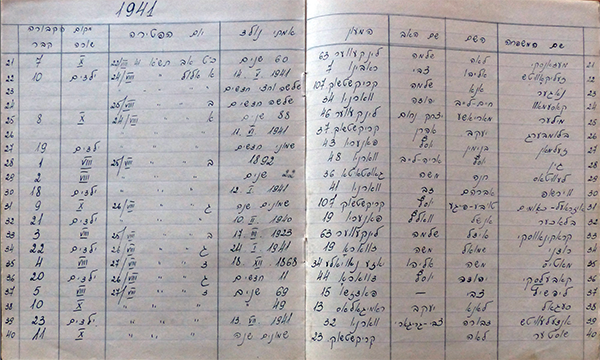
The record of Toibe-Feige Tuman Israel’s death in the. Kovno Ghetto.
It is this change that led Zoey to happen upon the Kovno Ghetto Cemetery list at JewishGen. It contains the names of those who died from “natural causes” between August 18, 1941, and December 31, 1945, in the ghetto as opposed to those murdered by “killing squads.” Toibe-Feiga, Zoey’s great-great-grandmother, was on that list.
Natural Causes in the Kovno Ghetto?
Dying from “natural causes” and buried in an individual grave seems strange in a time when it was more common for people to be executed in large numbers and buried in mass graves.
The name on the cemetery list appeared as “Israel-Kaumim, Toibe-Feive,” who died on August 26, 1941, just eight days after the Chevra Kadisha burial society had taken on this task. https://www.jewishgen.org/databases/Lithuania/KovnoCem.htm
The surname was unknown to us, though we knew “Teomim Israel.”
But Gary, with the help of Yiddish translators on Facebook’s Jewish Genealogy Portal (https://m.facebook.com/groups/JewishGenealogyPortal/) quickly figured out this was a transliteration error. The “Tof” was written as “Kof” in the handwritten cemetery record. Family connections can be lost forever with such simple typos.
Gary and Zoey noticed an address where the woman had died: Krisciukacio 107.(1) Zoey had initially speculated about the 1941 death year, given the significance of the year historically, but both Gary and Zoey assumed this address was where their ancestors lived in Kovno.
With some excitement, Gary did a Google search only to discover this was a former barracks called “The Reservat” (The Reserve), where homeless, sickly, and elderly people were housed in the early days of the Kovno Ghetto. Dov Levin’s article on Yad Vashem’s website, “How the Jewish Police in the Kovno Ghetto Saw Itself” described Krisciukacio 107 as a “filthy and neglected” detention center. https://www.yadvashem.org/download/about_holocaust/studies/LevinEngprint.pdf
The address was not the family home, but the place where our great-grandmother took her final breath on August 26, 1941, just two months after the Nazi invasion of Lithuania and eleven days after 24,000 additional local Jews were forced from their homes to join the 6,000 residents of a neighborhood that was sealed off to become the Kovno Ghetto. Toibe-Feiga, the mother of Bessie Israel, died from natural causes, in the midst of the Holocaust, and put to rest by the Chevra Kadisha, the burial society for Kovno and Slobodka.
Impact of World War II
Life in Eastern Europe had been turned upside down. The Soviets invaded Lithuania in June 1940. In January 1941, Toibe-Feiga, widowed since 1929, was listed as a registered voter appearing in a voter’s list in the LitvakSig section of JewishGen. The world churned again in June 1941 with the German invasion and the horrifying events that followed.
We determined from voter registration records that Toibe-Feiga had been living with her widowed daughter, Nekhama, and her grandchildren on a street that the Soviets had renamed, Raudonosios Armijo Prospektas (Red Army Boulevard). The family lived across the street from the Kaunas Choral Synagogue, built in 1871 and considered one of the most beautiful synagogues in the world.
In 2011, anti-Semites hung signs saying “Juden raus” (“Jews out”) and “Hitleris buvo teisus” (“Hitler was right”) on the building on April 20, Hitler’s birthday.
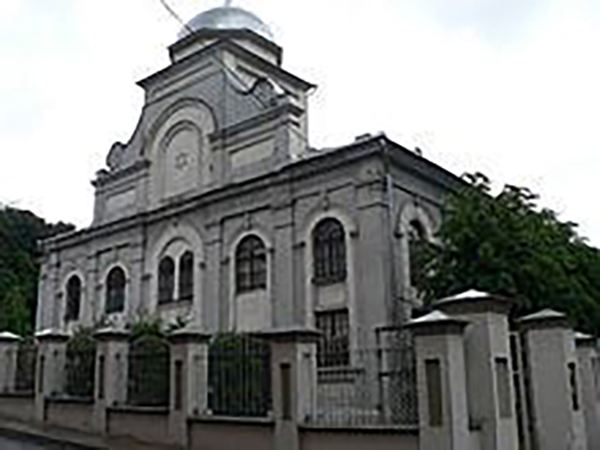
Choral Synagogue in Kaunas. Wikipedia Commons.
Arrests for Communist Activity
In 1935, Lithuanian authorities arrested Nekhama’s two older sons, Chaim Iosel and Reuven for Communist activities as we discovered in a database of Jewish Prisoners in Lithuania 1922–1940 found at
http://www.gutstein.net/trakai/files/LIT-1922-1940-Jewish%20Prisoners%20-%20Mar%201%202013.xls
Chaim Gotlib arrested
We obtained the arrest records for the two men from the Lithuanian Central State Archives https://www.archyvai.lt/en/archives/centralarchives.html. Twenty-one year old Reuven had been swept up in a communist demonstration and received a penalty of three months in prison or 1,500 Litas (~$5,000 in 2020 US dollars). It was a sum of money the family was not likely to have on hand.
Earlier, 24-year-old Chaim became a political prisoner sentenced to three years incarceration for distributing Lithuanian Communist Party literature. The record noted that a search of his apartment (which according to the 1935 revision was his mother’s home) revealed “nothing unusual except for a portrait of Ernst Thallman (2) hanging on the wall.”
Lithuanian translator Silvia Foti (3), a friend of Howard’s, said Chaim’s arrest record indicated that he was carrying a large number of communist publications when he was arrested in July 1935. He was serving in the Lithuanian Army at the time of his arrest. A witness said he was an atheist and a Communist Party member. Chaim was incarcerated at the infamous IX Fort.
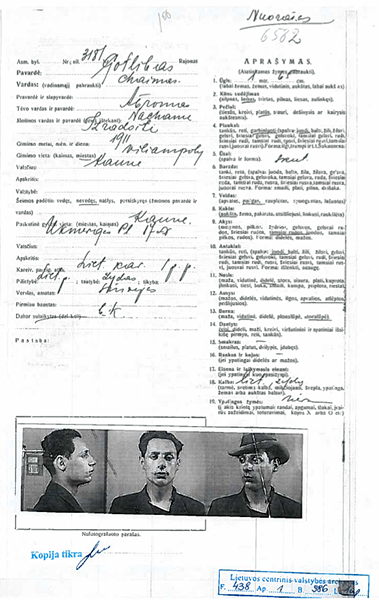
Chaim Gotlib’s arrest record.
Slaughterhouse IX
Six years later, in 1941, the fort became a slaughterhouse. The Nazis and their Lithuanian collaborators killed about 45,000 Jews from Lithuania and other European countries at the IX Fort.
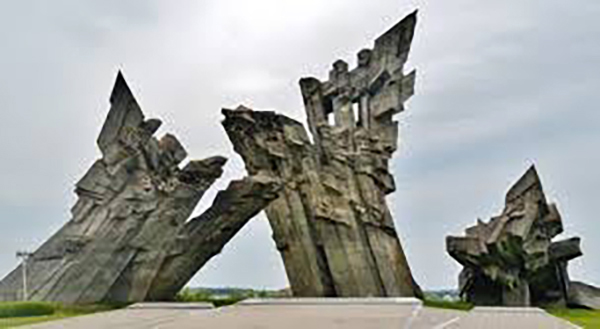
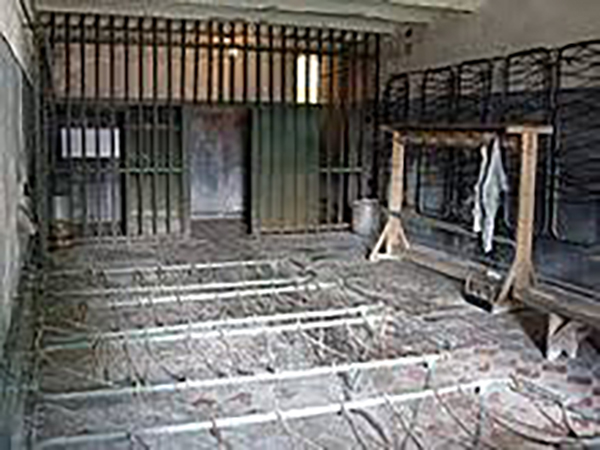
IX Memorial in Kaunas. Cells inside the fort. Wikipedia Commons.
Zoey’s find on her great-great-grandmother was a breakthrough for our family. It was the first documentation that a direct-line ancestor was a victim of the Shoah.
Zoey’s new perspective and different objectives found something we hadn’t seen or had missed 20 years ago when we last examined the records.
Howard and Gary shared parts of the story on Facebook and via Facebook groups Tracing the Tribe and the Jewish Genealogy Portal.
More than 250 people responded. One fellow researcher, Eilat Gordin Levitan, of Los Angeles, looked at the Israel family from Kovno at Yad Vashem’s Central Database of Shoah Victims’ Names.
In Search of Reuven
Eilat found a Reuven Gotlib from Ashdod who had listed seven family members in Yad Vashem’s Pages of Testimony Memorial Repository. One was his mother Nekhama Gotlib, our grandmother Bessie’s sister, and another was “Alte” (the old one) Israel, who was Reuven’s grandmother and Bessie’s mother. Alte was Toibe-Feiga. The rest were his sisters.
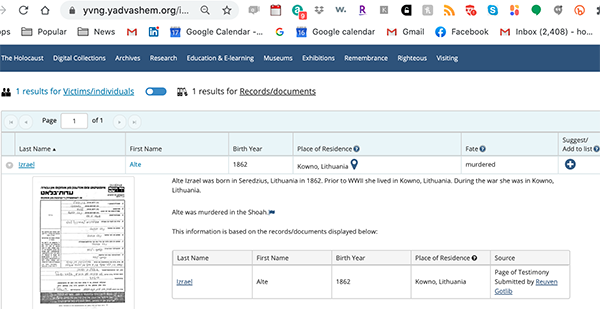
So another door in our research opened. We began a search for Reuven.
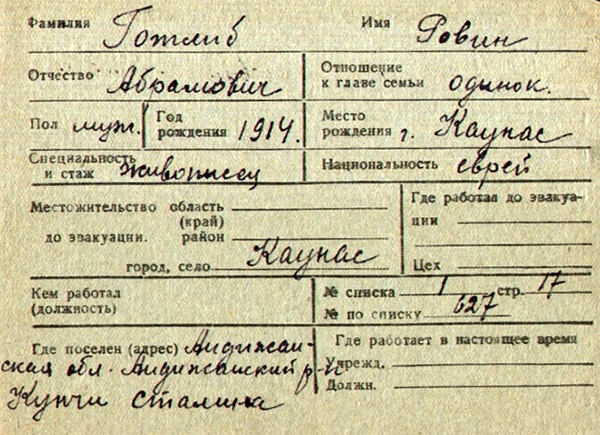
Reuven Gotlib’s refugee card
Danny Racotch, an Israeli researcher, saw the discussion about Toibe-Feiga and joined in. He found Reuven had immigrated from Tashkent, Uzbekistan to Ashdod, Israel in 1978. He also found in BillionGraves.com that Reuven had died and was buried in Ashdod in 2000.
https://howardwolinsky.medium.com/the-photo-how-a-family-portrait-finally-unlocked-long-buried-family-secrets-from-the-holocaust-316b44976814