#sw-1:
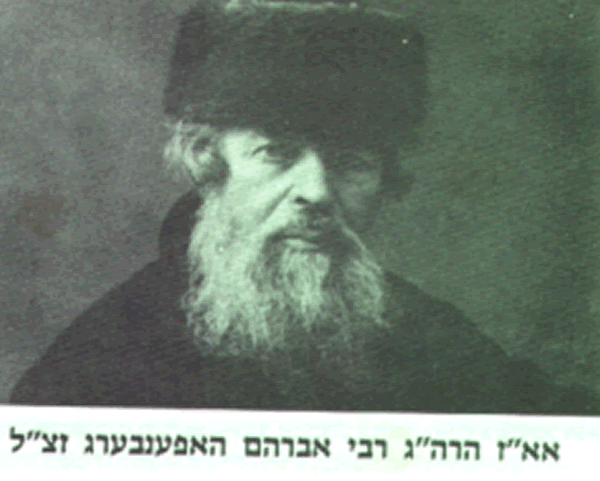
Rabbi Avraham Hofenberg, the Rabbi of Vashki for 43 years.
I was very glad to read it I was most excited to see my Grand father's name; Avraham Hofenberg mentioned there, what for I'm thanking you very much.
My parents were born in Vashki/ Shavli - Lithuania. They have made Aliya in 1924 - for reasons of ideology (Socialist Zionists). Mother Hayna neen Yatskan passed away in 1965. Father Yerakhmiel Hofenberg deceased in 1975.
My mother as said above was born to the Yatskan family, a son of which went to Warsaw where he founded the "Haynt" the renowned Yiddish journal. I do not have details about the Yatskans but I'm ready to investigate my father history. His story is not necessarily a rabbinical one, but as a local workers' leader during the First World War. He unified and organized forced workers, under the German rule, in the circumstances of then and at the German rule of then, naturally.
He established a dramatic band, which presented "The Kreutzer Sonata" on the stage.
At the premiere he was offered N. Bialik's poetry volume with a dedication in Hebrew.
As for my story:
I, Hofenberg Shraga was born in Israel in March 11, 1927 and grew- up and experienced what the generation of native born Sabras in 1920s experienced. Incidentally, I served in the IDF in Eilat (Um Rash Rash) in 1950. Eilat was Streets free, Hotels free, traffic lights free, traffic at all free. Nothing! - Desert only. *
With all due respect,
Hofenberg Shraga.,
The Story of the Hofenberg Family from a phone call to Shraga on 8-26- 2003;
My Father; Yerakhmiel Hofenberg was born in Vashki in 1894. He was the son of Ita and
Rabbi Avraham Hofenberger, who was born in the Hebrew year of 5613 (1853). Rabbi Avraham Hofenberger attended the Mir Yeshiva for his primary studies. After graduating he moved to Kovno to learn from Rabbi Eliezer Gardan.
The final studies he accomplished at the great and famous academy in Volozhin Eyts-Hayim Yeshiva. R' Aleksander Moyshe Shapiro ordained him as Rabbi in the Year of 5632 (1872). After six years in the Volozhin Yeshiva he received a teaching diploma from the genial Volozhin Yeshiva heads, the prodigious Hanaziv, from Reb Refoel Shapiro the later Yeshiva head and from Reb Hayim Soloveytshik.
He was elected as the Vashki Rabbi in 5647 (1887). Here he served as the town Rabbi for 43 years. The small village Konstanove was named by the vicinity Jews as Vashki and under this name it remains. The shtetl was situated in the Birz district, some 40m Km. north to Ponivezh. Washki was a small village. Prior to the First World War Vashki was populated by 50 Jewish families. The linen trade and its export to England were their main occupation. There were also other typically Jewish employment and professions.
Ita and Rabbi Avraham Hofenberger children;
1. Son ; Azriel Hofenberg was a writer of Yiddish plays. He moved to the states and lived with his sister; Sozka and her husband; Rabbi Eliezer Levin. He was never married. He wanted to make Aliah to Israel, but his brother Yerakhmiel, who lived in Israel suggested that he would have difficulties having his plays performed in Israel since David Ben Gurion (as many other leaders of the Yishuv) discouraged any attempts to institute the Yiddish culture
in Eretz Israel.
2. Shmuel Hofenberg. Not much is known about him; he was never married and at one point immigrated to the states. He was a simple guy not typical to his illustrious Rabbinical family. He did not like life in the U.S. and returned to Lithuania were he later died.
3. Daughter; Rashka (Pinchasovitz) survived the holocaust in a camp (Shtatoff). The son in law of her brother Pinchas was able to find her in Germany after the war. She immigrated to Israel.
4. Daughter; Rivka was married to Naphtali Magid and lived in Crimea. She survived the war (escaped to Soviet Asia) and some of her family immigrated to Israel .
5. Daughter Sozka and husband; Rabbi Eliezer Levin had 104 Children, grandchildren and great grandchildren. Most of the family is very religius and live in the states (established Talaz Yeshiva in Chicago and Yatid Neeman in Toronto)
6. son; Pinchas Hofenberg was a Hebrew teacher in Lithuania. He died of natural causes in ghetto Vilna during the war. His daughter lived in a kibbutz in Israel (Daphna?). The family found out about him from a female soldier in the IDF that served with Hofenberg Shraga and was a holocaust survivor and was prior to the war his student in the Tarbut school
7. Yerakhmiel Hofenberg (born in Vashki in 1894 died in Tel Aviv in 1975). Yerakhmiel Hofenberg left Lithuania for South Africa at age 17 c 1911. He lived there for about four years working in a market in Johannesburg. He returned to Lithuania just as World war 1 started. Per Shraga� His story is not necessarily a rabbinical one, but as a local workers' leader during the First World War in Novogrodok. He unified and organized forced workers, under the German rule, in the circumstances of then and at the German rule of then, naturally.
He established a dramatic band, which presented "The Kreutzer Sonata" on the stage.
At the premiere he was offered N. Bialik's poetry volume with a dedication in Hebrew.
Why was he in Novogrodok far from Vashki and Lithuania?
“â€?.During the First World War the Russians exiled all the Jews of Vashki deep into Russia. Only few returned to the shtetl after war. This was the fate of most of small villages in west Lithuania. The Jews resettled themselves in bigger towns and did not return to their natal congregations. Cut of from their Yiddish home and their tradition they became secularâ€?.â€
We know that in 1919 he was in Novogrodok in in the early 1920s he returned to Lithuania (after more then a hundred years it became independent of Russia and experienced a “renaissance†period that for the first years included also the Jews as “equal citizensâ€) were he was a member of Zeirei Zion (Socialist Zionist movement) in 1924 he made Aliah to Israel with his wife. They had two children; Shoshana (Kalo) was born in 1924 and Shraga in 1927.
Shoshana Z’’L studied with my fathers’ sister (Shoshana “Zoozi†nee Gordin Gefen Z’’L). They became best friends also with Tmima Livni Z’’L and Aliza Efron.
Back to Rabbi Hofenberg and Vashki�.
Prior to the Second World War 80 Jewish families lived in Vashki.
Rabbi Hofenberg published his Book "Voice in the Heights" in 5658 (1898). The Rabbi passed away at the month of Nissan, 5689 (1929).
His son in law; Rabbi Eliezer Levin (married to his daughter; Sozka) replaced him as the Vashki town Rabbi. He resettled to the States (1936? later Rabbi of Detroit and Cleveland) and was replaced by Rabbi Tsvi Yankilov.
Rabbi Tsvi Yankilov and his congregation were annihilated by the Nazis. .
I knew that my friend; Shraga Hofenberg was born to a family from Lithuania. We meet (at least) once a week in the Tel Aviv swimming pool.. Last week he told me that his father came to Israel from a shtetl named Viaskay or maybe Vashko in the twenties. At home I entered your site, found VASHKI and printed out for him 10 page copy. Shraga was very proud and excited to find there some words about his Grandfather "Rabbi Avraham Hofenberg who was a rabbi for 48 years and died in 1929". At the next swimming meeting he brought me two books. One of them Bialik's poetry which was offered to his father Yerakhmiel Hofenberg in 1918 with a dedication in Hebrew, and a memory book written by Pinkhas Halevi Liphshits "YIKVEY BRAKHA", where his grandfather's picture and biography are printed.
I'm sending you:
Translation from Hebrew of Shraga Hofenberg's letter he wrote to you
The "HAKDASHA" – dedication to Yerakhmiel Hofenberg, Shraga's father, scanned and translated from Hebrew.
R' Avraham Hofenberg's (Shraga's Grand Father) scanned picture, with a shortened translation of his biography, In the dedication (2) they wrote "Agudat Hapoalim Hayivrim" which I translated as "The HEBREW Workers Society". The final stamp is written in Yiddish "YIDDISHER Arbeyter Ferrayn" which means "The YIDDISH Workers Society". With many thanks
Moshe Porat. Shraga's letter to Eilat:
Ms Eilat Shalom,
My friend, Mr Porat, gave me an article's copy about Posval region's Jews in Lithuania from your Vashki Web-Site.
I was very glad to read it I was most excited to see my Grand father's name; Avraham Hofenberg mentioned there, what for I'm thanking you very much.
My parents were born in Shavli - Lithuania. They have made Aliya in 1924 - from idealistic reasons. Mother Hayna neen Yatskan passed away in 1965. Father Yerakhmiel Hofenberg deceased in 1975.
My mother as said above was born to the Yatskan family, a son of which went to Warsaw where he founded the "Haynt" the renowned Yiddish journal. I do not have details about the Yatskans but I'm ready to investigate my father history. His story is not necessarily a rabbinical one, but as a local workers' leader during the First World War. He unified and organized forced workers, under the German rule, in the circumstances of then and at the German rule of then, naturally.
He established a dramatic band, which presented "The Kreutzer Sonata" on the stage.
At the premiere he was offered N. Bialik's poetry volume with a dedication in Hebrew.
As for my story: I, Hofenberg Shraga was born in Israel and grew- up and experienced what the generation of native born Sabras in the 1920s experienced. Incidentally, I served in the IDF in Eilat (Um Rash Rash) in 1950. Eilat was Streets free, Hotels free, traffic lights free, traffic at all free. Nothing! - Desert only. *
With all due respect,
Hofenberg Shraga., Our eldest, the Rabbi Avraham Hofenberger, was born in the Hebrew year of 5613 (1853). He did his primary studies at the Mir Yeshiva. After graduating he moved to Kovno to learn from Rabbi Eliezer Gardan.
The final studies he accomplished at the great and famous academy in Volozhin Eyts-Hayim Yeshiva. R' Aleksander Moyshe Shapiro ordained him as Rabbi in the Year of 5632 (1872). After six years in the Volozhin Yeshiva he received a teaching diploma from the genial Volozhin Yeshiva heads, the prodigious Hanaziv, from Reb Refoel Shapiro the later Yeshiva head and from Reb Hayim Soloveytshik.
He was elected as the Vashki Rabbi in 5647 (1887). Here he served as the town Rabbi for 43 years. The small village Konstanove was named by the vicinity Jews as Vashki and under this name it remains. The shtetl was situated in the Birz district, some 40m Km. north to Ponivezh. Washki was a small village. Prior to the First World War Vashki was populated by 50 Jewish families. The linen trade and its export to England were their main occupation. There were also other typically Jewish employment and professions.
During the First World War the Russians exiled all the Jews deep into Russia. Only few returned to the shtetl after war. This was the fate of most of small villages in Lithuania. The Jews resettled themselves in bigger towns and did not return to their natal congregations. It was a national tragedy as they cut of from their Yiddish home, their tradition and became secular. Prior to the Second World War 80 Jewish families lived in Vashki.
Rabbi Hofenberg published his Book "Voice in the Heights" in 5658 (1898). The Rabbi passed away at the month of Nissan, 5689 (1929).
Rabbi Eliezer Levin replaced him as the Vashki town Rabbi. He resettled to the States seven Years later and was replaced by Rabbi Tsvi Yankilov.
Rabbi Tsvi Yankilov and his congregation were annihilated by the Nazis. .
The Jewish School in Shavli
The headmaster (or principal) was Rabbi Pinchos Hofenberg, the son of
Rabbi Chaim. He managed the school in the spirit of Judaism. The school
was a symbol of Jewish nationalism and faith in Jewish redemption. Most
of the teachers were Zionists, the center was the Land of Israel, and
the children understood the Hebrew language and made an effort to speak
it.
Information which I received from Shraga Hofenberg, born in Tel Aviv in 1927, the grandson of the rabbi could be found here: http://www.eilatgordinlevitan.com/kurenets/k_pages/hofenberg.html
Also in the geni tree. I will try to find the family of Shraga in Tel Aviv.
David Kaplan <dvk@sky.com>
My name is david kaplan and I am a great great grandson of Isaac hoffenberg ztl who was a brother to the rabbi Abraham hoffenberg ztl
I am also the keeper of the Scottish hoffenberg family tree and would love to swap information and be in touch
Kind regards
David