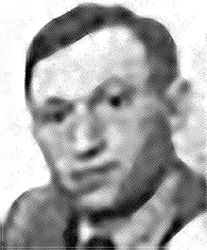
Moshe Alperovitz/Alperovich was a Holocaust survivor from Kurenets. I spoke with Moshe in 1995 at his home in the Tel Aviv area. Moshe's mother, Rashka, was the sister of my great grandmother, Frida. Here is some of what Moshe told me:
I was the youngest son of Zalman Alperovitz. My father was the son of Chaia Sara and Yechezchel and the paternal grandson of Binya Alperovitz. He had two brothers, Mendel Alperovitz and Moshe Alperovitz, and their families lived in Kurenets. My mother, Rashka, was the youngest daughter of Yehuda Alperovitz (the common ancestor of Eilat and mine). The last name Alperovitz/Alperovich, which both of my parents were born with, was very common in Kurenets. My parents might have been distantly related but I am not sure that they were. Both of my parents came from similar well-off backgrounds. Their ancestors were very respected in Kurenets for their charity, their piety and their service for the community.
We were four siblings: My sister Fiya (Phaia) was born in 1905. She left home when I was still a young child. She married Shimshon Rubin and they lived with their children in Dolhinov before the war. The picture below is of my sister Fiya during the First World War, when the region was under German occupation.

My brother Meir lived at home with us and helped my mother with her thriving business. He was very charming and spoke a few languages fluently. In the following photo, my brother Meir is the young boy on the right. You can see our home, which was at the main market in Kurenets. The picture was taken during the First World War.

My sister Sarah was my only immediate family member who also survived the Holocaust. In the US she was married to Jacob Geller. Before the war she was married to someone else and had two young sons. As the war started she had some problems with her husband. She returned and lived at our home with her two sons.
By the time I was born, my family was not as religiously observant as their ancestors. We celebrated all the Jewish holidays and on special occasions we would attend the synagogue. However, I did not attend a Yeshiva. This was like most of the families of Kurenets after the turn of the century, who also did not send their sons to Yeshivas. By the time I was ready to attend school, I attended the Hebrew Tarbut school, like almost every Jewish kid in town. Almost every subject was taught in Hebrew. The school had a secular zionist socialist flavor.
Our father was a merchant. Sadly he passed away when I was very young. At that time, life was very difficult for a widow who was raising her children alone. There was little respect for single or widowed women. My mother Rashka was very smart, forceful, confident and a great business woman. Despite running the business alone, she became very successful. She was very respected in the community and many people would come to her asking for advice.
Mother would often tell me about her childhood and her beloved siblings, who were now spread all over the world. She spoke of her brother, Wolf, who was smart and ambitious. Wolf was very unlucky. He served as a naval officer in the Czar's army in 1904. During that year, Japan offered to recognize Russian dominance in Manchuria in exchange for recognition of the Korean Empire as being within the Japanese sphere of influence. Russia refused and demanded the establishment of a neutral buffer zone between Russia and Japan in Korea, north of 39th parallel. The Imperial Japanese Government perceived this as obstructing their plans for expansion into mainland Asia and chose to go to war. After negotiations broke down in 1904, the Japanese navy launched a surprise attack on the Russian Eastern fleet at Port Arthur, China on 9 February 1904. Some time during that Russian-Japan war, which lasted a little longer than a year, Wolf was killed. The family never found the exact circumstances or date. Later, to keep his memory alive, some of his nephews were named after him.
My mother's brother Solomon Yitzi was involved with the 1905 failed revolution. It was primarily sparked by the international humiliation as a result of the Russian defeat in the Russo-Japanese War, which ended in the same year. Calls for revolution were intensified by the realization of the need for reform. Politicians such as Sergei Witte had succeeded in partially industrializing Russia but failed to reform and modernize Russia socially. The revolution failed, but its events foreshadowed the 1917 Russian Revolution just twelve years later. Mother’s brother Solomon Yitzi moved to the Soviet Union and lived in Gorky. In the 1930s my mother would send them Jewish inspired food during the holidays, as she knew that it was not available in the Soviet Union.
My mother had a sister who lived near Vilna when I was a young child. I can't recall her name but she had many sons and after her husband passed away, she and the teenage children immigrated to Brazil.
My mother's oldest sister was Frada (Frida, Frydel), born in 1870. She was married to Mordechai Gurevich, who was known as a religious scholar. He studied in his youth in a well known Yeshiva and many times he would travel to meet with the Chabad Lubavitch Rebbe. The family owned a hardware store. Since Mordechai was always busy with religious studies, Frada ran the business and raised the children. They had 6 children. Nathan was born in 1898, Meir (Eilat's grandfather) was born in 1901, Batia (Bender) was born in 1905, Sima (Lerman-Herbert) was born in 1911, Luba (Bardan) was born in 1914. There was also a brother Yehuda who died as a young child. Unlike their father, all the children were secular, with strong Zionist and Socialists ideologies. By 1925 Meir and Batia made Aliyah to Eretz Israel (Palestina) Batia and her husband Yizhak Bender were among the founders of Kibbutz Givaat Hashlosha and in 1952, Kibbutz Einat. Meir and his wife Bela Shulman were among the founders of Moshav Bitzaron. Sima and Luba also followed and settled near Meir in Moshav Bitzaron. Soon after, the parents came and settled near Batia.
By mid 1930, only Nathan was still living in Kurenets. Nathan lived with his wife, Batia Ayeshisky, and their children, Leah Shogol (born in 1922), Zalman (born in 1924) and Gershon (born in 1928) . Nathan was a merchant and owned a few stores. In the 1930s he owned a large textile store. He was well educated and led the parents association of the Tarbut Hebrew school in Kurenets. The kids were very involved with the Hashomer Hatzair movement, a left-leaning socialist Zionist youth movement that was very popular with the youth in Kurenets. I was a member of the much less popular Bitar Youth Movement, which was more to the right. Both youth movements were Zionist and had the same emphasis on Aliyah to Eretz Israel.
Other than the mother Batia, the entire family survived the Holocaust by hiding in the forests and joining the partisans. Zalman and Leah wrote about it in the Yizkor book. After the war, they made Aliyah to Eretz Israel.
Next door to them in Kurenets lived my mother's brother, Michael, with his clever wife, Pesia Kastrol, and their children. They had five daughters, Chana, Henia, Rachel, Rashka and Doba. Their only son, Nachum, was born in 1923. He wrote a book about his survival with the partisans and later crossing the front and joining the Red Army. His sister Doba also survived, hiding in the forest after escaping from the Vileyka camp. Both he and Doba immigrated to Israel and joined their sister Chana, who came there in the early 1930s. The parents and the sisters Rachel, Rashka and Henia perished in 1942.
My mother had a brother named Yaakov Moshe who lived close by in the town of Radishkovich, near Minsk. My mother told me that he was a very well-off merchant. He sent his two sons to study in France. I do not know if any of the family members survived the Holocaust. Maybe the sons in France?
It is difficult for me to talk about the Holocaust. Some things that I never shared with my sister can only be told after she passes away. Early in the morning of September 9th 1942 my mother, my sister and I realized that Kurenets was surrounded by Nazi forces. We talked to a neighbor and unanimously felt that it is the day that we feared for so long - the last day for Jewish Kurenets. They planned to annihilate all of us in a few hours.
We decided to try to escape and run to the forest. We made a huge, tragic mistake. Being in a hurry, we wanted to first try to get my mother and my sister into the forest and then if we would succeed, I would return and get the young boys who were still asleep. It took us a long time to run by foot deep into the forest. By the time I returned, I found our boy shot and killed in the doorway, which he must have opened to the killers. The baby was murdered in his bed. There was nothing I could do. I just ran back to the forest. My sister to this day never asked me about her children. My mother told me to never share the information with my sister.
Mother was murdered in March of 1943 during the first blockade, which was organized by the Nazis against the resistance and the Jews who were hiding in the forests. When we returned to the hiding area after escaping the Nazis deep in the forest, we found mother shot while sitting on a tree.
My brother Meir was working for the Nazis in the Vileyka camp. From a group of Jews who escaped to the forests and joined the resistance I heard that my brother was liked by the Nazi officers who ran the Vileyka camp. He made the mistake of thinking that he had a better chance of survival in the camp since the Nazis needed him and some other Jews from Kurenets and the area to do some essential work for them. He did not try to escape when he had a chance (many were killed during the escape). We know that he survived until the Red Army freed the area. We found out that the Nazis took the Jews by force when they retreated back. I was told that some or all of the Jews from the camp were found dead, killed by the Nazis at the outskirts of Vileyka. The Nazis did not like to leave any Jews alive.
I was amongst the first to get a visa to immigrate to Eretz Israel/Palestina, where I had many first cousins. I built my life here. I married Sharlota and we have two wonderful sons. My sister came to California and married Jacob Geller. They have one son.