| Kurenets Home Page |
| Kurenets Stories Menu |
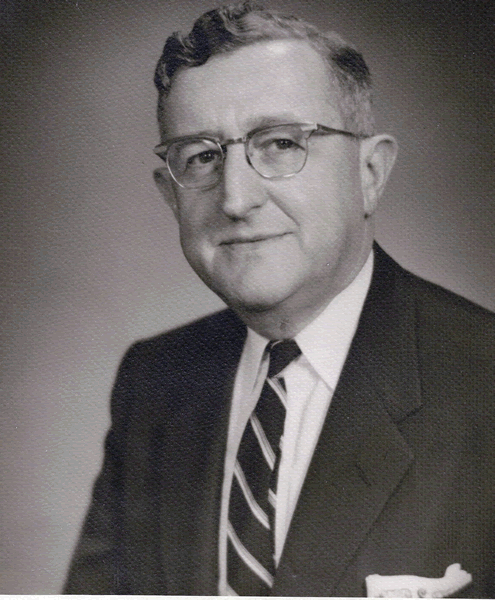
a more recent picture of Abraham Schulman.
Noah Lapidus wrote: ....My grandfather, Robert Schulman of Rochester, used to always talk about his cousins Isaac and Max Shoolman.
Aaron Schulman of Mozyr, Belarus (listed as Aron Schulmann on his passenger list from 1904) is my eldest known ancestor, born in 1874.
He married Sophie Holstein, and had three children- only one survived labor.
His son Abraham (b. 1899) was a New York City Assemblyman. Although the family is listed as living in Brooklyn in the 1910 Census, they are listed in a 1911 Rochester City Directory.
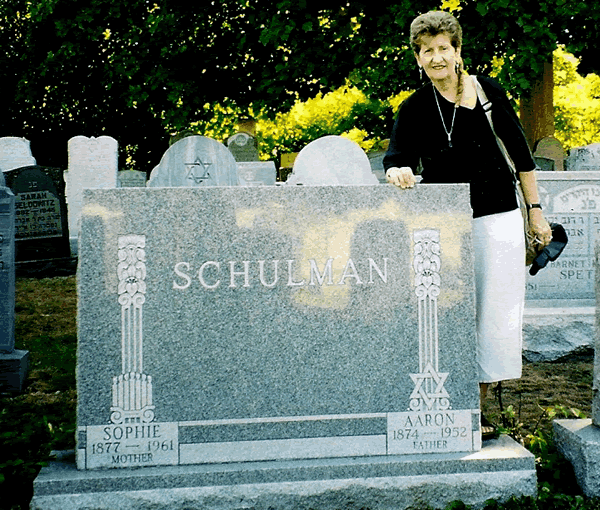
Aaron and Sophies graves
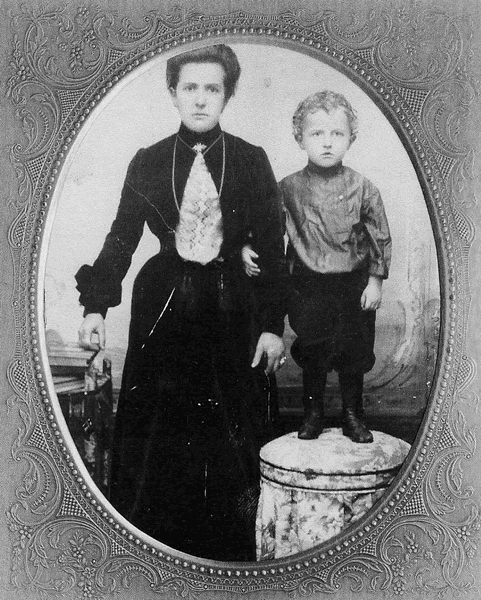
Abraham, only son of Aaron Schulman and Sophie nee Holstein (Sophie is also pictured) c 1902
The
Shoolman/ Spektor/ Levitan family of Kurenets
Kaila nee Spektor Pintov was
the sister of Josef, Shmuel and Max . Josef's father was a Levitan. The rest of
them were Spektors, born to the another father and same mother. Josef was the first
to leave Kurenets for America to avoid army service. He obtained false papers
with the name "Shoolman" and that is how all the brothers who came to
America subsequently became Shoolmans.
From the kurenets Yizkor book; During the fall of 1925, Max Shulman ( Shoolman,
the brother of keila Pintov, who was the mother of Badana Pintov ( she later married the first chief of staff of the israeli army; yaakov Dori) came
from the US. Max Shulman became very, very wealthy in the states and since he
was a very generous man, he transferred the entire family to Eretz Israel, and
their house he bought from them and donated as a Hebrew school that was named
for him ( Elimelech/ Max Shulman Tarbut school). They wrote in the Kurenets Yizkor book about Max Shulman;
"…I remember that fall, it was a very
cloudy and rainy fall, and the
streets were filled with mud and puddles. Despite all of this, people
were running all over town, looking to what the next good deed of Max
Shulman would be. First he went to the cemetery to pay a visit to the
graves of his forebears, and all the town was watching him. Many
joined him in his visit so they could tell what had happened, and
many, many stories were told about Max. They said that Max Shulman
gave the daughter of Tanhum, who had no hand, a lot of money and soon
she would go to Warsaw, where they prepare for her an artificial hand.
People told that he gave a huge amount of money to build a fancy bima
[a stage] in the synagogue of the Mitnagdim. It was a very, very
artistic bima. It had pillars that had braid-like carvings on it, and
on top of that, there were angelic creatures with their wings covering
the ceiling. It also had sculpted lions and tablets, and all sorts of
decorations that would bring to your heart the Bible studies that we
studied in school.
There was a Jew in our town by the name of Chanan Shlomo from Dolhinov
Street. He lived in a tiny house and people said that he was meticulous and
orderly, and even every rusty nail he would put in its appropriate place.
There was a time when Chanan Shlomo was a student in the cheder of Max
Shulman's father. The people found out that he had an “affaer”, two passages
written in calligraphy by the Rabbi that the students had to imitate to
practice their lettering, so in town they told that Max Shulman paid a huge
amount of money to buy the affaer from Chanan
Shlomo which was written by his father. It was a most dear treasure to him from
his father…
Memories, memories come before my eyes…"
(Prologue)
Below
is a freely transcribed version of an August 17, 1975, taped conversation,
mostly between Charles Shoolman and his son, Ira. It sets out the background and some details of Charles' and
his family's exit from Russia and their immigration into the United
States.
The
conversation itself was recorded by Anita's niece Lena Benlifer, in New
Bedford. Charles and Anita were
there with Ira who was in the U.S. on a business trip from Europe -- where he
was living at the time. They were
at the home of Rebecca and Al Feld.
Ruth and Don Barash, Fannie Bowdan and her sister Sarah were also
present.
(Dialogue)
Rebecca: Uncle
Charles.
Charles: Yes,
dear.
Rebecca: Listen,
Ruthie and Lee and Donald and Aunt Fannie have never heard your story about
when you left Russia. Would you
like to tell them the story?
Charles: How
can you tell a story like that?
Rebecca: You
start, "Once upon a time. . . ."
Charles: Who
the devil knows where to start? Or
where to end?
Rebecca: Ronald
called again last night, and he said, "You get Uncle Charles to just tell
the story, about when he lived in Russia."
Al: If
he had a couple of days, he could do it, but continuously it's hard to do.
Rebecca: Well,
he can like be telling Ira the story, and. . .
Charles: Ira
knows the story better than I do!
Rebecca: Well
all right, Ira. . .
Ira: I
wish I did.
Rebecca: .
. .converse with him, converse with Ira, they want to hear it, we want to hear
it.
Charles: You've
heard from me certain things, that came to my mind, that happened in Russia.
Rebecca: All
right, it'll come, they'll come to your mind again.
Charles: And
among those things were perhaps. . .
Ira: Let's
start with when your family was evicted from their home. Why were you evicted?
Charles: We
were accused by the authorities of selling stale herring to the military, to
the soldiers. ( During the First World War for about 3 years the area was on
the front. It kept changing hands between the Russians and the Germans)
Al: Was
it?
Charles: As
far as we were concerned, we ate those herring. There was nothing stale about it.
Ira: Why
do you think you were evicted?
Al: It
was a trumped up charge, in other words.
Charles: Well,
after all, we were a Jewish family, living in a village, and only about 15 Russian
vjorsts or 18 vjorsts from the front.
Ira: That's
about 15 or 18 kilometers.
Charles: Well
I don't know if vjorsts and kilometers are equal. A vjorst is less
than a mile.
Ira: Right. About 60%? That's what a kilometer is.
Charles: About
64%, or something like that.
Ira: You
were near the front and, being Jewish, you were suspected of being disloyal?
Charles: Well,
maybe suspect, I really don't know what were the true reasons.
Ira: At
this time was the Bolshevik
movement already underway?
Charles: Oh
no, not. . .we're talking about 1916.
Ira: You're
saying 1916, and the Bolshevik
revolution. . .
Charles: Yes,
a year later the Revolution started.
Ira: There
must have already been some revolutionary movement in the cities.
Charles: Not
that I, not that we could sense or that we heard anything about it. No. We didn't know anything about it. As far as we were concerned. . .
Ira: You
didn't know, but the authorities did. (The authorities were not yet concerned
about the Bolshevik revolution at
this point of time- they had more urgent matters, they were loosing the war
with Germany and they needed to fault someone. . .The Jews were an easy target.
Most of the Jews of western Lithuania were expelled in the spring of 1915, deep
in to Russia and Ukraine, for “Helping the German enemy”. Eilat)
Charles: As
far as we were concerned. . .Maybe in the big cities it was already brewing,
but as for us, we didn't know anything about it. Why would the Revolution have anything to do with our being
expelled?
Ira: Because
many of the leaders of the Bolshevik
movement were Jewish. Some of
those great communist thinkers.
Charles: But
they wouldn't make us move, would they?
Ira: If
in the cities -- in Moscow, in Leningrad, wherever -- the radicals, the Bolsheviks and anti-tsarists were Jewish, then this made the
Jews suspected of being fifth columnists.
Charles: Oh,
yes, then this would be sort of getting back at us.
Ira: Not
just getting back, as a precaution perhaps, because of a suspicion that you might
be revolutionaries.
Charles: Well
we were not revolutionaries. We
didn't know anything about that.
Ira: Was
there any other reason why the Jews would be suspected of being disloyal?
Charles: I
don't know. I mean there was
discrimination, but I really don't know the reason for it. Of course, Jews were never loved too
much anyway. As a matter of fact,
our manner of living there was only due to the fact that my father could do
some carpentry work. We were being
evicted by our own neighbors. They
made it sufficient. They reported
us. We lived in a village where
Jews were not allowed to own land, that is we didn't own and till land. And, as merchants, we were not allowed
to live in that village.
Ira: Were
you the only Jewish family there?
Charles: No,
there was another Jewish family, whose job it was to supervise a dairy where
cheese was being manufactured.
This milk was bought from our landlord in large volumes, and cheese was
being made in a dairy right there, and exported as far as Germany. And the most beautiful Swiss cheese you
ever ate!
Ira: Were
they also evicted?
Charles: By
the time, I think, we were evicted, I don't believe they were there
anymore. I don't remember them
being there.
Ira: Were
they also forced out?
Charles: They
may have left on their own, I don't know the reason for it. But that very night that we were
evicted, my father. . .we were forced out on a Friday night, and my father told
me I'd better harness the horse to the sled and get ready -- it was in the
winter, some time in December.
There was no way out of it.
Charles: Within
a mile and a half from where we lived there was a temporary railroad station,
because the permanent one, which was about four or five miles closer to the
front, was destroyed by German shells.
So it was near us, there was a railroad passing by us. And there was a crossing that became a
temporary railroad station. So,
when I harnessed the horse, and I loaded all our possessions that we could, at
the time -- and what was considered important was your pillows, the mattresses,
dishes. . .
Lena: The
lichte. . .
Charles: Yes,
the lichte is right, that's the
candlesticks, and so on. And the
children. . .
Ira: They
were considered important, too?
Charles: .
. .we dressed them too. Yes, rather
important. We dressed them all
up. We put them in the sled, and
off we went.
Lena: The
whole family?
Ira: How
many was that?
Charles: In
the family. . .
Ira: Eliot
was already in the States. . .
Charles: Eliot
was here. My (other) brother was
gone in the service already.
Ira: Your
brother Abraham.
Charles'
older brother, Abraham, a few years before
he
entered military service in the Russian Hussars.
Charles: So
it was the rest of us.
Ira: Which
was how many, ten, eleven?
Charles: Two
and five, about seven of us, I believe.
Ira: Is
that all?
Charles: Five
girls and two boys. (I.e., Anna, Kate, Gertrude, Lillian, Esther, Myer and
Charles -- seven children.)
Al: How
old were you then, Uncle Charles?
Charles: How
old was I? About 15, 16 years old.
Ira: You
were the oldest one at home?
Charles: Yes,
I was the oldest. I was Father's
right hand.
Ira: This
was the time that, I think you once told me, the officer in charge of the
military unit that evicted you was very polite and courteous.
Charles: Oh
yes, they were, whenever they came to evict us, they were courteous. They were not hostile in any way; they
had no reason for it. But, since
we refused to abide by their decree, so to speak, the time came when they said
this is it. And we just had to
move.
So
we took the kids, myself and my father, and our belongings and took them to the
temporary railroad station, and they loaded up. . .they got up on a freight
car. There were no passenger cars
there.
Anita: That
was on a Friday night.
Charles: That
was on a Friday night.
Anita: Your
father wasn't happy about that.
Ruth: Was
your mother still living, Uncle Charles?
Charles: She
was living, but at the time she wasn't home. She'd contracted typhoid fever, and she was treated
partially by a military doctor right there in the village. But he saw that she wasn't responding,
perhaps, properly, and the need was for better medical care. So she was sent to the rear, in a
hospital, which was about 25 or 30 vjorsts from us, say 20 miles,
and she was there for a while.
We
didn't go to see her there. But
eventually she was sent, oh about 115 miles away, to the rear, to the city of Diekipst, which was a capital city. By that we mean, in Russia, the states are named for the
capital of the state, generally the largest city.
Ira: It's
that way in many countries.
Charles: That's
why Vilna was the largest city in
the state where we lived, and Diekipst was a state-city, quite a distance away.
Ira: You
were how far from the front?
Charles: Where?
Ira: In
Garodtky?
Charles: In
Garodtky? I told you, Krevo/ Kreva/ Kreve, where my grandmother lived, where my mother was
born, was only 16 to 18 vjorsts,
about 12-14 miles, from where we lived in Garodtky. And
that Krevo/ Kreva/ Kreve ( near Vishnevo) was a Jewish town, in a valley, just a little bit away from us. It was between two, like mountains, or
high elevations. And that's where
the front happened to get stationed.
Beyond that point. . .
Ira: That's
where it stabilized.
Charles: Yes. That was in 1916, early '16, I
believe. It should be about
'16. Anyway, I had occasion to go
to that village -- again close to the front -- I must have told you about going
to salvage, or to save, my grandmother and grandfather. They had no horse and no wagon, and
they were too old to walk. When
the city was on fire, when the battles were going on and the inhabitants were.
. .
Ira: They
were refugees. They were
evacuating the city.
Charles: They
were refugees, evacuating. When
they were escaping the situation, my grandmother and grandfather could only get
about a mile, a mile and a half away to the rear. And they got located -- as a matter of fact -- in a village
where there were dug-outs.
After
some weeks, word came to us that my grandmother and grandfather were alive, and
they were in this village. And I
was chosen to go, to bring them to us.
The village that I went to, was no more than two or two and half miles
to the rear of Krevo/ Kreva/ Kreve,
and Krevo/ Kreva/ Kreve was
between the two fronts. Between
the Russian and the German front.
Ira: This
was how much before you were evicted?
Charles: This
was about the time of the Jewish High Holidays. And we were evicted around Christmas time, Chanukah time.
Ira: So,
were your grandparents living with you at this time?
Charles: Oh,
well when we brought them over, yes.
But eventually, we lived in Minsk.
Ira: You
went from Garodtky to Minsk, right?
Charles: Not
right away. Father took the family
to his home town, the town of Kurenets/ kurenitz ( 7 Kilometers from
Vileika), the county of Vileika, still in our own state of Vilna. The
railroad passed by there, and he took the children and himself into a place
where my uncle and aunt had lived.
But they had left for Minsk. They left, and evidently that flat was
still available, and that is where they lived.
Ira: You
say, your father and the children.
What were you doing? Did
you remain behind?
Charles: I
remained behind, with instructions to go to the next village, where a Jewish
family was living, whom we knew very well. To stay over there and beginning the following day, after
the Sabbath, I was to start moving all our possessions from. . .I was to clean
out the house. Because we only
took the children and the most essential things. But then I was told, by Father, to take all the rest of our
things and bring them to the mill.
We owned a mill right near the house.
Ira: You
owned that mill, or operated it?
Charles: No,
we operated it, I'm sorry. We
rented, it was a rental proposition.
The whole property was rented.
Ira: So
you were just being evicted from the house, not the mill?
Charles: No,
they were not concerned. As long
as the family was out, that's it.
They didn't. . .the fact that I would come there, the following week,
and remove the stuff from the house into the mill, that didn't concern
them. They didn't bother.
Ira: Were
you entitled to still operate the mill?
Charles: As
far as the mill is concerned, that was the end. I don't think Father came back to operate that mill. No, I think that was the end.
Ira: So
you were told to wait until the Sabbath was passed.
Charles: Oh,
by all means.
Ira: To
clean out the house. . .Wasn't this an emergency? Didn't it justify working on the Sabbath? You didn't know if you'd be permitted
to return.
Charles: No. What? To move the deizeh. Do you know what a deizeh is? It's
a big half-barrel that you take some of when you bake bread, you have a culture
in there. Anyway, when you bake
bread, you leave it from one bread to the other. The rye bread that we used to bake an ovenfull of -- big
bread, you know, that was the staff of life. Rye bread, black rye bread.
Ira: So,
you were supposed to move everything to the mill?
Charles: Yes. So I moved it and put it on the second
floor, above, in the loft. And
then, in time, we moved that stuff to Minsk, of course.
After a short time, my mother (may her soul rest in peace) got better
and, instead of being brought back to Garodtky, she was brought back to Kurenets, where we were.
Ira: How
long did you remain there?
Charles: Where? In Kurenets/ kurenitz? Maybe a
matter of, perhaps weeks or at most a couple of months.
Ira: Did
your father engage in any business there?
Charles: We
were in business at all times. We
were always in business.
Al: What
kind of business, Uncle Charles?
Charles: Just
a moment, not monkey business.
Ira: Importing
and exporting, across the frontier. . .
Charles: We
were providing. . .
Ira: .
. .without a license.
Lena: Smuggling?
Charles: We
were providing the Russian Army with what they needed, and they. . .
Ira: .
. .and they provided you with what you needed.
Charles: .
. .and they provided us with what we could use, to our advantage.
Ira: "Surplus."
Charles: Surplus?
Yes.
Ira: "Midnight
shopping."
Charles: Yes.
Anita: What
did you supply them with?
Charles: Well,
cigarettes, for instance. Things
like that.
Lena: Oh,
that's not that bad.
Ira: Depending
on whether they were taxed or not.
Charles: No,
no, wait a minute, during the war, under the Russian rule, nothing was
permitted, especially in that area.
Ira: You
needed a license.
Charles: Yes,
in the little country store that we had, in our little country store I think we
did have a license.
Ira: These
things were rationed?
Charles: There
was no rationing, to my knowledge.
Anita: What
did the soldiers give you, that you gave them cigarettes?
Charles: No,
we sold it to the merchants of the town, and they in turn sold it to the
military, to the soldiers.
Ira: But
this was not permissible? There
was no free market?
Charles: No,
this travelling by horse and wagon, although they didn't bother us. Oh, but what was contraband, when you
took military supplies, wire, or other things, and bought it from somebody and
that somebody had bought it from a soldier or an officer who sold it for his
own benefit, that was contraband.
There was no question about it.
Ira: What
kind of "surplus" did you buy?
Charles: I
didn't buy it. Father used to go
by train, and I was the one who drove the horse and wagon. And that was a "short little
trip", what was it, time-wise, I'll tell you time-wise. Left Sunday afternoon about 4:00 or
5:00, arrived there Tuesday morning.
Stayed there until Wednesday afternoon or Thursday morning, and got home
before Friday night for Shabbos
(Sabbath), just in time. That was
a weekly trip.
Ira: And
your wagon was loaded, with what?
Charles: Yes,
going with merchandise that the stores needed, and coming with merchandise that
we could turn into profit. As a
matter of fact, I remember one night (this is very interesting), I had to pick
up a load of hides, cattle hides, that were folded in salt and hidden off the
highway. And I guess somebody was,
wait a minute, this was out of town -- almost in the middle of the night. I went there, and I loaded up my wagon
with hides.
Incidentally,
these hides remind me of another story.
When I made my trip, and I was arriving close to Minsk, within about no more than a mile from the house,
perhaps less -- I wouldn't come through the main city of Minsk, there was no need of it. I had a short cut, through the back ways. And as I was coming. . .
Ira: Like
you do in Boston.
Charles: Very
likely, yes. You know, either left
or right, you'll get there just the same.
You remember. Anyway, I was
driving home, this was on a Friday afternoon, with the horse and wagon loaded
with these hides. And there was
the chief of police, visiting somebody there, not as a visitor but for some
business -- police business. And
he saw me drive by. So he said,
"Hey, you, what have you got there?" I said, "Nothing." He takes a look.
"Oh," he said, "You stay here, and wait until I come
out!"
Ira: He
took a look, and saw the hides?
Charles: Yes,
he saw the hides. So he realized
there was -- he had a chance -- there was contraband. (Nothing was legal.) And the little shegetz at whose
home he was said to me, "Don't wait for him. What do you want to wait for? Beat it! Get
away!" So I figured it might
be a good idea. And that poor
horse, whom ordinarily I wouldn't hit, I wouldn't punish him, being that this
was a matter of escape, I stood up and gave him a whack, and galloping off I
went, to the house with a load of hides.
This was at the end of the trip.
And I pulled into the yard -- there they have yards with houses
around. I don't think Father was
home yet. Anyway, it was a case of
unharnessing the horse and hiding the horse in the barn, and then getting the
hides out of the wagon and putting them in the cellar. And boy, even the girls -- Myer was too
small -- they were helping me too.
Anyway, in a matter of maybe 20 minutes, "Nor horse nor
hides". (Laughter.)
Lena: How
old were you then, Uncle Charles?
Charles: Well
this was. . .around '15 or '16.
Yes, I was 15 or 16.
Ira: Well,
to get back to the thread of the story, this business of, shall we say,
supplying the needs. . .
Charles: Serving
the army. . .
Ira: Right.
. .
Charles: and
also relieving them of some of their surpluses, yes.
Ira: You
were carrying on this trade both, when you were living in Garodtky and when you were living in Krevo/ Kreva/ Kreve. .
.
Charles: No. When we lived in Garodtky? No, no,
that became a business with us when we moved into Minsk, primarily.
Ira: Well
that's what I was asking, when you were temporarily in Kurenets/ kurenitz (
7 Kilometers from Vileika). . . .
Charles: Well
at this time, then, Father was already doing business with Minsk. And,
eventually, we moved all of our belongings from Garodtky, from the mill, into Minsk, not to Kurenets, because in Kurenets we
didn't stay very long -- perhaps a matter of six weeks. Father found a place in the outskirts
of Minsk, way in the outskirts of Minsk.
Incidentally, you're talking about Minsk. . . .
Ira: What
size was Minsk, what was the
population in those days?
Charles: Maybe
a half a million, maybe more.
Ira: No!
Charles: Oh,
yes. Why, you're talking about Minsk? Let me
tell you about Minsk. I read lately, in the city of Minsk, the Russians are now producing tractors of a type
they are exporting to the United States, and our farmers are buying them at
$8,000 a shot! How do you like
that? That's what happened under
the Russians. And, as far as Minsk is concerned, the Jewish people there were also
annihilated by the Germans, of course.
We weren't there, fortunately.
Or else. . .
Ira: You
stayed there until when?
Charles: Where,
in Minsk? Until Eliot came to
bring us over here. That was in
the summer of 1920. And what an
interesting. . .
Ira: Now,
what led up to that? Eliot.
. .
Charles: What
led up to that? Evidently, hmmm,
how did he know we were in Minsk?
Ira: Now,
the first member of your family to come to the U.S. was your Uncle Joe?
Charles: Oh,
now you're tracing the family.
Ira: Well,
what led up to Eliot coming to get you in the summer of 1920?
Charles: When
you go to Joe, you're going way back.
Ira: When
did he come over? When did he come
to the U.S.?
Charles: I
couldn't tell you, but Uncle Max must have come over around -- if Eliot was
here in 1913 -- and by 1913 Uncle Max was already in a position to call the
whole family from. . .
Ira: You
don't know when Joe came over?
Charles: No,
I cannot tell you.
Ira: Or
when Uncle Max came over? You have
said he was about 13 when he left home.
Charles: He
would be over here about 1890. So
let's say Joe was over here about 1885.
Ira: Joe
came over in the 1880's and Max came over around 1890. And Joe was Joe Levitan?
Charles: Well,
he was a Levitan, but he came over under the name of Shoolman because he
escaped military service. And he
came over under a false passport, yes.
Ira: Do
you know how his passport happened to have the name Shoolman on it?
Charles: No.
Ira: Was
it a German passport? Or a Russian
passport?
Charles: It
had to be a Russian passport, evidently.
Ira: Is
Shoolman a Russian name?
Charles: No,
neither is Shpekter. That was our true name, it was Shpekter or Spector in "English".
Ira: What
kind of a name was Shoolman?
Charles: Shoolman? I don't know. I never heard of the name Shoolman until after Uncle Max
came here. We were getting letters
from him that said Max Shoolman.
Ira: You
don't know where the name came from, but that Joe had a false passport with the
name Shoolman on it.
Charles: Yes.
Ira: And
it was a Russian passport.
Charles: Of
course it was a Russian passport!
Ira: And
you never heard the name Shoolman anywhere. Was it a Jewish name?
Do you know if it was Jewish, German or. . .
Charles: I
hadn't heard the name, but it could be.
Ira: So
Joe's name originally was Levitan, and he took the name Shoolman.
Charles: Right.
Ira: Now
Uncle Max, how did he get out?
Charles: Uncle
Max? Uncle Max was working in the
city of Vilna. He was working in a fruit store or
something, as a clerk. He left
home very early, at an early age.
You say he came here at 13.
I think that's a little early.
He left home at the age of 13, but he stayed in Vilna for a couple of years. Then, it may have been that he and another fellow decided
that, "Heh, we're going to go to America."
Ira: Who
is "we"?
Charles: Uncle
Max and this friend of his. And
when they came to America, they. . .evidently Uncle Max knew that he had a
brother here, because he eventually came to Boston.
Ira: This
was a half-brother, though.
Charles: Yes,
this was a half-brother.
Ira: And
Joe was also your father's half-brother, as well as Uncle Max's half-brother.
Charles: Yes. Correct. And Joe Shoolman was a carpenter, and also a small
contractor. So it's quite likely that,
in time. . . I don't know which came first, whether Uncle Max was peddling
china on the streets first and then worked for Uncle Joe, most likely that's
the way it was. But when he went
to work for Uncle Joe, I think he was a helper
Ira: On
construction sites?
Charles: On
construction sites. And
eventually, you know what way he went.
He became one of the big builders. . .
Ira: Let's
come back to that, but didn't he have any problem leaving Russia?
Charles: I
don't think so.
Ira: He
had not had military service had he?
Charles: Well
he left prior to his military service age.
Ira: That
was permitted?
Charles: What? Oh, yes. Yes, in other words, they did not stop children from
leaving. Evidently when you are
close to the military age. . .well, actually, Joe escaped military service,
didn't he? So he was subject to
arrest. When he got the false
name, he was no longer subject to arrest.
Ira: When
Uncle Max left, did he leave under the name Spector?
Charles: Yes!
Ira: And
he entered the U.S. under that name, and then he changed it?
Charles: Either
he changed it or, if Joe Shoolman met him, many people changed their names
right at Ellis Island. They'd say,
as a matter of easier spelling, or whatever it was. To the immigration officials, it didn't matter at all.
(. . .Tape ran out,
leaving a long gap. . .)
Ira: So,
to get back to 1913, when Uncle Max wrote and said he wanted to see the
family. How long a trip was it to Koenigsberg, where you were to meet him, from Vilna?
Charles: By
train, well I don't know how far it is from Koenigsberg to Vilna,
but let's say they did it in a day or less. It wasn't a very long distance.
Ira: This
was in East Germany, what would have become East Germany.
Charles: Yes. It's not far, it was not far from the
border.
Ira: And
there was no Poland at this time?
Charles: Oh
no, there was no Poland! There was
Polish language, but there was no Poland.
As a matter of fact, hmmm, the Polish, they remembered they were a
nation. I think they remembered they
were defeated, around the 1880s or something like that. They lost nationhood, and became part
of Russia. And they would say in
Polish, "Yessche polska nicz genellaeh."
Which, in Polish, means, "Poland is not rotted, yet."
And the Jews, among themselves, would say, "Ahlidz ginich
muschah." which means, "But
rot she must!"
(Laughter.) But that was
just a saying.
Ira: In
other words, you were more or less in what is now the western part of Poland?
Charles: Eastern. Eastern part of Poland. ( North
eastern- today it is Belarus)
Ira: Having
traveled across Poland to get to the Eastern part of Germany. . .
Charles: Well,
they didn't have to go all the way through Poland. It was shorter, I think. Well, they had to, they had to get to Vilna, and from Vilna to Danzig. I don't know where, but they had to
come to Koenigsberg.
Ira: You
keep saying, "they".
Didn't you make this trip?
Charles: No! No, I didn't, I wasn't taken. The only ones taken were Eliot, with
the intention of his going to this country, and there were my sisters Gertrude,
Kate (may their souls rest in peace) and Myer. Myer was only a little pup, about 10 years old. And the rest of us remained.
Ira: But
quite a few other people went.
I've seen the picture of the family gathering.
Charles: Well,
in Vilna we had Uncle Aaron, the
oldest of the Levitans who was in what was considered a very high class
business, buying lumber, in the woods as it's standing, and then cutting it
down and re-shipping it.
Ira: Did
he or any of his descendants come to the United States?
Charles: As
a matter of fact, one of his sons was here. His name was Litka Levitan. And he
gave Uncle Max some trouble. There
was a little, a little "pink" in his blood. And Uncle Max wasn't sorry when he went back.
Ira: And
whatever became of him, do you know?
In Koenigsberg, 1913
Top row, extreme
right, Eliot Shoolman. Second row:
second and third from left, Max Shoolman and May Shoolman; fifth and sixth from
left, Ida Shoolman and Sam Shoolman.
Bottom row: first (seated), third and sixth from left, Myer, Gertrude
and Kate Shoolman. Charles: We haven't heard from any of them. As a matter of fact, during the war or
something he was doing. . .Litka Levitan was doing espionage work for the Russian government.
Ira: For
the Russian government!
Charles: Yes.
Ira: In
which war?
Charles: .
. .or maybe for the Germans, I don't know. I'm talking about the First World War, naturally, this was
all the First World War.
Ira: But
you never knew what happened to Aaron Levitan or his descendants?
Charles: Aaron
died, maybe perhaps while we were there.
But. . .
Ira: And
his descendants?
Charles: And
his descendants? His son moved to.
. .he went to Russia. He lived
somewhere in Russia. And he had a
daughter. . .
Ira: Do
you know where they are today?
Charles: No!
Ira: So
we don't know.
Charles: We
don't know whether. . .or the other Jewish people. . .
Ira: I'm
just asking if you had any idea, whether they had gotten out of Russia, or. . .
Charles: No,
if they had gotten out of Russia, we would have gotten word! No, no, no.
Ira: Were
there many other members of the family in Vilna, at the time that you left?
Charles: Well,
when we came over here, that is on the way over. . .
Ira: Were
there many who stayed behind?
Charles: What,
from our family? Nobody stayed
behind. The whole family came
over.
Ira: Yes,
of your father's descendants, but I mean, his brothers, his sisters, everybody
came?
Charles: No,
no. Everybody came where, to this
country? No. Nobody came. The only one who came here was Eliot, because Uncle Max took
him.
Ira: I
meant later.
Charles: Oh,
well, that's a different year.
Ira: So,
in 1913, Eliot came back with Uncle Max.
Charles: Right,
and Uncle Max decided. . . he didn't even come with Max. He told his brother Joe, and Aunt
Bessie, who were coming from Germany direct to the United States, to take Eliot
along. And they took a trip, to
Paris or something, they wanted a little sightseeing.
Ira: Uncle
Max, with his wife, Aunt May?
Charles: Yes,
with Aunt May, of course.
Ira: So
Eliot came directly back. And he
stayed in the U.S. from then until 1920-21?
Charles: Yes,
he stayed. He was a boarder in a
house where Uncle Max, when he came over had stayed, with a Mrs. Palle, in Roxbury, on Blue Hill Avenue.
Ira: Now,
when Eliot came to the U.S., did he go to school, did he go right to work, or
what?
Charles: Oh,
that was the whole deal, that was the whole deal. He stayed with this woman, and they sent him to school. This was in 1913, and by 1919 he
graduated high school. And during
the war, I remember Eliot having said that he was. . .they had a boys' working
camp arrangement. The boys went to
work for the Government to help out, or they worked on farms, something like
that, because there was a shortage of help. This was during the war. He did that too.
But,
from 1919 the war was over as far as the United States was concerned. Uncle Max said to Eliot, "Now what
do you want to do? Do you want to
go to college? Or do you want to
go and bring your family?"
Because, we were accessible from the United States. Relations between the United States and
Poland were very good.
Ira: Now
you're in "Poland"? Now
Poland has come back into nationhood?
Charles: Oh,
yes, all of a sudden, how do we come -- being Russians -- how do we come to be
in Poland? It just so happened
that, in the year 1917, when the Revolution broke out and one of the big shots,
I don't know if you read about him - Trotsky? This
was in the time of Trotsky, Lenin, Kerensky. Trotsky
was making speeches to the soldiers on the front. He said, "Now that we have won liberty, freedom, what
do we want to die for?" He
said to them, "The Germans want land, let them have it! Russia's big enough!"
That's
all the soldiers had to hear. They
stopped fighting, so the Germans encouraged them to retreat. They didn't resist. And they were retreating. I was in the midst of it, because my
trip from Kurenets/ kurenitz ( 7 Kilometers from Vileika) to Minsk
was as if I was also retreating from the front, only at a different angle. So, I was traveling along with my
merchandise when the soldiers, when the military personnel and the guns and
everything were being moved.
Charles: The
Germans kept encouraging them by taking a shot in the air, every once in a
while. They didn't want to kill
them. They didn't have to. They were retreating quite
willingly. The only reason they
speeded up the retreat, was so that they would leave more materiél behind. That was their object, and they took
advantage of it, very nicely!
Ira: Who's
that? The Germans?
Charles: The
Germans, of course! As a matter of
fact, the German rail tracks. . .
Ira: Did
you "salvage" any of it yourself? Did you salvage any of that materiél?
Charles: No. You mean help myself to some of that
materiél? No, what have I got to
do with that? We used to buy
everything, prior to that. Now,
the German railroad tracks were a little narrower gauge than the Russian, and
they couldn't continue with their train.
They had followed them by train, practically. And by foot, and by horse, you know. They must have occupied, at that time,
a matter of roughly, I would say, maybe 300-400 miles into Russia. With a front of 1,000 miles long,
that's a nice piece of real estate!
Ira: When
you say into Russia, part of this is territory that had formerly been Poland?
Charles: No! Oh, when, when "formerly"?
Ira: In
the 19th Century?
Charles: Yes,
in the 19th century.
Ira: So,
after World War I, part of this became Poland again?
Charles: Yes,
due to the German defeat. Yes,
that's a story by itself.
Lee: So
is that Poland now, or Russia?
Charles: Poland,
but it is dominated by Russia now (1975).
Ira: Because
it's part of the Eastern Bloc.
Charles: Yes,
like East Germany now. It's under
the same set-up.
Ira: So,
this is now Poland, where you were living. The same state, county. . .
Charles: Garodtky? No, I
don't think so. When?
Ira: At
that time, I'm talking about 1919, 1920.
Charles: Oh. When the Russians retreated, and the
Germans followed, the Poles thought it wouldn't be a bad idea now, to kind of
"get our country back".
But that didn't really materialize. I think I was a little bit too soon. When Poland did become Poland again, is
when the Russians, around 1919 or 1920, it was in the summer I remember,
decided it's about time that we got back what we had. The picture had changed, they'd gotten reorganized or
whatever, regained their military strength and everything else. And they decided they're going to take
back what they had. And lo and
behold. . .
Ira: They
mounted a new offensive against the Germans.
Charles: Wait
a minute. That was just the very
time that Eliot had left Minsk. After coming to see us, and for the
purpose of bringing us over. Yes,
Eliot arrived in the summer of 1920.
Oh, he suffered from the difference in food, climate, environment. When he arrived, he was healthy as one
could be. Evidently he took
sick. From the food, maybe the water, whatever it was. It's a different environment. It didn't bother us. He was treated by local doctors, and
within a week or ten days when he got better, he said, "Well I have to go
back to Poland, to Warsaw, and see the American Consul."
Ira: Was
Eliot an American citizen at this time?
Charles: Yes. I'm sure he was. So what are we on now? Are we on the trip? Yes, I'm talking just about the time
that we were to leave Minsk, and
Eliot went to see the consul about getting our visas. And we
had to make our passports in Vilna,
too. That's the time when the
Russians decided to make an advance, to recapture what was theirs.
Ira: Yes.
. .
Charles: So,
here we are. Eliot is in Warsaw,
and we are under the Russians.
Ira: Dad,
you were saying this is the summer of 1920. But I remember you having told me in the past that your
family didn't arrive in the United States until 1921.
Charles: That
is so.
Ira: If
you could, please tell us in detail the chronology of what took place, when
Eliot came, how it was planned that you would all return with him to the United
States, and how it actually came about.
Charles: Well,
he went to Warsaw with the idea of accomplishing his mission to get the
Consul's reaction about our visas,
that is, to learn when could we get them.
And he, naturally, expected to come back when we would all get started
on our trip toward the United States, which was a long ways off
from where we were.
Ira: Time-wise.
Charles: Time-wise,
as it turned out, because it took us actually 20 weeks from early Fall until
January the 14th, 1921, before we came to the United States.
Ira: Were
these immigrant visas you were applying for, or tourist visas, or what?
Charles: These
were "permanent resident" visas, that's immigrant visas,
yes.
Ira: And
this had not been prearranged from the United States? I thought there was some work prior.
Charles: Oh,
yes, as far as the work that was done, Eliot -- through Uncle Max -- had a
letter of introduction to the American Consul, one written by then Senator
Henry Cabot Lodge, who was the grandfather of the present Henry Cabot
Lodge. He also had a letter of
introduction by the then Secretary of State, Charles E. Hughes.
Ira: Charles
Hughes?
Charles: Charles
Evans Hughes, I said "E."
Ira: .
. .who was also a Justice of the U.S. Supreme Court.
Charles: Later
on, yes. But with all this, when
we finally arrived in Warsaw (we're talking a little bit ahead of time, because
many things happened between leaving Minsk and arriving in Warsaw). . .
Ira: But
Eliot came with these letters?
Charles: Yes,
the letters he had. But we want to
come back to the time that the Russians advanced and occupied Minsk. We were
still there, and we even hid in the cellar, for fear that there might be some
shooting going on. And through the
cellar windows, we saw soldiers chasing each other, trying to either capture or
kill. The battle didn't last very
long. The Russians marched through
in very quick time. Evidently, the
Poles had made a big advance, and they kept retreating the best they could.
Ira: This
was now Russians against Poles?
Charles: Yes. Yes, against Poles, in Minsk. It
seems that after the Germans, during the Revolution, followed into Russia (the
distance that I mentioned before), the pressure was put on the Germans when the
United States joined the Allies there.
They couldn't hold all their captured territories in Russia, because
their forces were scattered, and still fight a successful war on the French
front. So evidently it was to
their advantage, I'm merely surmising, to withdraw from Russia, take all they
could, make the best deal with the Russians that they could. And they did make quite a deal, because
we were near the railroad, and we saw trains full of all kinds of materiél, not
only military. I mean, things like
flax and grain and everything else.
Evidently they made some kind of a deal, but they got well paid for
retreating.
That's
how the Poles happened to step in.
But now, when the Russians decided to retake what they'd lost, the Poles
resisted, but not too strongly.
Because the Russians were too much for them, then. They retreated, and the Russians
advanced quite a long distance, way beyond Vilna. But it
seems like history repeated itself.
During the First World War, during the fighting with Germany, the losses
in Poland were tremendous. And
that's also when my brother Abraham (a member of the elite Hussars) was killed, in the second battle that he
participated in. When the Russians
reached far into Poland, there were some areas where there were marshes, mud,
whatever the reason was, they went so far and then they had to retreat.
"Standing
on left side is Abraham, a soldier in the Russian army of "Hussars" about 18 years old.
Died
during the German-Russian war in 1915 as a result of a wound to his heart.
He
fought in the first battle for about 10 days, had a few days of rest and during
the second battle he received a fatal wound and did not survive.
Buried
near Warsaw according to Jewish religion by 'Chesed Shel Emes'.
C.D.S."
Ira: Well,
chronologically, we're still in the same time? 1919-1920?
Charles: We're
still in 1920, the time that we are about to leave for the United States. And, to complete the story, no sooner
did the Russians come in and occupy Minsk -- this could have been like on a Thursday -- and on Friday morning
there were notices posted all over the city that all men from the age of 17 to
45 had to register on Saturday morning for the purpose of military
service. And I was a candidate for
that group. And my father was
advised that the best thing to do, under the circumstances, was for me to
scram, run away as fast as I could and as best as I could.
Ira: At
this point, Eliot is in Warsaw?
Charles: Yes,
Eliot is still in Warsaw. He's in
Poland and we're in Russia! And
the two forces are fighting.
Ira: And
the Russians have occupied Minsk,
and they have ordered that all young, able-bodied men report for military
service.
Charles: Not
for military service, but to register for military service, yes. Well, had I been registered, it might
have been more difficult for me to leave the country, or I would be violating a
law already. Because they would
have had a record of me. So we
were advised that I beat it.
Well,
we knew a man from the town of Krevo/ Kreva/ Krave, where my mother was born, as I said before, and he
was a scribe or the Secretary of the town of Krevo/ Kreva/ Kreve on Jewish affairs. He had a record of all Jewish births and deaths, and he was
empowered to give birth certificates.
So it wasn't difficult to prevail upon him to give me a certificate
stating my age as younger than I was, so I wouldn't be subject to detainment --
even by the Polish -- because I was younger than the military age, with
that certificate.
That
man made use of the favor that he did for us, because he asked us to bring
German marks to his son, who was then in Vilna. Vilna was closer to Germany, and those marks could have been turned in, and they
could receive more, much more, of course than what they were worth under the Russians. Under the Russians, they weren't worth
very much. So, I packed my suit
which Eliot brought me from the United States -- that I never even wore -- and
some provisions for the road, and the money that these people gave me, the
marks.
Lena: Pardon
me, did you hide the money, in case you were searched?
Charles: It
was in my sack.
Lena: Yes,
but suppose you were stopped and searched? They would have taken the money.
Charles: By
whom? By the Russians?
Lena: Anybody.
Charles: If
I were stopped, yes.
Lena: Why
didn't you hide the money, then?
Charles: On
me? If they were searching, they
could search my body just as well.
Lena: That's
right, I suppose so.
Charles: As
a matter of fact, we'll come to an instance like that, too, about searching. So what are we talking about now? I'm leaving Minsk. . .
Ira: For
the city of Vilna. . .
Charles: .
. .for the city of Vilna. We were advised in this manner, that
under these conditions the front was considered liquid. There was no border; and they didn't
know whether a civilian is from Minsk
or whether he is native or from where.
And he would not be disturbed, most likely. When they would start checking passports and papers and
everything else, is when there is a frontier that's established, and they know
who's who and what's what. So that
was the ideal time for me, while the front was liquid, and I was on my
way.
Charles: I
remember my sister Kate escorting me out of the city. I didn't go through the city, I went on the back roads
-- the same roads that I came on when I brought the hides in -- and this was
about a mile and a half, on a Thursday night. And I knew the road, I knew where I was headed, because I
was on that road to Vilna already
before, by horse and wagon. This
was for me merely a repetition of what I did, but instead of doing it with a
horse and wagon, I headed out on foot.
But
when I reached the road that leads from Minsk to the next town, which was about 25 miles away, I
happened to meet in the outskirts of Minsk (about a mile or two from Minsk) what we call "commissioners". Commissioners were people who had a horse and wagon, and
they would transport passengers from one city to another, also merchandise
along with it. And they even used
to do some buying for the merchants, in the smaller towns, and they would
receive a commission for the buying and a compensation for carting the
merchandise. And that's why we
called them "commissioners".
So, since they were leaving Minsk that evening, and they had some passengers with them and some
merchandise, I asked them if they had room for another passenger. Naturally, I would pay them for
it. And they said go ahead, throw
your bag on. And off we went, with
them. And the transportation
consisted of. . .
Ira: You
mean yourself, not "we".
Charles: Yes,
I meant with the rest of the people.
My sister Kate went back to Minsk, to the city, to home.
And I was on my way to the next town. The means of transportation was this. On the level road -- and this was in
the late summer or fall, the roads were still good -- we could ride, but if
we'd come to a hill, we'd get off, so that the horses could make the hill with
the load. And that was a way of
traveling, in company with others, it was very nice.
We
arrived at the next city of Radoshkovichi/ radoshkovich , at about 2:00 in the morning. I remember we stayed overnight there,
and along with that group was a young man who was going to Kovno (Kaunas), that's the capital of Lithuania. And
later on, I found out that he was carrying a lot of German marks, that he wanted to trade off for money that he
could use.
Charles: The
next day, from the city of Radoshkovichi/ radoshkovich , there were no more commissioners and there were no
more trains. It meant going on
foot, and we started -- he and I -- in the morning and we walked toward the
next city. Again, another city I
may have mentioned, for instance after Radoshkovichi/ radoshkovich was Krascznaayeh, which was like a station, a railroad station. But we were headed for Molodechno/
Molodechna, which was a railroad
station where two railroads met.
One which comes from Minsk
towards Vilna and one that came
from the cities of Vitibsk and Polubsk, that was called. . .Polyesczka Railroad, and this was another railroad that came to Minsk.
Anyway,
we finally arrived in Molodechno/ Molodechna. From Molodechno/
Molodechna there were trains going
both to Vilna and to Minsk and to Polubsk, and we thought it might be a good idea, instead of walking, to ride
by train. The trains were, as I
mentioned before, not passenger cars. They were freight cars. The idea was, to get onto the freight car, and hitchhike, if
you didn't get caught and you didn't get stopped. So we were there, in the railroad station of Molodechno/
Molodechna. And again, I want you to note, that I knew the area, because
I had traveled there for a long time before -- I knew the roads, and it was not
altogether strange to me.
Now,
at the time I left Minsk, not
knowing or not to my knowledge, there was a second cousin of mine also by the
name of Spector, his name was Yerucham, and he was also headed to Vilna with the intention of reaching Israel. How do
you like that? So when we arrived
in Molodechno/ Molodechna, I
happened to see him and he said he was on his way to Vilna, too.
And he was hoping to reach Israel or Palestine, as we called
it then, Palestinah or
Israel. He got on a freight
car. The trains were being
maneuvered, back and forth, back and forth, changing tracks. And you never knew, by right, when they
would take that final trip, to go on their destination. So Yerucham got on a freight car. . .
Ira: Excuse
me, Dad, was there no possibility of purchasing passage, even though they were
freight cars?
Charles: No,
no, no, nothing was for sale. . . .
* * *
(Here
there is a gap in the tape recording.
Apparently Yerucham had become separated from Charles and his travel
companion, and he boarded a
different train. In any event, he
was then detained by soldiers or the police. In the meantime, Charles and his companion had managed to
board a train and. . .)
* * *
Charles: It
wasn't very long after, that we see Yerucham is walking.
They had let him go. We
asked him what happened. He said,
"They took my money away, and they pretended that they didn't see me
walk. They practically turned
away, as if to say, 'You can go.
We don't want you.'"
That's a fact. They let him
go!
* * *
(Another
gap in the tape.)
* * *
Charles: From
that point? I can tell you. From Molodechno/ Molodechna, 30 vjorsts to Smorgon, and from Smorgon to Vozshnyani, let's say it's another 35.
That's 65 vjorsts in
total. And from Vozshnyani I know that the distance was 50 vjorsts. So you
had a distance from Vilna at least
of 115 vjorsts and maybe more.
Ira: From
Molodechno/ Molodechna?
Charles: From
Molodechno/ Molodechna.
Ira: And
therefore the whole trip, from Minsk?
Charles: Oh,
from Minsk to Molodechno/
Molodechna was also 70 vjorsts.
Ira: And
the total was?
Charles: What
did I give you? I gave you a
distance of 65 and 50 is 115, and 70, I gave you 185. No, I'm afraid it was more than that. It was over 200.
Rebecca: Is
that miles?
Charles: Russian
vjorsts.
Ira: Kilometers.
Charles: Kilometers.
(. . .Pause. . .)
Ira: So
we were talking about the distance and, at this point, from Minsk to Vilna, we're not sure but it's somewhere over 200 vjorsts.
Charles: Correct.
Ira: Right,
but in any case, now from Molodechno/ Molodechna to Vilna,
you're going to proceed on foot, and you've got a remaining mileage of at least
these three installments.
* * *
(. . .Another
gap occurred in the tape. . . .)
* * *
Lena: "Hello,
hello, hello, testing, testing."
Charles: Unless
I thought of the German marks I was carrying.
Ira: Right. You were carrying marks, too.
Charles: Oh,
by the way, I'm glad you brought it up, because in Molodechno/ Molodechna. . .
* * *
(. . .Another
gap occurred in the tape. . . .)
* * *
Charles: We
asked them, would they please take our luggage, and give us their address, and
we would pick it up there. They
agreed to do it. So, when we
arrived at Vilna, . . . (another
gap). . .to give the money that was
in there. And right there and then
I opened up the bag, or perhaps a sack, to see if the money was there. The money was in a book, or it was
supposed to be. And we see there
is no money. I couldn't do very
much about it. I said, "There
was a certain book I had in here, and it seems to be missing." They said, "We don't know anything
about it!" Well, what could I
do? I couldn't accuse them. I couldn't prove anything. I took my bag, and I went back to my
Uncle's house. (Of course, I had already
gone first to my Uncle's house, and then I went to pick up my belongings from
these people.)
When
I (. . .another gap. . .) got a
little better, in a day or two, after my (digestive) problem cleared up, I told
my uncle what happened, and he said, "Well, in any event, you've got to
notify them (these two sons of the man who gave me the money) what
happened." Well, their attitude
was, you had money for us and we want that money. As if to say they don't believe me, that this money was
stolen.
In
the meanwhile, things had happened.
I think Eliot was able to go to kovno ( kaunas). And from there, he wrote a letter to
the folks, and he said to them -- either that, or I got that letter --
and he said, "Regardless of what you can bring with you, or not, pack your
bags and come right over to Warsaw. That's where we were going to meet, and
from where we were going to continue on our trip. As far as I
remember, he never came back to Vilna.
Ira: What
was the urgency of this? Was this
because he. . .
Charles: Well,
because the Russians had occupied Minsk! (In 1920 the Soviets took over the area of Minsk and east of it. It
would have been very difficult to leave the Soviet Union after that date) for
Ira: I
was about to ask, it's not because of the visas, it's because of. . .
Charles: No! We had to get out from under the
Russians ( Soviets)! Sure, to
escape the Russians. Now, here's a
peculiar thing. You're talking
about making everything clear.
Now, another situation is this:
after I got to Vilna, I
heard from Eliot, and he told me to get in touch with the Scovills. Their
name there was Skapinkas. They changed it in this country to Scovill. And, as
you know, the Scovills were the
family of Nathan Gordon, who was a very wealthy man. And when Eliot went to bring us, he told him, "Eliot,
if you can find my sister with the children, money is
no. . . ."
Ira: Bring
them too!
Charles: Bring
them too, yes. No matter what the
expense. We found this family, in Molodechno/
Molodechna . They were found, and they were told of
what the situation is. They
didn't, they couldn't even visualize that they could come to a country where
they would be so well received, so well taken care of. They were hesitant to take the
risk. Evidently, there wasn't a
great deal of communication between this Mr. Nathan Gordon and his sister,
there, Mrs. Scovill. She was a
widow. There were two boys and
three girls. There was Louis, and
Phil, and three girls, five children.
Anyway, in this letter that I got from Eliot, he said, "Reach the
Scovills, and tell them that this is the final warning to them. If they don't come, they remain
behind."
Ira: At
this point, are you in Vilna?
Charles: Yes,
I am in Vilna. I am out of the Russian jusidiction,
and he tells me to deliver a message to them.
Ira: Back
in Molodechno/ Molodechna?
Charles: Back
in Molodechno/ Molodechna! And don't you think that, on a Friday
afternoon, I boarded a train in the station of Vilna, a freight train headed to Molodechno/ Molodechna . . .
Ira: Illegally,
again?
Charles: Of
course, illegally. You couldn't
buy a ticket. So I'm headed for Molodechno/
Molodechna, to deliver this
message. And we were traveling all
night.
Ira: Excuse
me Dad, do you have any idea about when this is, now? You had set out from Minsk in September?
Charles: Roughly. Well, before the Jewish holidays,
yes. The end of August, the beginning
of September, yes.
Ira: And
how much later was this, that you arrived in Vilna?
Charles: Well,
in a matter of three or four days, I arrived in Vilna.
Ira: You
made it that quickly?
Charles: Oh,
yes.
Ira: And
you remained there, with your uncle for some period of time. And then, about how much later was it
that you set out, back to Molodechno/ Molodechna, to tell the Scovills. . . .
Charles: Oh,
I'm sure that it was within a week or so.
Oh, yes. I went back, and
by the time we got to the station before Molodechno/ Molodechna, some of the military police were checking the
passengers to see who's and what's going to Russia. And most of these, they were a number of Jewish boys and
girls, leaving Vilna for the
"Utopia", for Russia!
Communism! Socialism! The new life. You know, the prospect of great things, under the freedom,
the liberty of Russia.
So,
I was asked, and I told them I was going back to Molodechno/ Molodechna, that I am living there. I don't recall whether I had any papers on me or not. But I must have had the birth
certificate I already mentioned.
So that was something. That
was a document. That was
identification: Who I am; what I
am; and how old I am. My age was
"properly" recorded there, to my advantage of course. So, they said, "Well, when we come
to the next station, you go with these people to where they are going,"
which was the barracks. They were
already, more or less, directed to go to deep Russia, and this was a change
over to perhaps. . .it could have well been that the tracks were still the
German tracks, after Molodechno/ Molodechna. I don't
remember, but whatever it was, early in the morning on. . . .
Ira: Excuse
me, Dad. Do you mean that they did
not want you to stay in Molodechno/ Molodechna? They
were telling you to go with these other people, somewhere?
Charles: They
wanted me to join the others on the way to Russia. They said, "Join them, and stay with them!"
Ira: With
the idea being that you could stay in Molodechno/ Molodechna, or not?
Charles: They
were all. . .the entire train was emptied. Perhaps it only went as far as Molodechno/ Molodechna. But all
these passengers, who were bound for Russia, were being told to go to a certain
camp there, not far from the train.
And I was told to join them.
Well, when I got to Molodechno/ Molodechna, and I got off the train, I had a mission to
perform. I knew where I was, so I
headed to the Skapinkas. I took a try to see what would happen
if I would go my own way. Nobody
said anything, and I didn't say anything either. So I arrived there with this news, and I remember I didn't
eat since Friday afternoon, and this was Saturday morning. So I must have been pretty hungry. And they gave me some beet soup and
bread, and that was the most tasty meal I had. I'll never forget the beet soup and bread. Well, anyway. . . .
Ruth: You
had nerve then. You had nerve to
go there.
Charles: Listen,
at that time you don't even realize the hazards. Furthermore, it was going on all the time, more or less. I was told to do it, so I did it. So my mission was accomplished, and I
delivered the message.
Ira: What
was the response?
Charles: To
me, they didn't say. They didn't
tell me right there and then what they were going to do. But they did decide to come. They came to Vilna, maybe a little later. And now I am on my way back. I've got to get to Vilna.
Charles: You
know what I think happened? These
people, these Skapinkas must have
told me that my father and mother and the children drove through here, and they
are in Lebedevo with my uncle.
Ira: Where?
Charles: In
the town of Lebedevo. It was
nearby only about 10-12 miles. So,
the same day, I went to my uncle's place in the next town. Lo and behold, I meet my family.
Ira: The
whole family?
Charles: The
whole family! My mother and father
and the children. And they are on
their way to Vilna. And that was great news to me.
So,
I joined them, and I drove with them.
And we traveled, slowly, until we got into Vilna -- a few days.
Sure, that's how we got to Vilna. The whole family and
caboodle.
Fanny: Wasn't
that nice? And then, from Vilna you came to the United States?
Ira: So
now you're in Vilna. And when is this, still around October,
or September?
Charles: It's
September, it's September. It's
just before the Jewish holidays.
As a matter of fact, if my memory serves me right, we celebrated the
Jewish holidays there, in Vilna. The High Holidays.
Ira: Let's
continue the narrative. What
happened next, from the point of view of your leaving Europe?
Charles: The
Skapinkas arrived, and they didn't
have any passports yet. And Louis
Scovill was, already, he was much older than I was. I think he was then about 27 or so. And it seemed that he had to reach
certain people, and he was -- as far as I knew -- he had never been in Vilna. And I
knew Vilna a little bit better,
having been there before. I had to
take him to a certain place where papers were being made, or passports, or
something to that effect. So, we
were all there until such time as we got word to leave Vilna and come to Warsaw.
Ira: Eliot
never came to Vilna?
Charles: No,
not to my knowledge. As a matter
of fact, Eliot had another mission to perform. There was another family he was supposed to find, if he could,
by the name of Vogel. This Vogel was in Boston or in Chicago, I don't remember. And somehow, maybe through Uncle Max,
he knew about Eliot's trip, and wanted him to bring the other family. Eliot was busy with that, so he didn't
come back to Vilna.
We
arrived in Warsaw, and. . . .
Ira: About
when?
Charles: And
Eliot didn't even come with us to the United States. About when?
Well, let's say some time after the holidays, about the end of
September. We were in Vilna a few weeks.
That's true. It must have
been around the beginning of October.
Ira: And
when you arrived in Warsaw?
Charles: In
Warsaw, also, we found a place
where we could stay. And it was a
case of completing our passports, with the American visas.
Sam
Shoolman Charles
Shoolman
In
Warsaw, 1920
Passport
and/or visa
photos.
Ira: Now
you're with Eliot? He's in Warsaw, or he's off on a mission?
Charles: As
far as I know, he's not in Warsaw. I don't remember seeing him there. And we had to go -- we were standing in
line at 2:00 or 3:00 in the morning -- to reach the American Consulate
office.
Ira: At
2:00 or 3:00 in the morning? You
mean there were long lines?
Charles: Long,
long lines! There, yes! The emigration was going on.
There
will be a print of this. Rebecca
will have the copies. Nice seeing
you, good-bye.
Ira: Now
that Aunt Fanny and her sister, Sarah, have left the room, you were saying
there were very long lines. The
emigration was going on. I don't
understand.
Charles: Well,
many people wanted to go to the United States. But they had to have visas of course.
And it was first come, first served.
Ira: Well,
did you have instructions? Eliot
wasn't there. How did you know
what you were supposed to do?
Charles: Well,
it seemed that we had instructions.
Even though Eliot wasn't there, we had our passports already. What we needed was the visas.
Ira: And
did you have passage booked yet?
Charles: That
was up to Eliot. I had nothing to
do with it. He made those
arrangements.
Ira: Where
were you staying at the time?
Charles: We
were living with a private family.
They had accommodations.
Ira: Not
relatives?
Charles: No,
we had no relatives there. We paid
for our stay there, and I don't remember if we ate in that very place, or we went
out. But, we got along very well,
very well.
Ira: So
how long did it take you to get your visas, from the time you and the family arrived in Warsaw?
Charles: There
was, again, a period of at least 2-3 weeks.
Ira: Really?
Charles: At
least a couple of weeks, I don't remember exactly, before we got our visas.
Ira: And
then?
Charles: Once
we got our visas. . .Oh, this is Warsaw. . . Incidentally, a rather tragic thing happened on
our way from Vilna to Warsaw. When we
came to the city of Lodz, a large
city, a textile city, the train had stopped there. This was early in the morning, and some passengers wanted to
get on the train that we were on.
Ira: I'm
sorry, weren't you with your family on the horse and wagon?
Charles: Who
says horse and wagon? We were on a
train. We had no more horse and
wagon. Evidently, we had to leave
it, perhaps we sold the horse and wagon in Vilna.
So,
before the train left Lodz for Warsaw, there were many people who wanted to get on. And at this time, already, I remember
being in a passenger car, rather than a freight car. And many people wanted to get on. Among them, also, were soldiers -- who had preference --
Polish soldiers. And, at the top
of the stairs, in the railroad car, there were one or two Polish soldiers
standing, and an old Jewish man with a white beard wanted to get on. The train -- he was on the first step,
trying for his second -- the train was in motion and these soldiers kept
pushing him and pushing him, and they threw him off the train while the train
was in motion. You can't forget
those things, either! That's part
of the trip. Those were the
conditions.
Ira: You
said they threw him off the train?
Charles: While
the train was in motion. He may
have been badly hurt, he may have been killed. For them, that was a normal thing to do.
Ira: Well,
you were in Warsaw. You were just back-tracking to tell us
this story. You and the family
were in Warsaw.
Charles: We
were in Warsaw. We finally. . .
Ira: .
. .after a few weeks you got your visas and I was asking what happened then?
Charles: And
our next destination was the city of Gdansk, in Poland, which is. . .
Ira: Gdansk, yes, we know that name.
Charles: Yes,
but it has another name. What is
it? Wait a minute, there's a
German name for it.
Ira: It's
a port, isn't it?
Charles: Yes,
it's a port, on the Baltic.
Ira: Danzig?
Charles: Danzig is correct!
Danzig. That is correct. And the Polish word is Gdansk.
So,
it seems that. . .wait a minute, before we could be allowed to board a ship for
the United States, we had to be cleared for physical fitness, and we were sent
to special barracks, near the city of Gdansk, across the river. I think it was an island, because you couldn't just walk
off, or run away.
Ira: It
was a quarantine facility?
Charles: It
was a quarantine facility. We were
being checked and de-loused, if you please, if we had any. And, until that procedure was over, we
couldn't leave the place. When all
that was done. . .
Ira: Do
you recall if there were any inoculations, or anything else?
Charles: No
inoculations, as far as I remember.
Perhaps there were, but not as far as I remember.
Ira: Just
physical examinations and de-lousing.
Charles: When
we were cleared, there, then our next destination was Berlin.
Ira: By
ship?
Charles: By
train. Not a ship, no. The first time I saw what might look
like a ship, as opposed to a boat or to a canoe, was in Warsaw. There
is a river running through it, and it had a steam-engined boat. That was the first time I saw one. But, in Danzig, we already saw good sized. . .
(. . .Here there was
another gap in the tape. . .)
Ira: You
were saying that from Danzig you
went to Berlin. And I asked if you went by ship, and
you said no, and you digressed about the first time you did see a ship, and so
forth. From Danzig, your next destination was Berlin, and you went by train?
Charles: By
train, yes.
Ira: The
whole family, together?
Charles: Yes.
Ira: Again,
no sight of Eliot?
Charles: No,
Eliot did not come with us, even on the boat.
Ira: You
were communicating by letter or you had instructions, and so forth. . .
Charles: Incidentally,
Charles Daniels went with Eliot too, to bring his family, but he couldn't reach
them, because they were far -- deep into Russia.
Ira: Charles
Daniels was a cousin?
Charles: Yes,
a cousin or a second cousin. And
he wasn't with us either.
Ira: In
any event, you knew you had to get to Berlin.
Charles: Yes,
that was our itinerary. Berlin, and from Berlin. . .
Ira: How
long a trip was it, from Danzig to
Berlin?
Charles: From
Danzig to Berlin. . .
Ira: .
. .by train, approximately. A
day? A half a day?
Charles: Something
like that. I don't remember
exactly.
Ira: By
now, we're in October, or November?
Charles: Well,
the date of our departure, from Berlin, that's what you want to know?
Ira: No,
I'm asking about when you left from Danzig to Berlin, when that was.
Charles: The
only way I can tell you is to reverse the figuring. In Berlin, we
didn't stay very long. Only a day
or two, no more. And, of course,
from Berlin our next destination
was Gothenburg, Sweden, where we
took the boat, the Stockholm. You asked me about the date?
Ira: Approximately,
the date.
Charles: Yes. I know that after we were in Danzig, we were not confined. In spite of the fact that we were being processed, for
health reasons, I remember going to the city of Danzig. As a
matter of fact, we were shopping, it was quite novel, and it was
Christmas. That I remember. The stores were decorated, and the
people were on the streets. . .
Lena: Was
there snow?
Charles: Oh,
yes! They have winter there, and
it's beautiful. There was a
different, well, compared to what we had left behind, there was a different
atmosphere. Berlin was very interesting too. And, after we left Berlin -- again by train -- to Gothenburg, Sweden, it seems that we arrived at a given
hotel. It was all on our
itinerary. We arrived at the
hotel, in Gothenburg, early in the morning. Maybe it was one or two o'clock in the morning, and there
were tables set for us, and we were given a meal to eat. And that was the first decent meal that
I saw presented, for a long, long time.
There was no shortage of bread, or anything else, it was real tasty and
plentiful. So, we had a meal, and
we went to bed, and the next day we were to leave by boat.
Ira: For
the United States?
Charles: For
the United States! Yes. The name of the ship was the Stockholm. Strange
to say that many years later, when I used to go to New York on business trips,
I went to visit the Empire State Building. From the observation deck we could see the port, and once I
saw the same ship, the Stockholm.
(. .
.Here there was another gap in the tape. . .)
Charles: .
. .seeing people off. And we were
standing there, too, but we had no relatives seeing us off. Still, we saw the crowd and the mobs,
and every once in a while we'd run down into the ship, and see what was going
on. We'd never been on a ship. . .
Ira: "We"
being you and Phil Scovill?
Charles: How
right you are! Phil Scovill. And there, we saw that the dining room
was all set, for many people, with. . .Oh, beautifully set, and nobody is
eating, because everybody is on deck, saying good-byes and just watching the
event.
Charles: If
I understood right, somebody asked us if we wanted to eat. It was in German, or something. And I don't think we were inclined to
refuse.
(. .
.Here, another gap in the tape. . .)
Lena: My
father remembers, he was very sick, on the way over.
Charles: But,
I think we were told, if you eat well and you are active, it won't bother
you. Just be active, like nothing
happened. And we did it, Phil and
I. And it was quite an experience,
naturally. You've never been on a
ship, and here you are, going to the great country of America. . .
Ira: Was
this a steamship or a sailing vessel?
Charles: It
was a steamship, of course. For
goodness sakes, the Stockholm, 13
days it took to get here.
Ira: And
then, before you arrived, was there anything else particularly noteworthy on
the trip?
Charles: On
the trip? Oh, yes, how right you
are. The first thing I saw, after
that meal, when everybody got through (if they ate), when we were on deck, we
saw barrels after barrels of leftover food being thrown overboard. They didn't save it. People didn't eat it, from the
tables. Barrels of it! And it seemed as though the fish
followed and ate it.
We
were not in first class, that's true.
But it didn't bother me, the comfort of sleeping. We may have been in the hold.
Ira: "We"
being?
Charles: All
of us.
Ira: All
of you? Like in one large room for
the family, or bigger than that or smaller than that?
Charles: No,
not a large room. I guess there
were bunks and bunks and bunks.
And I think there were bunks on top and bunks below, perhaps.
Yes,
but a wonderful time was had by all.
Ira: Was
there anything else important, on the trip?
Charles: On
the ship, proper?
Ira: I
mean, did anything important happen to you or your family? Were there any illnesses or any deaths?
Charles: No,
no illnesses or deaths, thank God.
As a matter of fact, I had a wonderful time. . . .
Ira: And
then you arrived. Do you recall
when you reached the United States?
The date?
Charles: Yes, we reached the United States, I recall, our landing was January the 14th, 1921. But that was on a Friday, and we in fact arrived there Thursday afternoon. And it seems that the ship, first came to the pier. Perhaps they were unloading cargo and letting off the regular passengers, those that were American citizens. But we, being immigrants, had to be taken back to Ellis Island for processing
Last and first name- last place of residence- year---Age
Ispektow,Seimel --Kravo, Poland ---------1921 ----52 view view
view
view
view.
40 Ispektow,Chaja --Kravo, Poland-------- 1921 ----47
Ispektow,Chemach-- Kravo, Poland-------- 1921----- 17
Ispektow,Ester -----Kravo, Poland --------1921----- 8
Ispektow,Gita----- Kravo, Poland --------1921---- ----9
Ispektow,Klejla---- Kravo, Poland --------1921 --16
Ispektow,Leja -------Kravo, Poland --------1921 ----7
Ispektow,Meier------ Kravo, Poland -------1921--- 11
Ispektow,Nachama ------Kravo, Poland -----1921 ---13
More details;
First Name: Seimel
Last Name: Ispektow
Ethnicity: Poland,
Hebrew
Born in Kurenitz
Last Place of Residence:
Kravo, Poland
Date of Arrival: January
12, 1921
Age at Arrival: 52y Gender:
M Marital
Status: M
Ship of Travel:
Stockholm
Port of Departure:
Gothenburg
Going to brother; Max
Shoolman, 18 Dreymont Street, Boston
he is 5' 8" with
grey hair and brown eyes
Manifest Line Number:
0001
First Name: Chaja
Last Name: Ispektow
Ethnicity: Poland,
Hebrew
Last Place of Residence:
Kravo, Poland
Date of Arrival: January
12, 1921
Age at Arrival: 47y Gender:
F Marital
Status: M
Ship of Travel:
Stockholm
Port of Departure:
Gothenburg
Manifest Line Number:
0002
Going to brother in law
in Boston.She was born in Krevo, 5'2" , blond hair and grey eyes.
----
First Name: Chemach ( Charles?)
Last Name: Ispektow
Ethnicity: Poland,
Hebrew
Last Place of Residence:
Kravo, Poland
Date of Arrival: January
12, 1921
Age at Arrival: 17y Gender:
M Marital
Status: S
Ship of Travel:
Stockholm
Port of Departure:
Gothenburg
Manifest Line Number:
0003
5' 3" blond and brown eyes
---
First Name: Klejla
Last Name: Ispektow
Ethnicity: Poland,
Hebrew
Last Place of Residence:
Kravo, Poland
Date of Arrival: January
12, 1921
Age at Arrival: 16y Gender:
F Marital
Status: S
Ship of Travel:
Stockholm
Port of Departure:
Gothenburg
Manifest Line Number:
0004
5'1" dark hair and
brown eyes
---------
First Name: Nachama
Last Name: Ispektow
Ethnicity: Poland,
Hebrew
Last Place of Residence:
Kravo, Poland
Date of Arrival: January
12, 1921
Age at Arrival: 13y Gender:
F Marital
Status: S
Ship of Travel:
Stockholm
Port of Departure:
Gothenburg
Manifest Line Number:
0005
blond and brown eyes
-------------------------
First Name: Meier
Last Name: Ispektow
Ethnicity: Poland,
Hebrew
Last Place of Residence:
Kravo, Poland
Date of Arrival: January
12, 1921
Age at Arrival: 11y Gender:
M Marital
Status: S
Ship of Travel:
Stockholm
Port of Departure:
Gothenburg
Manifest Line Number:
0006
blond and brown eyes
--------------------------
First Name: Gita
Last Name: Ispektow
Ethnicity: Poland,
Hebrew
Last Place of Residence:
Kravo, Poland
Date of Arrival: January
12, 1921
Age at Arrival: 9y Gender:
F Marital
Status: S
Ship of Travel:
Stockholm
Port of Departure:
Gothenburg
Manifest Line Number:
0007
blond and brown eyes
--------------------------
First Name: Ester
Last Name: Ispektow
Ethnicity: Poland,
Hebrew
Last Place of Residence:
Kravo, Poland
Date of Arrival: January
12, 1921
Age at Arrival: 8y Gender:
F Marital
Status: S
Ship of Travel:
Stockholm
Port of Departure:
Gothenburg
Manifest Line Number:
0008
blond and brown eyes
----------------------------
First Name: Leja
Last Name: Ispektow
Ethnicity: Poland,
Hebrew
Last Place of Residence:
Kravo, Poland
Date of Arrival: January
12, 1921
Age at Arrival: 7y Gender:
F Marital
Status: S
Ship of Travel:
Stockholm
Port of Departure:
Gothenburg
Manifest Line Number:
0009
blond and brown eyes
-------------------
For all the kids it is
writen that they are going to their grandfather; max Shoolman
Ira: By
the ship, or on a smaller boat?
Charles: On
the ship. . .Oh, you may be right, because we were on a boat. But, wait a moment, the boat that I
remember being on was after we were processed. And Uncle Max was with us, after he had. . .
Ira: Please
don't get to that part of it, yet.
So, you were transferred from the pier to Ellis Island, without having
entered the United States.
Charles: What
I don't want to pass by is that this is what happened that Thursday evening. While we were at the pier, in New York,
Uncle Max got permission to come to the ship -- not onto the ship -- and sent
us baskets of fruit, and he said "hello". And he must have spoken Yiddish, because we spoke no
English. I had tried -- I had
gotten an English-Russian book.
Have you ever seen any old-time, bilingual books? I remember studying English, and I had
learned the phrase that, "An artisan, adapted a handle for an
ax." This is just an
example. These are the experiences
a man has when he comes over.
Of
course, the word "Hello" I'm sure I knew.
Ira: Well
these are details that are interesting, but they're not really relevant to what
we are trying to get down today.
Charles: When
Eliot and Charles (Daniels) came into the house, when they arrived in Minsk -- they both stayed in a hotel, incidentally, they
didn't stay with us. But when
they'd come over and they'd start talking about the various things that they
saw, and what happened, all I heard them say was, "Jesus Christ, Jesus
Christ!" They couldn't get over the difference,
the differences, so that's the first thing that I learned, was "Jesus
Christ!"
Ira: So
this Thursday night, Uncle Max met you when he waved to you from the pier, and
he sent you baskets of fruit, and so forth. And the next day. . .
Charles: .
. .the next day we learned that we were going to be transferred back to Ellis
Island. . .
Ira: .
. .for processing. How long did
you remain there?
Charles: It
seems that we remained there until about two o'clock in the afternoon.
Ira: Oh,
just that one day, Friday?
Charles: Oh
yes, that's all it took. I
remember seeing Uncle Max there, talking to the various officials. And I don't know if it was translated
to me, or how, but all I came to know was that the question was, "Will you
be responsible for these people?"
And he said, "Yes."
And they asked, "Are you in a position to take care of them, so
they wouldn't become a public charge?" And he said, "Yes." And they asked, "How can you prove it?" Perhaps that was the question, I'm not
quoting it, but this was the type of question it was. And they asked him, "What is your income? Your annual income?" And he said, "A hundred thousand
dollars a year." They asked,
"Can you substantiate it?"
"Well", he said, "would you like to call up such and such
a bank?" He did business
with, I don't know, New York National or whatever bank that was. Most likely they called up, and they
were convinced that he could take care of us.
Ira: In
fact, Uncle Max's income was probably more than that, at that time, wasn't it?
Charles: It
could well have been, but he didn't have to give them the full load.
Ira: So
then, you cleared Ellis Island, and you entered on the 14th of January,
Friday. And then what
happened? Did you remain in New York,
or did you leave directly?
Charles: Now,
this is Friday afternoon. We've
just gotten off Ellis Island, we were taken in small boats, and we are carrying
our personal belongings with us.
Uncle Max is with us on this ferry boat, or whatever it is, and he says,
"What are you carrying all this junk for?" And he started to throw the things off the boat. He didn't want us to take anything. And Father was pleading, you know,
certain things like books, records, or something like that. But Uncle Max didn't want us to bring
all the "junk" with us.
Lena: So
you threw it away?
Charles: He
did throw some things over, but when he saw that Father was perturbed, maybe he
stopped. At any rate, at the pier,
my two uncles were waiting for us -- my mother's brothers -- Uncle Abe and
Uncle Harry Jacobs. Uncle Abe was
newly married, maybe a year or two, to Aunt Anna, and he had a brand new home
he had built at that time, in Newark.
And we had our first supper there, on a Friday night. It was very nice, beautiful. And the next morning, Saturday, we went
to the Synagogue, and on Sunday Uncle Abe was to take us to New York by subway,
and put us on a train, so Uncle Max could meet us in Boston.
Ira: How
had Uncle Max come to New York? I
thought he met you with two cars and a chauffeur.
Charles: That
was in Boston, at Back Bay Station.
That's where he met us.
Ira: I
see. You took a train on Sunday?
Charles: We
took a train, and it seems, for some reason, when we got on the train -- oh,
there were locals and there were expresses -- and Myer, a small kid, got on the
local. . . Anyway, we lost him. We
were on another train. So, being
that we were on an express train, it seemed that we beat that train, and
somebody went out and they brought him back to us. There's another experience.
Another
thing, while we're talking about it:
This may not be important but, when we got down to the station, before
we got the train in New York, Uncle Abe bought us ice cream sodas. Well, we had ice cream in Russia, but
not an ice cream soda. I never had
anything like that, and it was pretty delicious. A nice thing to welcome us.
Ira: So,
then you came to Boston, and where did you stay, where did you first live in
Boston?
Charles: Well,
we arrived in Boston on a Sunday afternoon, that would be about five or six
o'clock in the evening. We stopped
at Back Bay Station, which was where we were told to get off. And when we got off at Back Bay
Station, there was Uncle Max with his chauffeur. And we went to the cars, and Uncle Max drove his Duzenburg,
and the chauffeur drove the Caddy.
We
were taken to Cheney Street in Roxbury, which is at Grove Hall, not far from
Franklin Park, about a block or two.
At that time, it was a beautiful area, not the way it is now, all run
down. There we are, we arrived
into a beautiful new home with a second floor, a seven-room apartment, all laid
out. The table was set, all the
furniture we needed, beds and everything else. And Aunt May was supervising the serving of the supper to
the newly arrived immigrants. And
that was a scene too.
Ira: Well,
that's terrific. Welcome to the
United States.
Charles: We
lived there on Cheney Street, from January until the next fall. In the meanwhile, Father wasn't feeling
well.
Ira: So,
that's when you decided you had to move to Milton?
Charles: Yes,
for Father's health. That's right.
Ira: Because
of pollution.
Charles: There
was so much pollution, he couldn't take it.
Lena: Pollution? In those days?
Ira: They
were burning coal, and. . .
Charles: If
you come from a. . .
Ira: .
. .and they were operating mills. . .
Lena: Really? In those days?
Charles: Yes.
. .
Ira: It
was worse, then, than it is today.
Charles: Well
I don't know that the pollution was that bad. But, nevertheless, the doctors advised Father to move to the
country. So Uncle Max sent out his
engineer, and he said we've got to find a house, and its got to be something
pretty nice -- a farm, so my brother can till the land and be in the open, the way he's used
to. And it's got to be not too far
from Boston, about eight miles would be ideal. And it was just about eight miles from Boston, in Milton.
In
Milton, c. 1924
(From right to left.) Top row:
Eliot Shoolman, Gertrude Shoolman (m. Levitan), Charles Shoolman, Kate
(Shoolman) Haberman, Irving Haberman.
Second row: Myer, Ida and Sam Shoolman, Anna Shoolman (m. Gordon). Bottom row: Lillian Shoolman (m.
Weiner), Esther Shoolman (m. Gerson).
Lena: Was
it already built?
Charles: Oh
yes, there was a home there. Of course
that one burned down, later on, in 1933, and Uncle Max built a new one there
for us.
Lena: I
remember the old one, and I remember the new one.
Charles: You
remember the old one? No kidding?
Lena: The
old one, I remember that, yes. As
a kid I went there to harvest potatoes.
When potato time came, the whole family was rounded up, and we went
there. That was a wonderful place.
Charles: A
lot of corn, lots of apples. . .
Ira: You
know, Dad, I was never clear on one or two points during your narrative. You did not know whether or not certain
relatives ever, really, left Russia?
There were certain people you kind of lost track of?
Charles: How
could they have left? We have
never heard from them. Where could
they have gone? Do you have someone
in mind?
Ira: Well,
we know of certain ones who went to Israel -- Palestine.
Charles: Well,
his two children are even today in Israel. You know that, don't you? But he never left.
Now,
we had another uncle, my mother's brother who was in Russia, and we never heard
from him.
Lena: In
other words, you have relatives in Russia now, or their descendants?
Charles: We
haven't heard from anyone. No,
haven't heard from anyone. As far
as those in Lithuania, or in the
area where we lived, the Germans -- well they reached as far as what -- they
were almost near Moscow, weren't
they?
Ira: You
mean now the Nazis.
Charles: Yes. They eliminated, they eliminated most
of the Jewish people. In Minsk. . .complete slaughter.
Ira: Except,
there were some who escaped.
Charles: Well,
perhaps, like anywhere else. But
we were in Minsk. Can you imagine if we hadn't been
brought over? If it weren't for
that, we would be among the missing.
Yes. (Sigh.)
Anything
else you'd like to know?
Lena: Yes,
how did you pay for your passage over, on the boat?
Charles: How
did we pay? Don't worry, Uncle Max
provided money for everything.
Eliot must have had checks and money, whatever he needed. There was no shortage of the material
things.
Ira: You
were telling us a little bit about the story with the German marks, and we got
off the track. These people didn't
take it seriously, the people for whom you were carrying the money when you
were traveling to Vilna. They didn't accept your story, they
said, "You had marks for us, and we expect to receive them."
Charles: Correct. That's right. And when Father got into Vilna, I told him the story, and he talked it over with
Uncle Baruch -- who was a very
learned man. And they decided that
the best thing to do is to tell these people that we are going to go to a
Judge, a Jewish Judge, a Rabbi. He
may have been a Judge, it didn't make any difference. In those places, in those days. . .
Ira: It's
still done today, Dad.
Charles: There
you are. Of course it's still
done.
Ira: It's
called a "beit din"
("house of judgment" or rabbinical court).
Charles: "Beit
din" is correct. And, whatever the Rabbi said, that
would be the decision. I'm quite
sure that the Rabbi wanted me to swear on a Bible, that I did not take the
money. And I had no compunctions
about doing it, and that was the end of the story.
Anything
else?
Ira: Okay,
Dad, so just to bring things up to the present day: We're still back in January
of 1921. Now it's a new family
that's just immigrated into the United States. How did you and your family work your way into society, and
get to where we are today?
Charles: How
did we work our way into society?
Well, we were very fortunate.
Again, I have to refer to Uncle Max. He told Father not to worry about anything. The children ought to go to school and
get an education, and he'd look after us.
Well, it wasn't very long before the children did go to school.
I
was already bigger and older, and I couldn't go to the public schools, so I
went to an evening school. They
had classes in night school, just the way they have now. There was, on Quincy Street in Roxbury,
a night school that I attended.
Next, during the day, there was a day school for immigrants in Boston,
in the "B.Y.M.C.U.", with two sessions held -- one before noon and
one in the afternoon. And there,
again, I was learning the English language, and there I met some fellows like
Milton Garb, the one who owned the Garb Drug Store later on and another fellow
or two. That was the beginning of
our "Americanization" process, so to speak, getting into American
society as you say.
Ira: So,
now we're in the early '20s, and you went to school, your brothers and sisters
went to school. Of course, Uncle
Eliot was older, he had already had his education.
Charles: Yes. So Uncle Max decided that we've got to
do something for this new family, and we've got to start a business for some
source of income. After some
consultations, they decided that they would open up a business -- a shoe
business. Eliot was going to be
one of the owners, together with Louis Scovill, who was the nephew of Nathan
Gordon (the partner of my uncle).
They together invested some money into this new enterprise, and they
started to open up the shoe stores.
The first store opened was in the great city of New Bedford -- the one
that just closed up on Purchase Street.
That was Store Number One.
That building, in which the store was opened, was built by Uncle
Max. And the Olympia Theater
across the street was also owned by Max Shoolman and Nathan Gordon.
Lena: No
kidding?
Charles: You
didn't know that? Don't you know
we always had passes to go there?
Of course!
And,
later on, the Metropolitan Theater of Boston and the Scollay Square and the
Olympia on Washington Street. So,
life was a lot better in the United States, than it was in Russia.
Lena: Then
you got married, in 1928, to Anita Simmons.
Charles: Yes,
a lucky girl, wasn't she?
(Laughter.)
Lena: You
said it! And you were lucky too, I
must say. She was beautiful. And then you had a family. Ira, fill in the details of the family.
Ira: Well,
I think you people can fill in the details as well as I.
Charles: Indeed,
we were very fortunate. We've been
saved, and we've been blessed with good children, with good health and with
good family relations. We have
very, very much to be grateful for!
(Epilogue)
Charles Shoolman died on November 2, 1995, at the age
of 95. His wife Anita died 24
hours later. At the funeral, their
daughter, Phyllis, spoke about Anita and of Anita and Charles as a couple, and
Ira had the following to say about Charles:
The
Hebrew words:
(V'shi-nan-tam l'va-neh-cha)
mean, "Thou shall teach thy children diligently".
This
expression,
(V'shi-nan-tam l'va-neh-cha)
"Thou shall teach thy children diligently" is a motto of the Solomon
Schechter Day School, which my three younger children attend.
"Sh'ma" is the
Hebrew word for "Hear," and the prayer known as the "Sh'ma"
begins, "Hear O Israel: the Lord is our God, the Lord is
one!" This prayer is known as
the "watchword" of our Jewish faith. It is, as my Dad taught me, the most important prayer in
Judaism. Traditionally, the Sh'ma is the first prayer a Jewish child learns, it's recited
several times each day, and its words are the last ones a person hopes to utter
when they die.
The
Sh'ma follows its declaration of
God's unity with the admonitions: to love God with all one's heart, and with
all one's soul, and with all one's might.
It
then goes on to emphasize that, "these words, which are commanded to you
on this day," shall be:
(al l'va-veh-cha) --
"in your heart."
These
words, these commandments to love
our one God and, as a corollary,
to love each other as human beings created in God's image, always were in Dad's heart.
He
took them to heart and lived by them, especially the passages which come next
in the Sh'ma, and which were fundamental elements of his daily life:
(V'shi-nan-tam l'va-neh-cha)
-- "And thou shall teach them diligently to thy children."
(v'di-bar-ta bam b'shiv-t'cha b'vei-teh-cha) " -- "Speaking of them when thou sittest
in thy house,"
(u-v'lech-t'cha va-deh-rech)
-- "And when thou walkest by the way,"
(u-v'shoch-b'cha u-v'ku-meh-cha.) -- "And when thou liest down, and when thou risest up."
Dad
himself had been diligently taught.
He had grown up learning, coming to know, and -- as second nature --
trying always to live all of
Judaism's 613 commandments.
It
was obvious, though, that what was always of paramount importance to him was:
` (V'shi-nan-tam
l'va-neh-cha) -- "And thou shall
teach them diligently to thy children."
For
this was not only the way for Charles Shoolman to be the good and kind,
considerate and charitable man that he was. It was also, he realized, the way for him to try and
transmit to future generations the most humane values of Judaism.
But
he didn't take
(l'va-neh-cha) , the
word(s) "to your children," very literally. For Dad, (l'va-neh-cha) --
"to your children," meant not only to Lynne, Phyllis, Burt, George,
Linda and me. And no, it wasn't
limited to our children and their children either.
It
included many other young people: nieces and nephews, neighbors and newsboys,
kids on the beach, part-time employees, lifetime customers, hospital and
nursing home aides or orderlies, and others with whom Dad had any personal contact.
Because
he took the Sh'ma so much to
heart, Dad automatically understood the meaning of
(V'shi-nan-tam l'va-neh-cha)
-- "And thou shall teach them diligently to thy children." He didn't make the mistake I often do
of saying, "Now sit down, listen to me and I'll tell you." He had in his heart:
(v'di-bar-ta bam b'shiv-t'cha b'vei-teh-cha). So he
really did speak of them -- of the commandments and of Jewish laws or
traditions, -- "when he was sitting in his house,"
(u-v'lech-t'cha va-deh-rech)
-- "and when he was walking (or driving) on the way."
Of
course, Dad only spoke of them
when they were relevant and appropriate. But as
you would expect, that was very, very
often!
Even
then, many times his "speaking of them" was with only a few words of
guidance or encouragement, and sometimes with no words at all, but by his own fine example. Those
were the best understood and easiest learned teachings of all!
Dad
was my father, my benefactor, my mentor, my fan and my friend. I was his son, his pupil and his
helper.
I
will always hear the words that I know were in his heart and --
if for no one else but God to hear -- on his lips with his dying breath:
"Hear O Israel: the Lord is our God, the Lord is one! Blessed be His glorious name for ever
and ever!"
May
you rest in peace, Dad. We all love you!
found records From the Ellis
Island site; Two Trips of max Shoolman;
First Name: Max Last Name: Shoolman Ethnicity: American Last Place of
Residence: Boston, Mass Date of Arrival: December 22, 1912 Age at
Arrival: 35y Gender: M Marital Status: M Ship of Travel: Oruba Port of
Departure: Bermuda Manifest Line Number: 0016 naturalization; U.S
court 1898
Address; 1988 Commonwealth Ave. Boston
First Name: Max
Last Name: Shoolman
Ethnicity: U.S.A.
Last Place of Residence: Boston
Date of Arrival: April 09, 1914
Age at Arrival: 37y Gender: M Marital Status: M
Ship of Travel: Imperator
Port of Departure: Cherbourg
Manifest Line Number: 0012
Born 1877
1988 Commonwealth Ave, Boston
First Name: May R.
Last Name: Shoolman
Ethnicity: U.S.A.
Born 1887
Last Place of Residence:
Date of Arrival: April 09, 1914
Age at Arrival: 27y Gender: M Marital Status: M
Ship of Travel: Imperator
Port of Departure: Cherbourg
Manifest Line Number: 0013
1988 Commonwealth Ave, Boston
EDITH SHOOLMAN'S HEBREW
COLLEGE LEGACY
BY JODI WERNER GREENWALD
Edith Shoolman was a passionate gardener. And her garden—lush with
flowers and ornamentals—was not the only place graced by her
nourishing cultivation. One of Hebrew College's most significant
benefactors, a woman with a deep commitment to children, teacher
training and Jewish education, she named and endowed the Shoolman
Graduate School of Jewish Education in 1993 with a $2 million bequest
made after the death of her husband, Eliot z'l. When Mrs. Shoolman
died in April at age 98, she ensured that the Shoolman Graduate School
would continue to flourish with another generous gift—a $1 million
bequest.
That gift, which will help to support new programs for the
professional training of Jewish educators, exemplifies her quiet and
generous philanthropy.
President David Gordis remembers her as "self effacing" and "a
very
fine and refined lady, really an artist and an aristocrat." Initially,
she resisted the idea of naming the school. "I had to persuade her
that it would be an example for others," he says.
Concerned with the impact of their gifts and not the recognition, Mrs.
Shoolman and her husband were a rare brand of philanthropist. Always
seeking ways to enhance the lives of children, they renewed their
interest in Hebrew College through their close friend and attorney,
former Hebrew College board chairman Herbert Berman z'l. (Mr.
Shoolman's uncle, Max Shoolman, was an original incorporator named in
the 1927 Charter of the College.)
After her husband passed away, Mrs. Shoolman spoke daily with Berman.
His friendship and support became a pillar in her life, and when
Berman passed away, his son Henry inherited their daily relationship,
which he now calls "a gift."
"She and Mr. Shoolman were generous out of genuine philanthropic
interest, not out of wanting to see their names in lights," says
Berman, who delivered remarks at Mrs. Shoolman's funeral.
"They were clearly part of our family, if not in law, certainly in
love."
Mrs. Shoolman had no patience for what she perceived as wasteful
spending, Berman says. He recalls visiting with her one afternoon when
her mail arrived. One of the envelopes was decorated with gold foil,
and she said, "What are they wasting money for? Isn't there a kid who
needs glasses or schoolbooks?"
The Shoolmans' zeal for supporting education inspired them to endow
the Edith and Eliot Shoolman Fellowship, awarded to Hebrew College
students active in the field of Jewish education as teachers or
administrators. They were also benefactors of the Solomon Schechter
Day School in Newton and Bridgewater State College, Mrs. Shoolman's
alma mater, where they established an award given annually to a senior
who has shown creative excellence in the study of English.
In 1996, Hebrew College awarded Mrs. Shoolman an honorary degree for
her contribution to the field of Jewish education—though it took some
persuasion. She did not acquiesce until Theodore H. Teplow, trustee,
former board chairman and a close family friend, wrote her a letter
conveying Hebrew College's strong desire to properly thank and
acknowledge her for being an exemplary community member, and that her
acceptance of this degree would be yet another gift to the
institution.
At the commencement exercises, her modest approach to giving was
publicly recognized by the presenter, Herbert Berman's widow and
former Hebrew College director and trustee, Evelyn Berman: "Countless
[people] have unknowingly been the beneficiary of your love and
concern for your fellow human being. You have chosen to better their
lives with the only reward being their success and happiness.
"Like the plants and trees of your garden, which you lovingly nurture
year after year, so have you assisted, and in turn improved, the
community."
President Gordis adds: "Edith Shoolman was one of the early pioneers
of the evolution of Hebrew College. Her commitment to the Shoolman
Graduate School is what moved us ahead to where we are now. She left
an important mark on the College."
The Hebrew College community mourns the loss of Edith Shoolman and
expresses its deepest sympathies to her sister, Frances Cohen; her
stepson, David Shoolman; and her niece, Ruth Donovan. May her memory
forever be a blessing.
THE HERBERT L. BERMAN, '36 SCHOLARSHIP
The Herbert L. Berman '36 Scholarship was established by The Eliot
Shoolman Charitable Lead Trust to commemorate Mr. Berman's dedication
to educational pursuits and community involvement
THE WANG THEATRE
--------------------------------------------------------------------------------
The initial developer of The Metropolitan was Max Shoolman and the
cost was over $8 million. Originally the Theatre was going to be named
The Capital Theatre, and attached to a hotel. Soon after construction
the hotel became an office building and the theatre renamed The
Metropolitan
Did you know that The Wang Center for the Performing Arts is a
not-for-profit organization and receives no city or federal funding?
The Wang Theatre is a National Historic Landmark built in 1925.
Did you know there are over a thousand light bulbs in The Wang
Theatre's Grand Lobby chandeliers?
Did you know when the Theatre first opened in 1925 that musicians
performed in the Grand Lobby, paintings by area artists hung on the
walls, ping pong and billiards where set up in the Lower Lobby to
amuse people while waiting to be seated?
.
The Wang Center employs over 1000 people.
-----------------------------------

Maxs' daughter;
Evelyn Shoolman Birth: September 25, 1909 - Massachusetts
Death: October 31, 1986 - Boston
Source: Birth, Marriage, & Death - Massachusetts Death Index, 1970-2001
Myer J Shoolman Birth: September 15, 1908 - Russia
Death: April 7, 1988 - Boston
Source: Birth, Marriage, & Death - Massachusetts Death Index, 1970-2001
Eliot B Shoolman Birth: April 1, 1898 - Russia
Death: September 30, 1990 - Boston
Source: Birth, Marriage, & Death - Massachusetts Death Index, 1970-2001
Jane F Shoolman Birth: April 6, 1902 - Massachusetts
Death: November 30, 1993 - Newton
Source: Birth, Marriage, & Death - Massachusetts Death Index, 1970-2001
( Is she related?)
Charles D Shoolman Birth: May 27, 1903 - Russia
Death: November 2, 1995 - Newton
Source: Birth, Marriage, & Death - Massachusetts Death Index, 1970-2001
Anita Shoolman Birth: August 11, 1901 - Other
Death: November 3, 1995 - Newton
Source: Birth, Marriage, & Death - Massachusetts Death Index, 1970-2001
1920 Census;
Name: Max Shoolman Age: 43 years Estimated birth year: abt 1877
Birthplace: Russia Race: White Home in 1920: Chesnat Hill,
Boston, Suffolk, Massachusetts Came to the country in 1893 na in 1900
Real Estate owner and operator
Wife May Rae was born in Pennsylvenia to Russian parents. she is 35 years old
daughter Ester/ Evelyn is 10 years old born in Mass.
daughter Hellen is 7 years old born in Mass.
son Theodore 1 years old born in Mass.
Nephew; Elliot B is 21 years old, came to the country from Russia in 1914.
Also living in the house; a nurse maid from England
Maid from Irland
cook from Irland
Brother in Law ? Levinton Edward? age 24? consruction of real estate
-------------------------------------
1930 census;
Name: Elliot B Shoolman
Age: 32
Estimated birth year: abt 1898
Birthplace: Poland
Relation to head-of-house: Head owner of a shoe store, Jewish
came to the country in 1913 married at age 28
Spouse's Name: Shaulamite ( Miel Dori told me that she is a
relative of Gidon Altshular from Rehovot) Shoolman age 27 married at
age 23
Race: White came to the country from Serbia in 1917
Home in 1930: New Bedford, Bristol, Massachusetts
-------------------------
Name: Joseph Shoolman
Age: 68
Estimated birth year: abt 1862
Birthplace: Russia
Relation to head-of-house: Head married at age 18 came to the U.S.
in 1890. renting the home for $80 a month
Spouse's Name: Bessie Shoolman also 68 married at age 18
Race: White
Home in 1930: Brookline, Norfolk, Massachusetts came to the U.S. in 1890
Thelma A granddaughter? age 17 is living with them,
born in Mass to Russian parents
-------------------------
Benjamin Shoolman
Age: 32 years
Estimated birth year: abt 1888
Birthplace: Russia
Race: White
Home in 1920: Boston, Suffolk, Massachusetts
-----------------------------------------
census 1910;
Morris Shoolman Birth: abt 1878
Residence: 1910 - 3-Wd Hartford, Hartford, Connecticut
Source: Census - 1910 United States Federal Census
------------------
census 1930;
Max Shoolman Birth: abt 1878 - Russia
Residence: 1930 - Brookline, Norfolk, Massachusetts
Source: Census - 1930 United States Federal Census
May R Shoolman Birth: abt 1886
Residence: 1930 - Brookline, Norfolk, Massachusetts
Source: Census - 1930 United States Federal Census
Evelyn Shoolman Birth: abt 1910
Residence: 1930 - Brookline, Norfolk, Massachusetts
Source: Census - 1930 United States Federal Census
Helen Shoolman Birth: abt 1912
Residence: 1930 - Brookline, Norfolk, Massachusetts
Source: Census - 1930 United States Federal Census
Theodore Shoolman Birth: abt 1919
Residence: 1930 - Brookline, Norfolk, Massachusetts
Source: Census - 1930 United States Federal Census
------------------------
Joseph Shoolman Birth: abt 1865 - Russia
Residence: 1930 - Boston, Suffolk, Massachusetts
Source: Census - 1930 United States Federal C
----------------------------------
Isaac Shoolman Birth: abt 1900 - Russia
Residence: 1930 - Rochester, Monroe, New York
Source: Census - 1930 United States Federal Census
Virginia Shoolman Birth: abt 1901
Residence: 1930 - Rochester, Monroe, New York
Source: Census - 1930 United States Federal Census
Charles Shoolman Birth: abt 1928
Residence: 1930 - Rochester, Monroe, New York
Source: Census - 1930 United States Federal Census
Abraham Shoolman Birth: abt 1877 - Russia
Residence: 1930 - Rochester, Monroe, New York
Source: Census - 1930 United States Federal Census
Rachel Shoolman Birth: abt 1879
Residence: 1930 - Rochester, Monroe, New York
Source: Census - 1930 United States Federal Census
Anna Shoolman Birth: abt 1903
Residence: 1930 - Rochester, Monroe, New York
Source: Census - 1930 United States Federal Census
Bertha Shoolman Birth: abt 1905
Residence: 1930 - Rochester, Monroe, New York
Source: Census - 1930 United States Federal Census
Jeanette Shoolman Birth: abt 1907
Residence: 1930 - Rochester, Monroe, New York
Source: Census - 1930 United States Federal Census
Philip Shoolman Birth: abt 1910
Residence: 1930 - Rochester, Monroe, New York
Source: Census - 1930 United States Federal Census
Mildred Shoolman Birth: abt 1913
Residence: 1930 - Rochester, Monroe, New York
Source: Census - 1930 United States Federal Census
Sidney Shoolman Birth: abt 1915
Residence: 1930 - Rochester, Monroe, New York
Source: Census - 1930 United States Federal Census
Herman J Shoolman Birth: abt 1872 - Indiana
Residence: 1910 - Washington Twp, Miami, Indiana
Source: Census - 1910 United States Federal Census
Isreal Shoolman Birth: abt 1874
Residence: 1910 - 7-Wd Manhattan, New York, New York
Source: Census - 1910 United States Federal Census
Joseph Shoolman Birth: abt 1860
Residence: 1910 - 6-Wd Malden, Middlesex, Massachusetts
Source: Census - 1910 United States Federal Census
Raymond Shoolman Birth: abt 1900 - Indiana
Residence: 1910 - Union Twp, Vanderburgh, Indiana
Source: Census - 1910 United States Federal Census
Results per page 10 20 50
Birth: 1887 - Russia;Poland
Residence: 1900 - Boston Ward 3, Suffolk, Massachusetts
Other: 1893
Source: Census - 1900 United States Federal Census
Bessie Shoolman Birth: 1861 - Russia;Poland
Residence: 1900 - Boston Ward 3, Suffolk, Massachusetts
Other: 1893
Source: Census - 1900 United States Federal Census
David Shoolman Birth: 1898 - Massachusetts
Residence: 1900 - Boston Ward 3, Suffolk, Massachusetts
Source: Census - 1900 United States Federal Census
Frances Mary Shoolman Birth: 1889 - Russia;Poland
Residence: 1900 - Boston Ward 3, Suffolk, Massachusetts
Other: 1893
Source: Census - 1900 United States Federal Census
Ida Shoolman Birth: 1884 - Russia;Poland
Residence: 1900 - Boston Ward 3, Suffolk, Massachusetts
Other: 1893
Source: Census - 1900 United States Federal Census
Joseph Shoolman Birth: 1861 - Russia;Poland
Residence: 1900 - Boston Ward 3, Suffolk, Massachusetts
Other: 1891
Source: Census - 1900 United States Federal Census
Kate Shoolman Birth: 1882 - Russia;Poland
Residence: 1900 - Boston Ward 3, Suffolk, Massachusetts
Other: 1893
Source: Census - 1900 United States Federal Census
Rose Shoolman Birth: 1891 - Russia;Poland
Residence: 1900 - Boston Ward 3, Suffolk, Massachusetts
Other: 1893
Source: Census - 1900 United States Federal Census
Rose Shoolman Birth: 1883 - Russia
Residence: 1900 - Cincinnati Ward 6, Hamilton, Ohio
Other: 1888
Source: Census - 1900 United States Federal Census
Sadie Shoolman Birth: 1893 - Massachusetts
Residence: 1900 - Boston Ward 3, Suffolk, Massachusetts
Source: Census - 1900 United States Federal Census
Thomas Shoolman Birth: 1880 - Russia
Residence: 1900 - Cincinnati Ward 6, Hamilton, Ohio
Other: 1888
Source: Census - 1900 United States Federal Census
William Shoolman Birth: 1885 - Russia
Residence: 1900 - Cincinnati Ward 6, Hamilton, Ohio
Other: 1888
Source: Census - 1900 United States Federal Census
Davis Shoolman Birth: 1857 - Poland
Residence: 1881 - 15 Wagners Buildings, Whitechapel, London, England
Source: Census - 1881 England Census
Benjamin Shoolman Birth: Other
Death: June 24, 1974 - Brookline
Source: Birth, Marriage, & Death - Massachusetts Death Index, 1970-2001
Emily R Shoolman Birth: Massachusetts
Death: November 19, 1975 - Brookline
Source: Birth, Marriage, & Death - Massachusetts Death Index, 1970-2001
Aaron SHOOLMAN : December 1902 - Builth, Breconshire Radnorshire
Source: Birth, Marriage, & Death - England and Wales, Civil
Registration Index: 1837-1983
Aaron Shoolman : December 1906 - Whitechapel, London Middlesex
Source: Birth, Marriage, & Death - England and Wales, Civil
Registration Index: 1837-1983
Abraham Joel Shoolman : September 1898 - Mile End Old Town, London Middlesex
Source: Birth, Marriage, & Death - England and Wales, Civil
Registration Index: 1837-1983
Alec Shoolman : March 1893 - Leeds (1837-1929), West Riding of Yorkshire
Source: Birth, Marriage, & Death - England and Wales, Civil
Registration Index: 1837-1983
Annie Shoolman Birth: abt 1895
: June 1895 - Marylebone (1837-1901), London Middlesex
Source: Birth, Marriage, & Death - England and Wales, Civil
Registration Index: 1837-1983
Annie Shoolman : March 1895 - Marylebone (1837-1901), London Middlesex
Source: Birth, Marriage, & Death - England and Wales, Civil
Registration Index: 1837-1983
Annie SshooHOOLMAN : June 1903 - Stepney, Greater London London Middlesex
Source: Birth, Marriage, & Death - England and Wales, Civil
Registration Index: 1837-1983
Benedict Myer Shoolman : June 1904 - Whitechapel, London Middlesex
Source: Birth, Marriage, & Death - England and Wales, Civil
Registration Index: 1837-1983
Bertha SHOOLMAN : September 1904 - Stepney, Greater London London Middlesex
Source: Birth, Marriage, & Death - England and Wales, Civil
Registration Index: 1837-1983
Betsy Shoolman : September 1902 - Leeds (1837-1929), West Riding of Yorkshire
Source: Birth, Marriage, & Death - England and Wales, Civil
Registration Index: 1837-1983
B_rnett Shoolman : March 1893 - Whitechapel, London Middlesex
Source: Birth, Marriage, & Death - England and Wales, Civil
Registration Index: 1837-1983
Charles Shoolman : June 1893 - Marylebone (1837-1901), London Middlesex
Source: Birth, Marriage, & Death - England and Wales, Civil
Registration Index: 1837-1983
David Shoolman : March 1883 - Prestwich, Lancashire
Source: Birth, Marriage, & Death - England and Wales, Civil
Registration Index: 1837-1983
Dora Shoolman : December 1904 - Whitechapel, London Middlesex
Source: Birth, Marriage, & Death - England and Wales, Civil
Registration Index: 1837-1983
Esther Shoolman : March 1899 - Leeds (1837-1929), West Riding of Yorkshire
Source: Birth, Marriage, & Death - England and Wales, Civil
Registration Index: 1837-1983
Etty SHOOLMAN : June 1901 - Leeds (1837-1929), West Riding of Yorkshire
Source: Birth, Marriage, & Death - England and Wales, Civil
Registration Index: 1837-1983
Etty Shoolman Birth: abt 1902
: June 1902 - Leeds (1837-1929), West Riding of Yorkshire
Source: Birth, Marriage, & Death - England and Wales, Civil
Registration Index: 1837-1983
Hannah Shoolman : September 1883 - Whitechapel, London Middlesex
Source: Birth, Marriage, & Death - England and Wales, Civil
Registration Index: 1837-1983
Harris Shoolman : September 1886 - Prestwich, Lancashire
Source: Birth, Marriage, & Death - England and Wales, Civil
Registration Index: 1837-1983
EDWARD SHOOLMAN Birth: 16 Aug 1910 - CALIFORNIA
Death: 1 Mar 1984 - SAN FRANCISCO
Source: Birth, Marriage, & Death - California Death Index, 1940-1997
EMIEL SHOOLMAN Birth: 5 Mar 1888 - OTHER COUNTRY
Death: 5 Jan 1985 - SAN FRANCISCO
Source: Birth, Marriage, & Death - California Death Index, 1940-1997
FANNIE SHOOLMAN Birth: 15 Oct 1890 - OTHER COUNTRY
Death: 22 Dec 1951 - SAN FRANCISCO
Source: Birth, Marriage, & Death - California Death Index, 1940-1997
Results per page 10 20 50
Results per page 10 20 50
GERALD SHOOLMAN Birth: 12 Oct 1909 - OTHER COUNTRY
Death: 2 Feb 1981 - LOS ANGELES
Source: Birth, Marriage, & Death - California Death Index, 1940-1997
JAMES SHOOLMAN Birth: 24 Oct 1944 - MASSACHUSETTS
Death: 10 Apr 1971 - SAN FRANCISCO
Source: Birth, Marriage, & Death - California Death Index, 1940-1997
MARIA H SHOOLMAN Birth: 19 Jun 1901 - OTHER COUNTRY
Death: 7 Dec 1997 - SAN MATEO
Source: Birth, Marriage, & Death - California Death Index, 1940-1997
MAYE SARA SHOOLMAN Birth: 15 Sep 1916 - CALIFORNIA
Death: 3 Jan 1994 - SAN MATEO
Source: Birth, Marriage, & Death - California Death Index, 1940-1997
NORMAN SHOOLMAN
SHOOLMAN Birth: 9 Jul 1902 - OTHER COUNTRY
Death: 22 Jun 1956 - LOS ANGELES
Source: Birth, Marriage, & Death - California Death Index, 1940-1997
REBECCA SHOOLMAN Birth: 26 May 1873 - ENGLAND
Death: 22 Sep 1968 - LOS ANGELES
Source: Birth, Marriage, & Death - California Death Index, 1940-1997
SIDNEY SHOOLMAN Birth: 25 May 1904 - ENGLAND
Death: 20 Oct 1961 - LOS ANGELES
Source: Birth, Marriage, & Death - California Death Index, 1940-1997
SIDNEY SHOOLMAN Death: 02/06/1946 00:00:00 1946 - OLMSTED
Source: Birth, Marriage, & Death - Minnesota Death Index, 1908-2002
Charlott Shoolman Birth: 6 Feb 1915 - San Francisco, California
Source: Birth, Marriage, & Death - California Birth Index, 1905-1995
Edward Shoolman Birth: 16 Aug 1910 - San Francisco, California
Source: Birth, Marriage, & Death - California Birth Index, 1905-1995
Kyra Nadine Shoolman Birth: 2 Mar 1990 - Santa Clara, California
Source: Birth, Marriage, & Death - California Birth Index, 1905-1995
Lindsay Nicole Shoolman Birth: 3 Oct 1984 - Orange, California
Source: Birth, Marriage, & Death - California Birth Index, 1905-1995
Marylin Shoolman Birth: 12 Jan 1939 - San Francisco, California
Source: Birth, Marriage, & Death - California Birth Index, 1905-1995
Molly Shoolman Birth: 16 Oct 1913 - San Francisco, California
Source: Birth, Marriage, & Death - California Birth Index, 1905-1995
Anita Shoolman Birth: 11 Aug 1901
Death: 3 Nov 1995 - 02166, Auburndale, Middlesex, Massachusetts,
United States of America
Other: Rhode Island
Source: Birth, Marriage, & Death - Social Security Death Index
Benjamin Shoolman Birth: 15 Jan 1887
Death: Jun 1974 - 02146, Brookline, Norfolk, Massachusetts, United
States of America
Other: Massachusetts
Source: Birth, Marriage, & Death - Social Security Death Index
Bertha Shoolman Birth: 23 Jul 1904
Death: Sep 1975 - 14621, Rochester, Monroe, New York, United States of America
Other: New York
Source: Birth, Marriage, & Death - Social Security Death Index
Charles D. Shoolman Birth: 27 May 1900
Death: 2 Nov 1995 - 02166, Auburndale, Middlesex, Massachusetts,
United States of America
Other: Rhode Island
Source: Birth, Marriage, & Death - Social Security Death Index
Dorothy Shoolman Birth: 22 Sep 1912
Death: May 1982 - 14618, Rochester, Monroe, New York, United States of America
Other: New York
Other: 14618, Rochester, Monroe, New York, United States of America
Source: Birth, Marriage, & Death - Social Security Death Index
Edith G. Shoolman Birth: 26 Aug 1904
Death: 4 Apr 2003 - 02459, Newton Center, Middlesex, Massachusetts,
United States of America
Other: Massachusetts
Source: Birth, Marriage, & Death - Social Security Death Index