From Jewish Daily Forward
One of Vilna's Own Trains a Lens on the City
Film
By Caroline Lagnado
Fri. Dec 22, 2006
http://www.forward.com/articles/one-of-vilna-s-own-trains-a-lens-on-the-city/
'As a young girl I took it for granted I would go to university and be a professional, that I would be an artist and a doctor!" exclaimed septuagenarian Mira Jedwabnik Van Doren. Though she's at an age when most start slowing down, the Vilna-born artist seems to be doing anything but: She has just released "The World Was Ours," an hour-long documentary on the four centuries of vibrant Jewish life that existed in Vilna before the Holocaust.
The product of a privileged childhood in a city often called "the Jerusalem of Lithuania," Van Doren was aware, even at a young age, "that this was an interesting and special place." Indeed, her departure from it was not — as it was with others — a result of fleeing danger: She left in 1939 on a family trip to New York to see the World's Fair.
"We didn't even take a winter coat," she said of the voyage, which unexpectedly turned into her family's immigration to Manhattan. Since she left before Vilna was ransacked and the Jews were ghettoized, Van Doren felt a sense of guilt, as well as the burden to actively remember the people who weren't as lucky, and the storied place she left behind. Over dinner in the late 1980s with fellow survivors from Vilna, she began thinking about producing "The World Was Ours."
"The World Was Ours" chronicles 400 years of vibrant Jewish life and leads to the charmed era Van Doren had been able to experience. It offers viewers a picture of Vilna at its apex, its pre-war best, when culture reigned supreme and members of the Jewish community were involved with a variety of clubs and unions including sports, choirs, Zionism, the Bund and TOZ medical care for all Jews. In the film, the Vilna-educated writer Czeslaw Milosz describes how there was "no one Vilna, everyone belonged to a different Vilna."
It was a challenge, not least because Van Doren's profession — she is a painter — is a very different medium from film. "A film is a story, with a beginning, middle, and an end, and it has to move," she noted. "A painting has no time element, and it's not a collaborative experience." Rather than creating a personal account, Van Doren wanted to take an anthropological approach to the film, and looked for articulate survivors who could recreate the life of the community on a larger basis instead of solely through familial and personal anecdotes, though the few stories that remain are some of the most memorable parts of the documentary.
But her training as an artist did influence the film. Van Doren studied art at the High School of Music and Art, in addition to Queens College, The Art Students League, and Columbia University, and she cited Georges Braque as a major artistic influence, particularly for his handling of space and his use of colors that elicit a "subtle, electric energy." But was a painting by one of Braque's peers, Pablo Picasso's Guernica, that Van Doren saw as a goal for her documentary. "There is no color, yet you can hear them wailing," she says, referring to the figures depicted in Picasso's horrifying black and white Spanish Civil War painting. "Picasso was able to make you hear the agony by his shapes." Van Doren continued, "I'm not a filmmaker so this was my inspiration."
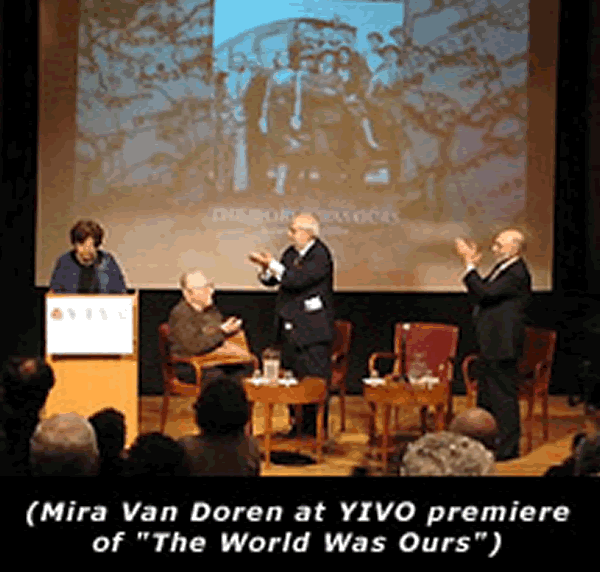
The film premiered at Brandeis last spring, and has screened at various festivals as well as a major recent showing at YIVO, a Jewish and Eastern-European research institute and another product of Jewish Vilna that has been transplanted to New York.
Van Doren is currently in the process of working on a companion book of photography to the film with her husband John Van Doren, a writer and professor, to whom she has been married for 51 years. Eventually, she would like to see "The World Was Ours" broadcast on public television to reach a wider audience. She is also interested in publishing a series of videos with the interviews she had to cut for lack of space — especially since the average age of survivors is increasing, and memories will soon be forgotten. "I was humbled by a lot," she said of the process, but especially "by the goals and the seriousness of the community."
Caroline Lagnado is a writer in New York.
Fri. Dec 22, 2006
--
MAY 2007
The World Was Ours: Mira Jedwabnik Van Doren
By Dr. Pola Rosen
After ten years of painstaking labor, research and travels to the city of her birth, Mira Van Doren has exquisitely captured the cultural life and the world that was Vilna before it was brutally cut off by the Nazis in World War II. Mira, the daughter of a surgeon and artist, was only ten when she left Vilna, but the memories of childhood friends that never survived and those classmates that surfaced only after being incarcerated in the concentration camps, had a lasting impression. Mira Van Doren has journeyed back in time to a place when Vilna was a cultural mecca, filled with literature, music, theater, books and an endless variety of cultural choices. She has recaptured her birth city, Vilna, in her documentary "The World Was Ours" dedicated to the memory of Jewish Vilna. It draws on a large collection of video interviews with dozens of survivors and scholars. Excerpts from diaries, letters, poems, newspaper stories, and other contemporary accounts supplement these interviews. Archival photographs and footage visualize the story of this remarkable community.
A voice-over narration by award-winning actor Mandy Patinkin weaves the many elements into a single story. Archival music evokes the spirit of the times and is supplemented by specially recorded performances of Yiddish, Polish, and other music popular in Vilna between the two world wars.
The Vilna Project, Inc. is preparing a book, which will complement the film. WNET Channel 13 has recently aired this documentary.
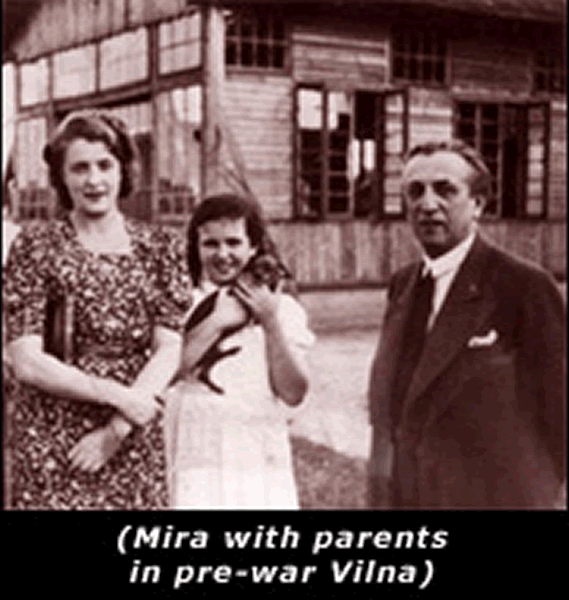
Mira Jedwabnik Van Doren, founder of The Vilna Project, was born in Wilno, Poland (now Vilnius, Lithuania) in 1929 to Dr. David Jedwabnik, a noted doctor, and Lydia Baruchson Jedwabnik, a gifted artist. Six days before Hitler marched into Poland (September 1, 1939), 10-year-old Mira sailed with her parents to the United States to visit the New York World's Fair.
Mira Jedwabnik Van Doren, founder of The Vilna Project, was born in Wilno, Poland (now Vilnius, Lithuania) in 1929 to Dr. David Jedwabnik, a noted doctor, and Lydia Baruchson Jedwabnik, a gifted artist. Six days before Hitler marched into Poland (September 1, 1939), 10-year-old Mira sailed with her parents to the United States to visit the New York World's Fair......
Streetscapes/130 West 57th Street; A Building and a Family With Intertwined Histories Save
By CHRISTOPHER GRAY
Published: June 11, 2000
IN August 1939, Mira Jedwabnik, 10, and her parents sailed from Poland to New York for a six-week vacation to see the World's Fair. But by the time they docked, the German Army was rampaging through Poland, and they were trapped in the United States.
The Jedwabniks moved into an old studio building at 130 West 57th Street, and for more than half a century it's been their home and business, for four generations of a family just as involved in art as in commerce.
Before the start of the Second World War, Lydia and David Jedwabnik led a prosperous life in Vilna, Poland (now Vilnius, Lithuania). The Jedwabniks lived in a Baroque-style apartment house. Mrs. Jedwabnik, now 92, was a painter, and Dr. Jedwabnik ran a hospital.
The Germans invaded Poland on Sept. 1, 1939, and the Jedwabnik's homeland collapsed within weeks. The Nazis killed most of their family, along with almost all the other Jews in Vilna. In New York, the Jedwabniks first settled on the Upper West Side, but after Dr. Jedwabnik was recertified to practice medicine, they looked for something that recalled the elegant quarters they had left.
Guided in part by young Mira, whose command of English was the best in the family, they settled at 130 West 57th Street, a co-op studio building built in 1908 as a twin to 140. The co-op failed in the 1930's, and the Metropolitan Life Insurance Company, which took over the building, was renting the apartments as best it could, although they were far from the clean, modern designs that were becoming popular.
The Jedwabniks took an apartment with a giant, double-height studio facing 57th Street with flanking regular-height bedrooms, dining room and kitchen. Lydia Jedwabnik decorated the apartment with red velvet wall hangings, antique furniture and artwork. She painted the neo-Classical fireplace with Chagall-like colors, and painted figures of Russian folk dancers on the panes of the windows. She was born in Odessa and educated in Moscow and Berlin, and speaks German, Polish, Russian, French and English.
During the war, Dr. Jedwabnik's brother, Abram, arrived from Paris and bought 130 West 57th Street from Metropolitan Life in 1945. He died in 1949 and left it to his brother. The family ran it themselves. ''My father had run a hospital, he didn't think it was such a big deal to run a building,'' says his daughter, now Mira Jedwabnik Van Doren.
What they got was a building with a distinguished history of tenants who included the novelist William Dean Howells and the artist Childe Hassam; the distinctive trapezoidal windows of 130 West 57th appear in several of his paintings.
Later tenants included Joseph Heller and Jose Ferrer, who often came to the Jedwabniks' New Year's Eve parties. Lydia Jedwabnik painted the dancers on her windows in honor of a visit by the Moiseyev ballet company.
After the war, Mira Jedwabnik embarked on a career as a mural and vitreous enamel artist, taking commissions like tables for the luxury liner United States and the powdery, highly colored elevator doors of 130 West 57th. Thumping the panels, which still look fresh after 30 years she said: ''See? Vandal-proof.''
In 1955 she married the professor and editor John Van Doren, son of Mark Van Doren, the late critic, poet and professor of English at Columbia University, in her parents' apartment. She took over management of the building in the 1980's. She and her son Daniel, a lawyer, now run it with an Old World approach. ''We come from a family of artists and writers, and this has always been a place for them,'' Mrs. Van Doren said.
Daniel's brother, Adam, an artist, architect and filmmaker, has his office in the building. He does the historical research for a growing lobby display, one of the most ambitious in New York.
About 10 years ago, he began researching census and other records to determine the earlier tenants. Buying through Web vendors like eBay and Bibliofind, he has collated photographs, Playbills, book covers and reproductions of paintings and letters, creating a series of framed collages. These include a lease with Joseph Heller; a letter to Mark Twain from William Dean Howells (on 130 West 57th Street letterhead); reproductions of Childe Hassam's paintings showing the windows; and photographs of the painting studio of Irving Wiles. And, on one wall, a giant mural salvaged from the old Russian Tea Room.
The Van Dorens have good lease records back to 1947, so they can document exactly which space Ray Charles rented, where the Rolling Stones practiced, and where Woody Allen's production company rented from the 1960's to the 1990's. But Adam Van Doren says he is frustrated by the earlier period, from 1908 to 1947; although early directories often list room numbers, only Polk's New York City Directory of 1933 lists apartment numbers.
So they have to fill in from occasional clues as best they can. They know that Hassam's studio was on the ninth floor west. That means the society figure Grace Wilson lived just below him, because in 1921 Hassam testified in court that he frequently had to jump up and down on the floor to complain about ragtime concerts at Mrs. Wilson's apartment. ''Discords, yelling, catcalling,'' the painter described them to The New York Times. ''It's an absolute riot.''
Daniel Van Doren was excited when he recently spotted the filmmaker D. W. Griffith listed as a resident in the 1925 census, although how they will determine his apartment number is difficult to say. The Van Dorens have only seven residential tenants left -- the rest of the 55 units are commercial -- and the increase in rental income has permitted them to maintain the building in the way they would like.
THEY cleaned the front a few years ago, and redid the hallways by exposing the mosaic tile and polishing the original mail chute. They salvage old flooring from one space and use it in another, they keep an eye out for more vintage doors and battle with the cable installers who ''have no regard for architectural integrity,'' Daniel Van Doren said.
''Accountants come in and they want to divide up the space,'' he said, waving at one of the high-ceilinged studios. ''We just say, This building is not for you.' '' This summer, the Van Dorens are putting up a new $30,000 metal and glass canopy on the street.
Dr. Jedwabnik died in 1972, but Lydia Jedwabnik still occupies the family's original apartment. Asked if she ever considered leaving the city or moving to a more residential neighborhood, she exclaimed: ''No! I like New York, and 57th Street, with Carnegie Hall and the Russian Tea Room.''
Mrs. Van Doren lives two floors above her mother, but her sons don't live at 130 West 57th Street, although Adam said, ''One day everybody will be living here.'' Both sons have young children who frequently visit.
At the same time that the Van Dorens began researching the history of their tenants, Mira Jedwabnik Van Doren began researching the history of the Jewish community of Vilna, and is now close to completing a documentary film. From a duplex office, she is searching for financing for the film's final editing. ''I've had such good fortune,'' she said.''If I can finish it, it will be my thank you to God.''
Vilna was a city of ideas, of dreams ... a city of scholars and poets ... a city of conviction and of tolerance and of respect for man."
- Y. Fain, Artist and Vilna Survivor
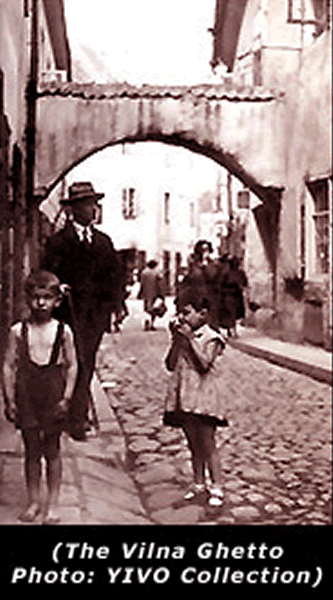
The Vilna Ghetto
The Vilna Project is a non-profit 501(c)3 organization based in New York City. Founded by Mira Jedwabnik Van Doren, the project is dedicated to documenting, preserving and disseminating information about the pre-war Jewish culture of Vilna, Poland (now Vilnius, Lithuania). Numerous interviews with survivors and scholars have been videotaped; archival texts, photographs, music and films from the United States, Israel and Europe have been collected.
In July, 1993, Ms. Van Doren spent 10 days in Vilnius attending the 50th Anniversary commemoration of the liquidation of the Vilna ghetto. While there, she filmed newly discovered archives located in a church where they had been hidden over 50 years earlier by the Jewish Community during the Holocaust. This footage can be seen in a 30-minute short ("The Hidden Treasures") made by Ms. Van Doren in 1998.
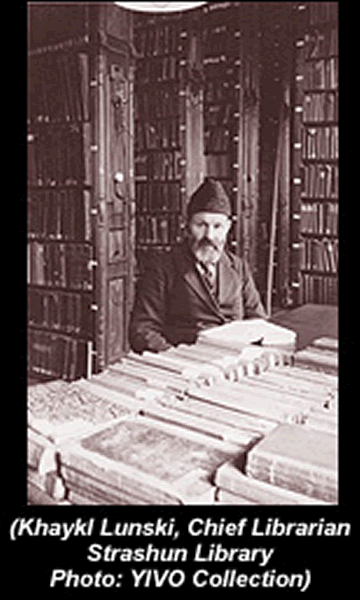
THE WORLD WAS OURS Khaykl Lunski, Chief Librarian of the Strashun Library
"THE WORLD WAS OURS", a documentary film dedicated to the memory of Jewish Vilna, draws on a large collection of video interviews with dozens of survivors and scholars, supplemented by archival photographs and footage, excerpts from diaries, letters, poems, newspaper stories and other contemporary accounts. A voice-over narration by award-winning actor, Mandy Patinkin, weaves the many elements into a single story. Archival music evokes the spirit of the times and is supplemented by specially recorded performances in Yiddish, Polish and other music popular in Vilna between the two World Wars.
Mira addressing audience at YIVO screening. Sharing the platform are (l-r) three Vilna survivors - Prof. Benjamin Harshav, Editor Will Begell, Artist Samuel Bak. (Photo courtesy of Dr. Michael Good)
The film received its World Première on April 30th, 2006 at the 9th Annual Film Festival held at Brandeis University in Waltham, Massachusetts. This was followed on November 7th, 2006 by a New York Première at the YIVO Institute for Jewish Research. There have since been a number of successful showings at various films (see web page "THE WORLD WAS OURS") and it will be shown on WNET - Channel 13 on April 14th at 9:00 PM, the first of four scheduled showings.
CURRENT PROJECTS
The Vilna Project, Inc. is preparing an educational study guide to accompany the DVD of the film. A book which will complement the film "THE WORLD WAS OURS" is also being prepared. In addition, plans are underway for a DVD collection called "The Last Voices of Vilna" that will consist of the many valuable and inspiring interviews of Vilna survivors and scholars that could not be included in the documentary. We are currently seeking funds to complete these projects