Kurenets Guestbook Archive: Part 2
Thank you for visiting our pages. We would like it if you would add to our new guestbook. Please return to Kurenets Home Page and click NEW GUESTBOOK.
I talked to Chaya Esther Nee Gurevitch/ Horwitz-Raich in New Haven, Connecticut. She was known in Kurenets as Chaya Gurevitch, the daughter of Chayim Israel Gurevitch. Chaya Esther (first cousin of my grandfather; Meir son of Mordechai gurevitz) had five much older brothers and two older sisters who were related to her only from her father’s side. Chayim Israel was married to the daughter of Shmuel Malach Alperovitz. She died in 1917. From her mother’s side she had a sister and a brother from her mother’s marriage to a Pilskin. Her mother was originally from Miadel and she would visit the cemetery there where her parents were buried. Her paternal sister Leah Nee Gurevitch-Benes lived in Kurenets. Her husband was Zusia. They didn’t have any children. They perished on 10-9-1942. Her other paternal sister, Rachel nee Gurevitch-Mula lived in Svir. She had a son Volvel, and two daughters. Her maternal sister Sonya lived in Dolhinov. She was married to Kaminkovitz. They had four or five sons. They all perished in Dolhinov. Her maternal brother was Rabbi Pilskin, who lived in Baltimore. He had a son who was a rabbi in Israel. From her five paternal brothers, one lived in Minsk — Yehoshua. He survived the war and returned to Minsk. One of his sons perished and the other’s whereabouts is unknown to Esther. Her other four brothers moved to New Haven, Connecticut many years before the war. Chaya Esther was hiding with her neighbors in Kurenets. Leibe and Freida-Bilka Ziskind and their three daughters, Dvora, Rivka, and (?). On that day, the Germans came to kill the residents of Kurenets. They hid underneath hay piles for a few days and then they were able to escape to a nearby village, where a Christian farmer who knew the Ziskind family told them how to reach the Narutz forest, where other people from Kurenetz were hiding. They were able to reach the forest and they spent two years hiding there with many others from Kurenets. Today Chaya Esther is responsible for the meetings of the Holocaust survivors in the New Haven area. She told me about other survivors, such as Sonya from Dolhinov and her husband Baruch Markman from Kurenets, and Charles Gelman (who was known as "Chetzkel Tzimerman) and his sister Dishka (who lived in New York).
Gurevitz family pictures;
http://eilatgordinlevitan.com/kurenets/k_pages/gurevitz.html
Many other families pictures could be found if you scroll down the page;
http://eilatgordinlevitan.com/kurenets/kurenets.html
for pictures
of the Gurevitz/ Horwitz family click here
For; Alperovitz | Baksht | Berkovitz
| Cheres | Davidson | Dinnerstein | Dubin | Gordon | Greenhouse | Gurevitz |
Katz | Katzowitz | Kopilovitz | Kramnik | Kremer | Krivitsky | Meirovitz | Norman
| Podberesky | Potashnik | Rabinovitz | Rabunski | Shiniyuk | Sosensky | Shulman
| Swirsky | Turov | Zaltzman | Zimmerman | Ziskind | Zusman for
the families pictures click and then scroll downs
- Thursday, February 14, 2002 at 21:39:51 (PST)
--------------------------------------------------------------------------------------------------------
I would like to thank Roger Rice
for the beautiful pictures of the KRIVITSKY
Family and for the two books that his great uncle David Krivitsky wrote c 1948.
David dedicated the one of the books to his sisters Liba (Rice) and Chana and
I think to the memory of his brother Harry (It is written in Yiddish)
One of the poems is dedicated to his sister Liba Rice another to his brother;
Harry Kamin. Many poems are dedicated to friends. Amongst them childhood friends
from Kurenitz; To Moris Cohen who also wrote in the kurenitz Yizkor book;
http://eilatgordinlevitan.com/kurenets/k_pages/stories_matia.html.
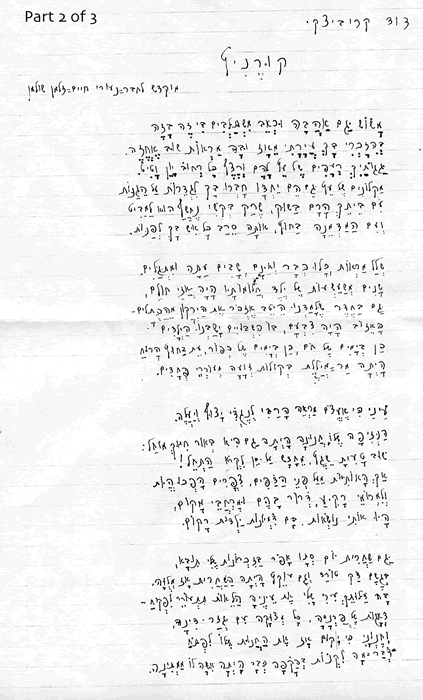
Another was dedicated to His childhood friend; Chaim Zalman Shulman.
Aharon Meirovitz was very kind and translated it to Hebrew and asked me to post
it here. You could find it in two parts;
http://eilatgordinlevitan.com/kurenets/k_pix/israel/61101_23b_heb_b.gif
http://eilatgordinlevitan.com/kurenets/k_pix/israel/61101_23c_heb_b.gif
Aharon chose the poem for the love that David had for his hometown Kurenitz
that he left so many years before. Most of the krivitsky family lived in New
Haven. Some (Like Alexander) changed their last name to Winik.
http://eilatgordinlevitan.com/kurenets/k_pages/krivitsky.html
click
for pictures of the Krivitsky family
USA -
Dear Eilat:
Shalom, while doing a search for EINBINDER I found (see below) a message that you left in a guestbook........
I just had a new discovery. I had been reaching a branch of my
Mother’s family with the surname, Skolnik or Shkolnik, all this time.
I have now learned that the family name in the beginning to mid 1800's
Was changed from EINBINDER.
<blockquote type=cite cite>Vetter Mendel Einbinder was Dovid's brother. Another brother was Chatzkle Alperowitz. The original family name was Einbinder. In order to avoid conscription into the Russian army, Chatzkle and Dovid took different surnames. Chatzkle changed surname to Alperowitz and Dovid changed surname to Skolnik
Dovid Skolnik was my great great grandfather. He was from a place not far from Vilna called Vileika / Wileika. His brother Chatzkle Alperowitz lived in a small town called Dunilowitz.
The many of my Skolnik and Alpert(owitz) family are located in New Haven CT.
This is all I know at the present. I've just started looking into my
Einbinder family.
Does any of this information sound familiar???
All the best,
Jay Lenefsky -Israel
hotdog@netvision.net.il
~*~*~*~*~*~*~*~*~*~*~*~*~*~*
EilatGordn@aol.com wrote:
Shalom,
I am starting a shtetl page for Krasne, Belarus.
in the eidb I found; ;Anbinder,Chaje Krasne, Russia 1913 63y
54 Anbinder,Schame Krasna 1906 35y
55 Anbinder,Zyzic Krasne, Russia 1913 18y
Also my relatives are the Einbinder family of New Haven who came from Kurenets in the 1920s' (next to Krasne, in the area of Vileyka). Is ;Krasne; in today Belarus? . Thank you. Eilat
Thank you very much it is most interesting,
Welcome to the Kurenets Site http://eilatgordinlevitan.com/kurenets/kurenets.html
Welcome to the Vileyka Site
http://eilatgordinlevitan.com/vileyka/vileyka.html
I created pages for Vileyka and next-door Kurenitz; some notes that I have;
Jenny nee Zavodnick Koslow Daughter and son-in-law; Stanley and Sylvia Katz wrote me that their Zavodnick family was from Kurenets and about Jenny's father; Skolnik from Vileyka. They live in New Haven
In a message dated 2/14/02 10:35:02 AM Pacific Standard Time, hotdog@netvision.net.il writes:
<< Sylvia Katz and I are 3rd cousins.
Ashka nee Kremer from Kurenitz married Meir Skolnik who perished in 1942. Picture of the children of his sister who were killed as partisans; http://eilatgordinlevitan.com/kurenets/k_pix/scenes_old/112901_kos_b.gif
Another note I received; "Amazing and wonderful website. My maternal grandmother Scolnik was from Kurenetz and she said half the town was named "Alperovich". . . As I look at your webiste, this seems very true. I hope to post some of her stories about Kurenetz c. 1900 when I get a chance. "
Laura Miner <76233.3413@compuserve.com>
NYC, NY USA
In a message dated 2/14/02 4:02:58 AM Pacific Standard Time, hotdog@netvision.net.il writes:
<< Chatzkle Alperowitz >>
In Kurenitz lived; Zalman, Mendel, and Moshe Alperovitz. they were the sons of Chatzkle the son of Binyamin
Zalman, Mendel, and Moshe were born c 1870. could their father Chazkle born before 1850 be your great great grandfathers' brother? you could find some of that family pictures in; Alperovitz http://eilatgordinlevitan.com/kurenets/k_pages/alperovitz.html
In a message dated 2/14/02 10:35:02 AM Pacific Standard Time, hotdog@netvision.net.il writes:
<< Stu Einbinder's family is from a place in Poland called , Mlawa. (as persome web page
I found). It is a great distance from the Vileka district so I am notsure right now that there is a connection. >>
Stu is related to me, and my family is from kurenitz his grandmother Perl (the sister of my great grandfather Mordechai Gurevitz and his grandfather, Nathan Einbinder, lived in Kurenits. his grandmother came from Kurenitz
so there must be a connection to the vileyka area if they found each other and lived and had children in Kurenitz!!! There were a few other Einbinder families in Kurenits as in Dolhinmov- Yitzhak Einbinder was a well known partisan from Kurenitz - read the story of Zalman Uri Gurevitz (my mothers’ first cousin); http://eilatgordinlevitan.com/kurenets/k_pages/stories_gurevitz.html
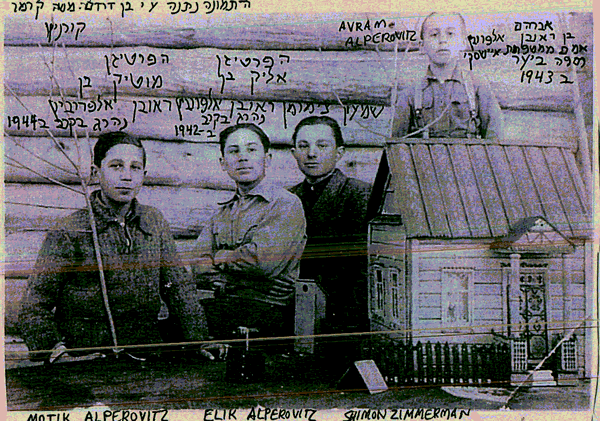
"Amongst us were Benjamin (Nyomka) Shulman, Shimon Zirolnik, Yitzhak Einbender, Mordechai (Motik) Alperovitz, Nachoom Alperovitz, and I. Our original troop leader was Kopel Spektor, a man of all seasons- an athlete, a bookworm, a mathematician, and a generous and dedicated person. He was like a father to us. During the days of the Soviets, he was a technician and a cartographer in the central train station in Molodechno, 30 kilometers from Kurenets. He was graduate of a technical institution in Vilna and an extremely capable man......One of Vlodia's men dressed as a policeman and took Noach Dinnerstien, Eliyahu Alperovich, Yitzhak Einbender, Nyomka Shulman, Yankale Alporevitch and I . We pretended we were prisoners going to work in the Vileyka camp, the partisan was very convincing in his roll as a cop. When we arrived we had to hide for many hours till nighttime came. All together there were about 40 people at the meeting. They pretended that it was a dance party. Inside everyone was armed. Berta introduced Vlodia as the commissar of the partisan Otriad. Vlodka said we must forget each other’s names; each one will get a nickname. We would work secretly, and most importantly make sure that no traitors infiltrated our group"
michaelp55@hotmail.com writes:
<< Shalom!
My mother's maiden name is Kurinets, and we come from Bobruisk, Belarus, but my mother always said that family came from the town of Kurinets. Do you have any idea how to search for relatives?
Mike Perkelvald
-----------------------------------------------------------------------------------------------------
Subj: Alperowitch
Date: 1/23/02 3:07:43 AM Pacific Standard Time
From: alperowitch@yahoo.com.br (Fernando Alperowitch)
Below you'll find the answers for the questions you ask my grandfather,Yitzhak
Alperowitch (son of Israel Hakatzav);
His Mother's maiden name is Chaya Swirski.
His grandfather, father of his mother, David Swirski,
and father of his father, Abrão David Alperowitch,
both died of old age.
He knows some living relatives:
S.Paulo:
Emilio Levinson, was born in Brazil, son of Shmerl
Swirski (brother of my granpa`s mother) with his
second wife. Changed the last name.
Chana Himelfarb, Emilio`s sister.
US: Zalman Alperowitch (Alpert) - cousin
Yacob(Jack) Alperowitch - cousin
Israel:
Yeoash Alperowitch (engeneering)- cousin
Shimon Cimerman-Riva Cimerman`s husband - cousin
The reason he came to Brazil: his uncle, Shmerel
Swirski, his mother’s brother, lived in SP.
He has some pictures, especially of his brother. He
will look for it to put on the site.
.
-
I am posting a note from the Dolhinov guest book because there were many family
relations between the two shtetls.
21 of January 2002
Here is an updated list of donors for the Dolhinov Cemetery Project:
1. Alperovich Tova Ramat Gan, Israel $250
2. Blum Bushke Givataim, Israel $250
3. Berzam Chaya Ramat Gan, Israel $250
4. Baranovski Chava Ramat Gan, Israel $250
5. Gitlitz Yecheskel Tel Aviv, Israel $250
6. Gitlin Avi Ramat Hasharon , Israel $375
7. Grosbein Chaim Petach Tikva, Israel $250
8. Golan (Goltz) Yechezkel Rehovot, Israel $185
9. Dr. Goltz- Doytch Miryam Haifa Israel $250
10.Chafetz Asya Tel Aviv, Israel $250
11.Chafetz Gutman Tel Aviv, Israel $250
12.Cheres Yehuda Herzelia, Israel $500
13.Finesilber Beny Haifa, Israel $250
14. Lenkin Nachum Holon, Israel $250
15. Norman Shimon Petach Tiqva, Israel $250
16. Norman Yitzhak Givataim, Israel $250
17. Fridman Moshe Kfar Saba, Israel $250
18. Koton Levi Ytzhak Holon, Israel $250
19.Kravchinski Rachel Petach Tiqva, Israel $250
20. Kremer-Sosenski Batya Ashdod, Israel $250
21.Dimshtein Lev Alfey Menashe, Israel $250
22.Perevoskin Aharon Ganey Yochanan, Israel $250
23.Shlechtman (Sosensky) Sima Ashdod, Israel $250
24.Shinuk David Rishon Lezion, Israel $250
25.Shulman Hinda Ramat Gan, Israel $250
26.Shamgar (Smorgonski) Shlomo, Givataim, Israel $250
27.Sosenski Yehuda Ganey Yochanan, Israel $250
28.Rubin Leon Ramat Efal, Israel $250
29.Rubin Arye Givataim, Israel $250
30.Rubin Victor Chedera, Israel $250
31.Rubin Israel Neveh Mivtach, Israel $250
32.Rapson/ Ekman Michael Avichail, Israel $250
33.Radashkovich Gideon Givataim, Israel $250
34.Radashkovich Mordechay Givataim, Israel $250
35.Radashkovich Roni Givataim, Israel $200
36.Podshivalov (Shpreregen) Fanya, Nesher; Israel $ 200
37.Fridman Eli Argentina $250.
38.Griner Chasya Brazil $375
39.Drewiacki Max Berlin, Germany $375
40.Mr. & Mrs. Jack Diamond Omaha, U.S.A $250
41.Eilat Gordin Levitan, Studio City, Ca U.S.A $250
42.Shmilovich Avraham Kvar Saba Israel $125
43.Tych Raja (nee Bronshtein) Ramat Gan Israel $275
44.Zolotov Zipora Lahavim Israel $250
45.Markman Sonya New Haven U.S.A. $100
46.Yofe Sima Ramat Gan Israel $125
47.Labunski Fanny(nee Ruderman) Haifa Israel $125
48. Radashkovich Eliyahu Ramat Gan Israel $100
49. Radashkovich Arie Tel Aviv Israel $125
50. Gayer Rita Petach Tiqva Israel $250
51. Rapson Dov (Melamed) Avichail Israel $250
52. Rapson Avigdor (Ekman) Herzelia Israel $250
53. Paz Yosef & Dvora Haifa Israel $250
54. Sosenski Yaakov Ashdod Israel $125
55. Sosenski Sima Ganey yochanan Israel $125
56. Ben Barak Gallia Rechovot Israel $125
57. Shor Maya (nee Sosenski) Bizaron Israel $125
58. Sosenski Eli Ashdod Israel $125
59. Kaplan Klila Tel Aviv Israel $125
60. Kanter Laura (nee Libe Rubin)Boca Raton Fl. U.S.A $500
61. Schuster Riva Kvar Saba Israel $125
62. Brant Sara Navei Mivtach Israel $100
63. Aminetsach Yehuda Herzelia Israel $125
64. Aminetsach Avraham Jerusalem Israel $125
65. Dr Shmilovich Zelig Omer Israel $125
66. Ruderman Florence New York U.S.A. $150
67. Chalifa Raya(nee Rubin)Navei Mivtach Israel $125
68. Shap Gerald & family (Grosbein)Cape-Town,South Africa $650
69. Harcavi (Furman) Meier Ramat Hasharon Israel $250
70. Harcavi (Furman) Chanan Ramat Efal Israel $250
71. Rosen Lester & Debby Glencoe , Chicago U.S.A. $250 + $50
72. Susan M. Goldsmith of Piedmont, CA ,U.S.A. $500
73. Jacob Chevlin, Florida, U.S.A $250
74. Simon Chevlin, New Haven, U.S.A $250
75. Shifra( nee Chevlin) Zamkov, New Haven, U.S.A. $500
76. Ester Telis (Dockshitzki) Cheshire, Con. U.S.A. $500
77. Prof. M. Shapiro Hod Hashron, Israel $100
78. Zipi Asafi (Grosbein) Kfar Saba, Israel $125
79. Dr. Orania Yanay Tel Aviv, Israel $250
80. Dr. Dimenshtein Victor Tel Aviv, Israel $250
81. Liberman Batya & Esar Fridman Kvar Saba, Israel $125
82. Rabani Ziva Jerusalem, Israel $125
83. Evalyn Krown New York,U.S.A.$100
84. Shamgar Giora ,Ramat Gan,Israel $125
85. Lechterman Chaim Tzahala,Israel $125
86. Malerevitch Batya (nee Lechterman) Tel Aviv,Israel $125
87. Gitlitz Orah & Tzipi, Givataim, Israel $125
88. Bronshtein Chana Ramat Gan , Israel $250
89. Doytch Israel, Petach Tiqva, Israel $125
90. Dr. Bronshtein Michael Tel Aviv ,Israel $250
91. Gutman Palant, Moshav Magshimim,Israel $250
92. Radashkovich Viera, Ramat Gan,Israel $125
93. Holland Nate, Winetka, IL,U.S.A. $125
94. Holland Bill , Chicago, U.S.A. $125
95. Garson Charllotte, Atlanta,Georgia,U.S.A. $250
96. Ben-tov Chaya, Ramat Gan, Israel $75
97. Gitlin Mordechy, Haifa, Israel $50
98. Kagan (Gendel) Malka, Haifa Israel $50
99. Adin (Eidelman) Dov, Beit Avot Efal, Israel $75
100. Rubin Elyakim, Givataim, Israel $50
101. Dr Pryss Leon, Natanya, Israel $60
102. Even Bila,Ramat Yitzchak,Israel $50
103. Prof Samuel Kassov, Hartford,USA $100
This is a list of donors who participated financially so far in the restoration
of
the Jewish Cemetery in Dolhinov.
The project is estimated to cost 30000 US dollars . 23000 of the sum has been
already collected.
For address of people on the list - email:
rubinlj@netvision.net.il (RUBIN LEON)
For letters:
Leon Rubin, 2 Hartsit str.,Ramat Efal, 52960, Israel
Tel. 03-6356469
.
-
Today I talked with Sara (From the
Norman, Kooperstooch/ Baskin family of Vileyka) and Boris Klor (from Michalishek
near Vilna.) The Klors have homes in Hamden, CT and in Delray Beach; FL.
Boris was born in Michalishek in 1921. Sara was born in Vileyka. her mother
was from the Norman family (a relative of Shalom and Moshe Norman) Her father
was from the Baskin/ kooperstooch family of Ilja. The original last name was
Baskin but some of the family changed their last name to Kooperstooch to avoid
serving in the Russian army prior to the First World War. I found some Information
on the Baskin family by using a search engine. I will post it in the next note.
Saras' family moved from Vileyka to Michalishek when she was still a young child.
She practically grew up with Boris Klor. As they grew they fell in love. Sara
moved to Vileyka during the rule of the Soviets (1939-1941) It was easier the
get a job in Vileyka that had many official Soviet offices.
In the summer of 1941, the day before the German invaded the Soviet Union, one
of Saras' sister came for a visit in Vileyka as summer vacation started. Both
sisters were able to get on a train to Russia during the first days of the German
invasion. They survived the war somewhere in the eastern regions of Russia.
Unknown to them a brother was also able to arrive in Russia. Two sisters were
in German camps. One Perished and the other survived.
Boris klor is the only person who survived the war from his entire family. He
was taken to ghetto Vilna with most of the Jews of his shtetl. He was able to
escape in 1943with a group of 27 young people mostly from Grodno, who were helped
by some Jewish partisans from the Narootz forest. It took them five days to
reach the forest. they were able to bring nine pistols. He later joined Warshilov
Brigade under markov. he served there with many from Kurenets, Svir, Myadel,
Postov, Krivichi and more. he knew many families from Kurenets who hid in the
area. For a short time he also served in the jewish unit under Yosef Glazman.
He told me about rivka Gvint, Rivka Alperovitz, shimon Zimerman, Sara and Moshe
Alperovitz (Rashkas'- my great grandmothers' sister) Ester Reich (Chaya Gurevitz
the daughter of Israel- my great grandfathers' brother) and Zalman, Gershon,
Lea and their father- Natan Gurevitz, the brother of my grandfather)
After the war Sara and Boris found each other. They came to Germany via Poland
and tried to get papers to settle in Israel. Saras' grandmother from the Baskin
family- was in the U. S for many years. she looked for survivors and when she
found them she was able to get papers for them and they all came to America.
.
I found a site with relatives of Sara; BASKIND FAMILY HISTORY
http://freepages.genealogy.rootsweb.com/~jlevinson/moearticle.html
By Moe Baskind
As I at last begin writing a history of our family, my greatest regret is that
my sister Rose is not alive. She would have given me much information of an
interesting nature that I only possess slightly.
Our family came from what is now either Poland or Lithuania.(now Belarus) We
are classed however as Litvoks. My father’s family lived in a village called
Ilya. If you can find a large map of Russia or Poland you might spot it. I once
saw it on a map, but I don't recall what book. It is somewhat south of the larger
city of Vilna.
My father, born about 1861 was the second oldest of a family of six boys and
one girl. The oldest although in my cousin Joseph Baskind's book he calls him
Menachim Mendel. Next was my father, Avrum Pesach, then David "Cooperstock,"
followed by Hirschl, Itche, Rivka (who became an Arian) and Shmeul. In Russia
the eldest son was exempt from army duty so somehow David was made the eldest
son of a Cooperstock family. They were the only family that never came over,
although some of the children came here, and some landed in Israel.
How they all made a living before coming to America, I can't tell you. Their
parents names were Berel and Rashi. Their father died rather young, and they
were all out on their own when youngsters. Their mother died about 1904 or 1905,
and I believe at the time, only my Aunt Rivka was living in Europe.
How well I remember the peculiar custom prevailing then that when a letter came
from Europe announcing the death of a parent or close relative, the news was
kept from the immediate family member. Sometimes, for a year. It would seem
that this would have an effect on saying kaddish, and why a death was kept secret,
I don't know.
Chai Mendel who landed and stayed in New York was a shammes and part reverend.
He was the father of Joseph, a prominent member and General Secretary of the
ARBEITER RING, the national Jewish Labor organization. His other children were
Louie, who has some children living in Miami Beach. Tillie Broida, who lived
in Pittsburgh for a while, and then moved to New York, and Fannie, who also
lived in New York. The other son who stayed in New York was Uncle Schmuel. The
was the father of Rose Somberg, now living in Cleveland.
I believe Uncle Hirshel, the father of Dinah Slavin, Minnie Baskind, Beckie
Minister, Rose Kohl, and Manny was the first to arrive in the United States.
His wife, Tante Sarita, was distantly related to the Brudno family of Cleveland
and perhaps that is why they came to Cleveland. The Brudno's already had a large
stogie factory in Cleveland. I remember it on lower Broadway. It must have been
five or six stories high. When Uncle Hirschel came to Cleveland, he immediately
went to work for the Brudno's. My Aunt Sarita was very proud of her ancestor,
Menasseh of Ilya, who is mentioned in the Encyclopedia Britanica as one of the
five famous pupils of the Vilna Gaon. That is why there are so many Emanuel's
in their family.
Tante Rivka married an Arian who was either a first or second cousin to the
Baskind's. They were the last of my father’s family to come over and consisted
of Ida Newmeyer, George who lived in California, Rose, now with the Blonder
company and retired. Harry a druggist who passed away early in life, and Ben,
the only one born in this country Ben passed away in 1973. The reason they came
later was due to the inability of my Uncle Isaac Arion to enter this country
on his first attempt. How well I remember his efforts, only to be turned away
at Ellis Island in New York because of weak eyes. I don't remember how many
times he tried but finally made it.
My Uncle Itche came over as a single man, and then brought over his future wife
Sarah. I vaguely remember their wedding, although Minnie Baskind says she remembers
it well. I think it about 1901 or 1902. They had four sons and one daughter.
All the sons became the famous druggists of Cleveland. Harry, the oldest became
the first Jewish Chairman of the State Pharmacy Board in Ohio. Perhaps the first
Jew in that capacity of any state. Harry died in 1975. Next was Jack, now retired,
who recently celebrated his 75th birthday. Then came Al and David, who passed
away early in life, and last, the only girl Florence. Of course all of these
cousins of mine have numerous children. There were many other cousins from Uncle
Schmuel's family as well.
Now some information of my mother's family. She was born about 1863. They were
not poor as my fathers. Her father and mother, Beritche and Pia, lived in Kablonka,
a small village not too far from Ilya. My grandfather inherited the rights to
the lease of a grain mill plus some small acreage of land. I call it rights
because they were not allowed to own any land. However their ancestors received
that right from the Poretz or Count who owned the land for many miles around.
My mother had an older sister Shana who married a specter and had one son, Abe.
None of Abe's children survive today. Other children of Shana are Dinah Kline,
who had several children. Gute Friedland, who had Dorothy and other daughters
and sons whom I don't remember.
A younger brother of my mother Moshe Hirschel Alpert had to leave a daughter
in Europe because of illness. Another daughter was Freda Rubenstein who lived
in Denver and passed away in 1976. Freda had a son and a daughter. Her daughter
lives in Denver and is called Mrs. Mosco. Abe, a son of Moshe Hirschel was a
druggist, now passed away. How many children, I don't know....
to
read Moe Baskin's story click here
-
http://www.nyu.edu/library/bobst/collections/exhibits/tam/JLC/2origins.html
The Jewish Labor Committee (JLC) was founded to provide a presence for Jewish
labor in the councils of the American trade-union movement and in the Jewish
"establishment," and to mobilize labor in the struggle against fascism.
Its founding meeting, at Central Plaza on New York's Lower East Side, on February
25th 1934, brought together more than a thousand delegates representing the
International Ladies' Garment Workers Union (ILGWU), Amalgamated Clothing Workers,
United Hebrew Trades, Workmen's Circle, Jewish Daily Forward Association, and
a number of smaller groups. Baruch Charney Vladeck, general manager of the Forward,
was chosen president; David Dubinsky of the ILGWU, treasurer; Joseph Baskin
of the Workmen's Circle, secretary; and Benjamin Gebiner, also of the Workmen's
Circle, executive secretary. Holding that only a broad-based workers' movement
could overthrow Hitlerism, the JLC emphasized its labor orientation and nonsectarian
philosophy. Its aims were to support Jewish rights everywhere, support all progressive
and democratic anti-fascist groups, aid refugees, and educate the American labor
movement (and the general public) about the Nazi threat.
The JLC was the brainchild of B.C. Vladeck, a brilliant writer and organizer
who was known for the elegance of his Yiddish oratory and who was adept at navigating
the perilous waters of New York immigrant politics. Vladeck, like most of the
early generation of Jewish American labor and socialist leaders, had served
his political apprenticeship in the famous "Bund" or General Jewish Workers'
Union of Lithuania, Poland, and Russia.
The Bund was a Jewish social-democratic party (legal in Poland, illegal in Russia),
which sustained its own network of schools and cultural/fraternal institutions
devoted to the strengthening of Yiddish culture and socialist values. Generally
hostile to both Zionism and Communism, it was associated with the social-democratic
Second International. In many areas, the founders of the JLC were translating
and adapting lessons learned in the ranks of the Bund for use in the very different
social milieu of America.
Workmen's Circle
HS 2330.W6 B3 1951 Y. Baskin: tsu zayn 70-yorikn yubiley. Nyu-York: Aroysgegebn
durkhn Natsyonaln ekzekutiv-komitet fun Arbeter-Ring, 1951
.
USA -
From;
http://freepages.genealogy.rootsweb.com/~jlevinson/interview.html
FREEDA HURWITZ:
Shevanovik was a farm. We lived on a farm.
SYLVIA LEVINSON: We are recording some
reminiscences on Sunday, March the 10th, 1980,
some of Mom's and Aunt Bea's reminiscences of
what life was like when they lived in Europe.
BEA WEINBERG: Seventy-six years ago.
BEA WEINBERG: Well, I lived all my childhood on an estate which belonged to
a Polish count. His name was Shizdevski (phonetic spelling). It was a beautiful
surroundings; hills, wood-covered, nuts that we used to go in the summer and
gather them, dry them and have them for the winter.
There were lakes where my brothers used to get up at four o'clock in the morning
and go fishing and were always successful. There was a beautiful stream that
ran right through the estate; clear water, not like what you see here. Wildflowers
on the hills and meadows, an orchard full of pears and plums and apples within
a few steps of our kitchen door.
SYLVIA LEVINSON: Well, now, you rented this land; why did you have to rent it?
BEA WEINBERG: Jews in Russia were not permitted to hold any kind of land.
SYLVIA LEVINSON: Did you pay the count money, or did you give them part of the
--
EEDA HURWITZ: No. We paid him. on the farm, we raised cows.
BEA WEINBERG: We had a dairy.
REEDA HURWITZ: We had a dairy. And we had chickens. We had geese. And we had
ducks and our own --- the chickens laid, we had our own eggs and our own vegetables.
We had a garden. We had all kinds of vegetables for making pickles and sauerkraut
and all the edible vegetables; potatoes, carrots.
SYLVIA LEVINSON: Who worked the farm and
raised the vegetables and took care of the cows
and chickens and everything?
BEA WEINBERG: We had the mujiks, what were known as the mujiks, the Russian
peasants who lived right in little houses on the farmland.
BEA WEINBERG: They were paid and they were given enough of the vegetables, the
fruits and all.... SYLVIA LEVINSON: What would they be
equivalent to what we know? Is there anything equivalent to that in this country?
BEA WEINBERG: I don't think so.
BURTON LEVINSON: We have tenant farmers.
SYLVIA LEVINSON: Would that be like that?
FREEDA HURWITZ: No. We used to give them
shares of the --
Now, we had a dairy, as was mentioned before. And the milk would be sent over.
There was a boy that was also, probably, a Jewish boy that would get fifty or
sixty dollars a year.
And the milk would be loaded in tremendous vats, like, see, and he would take
it to the market. There was a market on certain days in the little town; what
was it?
FREEDA HURWITZ: Danilovich.
BEA WEINBERG: Danilovich it was called.
SYLVIA LEVINSON: And that was the closest
little town to you?
BEA WEINBERG: Yes. Yes.
9 FREEDA HURWITZ: Yes.
10 SYLVIA LEVINSON: So when you are talking
11 about little, how many people lived there? Was
12 it like a --
13 FREEDA HURWITZ: Like a village.
14 BEA WEINBERG: I wouldn't say, because I
15 don't know, and I wouldn't want to speak as to
16 how many.
17 FREEDA HURWITZ: It wasn't as big as
18 maybe, maybe as big as Lebanon or those little
19 places around.
BEA WEINBERG: Well, we don't know how big Lebanon is.
22 SYLVIA LEVINSON: But it was where the farmers would bring their --
BEA WEINBERG: It was small. It is what you call, what is known in Yiddish literature
as a shtetl.
FREEDA HURWITZ: Yes, a shtetl. There were a lot of Jewish people there, a lot
of Jewish people.
SYLVIA LEVINSON: About how far would you
imagine your --
BEA WEINBERG: I would say twenty miles.
SYLVIA LEVINSON: About twenty miles from
there?
BEA WEINBERG: Yes.
SYLVIA LEVINSON: And then he would sell
the milk?
BEA WEINBERG: He would sell the milk and bring the money. And we had I don't
know how many cows, a lot of cows and sheep and geese; not ducks much because
we didn't have any water ....
SYLVIA LEVINSON: And those were the
2 Alberts, then.
3 FREEDA HURWITZ: Yes. Alperovich was
4 their name in --
5 BURTON LEVINSON: You see, these places
6 where they lived was what was known as the Pale
7 of Settlement. And that was the land that was
8 set aside where only Jews could live and where
9 only Jews could trade. That was the Pale of
10 Settlement in Russia.
11 SYLVIA LEVINSON: So that was where Aunt
12 Sonny and what, the Fettershimmin (phonetic
13 spelling).
14 FREEDA HURWITZ: Yes, the Fettershimmin.
15 BEA WEINBERG: When we lived --
16 SYLVIA LEVINSON: Whose brother was that,
17 Grandma's brother?
18 FREEDA HURWITZ: It --
19 SYLVIA LEVINSON: Papa's sister.
20 FREEDA HURWITZ: Papa's sister.
21 SYLVIA LEVINSON: Oh, she was grandpa's
BEA WEINBERG: Yitzhak didn't live -- he
13 lived in Postov.
14 FREEDA HURWITZ: In Postov.
15 SYLVIA LEVINSON: Where was Postov.
16 BEA WEINBERG: Postov was, I suppose,
17 about forty miles away
22 sister.
click
here for the rest
-
I am searching for my great grandfather
Harry Simon. He was born in the small town of Horodok Russia and left in 1914.
If any of you knew who he was or are from Horodok please EMail me.
Doron WRITER7416@aol.com
F.H. , MI USA -
Through great research by M.L. Anderson
and her friend Charlotte, I believe my grandfather came from your town. His
name was Samuel Sassinsky/Sossinsky/Sosinsky (one of those last names. He had
a brother Julius and sister Dina. He was born October 7, 1883. I understand
that he had relatives murdered in the holocaust, Sossensky(i). What I need to
know if there are any documentations or by knowledge when he came to America.
It had to be before 1910 when my aunt was born. He was married to Rose. I don't
know if it occurred there or here.
Thanks Les
Lester Solnin sollest49@nyc.rr.com
Queens Village, , NY USA -
I would like to thank Carlos Glikson for the note I found;
Date: Sat, 15 Dec 2001 13:36:13 -0300
from: "Carlos Glikson"
Subject: Re: Family roots in Kurenets
Haim Bar Levav is tracing his Swirsky family roots possibly to "the town of
Korenitz". May I suggest a link for (probably) Haim's Korenitz?
Eilat Gordin Levitan has worked very hard to offer the results of her
research on-line. A very interesting web page for Kurenets/ Kurenitz/
Kureniec - Latitude: 54 deg 33' Longitudes: 26 deg 27' - may be found at
http://www.eilatgordinlevitan.com/kurenets/kurenets.html
Eilat has been equally generous with other places of interest for her.
Links to Dolhinov, Krasne, Krivichi, Kurenets, Radoshkovichi, Vashki,
Vileyka, Vishnevo, and Volozhin may be found at the home page
http://www.eilatgordinlevitan.com/
Haim may find mentions in the Kurenets guestbook of a David Swirsky's
family (from nearby Dolhinov) arriving to the US in 1912
http://www.eilatgordinlevitan.com/kurenetsguestbook/kurenetsguestbook.html
Or links to Kurenets descendants home pages at
http://www.eilatgordinlevitan.com/kurenets/k_pages/descendants.html
Also information about the Kurenetser Memorial in Israel (in Hebrew - no
problem for Haim!) at
http://www.eilatgordinlevitan.com/kurenets/k_pages/mon.html
Hope this helps!
Carlos GLIKSON
Buenos Aires, Argentina
e-Mail cglikson@iname.com
Searching for
GLIKSON, GLICKSON, GLUCKSOHN, GLUECKSOHN: Marijampole, Suwalki, Augustow,
Sejny,Sopotkin,Koenigsberg. POKROISKY, POKROJSKI, POKROY: Suwalki, Seirijai.
ALPEROVICH, ALPEROWICZ: Kremenchug, Vilnius. HOLLANDERSKY, HOLLENDERSKI,
HOLLANDER: Suwalki, Seirijai, Lomza. TARNOPOLSKY, TARNOPOL: Kremenchug,
Kharkov. FELCHINSKY: Kremenchug, Vilnius. KARP: Grodno.
SMELIENSKY(?),KRASNAPOLSKY(?), BLUMIGDAL (?), GOLUMBIEWSKY, GOLOMB(?)
.
-
I am looking into my grandfather's
heritage. He came from Wisoki (not sure of the spelling) Russia/Poland in 1909.
His name was Hersh Len. Would like to know the area and any family.
roberta zimmerman robertazim@yahoo.com
Colonia, NJ USA -
In a message dated 1/14/02 9:50:13
AM Pacific Standard Time, Fernando.Alperowitch@bra.dupont.com writes:
Dear Ms. Gordin
I had scheduled to meet my grandfather (Yitzhak Alperovitz the son of Israel
hakatzav- Yitzhak was born in Kurenets c1910) on Wednesday, to talk about our
conversation and get all the answers you had asked me. If you need more
information, please let me know. He lives in another city (Santos) and I
will meet him here, since Mauro, my cousin who lives now in Israel is visiting
us.
I had asked a professional to translate and print out your web site
content, and I will give him to read. I believe after that I can record
some testimonies and even make a conference call with you, as me the
mediator. I just ask a couple of weeks to have this print out ready.
Looking forward to hear from you soon.
Best Regards
Fernando
Fernando Alperowitch Fernando.Alperowitch@bra.du
-
I called Michael Gibelman (Gable)
in Florida.
Michaels’ maternal grandfather was Velvel Alperovitz of kurenitz. Velvel
had thirteen children (with more then one wife) most of his children came to
the U.S c 1900 and settled in New York. Some if his children were:
1. There was a son Motel — Morris Alperovitz who lived in New York and
changed his last name to Alpert. He had two children.
2. A daughter Chaya Zipa married.. Taryevitz. They had four children. Two of
them never came to the U.S. —Motka and Zalman lived in Gorki after the
war. 3.
3. There was a daughter Ester Goss who lived in New York and had a son and a
daughter.
4. Another daughter was liza Dimond of New York
5. Michaels’ mother was Gitel who was born c 1895. She married Chaim Gitelman
and moved to Krivich to open a shoes manufacturing business. In Krivich Michael
and his sisters were born. (Michael 1920?). Later own the family returned to
Kurenitz. From 1934- 1937 michael attended the "Tarbut" School in
Dolhinov. In 1939 Michael left the Kurenitz area and lived in Gorki. During
the war he was in the far southeast region of the Soviet Union. After the war
ended he was in germany and tried to get papers to go to Israel but was not
able to. During that time he found out that both his mother and his father had
a large family in the U.S that was looking for any relatives who survived. In
1949 he came to the U.S. The only other relatives who survived were the Norman
brothers.
6. Meir Aharon Alperovitz died in Kurenitz before the war. See end of text post
for information about his family.
.
-
Today I called Shalom Norman in Israel.
He told me that every year he attends the memorial meetings for the Jews who
perished in Vileyka. The meetings are held during Purim since most of the residents
of Vileyka and other Jews who worked there from near by shtetls, were killed
during Purim of 1942. In 2002 the meeting will be held on the 28 of February.
Most of Shaloms' family was able to escape from Vileyka by train to Russia during
the first days of the German occupation. Shalom thinks that hundreds of people
from Vileyka were able to escape by trains, and most of the towns’ Jews
survived.
From reading the Yizkor books of other communities in the area and talking to
people I know that it is not so in other communities. At the most about 10%
of the Jews survived and very few of them were able to escape during the first
days. Most who tried were turned back when they reached the old Polish-Russian
border. Many did not try because they had no idea of the coming horrors.
In 1939 when the Russian invaded they sent people to Siberia but did not kill
any.
So most people in other communities were then under the impression that only
the communist Jews would be in danger from the Germans and others, especially
women and children would be safe.
Later I called Reuven Norman in Israel. Reuven was about sixteen in 1941. I
asked him if he knew if most of the Jews of Vileyka were saved. He said that
hundreds escaped by taking trains and others (like him) later on, but more Jews
from Vileyka perished then escaped. He said that he would try to find the numbers.
He told me that hundreds escaped because Vileyka had a train station and two
trains were able to go deep in to Russia during the first days of the occupation
by Germany. I asked Reuven why his family did not try to escape. He told me
that his father was a guard at the palace in St. Petersburg in 1914. At the
start of World War I he was sent to the front and was captured by the Germans.
He was a P.O.W for four years and felt that the Germans treated him very fairly
during that time. He truly disliked the communists- and said "The Germans
are very civilized people as far as my experience goes- why would they be different
now?"
The family did not question his decision. At that time the father ruled.
A few weeks later, some time in July of 1941 he immediately volunteered to work
when the Germans gave an order to all the Jewish man to come.
With another about fifty Jewish men from Vileyka he was a taken to work. All
day they dug holes in the ground and at the end of the day they were shot and
fell in the holes they dug. Some local Christians, who watched it, later told
their families about it.
Reuven told me that he was hiding in Kurenets with his grandfather’s family
during the first months of the war.
His mother was the daughter of Meir Aharon Alperovitz of Kurenitz. She was a
sister to Yermiyau, herzel, Shlomo and Feyga Michla Shmukler. Meir Aharon had
a sister who married an Eidelman in Krivichi and had a son Michael who now lives
in Florida. Yermiyahu and Hertzel Alperovitz died in the Vileyka camp. Both
were very helpful to the other people in the camp and hertzel was one of the
organizers of the escape. Hertzels’ wife Leyka survived the escape, Her
sister Liba was killed and her husband Mordechai and the two children survived.
After the war Leyka married Mordechai Alperowitz (the father of Yeoash). The
youngest brother Shlomo was a prisoner of war since 1939. (He was in the Polish
army). The family received letters from him for two years until the Germans
started the war with Russia. They do not know where he perished.
.
-
I called Reuven Norman in Israel.
His mother was the daughter of Meir Aharon Alperovitz of Kurenitz. She was a
sister to Yermiyuo, herzel, Shlomo and Feyga Michla Shmukler. Meir Aharon had
a sister who married an Eidelman in Krivichi and had a son Michael who now lives
in Florida. Yermiyahu and Hertzel Alperovitz died in the Vileyka camp. Both
were very helpful to the other people in the camp and hertzel was one of the
organizers of the escape. Hertzels’ wife Leyka survived the escape, Her
sister Liba was killed during the escape and her husband Mordechai and the two
children survived. After the war Leyka married her former brother in law; Mordechai
Alperowitz (the father of Yeoash). The youngest brother of Hertzel, Yermiyahu
and Feiga( Shlomo) was a prisoner of war since 1939. (He was in the Polish army).
The family received letters from him for two years until the Germans started
the war with Russia. They do not know where he perished.
.
-
you could find a poem by David Krivitsky
at;
http://eilatgordinlevitan.com/kurenets/k_pix/israel/61101_23b_heb_b.gif
The poem was dedicated to "My childhood friend; Chaim Zalman Shulman" It was
written in Yiddish long before the war and printed in the Kurenitz Yizkor book
in 1954.
The poet Aharon Meirovitz translated it to Hebrew and sent it to me a few months
ago.
click
for the poem
-
Roger Rice asked; any chance that
Kribitsky and Krivitsky are one in the same?
Yes! They must be- I just misspelled the name. There was a shtetl by the name
of Krivich near Kurenets the family must have come from there when Jews took
last names c 1820's.
I would "love" to have pictures of David and the rest of the family. Also any
stories in English or Yiddish.
"Images" by David Krivitsky
The year is 1880. My gloomy, little hometown is a hamlet surrounded by a thick
forest and wide, open fields. Her lingering and winding streets converge at
the vast, circular focal market. A variety of size and sorts of stores, from
the "huge" mercantile enterprise of Pini, the metal goods merchant, to a tiny
kiosk that belongs to Basha Beyle, the oil merchant, crowd the market. On most
days of the week one would find Jews wandering around the market without purpose.
The arrival of market day signals the awakening of the sleepy town and affords
the poor merchants a flashing glance of prosperity. The hatters repair the hats,
the tailors clean the shabby clothing, and the various peddlers prepare bags
and sacks to buy all manner of produce: from chickens, to potatoes, to hay.
Everyone awaits the farmers that will bring the harvest of their land and toil.
My small shtetl contains 300 families; all together about 1500 souls. Some tailors,
a few shoemakers, a number of blacksmiths, a small amount of butchers, three
big synagogues, and two minyans. A few "melamdim" (teachers), "talmud torah",
and many "chadarim". The big world is far from here, and a foreign concept to
the inhabitants. They know only the neighboring towns Vileyka, Smorgon, and
Molodechno. Of Vilna and Minsk: most townspeople had only heard, very few had
actually traveled so far. Most of the people who had traveled had left originally
to serve under the Tzar's army. These men tell amazing tales, stories that could
not be believed by anybody in their right mind.
There was a young boy named Bentze Dodge's. He was the son of one of the wealthiest
families in the region. His father was an agricultural merchant. They had an
extravagant home in the middle of the central market. Behind the main house
stood their barns and storage rooms. Bentze would never mingle with the town's
children. He was a son of the "highest status family" every one else was beneath
them. It was not matter that could be easily overlooked considering his uncle
was the famous Mr. Bitzkovsky from Smorgon! Bentze had a little puppy, and because
he had to keep it a secret from his father, he hid the puppy in one of the barns,
and there he would feed and care for him. Bentze poured the affection he withheld
from his peers into this little puppy. He would think constantly of new ways
to please the little pet. One day he decided that he would begin warming the
puppy's food. The boy put a makeshift stove in a hidden corner of the barn,
and from then on, he would warm the dog's food. A day came when Bentze was not
carefully watching the cooking. A fire started and spread to the hay that was
next to the little stove, the flames grew and grew. The boy was very scared,
and instead of running home and getting help to extinguish the fire, he escaped
from the barn with the dog, dashed across the adjacent garden, and hid in the
"shtable" (the torah study place) of the Chassidim. It took but a few minutes,
and the whole barn was engulfed in flames. In only an hour all of the homes
and the stores in the central market were in flames. The flames swallowed the
little wooden shacks. Like wild beasts, they jumped from home to home, from
street to street, gaining might with each new conquest, until they consumed
the whole town with a red, burning rage. The little ashes flew to the farthest
homes like smoldering black butterflies. Soon the town was covered with a cloud
of dark smoke. The central market leapt with flames. The confused Jews deserted
the town and ran first to the fields and gardens behind their homes and then
in the direction of the neighboring village of Poken. They carried babies, bags,
and dishes - whatever they could save. At evening time, all that was left of
the community were the fireplaces and the blackened frames of the buildings
that had stood only hours before. The ashes and dust had finally begun to settle.
Broken plates and sacks of bedding cluttered the outlying fields. The abandoned
bits and pieces appeared to the returning townspeople like open graves. As the
smoke disappeared, the totality of the destruction became more and more obvious.
Except for Eliyahu Yehosha's mill, and a few homes in the far end of Miyadel
Street, the whole town had surrendered to the fire. Days passed, and the Kurenitz
community began regaining its old spirit. Townspeople began rebuilding the stores
and houses. When they had finished rebuilding the town was nicer than it had
been before. Ringing the markets were modern, two story homes. The new stores
were built in the fashion of Smorgon. They had even built shelves in the barns.
The new synagogues were larger and more beautiful. How had the inhabitants been
able to afford to rebuild a town that exceeded what they had ever had before
upon the ashes of their old homes? This was a riddle that no one knew how to
answer.
Bentze grew up and was a student in the high school in nearby Vileyka, and when
he graduated, he went to the city of Dvinsk to further his education. In the
town amazing stories about Bentze circulated. The people said that he was so
successful in Dvinsk, that the governor of the whole province respected him
and often invited him to his home for teatime. Others would say that Bentze
was leading a movement to abolish the Tzar's authority. Yet others said that
Bentze was coming to Kurenitz anytime, and would take care of abusive employers
like Asher the haberdasher, that enslaved his assistants, , and Eliahu the blacksmith,
who spent his days in the house of prayers, instead of working in the smithery,
or the shoemaker Yerachmiel. Rumors spread that Bentze was planning to come
to town to assist his relative Masha Bitzkovsky from Smorgon in dividing her
father's riches amongst the laborers.
One morning Bentze appeared! Pandemonium reigned. No one had seen such a personality
before. Bentze was tall, he wore spectacles and a black top hat, and carried
a cane in his hand and a fancy shawl over his shoulders. A few young women who
worked as tailors claimed they knew the truth about this charming and inexplicable
man. This was a prince that pretended to be Bentze and had arrived to search
for his lost princess. It didn't take many days until everyone had discovered
the true reason for his visit. Bentze had remembered for all of his days the
annihilation that had arrived at his hands, and agonized about how to pay for
his crime. He swore a vow that one day he'd repay the town for the destruction
he had caused. And now he had returned to fulfill his promise. Bentze gathered
a group of children, boys and girls belonging to the poorest families and established
a school to teach them Russian and math. His students approached their non-religious
studies with the same enthusiasm as they put into their religious studies. People
in town began expressing their discomfort with what was happening. The religious
people started threatening|But we're talking about Bentze Dodgs', who had drank
tea with the governor of the whole region! I don't know if Bentze repaid the
town for the destruction he caused, but this I know for sure: Bentze helped
to enlighten dozens of boys and girls, and encouraged them to explore the world
passed the pale of settlement They will remember him with deep love, and I am
one of them.
http://eilatgordinlevitan.com/kurenets/k_pages/stories_images.html
to
read another story by David click here
-
To: Eliat Gordin Levitan
From: Roger Rice, Somerville, Massachusetts
re: Krivitisky family
First, thanks for all your work on the terrific Kurenets website. I have been
surfing in search of family history and came across the site yesterday. Towards
the end of the Read Natives, Descendants and Others link is the following "Looking
for family of:" entries- Krivitsky Bessi and David, New Haven, Connecticut and
also Alexander Winnick, attorney, New Haven, Father's surname: Krivitsky.
My grandmother, Lillie (or Libby) Krivitsky was from Kurenets and came to the
US around 1898. Her parents were Aaron and Rose (Stein) Krivitsky. She was married
to Morris Rice (or, more accurately Reis/Reiss) on June 10, 1906 in New Haven.
My great uncle David Krivitsky (Libby's brother) was a Yiddish poet and, I am
told, an anarchist and political radical of his time. I remember David's periodic
visits to New Haven in the 1950's (he slept on my grandmother's sofa, sometimes
for weeks on end). At some point in time I asked about two volumes of Yiddish
poetry and essays published by David, which sat on my father's bookshelf. I
was assured that they were worthless and that I could have them. One book (1948,
Grenich Printing, N.Y.) is entirely in Yiddish (which, unfortunately I don't
read). The second (1959, same publisher) is entitled Fun Bagin Biz Farnacht
(From Dawn to Twilight) and five of the poems are translated into English. Each
book has a picture of David (taken I would guess at ages 50 and 70 more or less).
I have a clear recollection of an exchange between David and a cousin, Leo Zimmerman,
in which David was describing the experience of laying on his back at night
in the Arizona desert and looking up at the stars. Leo wasn't buying the wonder
of David's story and replied, "We have stars in New Haven too" and suggested
that looking at stars wasn't a paying job. I also recall that some time in the
1950's my grandmother received a letter from a niece who was a doctor in Novo
Sibersk. I do not know her name, or what became of her.
Regarding your inquiry about Alexander Winnick and particularly the listing
of "Father's surname: Krivitsky". Al Winnick was for many years the law partner
of my late uncle, Milton Rice. I knew that there was a family relationship but
never quite understood what that was.
I hope that this is somewhat helpful. If you or anyone else want me to copy
David Krivitsky's books or pictures I'd be glad to do so. If anyone has further
information about my grandmother's parents and siblings (birth dates, parents
names etc.), or about David Krivitsky or the Novo Sibersk relatives I would
appreciate any information, including suggestions about how to pursue such inquiries.
Also, I notice that one of the translations in the stories section (entitled
"Images") is by a David Kribitsky. Any chance that Kribitsky and Krivitsky are
one in the same?
Roger Rice rlr@shore.net
Somerville, MA USA -
Nancy Holdan wrote;
My Svir website is up. It is just for a preview until I get more information.
http://www.shtetlinks.jewishgen.org/Svir
nholden@interserv.com
I am pasting here some information from the site;
Our Small Town - Swir
Extracts from a book from the Yivo Institute in New York written in Yiddish.
The extracts (ca. 8 pages on the description and history of the town Swir) were
sent to Belarus SIG by Arnold H. Wolfe, who had them translated into English
by a friend.
The town of Swir, where we saw for the first time in our lives the rays of the
sun: the town that first heard our childish delight; the town where our first
tears dropped: the town in which we played and joked throughout our childhood;
this was the town that became a part of ourselves like our own flesh and blood.
A long street with two squares and a few small alleys actually made up the whole
of Swir, and despite the description it was, in our eyes, the children of Swir,
nicer than any other town. Truthfully speaking there were no brick houses in
Swir. It was only one side wall and all the other parts of the house were built
of wood. The roofs were covered either with shingles, metal or plain straw.
Throughout our lifetime many houses grew old. There were houses which were practically
sunken in the earth up to the windows. Some homes did not even have wooden floors.
It was a rarity to have plumbing in the town of Swir. Most of the water was
derived from a well quite far away, and yet it seemed a wonder that no one hated
this place. On the contrary, everyone was tied to this town with their very
lives.
Anywhere a person of Swir was to be found, be it in New York or Los Angeles,
in Buenes Aires or in Cuba, in Paris or in Brazil, in London or Tel-Aviv, in
that place the one same heart was beating. All of them are bound like brothers
and sisters, their lives like one, and all this because of the forlorn little
town in a section of Vilna.
The town was very friendly. Even the nature around us was a witness that our
grandparents knew where to build their homes. From one side a stream, and from
the other side a lake, and the stream actually flows out of the lake near the
houses of the town. Around and around were forests, fields and small towns.
The town was not dipped in milk and honey, rather in green fields and flowers
and as far as the eye could see were various fruit trees. There were apple and
pear trees, plum and cherry trees, and blueberries without end.
During the summer the town was surrounded by ears of corn and stalks of wheat.
In the winter is was covered with a big white blanket of snow. The Jews of Swir
, therefore, lived a very contented life. In the old huts there lived good people
and devoted friends. Everyone felt secure in their homes, like a bird in its
nest, that is, until the wild barber came and the nest together with is birds
was broken and destroyed. Woe! Woe unto the faithful and devoted birds of Swir!
Woe! Woe unto their burned and destroyed nest.
Highlights of the History of Swir
Unfortunately, a lot of historical material and documentation is missing, thus
making it difficult to relate the exact history of Swir. Not only was our whole
city destroyed, but also our cultural and social life was uprooted. We were
physically uprooted from our very origin, as well as geographically lost. The
sources for further basic knowledge are lost to us today. Unfortunately, the
generation that could have enriched us with its knowledge has perished. Yet
we made an effort to relate the history of this town in a concise form.
It is clear that the town carries the name of the great Duke Swerski. His dynasty
ruled for hundreds of years over all the surrounding areas. It is also said
that on the peak of the mountain there stood a beautiful castle. In his honor
not only was the town named after him, but also tens of families named themselves
after the great Duke. It was extremely difficult for us to confirm with certainty
if the families today named Swirski spread throughout the world originated from
Swir.
According to all estimations the Jewish community was is existence for hundreds
of years. The old cemetery can be a witness to this as most graves are sunken
in the earth. The few monuments whose engraving was still legible dated back
one hundred and fifty years. The ledger that had all the deaths recorded on
it, and their place of burial was passed from one generation to the next, and
was an important historical document.
Most Jews of the town wandered in from surrounding towns or close cities. It
is difficult to know today whether they came of ther own free will or because
of the decree from the Czarist regime that Jews must leave the towns. Therefore,
many families who were forced to leave carried the name of their town. The Fuzileher,
Shpialer, Dubnikirer according to the origin of their town, for example, the
Kurgatkes originated from the town of Kureniaz, Miadler and Shuentzianer. The
big fire that broke out at the end of the century practically wiped out the
city. Therefore there are no old historical buildings or antiques left. The
synagogue was rebuilt after the fire in a modern style.
The town endured many wars. Napoleon and his army reached there. There is a
legend that the Swirer hills thinned out through him. Through the First World
War the town practically remained unharmed because the fighting front was further
away by several kilometers. Later however, by the Polish-Bolshevik War in 1920
there was a battle before the town was captured.
The stronghold of the Polish Army was on the hill of Swir, while the yet stronger
Bolshevik Red Army was located at the other side of the river. During the fierce
battle between the two armies which heavily destroyed many homes, the Jews escaped
to the cemetery. The cemetery was in close proximity to the city. The day after
the surrender of the Polish Army the Jews returned to their homes.
They later found out that it was a coincidence that they were saved because
they all hid behind the trees of the cemetery. The Russian Army saw that there
were large groups of people hiding there and mistook them for the Polish. They
were prepared to fire with their artillery when they heard the cry of a child
and the sound of animals. They realized then that they were only civilians.
In that war an eleven year old boy was wounded. He was Velvel, the son of the
Chassid.
The people who remained alive claimed that after the Second World War the greatest
majority of the town was destroyed. The synagogue became level with the earth.
The whole area was virtually uprooted. The Christian neighbors made the area
into gardens. No vestige of Jewish life, as it was, remained. Most tragic of
all, was that from approximately 200 families who lived there, remained only
100 survivors. These people were scattered all over the world, but the majority
of them are in Israel.
Geographical and Economic Situation
Even from a distance of 5 to 6 kilometers the contours of the town are visible
in the blue sky and extend long and narrow. Especially visible is the hill,
the Swir Everest in the middle of the market place, and the Swirer skyscraper
the Yedes wall.
The German occupation of the First World War extended the railroad to Constantine.
Swir is geographically located in west White Russia. The neighboring towns and
distances are as follows:
Kabilnik - 20 Kilometers
Michlisbak - 21 Kilometers
Sventzion - 37 Kilometers
Kurenetz - 49 Kilometers
Smargon - 42 Kilometers
Aside from the fact that the town was above sea level and the paths were cemented,
it was still very muddy on rainy days.
In back of the town there were lots of mud puddles. The farmers used to go to
town through the mud as a short cut. In a dry summer they picked up their pants
to their knees and splashed through the mud. During the fall and Spring it was
impossible to pass through the mud.
On the other side of town the ground was normal.
There were 1900 people in the town of Swir - 1100 Jews and 800 non Jews. Among
the gentiles there were White Russians and Poles. It was difficult to differentiate
who belonged to which nationality, because many rich people found it below their
dignity to admit they belonged to the White Russian nationality. They broke
their teeth in order to speak like Poles and claimed they belonged to the Polish
nationality. They let these people have their way, in letting them think they
were Polish.
The Jews lived in "The Street of the Third of May", which starts at the cloister
and goes till the horse market, a length of about one kilometer. That marked
the boundaries of the town. Many Jews also lived in smaller streets.
The people called Staravieren and tens of families built a village at the side
of the river and called Sloboda.
Most of the Jewish people in Swir were merchants. In front of every house on
the main street where goods were sold, there were many different types of stands.
There were textile, dry goods, hardware, building materials, bakeries, butcher
and other stands as well. For many people these stands were not their only means
of sustenance. In many families it was the job of the wives and daughters to
take care of these stands.
The men were the dealers, and dealt in many different trades. Some dealt with
wheat in large scale production. They used to purchase the wheat at the market
and exported large quantities to Vilna. Another dealt in the same manner with
potatoes, with fruit, with poultry, with eggs, with leather skins, with pig
hair and many others. There were many merchants who were occupied only during
certain seasons of the year, like fruit gardeners. Besides this, there were
many peddlers, and those who worked with their hands like shoemakers and tailors.
The Jews of Swir received the main financial help from the bank and the town's
Jewish Charity Organization. According to a report from Vilna, there were a
total of 140 members who belonged to the Jewish Charity Organization.
The greatest majority of the Jewish congregation lived very modestly, and yet
they were very satisfied and happy. Unfortunately, when the Second World War
broke out this contented life was utterly destroyed.
for the site http://www.shtetlinks.jewishgen.org/Svir
click
-
Szlesinger,Bejle Kurenice, Poland
1921 16y 12 Szlesinger,Chaye Kurenice, Poland 1921 10y 13 Szlesinger,Frzuk Kurenice,
Poland 1921 15y going to their father; Solomon- in New York
.
USA -
Dina and Julius Sassinski were brother and sister
Dina was born June 15, 1881 in Kurpnitz
She married Abraham Levine born 1895 in Bialystok, Poland and married 1913 at
Kurpnitz, Vilno, Poland. (she was quite a bit older than Abraham according to
relatives) They had two daughters born in US Sara and Ann. Sara was my mother
in law.
Julius Sassinski married Ann (not sure of her name) and had 2 sons. William
and David.
David was a prisoner and I have his number and Stalag number and a couple of
letters written in 1933 written in Yiddish Hebrew script.
William migrated to Canada via Liverpol to relatives. A cousin Louis Bast (spelling?)
lived in Detroit area.
William and Sara married (1st cousins) and had two children
Jules and Melvin. Jules is my late husband.
William and Sara went by the name William and Sara Leon.
for 17th & 18th century maps, the best place is
.
-
Death Year: 1960
File Number: 05459
Surname: EINBINDER
First Name: NATHAN
Middle Initial:
Sex: Male
Month of Birth:
Day of Birth:
Year of Birth: xxxYOB
Race: White
Hispanic Origin:
Age Units: Years
Age: 82
Month of Death: March
Day of Death: 30
Death State: Connecticut
Death County: New Haven
Death Town: New Haven
Birth : RUSSIA
Birth Town: KURENETS
Marital Status: Married
Decedent's Last Spouse: PEARL
Education:
State of Residence: Connecticut
County of Residence: New Haven
Town of Residence: New Haven
--------------
Death Year: 1964
File Number: 23785
Surname: EINBINDER
First Name: PEARL
Middle Initial:
Sex: Female
Month of Birth:
Day of Birth:
Year of Birth: xxxYOB
Race: White
Hispanic Origin:
Age Units: Years
Age: 85
Month of Death: December
Day of Death: 12
Death State: Connecticut
Death County: New Haven
Death Town: New Haven
Birth State: RUSSIA
Birth Town: KURENETS
Marital Status: Widowed
Decedent's Last Spouse: NATHAN
Education:
State of Residence: Connecticut
County of Residence: New Haven
Town of Residence: New Haven
Father's Surname: GUREVITZ ZALMAN- URI
Residence House Number:
Residence Street Name:
Residence Street Type:
Residence Zip Code:
Usual Occupation:
Industry:
-------------------------------------
Death Year: 1991
File Number: 25454
Surname: EINBINDER
First Name: ELI
Middle Initial: H
Sex: Male
Month of Birth: December
Day of Birth: 27
Year of Birth: 1913
Race: White
Hispanic Origin: No
Age Units: Years
Age: 77
Month of Death: December
Day of Death: 09
Death State: Connecticut
Death County: New Haven
Death Town: Branford
Birth State: Poland
Birth Town: KURENETS
Marital Status: Married
Decedent's Last Spouse: JEAN
Education: Unknown
State of Residence: Connecticut
County of Residence: New Haven
Town of Residence: New Haven
Father's Surname: EINBINDER NATHAN
Residence House Number: 1307
Residence Street Name: BLVD
Residence Street Type:
Residence Zip Code: 00000
Usual Occupation: OWNER
Industry: ELI PAPER CO
----------------------------------------
Death Year: 1982
File Number: 03545
Surname: EINBINDER
First Name: JACK
Middle Initial:
Sex: Unknown
Month of Birth: April
Day of Birth: 04
Year of Birth: xxxYOB11
Race: White
Hispanic Origin:
Age Units: Years
Age: 70
Month of Death: February
Day of Death: 19
Death State: Connecticut
Death County:
Death Town: New Haven
Birth State: Non-Western Hemisphere
Birth Town:
Marital Status: Married
Decedent's Last Spouse: BEATR
Education:
State of Residence: Connecticut
County of Residence:
Town of Residence: New Haven
Father's Surname: EINBINDER
Residence House Number: 451
Residence Street Name: NORTON
Residence Street Type: PKWY
Residence Zip Code: 06511
Usual Occupation: WHOLESALE PAPER GOOD
Industry: WHOLESALE PAPER
.
USA -
Red Cross 1942.
Bela nee Kramnik (her father was from Kurenets) Saliternik (see her story http://eilatgordinlevitan.com/volozhin/vol_pages/vol_stories_eve.html)
sent me two documents. Scanning attached.
The first one is an enquiry she had submitted to The Red Cross in Jerusalem
on December 11th 1941. It is printed in Polish language on a Red Cross official
form as follows: "Salitenik Bela, from Tel Aviv, 7 Nezah Israel St., Palestine
is asking the Red Cross to find out and to let her know the whereabouts and
of her mother Freyda Kramnik and family, from Volozhin, Market Square 7, Novogrudek
District, Occupied Poland - Belarus" . The enquiry bears several stamps
"Jerusalem Postage office", "Palestine Censor pass", "Red
Cross Committee — Geneva" and "January 9 1942".
The second document is the Red Cross in Geneva official answer, typed in Minsk,
dated September 23th 1942. It tells in German language that the Gebits comissar
in Vileyka could not find out Freyda Kramnik’s whereabouts.
It was all the Red Cross in Minsk agents had to tell.
It happened on the spring and summer months of 1942 when the Nazis executed
hundreds of thousands Jewish families in Belarus. The mass slaughters were accomplished
at daylight, in sight of the local gentiles, accompanied by music, dancing and
ringing the church bells. The sondercomando expeditions acted at this time overall
the entire Belarus-Litwak Yiddish Land. Frantz Karl Hess, second lieutenant
of the thirty second " Zondercommando" had accomplished on may 1942
his bloody acts in Volozhin, Vishnievo, Dolginov and Ivia brutally killing hundreds
of Jewish children, men and women among the thousands executed by his unit and
its local assistants. (See Frranz Karl Hess Trial in Volozhin Yizkor Book, page
576)
It was done before the eyes of the entire local gentile population.
The Red Cross agents certainly knew it, but did not yell. They did not tell
a word.
Porat Moshe
972-3-5230085
Byron St, 10
Tel Aviv 63411
poratm@netvision.net.il
to
read Berla story click here
-
My grandfather Zalman (Sam) Scolnik
and his brother Jassel(?) emigrated from Kurenets to Lewiston, Maine in 1908
to join another brother Yudel (Julius) who was already there. Another brother
Kalman came to the U.S. about 1890 and was married to a Mary Gurewitz.
Dave Fessler dfessler@houston.rr.com
Houston, Tx USA -
Today I decided to call the Normans
who wrote to the Vileyka site.
I called the information in Israel and asked for the number for Shalom Norman
in Rishon LeZion. I was told that there are two Shalom Niormans in Rishon LeZion!!
I took both numbers and one of them kept ringing busy (always on the net!).
I called the other number and the young man who answered as Shalom Norman said
that he had never seen the Vileyka site but his father Eli was from Vileyka!!
I called Eli Norman from Rishon and he told me that he was born in Vileyka but
he does not know; Shalom or Moshe or Avi Norman. He left Vileyka as a young
boy in July of 1941 when the Germans arrived. He left for Russia with his family
and in the last few years- all who are still alive from his Norman family live
in Israel. His fathers name was Shalom Norman and since he left vileyka as a
very young child he could not give me much information.
Since the other Shalom Norman was still unavailable and it was getting to late
to call in Israel, I called Shalom's brother; Moshe Norman
Woodbridge, CT USA.
Moshe had a "huge" amount of information to tell;
His father; Zvi Hirshel Norman was born in 1924 in vileyka. He was the son of
Shalom and Rosa Norman. (Rosa's family owned a hotel prior to 1939.) Zvi Hershel
had a sister who died of illness long before the war. He had a brother named
Izik who was born in 1929.
Sometime after Vileyka became part of the U.S.S.R (September 1939) Rosa took
her youngest son to Moscow, to visit her brother; Leyzer, A General!!! In the
Red Army.
They found themselves in Russia when Germany invaded the Vileyka area. Zvi Hirshel
Norman took a large amount of money from the store he worked as soon as the
invasion started and boarded a train to Russia. The soviets were very suspicious
of him for his last name that sounded German to them and for the large amount
of money that he had. They decided that he was a spy for Germany and sent him
to Siberia.
Later he Joined the Red Army and after the defeat of the Germans he moved to
Vilna near his uncle; Zusman Norman who also survived the war by escaping to
Russia.
Later zvi Hirsh Norman Married Asia and had; Mosahe who is 54 years old and
Shalom who is 48 years old. Moshe remembers that during the Jewish holidays
his uncle Zusman Norman took him to the synagogue in Vilna.
The uncle; Izik norman(born in 1929 in Vilyka) fell into a bad company and in
his youth lived the live of a" Russian hooligan" robbing trains. As I understand
now he lives in Israel with some of his children; Mote, Rya (in Moscow) and
another daughter.
Other relatives of the Normans; Lived in Haifa; Chanania and his brother Zev
norman,
Their cousin, Yosef Norman who owned a printing house.
Cousin Zila Navon born in Vileyka in 1911- died in Israel last month.'Children;
Sara in California; Zohar, Amnon and Arik in Israel.
Zila"s sister ; Gita Ben Shem Meishi Bezprozvani Z"L had a son; Zohar.
Zusman Norman ( Batia Norman was his wife) was the brother of the
grandfather, Shalom. Their son Peisl Zentechovski (Norman born 1922) lives in
Israel as well as the
daughter Sara gazkes and the grandchildren
relatives in the U.S.; The Kopershtook family; David was a barber and married
Chana, his brorher reuven changed his last name to Cooper.
A sister; Sara married Boris Clor.
.
-
I would like to know if someone knows
something about Zalman Pinkus Alperowicz (Helena Alperowicz's husband).
Pedro Alperowicz salonelcano@arnet.com.ar
Buenos Aires, Argentina -
Russian-Japanese War of 1904-1905
from Database of Russian Army Jewish soldiers
injured, killed or missing in action
Record No. Province City/Town/Village/District Surname
933 Vilna Iliya Gunter
Vilna Vilenskij d. Kostrul'
42 Vilna Kurenets Wolf Al'perovich (son of Yehuda)
2936 Vilna Vishnevo Zusman
.
-
I would like to thank the Norman
family for scanning a very important letter they received on August 3, 1944.
I will post the letter on the Vileyka site in a few days.
Here is what the son of Reuven Norman wrote me;
In 1944, My father and his brother did not know what has
happened to their families back in Vileika.
They did not know back then about the holocaust.
They were in Uzbekistan and as soon as they heard on the news that Vileika
was freed from the Nazis, they wrote a letter to the Vileika city council
asking for information about their families and other relatives.
The city (it seems) asked a man named Shmokler to send a reply to people that
asked for information about the Jews who lived in the area prior to the war.
Shmokler was one of the three Jewish partisans from Vileika that survived and
stayed back then in Vileika in 1944.
The reply letter;
Dear Reuven Zusmanovitz; (Reuven, son of Zusman norman)
In reply to your two letters I have some very sad facts to tell you.
your father was killed on the very first pogrom in Vileyka on July of 1941.
Your mother and sister perished during the third pogrom on 3-3-1942.
Barash David, Metuka and Shlomo Leibe; the three sons of Zelik, perished during
the first pogrom. Their wifes and children on the second pogrom; July 30th,
1941.
During that second progrom I also lost my wife, my sister Berta and her twins.
My mother, my brother in law and your aunt; Sara Mirka were killed on 3-3-1942.
The only people who survived -other then me- are;
Nany Shulman, Yosef Norman (son of Baruch)
Mulka Norman (son of David Mordechai the baker)
and Lazer Kopelovitz. We all joined the partisans during the war.Yosef , Mulka
and Lazer did not return yet to Vileika.
Noach Dinerstein, the son of Yosi leibe was also a partisan. He was killed in
action.
When you escaped to Russia my sister's son Aharon Shtieman was with you. I did
not hear from him yet. Could you write me as soon as possible if you know where
he is?
When the Germans left they burned the town - only a few homes in the outskirts
are left standing.Your home is gone. your relatives home is also gone.
Itza meir Bezporzany with his wife and their daughter, Malka- perished on 3-3-1942.
A. Shmokler
Some of the other surviving partisans were:
Shmuel Norman (died 10 yrs ago in Bat-Yam, Israel.)
Yosef Norman (died 2 yrs ago in Haifa, Israel)
After surviving as a partisan during the war, Shmokler (the writer of the letter)
died in 1947 on his way to Israel in a car accident at a refugee camp in Germany.
Names mentioned in the letter:
Barash David is actually Berl David (probably translation
error) who was my grandfather, Zusman Norman brother.
The mentioned Metuka is actually Moshe (probably translation error) who was
also Zusman Norman brother. (my father uncle)
The mentioned Shulman Leibe who was married to my fathers' aunt. His son "Israel
Shulman" is living today in Russia in Rostov and was in contact with my
father a few years ago.
The mentioned 3 sons of Zelik who were my fathers' uncles.
The mentioned Sarah Mirke was my father aunt.
The mentioned Itzhe Meir Bezprozbany was my father neighbor.
By the way, my father his brother and the other "old folks", are excited about
the
fact that you took the trouble to upload some of their heritage to the
internet.
They feel that somehow this gives this information some form of eternity.
Warm Regards
Avi Norman
Israel
mailto:avinor@yahoo.com
.
-
I ran into this page by accident
while researching the name Sklar (Shkliar, Shklyar, etc). My grandparents, Aaron
and Rachel Shklyar (first cousins, both named Shklyar), came from Minsk Goberniye,
but I do not recall the shtetl name.
Although I have not up to this time heard of Dolhinov, I am submitting this
query because I noticed long lists of the names Gitlin and Benenson. My grandmother's
sister Itteh married a Benenson (also a first cousin, exact relationship uncertain),
no children. Two of her other sisters, Riveh Minyeh and Guteh, married Gitlins
(two brothers). Another sister, Esther, married a Henkin (Genkin, Genkind, etc).
There were also two brothers, Zalman and Dodya, who remained in Russia. Both
apparently were killed at Borisov.
My grandmother's mother's maiden name was Drayzin, and my grandfather's mother's
maiden name was Minkoff.
Zalman Shkliar also appears in the Minsk marriage records for 1912, but I am
puzzled as to why only one name is listed in each of these records, some of
them obviously male and others female.
My grandfather had a brother Shimon Shklyar, who apparently died before 1898
and left a wife and two children. His sister Minyeh married an Edelkind. He
also had an apparently much older half-sister (presumably paternal), name unknown.
I say much older because she had a son Maileh Levine, born about 1874, who left
for Israel in 1914.
Can anyone connect with any of these details? Please e-mail me if there are
any connections.
Bob New York, NY
Robert L. Sklar bsklar@geo.hunter.cuny.edu
USA -
Today I talked with Eda Rosengaus
Feldbaum (via her daughter) who was born in Vileyka in 1902.
her father was Hirsh Rosengaus/Rosenhouse who was born in Vileyka and her mother
Rivka nee Rivlin was born in Kochanow.
During WW1 the family fled to Samara/ Russia exept for the oldest brother who
was able to get false papers for the name "Margolin" to come to New York to
be with his katznelson / Nelson uncle and aunt. two years later he went to Mexico.
After the war the rest of the family returned to Vileyka . By 1921 they all
joined Saul/Paul Margolin (he never changed his name back to Rosengaus) in Mexico.
One sister (Pola) married Shmuel Katzovitz of Vileyka in Mexico. In 1930 Eda
married Sol Feldbaum in NY. Eda kept in touch with friends from Vileyka amongst
them the Bunimewitz/ Benet family of New York.
.
-
UnkWI, Ben Gross
Author: Del Hamm Date: 21 Jul 2000 12:18 PM GMT
Post Reply | Mark Unread | Report Abuse Print Message
Any connections contact Del_Hamm@msn.com
BEN GROSS was born 1864, and died December 18, 1918. He married (1) LEAH HERMAN,
daughter of ZEV HERMAN and BRYNIA GOETTELMAN. She was born March 25, 1884, and
died June 18, 1952 in Milwaukee, Wi. He married (2) ANNA.
Notes for LEAH HERMAN: Buried in Anshe Lebowitz under name Lena Alperovitz,
Row 85, Grave 13.
Immigration: 1900, From Prussia
Children of BEN GROSS and LEAH HERMAN are:
SOPHIE GROSS.
HARRY GROSS. Never Married
MARCELLA GROSS.
MOLLY GROSS, d. Died young of colitus; m. BEN KAILEN, Molly died long ago
CELIA GROSS, b. April 01, 1902, Milwaukee, Wisconsin, United States; d. January
14, 1988, Milwaukee, Wisconsin, United States. Married Ben Troy
MINNIE GROSS, b. September 16, 1905; d. September 06, 1985.
Children of BEN GROSS and ANNA are:
FANNIE GROSS.
IDA GROSS, b. 1898; m. LOUIS OFFENBERGER.
no Children. She was over 101 when she passed away in a nursing home in Milwaukee
.
USA -
Yeshiva University
EW WORLD HASIDIM
Ethnographic Studies of Hasidic Jews in America
Janet S. Belcove-Shalin, editor
A collection of essays that examines the culture, politics, and social structure
of Hasidic Jewish life.
http://www.sunypress.edu/sunyp/backads/html/belcove_shalin.html
"Hasidim in the United States is clearly an important subject. There is increasing
in terest in the Hasidic community among other Jews, scholars of religion, and
residents of large urban areas. This book is an excellent anthology of current
research on Hasidic communities in the United States." -- Zalman Alpert, Yeshiva
University
Alpert is a highly
gifted librarian and member of the talented Yeshiva University Library staff.
His articles are usually informative and enriched oft times by knowledge not
normally accessible to others. His article on Rabbi Shimon Rom, a rosh
hayeshivah , printed in the weekly Algemeiner Journal , was a three-dimen-
sional depiction worthy of inclusion in any history of RIETS, the yeshivah of
Yeshiva University. And his observations have probably disconcerted
many complacent authors.
google search for Zalman Alpert of Yeshiva U.- son of Mendel, grandson of Chaim
Yitzhak, great grandson of Avraham David Alperowitz, the Katzav from Kurenitz.
"Oshry, Churban Litta, and Gerd Korman, "Survivors' Talmud and the U.S. Army,"
American Jewish History 73, no. 3 (Mar. 1984): 252-85. The author is grateful
to Zalman Alpert of the Yeshiva University Library for this reference."
"God's Middlemen : A Habad Retrospective : Stories of Mystical Rabbis
von Reuven Alpert, Betsalel Naor
US-Preisempfehlung*: $17.95
Preis: DM 42,53
EUR 21,74
Versandfertig innerhalb von 1 bis 2 Wochen.
Größeres Bild
Die rechtzeitige Lieferung zu Weihnachten können wir für diesen Artikel
leider nicht garantieren.
Wie wäre es jedoch mit einem Geschenkgutschein für Ihre Lieben?
*suggested retail price
Gebundene Ausgabe - 124 Seiten - White Cloud Press
Maße: 15 x 20 cm
Erscheinungsdatum: März 1998
ISBN: 188399117X
Amazon.de Verkaufsrang 572.039
(Zum Einlösen eines Geschenk- oder Aktionsgutscheines.) Bereits Kunde?
Hier anmelden, um 1-Click zu aktivieren.
(Wir richten einen für Sie ein)
Meinen Wunschzettel ansehen
Kundenrezensionen
Durchschnittliche Kundenbewertung:
Chabad-Lubavitch, a spiritual travelogue, 4. Juni 1998
Rezensentin/Rezensent: Zalman Alpert (alpert@yu1.yu.edu) aus New York City
The 6th Lubavitcher rebbe is quoted as saying that there were 3 types of Lubavitcher
chassidim,those who study the doctrines of Chabad, those of Chabad descent,
and those who observe Chabad customs and pray according to the Chabad rite,may
I add 1 more type , the Chabad Hassid devoted "Mekushar" to the rebbe, . In
the last 50 years the latter category has dominated the Chabad scene,as Chabad
became inseparable from its 7th generation leader, Rabbi Menachem Mendel Schneerson
(died 1994). This book is authored by men who fall into the first 3 categories
of Chabad Chassid. Alpert descended from the well known Alperowitz clan of White
Russia speaks for those who were never completely comfortable with being a follower
of Rabbi Schneerson, yet were spiritual seekers, and proud of their Chabad heritage.
Naor's introduction is an excellent short summary of the intellectual history
of the movement, and is especially useful for its copious notes of various origin.
Alpert's stories are memorable, yet a feeling of gloom, depression and death
hang over them. Chabad stresses joy, celebration,inwardness but not gloom, and
loss of hope, interestingly no where do Alpert and Naor discuss the role humor,
joy drinking, and communal celebration play in the life of Chabad. In addition
I can't understand why Naor does not discuss the role prayer and meditation
play in Chabad. As a historical note, I wonder why Naor does not mention Rabbi
Israel Noach Schneersohn of Nezhin as a Chabad rebbe ?Finally Naor and Alpert
choose not to discuss Chabad since 1994, do they have any thoughts on the future
? The book leaves me with 2 unanswered questions : Who is Reuven Alpert ? and
will there be another Lubavitcher rebbe?
.
USA -
Date: 12/17/01 7:03:53 AM Pacific
Standard Time
From: alperowitch@yahoo.com.br (Fernando Alperowitch)
Reply-to: fernando@alperowitch.com.br
To: eilatgordn@aol.com
Dear Sir
First of all, I would like to congratulate you for the excellent work you have
done, to put all this valuable information together. I was very impressed with
the web site...my sincerely thank you.
Since you had studied a lot about Kurenets, I believe you can help me and my
family to better understand what have happened with my ascendants and who knows,
contact a relative. My grand father came from Kurenets to Brazil in 1929. He
had studied in 2 Yeshivot in the region (Minsk and one more) and after receiving
letter from a uncle that had migratted to Brazil, he came here to meet him -
the anti-semitism in Polland / White Russia was already fearing the Jews.
His name is Isaac Alperowitch, son of Israel de Kassaf (the butcher) and Chaja.
My grandpa had 4 brothers and 2 sisters: Shmeron, Zundel, Yoshke, Abram David,
Itkha and Chana. Israel de Kassaf Alperowitch (my g grandfather) was son of
Abram David and Hassia. Chaja, my g grandmother was daughter of David and Chassy.
I know there were a number of families Alperowitch at Kurenets, but I would
like to know if you know this specific part of the family, and /or have any
information about their fate.
I thank you in advance
Best Regards
Fernando Alperowitch
São Paulo, Brazil
Dear Fernando,
I am so happy to hear from you. About a year ago I called your grandfather in
Brazil to tell him about the site.
I am in touch with the grandchildren of your great grandfather (Israel) brother;
Yiza Michael who was murdered at a young age c 1910; Shimon Zimerman is the
son of Zirel nee Alperovitch (first cousin of your grandfather)
You could read his story at http://eilatgordinlevitan.com/kurenets/k_pages/stories_zimmerman.html
Yehoash Alperovitch is the son of Liba, the sister of Shimon Zimermans' mother.
You could read his story at;
http://eilatgordinlevitan.com/kurenets/k_pages/stories_ghetto.html
http://eilatgordinlevitan.com/kurenets/k_pages/stories_blockade.html
I also talked to Zalman Alpert of Yeshiva University (New York) the son of Mendel
(son of Chaim Yizhak the brother of your great grandfather; Israel)
There was another first cousin of your grandfather; Zalman. He was a very well
known Chabad Rabbi;
http://eilatgordinlevitan.com/kurenets/k_pages/stories_2kurenetsers.html
I will post your note so they will know that you are looking for them.
Many wrote about Israel the Katzav the son of Avraham David who was also a Katzav
http://eilatgordinlevitan.com/kurenets/k_pages/stories_3years.html
.....
How we envied the birds that were free to sing and call each other, while we
were here, whispering, walking on our tip-toes, lost and fearful, not knowing
what danger zone we might reach next. All of a sudden, I smelled smoke. In panic,
we leapt into the bushes, fearing that there were people nearby who might see
us. Our eyes were searching, our ears were listening, and our minds wondered
what the origin of this smoke could be. Could it be shepherds from the neighboring
village that made a bonfire in the woods? Or maybe it was Jews who had escaped?
All of a sudden, I saw a group of people, gathered a short distance from the
road. It was Israel Alperovitz, our town's butcher, his wife Chaya, their son
Yosil, and the wife of Zondil their other son. They must have heard us approaching,
because they ran into the forest. I wanted to calm them down, but I knew it
was dangerous to yell, so I waved my hands and gave them signals saying that
they should lie on the ground. They recognized me, and lay down on the ground,
sighing with relief. When we reached them, we asked them why they had chosen
a rest place so near the road. Not only were they resting there, but they had
started a bonfire that could easily reveal their whereabouts. Israel replied
that they were afraid to enter the deep woods. The women asked desperately,
"What will happen to us? Who will be with us? Where will we go?" I was very
familiar with the surrounding area and I said, "First we must go to the deeper
woods, in the middle of the forest, as far as we can from the road. " I was
still full of energy, and eager to fight against our bitter fate. My senses
were sharpened, and in my heart I had many ideas and thoughts about how to survive.
But they looked so defeated. We walked towards the deeper woods for about an
hour. When I thought that we were a good distance from the road, we sat down
and built a small bonfire. Israel brought out from his bag his talit and tfilin,
and said, "Look, Yitzhak. God bless, I succeeded in taking this so that at least
I will have a talit at the hour of my death." We sat on the ground and Israel
told us how he was saved, and how he succeeded to leave town on the day of the
slaughter: Early in the morning, he had walked to the minyan to pray. He made
his way through the empty lots amongst the homes in the alley. While he was
walking, he ran into some Jews who told him that the Germans had come into the
town and were kidnapping Jews. Immediately, he ran home and led his family to
their hiding place under the floor, where they sat the entire day. At night
they abandoned their hiding place, and walked to Poken village, to the home
of the gentile Kashtzook, who was extremely gracious. He took them under his
wing, gave them a loaf of bread, and walked with them all the way to the forest.
Israel was a very religious Jew. He didn't touch the bread. All he ate were
the potatoes he had baked in the fire. Around three in the afternoon, a young
village girl who looked about seventeen, came from the woods. When she saw us,
she waved as if she was giving us a signal, and then she ran away. We still
don't know how to explain the signal. A few minutes later there was a barrage
of gunshots that seemed to come from the side of the road. We stomped the fire
out, destroyed any signs of our having been there, and ran into the woods. I
ran first, and everyone else was behind me. We ran for five kilometers, until
we found a niche hidden between two small hills, where we lay until darkness
came. Where Are We Going? We were three families traveling together. The Rugbin
family, Israel Alperovitz family, and my family. We all wondered where exactly
we were. The children were lying quietly, saying nothing. They were not a burden.
It was as if they understood that we were in a world of horrible occurrences,
and that they had to be responsible and acclimate themselves to the situation.
We were thirsty and hungry. I estimated that we were somewhere near the village
Hob. I remembered that near the village there was a little river, named Maentenna.
From my estimation, we were also about three kilometers from the village Stidiyonka.
The villagers from Stidiyonka were known as very cruel gentiles. So where should
we go, to Hob or to Stidiyonka? In Hob I also knew there were many isolated
farm houses, and that lessened the danger, so we chose to go to Hob. We held
hands as we walked so that we wouldn't get lost in the darkness. It was the
middle of the night by the time we reached the river. We didn't have any cups
or anything else we could drink from, so we all fell to the ground and drank
directly from the river. From there, we walked through the fields and headed
towards the first farm we encountered. There was no light in the house. When
we knocked, the farmer asked, "Who is there?" I answered, "Itzka from Kurenitz,
the son of Netka from Shvashzapole". He knew me before the war. He approached
the window and gave me half a loaf of bread and some onions. We went on, to
another farm, and there they also gave us half a loaf. We took some vegetables
from the garden, as well as a big gourd that was next to one of the fences,
and with all these supplies we returned to the women and children that were
waiting at the edge of the river. It was getting very late. We didn’t have
a watch, but we knew it was after midnight. We entered the woods, but couldn't
find our original spot. For three hours we roamed around. All of a sudden Israel
said, "My dears, I have no energy to continue. I'll stay here." He was much
more tired than the rest of us because he didn't eat the bread, so we stopped
and lay down on the ground, bundling up with each other. When we woke up, it
was already light. A plane flew over the woods, and the sound was unbearable.
We realized that today was Rosh Hashanah. Israel put on the talit, stood next
to a tree and prayed. He announced that we must pray for all of our townspeople.
When he said this, we all started to cry, and we couldn't console ourselves.
This was the first big cry after fifteen horrible months. We cried for all that
had occurred to us. As the sunset, we continued our journey. We walked towards
the village Tzavolitkes. When we were about three hundred meters from the village,
we met with more of the towns surviving Jews. To my surprise, my sister Rivka
with her husband and children, my brother Hilka with his wife, and the daughter
of my other brother were among them. I never imagined that anyone of my family
survived. They, in turn, had never imagined that I had survived. They lived
on Mydell Street, at the spot where the murderers started the killing spree.
Once again, we stood there crying, and then continued our journey. Now we had
twenty-seven people among our ranks. We entered the village. It was clear to
us that as Jews, we belonged to the night. The night, from now on, would be
our day. The gentiles didn't dare leave their homes at night. They feared the
dark. In this village, we got some bread and onions. That night, we rested in
an area between the villages Varoniyatz and Tsavolitzkes, in the middle of the
forest. The night was cold, the forest was very dry, and we were dying of thirst.
We squeezed plants and sucked their juices. All of sudden, Rogovin remembered
that in one of the farms there was a villager that owed him some money for a
sewing machine he had bought. We searched for the house of this gentile, and
he gave us bread and a pail of milk. We went to him before nighttime. He refused
to .....
Machum Alperovitz wrote....
On those days of horrors, the Jews of the town were not allowed to have contact
with each other, so we don't even know the extent of rebelling, particularly
in the cases of families who did not survived. However, even the little that
we know makes me feel deep respect for my townspeople. Another tale I must tell
is that of Israel Alperovich.
Israel was a deeply religious Jew. When he escaped with his family to the woods,
he continued keeping Kosher. He starved for many days but did not allow himself
to eat the bread and other food brought from the villagers, fearing that the
food was not kosher. Israel only ate potatoes that he baked in the fire and,
eventually, he died of starvation. I see much heroism in his deed: he never
lost his spiritual essence and his deep beliefs. When I compare his final journey
to the journey of the many thousands of Russian POW's who while passing trough
our town fought each other to get to food that was thrown to them, I can particularly
respect him.
http://eilatgordinlevitan.com/kurenets/k_pages/stories_n_alperovich.html
Nachum Alperovich: Chapters from the Underground
Israel
story;
-
WWI Civilian Draft Registrations
Name Birth Date Ethnicity Birth Place City/County State
Philip Alper 1890 W Kurenitz Vilna Russia NYC (Manhatta# 138 NY
Reuben Alper 20 Feb 1895 W Dolhinow Vilna Russia NYC (Manhatta# 161 NY Jacob
Alper 1 Sep 1886 W Wileka Wilna Russia NYC (Manhatta# 161 NY
Morris Alper 24 Sep 1895 W Wilayka Vilna Russia NYC (Manhatta# 161 NY
Solomon Joseph Alper 23 Apr 1888 W Vilna Vilna Russia Birmingham# 3
AL Bernard Alperowitz 16 Jun 1893 W Vileka Vileka Russia NYC (Bronx)# 11 NY
Alex Alperowitz 20 Dec 1895 W Wilna Schwentzen__ Russ. NYC (Brooklyn)# 85 NY
Uriah Harry Alperowitz 8 Aug 1891 W Vinala Russia NYC (Manhatta# 161 NY
Louis Alpert 5 Jul 1892 W Dokchitz Russia NYC (Bronx)# 10 N
Yoseph Alpert 5 Jul 1889 W Vilna Russia NYC (Bronx)# 10 NY
Nathan Alpert 14 Jul 1888 W Wilna Russia NYC (Bronx)# 14 NY
.
USA -
I found the names of two brothers
who were born in Kurenets To Nachum Castroll (Hashochet) who died c 1915.
Nachum Alperowitz was his grandson (nachum's mother Pesia was his daughter)
Costrell, Edwin. Wrote a book; How Maine Viewed the War, 1914-1917. Univ. of
Maine Studies, Second Series, No. 49, 1940. A study in public opinion
Here is what Nachum wrote abour his uncles; At our house, my mother's brothers
were often mentioned. Two of her brothers left for America before I was born,
My mother's other brother in America was Chanan Castroll(Edwin). He was the
secretary of the Communist party in New York. In 1938, he was a member of a
committee that went to Moscow, and people said that he even met Stalin! Hence
it must have been a familial trait the interest in political action....
ANNIE nee Alperowitz COSTRELL
SSN 373-70-9954 Residence: 48219 Detroit, Wayne, MI
Born 15 Dec 1885 Last Benefit:
Died Jan 1974 Issued: MI (1973)
--------------------------------------------------------------------------------
SOLOMON COSTRELL son of Nachum Hashochet and ? nee Alperovitz from Kurenets
SSN 381-32-1706 Residence: 48075 Southfield, Oakland, MI
Born 5 Jul 1884 Last Benefit:
Died Dec 1967 Issued: MI (1951)
her brothers left for America before I was born, one of them (SOLOMON COSTRELL)
had a candy store. His financial situation was not great and I remember that
in one of his letters he wrote, "I have a sweet business with a sour income."
.
-
1920 United States Federal Census
Alperowitz, Harry View Image Online
Images Online #: 1158 State: New York
County: New York Year: 1920
Township: Manhattan Roll: T625_1218
Age: 27 Page: 5A
Birthplace: Russia Race: W
ED: 1258
--------------------------------------------------------------------------------
Alperowitz, Jacob View Image Online
Images Online #: 118 State: New York
County: New York Year: 1920
Township: Manhattan Roll: T625_1226
Age: 40 Page: 8B
Birthplace: Russia Race: W
ED: 1478
--------------------------------------------------------------------------------
Alperowitz, Pearl View Image Online
Images Online #: 159 State: New York
County: New York Year: 1920
Township: Manhattan Roll: T625_1206
Age: 40 Page: 7B
Birthplace: Russia Race: W
ED: 855
--------------------------------------------------------------------------------
Alperovitz, David View Image Online
Images Online #: 376 State: New York
County: New York Year: 1920
Township: Manhattan Roll: T625_1214
Age: 65 Page: 16B
Birthplace: RUS;Minsk Race: W
ED: 1107
Sosensky, Herman View Image Online
Images Online #: 172 State: New York
County: New York Year: 1920
Township: Manhattan Roll: T625_1210
Age: 33 Page: 4B
Birthplace: Russia Race: W
ED: 984
--------------------------------------------------------------------------------
Sosensky??, Morris View Image Online
Images Online #: 811 State: New York
County: New York Year: 1920
Township: Manhattan Roll: T625_1183
Age: 60 Page: 8A
Birthplace: Russia Race: W
ED: 10
Dinerstein, Abraham View Image Online
Images Online #: 27 State: New York
County: New York Year: 1920
Township: Manhattan Roll: T625_1199
Age: 22 Page: 13A
Birthplace: Russia Race: W
ED: 592
--------------------------------------------------------------------------------
Dinerstein, Bernard View Image Online
Images Online #: 179 State: New York
County: New York Year: 1920
Township: Manhattan Roll: T625_1184
Age: 38 Page: 2B
Birthplace: Russia Race: W
ED: 28
--------------------------------------------------------------------------------
Dinerstein, Jacob View Image Online
Images Online #: 328 State: New York
County: Kings Year: 1920
Township: Brooklyn Roll: T625_1183
Age: 40 Page: 8B
Birthplace: Russia Race: W
ED: 1523
--------------------------------------------------------------------------------
Dinerstein, Moris View Image Online
Images Online #: 171 State: New York
County: New York Year: 1920
Township: Manhattan Roll: T625_1217
Age: 22 Page: 10A
Birthplace: Russia Race: W
ED: 1199
--------------------------------------------------------------------------------
Dinerstein, Morris View Image Online
Images Online #: 169 State: New York
County: New York Year: 1920
Township: Manhattan Roll: T625_1200
Age: 25 Page: 8B
Birthplace: Russia Race: W
ED: 632
--------------------------------------------------------------------------------
Dinerstein, William View Image Online
Images Online #: 262 State: New York
County: New York Year: 1920
Township: Manhattan Roll: T625_1209
Age: 25 Page: 37B
Birthplace: Deutschland Race: W
ED: 957
Dinnerstein, Maurice View Image Online
Images Online #: 125 State: New York
County: Kings Year: 1920
Township: Brooklyn Roll: T625_1183
Age: 31 Page: 8A
Birthplace: Russia Race: W
ED: 1518
--------------------------------------------------------------------------------
Dinnerstein, Meyer View Image Online
Images Online #: 348 State: New York
County: New York Year: 1920
Township: Manhattan Roll: T625_1212
Age: 46 Page: 12B
Birthplace: Russia Race: W
ED: 1044
--------------------------------------------------------------------------------
Dinnerstein, Morris View Image Online
Images Online #: 215 State: New York
County: New York Year: 1920
Township: Manhattan Roll: T625_1184
Age: 27 Page: 6B
Birthplace: Russia Race: W
ED: 29
--------------------------------------------------------------------------------
Dinnerstein, Phillip View Image Online
Images Online #: 626 State: New York
County: New York Year: 1920
Township: Manhattan Roll: T625_1217
Age: 50 Page: 23B
Birthplace: Russia Race: W
ED: 1210
--------------------------------------------------------------------------------
Dolgow, Hyman View Image Online
Images Online #: 1190 State: New York
County: New York Year: 1920
Township: Manhattan Roll: T625_1216
Age: 43 Page: 30B
Birthplace: Russia Race: W
ED: 1194
Dimenstein, Joseph View Image Online
Images Online #: 899 State: New York
County: New York Year: 1920
Township: Manhattan Roll: T625_1218
Age: 29 Page: 18B
Birthplace: Russia Race: W
ED: 1249
.
-
I would like to congratulate Nancy
Collier Holden nholden@interserv.com and Chaya Lupinsky mailto:lupinsky@netvision.net.il
for the most beautiful and informative job they have done in creating a site
for Myadel
http://www.shtetlinks.jewishgen.org/myadel/index.htm
From the site map;
Myadel ~ Stary Myadel ~ Miadel ~ Miadelai ~ Miadziol ~ Miadziel ~ Stary Miadziol
~ Nowy Miadziol
in the Grand Duchy of Lithuania ~ Poland ~ Russia ~ United Soviet Socialist
Republics ~ Belarus
The Myadel Region: Myadel ~ Stary Myadel
1. Region of Calm and Dreaming Lakes Part I (Three part article from a biography
of Rabbi Eliahu Gordon)
The Myadel Region (links to maps and locators, geology, geography, industry,
architecture and travel)
Aerial Map of Myadel Landscape
Print enlarged Aerial Map
2. How Miadziol adopted Family Names Part II
Surnames in Myadel
1923 Myadel Business Directory
Households in Myadel
Printable Map
Lithuanian State Historical Archives
Supplemental Lists
Miadziol 1765
Miadziol 1784
Stary Miadziol 1765
3. Jews and Lithuanians Part III
History of the Jews in the Myadel Region (links to history, timelines, Jews
in the Pale of Settlement)
Life in Myadel by Arye Geskin
Rabbi Avraham Shmuel Kosczevsky of Myadel
Pandemics 1800-1900 in Myadel Region
Deaths in Myadel 1811-1831
The cemetery in Myadel 30th of August, 1941
Memorial 1993
To my dear friends Miadler (An open letter from Sarah and John Alper of Canada)
Memorial and names from the murder site, September 21 1942
Deaths in Myadel 1941-1944
4. Photographic Portraits of the Myadel Region
5. Contacts
From the Visitors Journal;
I have always tried to form a picture of the towns in the Myadel Region, especially
Myadel and Kobylnik.
I wanted to walk on the streets of our past. I longed to see the stream where
the fish were caught; the river where my great great grandfather set the cut
trees adrift; the lake when the sun set; the dusty roads that led to Vilna and
the forests where the wolves howled. My grandmother was born there. My great
grandfather ran the mill nearby. My great great grandmother had a store on the
Jewish Street. My great great great grandfather was the box tax collector. My
family lived in Myadel for at least seven generations before coming to America
in 1894.
This site is my patchwork. It longs for your stories and your family names.
It will be richer for the memories of all our ancestors. In hopes that I have
been able to bring you some of what I longed for, please contribute your comments.
What kind of comment would you like to send?
http://www.shtetlinks.jewishgen.org/myadel/Journal.htm
Please visit
the site at http://www.shtetlinks.jewishgen.org/myadel/index.htm and click here
to write a note to Nancy.
-
FROM;
http://www.shtetlinks.jewishgen.org/myadel/How%20Myadlers%20chose%20Names.htm
HOW MYADSIOL ADOPTED FAMILY NAMES
Part II
One of the Myestetchkos in that region is that of Myadsiol. Its history goes
back more than eight centuries and is quite prominent on mediaeval geographical
maps. Local legends ascribe to it great prominence in the period of the ancient
Lithuanian monarchy. Its Jewish community, numbering about 200 souls, is also
of very remote beginnings. Most of them bear the family name Gordon, while the
remainder of the surnames are Hodosh. Gordon and Hodosh are still predominating
names in the membership list of the Myadsiol Benevolent Association of New York
City, the president of which is Mr. L. Gordon, a brother of Rabbi E. Gordon.
According to local tradition the surname Gordon was suggested for adoption by
one of the Jewish burghers of Myadsiol, a business woman, who on her travels
met venerable merchants by that name. But, as a matter of fact, the Gordons
seem to be related to the reputed Gordons of Bialystock. The surname Hodosh
is said to have been bestowed upon the latter settlers of Myadsiol to denote
their recency; Hodosh, meaning "new" in Hebrew.
ELIAHU’S PARENTS AND CHILDHOOD
One of the most esteemed citizens of Myadsiol was David Zeeb Gordon (d. Oct.
24, 1913),*(all dates are according to the Gregorian Calendar) who with his
wife Esther Hayah (d. April 12, 1917) represented the ideal type of Lithuanian
Jewry. Well versed in the Bible and Rabbinical lore, virtuous and upright above
all praise, with almost saintly piety and meekness and with the ever hopeful
endurance that sweetened and gladdened their toilful life, they were living
examples of the righteous and pious eulogized in the Psalms. On February 27th,
1865, Esther Hayah gave birth to her first child, Elijah, who was immediately
consecrated to a divine life. Elijah entered one of the local Heders at the
age of five and his unusual intelligence very shortly won for him the fame of
a prodigy. The facility with which he acquired the difficult parts of the Hebrew
Bible and the keen pilpul (casuistry) of the Talmud, was above any precedent
in his birthplace and in the neighboring Jewish towns. After he had been transferred
from one Melamed (teacher) to the other, they finally decided that he exhausted
their erudition and by their advice he was sent to the Rabbinical school of
Smorgoni, about 60 viersts north of Myadsiol, under the presidency of Rabbi
Loew Lichtmacher, His preciosity amazed his new masters and when he reached
the age of thirteen he was transferred to the Mayleh Yeshiva of Vilna, founded
in 1832.
CLICK
HERE FOR THE SITE
-
from Marriages in Minsk in 1912,
registered by Rabbi Khanelis (Khaneles)
http://www.jewishgen.org/belarus/minsk_marriages.htm
Abraham- Shimon Alperovitz son of Aizik from the Jewish community of Kurenets
age 26 (in 1912)Vitness; Tankelevich
Anta Cherny son of Girsh from the Jewish community of Dolhinov age 38 in 1912
was married before to Guttman? divorced vitnessed by Kharlip Abram
Marysia Dinerstein daughter of Khaim from the Jewish community of Kurenets age
29 in 1912 vitness Movshe Rubinstein
Dimenshtein L:eiba father; Rafael, from the Jewish community of Kurenets age
25
vitness Pogorlski Shimon
click here for
the entire list
-
Tikhon Bykov is my third cousin (I
am almost sure). My great grandmother; Frada nee Alperovitz had a brother Solomon-
Yitzi who moved to Gorki and had two daughters. Tikhon great grandfather was
Solomon Yitzhak Alperovitz http://eilatgordinlevitan.com/kurenets/k_pix/russia/r1_big.jpg
- he moved from Kurenets to Gorki and had two girls.
Tikhon visited with us last year and I gave him some pages from the 1816, 1834
and 1850 revision lists of Kurenets that I received from Ed Anders and Ronnie
Greenberg (both Alperovitz of Kurenets descendants)
Today I received an email from Tikhon;
... I am sending these files with translations to you. Some of
those papers are very hard almost impossible to read, so if I could not
read it, I just put "..." in the file. Sometimes I could read, but I was
not sure that I read it correctly, in that case I just used a gray
color for those names. Also about spelling, sometimes it is very
different to find an appropriate translation of those Russian letters and
sounds to English, maybe it will be even easier to translate this to
Hebrew. Anyway I was trying to have them sound in English approximately
like in Russian, so it may be different from traditional English
spellings of these names. You can change it. All second men's names are
names of the father (according to Russian tradition), I just removed
from all of them Russian ending "ovich" which "means son of" .
Unfortunately those papers are just a small part of complete lists of
1816, 1834 and 1850 revisions. If we only could have all of them, I am
sure we could trace several generations for all families.
I would like to thank Tikhon. I will post what he sent me on the Kurenets site
in a few days. I am pasting here a copy.
Revision list of 1816, August, Vilna guberniya, Vileyka district, Jewish community
of Kurenets.
family Male age according to the last revision (1811) Time of death, if any
age now family female absent since age now
4 Shimon Minushmo Reyztein His son Abram… 5618 1812 23 4 His wife R…na
His wife Leya His daughter Roha 46246
5 Arvi Heshmon Z….Leyzer Vigdor Rubinowitz Izrail Shimon Alperowitz His
son ...shba 51515923 1814 1813 Escaped 1813 64 5 His wife Tzirla His wife Sherra
His daughter Rivka. 405312
6 Shimon Shmual Gararu..ein His son Abram His grandson Boruh 60355 1814 4010
6 His wife Gada His daughter Leya 405
7 Movsha Itzik Galperowitz His son Meylah Boruh Itzik Galperowitz 491830 Escaped
1813 5435 7 His wife Leya His daughter 1. Liba 2. Shprintza His wife Ester His
daughter Lubka 4014123512
8 Neuh Itzik Rabinovitz 41 Escaped 1814 8
Revision list .of 1816, October, Jewish community of Kurenets.Omitted person's
List
# Male Age now # female age now
56 Leyba Ard… Shiopnik 18
57 Gershan Ehi… Reznik 26 50 His wife Rivka 25
58 Yankel …Vinnik 35 51 His wife Sara 25
59 Leyba Boruh Galperowitz 5
60 … … Galperowitz 4
61 Govsey Volder Elperovitz 5
62 Aaron Yankel … 5
63 Shmerka Girshon… Shtein 4
64 Leyba Movsha Shulman 60 52 His wife Zlataka 60
65 Itzko Haim Rabinowitz 4
66 David Va… Rabinowitz 4
67 David Ovsey Shulman 12
68 Honan Notka Galperowitz 14
69 Movsha Berko Reznik 4
70 E… Izrael Galperowitz 5
71 Izrael Leybanotka … 22 53 His wife … 22
72 David Abel Va.. 20 54 His wife … 22
73 Nohim Abel Va.. 6
( This list I have just in the copy, so I am doing translation from the copy,
not original)Revision list of 1834, Jewish community of Kurenets.
family Male Age according to the last revision (1816) Time of death, if any
Age now Family female absent since age now
1 Boruh Itzko Alperowitz His son Leyba 355 (1818) 5321 His wife Etta His wife
Leya 5121
4 David Kopel Alperowitz His nephew Zavel Abram 14(1818)22(1818) 1826 30 His
wife Zlata His daughter 1.Hanna 2. Dvoira 30113
13 Notka Itzko Alperowitz His son Leyba His grandson Zalman 4322(1818)Not born
yet Unknown since 1832 3812 His wife Hanna His daughter 1. Zelda 2.Shora 35106
14 Abram Leyba Alperowitz Not born yet 17 His wife Reyze 18
…1 Zemik Notka Alperowitz His son Elya 384 (1818) 5620 His wife Itka His
daughter 1.Isfra 2.Leya His wife Liba 544518
…2 Wolf Abram Alperowitz His son Girsha 34 Not born yet 5218 His wife Sheyna
His daughter Reyza His wife Hayka 51817
…4 Alimalech Movsha Alperowitz His son Itzko 18(1818) Not born yet 3418
His wife Tzirla His wife Nhama 3319
…8 Girsha Yudel Alperowitz His brother Pinkus Not born yet Not born yet
1715 His wife Hiena His wife Feyga 17
93 Berka Abram Alperowitz His son Yankel 434 6122 His wife Basya His daughter
Leya 5…1…
94 Meyer Berko Alperowitz His brother Yudsha 145 3223 His wife Nohama His daughter
Itka His wife Shora 3…221
98 Isser Pinkus Kukelshtein His nephew Benjamin Zemko Alperowitz 10(1818)?5
3223 His wife Leya His daughter Roha His wife Feyga His daughter Asna 325
99 Yosel Elion Alperowitz His son Layzer 36 Not born yet 5416 His wife Itka
His daughter Frada His granddaughter Tzipa 5418
101 Abram Anshel Alperowitz His son Srol Srol's son in law Zalman Boruh 6640
Not born yet 1827 5816 His wife Ginda His wife Itka 54
102 Movsha Itzko Alperowitz His son Aaron 544(1818) 1833 20 His wife I…His
daughter Leya
103 Honon Notka Alperowitz 14(1818) 30 His wife Zlata His daughter Leya
Revision list .of 1850, November 10th, Vilna guberniya, Vileyka district, Jewish
community of Kurenets.
family Male Age according to the last revision (1834) Time of death, if any
Age now Family female absent since age now
1 Boruh Itzko Alperowitz His son Leyba 5321 6937 1 His wife Etka Lievsha His
wife Leya Haim His daughters 1.Zlata 2.Hana 6737122
2 Kipel Gertzik Kushner 35 1849 2
3 Zelik N…Shpektor His grandson Zalman Mivsha N… … 43 not born
yet 5916 3 His wife Baseva M…His daughter Tzira 5118
4 David Kopel Alperowitz His son Itzko 30 was not accounted 4624 4 His wife
Zlata Girsha His daughter Rivka His wife Gena Abel His daughter Etka 4015242
5 David H… Kantor His relative Lievsha Leyba Gurevich 43 was not accounted
1838 20 5
6 Yurka Gilka Kravetz His son Rahtel Shmerko Meyer Kushner 35 was not accounted
43 unknown since1849 1847 20 6 His wife Seyna Yosev His wife Rahel Arron His
daughter Rivka 46201
7 Haim Y… Gurevich 47 1848 7 His wife Seyna Yosev His daughters 1.Elka
2.Sipora 401817
8 Gershon Y… Rechnik His relative Yosel Haim Shtein 42 was not accounted
1845 29 8 His wife Z…. Leyba His daughter Etka 251
9 Mokish Kopel Kopelowitz 53 unknown since 1850 9 His wife Nahama Wolfe 55
10 Aaron Mokish KopelowitzHis relative Abram Mokish Abelovitz 28was not accounted
4434 10 His wife Sora …His daughter RohaHis wife Roha Z…His daughters
1. Shulka2.Keysha 309301612…
11 Leyba Notkov Alperowitz His sons 1. Haykel 2. Zalman 38 was not accounted
12 1845 3228 11 His wife Baseva Yankel His daughter Lena His wife ……His
daughter …Hayka 3010253
Revision list .of 1850, November 10th, Vilna guberniya, Vileyka district, Jewish
community of Kurenets.
family male age according to the last revision (1834) Time of death, if any
age now family female absent since age now
84 Berko Abram Alperowitz His son Yankel 5922 1845 unknown since 1845 84
85 Meyer Berko Alperowitz His brother Nivel Nivel's nephew Nahum Shimon Meyerowitz
3223 was not accounted unknown since 1849 1848 20 85 His wife Zlata Kopetov..
20
86 Leyzer Morduhay KukelshteinHis son Abram 3918 1845 34 86 His wife …Leyba
His wife Shora Leyba His daughters 1.Sonya 2.Roha 3.Reyza 4.Gena 5034171451
87 Abram Shimshet Gorofinkel His son Itzko 5818 1840u nknown since 1844 87
88 Isser Pinkus Kukelshtein Benjamin Zemkov Alperowitz 3223 unknown since 1848
39 88 His wife Feyga SrolaHis daughters 1.Roha 2…ila 3.Ginda4… 39161253
89 Yosel Eyliv Alperowitz His son Leyzer 5416 1840 32 89 His wife Sora Guta…
30
90 Leib Haim Vinnik His sons 1.Yankel2. Leyzer Leybel 366 was not born yet 472212
90 His wife FrumaY ankel His wife Milka…. 4020
91 Srol Abram Alperowitz His son in law Zalman Boruh Alperowitz His son Ovsey
Shmuila 5826 was not born yet 74426 91 His wife Itka Srola His daughters 1.
Roha 2.Ginda 30173
92 Aron Movsha Alperowitz 20 36 92 His wife Sora Wolfe His daughters 1.Baleva
2.Leya 3.Dvina 4.Hana 301815108
This is probably the list of people for some year later than 1850, but it does
not have any title, so I do not know exactly, what it is, it has some comments
in the last column, but I can hardly read it
Name Family #
Alperowitz Movsha Zuskov 205
Alperowitz Ab… Moysha 16
Alperowitz Pinkus Yuda 20
Alperowitz Ruben ZemkovHis son Zelih 158…. 158
Alperowitz Zalman Leyba ….1855…
Alperowitz Abram Aaron His son Leyba 131…was omitted in 131
Alperowitz Abram David 55 Was found in Kurenetz
Alperowitz Itzko Gershon 9
Alperowitz Morduh Antzel His son Zemih Movsha 34 was omitted in 34
Alperowitz David Kopel His son Itzko 3
Alperowitz Morduh David 55
Alperowitz Leyba BoruhHis son David 1 was omitted in 1
Alperowitz Boruh Itzko …. 1 Was found in Kurenetz
Alperowitz Morduh Yudka …. 66 Was found
Alperowitz Zalman Boruch His son 1.Shmuylo2. Abram 65was omitted in 65
Alperowitz Aaron Wolf 15
Alperowitz Shmuylo Itzko His son Srol 58was omitted in 58
Alperowitz Zalman Leyba His son Berko 50was omitted in 50
Alperowitz Moysha Rafail …. 16
Alperowitz Leyba Meyer His son David 99 was omitted in 99
.
-
from http://boards.ancestry.com/mbexec/board/an/surnames.alpert
My father was Philip and my mother was Virginia. My father's father was Martin
H and his mother was Lena. My father had a brother Simon(moved to Detroit)and
Ted(New York) and a sister possibly vivian(now maybe yesowitch(sp). My brothers
and sisters are Barbara, Robert, Jerome(red),Marc, Alan and Dorothy. My dad
grew up in bayonne, New Jersey and I think his dad came through Ellis island.
I need help on my grandparents siblings,if any, and my greatgrandparents and
further. Any help would be appreciated. Thanks Martin H. Alpert
I am the daughter of Rubin Alpert and I am looking to communicate with the children
of Hyman or Benjamin or Israel Alpert. All lived in Brooklyn , New York .
Rochelle Alpert
Looking for any/all individuals of known
Russian descent with previous surname:
Alperovich(Hyman and Minnie Alperovich)
Steve Alpert
i know that my maternal grandfather was from Russia and that he emigrated in
the early part of the 20th century and ended up in NY with the name Alpert -
Samuel Alpert. i wonder if there is any relationship here. My grandfather was
supposed to go into the Russian army, but he was studying to be a cattle slaughterer
(shocket[sp]) and in order to avoid being drafted, he traveled to Germany and
escaped. He settled in NY, began a grocery business, married and had 3 daughters,
one of whom is my mother. I was excited when i saw the name "Alperovich" because
my mom had told me so many times how he came to NY and since the immigration
officers couldn't pronounce his name, gave him the name of Alpert.SherryWe are
cousins Martin !!!
My dad was Simon, your Dad's brother. I grew up in Detroit and moved to California
to finish my undergraduate degree at the University of Southern California.
I stayed in California and graduated Loyola Law School.
I knew your brother Bobby and Red and your sister the best. Your sister and
her then husband attended my wedding nearly 31 years ago in California. Your
brother Bobby and your dad my Uncle Phil attended my father's funeral and I
had an opportunity to during walks around the block get to know Bobby a lot
better than I had. Red and I got to know each other when I visited Long Island
at Grandma Lena's. We drank period.
My wife is Arlene, and is a teacher. We have 2 son's, Brett and Scott. Brett
is 26 and coordinates all of the financial planning services for Merrill Lynch's
Century City, California office and has his own private client base. He graduated
from University of California at Santa Barbara, magna cum laude. He was a great
baseball player who ended his career with a stress fracture in one of his vertebra.
Our younger son Scott is 23 and is currently backpacking through Europe. He
graduated last December from University of Arizona in Tucson. Prior to UofA
he played excellent football and ran track and now is belted in Jujitsu, Krav
Maga and Grappling(spelling?).He won the Tucson, Arizona open tournament last
year as a first degree brown belt, surprising many. He will have his black belt
as soon as he goes back for the testing. His intent is to go into law enforcement
when he returns.
My mother Rogie is still living in Detroit(Oak Park to be exact) and my brother
Terry and his two young daughters and wife are living in Bloomfield Hills (Detroit
area).
Me, I am a lawyer by trade, a commercial and constrution arbitrator, a City
of Los Angeles Airport Commissioner, A County of Los Angeles Judicial Procedures
Commissioner, the co-chair of the State of California Business Advisory Commission
and Chairman of the Board of the Encino-Tarzana Regional Medical Center in the
Los Angeles area, among other things. Lee
Now, where are you and tell us about your family, please.
I am the son of Sidney Alpert, late of Chicago and grandson of Israel Alpert
of
Bangor, Maine brian alpert
My Grandmother's maiden name was Eva Alpert. I know her father owned a farm
in Maine and that he had children from a previous marriage. I believe some moved
to NY. My grandmother stayed in Maine and Massauchusetts. We are from the Boston
area.
I noticed that you had family from Maine so I was curious since there are not
many Jewish people in Maine. Although my uncle (father's brother) lives in Bangor.
Any connection here?
Ellen
to read
or post notes click here
Research |Center for Advanced Holocaust
Studies | Jewish Resistance Bibliography | Belarus
http://www.ushmm.org/research/center/resistance/belarus.htmBOOKS
Aron, Isaac. Fallen Leaves: Stories of the Holocaust and the Partisans. New
York: Shengold Publishers, 1981.
Beirach, Moshe, and Aaron Meirovitch( from Kurenets), eds. Ve-zot li-te'udah:
be-Geta'ot uve-ya'arot Byelorusyah. Tel Aviv: Ghetto Fighters' House and the
United Kibbutz Movement, 1981.
Berk, L. Destined to Live: Memoirs of a Doctor with the Russian Partisans. Melbourne:
Paragon, 1992.
Cholawsky, Shalom. The Jews of Bielorussia During World War II. Amsterdam: Harwood
Academic Publishers, 1998.
Cholawsky, Shalom. Soldiers from the Ghetto: The First Uprising Against the
Nazis. San Diego: A. S. Barnes, 1980.
Cohen, Dov (Berl Kagan), and Jack (Idel) Kagan. With the Bielski Partisans.
Ilford, UK: Vallentine Mitchell, 1997.
Damesek, Eliyahu, and Aaron Meirovitch, eds. Otiyot be-'oferet: be-Milhemet
ha-'olam ha-sheniyah, li-fene ha-milhamah ve-aharehah (In leaden letters: Memories
of a partisan before and after the war). Tel Aviv: Ghetto Fighters' House and
the United Kibbutz Movement, 1983.
Eckmann, Lester Samuel, and Chaim Lazar. The Jewish Resistance: The History
of the Jewish Partisans in Lithuania and White Russia During the Nazi Occupation,
1940-1945. New York: Shengold, 1977.
Kagan, Jack, and Dov Cohen, eds. Surviving the Holocaust with the Russian Jewish
Partisans. Ilford, UK: Vallentine Mitchell, 1998.
Kalchheim, Moshe, ed. Mit shtoltsn gang, 1939-1945: Kapitlen geshikhte fun partizaner-kamf
in di Narotsher velder (Walking proud, 1939-1945: Chapters in the history of
partisan combat in the Narotch Forests). Israel: Organization of Partisans,
Underground Fighters and Ghetto Resisters in Israel, 1992.
Kowalski, Isaac. A Secret Press: The Story of a Jewish United Partisan Organization.
New York: Shengold, 1980.
Lidovski, Eli'ezer. U-sheviv ha-esh lo da'akh (And the bush was not consumed).
Tel Aviv: Be-hotsa'at Irgun ha-partizanim, lohame ha-mahtarot u-morde ha-geta'ot
be-Yi'sra'el, 1986.
Liond, Reuven. Partizan yehudi ba-ya'ar (Jewish partisans in the forest). Tel
Aviv: Sifriyat po'alim, 1993.
Neshamit, Sarah. ha-pelugah ha-51: korot ha-kevutsah ha-partizanit shel Yehude
geto Slonim (Unit 51: History of the partisan unit of the Slonim Ghetto). Tel
Aviv: Ghetto Fighters' House, 1990.
Rubin, Sulia Wolozhinski. Against the Tide: The Story of an Unknown Partisan.
Jerusalem: Posner, 1980.
Sluchowski, Abrasha. Fun geto in di velder (From the ghetto to the forests).
Paris: Oyfsnay, 1975.
Smolar, Hersh. The Minsk Ghetto: Soviet-Jewish Partisans Against the Nazis.
New York: Holocaust Publications, 1989.
Smolar, Hersh. Yehudim Sovyetiyim me-ahore gidrot-ha-geto (Soviet Jews behind
ghetto walls). Tel Aviv: Universitat Tel-Aviv, Bet-ha-sefer le-mada'e ha-Yahadut
'a. sh. Hayim Rozenberg: moreshet, bet 'edut 'a. sh. Mordekhai Anilevits: Sifriyat
po'alim, 1984.
Solomian-Loc, Fanny. Woman Facing the Gallows. Amherst: Wordpro, 1981.
Tec, Nechama. Defiance: The Bielski Partisans, The Story of the Largest Armed
Resistance by Jews During World War II. Oxford: Oxford University Press, 1993.
ARTICLES
Smilovitsky, Leonid. "Righteous Gentiles, the Partisans, and Jewish Survival
in Belorussia, 1941-1944." Holocaust and Genocide Studies, 11:3 (1997): 301-29.
Tec, Nechama, and Daniel Weiss. "A Historical Injustice: The Case of Masha Bruskina."
Holocaust and Genocide Studies, 11:3 (1997): 366-77.
click
here for the site
-
Asociación de Genealogía
Judía de Argentina
Nueva Dirección
www.agja.org.ar
--------------------------------------------------------------------------------
Libro de Visitantes y buscadores de familaires
Verlo
Dejar un mensaje
--------------------------------------------------------------------------------
Enlaces
Links
Genealogía Judía
Genealogía en General
Personales de Socios de AGJA
Judaismo en Argentina
Documentación e info oficial de Argentina
Genealogía en Argentina
Otras asociaciones del mundo.
Otros enlaces
--------------------------------------------------------------------------------
Para Escribirnos
Escríbanos!.
Recuerde que la Asociación NO realiza investigaciones ni búsquedas
y que las consultas a las bases de datos no son gratuitas
--------------------------------------------------------------------------------
Acerca de la AGJA
Estatutos
Site primigenio de la entonces Sociedad Argentina de Genealogía Judía
Biblioteca
Escríbanos!
--------------------------------------------------------------------------------
FAQ
Respuestas a las preguntas más frecuentes
--------------------------------------------------------------------------------
Visitantes desde el 21 de julio de 1998 FastCounter by LinkExchange
28247
--------------------------------------------------------------------------------
Volver al inicio
--------------------------------------------------------------------------------
El Nuevo formato y la Nueva dirección del Sitio Oficial de la AGJA
Marzo 4, 2001: Presentamos la nueva dirección oficial esta vez con el
.ORG correspondiente a organizaciones de este tipo. De esta forma, la dirección
queda http://www.agja.org.ar y al mismo tiempo, cambiamos el formato por este
más cómodo y ordenado. No dejen de escribirnos comentando y proponiendo
ideas para el site.
Podrán notar que aun no se ha aplicado el nuevo diseño a todas
las páginas pero estará listo en poco tiempo.
--------------------------------------------------------------------------------
Adquiera los Toldot por Internet
Una editorial electrónica ha editado los Toldot Nrs. 9, 10, 11 y 12 en
Internet y se pueden adquirir a la módica suma de $3!
Para conseguir los Toldot digitales, ahora pueden ir a
Toldot #9
Toldot #10
Toldot #11
Toldot #12
Toldot se puede conseguir -en original o en fotocopia si el Toldot correspondiente
ya está agotado- (agotados 1, 3, 4 ,5 y 7 ) a $5 cada número incluido
correo en Argentina y paises limítrofes y $7 para el resto del mundo.
Se pueden retirar personalmente de la sede de la entidad previo aviso por e-mail
y/o en las reuniones de la AGJA previo aviso, en ese caso se deduce el valor
del franqueo de $1 en Buenos Aires. Oferta especial por tiempo limitado hasta
agotar existencia: los Toldot 6, 11 y 12 por $10 los tres incluido franqueo
en Argentina y $12 para el exterior. La colección completa, con franqueo
en Argentina sale $50, $60 en América y $65 en el resto del mundo.
--------------------------------------------------------------------------------
InfoFile de Genealogía Judía en Argentina en JewishGen
Gracias a Diana Nincowicz que escribió en inglés una guía
de como investigar en Argentina y que la presento en el ultimo Congreso que
se realizo en agosto de 199? en New York podemos notificarles a Uds que dicha
GUIA fue incluida en Jewishgen y puede accederse a ella en: http://www.jewishgen.org/infofiles/Argentina.html
--------------------------------------------------------------------------------
ArGeneJud
Está en funcionamiento la lista de correo dedicada a la Genealogía
Judía en Argentina. Para suscribirse deben mandar un mensaje en blanco
a argenejud-subscribe@egroups.com y esperar la autorización por parte
de alguno de los moderadores. También se pueden suscribir desde este
cuadro
Archivo argenejud - Argenejud archive
.
-
Yartzeit of R. Zalman of Korenitz,
student of the Alter Rebbe, 5598 [1837]. On the day before his passing, he said
Chasidus about Yud-Tes Kislev, "His soul will rest in good," and 'in good,'
'B’Tov,' is Gematria: nineteen". (Beis Rebbe)
.
-
I would like to thank Jerry Jerome
Seligsohn for the
List of members of Chevra Khal Chasidim Anshe Kurenitz
Ainbinder, Frances, Bklyn
Alperowitz, Sadie, Bx
Albert, Bertie, Bklyn
Alberts,Alfred and Edith, Bklyn
Alberts, Ida, Bklyn
Alberts, Max, Hon Vice Pres, Bklyn
Alpert, Ben, Whitestone
Alpert, Dora, Bx
Alpert,Frances ,Hicksville, LI
Alpert, Hyman, Whitestone, LI
Alpert, Louis, Bx
Alpert, Morris, Central Islip,LI
Alpert,Pauline,Central Islip
Alpert,Rose, Bx
Alpert, Sylvia, Miami Fla
Beckenstein, Mr, Belleville, Wash
Bengis, I, Bx
Cohen, Albert, NYC
Cohen,Israel,NYC
Cohen, Louis, Far Rockaway, LI
Cohen, Sarah, Belle Harbor, LI
Cohen,William, NYC
Dickstein, Bessie, NYC
Dickstein, Jacob, NYC
Dickstein, Julius, Bx
Dickstein,Morris, Bklyn, President
Dickstein, Philip, Chicago
Dickstein,Rachel, Bklyn
Dickstein, Sam,Bx
Dinerstein, Harry, Bklyn
Dinerstein, Jacob, Bx
Dinerstein, Louis, Bx,Treasurer
Dinerstein, Robert and Mrs, Lake Grove,LI
Dinerstein, Sam and Anna, Astoria, LI
Diamondstein, Minnie, Bklyn
Doen, Ida, Bklyn
Dover, Hilda, Bklyn
Edison, Max, Bklyn
Ellis,Florence, Bklyn
Ellis,Harry, West NY,NJ
Ellis,Max and Celia, Laurelton,NY
Ellis,Minnie, Bklyn.
Ellis,Rubin,Jersey City, NJ
Feldman,stanley and Clare, NYC
Feuers,Michael, Flushing
Fisher, Harry, Bklyn
Forman,Frances, Bklyn
Forman, I, Bklyn
Forman, Rose, far Rockaway, LI
Ginsberg, Abraham and Sophie, NyC
Glazer, Ben, NY
Gordon, Frank, Bklyn
Gordon, I, NYC
Gordon, Julius, Bklyn
Gordon, Mary, NYC
Gordon, Rose, Newark,NJ
Greenfield, Dora, Bx
Hoffman, Mrs D, Bx
Kaplowitz, Rose, Bklyn
Kapolow, Garson, Staten Island
Kapolow, Rose, NYC
Kay, Raymond, Jamaica,LI
Kay, Sam, Jamaica LI
Kramer, J R, NYC
Kramer, Julius, Bklyn
Kramer, Louis, Bklyn
Kramer, Martin, Bklyn
Kramer, Meyer, NYC
Kraus, Irving, Bx
Kurnitz, Frances, Bklyn
Lerner, AJ, Bklyn
Lerner, Jack, Bklyn
Lerner, Rose,Bklyn
Lipkow, Mary, Jamaica Estates,LI
Lipkow, Leo, Jackson Heights, LI
Lipkowitz[Lipper], Michael, Bellemore,LI
Lipton, Maurice and Lorraine, Bellemore, LI
Lubow, Celia, Bx
Lubow,Mr and Mrs Joseph, Douglaston, LI
Meltzer, Barnett, Bx
Meltzer, Essie, Bx
Meltzer, Robert, Miami Beach, Fla
Peikon, Herman, Bklyn, Secretary
Peikon, Isaac, River Edge, NJ
Peikon, Julia
Peikon, louis, Bklyn
Peikon, sarah, Bklyn
Peller, Morris, NYC
Pike, Rose, LA, Bx
Ort, Marvin and Sydelle, Bklyn
Reichel, A, Bx
Reichel, tessie, NYC
Rubin, Abraham, NYC
Sanders, Sylvia [Dr], NYC
Schiffman, Harold and Celia, NYC
Scolnick,Arthur, Hartford, Conn
Scolnick, IL, Hartford, Conn
Scolnick, Jacob, Bklyn
Scolnick, Mr and Mrs Julius,Bx, Vice President
Scolnick, William, Bklyn
Seidel, Walter
Siskind, Louis, Bklyn
Sklar,H, Hartford, Conn
Sosinsky, Mrs Julian, Bx
Stein, Fannie
Stein, Sam, NYC
Steinbrecher, Zachary, Sea Bright, NJ
Trager, Bernhard, Yonkers
Trager, Doris
Warnitsky, Robert
Weiss,abraham, Bx
Weiss, Benjamin, Bx
Weiss, Edna, Bx
Weiss, Laura, Bx
Wolpert, Samuel, Bklyn
Yancovitch, Allan and Gail, Bx
Zager, I,Bklyn
Zimmerman, Etta, East Meadow, LI
Zimmerman,Eva, Bklyn
Zimmerman, Gertrude, Bklyn
Zimmerman,Ida, Bklyn
Zimmerman, Philip, Poughkeepsie, NY
Zowodnick, Mrs L, New Haven, Conn
I will post on the Kurenets site the list with addresses in a few days.
.
-
From; http://familytreemaker.genealogy.com/users/a/l/p/Richard-H-Alpert/GENE2-0001.html
REUVEN2 ALPEROVITZ (ABRAHAM ELIHU?1) was born 1868, and died May 19, 1916 in
Sheboygan, WI. He married ZLOTTA ZLOTTA FRANCIS FANNY KOPOLOWITZ. She was born
1872 in Kurenitz, Belarus, and died on April 10, 1945.
Notes for REUVEN ALPEROVITZ:
!Twin of Louis. Death Certificate#377 in Book #17 in the Sheboygan County Building
dates birth in 1872. He is listed as a peddler. His twin Louis's Death Certificate#
328 Book # 40 dates his birth in 1869. It is likely that the 1868 date is
off the gravestone in the cemetery in Kohler.
Notes for ZLOTTA ZLOTTA FRANCIS FANNY KOPOLOWITZ:
! Frances (Zlata) Kopolowitz Alperovitz brought her five children to America.
They are listed on the manifest of alien passengers for the United States as
traveling on the S.S. Rhein that sailed from Bremen, Germany on December 30,
1909.
At the time Sarah was 11, Hilda 9, Jennie 6, Max 4 and Ceil was 3. Zlata was
33 years old at the time. She arrived with her family in Baltimore Md's port
on January 16, 1910. There was not enough money for train tickets to Sheboygan,
Wisconsin so she hid two of her children under her skirt. On route she got off
to buy food. The train left without her, separating her from her children. She
spoke only Yiddish, nor could she read or write English, but somehow made herself
understood. The train personnel were informed fo her dilemma and communicated
ahead to the train that the children were on. Zlata was sent on another train
and was reunited with her children. Karen Entous believes her birth year was
1876.
Reuven Alperovitz most likely came to America in April 1905 with his older brother
Nissan. They traveled on the SS Yarland and arrived in Baltimore Maryland. Reuven
made a return trip to Europe and arranged for the rest of his family to
immigrate to America. Lori Napuck 7-18-1986 Mark Alpert 12-30-1986 Sheboygan
Wisconsin Court House 7-1986 National Archives in Washington, D C 12-1986
ZLOTTA FRANCIS FANNY KOPOLOWITZ:
Burial: Kohler, WI
Reuven and Zlata Alperovitz attended the Ahavas Sholem Synagogue on 13th Street
in Sheboygan and lived on John Court and 15th Street. They came to America because
it was a free country and they could make a better life here. They
followed relatives and friends who came from Minsk Gubernia, Belorussia. Their
granddaughter; Karen Alpert Entous thinks that the Sheboygan, Wisconsin, area
was very similar to the area that they came from. A big city would not have
appealed to them. They preferred open country areas. Reuven was a shoemaker
in Russia and a junk peddler in Sheboygan. Karen's father, John Alpert, remembers
making the rounds with him and eating at a local bar which served free lunches
when you ordered a beer.
Reuven died from complications of appendicitis. He left a wife and 8 children.
He must have been in his 40s at the time. The family struggled to exist. Max
and John started working at early ages. They had a newspaper route selling
the Liberty magazine. Zlata died in her seventies. John remembers that she had
a lovely voice and loved to sing.
More About REUVEN ALPEROVITZ:
Burial: 1916, Kohler, WI
Children of REUVEN ALPEROVITZ and ZLOTTA KOPOLOWITZ are:
26. i. SARAH3 ALPEROVITZ, b. June 15, 1898, Kurinitz, Belarus; d. November 24,
1961.
26. SARAH3 ALPEROVITZ (REUVEN2, ABRAHAM ELIHU?1) was born June 15, 1898 in Kurinitz,
Lithuania, and died November 24, 1961. She married MEYER GOLDWATER September
09, 1917. He was born March 14, 1892 in Manchester, England, and died February
02, 1958. MEYER GOLDWATER:
! Grocer.
Children of SARAH ALPEROVITZ and MEYER GOLDWATER are:
64. i. ROBERT4 GOLDWATER, b. July 21, 1918, Sheboygan, WI; d. July 09, 1985.
JUNE GOLDWATER
JAMES GOLDWATER, b. May 08, 1923, Sheboygan, WI; d. April 08, 1945, World War
II.
Notes for JAMES GOLDWATER:
! Died in World War II.
HARRIET GOLDWATER
. JENNIE GNESHE3 ALPEROVITZ (REUVEN2, ABRAHAM ELIHU?1) was born October 04,
1900 in Kurinitz, Lithuania, and died December 15, 1977. She married ABRAHAM
STEIN February 25, 1921. He was born January 26, 1896 in Russia, and died June
04, 1982.
Notes for JENNIE GNESHE ALPEROVITZ:
! Lived at 1417 Lenz Ct. Sheboygan, WI. Housewife, storekeeper
! Aunt Jennie was known for her delicious Jewish cooking. Somehow the walls
of their home were expandable and there was always room for everyone. She spend
days preparing for the feast and kept kosher. I always looked forward to a trip
to
Sheboygan to visit family. After the family meal, the cousins took off and played.
Eventually we go tired running up and down the stairs and found a place to lie
down until it was time to go home. My favorite place was one of the side
bedrooms with all the fur coats on the bed. It made a wonderful cozy place to
be while they drank schnapps and played cards. Karen Alpert Entous.
More About JENNIE GNESHE ALPEROVITZ:
Burial: Kohler, WI
Notes for ABRAHAM STEIN:
! Grocer.
More About ABRAHAM STEIN:
Burial: Kohler, WI
Children of JENNIE ALPEROVITZ and ABRAHAM STEIN are:
67. i. CHAIM REUVEN RALPH4 STEIN, b. March 25, 1923, Sheboygan, WI; d. May 07,
1965.
68. ii. DOLORES STEIN,
ii. HILDA ALPEROVITZ, b. 1900, Kurinitz, Belarus; m. SAM LAMBERG.
Notes for HILDA ALPEROVITZ:
!Divorced, No children.
More About HILDA ALPEROVITZ:
Burial: Kohler, WI
28. iv. MAX ABRAHAM MENDEL ALPERT ALPEROVITZ, b. December 25, 1903, Minsk, Russia;
d. July 10, 1974.
28. MAX ABRAHAM MENDEL ALPERT3 ALPEROVITZ (REUVEN2, ABRAHAM ELIHU?1) was born
December 25, 1903 in Minsk, Russia, and died July 10, 1974. He married BERTHA
BELINKE. She was born December 25, 1904 in Kamen, Belorussia.
Notes for MAX ABRAHAM MENDEL ALPERT ALPEROVITZ:
!Born in Rhemila, Poland? Naturalization admission 4-9-1934. Lived at 505 Waldo
Blvd., Manitowoc, WI., and 1204 Los Angeles Ave, Sheboygan,WI.
More About MAX ABRAHAM MENDEL ALPERT ALPEROVITZ:
Burial: Manitowoc, WI
Christening: January 16, 1910, Baltimore, SS Rhein, Bremen
Notes for BERTHA BELINKE:
! As of August 1986, was in the Milwaukee Jewish Old Home.
Children of MAX ALPEROVITZ and BERTHA BELINKE are:
69. i. CHARLES4 ALPERT,
70. ii. RHEA ALPERT, b.
29
29. v. CELIA CEIL ALPEROVITZ, b. December 18, 1907, Kurinitz, Belarus.
CELIA CEIL3 ALPEROVITZ (REUVEN2, ABRAHAM ELIHU?1) was born December 18, 1907
in Kurinitz, Lithuania. She married (1) JACK KRAMER April 10, 1927. He was born
in NY, NY, and died May 23, 1942. She married (2) CHARLES LEVY September 01,
1957. He died September 01, 1957.
Notes for CELIA CEIL ALPEROVITZ:
! Worked at Prange's in sales in Sheboygan.
!AD: 7901 W Glenbrook Road, Milwaukee, WI 53223, 414-355-3018.
Notes for CHARLES LEVY:
!salesman.
Children of CELIA ALPEROVITZ and JACK KRAMER are:
71. i. DR. RICHARD4 KRAMER, b.
72. ii. DR. DONALD KRAMER, b. .
73. iii. BARBARA KRAMER, b. .
30. vi. JOHN ISAAC ALPERT ALPEROVITZ, b. November 14, 1910, Sheboygan, WI.
JOHN ISAAC ALPERT3 ALPEROVITZ (REUVEN2, ABRAHAM ELIHU?1) was born November 14,
1910 in Sheboygan, WI. He married BIRDIE GLADYS FERN HOFFMAN March 08, 1936
in Wausau, WI. She was born January 15, 1912 in Duluth, MN.
In 1932 John J.(?) Alpert and John H. Alpert ( a first cousin) were partners
in a produce warehouse on Calumet Drive in Sheboygan, Wisconsin. In 1933 John
J. started the original ABC Market in Manitowoc, Wisconsin. The store was located
at
10th and Washington. Originally the building was a movie theatre. John was looking
for a permanent location to sell produce. In 1934, he added grocery items to
sell in the store. His brother Max was a partner with a first cousin at the
Levitan Fruit Company. John asked him to join him as a partner in 1936. In 1936,
John and Max opened another store in Appleton, Wisconsin. Birdie and John were
just married. Max, Bertha, ohn, and Birdie actively sought out the location.
They
liked the area. John and Birdie took an apartment on the top of Voek's Meat
Market on College Ave. John ran the store at 206 East College Ave. Same Belinke,
Bertha's brother, worked for John in Appleton from 1936 to 1938. Max continued
the
operation of the Manitowoc store. Morrie Schuster, a brother-in-law, worked
in Manitowoc from 1937 to 1947. At the end of World War II, in about 1947, John
bought out Max's interest in the two stores and took in Ray Alpert, a first
cousin.
Ray ran the existing Manitowoc store at 10th and Washington. In 1954, John and
Ray built the new ABC Supermarket at 2001 Washington St. In 1959 Ray bought
out John's interest and John retired. The Appleton store was closed in 1957.
In 1960,
John and Birdie moved to Florida after selling all their interests in Wisconsin.
His retirement lasted five years. In 1965 he joined a wholesale produce company
in Miama, Florida and sold produce to supermarkets in the Miama area. In 1979
John left the Miami market and operated his own wholesale produce business in
Broward and Palm Beach county. In 1986 he conduced business from November to
June in his newly designed custom built truck.
Children of JOHN ALPEROVITZ and GLADYS HOFFMAN are:
74. i. KAREN4 ALPERT, b.
75. ii. RENE ALPERT, b.
31. MARY3 ALPEROVITZ (REUVEN2, ABRAHAM ELIHU?1) was born September 07, 1912
in Sheboygan, WI, and died May 20, 1985. She married MORRIS SCHUSTER March 22,
1936. He was born April 24, 1910 in Ruda, Poland.
Notes for MARY ALPEROVITZ:
!Salesperson. Named after Mary Markinau Alperovitz, her paternal grandmother.
Children of MARY ALPEROVITZ and MORRIS SCHUSTER are:
76. i. ROSALIE4 SCHUSTER, b.
77. ii. RABBI STANLEY SCHUSTER, b.
78. iii. MICHAEL SCHUSTER, b.
32. ETHEL3 ALPEROVITZ (REUVEN2, ABRAHAM ELIHU?1) was born September 15, 1915
in Sheboygan, WI, and died April 06, 1985. She married MACK WINKLER June 12,
1938. He was born February 12, 1921 in Chicago, IL.
More About ETHEL ALPEROVITZ:
Burial: Chicago, ILChildren of ETHEL ALPEROVITZ and MACK WINKLER are:
79. i. JUDITH RAE4 WINKLER,
ii. STEVE WINKLER,
Notes for STEVE WINKLER:Optician
DR FRANCENE SUSAN WINKLER,
iv. LAURENCE MARC WINKLER
click
here for the entire family tree
-
http://eilatgordinlevitan.com/kurenets/k_pix/scenes_old/112901_kos_b.gif
I would like to thank Moshe Kramer and his family for the great pictures of
Kurenitzers that they gave me to post on the site.
Moshe is the son of Menachem Mendel and Chana nee Ayesheski Kramer .
The grandson of Yehoshua Leib Hacohen Kramer and Ashka.
Moshes' mother is the sister of Gershon Ayesheski and Batia Gurevitz
(My mother and Moshe share first cousins; Zalman , Lea and Gershon the children
of Natan Gurevitz , my mothers' uncle and Batia Moshes' aunt)
Moshe had sisters and brothers who were much older then him from the marriage
of his father with his first wife from the Alperovitz family: Moshe loved his
sister Henia who was very smart and educated. she perished in the war. His brother
Chaim married a girl from Dolhinov from the Dokshitzi family they had one daughter.
Motel Dokshitzi, Chaims' brother in law was in the Kanhanina camp during the
war. the family arranged for him an escape to kurenitz but he was found and
killed. Chaim is the only one who survived. After the war he came to California
and had a son with his second wife.
Moshe also had two much older sisters; Ashka and Bushka. Bushka was very clever.
She was the unofficial matchmaker of Kurenets. Also people would come to her
for advice.
Moshe remembers that at one time a young Jewish woman came with her father to
Bushka and told her that she was molested by a Christian man and now she is
pregnant. bushka arranged an abortion for her.
Bushka was married to Meir Shkolnik. Meir was the brother of the mother of Motik,
Elik and Avraham alperovitz. motik and Elik joined the partisans and Elik was
killed while defending the partisans camp in the spring of 1942. Motik , Abraham
their mother and father (Reuven- Zishka Alperovitz) were able to escape to the
forest and were amongst the first group of Kurenetzers who crossed to the partisans
controlled area.
Motik died while fighting the Germans in 1944. The rest of reuven-Zishka Alperovitz
family perished with Meir Shkolnik. Ashka and bushka survived and lived in the
U.S
You could find a beautiful picture of Motik, Elik and Abraham Alperovitz with
Shimon Zimerman;
http://eilatgordinlevitan.com/kurenets/k_pix/scenes_old/112901_kos_b.gif
i will write more about Moshe and his family later.
picture
of Motik, Elik and Abraham Alperovitz with Shimon Zimerman click
I called SIMON CHEVLIN in New Jersey.
Simon was born in Dolhinov in 1930, the third child to his parents. Simons'
mother was from the katz family (her mother was Briena Katz who was known as
the "Grandma of the partisans")
Simon and his family were hiding with the Belorussian family of Haranin who
lived in the woods near Dolhinov during the three acts of the ANNIHILATION of
the Jews of dolhinov. In the summer of 1942 they left their hiding place and
joined other survivors from Dolhinov who (with the help of some partisans) were
going to walk hundreds of kilometers in enemy territory to cross the front line
to Russia.
A month passed and they were in the vicinity of Pleshntziz when the German surrounded
them and starter shooting. Simon's grandmother; Breina Katz, was badly wounded,
the rest of the family was able to escape with many other Jews.
The next day a group of Russian partisans found the badly wounded 74 years old
Breina Katz. The leader of the partisans; Gregory Stephanos of Siberia ordered
the troop the bring Breina with them to the camp. one of the partisans said
"what do you need an old wounded "Yide" for?" Gregory Stephanos said; "for such
disrespect you will carry her on your back all the way to our camp. Breina survived
and was with the partisan troop for the entire war, She would clean and cook
for them and was known as "Our Grandmother". On July 3 1944 Breina Katz riding
a horse at head of her partisan troops was the very first person to enter liberated
Dolhinov. Breina Katz died years later in Kibbutz dafna , Israel she lived there
with her children , grandchildren and greatgrandchildren.
Back to 1942- the group from Dolhinov was able to reach the front with Russia-
the were divided to smaller groups Simon with his sister Shifra and his youngst
brother were amongst the first group. They were shot at and some of their group
was killed - but they survived and were taken deep into Russia. Their older
borther was with the second group. they crossed into Russia safely but when
they arrived into Russia the brother was mistakenly told that the entire family
was killed. He joined the red army and was killed in action.
when the family heard in 1944 that Dolhinov was liberated they sent a letter
to the Haranin family and found out that Breina survived. Teenage Simon immediately
left Siberia for Dolhinov to see is beloved grandmother and to look for his
oldest brother.
In 1990 Simon went to Belarus and found the daughters of the Haranin family
who saved his life. Since then he goes to the area about every six weeks for
a week. He opened a branch of his business in Molodechno (he stays with the
sisters Haranin)
on Most visits to the area Simon also goes to the Dolhinow cemetery and cleans
the graves and he put the fallen grave stones all up with his on hands. (once
he was even yelled at by a jewish woman for disrespect for the dead by putting
up the fallen grave stones, The Jewish woman , a native of Dolhinov, came to
visit the graves with her family from Oshmieni)
Simons info; MONROE TWP, NJ (305)725-2899
JACK CHEVLIN FOR SIMON CHEVLIN jackjc1931
. jackjc1931
USA -
Subj: Wimenitz / Wiminiez
Date: 11/27/01 7:13:08 AM Pacific Standard Time
From: EilatGordn
To: Hilmis
The guest book you signed is for a shtetl; Kurenets in today Belarus.
in a Ellis Island manifest I found that a family from the shtetl - the Lurie
family, went to a cousin; Salaman Wiminiez, 58 Montegomry St. New York;
Manifest for Carpathia
Sailing from Liverpool
September 02, 1904.
0013. Lurie, Salman M 25y S Russia Hebrew Kurenez a tailor
going to cousin Salaman Wiminiez, 58 Montegomry St. New York
. Lurie, Chaie F 22y S Russia Hebrew Kurenez a dressmaker going to cousin Salaman
Wiminiez, 58 Montgomery St. New York
next to their name on the same manifest was a Wiminiz family who went to their
son;
the same; Salaman Wiminiz, 58 Montgomery St. New York
0015. Wiminiz, Faiwel M 52y M Russia Hebrew Lipy joiner
0017. Wiminiz, Zerne F 24y M Russia Hebrew Lipy seamstress
. Wiminiz, Hirsh M 31y M Russia Hebrew Lipy painter
0018. Wiminiz, Rire F 20y S Russia Hebrew Lipy seamstress
0019. Wiminiz, Chaim M 15y S Russia Hebrew Lipy laborer
http://www.ellisisland.org/EIFile/popup_weif_5a.asp?src=%2Fcgi%2Dbin%2Ftif2gif%2Eexe%3FT%3DG%3A%5C%5CT715%2D0490%5C%5CT715%2D04900503%2ETIF%26S%3D%2E5&pID=104113080205&name=Chaim%26nbsp%3BWiminiz&doa=September+02%2C+1904&port=Liverpool&line=0019
click
for the original manidest
-
In the Ellis I sland manifest I found;
Manifest for Carpathia
Sailing from Liverpool
September 02, 1904.
Alperowiz, Chaim M 30y M Russia Hebrew Kurenez a tailor- no address
0013. Lurie, Salman M 25y S Russia Hebrew Kurenez a tailor
going to cousin Salaman Wiminiez, 58 Montegomry St. New York
. Lurie, Chaie F 22y S Russia Hebrew Kurenez a dressmaker going to cousin Salaman
Wiminiez, 58 Montegomry St. New York
.
-
Does anyone know how (or if) the
Alperowitz family was related to the Wimenitz family? Someone put a reference
to the Ellis Island manifest in the guest book. My grandmother was Wimenitz,
and I have been researching the name. Leslie Moser Hilmis@aol.com
Leslie Moser Hilmis@aol.com
Hillsdale, NJ USA -
Avi Norman mailto:avinor@yahoo.com
wrote;
The name of my grandmother before marriage (who off course I never knew) was
Rachel (Reshke) Alperovitch and she was from Kurenitz, daughter of Meir Aharon
Alperovitch.
I'm the son of Tuvya Norman the son of Rachel & Zusya Norman of Vileyka.
Both my Father Tuvya Norman and his brother Reuben Norman were exited to hear
about this Vileyka site.
Reuben Norman that appears in the picture you mentioned, is my fathers cousin.
My father thinks that he wears Polish Army cavaliers
uniforms. By the way, his sister Zila Navon (Norman) is still leaving in Kfar-Sirkin
Israel. She is about 90 yrs old now.
My uncle name is also Reuben Norman.
Yosef Norman of Haifa was a close friend of my dad. According to my dad,Yosef
passed away a couple of years ago.
.
Israel -
From: JSelig3460
To: EilatGordn
Young Kivitzer Benev Assn 1964-76 Pt I
Ledger Book with minutes in English and separate pages for dues payments of
individuals with home addresses, name changes, date of death, etc. The great
majority of burials take place at Montefiore.
Officers
Katzelnick, Sam,Pres, Riverdale
Kayden, Leo, VP,Flushing
Katzowitz, Sam, Treas, Bx
Kneiberl, Sam, Sec'y, West Palm Beach, Fla
Dues Payers
Alpert, Michael and Lila, NYC
Dorfman,Sol, W Palm Bch, Fla
Fishman, Ben, Bklyn
Fishman, Harry, Bklyn
Gottlieb, Pincus Philip, Bklyn
Pincus, Ruth
Gitlin David, Bklyn
Gitlin,Rose, NYC
Gitlin, Sylvia, Bklyn
Gitlitz, Jacob and Mira,
Herman, Harry and Fay, Flushing LI
Herman, Beverly, Flushing
Herman, Donald and Marylin, Bayside
Einhorn, Lillian, LA, Calif
Kashinitz, Abe and Lena, Bklyn
Kashinitz, William, Bklyn
Katz,Ida, Bklyn
Katzelnick, A, Bklyn
Katzelnick, Frank and Rhoda, Glen Oaks, LI
Katzelnick, Mary, Bklyn
Katzowitz, Corinne, Flushing LI
Katzowitz, Selig, Miami Bch, Fla
Katzoff, Ida, bklyn
Katzowitz, Frieda, Bx
Katzowitz, David, Bx
Katzowitz, Harold and Toby, Fairlawn, NJ
Katzowitz, Dorothy, Bx
Katz, Jack, Bklyn
Katzowitz, Max, Easchester, NY
Katzowitz, Max, Bx
Katzowitz, Rubin, Bx
Katzowitz, Irene, Bx
Gottlieb,I.
Kroll, H
Kroll, M
Kirshner, June,Bx
Kayden, Ettie, Flushing LI
Kayden, Warren, Huntington LI
Landowitz, Jack and Tilda, Bx
Landowitz, Philipand Ethel, Bklyn
Lieberman, Al, No Mi Bch, Fla
Lieberman, C
Lazaruk, Yetta, Howard Bch,LI
Nagler, Henry, W Palm Bch, Fla
Pollisky, Sally, Bklyn
Pollisky, Norman, membership terminated
Rosensweig, Louis, Springfield, NJ
Roth,Louis, Bayside
Rebold,Morris, Bklyn
Rosensweig, Abe, Elizabeth, NJ
Schulman, Herman, No Babylon, LI
Schulman, Irving, No Babylon
Schulman,Norman and Sara, Huntington, LI
Schulman, Morton, Bellemore, LI
Seiden, L
Seiden,Mollie, Bklyn
Shapiro, Sam and Ida, Bklyn
Sorin,Michael, Bklyn
Spindell, Lillie, Bklyn
Weinberg, H
Zerlin,Sara, Far Rockaway,LI
This completes my research. Yet to come is a prologue and the names offered
by the Krivitzers who are currently maintaining their landsmanshaften organization.
Erster Krzywcza An San Benevolent Society 1946-66
In a ledgerbook with minutes in Yiddish there appears a list of membership names
in English which stops half way through the alphabet. The remaining names were
gleaned from the minutes which included notices of death and some membership
names which I transliterated from the YiddishMore will follow from the Young
Krivitzer Benevolent Society. Also please note that the place name is written
in the Polish style. [What does An San mean?].This is not a prologue.
Adler, David
Adler, Esther Mrs
Berner, Max,Bx
Berger, Esther, Little Neck LI
Bessem, Abraham, Rockaway Park LI
Comander, Mrs Lottie, Bklyn
Cooper, Joseph
Fast,Clara
Gewanter, Mrs Fannie, Bx
Glicksman, David
Glicksman, Harry, Bklyn
Glicksman, Lillie, Bklyn
Goldstein,Philip
Goldstein, Rose
Heilman, Sidney
Hoffner, Leo
Jacobowitz, Shirley, Bklyn
Kalter, Max
Katz, Charles, Bklyn
Kestenbaum, Dr Leo, Bx
Kestenbaum, Regina, Neponsit
Klugman, Sidney, Bx
Kovesh, Joseph, NYC
Krantz, Mollie, Bx
Kupferberg, Reuben, Rego Park
Langanger, Julius
Levine, Nettie, Berkley Heights, NJ
Marks, Sadie
Miller, Tillie
Neiss, Max
Ringel, Evan
Ringel, Joseph
Ringel, Morris
.
-
I would like to thank Edward Anders
for the very important book he sent me about
JEWS IN LIEPAJA/LATVIA, 1941-45
A DATABASE OF VICTIMS AND SURVIVORS
Edward Anders (originally Alperovitch) was born in Liepaja in 1926. His father
Adolf was a grain exporter and his grandfather Israel (born in Kurenets d. 1934)
was gabbai of the main synagogue. Edward and his mother Erika (b. Sheftelovich-Levental)
survived the Holocaust by falsely claiming that she was an Aryan foundling raised
by Jewish parents, but his father and 24 other relatives perished. Erika and
Edward got to Germany in 1944 and emigrated to the US in 1949. From 1955 to
1991 Edward was Professor of Chemistry at the University of Chicago, where he
did research on meteorites and lunar rocks (http://www.biograph.comstar.ru/bank/anders.htm).
After his retirement he urged a survivors’ organization to recover the
names of Liepaja Holocaust victims from archives in Riga, but when the organization
showed no interest, he organized and financed the project himself.
About 7100 Jews lived in Liepaja, Latvia on 14 June 1941. (Our database contains
about 6700 of them). Some 200 were deported to the USSR that day, a few hundred
fled to the USSR after Germany attacked the USSR on 22 June 1941, and most of
the remaining ones were killed during the German occupation that began on 29
June 1941. Most men were shot during the summer and fall; at first near the
lighthouse, then on the Naval Base, and finally in the dunes of Shkede north
of town. Women and children were largely spared until the big Aktion of 14-17
December, 1941, when 2749 Jews were shot. (Pictures of the shootings, taken
by the Security Police and secretly copied by survivor David Zivcon, can be
seen at http://motlc.wiesenthal.com/albums/palbum/p02/a0111p2.html). Killings
continued in early 1942, and by the time the ghetto was established on 1 July
1942, only 832 Jews were left.
The ghetto was closed on 8 October 1943, when the survivors were taken to Riga.
Young adults were generally spared, but in the next few months older people
and women with children were killed locally or in Auschwitz. When the Red Army
approached Riga in the summer of 1944, the survivors were sent to the Stutthof
concentration camp near Danzig in several transports, from August to October
1944. Many died in the increasingly brutal conditions of this camp, especially
on death marches in early 1945, and fewer than 200 survived. Of the deportees
and refugees to the USSR, many perished, but some 300 survived.
For a detailed historical account of the Holocaust in Liepaja, see the following
excerpt http://www.ej-anders.com/EZERG.PDF from Ch. 9 of Andrew Ezergailis,
The Holocaust in Latvia, 1941-44. To view this document, you will need the Adobe
Acrobat Reader, which is available at http://www.adobe.com/products/acrobat/readermain.html
as a free download. An excellent book on 20th century Jewish life in Latvia
is Latvians and Jews between Germany and Russia by the journalist Frank Gordon,
now living in Tel Aviv. It is available as a free download at http://vip.latnet.lv/LPRA/frank_gordon.htm
Families who originated in Kurenets:
Name Edvards Alperovichs [1], 4325
Birth 21 6 1926, Liepaja
Address1941 12 4 1937, Uliha 68-1
Occupation Skolnieks
Flags FalsePapers, Survived
Father Adolfs Alperovichs, 4322 (1897-1941)
Mother Erika Alperovichs, 4323 (1897-1992)
Name Adolfs Alperovichs [1], 4322
Birth 6 2 1897, Liepaja
Birth Memo New Style
Death 9 12 1941, Liepaja [3], [2], [79]
Death Memo Y1779502
AddressOld 2 6 1933, Peldu 33/5 [2]
AddressOld Memo abt 1920 Lorencha 8
Address1941 12 4 1937, Uliha 68-1 [4]
Address1941 Memo 11 1 1936 Toma 56
Occupation Eksportiers
Alias/AKA Aba [2]
FathersName Srol (born in Kurenets)[2]
MothersName Hena Ginsburg [79]
SpousesName Erika [79]
Flags Killed
Mother Hena Alperovichs, 1 (1869-1941)
Notes
Arrested 2 12 41, shot 9 12 41. "Liepajas apgabaltiesas prokurors ar sh. g.
rakstu Nr. 74 pazino, ka atbildetajs Adolfs Alperovichs 1941. g. 9. decembri
miris_" [
Name Erika Alperovichs [1], 4323
Birth 30 12 1897, Liepaja
Death 17 7 1992, Chicago
Address1941 12 4 1937, Uliha 68-1
Occupation Majskolotaja
Alias/AKA Erika Alperovichs
Flags FalsePapers, Survived
Father Arons Ore Sheftelovichs-Meirans, 366 (1857-1941)
Mother Zhenija Sheftelovichs-Meirans, 367 (1861-1941)
Name Arons Ore Sheftelovichs-Meirans [1], 366
Birth 18 10 1857, Liepaja
Death 23 9 1941, Liepaja [79]
Death Memo Y1293886
Address1941 1 9 1915, Dika 5-1
Occupation Bez nodarboshanas
FathersName Jakob [79]
MothersName Amalia Freidberg [79]
SpousesName Ette Jenny [79]
Flags Killed
Notes
Arrested while praying at window on Rosh Hashanah [
Name Zhenija Sheftelovichs-Meirans [1], 367
Birth 16 4 1861, Jelgava [1], [79]
Birth Memo 1862 in Ref 79
Death 16 12 1941, Liepaja [15], [79]
Death Memo Y1819028--15 12 41
Address1941 1 9 1915, Dika 5-1
Occupation Majsaimniece
Alias/AKA Ete Sheina
MaidenName Fraenkel
FathersName Aron [79]
MothersName Sabine Kallmeyer [79]
SpousesName Aron
Flags Killed
Name Hena Alperovichs [1], 1
Birth 29 7 1869, Daugavpils
Death 15 12 1941, Liepaja [2], [79]
Death Memo Shot; Y1817968
AddressOld 27 8 1928, Toma 56/2
AddressOld Memo Graudu iela
Address1941 27 8 1928, Toma 56/2 [1]
Occupation Majsaimniece
Alias/AKA housewife [79]
MaidenName Ginzburgs [2]
FathersName Abrams
SpousesName Israel [79]
Flags Killed
Name Georgs Alperovichs [1], 4324
Birth 25 8 1924, Liepaja
Death 14 1 1944, Liepaja [2]
Address1941 12 4 1937, Uliha 68-1
Occupation Skolnieks
Flags FalsePapers, Killed
Father Adolfs Alperovichs, 4322 (1897-1941)
Mother Erika Alperovichs, 4323 (1897-1992)
Name Keile Alperovichs [1], 2
Birth 1875, Vilna
Death 11 1941, Liepaja [2], [79]
Death Memo Y1779488--41, Liepaja
AddressOld 5 9 1923, Toma 56/2
AddressOld Memo Graudu iela
Address1941 5 9 1923, Toma 56/2
Address1941 Memo Graudu iela
Occupation majsaimniece
FathersName Ovsey [79]
Flags Killed
Notes
Arrested while standing in line at Jewish grocery store. Single.
Name Vulfs Alperovichs [1], 2777
Birth 25 7 1877, Kurenec
AddressOld Barenu 13
Address1941 7 4 1941, Darza 7-1
Occupation Gramatvedis
Mendel Kastrels
b. 1874, Kurenec Belarus
d. abt 1941, Liepaja
Occup. Chemical engineer
1941. Liepaja
OldAdd.
Alias.
KZ.
Flags. Killed
b. ? 1884, Vilnas guberna, Lietuva
d. abt 1941, Liepaja
Occup. housewife
1941. 7 1941, Peldu/Vittes 56/12-3
OldAdd. bef 7 1941, Vitolu 13-13
Alias. Tania Kastrel/Kostrelis
KZ.
Flags. Killed
Leibs-Jehuda Kastrelis Rachele Kastrelis
b. 1872, Kurenec Belarus
d. 7 1941, Piedruja
Occup. Wholesale merchant
1941. Barenu 13
OldAdd.
Alias. Leiba Yehuda Kastrel
KZ.
Flags. Killed b. 1878, Gorodok, Minska, Baltkrievija
d. 7 1941, Piedruja
Rachele Kastrelis
Occup. housewife
1941.
OldAdd.
Alias. Kastrel/Kostrelis Rachel
KZ.
Flags. Killed
Children; Meirs Kostrelis
b. 18 6 1910, Liepaja
d. 24 7 1941, Liepaja
Occup. Ekonomists-gramatvedis, sabiedriskos darbos
1941. 27 3 1941, Alejas 22-2
OldAdd. Barenu 13
Alias. Meier Kastrel/Kastrelis
KZ.
Flags. Killed
Name Lija Kostrelis [1], 721
Birth 23 7 1905, Vilna
Death 15 12 1941, Liepaja [68]
AddressOld Barenu 13
Address1941 27 3 1941, Alejas 22-2
Occupation Medmasa
Flags Killed
Nav atgriezies no darba 24.07 [1]
Children Dina, 722 (1926-1941)
b. 25 10 1911, Liepaja
d. 24 7 1941, Liepaja
Occup. Clerk
1941. Liepaja
OldAdd.
Alias.
KZ.
Flags. Killed
Name Vulfs Alperovichs [1], 2777
Birth 25 7 1877, Kurenec
AddressOld Barenu 13
Address1941 7 4 1941, Darza 7-1
Occupation Gramatvedis
http://www.ej-anders.com/index.htm
click for JEWS IN LIEPAJA/LATVIA,
1941-45
-
I would like to thank Yehuda Cheres
for sharing the letters he received from Shimon Peres, Ariel Sharon and others,
thanking him for the book that he wrote about his childhood in Kurenets and
his hiding with his family and many other Jewish
families from Kurenets for more then two years in the forests of Belarus and
losing his mother who refused to tell the Germans where the Jews are hiding.
I will post the letters soon.
click
for a letter for Yehuda Cheres from the Ambassador of Belarue in Israel
-
Rubim/ Katz/ Kazovitz of Dolhinov
and the area family tree;Descendants of Rueven Laib Rubin
Generation No. 1
1. RUEVEN LAIB1 RUBIN died Deceased. He married MUNA FAIGA.
Children of RUEVEN RUBIN and MUNA FAIGA are:
2. i. ABRAHAM DAVID2 RUBIN, d. Deceased.
ii. SHMUEL ITCHE RUBIN, d. Deceased.
iii. YIRME YANKEL RUBIN, d. Deceased.
iv. ELIEZER RUBIN, d. Deceased.
3. v. MASHA RUBIN, d. Deceased.
4. vi. GABRIEL RUBIN, d. Deceased.
5. vii. RIVA RUBIN, d. Deceased.
6. viii. PESHA RUBIN, d. Deceased.
Generation No. 2
2. ABRAHAM DAVID2 RUBIN (RUEVEN LAIB1) died Deceased. He married RACHEL KATZ,
daughter of DAVID KATZ and TSIVA.
Children of ABRAHAM RUBIN and RACHEL KATZ are:
7. i. NATHAN3 RUBIN, d. Deceased.
8. ii. JACOB RUBIN, d. Deceased.
iii. SHMUEL BEREL RUBIN.
iv. MUNA FAIGA RUBIN.
9. v. HARRY RUBIN, d. Deceased.
vi. GITTEL RUBIN.
vii. GABRIEL RUBIN.
10. viii. PAULINE RUBIN, d. Deceased.
11. ix. LILLIAN RUBIN, d. Deceased.
12. x. GERTRUDE RUBIN, d. Deceased.
3. MASHA2 RUBIN (RUEVEN LAIB1) died Deceased. She married HERSHEL KATZOWITZ.
Children of MASHA RUBIN and HERSHEL KATZOWITZ are:
i. YONKEL3 KATZOWITZ.
ii. BALKA KATZOWITZ.
13. iii. JOSEPH KATZ, b. June 25, 1879, Dolginovo; d. October 21, 1952.
14. iv. MUNUCH KATZOWITZ, d. Deceased.
15. v. PELTA KATZOWITZ.
16. vi. ROSE KATZOWITZ.
vii. IDA KATZOWITZ.
4. GABRIEL2 RUBIN (RUEVEN LAIB1) died Deceased. He married GUTA ZELDA.
Children of GABRIEL RUBIN and GUTA ZELDA are:
i. SON3 RUBIN.
17. ii. PAULINE RUBIN, d. Deceased.
5. RIVA2 RUBIN (RUEVEN LAIB1) died Deceased. She married SHMUEL LAIB RUBIN.
Children of RIVA RUBIN and SHMUEL RUBIN are:
18. i. FANNIE3 RUBIN.
19. ii. DORA RUBIN, d. Deceased.
iii. YERME YONKEL RUBIN.
iv. IDA RUBIN.
v. HARRY RUBIN.
6. PESHA2 RUBIN (RUEVEN LAIB1) died Deceased. She married ZEV.
Children of PESHA RUBIN and ZEV are:
i. MUNA FAIGA3 ZEV, m. NORMAN.
20. ii. PELTA ZEV.
21. iii. CELIA ZEV.
iv. LAKA ZEV, m. KATZ.
Generation No. 3
7. NATHAN3 RUBIN (ABRAHAM DAVID2, RUEVEN LAIB1) died Deceased. He married BLUMA
FUTERFAS.
Children of NATHAN RUBIN and BLUMA FUTERFAS are:
i. JOSEPH4 RUBIN, d. Deceased.
22. ii. BEN RUBIN, b. November 12, 1913; d. January 05, 1995.
23. iii. SADIE RUBIN, b. April 30, 1915.
iv. ANNE RUBIN, d. Deceased.
24. v. MORRIS RUBIN.
8. JACOB3 RUBIN (ABRAHAM DAVID2, RUEVEN LAIB1) died Deceased. He married (1)
FANNIE RUBIN, daughter of SHMUEL RUBIN and RIVA RUBIN. He married (2) IDA STEINMAN.
Children of JACOB RUBIN and FANNIE RUBIN are:
25. i. ABRAHAM4 RUBIN, b. May 10, 1916, Washington, DC.
26. ii. ROBERT RUBIN, b. July 06, 1920; d. March 20, 1970.
Children of JACOB RUBIN and IDA STEINMAN are:
27. iii. RITA4 STEINMAN, b. June 02, 1888; d. July 1967.
28. iv. IRENE STEINMAN, b. October 20, 1911; d. February 1987.
9. HARRY3 RUBIN (ABRAHAM DAVID2, RUEVEN LAIB1) died Deceased. He married JENNIE
DUGOFF.
Children of HARRY RUBIN and JENNIE DUGOFF are:
29. i. LEE4 RUBIN, d. Deceased.
30. ii. BENJAMIN RUBIN, b. February 19, 1923, Washington, DC.
iii. LOUIS RUBIN, b. August 14, 1928, Washington, DC.
10. PAULINE3 RUBIN (ABRAHAM DAVID2, RUEVEN LAIB1) died Deceased. She married
MAX CHAFETS.
Children of PAULINE RUBIN and MAX CHAFETS are:
31. i. SAMUEL4 CHAFETS, d. 1964.
32. ii. RUTH CHAFETS.
33. iii. BETTY CHAFETS.
11. LILLIAN3 RUBIN (ABRAHAM DAVID2, RUEVEN LAIB1) died Deceased. She married
NORMAN SILVERMAN.
Children of LILLIAN RUBIN and NORMAN SILVERMAN are:
34. i. SYLVIA4 SILVERMAN.
35. ii. FLORENCE SILVERMAN, b. October 14, 1931, Detroit, MI.
12. GERTRUDE3 RUBIN (ABRAHAM DAVID2, RUEVEN LAIB1) died Deceased. She married
PINKUS BLEIER.
Child of GERTRUDE RUBIN and PINKUS BLEIER is:
36. i. BERNARD4 BLEIER, d. Deceased.
13. JOSEPH3 KATZ (MASHA2 RUBIN, RUEVEN LAIB1) was born June 25, 1879 in Dolginovo,
and died October 21, 1952. He married FANNIE SCHULMAN November 03, 1903, daughter
of SAUL SCHULMAN and GUSA RUBIN.
Children of JOSEPH KATZ and FANNIE SCHULMAN are:
37. i. ROSE4 KATZ, b. July 17, 1904; d. October 19, 1979.
38. ii. HARRY KATZ, b. June 30, 1909.
39. iii. MORRIS KATZ, b. July 30, 1918; d. September 06, 1996, Vienna, Va.
40. iv. GERTRUDE KATZ, b. February 03, 1906, New York City, NY.
v. CHARLOTTE KATZ, b. September 20, 1911; d. February 13, 1994.
14. MUNUCH3 KATZOWITZ (MASHA2 RUBIN, RUEVEN LAIB1) died Deceased. He married
PAULINE RUBIN, daughter of GABRIEL RUBIN and GUTA ZELDA.
Children of MUNUCH KATZOWITZ and PAULINE RUBIN are:
41. i. GABRIEL4 KAYE, b. August 23, 1913, Poland; d. January 27, 1982, Boca
Raton, FL.
42. ii. ANN KATZOWITZ, b. September 06, 1919, Brooklyn, NY.
43. iii. MIMI KATZOWITZ.
15. PELTA3 KATZOWITZ (MASHA2 RUBIN, RUEVEN LAIB1). She married YONKEL RADUSKOVICH.
Children of PELTA KATZOWITZ and YONKEL RADUSKOVICH are:
44. i. LABEL4 RADUSKOVICH.
45. ii. ELIEZAR RADUSKOVICH.
iii. ? RADUSKOVICH.
16. ROSE3 KATZOWITZ (MASHA2 RUBIN, RUEVEN LAIB1). She married MORRIS WEXLER.
Children of ROSE KATZOWITZ and MORRIS WEXLER are:
46. i. HARRY4 WEXLER.
47. ii. LARRY WEXLER.
48. iii. EVELYN WEXLER, d. Abt. 1993.
17. PAULINE3 RUBIN (GABRIEL2, RUEVEN LAIB1) died Deceased. She married MUNUCH
KATZOWITZ, son of HERSHEL KATZOWITZ and MASHA RUBIN.
Children of PAULINE RUBIN and MUNUCH KATZOWITZ are:
41. i. GABRIEL4 KAYE, b. August 23, 1913, Poland; d. January 27, 1982, Boca
Raton, FL.
42. ii. ANN KATZOWITZ, b. September 06, 1919, Brooklyn, NY.
43. iii. MIMI KATZOWITZ.
18. FANNIE3 RUBIN (RIVA2, RUEVEN LAIB1). She married JACOB RUBIN, son of ABRAHAM
RUBIN and RACHEL KATZ.
Children of FANNIE RUBIN and JACOB RUBIN are:
25. i. ABRAHAM4 RUBIN, b. May 10, 1916, Washington, DC.
26. ii. ROBERT RUBIN, b. July 06, 1920; d. March 20, 1970.
19. DORA3 RUBIN (RIVA2, RUEVEN LAIB1) died Deceased. She married JERRY GLANZ.
Children of DORA RUBIN and JERRY GLANZ are:
i. PAULINE4 GLANZ.
ii. ROSE GLANZ, m. JACOB GLUCKSMAN.
49. iii. ALEX GLANZ.
50. iv. SAM GLANZ.
51. v. DAVID GLANZ, b. April 18, 1931.
20. PELTA3 ZEV (PESHA2 RUBIN, RUEVEN LAIB1). She married HUSBAND OF PELTA ZEV
?.
Child of PELTA ZEV and HUSBAND ? is:
i. SHMUEL ITCHIK4 ?.
21. CELIA3 ZEV (PESHA2 RUBIN, RUEVEN LAIB1). She married MOISHE SHULMAN.
Children of CELIA ZEV and MOISHE SHULMAN are:
52. i. DOVID4 SHULMAN.
ii. SIMA SHULMAN, m. KOREY GREGORIAN.
http://members.aol.com/dfeigen116/chartrub.html
for the rest of the
family tree click here
-
n a message dated 11/15/01 1:09:32
PM Pacific Standard Time,
Richard.Olderman@usdoj.gov writes:
My family of New Haven Aldermans appear to be from Kurenets, but query:
are the Kurnetskys they married also from the same town? At least one death
certificate -- for my great grandmother Stira -- says she was born in Kurenets,
and that her maiden name was Kurnitsky
A majority (about 65%) of Jewish family names are derived from actual place
names throughout the diaspora and in Israel. The reason for this are
numerous: Jews assumed names to record their place of birth and origins; in
memory of a certain town though which they passed on their migrations which
had some meaning for the family, or to honour a town of which they had heard
(particularly from Erez Israel)
MARIS COHEN , New Haven wrote in the 1950's about Kurenets. . ............In
the old shtetl, we were not used to last names. It was unnecessary. There,we
called each other by the name of the father, mother, grandfather, or
grandmother, or their vocation or craft.
We knew each other as laibe mashe's, Yehuda Zushe's, the Yechiel Kalman the
doctor, Michael the forester, Ara the fisherman, Penia the metal merchant,
Shimon the oilman. Asher the haberdasher, Mordecai the taylor, Eliyahu the
smith, Yarochmiel the shoe repairman. There were two other Yarochmeils that
were also in shoe repair, so we would call them little and big Yarochmiels.
The other was not big and not little. Just Yarochmiel the shoerepairman The
same way as the old people were named, so were the young people named.
Yoshka Chaim's, chaim Zalman Elya Yehoshua's, Baroch Vigdaras' (Zukerman),
Mendel Faiga's (Alpert), Havas Rasile's (Shapiro- Alperovitz), Zalman
Nachum's (Kastrel ?), Leybzke Lea Atka's, Zertel Pinis' and Sara Reyzel Dvora
Shlomo Sheyna Feigas'. If you just said Sara Reyzel Dvoras' , people would
not know the one you are refering to.
In our town, no one knew last names nevertheless, the generation ties never
ended and no one was ever lost.....
Marris should have added that when people moved to Kurenets from another
shtetl or when kurenitzers moved to another shtetl, they would be named for
the original shtetl. When they had to chose a last name (c1820's ) they took
that name.
Eli Zimmerman (a Kurenitz native who moved to New Haven) writes....
There were little fishing towns like Zaneritz in the Kurenitz area. There was
plenty of fish to eat in Zaneritz but not much else. And there was trouble
even in selling fish. Ask the Horwitz or the Zanrotsky (from Zaneritz)
families. ....(the Horwitz family is realted to me)
Eli wrote about others from Kurenets Prominent attorney, Alexander Winik, was
born there about that time. But soon we moved in with Leib Dimenstein, the
father of Sam Dimenstien, and his family. It sounds like a lot of moving but
actually it was done within the same group of tenements on the same street.
As a matter of fact, Shamos Mordche Alderman (first cousin of Richard Aldermans
grandfather)
was another neighbor. Only later when my mother cam from Europe in 1909 with
my two brothers and sister did we get a place of our own on Lafayette Street.
.
-
MOLODECHNO (the nearest city to kurenets)
Jewish Religious Community " Hevra Tegilim" Head of the community:
Gennady BASKIN Total number of Jews: 1,000 . The community was formed in September
1998, registered in March 1999. Activities:"Kabbalat Shabbat". There
is 1 synagogue.
http://eejhp.tripod.ca/map.htm#write
click here to write to the community.
-
In a message dated 11/12/01 8:01:49
AM Pacific Standard Time, entous@pacbell.net writes:
November 12, 2001
Dear Eliat,
Perhaps this will be of help. I have notes from October 3, 1987, but unfortunately
I do not have the source.. kae
Heilbron
(Halperin, Hallbronn, Alperin, Halper, Helper, Alpron, Galperin, etc.)
These names are all derived from the city of Heilbronn in Wurttemberg, Germany,
where Jews have lived since the early 13th century. (The name "Halperin" can
be first found in the Middle Ages.)
The principal German variants of Heilbron are Heilpron, Heilprin, Heilpern,
Heilpron, Hellbon, Helper, Halbron, Halperin, Halpern, Halpersohn, Halpert,
Holper, Alpern, Elperin, and Elpern. Russian forms include Galpern and Golpern,
and there is an Italian variant Alpruni.
A majority (about 65%) of Jewish family names are derived from actual place
names throughout the diaspora and in Israel. The reason for this are numerous:
Jews assumed names to record their place of birth and origins; in memory of
a certain town though which they passed on their migrations which had some meaning
for the family, or to honour a town of which they had heard (particularly from
Erez Israel). Sometimes place names became widespread through the copying of
a name which had been made famous by a certain family, or which had been adopted
by a Hassidic dynasty. However, many Jewish names which were originally called
after a place name have become so distorted and changed that unless the family
kept records, the roots of the name can no longer be traced."
I created a page for Vilejka with many pictures from the Yizkor book;
http://eilatgordinlevitan.com/vileyka/vileyka.html
Please Help! look at the page and let other from Vileyka know about it. please
sign the Vileyka (or Kurenets) guest book with your name and email address.
.click here for
the Vileyka page
-
I would like to create shtetl pages
for Krasne and Ilia - any help would be welcomed. Daniel Scaliter of Argentina
dscaliter@tutopia.com will help with the krasne page ( he has many pictures
of the Monin family from Krasne) Also Jason Alpert will help with his family
tree of the Alperovitz, Gelperyn, Halperin of Krasnoje N/usza and also with
"huge" amount of information that he collected.
.Eilat
-
I called Jason Alpert in new York.
Jasons' father was first cousin of the sisters; Ema nee Alperovitz Zivoni, Helna
nee Alperovitz Alperowitz, Rachael nee Alperovitz Alperovitz (both married Alperovitzes),?
nee Alperovitz Gordon (mother of Riva, the wife of Shimon Zimmerman) and Dora
nee Alperovitz Rubinstein or Rabinovitz who died in New York. They also had
a brother Eliyahu who perished in Kurenets.
Jason told me that the family has a cousin; Raquel List (She is from the Levin/
Wouk side) She is married to leopold List and they live in Argentina. They also
have a cousin Zohara Nahari who lives in Haifa.
.
USA -
Report by Kube on the Extermination
of Jews and the Fight Against the Partisans in Byelorussia
http://212.143.122.31/about_holocaust/documents/part3/doc187.html
Minsk, July 31, 1942
The Generalkommissar for Byelorussia
Gauleiter /G 507/42 g
To
Reichskommissar for Ostland
Gauleiter Hinrich Lohse
Riga
Secret
Re: Combating Partisans and Aktion against Jews
in the Generalbezirk of Byelorussia
In all the clashes with the partisans in Byelorussia it has proved that Jewry,
both in the formerly Polish, as well as in the formerly Soviet parts of the
District General, is the main bearer of the partisan movement, together with
the Polish resistance movement in the East and the Red Army from Moscow. In
consequence, the treatment of Jewry in Byelorussia is a matter of political
importance owing to the danger to the entire economy. It must therefore be solved
in accordance with political considerations and not merely economic needs. Following
exhaustive discussions with the SS Brigadefuehrer Zenner and the exceedingly
capable Leader of the SD, SS Obersturmbannfuehrer Dr. jur. Strauch, we have
liquidated about 55,000 Jews in Byelorussia in the past 10 weeks. In the area
of Minsk county Jewry has been completely eliminated without any danger to the
manpower requirements. In the predominantly Polish area of Lida, 16,000 Jews
were liquidated, in Slonim, 8,000, etc.
Owing to encroachment by the Army Rear Zone (Command), which has already been
reported, there was interference with the preparations we had made for the liquidation
of the Jews in Glebokie. Without contacting me, the Army Rear Zone Command liquidated
10,000 Jews, whose systematic elimination had in any case been planned by us.
In the city of Minsk about 10,000 Jews were liquidated on July 28 and 29. Of
these 6,500 were Russian Jews mainly old men, women and children and the rest
Jews incapable of work, who were sent to Minsk in November of last year by order
of the Fuehrer, mainly from Vienna, Bruenn, Bremen and Berlin.
The District of Sluzk has also been relieved of several thousand Jews. The same
applies to Nowogrodek and Wilejka. Radical measures are planned for Baranowitschi
and Hanzewitschi. In Baranowitschi there are still another 10,000 Jews in the
city itself, of whom 9,000 will be liquidated next month.
In the city of Minsk about 2,600 Jews from Germany have remained. In addition
all of the 6,000 Russian Jews and Jewesses remained alive who were employed
during the Aktion by various units [of the Wehrmacht]. In future, too, Minsk
will remain the largest Jewish element owing to the concentration of armament
industries in the area and as the requirements of the railroad make this necessary
for the time being. In all other areas the number of Jews used for work will
be reduced by the SD and myself to a maximum of 800, and, if possible, 500,
so that when the remaining planned Aktionen have been completed there will be
8,600 in Minsk and about 7,000 Jews in the 10 other districts, including the
Jew-free Minsk District. There will then be no further danger that the partisans
can still rely to any real extent on Jewry. Naturally I and the SD would like
it best if Jewry in the Generalbezirk of Byelorussia was finally eliminated
after their labor is no longer required by the Wehrmacht. For the time being
the essential requirements of the Wehrmacht, the main employer of Jewry, are
being taken into consideration.
In addition to this unambiguous attitude towards Jewry, the SD in Byelorussia
also has the onerous task of continually transferring new transports of Jews
from the Reich to their destination. This causes excessive strain on the physical
and spiritual capacities of the personnel of the SD, and withdraws them from
duties within the area of Byelorussia itself.
I should therefore be grateful if the Reichskommissar could see his way to stopping
further deportations of Jews to Minsk at least until the danger from the partisans
has been finally overcome. I need 100 percent of the SD manpower against the
Partisans and the Polish Resistance Movement, which together occupy the entire
strength of the not overwhelmingly strong SD units.
After completion of the Aktion against the Jews in Minsk, SS Obersturmbannfuehrer
Dr. Strauch reported to me this night, with justified indignation, that suddenly,
without instructions from the Reichsfuehrer, and without notification to the
Generalkommissar, a transport of 1,000 Jews from Warsaw has arrived for the
local Luftwaffe Command.
I beg the Reichskommissar (already warned by telegram) to prevent the dispatch
of such transports, in his capacity as supreme authority in Ostland. The Polish
Jew, exactly like the Russian Jew, is an enemy of the German nation. He represents
a politically dangerous element, a danger which far exceeds his value as a skilled
worker. Under no circumstances should the army or the Luftwaffe import Jews
into an area under civil administration, either from the Government-General
or from elsewhere, without the approval of the Reichskommissar, as this endangers
the entire political task here and the security of the Generalbezirk. I am in
full agreement with the Commander of the SD in Byelorussia that we should liquidate
every transport of Jews not arranged, or announced to us, by our superior officers,
to prevent further disturbances in Byelorussia.
The Generalkommissar
for Byelorussia
signed Kube
click
to read more
-
Manifest for Rotterdam
Sailing from Rotterdam October 27, 1922;
.Charasz, Icchok Male 33 years old Married from Poland, Hebrew born in Krzeieniec.
wife; Charasz, Rozalja Female 30 years old Married Poland, Hebrew Krzeeniec,
Poland
son; Charasz, Symcha Male 9 years old single Poland, Hebrew Krzemieniec
Charasz, Abram M 7y S Poland, Hebrew Krzemieniec
Charasz, Sara F 3y S Poland, Hebrew Krzemieniec
All going to fathers (Charasz, Icchok)' brother; Isador Kharasz, 3534 13th place
Chicago
http://www.ellisisland.org/EIFile/popup_weif_5a.asp?src=%2Fcgi%2Dbin%2Ftif2gif%2Eexe%3FT%3DI%3A%5C%5CT715%2D3205%5C%5CT715%2D32050929%2ETIF%26S%3D%2E5&pID=603239010117&name=Abram%26nbsp%3BCharasz&doa=October+++27%2C+1922&port=Rotterdam&line=0004
click
for the original manifest
-
Dear Daniel,
Look at http://www.monin.com.au/history.html
"...The success of Monin is a family achievement. In 1912, Georges Monin founded
his company in the heart of France to create 100% natural syrups. His son Paul
continued in the same spirit and initiated its development to the international
market. Today Olivier, third generation, perpetuates the family tradition while
moving towards the third millennium where innovation and the internationalization
are paramount"...
They must be your relatives! was he born in France? I know
that some families who came to the Vilna area c 1820- were the Jews who were
expelled from Spain to France - some family members left east some lived in
France and practiced the Jewish traditions in secrete. maybe Soda making was
another Monin family screte!!!
MONIN - SINCE 1912!
In 1912, Georges Monin decided to set up as a liquor and syrup manufacturer
in historic Bourges, once the capital of France. From the very beginning, he
devoted his products exclusively to the professionals of the bar trade, restaurants,
and gourmet retailers who were moved by his determination for outstanding quality
which distinguished Monin from the standard brands. His slogan La Passion de
la Qualité ("Passion for Quality") became the Monin motto.
By the 1930s, Monin had become one of the leading fruit syrup brands on the
domestic market. The company started to expand overseas; Morocco, Malta, Tunisia,
the Caribbean Islands and West Africa, where the tropical fruit used in Monin
syrups came from.
Three generations later, Monin is the world leader in the manufacturing and
marketing of premium syrups, liqueurs, aperitifs, non-alcoholic cocktails and
ice tea concentrates.
It is now acclaimed in over 85 countries worldwide, in Eastern and Western Europe,
Russia, China, Japan, Taiwan, Australia, Turkey, Africa and throughout North
and South America. Monin-USA started in 1993, and three years later the production
facility was opened in 1996 in Clearwater, Florida. It is here that all product
is produced for supplying the Western Hemisphere. The raw materials come from
France where they are naturally extracted. They are blended and bottled in Clearwater
to yield the same high quality achieved in France for three generations.
In 1993 Monin was appointed Member of the prestigious International Bartenders’
Association (I.B.A.). Monin is the only brand of syrups to appear side by side
with world-famous trade names in drinks and beverages.
In 1994 Monin was awarded the Grand Prize of European Excellence for perfection
in production. In addition, in 1993 Monin participated in the International
Cocktail Competition in Vienna, receiving several awards and reconfirmed its
reputation for excellence by winning three gold medals during the 1996 International
Cocktail Competition in Tokyo. Monin was used in the winning recipes of three
official I.B.A. cocktails.
Today, Monin is the world’s largest and best-known producer of premium
flavorings for beverage and culinary applications. With over 60 natural flavors,
Monin provides the elements to serve creative, great tasting offerings for the
on-premise operator. Recipes, point of sale merchandising materials and customized
drink development are all available to help translate Monin flavors into profitable
sales and satisfied guests.
click for "Monin"
. -
Subj: About Monin surname and Krasne
Shtetl
Date: 11/9/01 6:49:28 AM Pacific Standard Time
From: dscaliter@tutopia.com (Daniel Scaliter)
To: eilatgordn@aol.com (Eilat Gordin Levitan), rifleman@alum.mit.edu (Marc Monene)
Eilat:
Months ago I had mail to you and Laura Miner, because i found that she talk
about a MONIN from Minsk who were in the 'soda bussines'. I had look this
month a little bit more about the shtetl of Krasne from where my grandfather
Akiva MONIN. Now i find that your site www.eitalgordinlevitan.com and your
guestbook are the more similar groups to my own genealogical interest on my
MONIN family. When I read before the place named 'Wileika' it don't tell me
nothing. Now looking detailed maps i found that's one of the nearest
locations to Krasne (Krasnoe, Krasnoye) are the towns Wileika and
Molodechno. Well I need so much information but I feel that I found a right
way.
I would like to receive more information from Laura Miner about the MONINS
in the soda bussines.
This is the basic information about my lost family from Krasne.
Aron MONIN (born about 1870, he is in Ellis Island Database as 'Aron
Monsin') married to ???????
They had one daughter Sheine MONIN who establish in the U.S. in 1913 (also
in EIDB as Scheiwe MONIN; she went before to U.S. in 1906 with Elke MONIN, I
think an aunt of her, this manifest is missing I had receive a copy)
Aron MONIN is on 1929 Polish Bussines directory on page 2083, first row, up;
accesible as PDf on JRI-PL JewishGen. There are two other MONINS on this
directory: Judel and Itko: Aron's brothers? Aron a 'sklep' store (drinks and
soda) in Krasne and i have photos of he in the store.
Aron MONIN is mentioned up to three times on Chayesh's work "On the front
line in Lithuania:1915" about German-Russian War.
Aron lost his first spouse and married Basha ZAGALOVITCH
They had three children:
- Tame MONIN
- Akiva MONIN (my grandfather), born about 1903 in Krasne, Molodechno. (I
think they had 'adjust' his birthdate to can left Europe before serving in
the army and the right birth year is 1905...) He went to Argentina in 1922.
- Yankel (Yakob) MONIN. Yankel was the first to die hanged with a rope. He's
is in the last photo received by my father 1n 1939...
I'm begining to research for Holocaust records about MONIN and how knows
about survivors...
I have some Yiddish letters writed to my grandfather from his Krasne family
about 1930 and around thirty photos with 'yiddish writed backs' to translate
i hope this open new windows on my research.
I would like to keep in touch with you. Respetuosly,
Daniel Scaliter.
Buenos Aires, Argentina.
PD: I send a copy of this mail to Mr Marc Monene who is researching for the
surname MONIN in Wileika, his mail address is: rifleman@alum.mit.edu
.
-
ON THE FRONT LINE IN LITHUANIA, 1915:
STORIES OF JEWISH EYEWITNESSES
by Anatolii Chayesh http://www.jewishgen.org/litvak/1915fline.htm
The Town of Krasnoe, District of Vilieka 42
From August 1915, our troops began to pass through Krasnoe, behaving themselves
peacefully toward to inhabitants. However, starting with the battles near Molodechno,
Cossacks appeared in Krasnoe. On September 4 they began to rob Jewish shops:
they plundered the colony store of Shlioma Movsha Brudner, robbed and destroyed
the property of the rich merchant Iona, the flour shop of Iosel Gordon, and
others. Some of the local residents helped the Cossacks, and the latter gave
them part of the loot. They handed 700 pounds from the steam mill of Getsel
Bik. Aron Monin saw them rob the crypt of Rakhila Gordon and pointed out four
of the robbers to the commandant of the town and to constable Bokhan.
In fear of the pogrom, Jews left town, some of the Christians also left, frightened
by the expected battle. Then Christians from neighboring villages (Rekuvshchizna,
Osovtsy, Ulianovshchina) came to Krasnoe and, taking advantage of the absence
of the owners, broke open one cellar after another and plundered the goods stored
in them. A certain Adam Mankovsky went around town and noted who the robbers
were. Two residents of Krasnoe, Aron Monin and Movsha Brudner, hid in the house
of the nobleman, Stanislav Targonsky.
On September 7th or 8th, peasants told the Cossacks that German spies were hidden
in Targonsky’s place. Cossacks went to Targonsky’s, but he explained
that he had neighbors as guests, and they went away. At that time, the lame
Varfolomei Bogachevsky said that Monin and Brudner were hiding Germans, and
that at all costs they should be gotten rid off.
The robbing went on for several days. During the night of September 14, the
plenipotentiary of the Society of Artisan Labor, Slonim, passed through. There
were no residents in the town. Captured Germans were put in the synagogue. The
Torah scrolls were torn and cut, and Cossacks rolled their own cigarettes out
of pages of the Talmud
click here to read more
-
Re: ALPERT FROM BELARUS
Posted by: Bunny Alpert Garnick Date: January 23, 2001 at 15:38:42
In Reply to: ALPERT FROM BELARUS by eilat of 23
I have been trying to find relatives that survieved the war. What do you know?
My grandfather'sname was Bernard and he was a blacksmith in a small Polish town
called "Vilaka" . I don't know the spelling
Moishe Alpert went to Brunswick, ME (Cooks Corner). My grandmother (his daughter)
Chava (Eva) Alpert Weinstein joined him there in 1902.
Posted by: Deborah Alpert Sleight Date: July 10, 2001 at 09:03:23
In Reply to: Alpert from Lithuania to ME circa 1900 by Ellen of 23
Do you know where in Lithuania your great-grandfather Moishe Alpert emigrated
from? My grandfather Joseph Alpert emigrated from Vilnius, Lithuania to New
York around 1910.
He left behind him his father, Avram Adel Alperovitz, his mother and his five
sisters. The sisters eventually emigrated to various countries, including France,
Israel and the U.S.
Posted by: Amram Eshel Date: July 20, 2001 at 02:48:16
In Reply to: Avram Adel Alperovitz 1875 Belarus by Deborah Alpert Sleight of
23
Debby,
1.
Smorgon, Belarus is 62 miles northwest of Minsk, halfway between Minsk and Vilnius.
2.
www.jewishgen.org/jgff gives addresses of researches who are looking for (and
hopefully have info on) specific surnames and families:
Sheila Reback (#2609)
208 Sovereign Court
Altamonte Springs, FL
32701
sreback@juno.com
Researching Alperowitz from Smorgon.
Contact her.
I hope this info helps you.
AmramDear Amram:
Thank you so much for the researcher's name. I will contact her immediately.
How do you know where Smorgon is? Have you been there? I would love to visit
sometime. It would be very cool if I could find relatives to visit.
Posted by: Bunny Alpert Garnick Date: July 16, 2001 at 07:38:26
In Reply to: Avram Adel Alperovitz 1875 Belarus by Deborah Alpert Sleight of
23
Did they settle in New England? We ahd a branch of the family that settled there.
My Uncle Joseph knew them but they had a family fight and never spoke again..
People can do stupid things.
Posted by: Debby Sleight Date: July 19, 2001 at 12:01:54
In Reply to: Re: Avram Adel Alperovitz 1875 Belarus by Bunny Alpert Garnick
of 23
Let's see. My father was born in Peabody, Mass., and I seem to recall he had
relatives in Nashua, NH, but I will have to check on this. It may be that the
Nashua relatives were on his mother's side (Katz).
My father's sisters may recall relatives in New England. I'll email them about
it.
Posted by: Rose Walley Marks Date: July 06, 2001 at 04:49:41
In Reply to: Avram Adel Alperovitz 1875 Belarus by Deborah Alpert Sleight of
23
My grandfather Leon Alpert and grandmother Hilda Augusta Kawalski Alpert emigrated
from Minsk, Belarus about 1893 to Savannah, Ga. This is the first time I have
seen the variations in the name Alpert. Where did your family emigrate to? Would
love to hear from you. I, too, am so excited to find this site as I know so
little about my grandparents. Hope to hear from you! Rose
Posted by: Bunny Alpert Garnick Date: July 16, 2001 at 07:41:49
In Reply to: Re: Avram Adel Alperovitz 1875 Belarus by Rose Walley Marks of
23
Part of the family went to central NY state and part to NYC. My husband and
I lived for many years (27) in Augusta Ga. Where are you living now?
Posted by: Deborah Alpert Sleight Date: July 10, 2001 at 08:58:56
In Reply to: Re: Avram Adel Alperovitz 1875 Belarus by Rose Walley Marks of
23
Hi, Rose. Thanks for the reply. My grandfather, Joseph Alpert, emigrated to
the U.S. around 1910 from Vilna. He did not go through Ellis Island, but somewhere
else (I don't know where yet). He lived for a few years in Peabody, MA, where
my father was born. They then moved to NYC, to Manhattan, where my father and
his three sisters grew up.
Do you know much about your Alperts in Minsk? Were they named Alpert?
From what I understand, the name Alpert derives from the Bavarian city of Heilbronn.
Variations include Halprin, Helprin, Galprin, Galparin, Alperin, Alperovitz,
and so on.
Posted by: Bunny Alpert Garnick Date: July 16, 2001 at 07:47:57
In Reply to: Re: Avram Adel Alperovitz 1875 Belarus by Deborah Alpert Sleight
of 23
I was taught that they family originated from Portugal and that the name was
originally Alporto meaning open door. They went east during the Inquesition.
Posted by: Debby Sleight Date: July 19, 2001 at 11:58:09
In Reply to: Re: Avram Adel Alperovitz 1875 Belarus by Bunny Alpert Garnick
of 23
Very interesting. I'll have to find the book wherein I found the Heilbronn origin.
Of course, I don't think there was any documentation of that origin in the book.
I don't suppose your family has any documentation of the Alporto origin, other
than family legend? That was one I had never heard. Of course, there could be
more than one origin, and the name happened to be changed to the same spelling.
DebbyPosted by: Bunny Alpert Garnick Date: July 19, 2001 at 16:29:29
In Reply to: Re: Avram Adel Alperovitz 1875 Belarus by Debby Sleight of 23
Get a book called the either _"_The Grandees orThe Grandes I can't remember
the exact tittle. I believe the book came out 20 to 30 years ago. It is about
the Jews after thre Inquisition The name ia in that book. I am sorry but that
is all the help I can be.
.
USA -
Manifest for Bremen
Sailing from Bremen March 08, 1904.
Halper, Dawid Hirsch M 20y S Hebrew Russia Kurnitz
0012. Bilaner, Riwke F 6y S Hebrew Russia Kurnitz
. Bilaner, Gittel F 33y M Hebrew Russia Kurnitz
0010. Bilaner, Schmil M 13y S Hebrew Russia Kurnitz
0014. Bilaner, Hersch M 3y S Hebrew Russia Kurnitz
. Bilamer, Schaje M 10y S Hebrew Russia Kurnitz
0013. Bilaner, Dawid M 5y S Hebrew Russia Kurnitz
January 12, 1909
Manifest for Main
Sailing from Bremen;
. Burstein, Schewe F 34y M Russia, Hebrew Kornice, Russia
. Burstein, Meische M 9y S Russia, Hebrew Kornice, Russia
Burstein, Limde M 3y 6m S Russia, Hebrew Kornice
. Burstein, Matle F 6y S Russia, Hebrew Kornice, Russia
. Burstein, Feige F 2y S Russia, Hebrew Kornice, Russia
. Burstein, Notte M 7y 9m S Russia, Hebrew Kornice, Russia
0029. Sik, Viktor M 30y M Russia, Hebrew Smorgon, Russia
. Paripa, Lestofi M 29y M Russia, Russian Krewitze, Russia
http://www.ellisisland.org/EIFile/popup_weif_5a.asp?src=%2Fcgi%2Dbin%2Ftif2gif%2Eexe%3FT%3DG%3A%5C%5CT715%2D1186%5C%5CT715%2D11860024%2ETIF%26S%3D%2E5&pID=101505150229&name=Schewe%26nbsp%3BBurstein&doa=January+++12%2C+1909&port=Bremen&line=0019
9
click
for the original manifest
USA -
Manifest for Carpathia
Sailing from Liverpool
September 02, 1904.
Alperowiz, Chaim M 30y M Russia Hebrew Kurenez a tailor- no address
0013. Lurie, Salman M 25y S Russia Hebrew Kurenez a tailor going to cousin Salaman
Wiminiez, 58 Montegomry St. New York
. Lurie, Chaie F 22y S Russia Hebrew Kurenez a dressmaker going to cousin Salaman
Wiminiez, 58 Montegomry St. New York
.
USA -
n a message dated 11/7/01 2:35:22
PM Pacific Standard Time, marymrbethesda-list.com@affinity.net writes:
I noticed the term "Hebrew Jewje" on this website. Would anyone know what "Jewje"
means? Thank you.
It means a jewish person who came to the U.S from the shtetl of Jewje (Vievis)-
it is taken from the ellisisland list of passangers who came to the U.S c 1885-
1924.
.
-
I noticed the term "Hebrew Jewje"
on this website. Would anyone know what "Jewje" means? Thank you.
Mary Reise marymrbethesda-list.com
Bethesda, MD USA -
Hi all,
I am trying to research my EKMAN family from Dolginovo and Ilya, Belarus
from the 1800's and 1900's. However, I keep on running into a brick wall.
Has anyone had any luck with these towns or know if documents even exist?
I would be willing to hire a reseacher and would love to get any feedback
from others who have done so for these towns as well.
Thanks very much,
Michael Trapunsky
Queens, New York
trapunsky@earthlink.net
Dear Michael Trapunsky:
Some Ilya records do exist in the Vilna archives for the Vileika distrcit, of
which Ilya is part. There may also be records in Minsk. I will forward more
details to you as soon as time permits. I would be very interested in a cooperative
project, and can give you some additional researchers names if you are willing
to play an organizing role. I have a fair amount of material, including the
Ilya yizkor book, but very little time.
--Steve Rosen, bethesda, maryland
researching DINNERSTEIN in Ilya, Belarus
.
USA -
msc429@optonline.net Michael Cohen
researching Cohen/Kagan from Kurenets
Stanley S. Katz SSKATZ915@aol.com researching Zavodnick from Kurenets
arturkav@hotmail.com Artur Kavalerchik researching Hodos from Kurenets
Ellen Goldsmith Danziger ellend@nyct.net researching Goldschmidt from Kurenets
Jwallne@attglobal.net researching Kotkin Kurenets
new at JewishGen Family Finder
USA -
Hi, Michael and Eilat,
Regarding further research on Meyer Kantor in the USA, there are many
avenues to pursue. Of course, the name Kantor is quite common, so
there will be many people of this name to sift through.
Specifically, regarding:
I found;
full Context of New York Naturalization Petition Index, 1907-24
[Unable to display image]
Viewing records 75624-75633 of 168791 Matches
Name: Mayer (Mayar) Kantor
Address: 91 Eldridge St.
Volume #: 81
Page #: 50
date of Naturalization: 04 Sep 1912
do you know how I could research it? Thank you so much. Eilat
I would guess that you found this reference on Ancestry.com. Is this
correct?
If so, then this reference is likely for a naturalization record from
the New York County Supreme Court, and copies of these records are
_only_ available from the New York County (i.e. Manhattan) Clerk's
Office, Division of Old Records. The US National Archives does not
have copies of these records.
You can order a copy of the above naturalization document by writing to
the New York County Clerk's Office, Division of Old Records, at
New York County Clerk, Room 103B
60 Centre St.
New York, NY 10007-1402
(I'm not sure of the cost of these records, but it is probably pretty
nominal, perhaps $10).
The US Naturalization Petition documents usually contains a wealth of
information, including birthplace and date, and names of spouse and
children, if there are any.
One can also get a copy of the document in person by visiting the
Division of Old Records office in New York located in Room 703 (7th
floor) on 31 Chambers St (near corner of Centre St). Their normal
operating hours are Tues. and Thurs. from 9am-5pm or M, W, F by
appointment only. The office is always closed on Sat., Sun., and all
holidays. For details, call during these hours at (212) 374-4376 or
(212) 374-4781.
(By the way, I'm not sure how this office's operations were affected by
the Sept. 11 terrorist attack in New York, since I recall that they are
located pretty close to the World Trade Center.)
One could also pursue looking for Meyer Kantor in the New York Census
for 1910, and 1920, or in the NY City Directories. The Census can be
found in the New York National Archives Regional Center, and the City
Directories can be found in the NY Public Library. Again, this search
will be more difficult due to the common nature of Meyer Kanbtor's
name.
As for the South African search, there is also much that can be done.
If you know more details of the names, and where (and when) the family
lived in South Africa, I could suggest some more specific areas to
pursue. Let me know.
If you are interested in looking at more general information on
researching in South Africa, take a look at:
http://www.jewishgen.org/safrica
Well, I hope this helps. Let me know if you have any other questions,
or need any clarification on the above information. I'll be more than
glad to help.
Regards,
Roy
http://www.jewishgen.org/safrica
USA -
Subj: Kurenets Partisan page
Date: 11/2/01 5:40:09 PM Pacific Standard Time
From: winklerh@hotmail.com (Helen Winkler)
To: eilatgordn@aol.com
Dear Eilat,
I've been looking at the photos on your Kurenets web site and noticed a photo
about a performing music and dance troupe called Hoopsa Smikum on the Partisans
page. Can you point me to other information about the activities of this group?
I'm always interested in learning more about the role of music and dance in
the lives of Jews in Eastern Europe. Was the troupe composed of both Jews and
non-Jews?
Sincerely,
Helen Winkler
winklerh@hotmail.com
Helen's Yiddish Dance Page
http://www.angelfire.com/ns/helenwinkler
Calgary Folkdance Fridays
http://www.cadvision.com/winklerj/cff.html
--------------
Dear Helen,
the troupe was composed of Jews (And others) who were hiding in the forests
of Belarus during the holocaust. Their Job was to entertain the underground
resistance troupes who were fighting the Germans!!!!
I took the picture from a book about the Jewish resistance (in Hebrew) Chana
nee Pozner wrote her amazing story of survival so did Yechiel Borgin. you could
most likely get in touch with Chana by writing to Shimon Zimmerman
Kfar Harif
Doar Na Shikmim , 79830
Israel
Phone number from Israel; 08 858 2484
Phone number from the U.S.A; 011-972- 8 858- 2484
Zimmerman http://eilatgordinlevitan.com/kurenets/k_pages/stories_zimmerman.html
Shimons story is taken from the same book that Chana and Yechiel wrote their
story. Eilat
click
for Shimons' story.
-
http://www.eilatgordinlevitan.com/kurenets/k_pages/file.html
I would like to thank Shlomo Alperovich for the great pictures he sent me of
kurenets after the war.Shloma and his brother, Abraham were born in kurenets
after the war and were the last Jewish family to live there. Shlomo also sent
pictures from his recent visit to the area.
click
here for the pictures
-
Excellent site, Eilat. Great Job!!!
Ed.
USA -
test123
test123
USA -
http://eilatgordinlevitan.com/kurenets/k_pix/america/92501_6_b.giffamily
pictures
Date: 10/20/01 3:35:36 PM Pacific Daylight Time
From: Jordanwouk@cs.com
To: EilatGordn
Eilat -
What a pleasant surprise! Do you know who did the captions. (Your third cousin,
Edna from Israel
Some corrections.
1. Family name is spelled Wouk.
2. Herman Wouk was in the Navy, not the Army
2. The picture immediately to the right of Herman Wouk the woman on the right
is Joy Wouk, my mother. (Sarah Wouk is Herman's wife and she is not in the photograph.)
The child behind is ME! Jordan Wouk.
THANK YOU!
- Jordan
click
here for the pictures;
-
ubj: Ellis Island Search Results
for Jewish Passengers who came from Donilowitz.
Date: 10/20/01 1:45:32 PM Pacific Daylight Time
From: NSchu27300
To: EilatGordn
Dear EILAT;
Thank you loads for your research. Not only were many of my late mother(LIBA
CEJTEL) relatives on it but some in particular you found for me that I had no
facts where to look as time was not known; they were SZYMKA PEN and husband
DAVID. She was my great aunt! Thanks, HERBERT SCHULMAN, N.C.
.
USA -
we drove to a different part of Belarus
- Molodechno, Vileka and Iliya. This is the northwestern part, close to the
Lithuanian border. After WWI, it was transferred to the new Poland. This area
is connected to the family of my friend, Avraham Chesekov. His relatives from
Minsk volunteered to drive us around for the entire day, so we did not need
our hired driver anymore. In Molodechno, there is an archive of the area, where
one can request a search for one's relatives. They have a list of voters for
the Polish Saim. Although there wasn't much point in requesting a search for
the Tavger family here, I did so anyhow, and after some time, I received an
answer in the negative.
In Vileka there is a Jewish cemetery surrounded by a fence. Some of the older
graves remain. I wrote down all the family names that I could read there. Someone
made some cement fillings for the gravestones in a totally different style (the
gravestones instead of standing were lying). But here too, the hand of vandalism
reached. Here and there vodka bottles were left over from drunken nighttime
parties. At the entrance to the cemetery is a general monument in memory of
those killed in the holocaust. Outside the fenced off area, at the bottom of
the hill and below, are scattered a large number of gravestones. Probably the
cemetery was once much larger. Next to the cemetery was a non-Jewish lady who
was in charge of watching the place; this is what her father did, and this is
what she does. There is someone in Vilna who keeps in touch with her and is
responsible for the care of the cemetery
The lady brought us to a Jewish women, almost the only one in the town, a smart
and intelligent woman. We met her digging in her garden, but this did not keep
her from remembering even the smallest of details, telephone numbers and addresses
of people. My friend Avraham asked her numerous questions about his family,
and as always I asked if she had ever heard of the Tavger family. To my surprise,
she answered in the positive. It became clear that she had known in her youth
(today she is 70 years old)the sisters of Chaim Touger who lives in Herzliya,
in Israel. He and his family did not live in Vileka but in Krivitchi, about
50 kilometers to the northeast. Each time Mrs. Chodos produced a new detail
of information, all those standing around jumped with admiration. This knowledgeable
woman even brought us to an army quarters building whose walls were constructed
of gravestones from the Jewish cemetery. She had found this out by chance when
some of the plaster crumbled from the wall and the Hebrew letters showed through.
Afterwards, we visited at the home of the partisan, Safonov. He had received
from Yad Vashem a certificate for the "Non-Jewish Righteous of the World" for
saving Jews. I must say truthfully that I never met before a non-Jew who saved
Jews, and when I stood next to him, I was deeply moved. When he asked me to
translate for him what was written on the certificate and on the medallion,
I read and translated with tears in my eyes and my voice trembling.
We drove with him to Iliya, about 40 kilometers from Vileka. There we saw a
monument to the martyrs of Iliya with the names of those killed. The monument
was erected through the efforts of someone who was saved by Safonov and now
lives in Israel - his name is Degani. Safonov is responsible for the monument.
Afterwards, we found the cemetery. On the flat, open plain, far from the road,
a sight which appears strange among the surrounding farms is suddenly seen -
many gravestones standing straight. The cemetery is not fenced off, but fortunately
is kept in fairly good condition. Again I copied all the names which I could
read from the gravestones.
We returned Safonov to Vileka. When we parted, I felt I couldn't just say good-bye
simply to a "Non-Jewish Righteous of the World" who had saved Jews. I dared
to hug him with all of my heart and thanked him in the name of all the children
of Israel.
Towards evening we returned to Minsk, and here ended our trip to the land where
our fathers lived. I returned home with my thoughts in turmoil about care for
the neglected cemeteries. It is impossible to leave things in their present
state. What must those villagers, whom I met everywhere, think about us, those
smart Jews, filled with incentive and means!? How have they left their fathers
who are buried in the land they lived in!? I see their houses and their eyes
staring at us, the Jews, and I am filled with shame for my nation. But the burning
enthusiasm I felt then has already managed to be cooled by the pragmatic words
of people who reacted to my ideas. There is a need for a huge monetary investment,
they said, and also a need for organization. Who can undertake all this? And
so I returned in the meantime to the course of everyday life.
.
-
October 2001
Joseph F. Troy the grandson of Yakov Shulman of Kurenets (Yakov was the son
of Zvi Hirsh and Bela Shulman and brother of Arzik der Beyger Shulman) Died
this week.
Joseph F. Troy;
PREPARATORY EDUCATION: Yale University (B.A., 1960).
LEGAL EDUCATION: Harvard Law School (LL.B., 1963).
ADMITTED TO THE BAR: California (1964); District of Columbia (1979).
PROFESSIONAL AFFILIATIONS: American Judicature Society, Los Angeles County Bar
Association, State Bar of California, District of Columbia Bar Association,
American Bar Association.
LANGUAGE: French.
EXPERIENCE: Co-founded Troy & Gould 1970.
Mr. Troy specializes in corporate, securities and business law, with emphasis
on venture capital, public offerings, mergers and acquisitions, corporate finance
and international capital market transactions. He also regularly advises boards
of directors of public companies and he co-authored (with other members of his
firm) a book entitled Advising and Defending Corporate Directors and Officers.
In connection with lectures delivered to the Continuing Education of the Bar,
he has also written a handbook on advising boards of directors on their legal
responsibilities, first published in 1979 and revised and republished in 1994.
He was the creator, as lawyer for the issuer, of the first major asset securitization
transaction involving automobile receivables - the first series of "CARs" (Certificates
of Automobile Receivables), distributed by Salomon Brothers in 1985 and 1986.
As the architect of the IPO of Movie Gallery, Inc., in 1995, he completed one
of the first major roll-ups where the targeted acquisitions were contingent
upon, and paid out of the proceeds of, the public offering.
As past chair of the Business and Corporations Law Section of the Los Angeles
County Bar Association, he participated in the drafting of the California General
Corporations Law. As chair of the California State Bar Business Court Committee
and the Task Force on Complex Litigation from 1991 to 1999, he participated
in the creation of California's new system of Complex Litigation Courts.
Mr. Troy is listed (under the category of corporate law) in The Best Lawyers
in America, a lawyer referral reference that ranks attorneys based on peer review.
In 1997 he received the Marvin Green Award from the Los Angeles County Bar Association's
Business and Corporations Law Section for service to the Los Angeles legal community.
PROFESSIONAL ACTIVITIES: Chairman of the Task Force on Complex Litigation, of
the California State Bar established in 1997 to explore the feasibility of creating
a system of separate business and commercial law courts in California; past
chairman of the Business Court Committee of the California State Bar Business
Law Section (1991-97); chairman of the annual American Electronics Association
Corporate Finance Conference, 1985-98; chairman of the national Lawyers' Committee
of the American Electronics Association, 1983-86; member of the Corporations
Committee of the Business Law Section of the California State Bar,1990-93; member
of the Securitization of Assets subcommittee of the Developments in Business
Financing Committee of the American Bar Association; former chairman and member
of the Executive Committee of the Business and Corporations Law Section of the
Los Angeles County Bar Association; former member of the Corporations Committee
of the State Bar Business Law Section (1990-94).
CIVIC ACTIVITIES: Chairman of The International Festival Society (American Friends
of the Salzburg Festival); recipient of Knight's Cross, First Class, Republic
of Austria; member of the board of directors of UCLA's Jonsson Cancer Center
Foundation; member of the board of directors of the Los Angeles Opera; co-founder
and former director, president, and chairman of the Los Angeles Chamber Orchestra;
member of the board of directors of Movie Gallery, Inc.; former member of the
Los Angeles Committee on Foreign Relations; former Honorary Consul of Tunisia
in Los Angeles; former president and director of the French-American Chamber
of Commerce of Los Angeles; member of the board of governors of the Wine and
Food Society of Southern California, Inc.; member of The California Club; member
of The Beach Club; former member of the board of directors of the Brentwood
Park Property Owners Association; chairman, Harvard Law School Class of 1963
Reunion Gift Fund; member, International Lawyers' Group.
REPRESENTATIVE PUBLICATIONS AND LECTURES: Co-author of Advising and Defending
Corporate Directors and Officers, California Continuing Education of the Bar
(1998). Author, "Lawyer's as Shareholders: When Law Firms Purchase Stock From
Their Clients or Take Stock in Lieu of Fees," 5 Law Firm Governance, p.1 (Autumn
2000). Author, "Taking Stock in a Client's Company: The Lawyer as Investor,"
13 California Litigation, p. 10 (No. 2, 2000), State Bar of California. Author,
"Investing in Clients: Taking Stock for Cash or Services" (lecture and outline
for Los Angeles County Bar Association 2000 Annual Glendon Tremaine Symposium).
Co-author and speaker, "Protecting Corporate Officers and Directors from Liability,"
(CEB Program Handbook, 1994); author, "Business Courts for California: A Status
Report and the Argument for Change," 16 California Business Law Reporter (CEB),
p. 24 (July 1994); author "Lawyers Specialize; Should Judges?," California Bar
Journal, p. 13 (July 1994); author "A Pilot Project for the Creation of Business
and Commercial Law Divisions in the California Courts," 15 Business Law News,
p. 3 (Summer 1993), State Bar of California; author, "Judicial Specialization:
A Proposal for Business and Commercial Law Divisions in the Superior Courts,"
27 Beverly Hills Bar Association Journal, p. 100; co-author, "How Section 2115
Affects Your Delaware Clients: A Comparison of Delaware and California Law Applicable
to Quasi-California Corporations," 15 Business Law News, p. 5 (Summer 1993),
State Bar of California; co-author, "Public and Private Securities Offerings
of California Companies" (lecture and outline for Los Angeles County Bar Association
30th Annual Securities Regulation Seminar); author, "Homebuilder and Developer
Public Offerings" (article in The Stranger Report, January 1992); co-author,
"A Specialized Business Court for the State of California" (Report of the Business
Court Committee,1991); author, "Corporate Aspects of Dissolution" (chapter of
book, Closely Held Corporations 1990); author, "Accountability of Corporate
Management" (CEB Handbook, 1979); author, "Securitization of Receivables and
Mortages" (course outline and lecture); author, "Dismissing Directors and Officers
Suits" (article in Business Insurance, July 1980); author, "Use of Litigation
Committees to Dismiss Derivative Actions" (Recent Developments in Corporate
and Securities Laws, 14 Loyola Law Review 79, 93 (1980); author, "The Business
Judgment Rule" (course outline and lecture); author, "Practical Aspects of Going
Public" (course outline and lecture); speaker, "Advising California Business
Enterprises" (outline, forms, and lecture series); speaker, "Raising Capital
for California Companies: Public and Private Offerings" (lecture and outline);
speaker, "Current Developments in Venture Capital" (lecture series); speaker,
"Advising and Defending Corporate Officers and Directors" (lecture series and
course materials); speaker, "Corporate Opportunity and Conflict of Interest";
author, "Lawyers Can Help Small Companies Grow" (article in American Electronics
Association Update); speaker, "The Outlook for High Tech Public Offerings in
1987"; author, "Securitization of Mortgages and Receivables" (outline); author,
"Securitization of Automobile Receivables" (outline); speaker, "Issues in the
Structuring of Master Limited Partnerships" (lecture and outline); author, Net
Operating Loss Sharing Agreement (in Volume II of Bittker and Eustace, Federal
Income Taxation of Corporations and Shareholders); guest lecturer, UCLA Graduate
School of Management (the Anderson School); .
http://www.troygould.com/profile/troy.html
to read about Joe Troy
click here
USA -
Subj: Fw: Jewish/nonJewish People
Search, Graves Reconstraction, Genealogy
Date: 10/10/01 1:04:15 PM Pacific Daylight Time
From: lisa@russianancestors.com (Russian Ancestors)
To: eeldercare@aol.com
Dear Readers!
On behalf of the Chief Rabbi of Russia, we would like to introduce a new program
which is carried out in Moscow by the Beit-Talchum Community with the support
of the URS (United Russian Synagogue).
Russian Ancestors (http://www.russianancestors.com)
This project is a unique source of historical information, which is aimed specifically
at Russian immigrants who are intrigued about their ancestral roots. Our site
enables the user to create a genealogical tree, to locate a missing relative,
or even to find a grave of an ancestor and improve its condition.
An abundance of information, including former KGB archives is now accessible
to us through our status and connections. We must not miss this wonderful opportunity
to reconstruct our past, which has been concealed by the tyrannical Soviet regime
for so many years.
Please, read the recommendation letter of the Chief Rabbi of Russia: http://www.russianancestors.com/letter.shtml
We kindly ask you to support and assist us in spreading the word about our new
site. If you have a website, we would be grateful if you placed a Russian Ancestor's
web-link on it. Whenever possible, please distribute this announcement. We hope
you will join us in our task of connecting people with their past!
We express a huge gratitude for your assistance in this noble enterprise. We
wait for your responses and counter offers.
Sincerely, the head of community Beit Talchum,
Rambam Yusufov.
Assistant Lisa lisa@russianancestors.com
http://www.russianancestors.com
click here for the site
-
LPEROWITZ, ASHER born; 1893 died;
December 05, 1959 New Haven, New Haven, Connecticut. Married to;
ALPEROWITZ, ESTHER born; 9-18- 1895 died; December 02, 1980 West Haven, , Connecticut
Father's Surname: RUBIN
ALPEROWITZ, MARY wife of Zalman. born 1890, Died January 13, 1969 New Haven,
New Haven, Connecticut
ALPEROWITZ, ALEXANDER March 03, 1990 Hartford, Hartford, Connecticut
Surname: ALPEROWITZ
First Name: ALEXANDER
Middle Initial:
Sex: Male
Month of Birth: January
Day of Birth: 06
Year of Birth: 1995
Age: 95
Month of Death: March
Day of Death: 03
Death State: Connecticut
Death County: Hartford
Death Town: Hartford
Birth State: Russia
Birth Town:
Marital Status: Married
Decedent's Last Spouse: SYLVI
Education: Primary/Secondary
State of Residence: Connecticut
County of Residence: Hartford
Town of Residence: Bloomfield
Father's Surname: ALPEROWITZ
Residence House Number: 24
Residence Street Name: BEATRICE
Residence Street Type: AV
Residence Zip Code: 060023337
Usual Occupation: MACH OP
Industry: LADY GARMET MFG
.
USA -
The Jewish Genealogical Society,
Inc, is pleased to announce that we have begun phase 3, the proofing of the
database. We now have more than 250,000 names of individuals who were either
naturalized or who filed Declarations of Intention to become naturalized citizens
in State Supreme Court, Kings County, during the years 1907-1924, in the database.
The information for this database was taken from the handwritten indexes located
in the Kings County Clerk's Office. Based upon proofing completed to date, we
estimate the database includes 98% of those who filed with this court. We hope
to pick up the remainder while completing the proofing against the original
records. YOUR HELP IS NEEDED
Kings County (Brooklyn, NY) Naturalization Index
Records Found 9for some last names that were common in Kurenets;
SURNAME First Name Year
Alperowitz Alex
Alperowitz Bernard
Alperowitz Chayim Israel 1913
Alperowitz Elias 1913
Alperowitz Elias/Mendel 1913
Alperowitz Harry 1909
Alperowitz Julius
Alperowitz Mendel 1920
Alperowitz Mendel 1913
Alperowitz Mendel 1913
Alperowitz Morris 1909
Alperowitz Nathan/Notil
Alperowitz Rubin
Alperowicz Noach 1911
Alperowitz Bernard
Alperovitz Chaim
Alperawitz Isidor
Alperowitz Julius
Alperovitz Lois 1909
Alperovitz Max
Winik Affi/Affe/Abe
Winik Jankel
Winnick Abraham 1921
Weinick Abraham 1909
Winick Benjamin/Aaron 1914
Winek Berl 1921
Winck Chaim Zelik 1921
Winick Froim 1921
Winick Charles 1916
Wienick Isaac
Zowodnik Hyman 1921
Rabunsky Mendel 1915
Sosensky Harry
Sosonsky Abraham
Sosinsky Benjamin 1910
Sosonsky Jack
Sosonsky Louis 1916
Sasinsky Max 1911
Smorgonsky Haris
Smorgonsky Nathan
Smorgonsky Rubin
Records Located at:
County Clerk's Office
State Supreme Court, Kings County (Brooklyn)
360 Adams Street, Room 0079 (cross streets: Johnson, Court & Joralemon Sts)
Brooklyn, NY 11201
Please Note!
Due to the increase demand for Naturalization records in the Kings County Clerk's
Office, the wait is aprx. 4-6 months for mail requests. The cost of a Naturalization
record ordered by mail is $10. However, you can visit the Kings County Clerk's
Office, Basement Record Room 079 and copy the record yourself. Currently, there
is no charge for self-service copies. See FAQs for further information
click for the database
Trosky, Basche F 19y S Hebrew, Russia Karenetz May 14, 1907. Port of Departure;
Antwerp
going to uncle Lifshitz on 75 Second Ave. New York
Treszansky, Hitel M 19y S Russia, Hebrew Kusnitz, Russia November 05, 1912
. Tresczansky, Mordche Leib M 26y S Russia, Hebrew Kuznicz May 18, 1911
. Treszczanski, Abe M 29y S Poland, Hebrew Krynic, Poland July 26, 1921 going
to brother in Law; Harry Glazar Brooklyn
Trachtentich, Ruchla F 59y W Polish, Hebrew Krzemienice, Pinsk. Reg January
27, 1923 going to son in law J.Batt 40 sylvan Ave New Haven Conn.
. Trachtentich, Chaim M 24y S Polish, Hebrew Krzemienice, Pinsk. Reg. January
27, 1923
Toingold,Efraim Komiwitz ? 1903 11y
1567 Toingold,Heul Komiwitz ? 1903 7y
1568 Toingold,Jossel Komiwitz ? 1903 6m
1569 Toingold,Riwke Komiwitz ? 1903 32y
Tokman,Abrahm Krivoser, Russia 1904 inf
1608 Tokman,Keith Krivoser, Russia 1904 7y
1609 Tokman,Leiser Krivoser, Russia 1904 8y
1610 Tokman,Noach Krivoser, Russia 1904 3y
1611 Tokman,Riwke Krivoser, Russia 1904 33y
Traibmann,Beile Kolnitz, Wolin, Russia 1909 11y
1940 Traibmann,Gittel Kolnitz, Wolin, Russia 1909 6y
1941 Traibmann,Luzer Kolnitz, Wolin, Russia 1909 8y
1942 Traibmann,Sarah Kolnitz, Wolin, Russia 1909 34y
. Tudin, Dawid M 37y M Russia, Hebrew Kretnize, Russia June 24, 1907going to
uncle in New York..
. Tumanski, Meite F 40y M Russia, Hebrew Kaurin, Russia December 06, 1909 going
to husband ; FalkTumanski, in Chicago
Tumanski, Neche F 4y S Russia, Hebrew Kaurin, December 06, 1909
. Tumanski, Feige F 10y S Russia, Hebrew Kauren, Russia December 06, 1909
. Tumanski, Leizer M 8y S Russia, Hebrew Kauren, Russia December 06, 1909
Tumanski, Itzig M 6y S Russia, Hebrew Kaurin, Russia December 06, 1909
Tzatzkin,Feiza Kriwoje Ozero, Russia 1913 25y
2639 Tzatzkin,Itzko Kriwoje Ozero, Russia 1913 28y
. Tylenski, Karol M 30y M Russia, Hebrew Cernice, Russia May 03, 1907 going
to brother in law in Chicago.
Tillis, Abram M 36Y M Russia Hebrew Kurinec, Russia . going to Newark to brother
M.Tillis
Leibowitz, Leibe M 18Y S Russia Hebrew Krewtzy Russia going to uncle in New
York
Leibowitz, Baske F 19Y S Russia Hebrew Krewtzy, Russia
June 21, 1909;
. Katzke, Jankel M 18y S Russia, Hebr. Konitze, Russ.
0009. Teitel, Malie F 21y S Russia, Hebr.Kornice, Russ.
0010. Teitel, Simche M 20y S Russia, Hebr. Kornice, Russ going to brother Yankel
in Boston
. Lerner, Ruchel F 5y S Russia, Hebr. Konitze, Russ
. Lerner, Scheine F 29y M Russia, Hebrew Konitze, Russ going to husband; Rubin
Lerner New York
. Lerner, Benjamin M 8y S Russia, Hebr. Konitze, Russ. .
November 13, 1913;
Teitelbaum, Feiwish M 28y M Russia, Hebrew Granetz, Russia
.
-
Manifest for Aquitania
Sailing from Southampton September 28, 1923
0019. Tabacznik, Pesia-Mindla F 18y S Hebrew Kozenieniec Poland going to father;
Abraham BerTabacznik, St. Louis Mo.
0018. Tabacznik, Roza F 40y M Hebrew Kozenieniec Poland
Manifest for Czar June 11, 1912
Sailing from Libau, Russia;
. Tanklewsky, Chaja F 45y M Russia-Hebrew Kosenetz
. Tanklewsky, Nonja F 9y S Russia-Hebrew Kosenetz
. Tanklewsky, Stzko M 50y M Russia-Hebrew Kosenetz, Russia
0010. Tanklewsky, Mendel M 11y S Russia-Hebrew Kosenetz, Russia
0012. Tanklewsky, Bluma F 4y S Russia-Hebrew Kosenetz
Manifest for Zeeland
Sailing from Antwerp Manifest for Kroonland June 10, 1913
. Tarlausky, Chame F 19y S Russia, Hebrew Kurny, Russia
Manifest for Zeeland
Sailing from Antwerp
Manifest for Lucania
Sailing from Liverpool August 25, 1906
. Tilles, Abraham M 39y M Russia, Hebrew Kurenitz
0030. Kapershok, Morduch M 37y M Russia, Hebrew Kurenitz
. Sawzik, Daniel M 28y S Russia, Hebrew Wilceiky
Sailing from Libau, Russia June 11, 1912
. Taukleiosky, Fzus M 50y M Russia-Hebrew Kosenetz
. Taukleiosky, Caja F 45y M Russia-Hebrew Kosenetz, Russia
0007. Taukleiosky, Mendel M 11y S Russia-Hebrew Kosenetz, Russia
0008. Taukleiosky, Nanja U 9y S Russia-Hebrew Kosenetz
Tendler,Ajzyk Kamienice, Poland 1923 33 Passenger Record Text Manifest Scanned
Manifest
881 Tendler,Alter Kamienice, Pinsk Reg, Poland 1923 16y
Tendrach,Gossel Kanevetz, Russia 1908 20y
. Taukleiosky, Bluma U 4y S Russia-Hebrew Kosenetz
Sailing from Antwerp January 20, 1904
. Vinastein, Abreh M 17 S Russia - Hebrew Korenitz
Manifest for Vaderland
Sailing from Antwerp August 21, 1906
0020. Verunker, Chaus F 17y S Russia, Hebrew Kordcnc, Russia
Manifest for Kroonland
Sailing from Antwerp. July 28, 1903
. Uglanski, Chaim M 18y S Russia, Hebrew Konninitz going to father; AlterUglanski
in New York
Cohn, Max M 16y S Russia, Hebrew Konaenetz . going to brother in N..ton Mass
Schwidnik, Josef M 30y M Russia, Hebrew Koriinitz . going to cousin in New York
Ahranowski, Hirsch M 16y S Russia, Hebrew Korinstz
. Ahranowski, Meiche M 30y M Russia, Hebrew Korinitz
0013. Flamenbaum, Schmuel M 18y S Russia, Hebrew Korinitz going to father Berl
Flamenbaum, in New York
. Krawitz, Dawid M 30y S Russia, Hebrew Korinstz
0015. Sanktor, Aron M 24y M Russia, Hebrew Koininitz going to cousin in new
york
.
-
Manifest for New Rochelle
Sailing from Danzig September 17, 1920.
Wainer, Sara F 25y S Poland, Hebrew Kurinicz, Poland going to husband; Harry
Wainer 516 Myrtle Ave, Brooklyn
Manifest for President Lincoln
Sailing from Hamburg April 14, 1910.
Weissenholz, Itte F 32y M Russian Hebrew Kurenci, Russia going to husband Leib
Weissenholz in South Boston
0021. Weissenholz, Elieser M 11m S Russian Hebrew Kurenci, Russia
Manifest for Albano
Sailing from Hamburg June 01, 1906
. Wiener, Rochel F 30y M Russia, Hebrew Kurenetz
0012. Wiener, Asie F 11m S Russia, Hebrew Kurenetz
. Wiener, Scheine F 3y 6m S Russia, Hebrew Kurenetz
Manifest for Amerika
Sailing from Hamburg December 20, 1910.
Winick, Frume F 25y S Russia, Hebrew Kuranasz, going to uncle Max Karlusky
Manifest for Celtic
Sailing from Liverpool June 20, 1921
Winik, Rywka F 20y S Poland Jewish Kurfeina, Poland.
going to brother in law; L. Wilker, 114 Lyland St. Detroit
Manifest for Korea
Sailing from Libau
. Winnik, Dreise F 42y W Russia, Hebrew Kurinotz going to son H.Winnik 224 Commerce
St. New York
. Winnik, Yossel M 11y S Russia, Hebrew Kurinotz
. Winnik, Wulf M 10y S Russia, Hebrew Kurinotz, Wilno
. Winnik, Eidle F 10y S Russia, Hebrew Kurinotz
. Winnik, Sora F 8y S Russia, Hebrew Kurinotz, Wilno
Manifest for Birma
Sailing from Libau. May 10, 1911
Winnik, Frume F 25y M Russia Hebrew Kurenitz
Manifest for Rhein
Sailing from Bremen March 18, 1902.
Wintz, Sore F 24y S Russia Hebrew Kuronitz going to brothe; Ch Wintz, 80 Essex
. Witkin, Moische M 22y S Russia, Hebrew Kurhan
Manifest for Vaderland
Sailing from Antwerp. July 30, 1907
Wunsr, Lizelike M 21y S Russia Hebrew Kuvenstz
Manifest for Kronprinz Wilhelm
Sailing from Bremen September 10, 1912.
Wachbroct, Vachman M 26y M Russia (Hebrew) Konatz, Russia
Manifest for Finland
Sailing from Antwerp May 04, 1921
. Wacholter, Frajda F 36y M Polish, Hebrew Korozynice, Poland
Wacholter, Sara F 9y S Polish, Hebrew Korozynice, Poland
. Wacholter, Simcha F 11y S Polish, Hebrew Korozynice, Poland
going to husband; Hyman 84 colombia St. Manhattan.
June 29, 1903 Port of Departure Antwerp
Weisbrod, Dwoire F 22y S Russia, Hebrew Koranitz going to brother
0027. Winik, Reichel F 20y M Russia, Hebrew Koranitz
Winik, Chaim M 23y M Russia, Hebrew Koranitz going to father; K. Winik in New
Haven
July 25, 1909 Manifest for Cleveland
Sailing from Hamburg, Germany
. ( Melzer)Welzer, Chajin M 43y M Hebrew Karenics going to son in law;Max Fel.......Prince
St.
Manifest for Zeeland
Sailing from Antwerp August 01, 1921
0023. Weizenbaum, Kiwa M 22y S Polish, Hebrew Kriniza, Poland
Manifest for Carmania
Sailing from Liverpool January 07, 191300
12. Worobjew, Gershon Moiche M 22y S Russia, Hebrew Kernzy, Russia Manifest
for Estonia
Sailing from Libau September 01, 1923
September 01, 1923
. Woskoboinik, Schimen M 58y W Russian Hebrew Kernitz, Russia to son in law;
Benjamin Cohen in Philadelphia (3900 N. Fairhill St.)
. Aleinik, Jacob M 37y M Russian Hebrew Weliki Ustuk, Russia
. Aleinik, Elene F 28y M Russian Hebrew Weliki Ustuk, Russia
0026. Aleinik, Dveire F 2y S Russian Hebrew Weliki Ustuk, Russia
. Aleinik, Chane F 8y S Russian Hebrew Weliki Ustuk, Russia
ALL going to brother in law; Alex Miller in Detroit
.
-
Manifest for New Rochelle
Sailing from Danzig September 17, 1920.
Wainer, Sara F 25y S Poland, Hebrew Kurinicz, Poland going to husband; Harry
Wainer 516 Myrtle Ave, Brooklyn
Manifest for President Lincoln
Sailing from Hamburg April 14, 1910.
Weissenholz, Itte F 32y M Russian Hebrew Kurenci, Russia going to husband Leib
Weissenholz in South Boston
0021. Weissenholz, Elieser M 11m S Russian Hebrew Kurenci, Russia
Manifest for Albano
Sailing from Hamburg June 01, 1906
. Wiener, Rochel F 30y M Russia, Hebrew Kurenetz
0012. Wiener, Asie F 11m S Russia, Hebrew Kurenetz
. Wiener, Scheine F 3y 6m S Russia, Hebrew Kurenetz
Manifest for Amerika
Sailing from Hamburg December 20, 1910.
Winick, Frume F 25y S Russia, Hebrew Kuranasz, going to uncle Max Karlusky
Manifest for Celtic
Sailing from Liverpool June 20, 1921
Winik, Rywka F 20y S Poland Jewish Kurfeina, Poland.
going to brother in law; L. Wilker, 114 Lyland St. Detroit
Manifest for Korea
Sailing from Libau
. Winnik, Dreise F 42y W Russia, Hebrew Kurinotz going to son H.Winnik 224 Commerce
St. New York
. Winnik, Yossel M 11y S Russia, Hebrew Kurinotz
. Winnik, Wulf M 10y S Russia, Hebrew Kurinotz, Wilno
. Winnik, Eidle F 10y S Russia, Hebrew Kurinotz
. Winnik, Sora F 8y S Russia, Hebrew Kurinotz, Wilno
Manifest for Birma
Sailing from Libau. May 10, 1911
Winnik, Frume F 25y M Russia Hebrew Kurenitz
Manifest for Rhein
Sailing from Bremen March 18, 1902.
Wintz, Sore F 24y S Russia Hebrew Kuronitz going to brothe; Ch Wintz, 80 Essex
. Witkin, Moische M 22y S Russia, Hebrew Kurhan
Manifest for Vaderland
Sailing from Antwerp. July 30, 1907
Wunsr, Lizelike M 21y S Russia Hebrew Kuvenstz
Manifest for Kronprinz Wilhelm
Sailing from Bremen September 10, 1912.
Wachbroct, Vachman M 26y M Russia (Hebrew) Konatz, Russia
Manifest for Finland
Sailing from Antwerp May 04, 1921
. Wacholter, Frajda F 36y M Polish, Hebrew Korozynice, Poland
Wacholter, Sara F 9y S Polish, Hebrew Korozynice, Poland
. Wacholter, Simcha F 11y S Polish, Hebrew Korozynice, Poland
going to husband; Hyman 84 colombia St. Manhattan
.
-
Manifest for Lucania
Sailing from Liverpool. JulyManifest for Lucania
Sailing from Liverpool. July 28, 1906
Yentes, Chaim M 28y S Russian Hebrew Kore...,
Manifest for Uranium
Sailing from Rotterdam September 05, 1912. .
Kuschnir, Scheindl F 23y M Russia, Hebrew Karnenec, Russia
Kuschnir, Rachinsl M 23y M Russia, Hebrew Karnecec, Russia .
Sandler, Lea Bassie F 47y W Russia, Hebrew Karnecec, Russia
Yurist, Feida F 30y M Russia, Hebrew Karnecec .
. Yurist, Froim M 9y S Russia, Hebrew Karnecec
. Yurist, Chaje Bine F 2y S Russia, Hebrew Karnecec, Russia
. Yurist, Zalek M 11m S Russia, Hebrew Karnecec
.
-
Manifest for Konigen Luise
Sailing from Bremen August 07, 1913
. Zimmermann, Peissach M 42y M Russia, Hebrew Kurenietz
Manifest for Noordam
Sailing from Rotterdam May 16, 1906
. Zimmerman, Libe F 28y M Russia Hebrew Kuranjets going to husband; M. Zimmerman
95 Lincoln St. Brockton Mass
. Zimmerman, Himke M 4y S Russian Hebrew Kuranjets
Manifest for Volturno
Sailing from Rotterdam May 30, 1911
0005. Zimmerman, Gersch M 21y S Russia Hebrew Kurmitz, Russia
Manifest for Laconia
Sailing from Liverpool January 29, 1912
. Zimerman, Freide F 19y S Russian Hebrew Kurinetz, Russia
Manifest for Ryndam
Sailing from Rotterdam April 09, 1913
. Zimmerman, Rochel F 18y S Russia, Hebrew Keranitz, Russia
.Manifest for Etruria
Sailing from Liverpool January 05, 1907
0001. Zilberberg, Berl M 23y S Russia Hebrew Korrenic, Russia going to brother;
Yosel Zilberberg
New York
Manifest for Kursk
Sailing from Libau September 22, 1911
. Zirulnik, Raske F 21y S Russia-Hebrew Kurenetz, Russia
Manifest for Caledonia
Sailing from Glasgow July 22, 1906
. Zaltsman, Dwoire F 22y M Russian, Hebrew Kornitz
. Zaltsman, Jochwed M 4y S Russian, Hebrew Kornitz
. Zaltsman, Saehan M 3y S Russian, Hebrew Kornitz
.. Roitman, Chane Lea F 45y M Russian, Hebrew Konietze
Roitman, Zipe F 18y S Russian, Hebrew Konietze
Manifest for Birma
Sailing from Libau February 15, 1913
. Zawodnik, Abram M 17y S Russia Hebrew Kurenitzi
. Zawodnik, Beilke F 14y S Russia Hebrew Kurenitzi
. Zawodnik, Cipe F 16y S Russia Hebrew Kurenitzi
going to fathers Y. Zawodnik in Brooklyn and M. Zawodnik 383 E. 10th New York
Manifest for Gdansk
Sailing from Danzig
0022. Zawodnik, Sara F 51y M Hebrew Polish Kurenec, Poland
0023. Zawodnik, Basiewa F 12y S Hebrew Polish Kurenec
0024. Zawodnik, Chaja F 10y S Hebrew Polish Kurenec, Poland
0025. Zawodnik, Eska F 15y S Hebrew Polish Kurenec
going to husband and father Mendel Zawodnik, 313 Montana Ave. Brooklyn
Manifest for Gdansk
Sailing from Danzig January 29, 1921
. Zawodnik, Rywka F 46y M Hebrew Polish Kurenec, Poland husbandl Lejbe Zawodnik,
315 Montana Ave. Brooklyn
. Zawodnik, Sora F 16y S Hebrew Polish Kurenec, Poland
Zawodnik, Boruch M 13y S Hebrew Polish Kurenec
. Zawodnik, Chana F 19y S Hebrew Polish Kurenec, Poland father Mendel Zawodnik,
315 Montana Ave. Brooklyn
. Blumberg, Jakob M 11y S Hebrew Polish Wolczyn, Poland
. Blumberg, Estera F 32y M Hebrew Polish Wolczyn, Poland
0029. Szpitalnik, Jankiel M 23y M Hebrew Polish Woloczysk, Poland
0030. Szpitalnik, Mejer M 3m S Hebrew Polish Woloczyak, Poland
Manifest for Carmania
Sailing from Liverpool February 13, 1923
Zolin, Szika M 37y M Russia, Hebrew last Place of Residence Kozienicz, Poland
born; Chmielnik, Russia
Zolin, Jochewet F 28y M Russia, Hebrew Kozieniec, Poland
Zolin, Jankiel M 6y S Russia, Hebrew Kozieniec
Zolin, Awrun M 7y S Russia, Hebrew Kozieniec .
Zolin, Welwel M 8y S Russia, Hebrew Kozieniec, Poland
Zolin, Chawe F 2y S Russia, Hebrew Kozieniec
all going to brother of Jochewet Barnet Kutzman in Brooklyn..
Manifest for Blucher
Sailing from Hamburg June 19, 1904
Zimmermann, Ore M 29y M Russian, Hebrew Kusnitz going to brother in law; Mendel
........, New York
Manifest for Potsdam
Sailing from Rotterdam November 29, 1910
. Zitomirsky, Slawe F 17y S Russian, Hebrew Kizenetz, Russia going to brother
Harry 823 E.101th St. New York
.
-
Manifest for Rotterdam
Sailing from Rotterdam. October 27, 1922
. Barkan, Etta F 23y M Russia, Hebrew Kurzenicz, Poland
0011. Barkan, Icchok M 9m S Russia, Hebrew Kurzenicz
. Barkan, Abram M 2y S Russia, Hebrew Kurzenicz, Poland
0008. Barkan, Lejb M 30y M Russia, Hebrew Kurzenicz born in Dolginow
going to brother; Sam Barkan in 3317 E. 119th st. ClevelandOhio
Manifest for Carmania
Sailing from Liverpool November 24, 1913
. Berstein, Moiscle M 30y M Russia, Hebrew Korcjinetz
. Berstein, Feige F 18y M Russia, Hebrew Korcjinetz going to uncle in Brooklyn
. Rosenthal, Schmul M 16y S Russia, Hebrew Walzan, Russia
Manifest for President Lincoln
Sailing from Hamburg April 17, 1908
. Birnbaum, Abraham M 20y S Russia, Hebrew Korzenice, Russia
Manifest for Kroonland
Sailing from Antwerp April 05, 1921
Adler, Mojzek M 19y S Polish, Hebrew Krzywczes going to brother; Sigmond Adler
in Chicago.
Manifest for Russia
Sailing from Liban April 11, 1910
Ailelrod, Chaie F 17y S Hebrew Russia Kviczize, Russia
0015. Ailelrod, Simke F 7y S Hebrew Russia Kviczize
both going to father Axelrad in New York
Manifest for Campania
Sailing from Liverpool December 28, 1913
. Aizenberg, Schifra F 28y M Russia, Hebrew Kornice, Russia
. Aizenberg, David M 3y S Russia, Hebrew Kornice, Russia
0016. Aizenberg, Ita F 9m S Russia, Hebrew Kornice, Russia
. Aizenberg, Clara F 6y S Russia, Hebrew Kornice
all going to husband and father; Yosef Aizenberg 338 7th St Jersey City, N.
J.
http://www.ellisisland.org/EIFile/popup_weif_5a.asp?src=%2Fcgi%2Dbin%2Ftif2gif%2Eexe%3FT%3DH%3A%5C%5CT715%2D2245%5C%5CT715%2D22451115%2ETIF%26S%3D%2E5&pID=100825140183&name=Clara%26nbsp%3BAizenberg&doa=December++28%2C+1913&port=Liverpool&line=0014Manifest
for Jelunga
Sailing from Rotterdam, Holland July 18, 1908
. Schernowitzki, Fischel M 22y M Russian Hebrew Krusinetz
Manifest for Vaderland
Sailing from Antwerp May 01, 1906
. Schulmann, Judel M 22y S Hebrew, Russia Kurcniz tailor going to uncle; V.
Losvic?
. Markiewicz, Maryanna F 22y M Polish, Russia Kouric
0004. Markiewicz, Kasimirz M 7m S Polish, Russia Kouric
Manifest for Minnekahda
Sailing from Antwerp December 01, 1923
. Szkalr, Chaim M 18y S Polish, Hebrew Kurzenice goiung to father; Max Sklar
92 Canal street, New York
. Kopelowicz, Icko M 25y S Polish, Hebrew Kurzenice, Poland going to brother
S. Kopelowicz, 61 Montgomery SAZt. New York.
Mont,Lure Korzeniec, 1908 19y
38 Month,Sure Korzenice, 1909 14y
Wischnewski,Leiser Kersnicze, Russia 1909 17y
Glikes,Herzki Krusnitz, Russia 1909 42y
Manifest for Carmania
Sailing from Liverpool February 10, 1907
. Gordon, Mowscha M 27y M Russia, Hebrew Korsnitz, Russia
Gordon, Chaje F 25y M Russia, Hebrew Korsnitz, Russia
. Gordon, Isai M 11m S Russia, Hebrew Korsnitz, Russia
all going to friend; H. Hashdan 58 Prince Street, New Haven Conn
Reisman,Chaje Krucenic, Russia 1907 18y
=
-
January 10, 1922 Manifest for Rochambeau
Sailing from Le Havre;
Lewin, Liba F 10y S Russian, Hebrew Kurzeniec .
Lewin, Ester F 18y S Russian, Hebrew Kurzeniec .
Lewin, Chaja F 15y S Russian, Hebrew Kurzeniec
all going to father; David Lewin 92 Canal Street, New York
Manifest for America
Sailing from Bremen February 19, 1923.
Lipper, Ita F 22y S Poland Hebrew Korzenica, Poland
0012. Lipper, Jacob M 17y S Poland Hebrew Korzenica, Poland
. Lipper, Mojzesz M 58y M Poland Hebrew Korzenica, Poland
. Lipper, Isaak M 13y S Poland Hebrew Korzenica, Poland
. Lipper, Estera F 51y M Poland Hebrew Korzenica, Poland
0014. Lipper, Markus M 7y S Poland Hebrew Korzenica, Poland
Latnik,Ida Kraenetz, Russia 1909 19y
Liss,Ester Kernice, Russia 1913 17y
Lopschitz,Mendel Kurnitze, Russia 1907 33y
Lurie,Chaie Kuronez 1904 22y Passenger Record Text Manifest Scanned Manifest
29 Lurie,Salman Kuronez 1904 25y
Manifest for Kroonland
Sailing from Antwerp. July 10, 1922
. Lewin, Cheme F 39y M Hebrew Russian Kuremic, Russia
. Lewin, Henia F 7y S Hebrew Russian Kuremic
Lewin, Jankiel
September 02, 1904 Port of Departure; Liverpool;
. Alperowiz, Chaim M 30y M Russia Hebrew Kuronez tailor
. Lurie, Salman M 25y S Russia Hebrew Kuronez tailor
. Lurie, Chaie F 22y S Russia Hebrew Kuronez dressmakerall going to cousin in
Salemen Wiminitz? New York
http://www.ellisisland.org/EIFile/popup_weif_5a.asp?src=%2Fcgi%2Dbin%2Ftif2gif%2Eexe%3FT%3DG%3A%5C%5CT715%2D0490%5C%5CT715%2D04900503%2ETIF%26S%3D%2E5&pID=104113080200&name=Chaie%26nbsp%3BLurie&doa=September+02%2C+1904&port=Liverpool&line=0014
click
for the original manifest
USA -
In the years 1921 and 1922 at list
three Kopolewitz families left kurenets for the U.S;
Manifest for Finland
Sailing from Antwerp & Southampton June 13, 1921.
Kopelowicz, Rachela F 35y M Polish, Hebrew Korzeniec, Poland going to husband;
Sam Koplowitz 61 Motgomery St. Manhatten, New York
Kopelowicz, Gisia F 8y S Polish, Hebrew Korzeniec, Poland
.Kopelowicz, Welwel M 13y S Polish, Hebrew Korzeniec, Poland .
Kopelowicz, Dawid M 15y S Polish, Hebrew Korzeniec, Poland http://www.ellisisland.org/EIFile/popup_weif_5a.asp?src=%2Fcgi%2Dbin%2Ftif2gif%2Eexe%3FT%3DI%3A%5C%5CT715%2D2981%5C%5CT715%2D29810726%2ETIF%26S%3D%2E5&pID=104173070089&name=Rachela%26nbsp%3BKopelowicz&doa=June++++++13%2C+1921&port=Antwerp+%26+Southampton&line=0001
Manifest for Kroonland
Sailing from Antwerp April 05, 1921
. Kopolowicz, Sara F 50y M Polish, Hebrew Kurzieniec, Poland
. Kopolowica, Roza F 25y S Polish, Hebrew Kurzieniec, Poland
. Kopolowicz, Rywka F 16y S Polish, Hebrew Kurzieniec, Poland
. Kopolowicz, Gerszon M 12y S Polish, Hebrew Kurzieniec, Poland
. Kopolowicz, Szulem M 10y S Polish, Hebrew Kurzieniec, Poland
all going to husband and father; J. Kapalew 624 Harrison Ave. Boston, Mass.
http://www.ellisisland.org/EIFile/popup_weif_5a.asp?src=%2Fcgi%2Dbin%2Ftif2gif%2Eexe%3FT%3DI%3A%5C%5CT715%2D2947%5C%5CT715%2D29470340%2ETIF%26S%3D%2E5&pID=100162060012&name=Gerszon%26nbsp%3BKopolowicz&doa=April+++++05%2C+1921&port=Antwerp&line=0012
Manifest for Kroonland
Sailing from Antwerp September 17, 1922.
Kopelowicz, Josif M 35y M Polish/Hebrew Kurzenice, Pinsk REg. going to father;Luis
Kopelowicz, Rachel F 26y M Polish/Hebrew Kurzenice, Pinsk REg.
Kopelowicz, Zoruch M 1y S Polish/Hebrew Kurzenice, Pinsk REg.
all going to father of Josif;Luis Kopelowitz 93 Prince Street, New Haven, Conn
. Awruch, Genia F 18y S Polish/Hebrew Wielka, Pinsk Reg ..http://www.ellisisland.org/EIFile/popup_weif_5a.asp?src=%2Fcgi%2Dbin%2Ftif2gif%2Eexe%3FT%3DI%3A%5C%5CT715%2D3181%5C%5CT715%2D31810330%2ETIF%26S%3D%2E5&pID=603587080022&name=Josif%26nbsp%3BKopelowicz&doa=September+17%2C+1922&port=Antwerp&line=0015
click
for one of the manifests
USA -
In the Yizkor book for Kurenitz Israel
Gvint wrote reminiscences of his happy childhood in Kurenets. he wrote of the
beautiful twin girls who danced the ballet "Swan lake" and all the boys were
secretly in love with them. He wrote that they left kurenets to join their father
in the U.S.- I found the 14 years old Michla and Menuch Luria on the Ellis Island
Database;
Manifest for Zeeland .
Sailing from Antwerp November 10, 1923
Lurja, Pesia F 43 M Polish, Hebrew Kurzeniec .
. Lurja, Michla F 14 S Polish, Hebrew Kurzeniec
Lurja, Mnicha F 14 S Polish, Hebrew Kurzeniec .
Lurja, Gita F 18 S Polish, Hebrew Kurzeniec
going to husband and father Mendel/Max Luria, 207 Church Ave. Brooklyn
Manifest for Pittsburgh
Sailing from Antwerp November 05, 1924
Luria, Pesia F 44y M Polish, Hebrew Kurzenic November 05, 1924 going to husband
Max Luria, 207 Church Ave. Brooklyn
.
USA -
The Fidler family of Kurenets was
a family of Musicians, they were well known in the enire Vileyka area in the
early 1900s'.
I found some who came to the U.S;Manifest for Grosser Kurfuerst
Sailing from Bremen.September 15, 1908 all going to son and brother j. Fidler
in Utica New York
Fidler, Ruwen M 47y M Russia, Hebrew Kuvgniec, Russia
. Fidler, Jurte F 50y M Russia, Hebrew Kuvgniec, Russia
. Fidler, Leibe M 9Y6M S Russia, Hebrew Kuvgniec
. Fidler, Mirke F 20y S Russia, Hebrew Kuvgniec, Russia
1. Fidler, Lippe F 9Y6M S Russia, Hebrew Kuvgniec
. Fidler, Chemi M 25y S Russia, Hebrew Kuvgniec, Russia
9. Fidler, Naum M 15y S Russia, Hebrew Kuvgniec
. Fidler, Saloman M 28y S Russia, Hebrew Kuvgniec, (Sould say Kureniec)
.
USA -
JEWS IN LIEPAJA/LATVIA, 1941-45
A DATABASE OF VICTIMS AND SURVIVORS
Edward Anders (Burlingame, CA, USA descendant of Kurenets) and Juris Dubrovskis
(Riga, Latvia)
Many Liepaja Jewish families and their friends were totally wiped out in the
Holocaust, leaving nobody to remember their names. Thus, of the 6000+ Liepaja
Jews who perished in WWII, only about 1500 are recorded at Yad Vashem. Such
oblivion would have pleased Hitler.
We have therefore spent 2 years searching for the names, and are now reporting
them on this web site. A memorial book will be published in early 2001 and will
be sent at no charge to all Liepaja Jews whose addresses we know.
http://www.ej-anders.com/index.htm
some Jews that originated in Kurenets;
Name Vulfs Alperovichs [1], 2777
Birth 25 7 1877, Kurenec
AddressOld Barenu 13
Address1941 7 4 1941, Darza 7-1
Occupation Gramatvedis
other Alperovichs;
Adolfs
Edvards
Erika
Georgs
Hena
Keile
KastrelisLeibs-Jehuda Kastrelis
(1872 Kurenets- 1941)
Rachele Kastrelis
(1878 - 1941)
Jakob Kastrelis
b. 25 10 1911, Liepaja
d. 24 7 1941, Liepaja
Occup. Clerk
1941. Liepaja
OldAdd.
Alias.
KZ.
Flags. Killed
Kastrels
Mendel b. 1874, Kurenec Belarus
d. abt 1941, Liepaja
Occup. Chemical engineer
1941. Liepaja
OldAdd.
Alias.
KZ.
Flags. Killed
Taube
b. ? 1884, Vilnas guberna, Lietuva
d. abt 1941, Liepaja
Occup. housewife
1941. 7 1941, Peldu/Vittes 56/12-3
OldAdd. bef 7 1941, Vitolu 13-13
Alias. Tania Kastrel/Kostrelis
KZ.
Flags. Killed
Meirs Kostrelis
(1910 - 1941)
Lija Kostrelis
(1905 - 1941)
Dina Kostrelis
b. 31 1 1926, Linkova? (Lietuva)
d. 15 12 1941, Liepaja
Occup. Skolniece
1941. 27 3 1941, Alejas 22-2
OldAdd. Barenu 13
Alias.
KZ.
Flags
Lija Kostrelis
b. 18 6 1910, Liepaja
d. 24 7 1941, Liepaja
Occup. Ekonomists-gramatvedis, sabiedriskos darbos
1941. 27 3 1941, Alejas 22-2
OldAdd. Barenu 13
Alias. Meier Kastrel/Kastrelis
KZ.
Flags. Killed b. 23 7 1905, Vilna
d. 15 12 1941, Liepaja
Occup. Medmasa
1941. 27 3 1941, Alejas 22-2
OldAdd. Barenu 13
Alias.
KZ.
Flags. Killed
Lija Kostrelis
b. 18 6 1910, Liepaja
d. 24 7 1941, Liepaja
Occup. Ekonomists-gramatvedis, sabiedriskos darbos
1941. 27 3 1941, Alejas 22-2
OldAdd. Barenu 13
Alias. Meier Kastrel/Kastrelis
KZ.
Flags. Killed b. 23 7 1905, Vilna
d. 15 12 1941, Liepaja
Occup. Medmasa
1941. 27 3 1941, Alejas 22-2
OldAdd. Barenu 13
Alias.
KZ.
Flags. Killed
taken from;
JEWS IN LIEPAJA/LATVIA, 1941-45
A DATABASE OF VICTIMS AND SURVIVORS
click for JEWS IN LIEPAJA/LATVIA,
1941-45
-
You could find a picture that was
given to me by Edna nee Zivony Litvak. The picture is of a meeting that took
place fifty years ago in her house in Tel Aviv, when natives of Kurenitz came
to greet her aunt; Helena- Yente Alperovitz, who came for a visit from Argentina;
http://eilatgordinlevitan.com/kurenets/k_pix/israel/70401_11_b.gif
YOSSI (Alperowitz) OPHIR took a picture during the memorial for the Jews who
perished in Kurenitz 59 years ago;
http://eilatgordinlevitan.com/kurenets/k_pix/israel/91801_7_b.gif
Please let me know if you recognize any of the people. Eilat. eilatgordn@aol.com
click
for the picture from 1950.
-
Subj: [belarus] Harold Rhode DESCENDENT
OF DOLHINOV
Date: 9/17/01 9:13:27 AM Pacific Daylight Time
From: hrhode@erols.com (Harold Rhode)
To: belarus@lyris.jewishgen.org (Belarus SIG)~~~~~~~~~~~~~~~~~~~~~~~~~~~~~~~~~~~~~~~~~~~~~~
Yes, I do work in the Pentagon, but I was in Cairo when this happened.
I am alive and well, though I must tell you all that seeing the damage at the
Pentagon in person is much worse than watching it on TV.
It's incredulous!
Shana Tova u-meborekhet. And G-d willing, this year will be much better
than the last.
Harold Rhode
Support the work of the Belarus SIG and JewishGen by
clicking on http://www.jewishgen.org/JewishGen-erosity/belarus.html
~~~~~~~~~~~~~~~~~~~~~~~~~~~~~~~~~~~~~~~~~~~~~~~~~~~~~~~~~~~~~~~~~~~
***Encyclopedia of Jewish Life now available***
.
.
USA -
N AUG. 2001 I VISITED KURENETS WITH
MY WIFE SHULAMIT . IT WAS A MOST MEMORABLE VISIT.
I MET WITH YERACHMIEL DORI SON OF YAKOV DORI THE FIRST "RAMATKAL". (CHIEF OF
THE ARMY) HIS MOTHER -BADANA NEE PINTOV, WHO WAS ALSO RELATED TO THE SHULMAN
FAMILY WAS FROM KURENETS. (SHE WAS A TEACHER IN KURENETS IN 1924)
ATTACHED ARE SOME PHOTOS FROM THE VISIT, A MAP AND PHOTOS FROM THE "AZKARA "
LAST WEEK IN TEL AVIV.
I ALSO HAVE A MAP OF KURENETS DRAWN BY AARON MEIROVICH (THE WRITER-EDITOR OF
"MEGILAT KURENITZ"),
HE DREW THE MAP FROM MEMORY, IN COLORS . THE ORIGINAL IS IN THE HANDS OF YERACHMIEL
DORI.
SHANA TOVA
YOSSI OPHIR
. ophir_y@netvision.net.il
-
Dear Eilat,
I can't thank you enough for all the time and effort you have put out for our
little informal SIG.
I was struck by the results of your search and said to myself that it just can't
be that 1250 people came to the US from the town of Lechovich via Ellis Island.
Attached is my attempt to make sense of the number.
Hope you enjoy.
Neville.
LECHOVICHERS in the EIDB
by Neville Lamdan
(September, 2001)
The Ellis Island Database is an extraordinary resource. Eilat Gordin was kind
enough to comb it for the SIG and she produced almost 1,200 people who gave
Lechovich or places with similar names as their last place of residence. SIG
members provided another 66 individuals who were not on Eilat's list.
Hence, the question immediately arose whether it was credible that about 1250
Lechovichers could have headed for Ellis Island in the years 1896 and 1924 -
bearing in mind that in 1897 the Russian census showed just 3,846 Jews in the
town (within a total population of 5,016). Put another way, could it really
be that some 32.5%, or almost a third, of the town's Jews in 1897 entered the
US in the period indicated via Ellis Island alone?
On the face of it, the answer was simply "no". The figure of some 1250 individuals
clearly required critical examination.
The first thing to be done was to delete people on the list of almost 1200 who
came from places picked up by the EIDB Soundex facility which were patently
not Lechovich, as the town was called by the Jews (Lachowicze in Polish, Lyakhovichi
in Belorussian, to mention only a couple of several variants). Then people from
"highly improbable" places had also to be stripped out. Since due caution was
exercised in the elimination process, the reduced list - 939 names - was assumed
to be overstated by 10%. When that percentage is deducted, and the 66 individuals
on the SIG's input list are added back, the revised total was 911.
However, the original question persisted. Was it reasonable that over 900 of
the town's Jews in 1897 - 23.4%, or aalmost a quarter of them - could have headed
for Ellis Island during the time period in question? And factor in another consideration,
not yet mentioned - that, after 1897, the town's population did not grow but,
quite the reverse, it shrunk significantly,
partly because of the magnetic attraction of more prosperous towns nearby, especially
Baranovich which was booming thanks to the railroad, and partly because of the
adverse impact of World War I, when Lechovich found itself in the middle of
a war zone and was partly evacuated.
One possible hypothesis to explain the apparent anomaly meaningfully could be
that many of those who are recorded in the EIDB as coming from Lechovich did
not actually come from the town itself, but from the numerous villages in the
administrative sub-district surrounding the town. Those people would have very
naturally given "Lechovich" as their place of residence, because that was how
they were registered in Czarist Russia at the time. And if one assumes, somewhat
arbitrarily, that at least as many Jews lived in the villages and outlying places
as in the town itself, the number of just over 900 can readily be halved to
approximately 450 - or 11.7% of the 1897 figure. This surely is a more reasonable
figure for people from lechovich proper.
Additional refinements may be required, but they are of a lesser order.
For example, not everyone who arrived at Ellis Island was admitted to the US
- so remove, say, another 1-2% (?). Then, many bona fide Lechovichers had relocated
before they sailed for America and are thus listed in the Ships' Manifests as
coming from such towns as Baranovich, Nesvizh and Kletsk
- so add on, say 2-3% (?).
Altogether, after adjusting the numbers as above, it appears that perhaps 12-13%
of the town's population in 1897 (460 - 500 individuals) entered the US via
Ellis Island. In and of itself, this is a fascinating statistic, bearing in
mind the many other entry-points into the US, including overland via Canada.
An additional perspective is to be found in a Polish Census which recorded the
town's Jewish population, in 1921, as 1656 individuals (out of a total of 2819).
This depleted number in comparison with 1897 (less than half) clearly reflects
a combination of emigration, relocation and the effects of war.
Some Particulars.
1. Rhythm of Migration.
The first Lechovicher found to have passed through Ellis Island is Reise Mandel-Adelsohn,
who arrived with her children (via Kletsk) in 1896. Thereafter, people came
in one's and two's, until the trickle became a flow in 1902 (with 16 names).
Lechovich arrivals totally ceased during World War I and the two years of Russian-Polish
turmoil thereafter, only to resume slowly in 1920 (a mere 95 people over the
five years between 1920 and 1924).
2. Peak Years of Arrival.
446 or virtually half of our core group of "over 900" Lechovichers arrived in
just four years: 106 in 1904 (the year after the Kishenev Pogroms);
117 and 105 in 1906 and 1907 respectively (the two years after the "1905 Revolution");
and 118 in 1913 (the year before the outbreak of World War 1).
3. Ages.
Lechovichers arriving at Ellis Island ranged in age from a new-born of two months
to a 67 year old. However, 462 - or over half of the core group - fell into
the 16 - 25 year old bracket. If that bracket is widened to 14 - 30 years old,
then the number rises to 570, or about 63% of the total. Noteworthy.
4. Family Groupings and Migration Patterns.
Among the Lechovichers arriving at Ellis Island were singles, husbands travelling
ahead of their families, wives and children joining their husbands and fathers,
complete families, and even a few elderly people. The different groupings are
difficult to quantify but presumably they reflect the general migration patterns
of Jews from other "shtetlach" in the Minsk Guber
.
-
) Harold Rhode works for the Dept.
of Defense; I believe in the Pentagon.
Do we know that
he is OK?
If there are other Pentagon or World Trade Center-Jewish Gen affiliates
affected, I think it is important to use some central networking
mechanism to check in and let us know. Perhaps this is the most
effective mechanism?
Cliff Karchmer
(Researching rabinowitz, Karchmer, Milner, Davidson)To: rubinlj@netvision.net.il,
EilatGordn@aol.com
Dear Leon Rubin,
My ancestors come from Dolhinov - names Rubin, Axelrod, and Shuman.
Belwo please find the earliest RUbin ancestors from the 1834 and 1850 Dolhinov
Revision Lists.
I'll be in ISrael from August 24 (a few hours before Shabbat) through 6 Septmber.
Can we meet?
Kol Tuv.
Harold Rhode
Earliest Descendants of Rubin Family of Dolhinov from the 1834 and 1850 Dolginovo
Revision Lists
1 Ancestor Rubin
......... 2 Yermiya Rubin b: Bef. 1743 in Dolhinov?
.................... 3 Gabriel Rubin b: 1763 in Dolginovo
............................... 4 Yankel Rubin b: 1791 in Dolginovo d: 1833
in Dolginovo
................................... +Sora ? b: 1805 in Dolginovo ?
........................................... 5 Gnesia Rubin b: 1815
........................................... 5 Borukh Rubin b: 1819 in Dolginovo
d: 1833 in Dolginovo
........................................... 5 Gavriel Rubin b: 1822 in Dolginovo
d: in Dolginovo
........................................... 5 Khatzkel Rubin b: 1826 in Dolginovo
............................... *2nd Wife of Yankel Rubin:
................................... +Khaya ?
........................................... 5 Leiba Rubin b: 1838 in Dolginovo
............................... 4 Nosel Rubin b: 1798 in Dolginovo
............................... 4 Itska Rubin b: 1809 in Dolginovo
................................... +It'ka ? b: 1812 in Dolginovo
......... 2 Rubin Rubin b: Bef. 1743 in Dolginovo ?
.................... 3 Gabriel Rubin b: 1758 in Dolginovo d: 1824 in Dolginovo
............................... 4 Rubin Rubin b: 1798 in Dolginovo
........................................... 5 Abram Rubin b: 1812 in Dolginovo
............................................... +Sheina ? b: 1816 in Dolginovo
...................................................... 6 Basia? Rubin b: 1831
in Dolginovo
........................................... 5 Shamrka Rubin b: 1821 in Dolginovo
............................... 4 Volf Rubin b: 1796 in Dolginovo
................................... +Chana ? b: 1798
........................................... 5 David Rubin b: 1816 in Dolginovo
)
.
USA -
Subj: Your Web site
Date: 9/6/01 9:29:20 PM Pacific Daylight Time
From: mymble@nwu.edu (David W. Cugell, MD)
To: eilatgordn@aol.com
Mr. Levitan: I have just come across your fabulous family archive
web site. I am particularly intrigued by Michael Castrol's lengthy
essay about New Haven, where I am from, and the Milford and Rosenbaum
Tutoring Schools. The Rosenbaums were my Uncles, and my Father is
mentioned in his essay. Can you put me in touch with him??
I would be most grateful. David W. Cugell.
--
David W. Cugell, MD
Northwestern University
mymble@nwu.edu
. mymble@nwu.edu
-
Subj: Your Web site
Date: 9/6/01 9:29:20 PM Pacific Daylight Time
From: mymble@nwu.edu (David W. Cugell, MD)
To: eilatgordn@aol.com
Mr. Levitan: I have just come across your fabulous family archive
web site. I am particularly intrigued by Michael Castrol's lengthy
essay about New Haven, where I am from, and the Milford and Rosenbaum
Tutoring Schools. The Rosenbaums were my Uncles, and my Father is
mentioned in his essay. Can you put me in touch with him??
I would be most grateful. David W. Cugell.
--
David W. Cugell, MD
Northwestern University
mymble@nwu.edu
. mymble@nwu.edu
USA -
Hirsch Gurwitz Molodezno, Russia
1907 21
. Judel Gurwitz Smorgon, Russia 1910 24
168. Koppel Gurwitz Swenzion 1905 17
. Rifke Gurwitz Smargon, Russia 1910 17 .
Schie Gurwitz Samorgon 1905 18 .
Gerson Gurwitz Krasno, Russia 1910 16 going to father; Yude Gurwitz - 14 Plamer
Street New Hawen, Conn.
1912 ;
Gurwitz, Mayasse F 36y M Russia, Hebrew Krasnoje, Russia
. Gurwitz, Schlinna M 11y S Russia, Hebrew Krasnoje, Russia
Gurwitz, Frume F 15y S Russia, Hebrew Krasnoje, Russia
. Gurwitz, Sore F 5y S Russia, Hebrew Krasnoje, Russia .
Gurwitz, Izik M 9y S Russia, Hebrew Krasnoje, Russia
Gurwitz, Efraim M 6y S Russia, Hebrew Krasnoje, Russia
Gurwitz, Rifke F 5y S Russia, Hebrew Krasnoje, Russia
April 09, 1914
Marien Gorwitz; Gorwitz, Marien M 40y M Russia,Hebrew Wisznowe going to son
in law in Hartford Conn.
November 10, 1923;
. Gurwicz, Chaj-Sura F 47 M Polish, Hebrew Wiszniewo, Poland going to husband
M. Hurwitz 8 Bissel Street, Hartford, Conn.
Gurwicz, Wichna F 10 S Polish, Hebrew Wiszniewo, Poland
. Gurwicz, Shisia, Sionia M 17 S Polish, Hebrew Wiszniewo, Poland .
Gurwicz, Rachela F 9 S Polish, Hebrew Wiszniewo, Poland
Manifest for Russia
Sailing from Libau, Russia March 07, 1914
.. Gurewicz, Morduch M 26y M Russia, Hebrew Krientzy
. Gurewicz, Tosche F 17y S Russia Hebrew Radaskowicz November 09, 1904
going to cousin Chaim Cooperstein New York.
September 06, 1923
Gurewitch, Dwoisia F 40 M Russian, Hebrew Zlobin, Russia going to husband Gershon
Gurewitch in Whiting Ind.
0014. Gurewitch, Leiba M 9 S Russian, Hebrew Zlobin, Russia
. Gurewitch, Chaja F 15 S Russian, Hebrew Zlobin, Russia
0013. Gurewitch, Chaim M 10 S Russian, Hebrew Zlobin, Russia
. Gurewitch, Rachil F 13 M Russian, Hebrew Zlobin
June 11, 1908 Manifest for Kherson
Sailing from Libau.
Gurewitz, Rasse F 24y M Russia, Hebrew Mirgorad, Poltawa
. Gurewitz, Abrahm M 28y M Russia, Hebrew Mirgorad
0009. Gurewitz, Biue F 32y M Russia, Hebrew Jewje, going to father in Morristown
New York
. Gurewitz, Berl M 7y S Russia, Hebrew Jewje, Wilno
0012. Gurewitz, Abrahm M 3y S Russia, Hebrew Jewje,
. Gurewitz, Notte M 5y S Russia, Hebrew Jewje
.
-
Manifest for Belgravia
Sailing from Hamburg December 11, 1904
. Seidenknopp, Bornoh M 36y S Russian Hebrew Wilna going to brother in law;
Leiser Kramer in New York.
November 25, 1912
Port of Departure; Glasgow
. Seidenknopp, Chaie F 38y M Russia, Hebrew Kurewitz, Russia
. Seidenknopp, Elias M 13y S Russia, Hebrew Kurewitz
. Seidenknopp, Sore F 11y S Russia, Hebrew Kurewitz
. Seidenknopp, Schewe F 9y S Russia, Hebrew Kurewitz, Russia
. Seidenknopp, Itzke M 6y S Russia, Hebrew Kurewitz, Russia
. Seidenknopp, Meyer M 5y S Russia, Hebrew Kurewitz
. Seidenknopp, Leie F 3y S Russia, Hebrew Kurewitz, Russia
. Seidenknopp, Roche F 2y S Russia, Hebrew Kurewitz
going to husband and father; Sam Seidel.
. Gurwitz, Mayasse F 36y M Russia, Hebrew Krasnoje, Russia
. Gurwitz, Schlinna M 11y S Russia, Hebrew Krasnoje, Russia
Gurwitz, Frume F 15y S Russia, Hebrew Krasnoje, Russia
. Gurwitz, Sore F 5y S Russia, Hebrew Krasnoje, Russia .
Gurwitz, Izik M 9y S Russia, Hebrew Krasnoje, Russia
Gurwitz, Efraim M 6y S Russia, Hebrew Krasnoje, Russia
Gurwitz, Rifke F 5y S Russia, Hebrew Krasnoje, Russia
going to husband Lide Gurwitz, 16 1/2 Do.. Street, New Haven
.
-
Manifest for Bremen
Sailing from Bremen September 03, 1907
1. Keile Pintoff Kurence, Russia 1907 27
3. Elie Pintoff Kurence, Russia 1907 17
5. Berta Pintoff Kurence, Russia 1907 3
4. Petar Pintoff Pirgos, Bulgary 1907 38
2. Beatrice Pintoff New York, N.Y., U.S.A. 1924 30 10 years in the U.S born
in Gluboky back from a trip to P. R
1. Chase Pintow Glonbocke 1906 45
2. Cippe Pintow Glonbocke 1906 9
3. Israel Josche Pintow Glubok... 1904 17
4. Nechame Pintow Wilna 1904 25
5. Roda Pintow Minsk, Russia 1909 5
6. Abram Pintow Gluboky, Wilna 1907 47
7. Basche Pintow Glonbocke 1906 11
8. Riwke Pintow Zedrin, Russia 1913 18
9. Abe Pintow Wilna 1907 39
10. Leie Pintow Minsk, Russia 1909 29
11. Peisach Pintow Odessa 1903 29
12. Douke Pintow Wilna 1904 2
13. Israel Pintow Minsk, Russia 1909 8
14. Leah Pintow Glonbocke
.
USA -
To all ,
I have just returned from Lithuania. I worked for one week in the National
Archives. In a very friendly ambiance, with lot of help from the employees.
Even we (Belorussian group), lot of the documents can be found for us in Vilnius.
This part ( western Belarus) was Polish up to 1795 and from 1922 to 1939.
The town Vilnius was the district center and had a University since XVII century:Uniwersytet
Stefana Batorego. As my father was from Nowogrodek, he
studied medicine in Wilno from 1928 to 1935. The entire (?) archives of the
University are there.
Many other documents concerning Belarus could be also found there.
I will give you some information from their publication:
files 70,1084: election to Polish Sejm.
files 51, ...: local administation, many of them from to-days Belorusia.
files 120...: army documents
files 126...: justice
files 172...: schools,
etc.
Many of them concern the Jewish organisations.
Attention: file 287 has 68 units and concerns IWO in Wilno: 1904-1938.
The adress is:
Lietuvos Centrinis Valstybinis Archyvas (LCVA)
2016 Vilnius, gatve O.Milasiaus 21
phone: + 370 2 764718.
I used the Polish language, but they speak also English or French. They speak
but don't like Russian.
All the documents I looked were in Polish as they concerned the period when
Wilno belonged to Poland.
In compression with the working conditions in Belarus (I worked in 2 archives;
Grodno and Minsk) they are much, much better in Vilnius. The work in place is
free of charge, the Xerox copies are 24cents/A4
(210x297mm) up to 2,5$ for abt. 1 square meter.
Many European citizens don't need the visa. The hotel, restauranta conditions
can be compared to a normal Western standards. Air communication from many towns.
Sleeping car train from Warsaw 10 hours, arriving at 8am.
Please fill free to ask me for the general questions, but not about the details
as they have 2,750,076 documents.
Searching: LIMON, DELATYCKI, KAPLINSKI, MACZYNSKI, GIERASIMOWICZ from
Slonim, Nowogrodek, Lida
Best wishes
Henryk Limon limon@EIG.UNIGE.CH
Geneva, Switzerland -
Manifest for Patricia
Sailing from Hamburg April 02, 1904
. Bernstein, Abram M 32y M Russian/Hebrew Weloschin
0019. Bernstein, Schais M 33y M Russian/Hebrew Weloschin
.
. Schopsenwoll, Jens M 28y M Russian/Hebrew Wilna
Buchbinder, Mochim M 23y S Russian/Hebrew Wisoki
Manifest for Patria
Sailing from Hamburg June 23, 1899.
Bernstein, Zirel F 35y M Russian Kurenitz going to husband ? Bernstein New York
0028. Bernstein, Ettel F 5y S Russian Kurenitz
0029. Bernstein, Chane F 2y S Russian Kurmitz
Manifest for Kroonland
Sailing from Antwerp 1906
. Bernstein, Chane F 11y S Russian Walozyn
0002. Lapides, Ester Lea F 40y M Russian Oszmiany
Manifest for Kroonland
Sailing from Antwerp June 05, 1906
. Jankelawitz, Gittel M 18y S Russian Walezyn
0006. Bernstein, Sare F 31y M Russian Walezyn
0007. Bernstein, Tamare F 8y S Russian Walezyn
0008. Bernstein, Schmuel M 6y S Russian Walezyn
0009. Bernstein, Hensch M 3y S Russian Walezyn
0010. Bernstein, Jassel M 11m S Russian Walezyn
.
USA -
Schulman,Gitte Neky, Russia 1914
21y
50 Schulmann,Chaie from Neki (Neki/Nieki is a small hamlet next to Kurenitz)
arrived in the U.S in 1907 at age 19 years old
Schulmann,Sise Neki 1907 18y
52 Schulmmann,Schoel Niky, Russia 1910 20y
.
USA -
Manifest for Amsterdam
Sailing from Rotterdam May 21, 1901
Melamed, Bake F 25y M Russia Kaurenitz going to husband M. Melamed in Brooklyn.
0008. Melamed, Mates M 11m M Russia Kaurenitz
. Melamed, Dware F 7y M Russia Kaurenitz http://www.ellisisland.org/EIFile/popup_weif_5a.asp?src=%2Fcgi%2Dbin%2Ftif2gif%2Eexe%3FT%3DK%3A%5C%5CT715%2D0197%5C%5CT715%2D01970430%2ETIF%26S%3D%2E5&pID=605271080186&name=Bake%26nbsp%3BMelamed&doa=May+++++++21%2C+1901&port=Rotterdam&line=0006
click
for the original manifest
USA -
"One Step" Ellis Island Search Results
for Jewish Passengers who came from Ilja (next to Kurenitz)
Alperowicz,Ruwen Ilja, Wilna 1904 20y Passenger Record Text Manifest Scanned
Manifest
6 Alperowiez,Lejba Ilja, Poland 1921 16y Passenger Record Text Manifest Scanned
Manifest
7 Alperowitz,Eisik Ilje 1904 23 Passenger Record Text Manifest Scanned Manifest
8 Alperowitz,Ruchel Ille, Russia 1907 19y Passenger Record Text Manifest Scanned
Manifest
9 Alperswicz,David Ilja, Russia 1909 15y Passenger Record Text Manifest Scanned
Manifest
10 Alperswicz,Faja Ilja, Russia 1909 19y Passenger Record Text Manifest Scanned
Manifest
11 Alperswicz,Michle Ilja, Russia 1909 11y
21 Argan,Meite Rochel Ilia, Russia 1912 8y Passenger Record Text Manifest Scanned
Manifest
22 Argan,Menaschen Ilia, Russia 1912 10y Passenger Record Text Manifest Scanned
Manifest
23 Argan,Sore Ilia, Russia 1912 45y
Basin,Sanja Elje, Russia 1910 17y Passenger Record Text Manifest Scanned Manifest
6 Batwinik,Ioel Ilja 1904 18y Passenger Record Text Manifest Scanned Manifest
7 Batwinik,Rachel Ilye 1904 26y
Berkowitz,Peisack Ilye, Russia 1910 17y Passenger Record Text Manifest Scanned
Manifest 28 Bier,Roche Dreiset Ilia, Russia 1912 17y
Bornik,Boruch Ilia 1905 25y Botwinik,Abraham Ilia 1906 16y Passenger Record
Text Manifest Scanned Manifest
39 Botwinik,Chaje Ilia 1906 50y Passenger Record Text Manifest Scanned Manifest
40 Botwinik,Jankel Ilia 1906 12y Passenger Record Text Manifest Scanned Manifest
41 Botwinik,Mordche Ilia 1906 50y
Brande,Dwoire Ilye 1904 20y
Botwinska,Isak Oulu, Poland 1921 65y Passenger Record Text Manifest Scanned
Manifest
43 Botwinska,Sure Oulu, Poland 1921 50y
Chadich,Michel Ilia, Russia 1907 15 Passenger Record Text Manifest Scanned Manifest
3 Chadish,Michal Ilia, Russia 1907 15y Passenger Record Text Manifest Scanned
Manifest
4 Chaifitz,Abram Ilia 1906 14y Passenger Record Text Manifest Scanned Manifest
5 Chaikin,Chiemie Ilya 1904 22y Passenger Record Text Manifest Scanned Manifest
6 Chaikin,Sora Ilia, Russia 1907 20y Passenger Record Text Manifest Scanned
Manifest
7 Chajianow,Herschel Olla, Russia 1913 22y Passenger Record Text Manifest Scanned
Manifest
8 Chanin,Ciwie Ille, Russia 1907 10y Passenger Record Text Manifest Scanned
Manifest
9 Chanin,Efraim Ille, Russia 1907 19y Passenger Record Text Manifest Scanned
Manifest
10 Chanin,Feige Ille, Russia 1907 42y Passenger Record Text Manifest Scanned
Manifest
11 Chanin,Jossel Ille, Russia 1907 8y
Cheifer,Bassie Ille 1905 25y
16 Chauin,Chane Ilia 1905 15y
Daniszewski,Ruwen Ilja, Russia 1910 18y Passenger Record Text Manifest Scanned
Manifest
2 Danzig,Abram Ilia 1904 2y Passenger Record Text Manifest Scanned Manifest
3 Danzig,Anna Ilia 1904 3y Passenger Record Text Manifest Scanned Manifest
4 Danzig,Paie Ilia 1904 41y Passenger Record Text Manifest Scanned Manifest
5 Danzig,Tanbe Ilia 1904 19y Passenger Record Text Manifest Scanned Manifest
6 Davidansky,Chuna Elia..., Russia 1908 ...y Passenger Record Text Manifest
Scanned Manifest
7 Davidansky,Maltka Elia..., Russia 1908 44y
11 Dinerstein,Ester Ilje 1906 16y Passenger Record Text Manifest Scanned Manifest
12 Dinestein,Itge Ilie, Russia 1909 18y Passenger Record Text Manifest Scanned
Manifest
13 Dinestein,Itge Ilie, Russia 1909 18y Passenger Record Text Manifest Scanned
Manifest
14 Disenstein,Sarah Ilia 1903 18y Passenger Record Text Manifest Scanned Manifest
15 Dobrowski,Sore Ilie, Russia 1912 18y
Eberiel,Jeschiel Ilia 1904 22y
Epstein,Moische Ille 1904 31y
Dubrowski,Boruch Ilja, Pinsk Reg. 1922 27y
Farberman,Grunia Ilja, Poland 1921 19y Passenger
Farbman,Jossel Ulla 1906 27y Passenger Record Text Manifest Scanned Manifest
5 Farbman,Mosche Ulla 1906 15y Passenger Record Text Manifest Scanned Manifest
6 Feigelman,Mendel Uhle 1904 31y Passenger Record Text Manifest Scanned Manifest
7 Feinberg,Ber Ilia 1906 9m Passenger Record Text Manifest Scanned Manifest
8 Feinberg,Chaim Ula, Russia 1907 16y Passenger Record Text Manifest Scanned
Manifest
9 Feinberg,Freide Ilia 1906 22y Passenger Record Text Manifest Scanned Manifest
10 Feinberg,Moische Ula, Russia 1907 18y Passenger Record Text Manifest Scanned
Manifest
11 Feinberg,Moische Ula, Russia 1907 18y Passenger Record Text Manifest Scanned
Manifest
12 Feinberg,Oscher Ilia 1906 2y Passenger Record Text Manifest Scanned Manifest
13 Feinberg,Schman Ula, Russia 1907 16y Passenger Record Text Manifest Scanned
Manifest
14 Feinberg,Wigdor Ula, Russia 1907 46y
Feldmann,Moische Ilya 1904 19y Passenger Record Text Manifest Scanned Manifest
18 Feldtrager,Bezl Oile 1904 30y
Gellm Gillen,Chaie Ilia 1903 20y Passenger ann,Jacob Illia 1904 21y Ginsburg,Josef
Ijole, Russia 1907 21y Passenger Record Text Manifest Scanned Manifest
8 Gitloy,Isaak Illy 1904 34y Passenger Record Text Manifest Scanned Manifest
9 Gittlin,Aron Ilje 1903 24y
23 Goldberg,Sejne Ily, Russia 1907 32y
44 Gruber,Hersch Illa 1907 17y
Gordon,Berl Elie, Russia 1913 25y
Hudner,Menash Ilia, Russia 1912 18y Passenger Record Text Manifest Scanned Manifest
23 Hutner,Chaie Ilia, Russia 1910 17y Passenger Record Text Manifest Scanned
Manifest
24 Hutner,Masez Ilia, Russia 1910 19y Passenger Record Text Manifest Scanned
Manifest
25 Hutner,Ruwen Ilia, Russia 1911 22y
Huttner,Feigi Ilia, Russia 1912 35y Passenger Record Text Manifest Scanned Manifest
27 Huttner,Freide Ilia, Russia 1912 6y Passenger Record Text Manifest Scanned
Manifest
28 Huttner,Ida Ilia, Russia 1912 8y
Fischer,Hersch Meyer Olih, Russia 1914 20
Izyzron,Israel Ilja, Russia 1922 8y Passenger Record Text Manifest Scanned Manifest
5 Izyzron,Sonn Ilja, Russia 1922 25y
Jaffi,Schloime Ula 1904 22y Passenger Record Text Manifest Scanned Manifest
3 Jakobovitz,Josef Ulya 1904 19y
4 Jarschefsky,Genja Ilije, Russia 1912 22y y
Kahan,Basche Ilje 1905 35y Passenger Record Text Manifest Scanned Manifest
8 Kahan,Chaim Ilje 1905 9y Passenger
Kahan,Nochim Ilje 1905 8y Passenger Record Text Manifest Scanned Manifest
11 Kannenberg,Emil Chicago, Ill. 1912 27y Passenger Record Text Manifest Scanned
Manifest
12 Kapilowicz,Rochel Ily, Russia 1907 16y
18 Kasdan,Chaike Illia, Russia 1906 17y
20 Katzel,Chana Ilja, Russia 1910 16y
12 Kapilowicz,Rochel Ily, Russia 1907 16y
Klein,Abram Ilia, Russia 1907 49y Passenger Record Text Manifest Scanned Manifest
31 Klein,Beile Ilia, Russia 1907 20y Passenger Record Text Manifest Scanned
Manifest
32 Klein,Elie Ilia, 1906 17y
Klein,Moses Ilia, Russia 1907 17y Passenger Record Text Manifest Scanned Manifest
36 Klein,Sali Ola St. Latzlo, ext Manifest Scanned Manifest
37 Klein,Sore Ilia, Russia 1907 49y
Kopelowitz,Ester Ilya 1905 36y Passenger Record Text Manifest Scanned Manifest
52 Kopelowitz,Feige Ilya 1905 9y Passenger Record Text Manifest Scanned Manifest
53 Kopelowitz,Jente Ilya 1905 7y Passenger Record Text Manifest Scanned Manifest
54 Kopelowitz,Leie Ilya 1905 3y Passenger Record Text Manifest Scanned Manifest
55 Kopelowitz,Minie Ilia, Russia 1912 20y Passenger Record Text Manifest Scanned
Manifest
56 Kopelowitz,Schone Ily
Kopelowicz,Tama Ilja, Pinsk Reg 1923 63y
Lapidus,Eidle Ilia, Russia 1905 18 y
Lawit,Nachanise Ila, Russia 1909 32y
y Lcktermann,Mere Ily 1906 15y Passenger Record Text Manifest Scanned Manifest
7 Leberfarb,Schmiel Ile., Russia 1907 24y Passenger Record Text Manifest Scanned
Manifest
8 Leff,Rasze Ille Wilna 1905 24y
Lewin,Dwosche Ilia 1906 60y Passenger Record Text Manifest Scanned Manifest
20 Lewin,Ether Ullay, Russia 1907 17y Passenger Record Text Manifest Scanned
Manifest
21 Lewin,Gutmann Ilia 1906 67y Passenger Record Text Manifest Scanned Manifest
22 Lewin,Itte Elje, Russia 1912 19y Passenger Record Text Manifest Scanned Manifest
23 Lewin,Jankel Ulla, Russia 1908 25y Passenger Record Text Manifest Scanned
Manifest
24 Lewin,Kofel Ulla, Russia 1913 50y Passenger Record Text Manifest Scanned
Manifest
25 Lewin,Michal Elje, Russia 1912 16y
Lewkow,Chaje Ile, Russia 1909 37y Passenger Record Text Manifest Scanned Manifest
33 Lewkow,Hirsch Ile, Russia 1909 9y Passenger Record Text Manifest Scanned
Manifest
34 Lewkow,Leie Ile, Russia 1909 8y Passenger Record Text Manifest Scanned Manifest
35 Lewkow,Salmen Ile, Russia 1909 6y
Lichtesman,Feige Illa 1905 32y Passenger Record Text Manifest Scanned Manifest
39 Lichtesman,Itte Illa 1905 11y Passenger Record Text Manifest Scanned Manifest
40 Lichtesman,Joche Illa 1905 6y Passenger Record Text Manifest Scanned Manifest
41 Lichtesman,Rochel Illa 1905 9y Passenger
45 Liman,Chana Ilja, Russia 1922 17y Passenger Record Text Manifest Scanned
Manifest
46 Liman,Mala Ilja, Russia 1922 61y Passenger Record Text Manifest Scanned Manifest
47 Liman,Rasia Ilja, Russia 1922 22y Passenger Record Text Manifest Scanned
Manifest
48 Liman,Tauba Ilja, Russia 1922 16y
Lewin,Sara Elje, Russia 1912 9y
Markowitz,Mendel Ullja, Russia 1911 33y
Miller,Mordche Ilia 1905 42y Passenger Record Text Manifest Scanned Manifest
29 Miller,Roche Ilia 1905 34y
Narkowitz,Beilke Ulja, Russia 1913 11 Passenger Record Text Manifest Scanned
Manifest
2 Narkowitz,Berko Ulja, Russia 1913 15 Passenger Record Text Manifest Scanned
Manifest
3 Narkowitz,Chanse Ulja, Russia 1913 7 Passenger Record Text Manifest Scanned
Manifest
4 Narkowitz,Chowa Ulja, Russia 1913 35 Passenger Record Text Manifest Scanned
Manifest
5 Narkowitz,Elie Ulja, Russia 1913 9
Orjan,Meite Rochel Ilia, Russia 1912 8y Passenger Record Text Manifest Scanned
Manifest
7 Orjan,Menaschen Ilia, Russia 1912 10y Passenger Record Text Manifest Scanned
Manifest
8 Orjan,Sore Ilia, Russia 1912 45y
Rabunsky,Frume Ilye, Russia 1906 18y Obstbaum,Hene Ilia, Russia 1907 18y Miller,Wolf
Ilia 1905 62
Radaszkowicz,Hirschel Ilie, Russia 1907 16y Passenger Record Text Manifest Scanned
Manifest
11 Radoskowitz,Chaie Ilia, Russia 1911 17y Passenger Record Text Manifest Scanned
Manifest
12 Ragozin,Basche Illa, Russia 1907 20y Passenger Record Text Manifest Scanned
Manifest
13 Raiski,Jospe Olla/Russia 1913 19y Passenger Record Text Manifest Scanned
Manifest
14 Reier,Leib Ilie 1904 27y Passenger Record Text Manifest Scanned Manifest
15 Reier,Peissach Ilie 1904 35y
Reier,Leib Ilie 1904 27y Passenger Record Text Manifest Scanned Manifest
15 Reier,Peissach Ilie 1904 35y
Riger,Gitel Ilie, Wilna 1905 17y Passenger Record Text Manifest Scanned Manifest
21 Riger,Itzko Ilja 1906 54y Passenger Record Text Manifest Scanned Manifest
22 Roczewicz,Peisach Chaim Ilia, Russia 1907 45y Passenger Record Text Manifest
Scanned Manifest
23 Rogosin,Frume Ilje 1905 25y
Rozosin,Ario Ilje 1905 23y Passenger Record Text Manifest Scanned Manifest
38 Rubin,Chaie Ilja 1906 17y
Rurr,Basche Illie, Russia 1908 50y Passenger Record Text Manifest Scanned Manifest
42 Rurr,Simmon Illie, Russia 1908 15y Passenger Record Text Manifest Scanned
Manifest
43 Ryjer,Elija Zondel Ilja, Poland 1923 60y Passenger Record Text Manifest Scanned
Manifest
44 Ryjer,Frejda Ilja, Poland 1923 55y
Sack,Chawe Ile, 1906 16y Passenger Record Text Manifest Scanned Manifest
8 Sack,Keile Oly, Russia 1914 17y Passenger Record Text Manifest Scanned Manifest
9 Sakoluik,Huide Ilia 1905 16y
11 Samson,Bere Illie, Russia 1912 7y Passenger Record Text Manifest Scanned
Manifest
12 Samson,Freide Illie, Russia 1912 9y Passenger Record Text Manifest Scanned
Manifest
13 Samson,Mathe Illie, Russia 1912 34y
Scherman,Pesia Ile, Russia 1910 17y Passenger Record Text Manifest Scanned Manifest
Schinder,Chaie Ily 1906 19y Passenger Record Text Manifest Scanned Manifest
32 Schinder,Oscher Ilia, Russia 1907 19y Passenger Record Text Manifest Scanned
Manifest
33 Schinder,Riwke Ilia 1906 17y
Scholnik,Etke Illy, Russia 1907 15y Passenger Record Text Manifest Scanned Manifest
44 Scholnik,Mettke Illy, Russia 1907 13y
Segalowitz,Rasche Ilia, Russia 1910 17y Passenger Record Text Manifest Scanned
Manifest
53 Seldowitz,Salmon Ulla, Russia 1904 23y
Silbergleit,Abram Ilia, Russia 1910 7y Passenger Record Text Manifest Scanned
Manifest
62 Silbergleit,Chajke Ilia, Russia 1910 5y Passenger Record Text Manifest Scanned
Manifest
63 Silbergleit,Mairke Ilia, Russia 1910 35y
Sinder,Pesse Ilje 1906 21y Passenger Record Text Manifest Scanned Manifest
70 Sindler,Scholem Ilyo, Russia 1912 23y
Sjoarber,Leibel Ilja 1903 17y Passenger Record Text Manifest Scanned Manifest
78 Skolink,Berl Ilya 1904 22y Passenger Record Text Manifest Scanned Manifest
79 Slavin,Mendel Ule 1904 32y
Sosman,Nochem Ilia, Russia 1911 23y Passenger Record Text Manifest Scanned Manifest
89 Sossman,Mone Ilia 1906 8y Passenger Record Text Manifest Scanned Manifest
90 Sossmann,Elly Ilio 1904 33y Passenger Record Text Manifest Scanned Manifest
91 Sparber,Chaim Ilia 1906 4y Passenger Record Text Manifest Scanned Manifest
92 Sparber,Nische Ilia 1906 25y Passenger Record Text Manifest Scanned Manifest
93 Sparber,Nochem Ilia 1906 3y Passenger Record Text Manifest Scanned Manifest
94 Sparber,Schloince Ilie 1905 16y
Solomicz,Etke Illia, Russia 1912 19y
Silbergleik,Moses Ilya, 1904 29y
Sprivak,Schaje ...illa 1906 17y Passenger Record Text Manifest Scanned Manifest
107 Steiman,Moishe Ilie, Russia 1913 26y
Steinman,Ephroim Ulla, Russia 1910 19y Passenger Record Text Manifest Scanned
Manifest
114 Steinman,Kuna Dreiz Ilja, Russia 1922 15y
Swerdlon,Sarah Uly, Russia 1908 20y Passenger Record Text Manifest Scanned Manifest
119 Switanski,Boruch Chicago, Ill., USA 1913 28y Passenger Record Text Manifest
Scanned Manifest
120 Szkolnik,Cirl Ile 1906 45y Passenger Record Text Manifest Scanned Manifest
121 Szkolnik,David Ile 1906 50y
Tabakov,Hitel Ula 1906 4y Passenger Record Text Manifest Scanned Manifest
2 Tabakov,Hode Ula 1906 29y Passenger Record Text Manifest Scanned Manifest
3 Tabakov,Mary Ula 1906 2y Passenger Record Text Manifest Scanned Manifest
4 Tabakov,Rive Ula 1906 9m Passenger Record Text Manifest Scanned Manifest
5 Tabakov,Simon Ula 1906 6y
Turin,Moische Ile, Russia 1912 55y Passenger Record Text Manifest Scanned Manifest
21 Turin,Rachel Ile, Russia 1912 50y Passenger Record Text Manifest Scanned
Manifest
22 Turin,Sure Ile, Russia 1912 20y Passenger Record Text Manifest Scanned Manifest
23 Turnn,Hendel Illi, Russia 1910 18y
Tishberg,Abram Ulie, Russia 1910 21y Passenger Record Text Manifest Scanned
Manifest
15 Tiskowic,Seike Chicago, Ill. 1906 7
Utner,Chave Ile, 1906 28y
Waisbord-Weis,Chane Ilje, Russia 1910 47 Passenger Record Text Manifest Scanned
Manifest
2 Waisbord-Weis,Nechame Ilje, Russia 1910 23 Passenger Record Text Manifest
Scanned Manifest
3 Waisbord-Weis,Sore Ilje, Russia 1910 17
Wilkareisky,Sore Ilje 1902 18 y
Zerman,Chaie Aioalae 1906 28y Passenger Record Text Manifest Scanned Manifest
4 Zerman,Kesse Aioalae 1906 5y Passenger Record Text Manifest Scanned Manifest
5 Zerman,Nuchin Aioalae 1906 7y Passenger Record Text Manifest Scanned Manifest
6 Zerman,Wulf Aioalae 1906 9y Passenger Record Text Manifest Scanned Manifest
7 Zilber,Hersch Ilje 1905 17y
.
-
urel Czruluik Kurenitz, Russia 1912
22
Manifest Beilke Demenstein Kurinetz, Russia 1909 19 Zus Degtjar Kurinicz, Russia
1914 Ettka Dickstein Kurence 1906 29 Passenger Record Text Manifest Scanned
Manifest
17 Israel Dickstein Kurianetz, Wilan 1902 30 Passenger Record Text Manifest
Scanned Manifest
18 Josef Dickstein Kurence 1906 3 Passenger Record Text Manifest Scanned Manifest
19 Pesche Dickstein Kurence 1906 5 Passenger Record Text Manifest Scanned Manifest
20 Ude Dickstein Kurence 1906 8 Passenger Record Text Manifest Scanned Manifest
21 Mirke Dikstein Kuriuer, Russia 1909 28 Passenger Record Text Manifest Scanned
Manifest
22 Rlschke Dikstein Kuriuer, Russia 1909 3 Passenger Record Text Manifest Scanned
Manifest
23 Selde Dikstein Kuriuer, Russia 1909 2 26 Beile Dinnienstein Kurswitz, Wilno
1907 0 Passenger Record Text Manifest Scanned Manifest
27 Edga Dinnienstein Kurswitz, Wilno 1907 4
Minna Dmerstein Kurinetz, Russia 1914 18
Edga Durenstein Kurswitz, Wilno 1907 35
Bovich Dinerstein Kursnite 1906 25
29 Awram Elskewitz Kurmetz, Russia 1909 7 Passenger Record Text Manifest Scanned
Manifest
30 Chaim Elskewitz Kurmetz, Russia 1909 9 Passenger Record Text Manifest Scanned
Manifest
31 Itske Elskewitz Kurmetz, Russia 1909 35 Passenger Record Text Manifest Scanned
Manifest
32 Motke Elskewitz Kurmetz, Russia 1909 5
Beilke Demenstein Kurinetz, Russia 1909 19 26 Scanned Manifest
Leib Fiedler Kurenitze 1904 28
Sora Feldman Kuranitz, Russia 1911 18
Benjamin Garfinkel Kurinitz 1904 33
Feigel Gitlitz Kurenstz 1904 17 Passenger Record Text Manifest Scanned Manifest
98 Basche Gittlitz Kurenitz, Wilna 1905 16 Passenger Record Text Manifest Scanned
Manifest
99 Chienne Reise Gittlitz Kurenitz, Wilna 1905 40
Chaim Glazer Kurinitz, Russia 1912 19 Passenger Record Text Manifest Scanned
Manifest
113 Itke Glazer Kurinitz, Russia 1912 46 Passenger Record Text Manifest Scanned
Manifest
114 Oscher Glazer Kurinitz, Russia 1912 17
Moische Goldner Kurnise 1905 1 Passenger Record Text Manifest Scanned Manifest
165 Riwke Goldner Kurnise 1905 25
Chaje Goldenberg Kurnise 1905 55
Dawid Hirsch Halper Kurnitz 1904 20 Passenger Record Text Manifest Scanned Manifest
4 Elke Halper Kuranitz, Russia 1911 8 Passenger Record Text Manifest Scanned
Manifest
5 Rose Halper Kuranitz, Russia 1911 35 Passenger Record Text Manifest Scanned
Manifest
6 Scheike Halper Kuranitz, Russia 1911 6 Passenger Record Text Manifest Scanned
Manifest
7 Manaste Halpern Proskurow 1903 32 Passenger Record Text Manifest Scanned Manifest
8 Chasse Halperowicz Kurenitz, Russia 1907 18 Passenger Record Text Manifest
Scanned Manifest
9 Rosa Halperowicz Kurenitz, Russia 1907 26
Jakob Hiller Kurewitz 1904 28
Chaja Basia Kac Kurzeniec, Poland 1923 9 Passenger Record Text Manifest Scanned
Manifest
2 Chjenia Kac Kurzeniec, Poland 1923 29 Passenger Record Text Manifest Scanned
Manifest
3 Isreal Michal Kac Kurzeniec, Poland 1923 48 Passenger
Roche Kahan Kurmetz 1905 26
Zinje Kahan Kurenice, Russia 1907 20
Jankel Kapelowicz Kurwitz 1904 23 Passenger Record Text Manifest Scanned Manifest
40 Morduch Kapershok Kurenitz 1906 37
Ete Kalzowitz Kurenitz, Russia 1910 17
David Katz Kurzeniec, Poland 1923 13 Passenger Record Text Manifest Scanned
Manifest
63 Feige Katz Proskurow, Russia 1913 20 Passenger Record Text Manifest Scanned
Manifest
64 Hinda Katz Kurzeniec, Poland 1923 39 Passenger Record Text Manifest Scanned
Manifest
65 Jane Katz Proskurow 1906 3 Passenger Record Text Manifest Scanned Manifest
66 Leib Z. Katz Kurzeniec, Poland 1923 9
Boruch Katzowitz Kurmitz, Russia 1910 0 Passenger Record Text Manifest Scanned
Manifest
83 Itzchok Katzowitz Kurmitz, Russia 1910 14 Passenger Record Text Manifest
Scanned Manifest
84 Jankel Katzowitz Kurmitz, Russia 1910 50 Passenger Record Text Manifest Scanned
Manifest
85 Leie Katzowitz Kurmitz, Russia 1910 5 Passenger Record Text Manifest Scanned
Manifest
86 Lesche Katzowitz Kurmitz, Russia
Salman Kazowitz Kurniz 1906 15
Gitte Kahan Kurmetz 1905 4 Jossel Kahan Kurmetz
Sarach Kopelowice Kuronec 1905 22 Passenger Record Text Manifest Scanned Manifest
166 Icko Kopelowicz Kurzenice, Poland 1923 25 Passenger Record Text Manifest
Scanned Manifest
167 Josif Kopelowicz Kurzenice, Pinsk REg. 1922 35 Passenger Record Text Manifest
Scanned Manifest
168 Rachel Kopelowicz Kurzenice, Pinsk Reg 1922 26 Passenger Record Text Manifest
Scanned Manifest
169 Zoruch Kopelowicz Kurzenice, Pinsk Reg 1922 1 Passenger Record Text Manifest
Scanned Manifest
170 Abram Kopelowitz Kurence, Russia 1909 5 Passenger Record Text Manifest Scanned
Manifest
171 Sare Kopelowitz Kurewitz 1899 37 Passenger Record Text Manifest Scanned
Manifest
172 Zore Kopelowitz Kurence, Russia 1909 23 Passenger Record Text Manifest Scanned
Manifest
173 Isaak Kopet Prozkurow, Russia 1913 25 Passenger Record Text Manifest Scanned
Manifest
174 Sore Koplin Kurewitz, Russia 1907 26 Passenger Record Text Manifest Scanned
Manifest
175 Roza Kopolowica Kurzieniec, Poland 1921 25 Passenger Record Text Manifest
Scanned Manifest Gerszon Kopolowicz Kurzieniec, Poland 1921 12 Passenger Record
Text Manifest Scanned Manifest
177 Rywka Kopolowicz Kurzieniec, Poland 1921 16 Passenger Record Text Manifest
Scanned Manifest
178 Sara Kopolowicz Kurzieniec, Poland 1921 50 Passenger Record Text Manifest
Scanned Manifest
179 Szulem Kopolowicz Kurzieniec, Poland 1921 10 Passenger Record Text Manifest
Scanned Manifest
180 Nossen Koppelewitz Kurimetz, Russia 1909 21 Passenger
Malka Kramnik Kurenec, Russia 1912 21
David Kubin Kurowitz 1904 19 Passenger Record Text Manifest Scanned Manifest
259 Risze Kubin Kurowitz 1904 19
Fazno Kupeliowitz Kurcnitz, Russia 1912 36
Difse Lewenthal Kurynietz, Russia 1909 22
Moische Lafelowiz Kure... 1904 25
Difse Lewenthal Kurynietz, Russia 1909 22 Passenger Record Text Manifest Scanned
Manifest
63 Abe Lewin Kurysky 1906 18 Passenger Record Text Manifest Scanned Manifest
64 Chaja Lewin Kurzeniec, Russia 1922 15 Passenger Record Text Manifest Scanned
Manifest
65 Cheme Lewin Kuremic, Russia 1922 39 Passenger Record Text Manifest Scanned
Manifest
66 Ester Lewin Kurzeniec, Russia 1922 18 Passenger Record Text Manifest Scanned
Manifest
67 Henia Lewin Kuremic, Russia 1922 7 Passenger Record Text Manifest Scanned
Manifest Liba Lewin Kurzeniec, Russia 1922 10 Passenger
6
Mendel Lopschitz Kurnitze, Russia 1907 33
Ester Limann Kurenitz 1905 21
Pesia Luria Kurzenic, Poland 1924 44 Passenger Record Text Manifest Scanned
Manifest
115 Chaie Lurie Kuronez 1904 22 Passenger Record Text Manifest Scanned Manifest
116 Chaja Lurie Kursenai, Lithuan 1921 60 Passenger Record Text Manifest Scanned
Manifest
117 Pinohes Lurie Kurlano 1906 10 Passenger Record Text Manifest Scanned Manifest
118 Salman Lurie Kuronez 1904 25 Passenger Record Text Manifest Scanned Manifest
119 Seima Lurie Kursenai, Lithuan 1921 59 Passenger Record Text Manifest Scanned
Manifest
120 Gita Lurja Kurzeniec, Poland 121 Michla Lurja Kurzeniec, Poland 1923 14
Passenger Record Text Manifest Scanned Manifest
122 Mnicha Lurja Kurzeniec, Poland 1923 14 Passenger Record Text Manifest Scanned
Manifest 121 Michla Lurja Kurzeniec, Poland 1923 14 Passenger Record Text Manifest
Scanned Manifest
122 Mnicha Lurja Kurzeniec, Poland 1923 14 Passenger Record Text Manifest Scanned
Manifest
123 Pesia Lurja Kurzeniec, Poland 1923 43 Nubanke Meierowitz Kurolitz, Russia
1910 18 Gisja Mazel Kurmicz, Poland 1922 30
Aron Mekler Kurnitz 1903 26 Passenger Record Text Manifest Scanned Manifest
40 Meyer Mekler Kurswitz 1904 19 Passenger
123 Pesia Lurja Kurzeniec, Poland 1923 43
Boruch Meltzer Kurenitz, Russia 1912 4 Passenger Record Text Manifest Scanned
Manifest
46 Dawid Meltzer Kurenitz, Russia 1912 14 Passenger Record Text Manifest Scanned
Manifest
47 Efe Meltzer Kurenitz, Russia 1912 40 Passenger Record Text Manifest Scanned
Manifest
48 Flate Meltzer Kurenitz, Russia 1912 16 Passenger Record Text Manifest Scanned
Manifest
49 Kapel Meltzer Kurwitz, Russia 1912 25 Passenger Record Text Manifest Scanned
Manifest
50 Kesziel Meltzer Kuruic, Russia 1908 36
Nassen Meltzer Kurenitz, Russia 1912 7 Passenger Record Text Manifest Scanned
Manifest
52 Perl Meltzer Kurenitz, Russia 1912 9 Passenger Record Text Manifest Scanned
Manifest
53 Riwre Meltzer Kurenetz, Russia 1907 17 Passenger Record Text Manifest Scanned
Manifest
54 Teibe Meltzer Kurenitz, Russia 1912 18
Nassen Meltzer Kurenitz, Russia 1912 7 Passenger Record Text Manifest Scanned
Manifest
52 Perl Meltzer Kurenitz, Russia 1912 9 Passenger Record Text Manifest Scanned
Manifest
53 Riwre Meltzer Kurenetz, Russia 1907 17 Passenger Record Text Manifest Scanned
Manifest
54 Teibe Meltzer Kurenitz, Russia 1912 18
Dreise Melzer Kurinitz 1904 1 Passenger Record Text Manifest Scanned Manifest
58 Ester Melzer Kurinitz 1904 28 Passenger Record Text Manifest Scanned Manifest
59 Ette Melzer Kurenitz, Wilna 1907 53 Passenger Record Text Manifest Scanned
Manifest
60 Manasche Melzer Kurymaw, Russia 1909 18 Passenger Record Text Manifest Scanned
Manifest
61 Meier Melzer Kurenith 1904 18 Passenger Record Text Manifest Scanned Manifest
62 Schimke Melzer Kurenitz, Wilna 1907 7 Passenger Record Text Manifest Scanned
Manifest
63 Schimki Melzer Kuremitz, Russia 1907 17 Passenger Record Text Manifest Scanned
Manifest
64 Scholom Melzer Kurenitz, Wilna 1907 11 Passenger Record Text Manifest Scanned
Manifest
65 Wolf Melzer Kuremitz, Russia Etel Merkler Kurtic 1906 19 Passenger Record
Text Manifest Scanned Manifest
71 Janos Merkler Kurtic 1906 28 Passenger Record Text Manifest Scanned Manifest
Anticke Mogilanker Kuremitz 1903 15 Passenger
72 Kate...sa Merkler Kurtic 1906 15 Guttmann Muller Kurenitz, Russia 1910 35
Passenger Record Text Manifest Scanned Manifest
130 Leib Muller Kurenitz, Russia 1910 38 Passenger Record Text Manifest Scanned
Manifest
131 Riwe Muller Kurenitz, Russia 1910 15
Jankef L. Nacheinn Kurewitz 1906 30
Bisech Nechanskin Kureniz, Russia 1914 19
Israel Ollperowitz Kurwitz 1906 45 Passenger Record Text Manifest Scanned Manifest
9 Jankel Ollperowitz Kurwitz 1906 16
Cyrla Parnes Kurowice, Poland 1923 53
Rachmiel Peykon Kuronicz, Russia 1910 22 Passenger Record Text Manifest Scanned
Manifest
35 Berta Pintoff Kurence, Russia 1907 3 Passenger Record Text Manifest Scanned
Manifest
36 Elie Pintoff Kurence, Russia 1907 17 Passenger Record Text Manifest Scanned
Manifest
37 Keile Pintoff Kurence, Russia 1907 27
Gita Pjasbunowitz Kurenitz, Russia 1912 17
Mina Preiss Kurzany, Russia 1912 11 Passenger Record Text Manifest Scanned Manifest
69 Schmul Preiss Kurzany, Russia 1912 8 Passenger Record Text Manifest Scanned
Manifest
70 Chaim Prenfs Kurszany, Russia 1909 4 Passenger Record Text Manifest Scanned
Manifest
71 Sore Feiga Prenfs Kurszany, Russia 1909 33 Passenger Record Text Manifest
Scanned Manifest
72 Yore Pressmann Kuronec, Russia 1908 25
Chane Popernaja Kuradicz, Russia 1910 28 Passenger Record Text Manifest Scanned
Manifest
59 Chane Popernaja Kurodicz, Russia 1910 28 Passenger Record Text Manifest Scanned
Manifest
60 Leie Popernaja Kuradicz, Russia 1910 0 Passenger Record Text Manifest Scanned
Manifest
61 Leie Popernaja Kurodicz, Russia 1910 0 Passenger Record Text Manifest Scanned
Manifest
62 Selde Popernaja Kuradicz, Russia 1910 4 Passenger Record Text Manifest Scanned
Manifest
63 Selde Popernaja Kurodicz, Russia 1910 4
Mojsche Rabaunski Kuryuice, Russia 1913 49
Chana Rabinowitz Kurenetz, Russia 1910 31
Schime Rabinowitz Kuranitz 1905 39 Passenger Record Text Manifest Scanned Manifest
16 Schmuel Rabinowitz Kurenetz, Russia 1910 9
Mera Rabinowitz Kurenetz, Russia 1910 6
Elka Rapson Kurinetz, Russia 1912 17 Passenger Record Text Manifest Scanned
Manifest
27 Scheine Rapson Kurinetz, Russia 1912 23 Passenger Record Text Manifest Scanned
Manifest
28 Zire Rapson Kuronich, Russia 1911 21 Passenger Record Text Manifest Scanned
Manifest
29 Manashem Lusaman Raschkind Kurenety 1906 46
Schmul Rez Kurnhanz, Russia 1911 15
Rachel Jitel Robinusvig Kurbliz, Russia 1913 32 Passenger Record Text Manifest
Scanned Manifest
64 Rose Robninusvig Kurbliz, Russia 1913 3
Kasch Roskind Kurenetz 1904 18
Nota Rudinzky Kurnietz, Russia 1909 17 Passenger Record Text Manifest Scanned
Manifest
147 Nate Rudnizky Kurinetz, Russia 1909 17
Marian Rubinstein Kurnitza, Russia 1907 19
Simon Rubin Kurotnice, Poland 1921 24
Chasche Rubin Kuriuer, Russia 1909 50
18 Chawe Samet Kurotnice, Poland 1921 5 Passenger Record Text Manifest Scanned
Manifest
19 Jakob Samet Kurotnice, Poland 1921 9 Passenger Record Text Manifest Scanned
Manifest
20 Marya Samet Kurotnice, Poland 1921 24 Passenger Record Text Manifest Scanned
Manifest
21 Merryla Samet Kurotnice, Poland 1921 60 Passenger Record Text Manifest Scanned
Manifest
22 Moisze Samet Kurotnice, Poland 1921 51
Hirsch Sankin Kurenitz 1903 32
Berl Saltzman Kurnitza 1903 24
Chiene Sawodnik Kurevetz, Russia 1910 19 Passenger Record Text Manifest Scanned
Manifest
44 Chiene Sawodnik Kurenitzi, Russia 1911 17 Passenger Record Text Manifest
Scanned Manifest
45 Mendel Sawodnik Kurevetz, Russia 1910 40 Passenger Record Text Manifest Scanned
Manifest
46 Nechame Sawodnik Kurevetz, Russia 1910 16 Passenger Record Text Manifest
Scanned Manifest
47 Sore Sawodnik Kurevetz, Russia 1910 41 Passenger Record Text Manifest Scanned
Manifest
48 Taibe Sawodnik Kurenitzi, Russia 1911 16 Passenger Record Text Manifest Scanned
Manifest
49 Leib Sawostnik Kurswitz, Wilno 1907 33 Passenger
Hirsche Schapiro Kurschany, Russia 1911
Nussie Schechner Kuryweze
Girsch Schapiro Kuriketz, Russia 1907 18
Lemach Schlomowitz Kurszani, Russia 1908 46
132 Anrum Schneider Kurnitz, Russia 1907 3 Passenger Record Text Manifest Scanned
Manifest
133 Cille Schneider Sekura, Russia 1910 20 Passenger Record Text Manifest Scanned
Manifest
134 Czarne Schneider Sekurjany, Russia 1910 18 Passenger Record Text Manifest
Scanned Manifest
135 Elia Schneider Kurnitz, Russia 1907 6 Passenger Record Text Manifest Scanned
Manifest
136 Gitel Schneider Sekurany, Russia 1913 17 Passenger Record Text Manifest
Scanned Manifest
137 Irun Schneider Kurtin, Russia 1911 50 Passenger Record Text Manifest Scanned
Manifest
138 Mendel Schneider Kurnitz, Russia 1907 34 Passenger Record Text Manifest
Scanned Manifest
139 Meyer Schneider Kurnitz, Russia 1907 9 Passenger Record Text Manifest Scanned
Manifest
140 Mordche Schneider Sekurany, Russia 1913 30 Passenger Record Text Manifest
Scanned Manifest
141 Perser Schneider Kurland 1904 25 Passenger Record Text Manifest Scanned
Manifest
142 Salomon Schneider Sekura, Russia 1910 26 Passenger Record Text Manifest
Scanned Manifest
143 Scheindel Schneider Kurnitz, Russia 1907 2
Elli Schullman Kurewitz 1906 18 Passenger Record Text Manifest Scanned Manifest
172 Leie Schullman Russia Kurewitz 1912 18 Passenger Record Text Manifest Scanned
Manifest
173 Hene Schulman Kurenetz, Russia 1912 18 Passenger Record Text Manifest Scanned
Manifest
174 Reitze Schulman Kurnetz, Russia 1910 20 Passenger Record Text Manifest Scanned
Manifest
175 Rubin Schulman Kuronitz, Russia 1913 16 Passenger Record Text Manifest Scanned
Manifest
Judel Schulmann Kurcniz 1906 22
Chaim Schuster Kurenitz 1906 25
Esther Segalowitz Kurinetz, Russia 1909 8
Jankel Sclar Kurenec, Wilna, Russia 1922 15
226 Janchen Segalowitz Kurinetz, Russia 1909 4 Passenger Record Text Manifest
Scanned Manifest
227 Mere Segalowitz Kurinetz, Russia 1909 6 Passenger Record Text Manifest Scanned
Manifest
228 Michel Segalowitz Kurinetz, Russia 1909 3 Passenger Record Text Manifest
Scanned Manifest
229 Pesche Segalowitz Kurinetz, Russia 1909 40 Passenger Record Text Manifest
Scanned Manifest
230 Sarah Segalowitz Kurinetz, Russia 1909 18 Passenger
Chaie Seidenknopp Kurewitz, Russia 1912 38 Passenger Record Text Manifest Scanned
Manifest
237 Elias Seidenknopp Kurewitz, Russia 1912 13 Passenger Record Text Manifest
Scanned Manifest
238 Itzke Seidenknopp Kurewitz, Russia 1912 6 Passenger Record Text Manifest
Scanned Manifest
239 Leie Seidenknopp Kurewitz, Russia 1912 3 Passenger Record Text Manifest
Scanned Manifest
240 Meyer Seidenknopp Kurewitz, Russia 1912 5 Passenger Record Text Manifest
Scanned Manifest
241 Roche Seidenknopp Kurewitz, Russia 1912 2 Passenger Record Text Manifest
Scanned Manifest
242 Schewe Seidenknopp Kurewitz, Russia 1912 9 Passenger Record Text Manifest
Scanned Manifest
243 Sore Seidenknopp Kurewitz, Russia 1912 11
Elke Sosensky Kurinetz, Russia 1908 46 Passenger Record Text Manifest Scanned
Manifest
353 Ester Sosensky Kurinetz, Russia 1908 10 Passenger Record Text Manifest Scanned
Manifest
354 Salmen Sosensky Kurinetz, Russia 1908 12
Basche Stolar Kureniz, Russia 1913 18
Jochel Spector Kurenetz, Russia 1910 30
Chaim Szkalr Kurzenice, Poland 1923 18 Passenger Record Text Manifest Scanned
Manifest
414 Hirsch Szkolnich Kurinetz 1905
408 Mausze Szaffer Kurenitz 1904 27 Passenger
Reivke Sunck Kurszani 1904 23
Sonie Szpicinecky Kurna, Russia 1913 18
Abraham Tilles Kurenitz 1906 39 Passenger Record Text Manifest Scanned Manifest
22 Abram Tillis Kurmes, Russia 1914 36
Zofija Valiene Kurzenai, Lithuania 1923 36 Passenger Record Text Manifest Scanned
Manifest
3 Stanislava Valius Kurzenai, Lithuania 1923 13 Passenger Record Text Manifest
Scanned Manifest
4 Vladislava Valius Kurzenai, Lithuania 1923 9 Passenger
Sara Wainer Kurinicz, Poland 1920 25
Elieser Weissenholz Kurenci, Russia 1910 0 Passenger Record Text Manifest Scanned
Manifest
79 Itte Weissenholz Kurenci, Russia 1910 32
Asie Wiener Kurenetz 1906 0 Passenger Record Text Manifest Scanned Manifest
117 Heschel Wiener Kurilowcs, Russia 1911 18 Passenger Record Text Manifest
Scanned Manifest
118 Rochel Wiener Kurenetz 1906 30
Heschel Wiener Kurilowcs, Russia 1911 18 Passenger Record Text Manifest Scanned
Manifest
118 Rochel Wiener Kurenetz 1906 30 Passenger Record Text Manifest Scanned Manifest
119 Scheine Wiener Kurenetz 1906 3
Dreise Winnik Kurinotz, Wilno 1907 42 Passenger Record Text Manifest Scanned
Manifest
143 Eidle Winnik Kurinotz, Wilno 1907 10 Passenger Record Text Manifest Scanned
Manifest
144 Frume Winnik Kurenitz, Russia 1911 25 Passenger Record Text Manifest Scanned
Manifest
145 Notke Winnik Kurinetz, Wilna 1907 17 Passenger Record Text Manifest Scanned
Manifest
146 Sora Winnik Kurinotz, Wilno 1907 8 Passenger Record Text Manifest Scanned
Manifest
147 Wulf Winnik Kurinotz, Wilno 1907 10 Passenger Record Text Manifest Scanned
Manifest
148 Yossel Winnik Kurinotz, Wilno 1907 11 Passenger Record Text Manifest Scanned
Manifest
149 Leib Winokur Proskurow 1903 35 Passenger Record Text Manifest Scanned Manifest
150 Sore Wintz Kurowitz 1902 24 Passenger Record Text Manifest Scanned Manifest
Abram Zawodnik Kurenitzi, Russia 1913 17 Passenger Record Text Manifest Scanned
Manifest
7 Basiewa Zawodnik Kurenec, Poland 1921 12 Passenger Record Text Manifest Scanned
Manifest
8 Beilke Zawodnik Kurenitzi, Russia 1913 14 Passenger Record Text Manifest Scanned
Manifest
9 Boruch Zawodnik Kurenec, Poland 1921 13 Passenger Record Text Manifest Scanned
Manifest
10 Chaja Zawodnik Kurenec, Poland 1921 10 Passenger Record Text Manifest Scanned
Manifest
11 Chana Zawodnik Kurenec, Poland 1921 19 Passenger Record Text Manifest Scanned
Manifest
12 Cipe Zawodnik Kurenitzi, Russia 1913 16 Passenger Record Text Manifest Scanned
Manifest
13 Eska Zawodnik Kurenec, Poland 1921 15 Passenger Record Text Manifest Scanned
Manifest
14 Rywka Zawodnik Kurenec, Poland 1921 46 Passenger Record Text Manifest Scanned
Manifest
15 Sara Zawodnik Kurenec, Poland 1921 51 Passenger
.
USA -
Simen Backer Kuranec, Russia 1913
23 31 Abram Barkan Kurzenicz, Poland 1922 2 Passenger Record Text Manifest Scanned
Manifest
32 Etta Barkan Kurzenicz, Poland 1922 23 Passenger Record Text Manifest Scanned
Manifest
33 Icchok Barkan Kurzenicz, Poland 1922 0 Passenger Record Text Manifest Scanned
Manifest
34 Lejb Barkan Kurzenicz, Poland 1922 30
Alter Baschak Kurczicz, Russia 1907 17
Simon Becker Kurinetz, Russia 1913 22
Dweira Beleinzky Kurenje, Russia 1914 22 Passenger Record Text Manifest Scanned
Manifest
67 Leiba Beleinzky Kurenje, Russia 1914 23
Schaje Bilamer Kurnitz 1904 10 Passenger Record Text Manifest Scanned Manifest
147 Dawid Bilaner Kurnitz 1904 5 Passenger Record Text Manifest Scanned Manifest
148 Gittel Bilaner Kurnitz 1904 33 Passenger Record Text Manifest Scanned Manifest
149 Hersch Bilaner Kurnitz 1904 3 Passenger Record Text Manifest Scanned Manifest
150 Riwke Bilaner Kurnitz 1904 6 Passenger Record Text Manifest Scanned Manifest
Schmil Bilaner Kurnitz 1904 13
Boruch Chast Kurenetz, Russia 1904 18 Passenger Record Text Manifest Scanned
Manifest
29 Vigdor Chast Kurenetz, Russia 1904 44
Nachame Chst Kurenetz, Russia 1904 20
Eli Chimorman Kuremtz 1906 16 Sore Chajet Kurenetz 1905 18
Eida Cymerman Kurzeniec, Poland 1921 16 Passenger Record Text Manifest Scanned
Manifest
63 Freida Cymerman Kurzeniec, Poland 1921 13 Passenger Record Text Manifest
Scanned Manifest
64 Josef Cyrulnik Kurenice, Poland 1921 30
Name Residence Arrived Age
1 Naftali Alperowicz Kurenitz 1904 32
2 Israel Alperowitz Kurenitz 1903 30
3 Liwscha Alperowitz Kurenitz 1903 51
4 Schmvl Alperowitz Kurenitz 1905 17
1 Jsak Abramowig Kurenetz, Russia 1911 3
2 Bhane Abramowiy Kurenetz, Russia 1911 37
3 Schleim Alperanitz Kurenitz, Russia 1911 18
4 Chane Alperin Kurenetz, Russia 1908 4
5 Dawid Alperin Kurenetz, Russia 1908 7
6 Mariasche Alperin Kurenetz, Russia 1908 36
7 Meische Alperin Kurenetz, Russia 1908 11
8 Motel Alperin Kurenetz, Russia 1908 9
9 Refail Alperin Kurenetz, Russia 1908 9
10 Sonie Alperin Kurenetz, Russia 1908 2
11 Bimia Alperowicz Kurenetz, Russia 1914 19
12 Naftali Alperowicz Kurenitz 1904 32
13 Abel Alperowitz Kurenetz, Russia 1908 33
14 Abram Alperowitz Kurenes 1904 20
15 Abram Alperowitz Wilna, Kurenicz, Russia 1909 24
16 Dwiere Alperowitz Kurenetz, Russia 1913 19
17 Israel Alperowitz Kurenitz 1903 30 8
lIiwscha Alperowitz Kurenitz 1903 51 t
19 Nochem Alperowitz Kurenetz, Russia 1911 19 t
20 Roche Alperowitz Kurenetz 1905 21
21 Schmvl Alperowitz Kurenitz 1905 17
22 Sprinze Alperowitz Kurenetz 1906 23
23 Chaie Alpert Kurenitz, Russia 1909 50
24 Moses Alpert Kurenitz, Russia 1909 14
25 Nechame Alpert Kurenitz, Russia 1909 10
Jsak Abramowig Kurenetz, Russia 1911 3
Bhane Abramowiy Kurenetz, Russia
Bhane Abramowiy Kurenetz, Russia
Hirsch Ajsbinder Kurczeniece, Poland 1921 7 Passenger Record Text Manifest Scanned
Manifest
21 Jankel Ajsbinder Kurczeniece, Poland 1921 9 Passenger Record Text Manifest
Scanned Manifest
22 Perle Ajsbinder Kurczeniece, Poland 1921 41 Passenger Record Text Manifest
Scanned Manifest
23 Rywka Ajsbinder Kurczeniece, Poland 1921 17 Passenger Record Text Manifest
Scanned
Hirsch Alferowitz Kurmitz, Russia 1910 16
Schleim Alperanitz Kurenitz, Russia 1911 18 Passenger Record Text Manifest Scanned
Manifest
31 Chane Alperin Kurenetz, Russia 1908 4 Passenger Record Text Manifest Scanned
Manifest
32 Dawid Alperin Kurenetz, Russia 1908 7 Passenger Record Text Manifest Scanned
Manifest
33 Mariasche Alperin Kurenetz, Russia 1908 36 Passenger Record Text Manifest
Scanned Manifest
34 Meische Alperin Kurenetz, Russia 1908 11 Passenger Record Text Manifest Scanned
Manifest
35 Motel Alperin Kurenetz, Russia 1908 9 Passenger Record Text Manifest Scanned
Manifest
36 Refail Alperin Kurenetz, Russia 1908 9 Passenger Record Text Manifest Scanned
Manifest
37 Sonie Alperin Kurenetz, Russia 1908 2 Passenger Record Text Manifest Scanned
Manifest
38 Abram Morduch Alperovitz Kurinetz, Russia 1908 41 Passenger Record Text Manifest
Scanned Manifest
39 Pinchos Alperovitz Kurinetz, Russia 1908 10 Passenger Record Text Manifest
Scanned Manifest
40 Bimia Alperowicz Kurenetz, Russia 1914 19 Passenger Record Text Manifest
Scanned Manifest
41 Chaim Alperowicz Kurinec, Russia 1914 16
Chana R. Alperowicz Kurrenice, Poland 1922 59 Passenger Record Text Manifest
Scanned Manifest
43 Esther Alperowicz Kurinec, Russia 1914 10 Passenger Record Text Manifest
Scanned Manifest
44 Mowsza Alperowicz Kurrenice, Poland 1922 67 Passenger Record Text Manifest
Scanned Manifest
45 Naftali Alperowicz Kurenitz 1904 32 Passenger Record Text Manifest Scanned
Manifest
46 Rocha Alperowicz Kurinec, Russia 1914 18 Passenger Record Text Manifest Scanned
Manifest
47 Abel Alperowitz Kurenetz, Russia 1908 33 Passenger Record Text Manifest Scanned
Manifest
48 Abram Alperowitz Kurenes 1904 20 Passenger Record Text Manifest Scanned Manifest
49 Abram Alperowitz Wilna, Kurenicz, Russia 1909 24 Passenger Record Text Manifest
Scanned Manifest
50 Chacie Alperowitz Kuremiec, Russia 1910 26 Passenger Record Text Manifest
Scanned Manifest
51 Dwiere Alperowitz Kurenetz, Russia 1913 19 Passenger Record Text Manifest
Scanned Manifest
52 Eisiq Alperowitz Kuranitz 1906 0 Passenger Record Text Manifest Scanned Manifest
53 Israel Alperowitz Kurenitz 1903 30 Passenger Record Text Manifest Scanned
Manifest
54 Leile Alperowitz Kurinctz, Wilna 1907 18 Passenger Record Text Manifest Scanned
Manifest
55 Leiser Alperowitz Kuronitz, Wilna 1908 18 Passenger Record Text Manifest
Scanned Manifest
56 Liwscha Alperowitz Kurenitz 1903 51 Passenger Record Text Manifest Scanned
Manifest
57 Manie Alperowitz Kuranitz 1906 32 Passenger Record Text Manifest Scanned
Manifest
58 Mordsche Alperowitz Kurewicz, Russia 1914 18 Passenger Record Text Manifest
Scanned Manifest
59 Moses Alperowitz Kuranitz 1904 32 Passenger Record Text Manifest Scanned
Manifest
60 Nochem Alperowitz Kurenetz, Russia 1911 19 Passenger Record Text Manifest
Scanned Manifest
61 Pinchos Alperowitz Kurinetz, Russia 1914 21 Passenger Record Text Manifest
Scanned Manifest
62 Roche Alperowitz Kurenetz 1905 21 Passenger Record Text Manifest Scanned
Manifest
63 Rubin Alperowitz Kurinelz, Wilna 1908 27 Passenger Record Text Manifest Scanned
Manifest
64 Schmvl Alperowitz Kurenitz 1905 17 Passenger Record Text Manifest Scanned
Manifest
65 Slate Alperowitz Kurinez, Russia 1911 24 Passenger Record Text Manifest Scanned
Manifest
66 Sprinze Alperowitz Kurenetz 1906 23 Passenger Record Text Manifest Scanned
Manifest
67 Taube Alperowitz Kuremiec, Russia 1910 24 Passenger Record Text Manifest
Scanned Manifest
68 Chaim Alperowiz Kuronez 1904 30 Passenger Record Text Manifest Scanned Manifest
69 Chaie Alpert Kurenitz, Russia 1909 50 Passenger Record Text Manifest Scanned
Manifest
70 Chane Alpert Kurowicz 1906 55 Passenger Record Text Manifest Scanned Manifest
71 Henne Alpert Kurowicz 1906 3 Passenger Record Text Manifest Scanned Manifest
72 Henne Alpert Kurowicz 1906 18 Passenger Record Text Manifest Scanned Manifest
73 Izig Alpert Kurowicz 1906 9 Passenger Record Text Manifest Scanned Manifest
74 Meische Alpert Kurowicz 1906 10 Passenger Record Text Manifest Scanned Manifest
75 Michla Alpert Kurzemiec, Poland 1921 22 Passenger Record Text Manifest Scanned
Manifest
Moses Alpert Kurenitz, Russia 1909 14 Passenger Record Text Manifest Scanned
Manifest
77 Nechame Alpert Kurenitz, Russia 1909 10 Passenger Record Text Manifest Scanned
Manifest
78 Pesche Alpert Kurowicz 1906 16 Passenger Record Text Manifest Scanned Manifest
79 Rasche Alpert Kurenitz, Russia 1909 9 Passenger Record Text Manifest Scanned
Manifest
80 Roszka Alpert Kurzemiec, Poland 1921 31 Passenger Record Text Manifest Scanned
Manifest
81 Mordsche Alperwitz Kurnitz, Russia 1913 18
.
USA -
I FOUND THE RECORDS OF MY GREAT GRANDFATHER
( MORDECHAI GUREWITZ) SISTER ON ELLIS ISLAND;
Manifest for Berengaria
Sailing from Southampton October 17, 1921
Ajsbinder, Perle (NEE GUREWITZ)F 41y M Poland, Hebrew Kurczeniece, Poland GOING
TO HUSBAND; NATHAN EINBINDER C/O GOLDBERG 352- 354 LAFAYETT STREET, NEW HAVEN
CONN.
0012. Ajsbinder, Rywka F 17y S Poland, Hebrew Kurczeniece, Poland
0013. Ajsbinder, Jankel M 9y S Poland, Hebrew Kurczeniece, Poland
0014. Ajsbinder, Hirsch M 7y S Poland, Hebrew Kurczeniece, Poland
http://www.ellisisland.org/EIFile/popup_weif_5a.asp?src=%2Fcgi%2Dbin%2Ftif2gif%2Eexe%3FT%3DI%3A%5C%5CT715%2D3038%5C%5CT715%2D30380207%2ETIF%26S%3D%2E5&pID=100048030675&name=Hirsch%26nbsp%3BAjsbinder&doa=October+++17%2C+1921&port=Southampton&line=0014
CLICK
FOR THE ORIGINAL RECORDS;
USA -
...download the new Puissance "Total
Cleansing" album at
www.puissance.org
s
USA -
Cllifford L Karchmer wrote:
1. My ancestors lived in Vishnevo, Oshmiany, and Devenishkes--all in the
Oshmiany uezd but two of the towns are in Belarus today. Will the Vishnevo and
Oshmiany records be in
the Lithuanian State Archives?
Based on what information I have from the FHL, they have completed the filming
of vital records in the Vilnius Archive for areas that were part of Vilna gubernia.
At
http://www.jewishgen.org/belarus/belarus_records_vilna_archives.htm. there
is a list of vital records from areas now in Belarus that have been filmed by
the FHL and are available through your local FHCs. As you can see, there does
not appear to be any records from the shtetls you want. There are
other records that might help you in your research: Revision Lists. Please
check the All Lithuanian Database. Some of the information you are looking
for is there. JewishGen is working on the technical issues that will allow searching
of shtetls that were in different countries so they can be
searched from more than one All XXX Database. This will make research
easier for all of us.
Dave
http://www.jewishgen.org/belarus/belarus_records_vilna_archives.htm
USA -
solucion matematica numero 666
36+35+34+33+32+31+30+29+28+27+26+25+24+23+22+21+20+19+18+17+16+15+14+13+12+11+10+9+8+7+6+5+4+3+2+1=666
1+2+3+4+5+6+7+8+9+10+11+12+13+14+15+16+17+18+19+20+21+22+23+24+25+26+27+28+29+30+31+32+33+34+35+36=666
comentarte ester que esta solucion matematica-progresion algebraica,fue enviada
al ompi-organizacion mundial de la propiedad intelectual para propiedad intelectual,derechos
de autor,reserva de dominio,derechos anexos,marcas y patentes sobre dicha solucion
matematica el nov-2000 y es la hora que no he recibido acuse de recibo,con lo
cual quiere decir que he interpuesto ante el tribunal de cuentas de la comunidad
economica europea denuncia por mal manejo en dicha entidad ya que a la fecha
de hoy no recibo acuse de recibo 9-8-2001.para que te hagas una idea de la situacion
mi caso de propiedad intelectual esta en manos de interviu.
como el que mas te estimo y siempre con el positivo de que las cosas se van
a resolver,como el que mas te estima.
comentarte que para cesion,concesion,explotacion o inclusive venta de dicha
solucion matematica-progresion algebraica.
atte
fonchy79@hotmail.com
pd. a ver si recuperamos ese animo.
cotes
calderon alfonso fonchy79@hotmail.com
barranquilla, atl colombia -
solucion matematica numero 666
36+35+34+33+32+31+30+29+28+27+26+25+24+23+22+21+20+19+18+17+16+15+14+13+12+11+10+9+8+7+6+5+4+3+2+1=666
1+2+3+4+5+6+7+8+9+10+11+12+13+14+15+16+17+18+19+20+21+22+23+24+25+26+27+28+29+30+31+32+33+34+35+36=666
comentarte ester que esta solucion matematica-progresion algebraica,fue enviada
al ompi-organizacion mundial de la propiedad intelectual para propiedad intelectual,derechos
de autor,reserva de dominio,derechos anexos,marcas y patentes sobre dicha solucion
matematica el nov-2000 y es la hora que no he recibido acuse de recibo,con lo
cual quiere decir que he interpuesto ante el tribunal de cuentas de la comunidad
economica europea denuncia por mal manejo en dicha entidad ya que a la fecha
de hoy no recibo acuse de recibo 9-8-2001.para que te hagas una idea de la situacion
mi caso de propiedad intelectual esta en manos de interviu.
como el que mas te estimo y siempre con el positivo de que las cosas se van
a resolver,como el que mas te estima.
comentarte que para cesion,concesion,explotacion o inclusive venta de dicha
solucion matematica-progresion algebraica.
atte
fonchy79@hotmail.com
pd. a ver si recuperamos ese animo.
cotes
calderon alfonso fonchy79@hotmail.com
barranquilla, atl colombia -
Subj: [belarus] Has anyone heard
of the name Remeberg?
Date: Sun, 5 Aug 2001 10:37:12 PM Eastern Daylight Time
From: Ellen Danziger
To: "Belarus SIG"
My great grandmother's last name was Remeberg. Has anyone ever heard of it or
Know anything about it?
Ellen Goldsmith Danziger
New York, NY
Researching: Molodecheno: GOLDSMITH, SOKOLSKY
Kurenets: GOLDSMITH
Krasnae: GREENHOUSE, REMEBERG
ellend@nyct.net Goldsmith Danziger
USA -
Subj: [belarus] Help!!: Jewish Historical
Research In Vilnius
Date: 8/2/01 10:29:08 AM Pacific Daylight Time
From: rabinowitz@juno.com (Cllifford L Karchmer)
To: belarus@lyris.jewishgen.org (Belarus SIG)
CC: belarus@lyris.jewishgen.org
A relative will be traveling to Vilnius shortly and wants to conduct some family
research. I have some questions which I hope to answer so that he can complete
the research while there.
1. My ancestors lived in Vishnevo, Oshmiany, and Devenishkes--all in the
Oshmiany uezd but two of the towns are in Belarus today. Will the Vishnevo and
Oshmiany records be in
the Lithuanian State Archives?
2. We want to find the birth, marriage, and death records of two ancestors,
Nathan Rabinowitz and his wife Rachel, who lived from about 1799-1896. Do we
go to the Lithuanian State Archives for all information, or is there a separate
archive for marriage and non-vital
records?
3. Can the request for records, archives search, and receipt of
records--all be done in one day, and how long does it take
(approximately)?
4. What language will the records be in, and are there translators
available through the state archives, or does one have to hire one's own?
5. What is the cost for copies (Xerox) of birth, death, and marriage
records?
6. Anything else we should know or tips you would give us?
Many thanks for this help.
Regards,
Cliff Karchmer
(Oshmiany Research Group)
Researching: Rabinowitz, Karchmer, Milner, and Davidson,
from Vilna, Oshmiany, Vishnevo,Devenishkes, Alytus, Lipnishkes, and Olkenik
. .
-
Invito a los habitantes de Kurenetz
o a sus descendientes que vivan en la Argentina a comunicarse conmigo a salonelcano@arnet.com.ar
para poder reunirnos y cambiar impresiones.
In english: I invite to the Kurenetz citizen or descendants who live in Argentina
to comunicate with me to salonelcano@arnet.com.ar to meet.
Pedro Alperowicz salonelcano@arnet.com.ar
Buenos Aires, Argentina -
Manifest for Lucania
Sailing from Liverpool December 15, 1906
Alperowitz, Pesse F 37 M Russian, Hebrew Kurenetz, Russia all going to New Haven
to husband / father B. Alperovitz 8 Factoty Street
0011. Alperowitz, Sore F 9 S Russian, Hebrew Kurenetz, Russia
0012. Alperowitz, Chasche F 8 S Russian, Hebrew Kurenetz, Russia
0013. Alperowitz, Selete F 7 S Russian, Hebrew Kurenetz, Russia
0014. Alperowitz, Jache F 6y S Russian, Hebrew Kurenetz, Russia
0015. Alperowitz, Slate F 4 S Russian, Hebrew Kurenetz, Russia
0016. Brumstein, Selde F 21 S Russian, Hebrew Kurenetz, Russia going to father
jake Brumstein, 107 Oak street, new Haven
http://www.ellisisland.org/EIFile/popup_weif_5a.asp?src=%2Fcgi%2Dbin%2Ftif2gif%2Eexe%3FT%3DG%3A%5C%5CT715%2D0810%5C%5CT715%2D08100380%2ETIF%26S%3D%2E5&pID=102340060531&name=Jache%26nbsp%3BAlperowitz&doa=December++15%2C+1906&port=Liverpool&line=0014
click
for the original manifest.
USA -
My father-in-law, Mark Albert, appears
in your list as Mordche Alperowitz, arriving in NY in 1914 with his mother Blume
and his older brother Michal.
Is Dalkinew/Dolhinow related to Kurenets?
Paul Chernick applnick@concentric.net
Lexington, MA United States -
Manifest for Philadelphia
Sailing from Southampton March 02, 1914
0002. Alperowicz, Rocha Female 18 years old Married Russia Hebrew Kurinec, Russia
0003. Alperowicz, Chaim M 16y S Russia Hebrew Kurinec, Russia
0004. Alperowicz, Esther F 10y S Russia Hebrew Kurinec, Russia
0005. Alperowicz, Abram M 8y S Claims U.S. Born Kurinec,Russia
Manifest for Lucania
Sailing from Liverpool June 30, 1906
. Kapelowicz, Abram M 18y S Russia, Hebrew Dalgimovo
0015. Alperowicz, Abe M 18y S Russia, Hebrew Dalginovo.
Manifest for Batavia
Sailing from Hamburg June 03, 1906
Alperowicz, Barche F 23y S Russia, Hebrew Dolginow going to brother Aidsik Alperowicz
in New York
Alperowicz, Fritel M 18y S Russia, Hebrew Dolginow
Swirsky, Zlinne F 35y M Russia, Hebrew Dolgnof going to husband David Swisky
in New York
0015. Swirsky, Sore F 9y S Russia, Hebrew Dolginof
0016. Swirsky, Leib M 6y S Russia, Hebrew Dolginof
0017. Swirsky, Abram M 5y S Russia, Hebrew Dolginof
0018. Swirsky, Reise F 3y S Russia, Hebrew Dolginof
0019. Swirsky, Itze M 2y S Russia, Hebrew Dolginof
Manifest for Kursk
Sailing from Libau February 06, 1912
. Alperowicz, Chaja F 52y M Russia Wileiki, Russia
0008. Alperowicz, Baschew F 11y S Russia Wileiki, Russia
0009. h10y S Russia Wileiki, Russia
0010. Alperowicz, Leib M 8y S Russia Wileiki, Russia
all going to husband/father S Alperovitz 41 w. 13th St. New York
http://www.ellisisland.org/EIFile/popup_weif_5a.asp?src=%2Fcgi%2Dbin%2Ftif2gif%2Eexe%3FT%3DH%3A%5C%5CT715%2D1803%5C%5CT715%2D18030455%2ETIF%26S%3D%2E5&pID=100839070113&name=Baschew%26nbsp%3BAlperowicz&doa=February++06%2C+1912&port=Libau&line=0008
July 13, 1910
Manifest for Bremen
Sailing from Bremen
. Alperowicz, Basse Female 17 years old, Single Russia born in Dalinow going
to sister H. Al;erovicz in New York
http://www.ellisisland.org/EIFile/popup_weif_5a.asp?src=%2Fcgi%2Dbin%2Ftif2gif%2Eexe%3FT%3DG%3A%5C%5CT715%2D1516%5C%5CT715%2D15160314%2ETIF%26S%3D%2E5&pID=101388040215&name=Basse%26nbsp%3BAlperowicz&doa=July++++++13%2C+1910&port=Bremen&line=0013.
Manifest for Rotterdam
Sailing from Rotterdam December 01, 1922
Alperowicz, Sora F 43y M Poland, Hebrew Wilejka, Poland
0002. Alperowicz, Benejan M 13y S Poland, Hebrew Wilejka
Manifest for Vaterland July 04, 1914
Sailing from Hamburg
. Alperowicz, Bimia F 19y S Russia; Hebrew Kurenetz, Russia
Manifest for Nieuw Amsterdam
Sailing from Rotterdam August 06, 1922
. Alperowicz, Mowsza M 67y M Poland, Hebrew Kurrenice, Poland going to son;
Jacob Alperowicz 114 AdaMS STREET, HOBOKEN, NEW YORK
0030. Alperowicz, Chana R. F 59y M Poland, Hebrew Kurrenice, Poland
http://www.ellisisland.org/EIFile/popup_weif_5a.asp?src=%2Fcgi%2Dbin%2Ftif2gif%2Eexe%3FT%3DI%3A%5C%5CT715%2D3154%5C%5CT715%2D31541016%2ETIF%26S%3D%2E5&pID=603760010302&name=Chana+R%2E%26nbsp%3BAlperowicz&doa=August++++06%2C+1922&port=Rotterdam&line=0030
line 30
CLICK
FOR MANIFEST
USA -
January 29, 1912
Manifest for Laconia
Sailing from Liverpool
Zimerman, Freide F 19y S Russian Hebrew Kurinetz, Russia going to uncle; E.
Sosensky Yonkers, New York
http://www.ellisisland.org/EIFile/popup_weif_5a.asp?src=%2Fcgi%2Dbin%2Ftif2gif%2Eexe%3FT%3DH%3A%5C%5CT715%2D1800%5C%5CT715%2D18000124%2ETIF%26S%3D%2E5&pID=103123030718&name=Freide%26nbsp%3BZimerman&doa=January+++29%2C+1912&port=Liverpool&line=0011
click
for the original manifest
USA -
Manifest for Mauretania
Sailing from Liverpool
June 11, 1909
Zimerman, Chane F 42y M Russia, Hebrew Kurenitz, Russia
0017. Zimerman, Fiwe F 11y S Russia, Hebrew Kurenitz, Russia
0018. Zimerman, Hirsche M 7y S Russia, Hebrew Kurenitz, Russia
0019. Zimerman, Friede F 4y S Russia, Hebrew Kurewitz, Russia
all going to husband and father; J. Zimerman, 224 Commercial Str. New Haven
Conn.
http://www.ellisisland.org/EIFile/popup_weif_5a.asp?src=%2Fcgi%2Dbin%2Ftif2gif%2Eexe%3FT%3DG%3A%5C%5CT715%2D1285%5C%5CT715%2D12850716%2ETIF%26S%3D%2E5&pID=101618030123&name=Chane%26nbsp%3BZimerman&doa=June++++++11%2C+1909&port=Liverpool&line=0016
click
for the original manifest
USA -
Manifest for Finland
Sailing from Antwerp June 25, 1922
Cymerman, Sora F 17y S Russian Korenietz, Russia GOING TO FATHER PHILIPZIMMERMAN,
102 MONROE ST. NEW YORK
0022. Cymerman, Liba F 9Y S Russian Korenietz, http://www.ellisisland.org/EIFile/popup_weif_5a.asp?src=%2Fcgi%2Dbin%2Ftif2gif%2Eexe%3FT%3DI%3A%5C%5CT715%2D3131%5C%5CT715%2D31310182%2ETIF%26S%3D%2E5&pID=605242040080&name=Sora%26nbsp%3BCymerman&doa=June++++++25%2C+1922&port=Antwerp&line=0021
CLICK
FOR THE ORIGINAL MANIFEST
USA -
Manifest for Rotterdam
Sailing from Rotterdam December 06, 1921
0029. Cymerman, Eida F 16y S Polish, Hebrew Kurzeniec, Poland going to father
Phillip Zimmerman, 102 Monroe Street New York
0030. Cymerman, Freida F 13y S Polish, Hebrew Kurzeniec, Poland
http://www.ellisisland.org/EIFile/popup_weif_5a.asp?src=%2Fcgi%2Dbin%2Ftif2gif%2Eexe%3FT%3DI%3A%5C%5CT715%2D3059%5C%5CT715%2D30590643%2ETIF%26S%3D%2E5&pID=100026030160&name=Eida%26nbsp%3BCymerman&doa=December++06%2C+1921&port=Rotterdam&line=0029
click
for the original manifest
USA -
Subj: Re: Vileika Research Group
Date: 7/22/01 11:51:39 PM Pacific Daylight Time
From: gen@optonline.net (Stephen A. Cohen)
To: ewenczyk@wanadoo.fr (Daniel Ewenczyk)
CC: dlfrankel@mindspring.com (Diane Frankel), dovid@bigfoot.com (David Gross),
vitebsk@hotmail.com (Edward Berson), eilatgordn@aol.com (Eilat Gordin Levitan),
Lainslyd@cs.com (Elaine Siegel), OLD67@aol.com (Ely Margolin Fishkin), enabob@worldnet.att.net
(Ena Jacobs), jejton@aol.com (Eric Norman), edonath@worldnet.att.net (Ethel
Donath), sonnymel@aol.com (Evalyn Krown), haflo@cadvision.com (Florence Elman),
frances@sacker.co.uk (Frances Sacker), galeb@nsu.acast.nova.edu (Gale Bouchillon),
asssam@themail.com (Gail Samowitz), gil_el@netvision.net.il (Gil Elimor), hrhode@erols.com
(Harold Rhode), nschu27300@aol.com (Herbert M. Schulman), momofkorse@fuse.net
(Hildi Korse), Cheezhed00@aol.com (Ian Solon), zach4v6@actcom.co.il (Israel
Pickholtz), Zapote1@aol.com (Ivonne Shapiro), jhodes@pacbell.net (Jay Hodes),
hotdog@netvision.net.il (Jay Lenefsky), Jwallne@attglobal.net (Jeffrey Wallner),
jbernste@home.com (Jerry Bernstein), termite@ibm.net (Jerry Gottleib), JeromeR382@aol.com
(Jerry Ruderman), joell@primenet.com (Joel Levinson), levinson@carroll.com (Jon
M. Levinson), jsalpert@beachnet.com (Jordan S. Alpert), ophir_y@netvision.net.il
(Joseph Alperovich), joycekp@webtv.net (Joyce K. Peck)
----------------------------------------------------------------------------------------
Name: Stephen A. Cohen (JewishGen #12106)
East Meadow NY (Long Island) - USA
E-mail:
Fax: (516) 826-5056 (24 hrs)
----------------------------------------------------------------------------------------
Dear Vileika Research Group members,
The following is being sent to every member but is a response to Nancy
Holden's below inquiry:
=====================================================
Thank you for your letter, but you and I had been in contact when I started
trying to organize the district research during last Summer. My records show
that you are researching GORDON in Myadel. If you have other surnames
or towns you are interested in, please let me know.
The research group was set up to organize the researching for the entire Vilieka
Uyezd (district) of Belarus, not for just one town or group of towns.
It was my thought, as discussed with Dave Fox & Mike Meshenberg of the Belarus
SIG, that we would eventually organize into sub groups for each
town, but participate as a group to make purchases or translate of major documents
like the 1850 Vilna Revision list.
In your letter, you have asked a number of questions which I have been meaning
to address to the entire group. Since my E-mail server blocks any message going
to more than forty people (to avoid people sending spam) this
letter will be sent in smaller batches.
A full list of the 136 members and the towns they are interested in appears
at the end of this note. If you know of other researchers who are interested
in the towns of the district, who are not listed, please ask them to write to
me.
We were told by Harold Rhode that the only post 1842 revision list for the district
that survived WW2, was the 1850 list in the Vilna Archives.
He advised us that he had very good contacts with the Vilna archivist and with
Reigina Kapelovich. He had proposed to have a set of copies made of this list
and its supplements for the entire district. An approximate cost of $2200 was
discussed.
An account was opened with Jewishgen to raise the necessary money, but less
than 20% has been obtained. I like to thank the those members who did contribute.
During the Winter Dave Fox sent me the following message from which I am cutting
& pasting, so that you will all know the actual exact facts:
"Bad news! I finally was able to reach Harold Rhode. He was overseas again.
He had just received word from Reigina Kapelovich that she no longer had access
to copy records in Vilna.
Someone (I think it was an American) blew the whistle to some officials and
now everyone is afraid to copy anything. The good news is that the FHL is filming
Jewish records at a rapid rate."
We had known the FHL was doing a lot of filming at Vilna, but the initial reports
were that the revision list records, were for some reason, not being included.
At my last contact with Dave & Mike, they had not learned of the specifics
of what documents were filmed and when those films would be available to the
public. Do any of you have a contact who can answer those questions.
If the 1850 revision list was already filmed, then it would be senseless to
make any further waves at the Vilna Archives. The pre 1842 records for the district
are at Minsk and I'm sure that we all want these documents as
well, but the key for many of us is the linking of our US research to the families
in the district before their emigration to this country.
In reading several books on Belarus history, I have also learned of census reports
under the Soviet regime during the early 1920s and after WW2. Thus far my inquiries
concerning these records have not been successful.
As Joel Ratner, who runs the Vilna study group (latvaksig) and Ellen Sadove
Renck of the Lida district study group (Belarus SSIG) can tell you,
making copies is the lesser expense to having these same copies translated.
Joel raised the funds and purchased the entire revision list for the city of
Vilna, but less than 20% has been translated, because of the lack of funding.
The Lida group has been far more fortunate.
To make this research group effective, we must be able to raise more money to
fund the necessary research and if our own members do not have the language
skills or the time to translate large amounts of material, to fund
the required translations.
Step #3 is typing this translated data into Excel, Lotus 123 or data base formats.
This will require large numbers of members participating and
sharing the workload.
As a group we cannot spread our resources too thin. I chose the 1850 revision
list as our first project, because I felt it would be generally help more of
our membership, than other possible projects.
Since there was no feed back on other possible targets of research, I assume
that the other members agreed with me.
The following is the full list of the members of the Vileika Research Group
and the towns that each is interested in:
Abe Liboff , 10,11
Alan Berliner , 10
Alexander Kapustin , 7
Alexander Scheingauz , 11
Allan Gottlieb , 10
Alma Cahn , 3
Alvin Docton , 59
Anatolio Kronik , 36
Andrew Adler , 3
Andi Alpert Ziegelman ,20
Andrew H. Fox , 3
Ann M Hellman , 11
Arleen Shapiro , 15
Arthur Wouk , 8, 17
Avrohom Krauss , 10,11
Avrohom Lurie , 10
Barbara Becker , 11
Barbara Khait , 20,10
Beatrice Markel , 15, 20
Ben Gore , 11
Bennett Cohon , 3, 16,18
Bernard I. Margolis , 20,3
Beryl Blickstein , 11
Betsy Zucker , 11
Boris Feldblyum , 15
Brenda Menkis , 19
Bruce W. Goldstein , 9
Chaim Grosbein , 15
Charles Nydorf , 3
Charlotte Abrams , 3B
Chaya Lupinsky ,19
Chris Guss , 3
Cinda Rosenberg , 16
Cynthia Surprise , 3
Daniel S. Katz 11
Daniel Ewenczyk , 19
Diane Frankel , 15, 20
Dovid Gross , 3
Edward Berson , 3
Eilat Gordin Levitan , 8
Elaine Siegel , 45
Ely Margolin Fishkin , 20
Ena Jacobs , 11
Eric Norman , 15
Ethel Donath , 17
Evalyn Krown , 15
Florence Elman , 15,17
Frances Sacker , 18
Gale Bouchillon , 10
Gail Samowitz , 3C
Gil Elimor , 10
Harold Rhode , 15
Herbert M. Schulman ,3, 16
Hildi Korse , 15
Ian Solon , 10
Israel Pickholtz , 15
Ivonne Shapiro , 17
Jay Hodes , 15,17
Jay Lenefsky , 17,20
Jeffrey Wallner , 8
Jerry Bernstein , 11
Jerry Gottleib , 11
Jerry Ruderman , 10
Joel Levinson , 17
Jon M. Levinson , 15
Jordan S. Alpert , 15
Joseph Alperovich , 8
Joyce K. Peck , 11
Judith Green , 9
Judith Romney Wegner , 3
Judy Rodenstein , 10
Judy Wolkovitch , 16
Julie Morgan , 3
Katrherine S Harris , 11
Laurence Alpert , 8
Lawrence S. Hofrichter ,11
Lee Trimboli , 19
Linder Tender , 11
Lori Wenig , 20
Louis Berman , 10
Marjorie Freedman , 20
Michael Alan Gendel ,8
Michael Glazer , 3
Michael Gringauz ,11
Michael Trapunsky , 15, 17
Michael Gordon , 10
Michael Horowitz , 11
Mike Posnick , 15, 27
Miles Hochstein , 11
Milt Botwinick , 11
Mordechai Shechter ,11
Mordechai Tzvi , 17
Murray Goldwaser ,15
Moses Varshavsky , 11
Moshe Istrin , 19
Nahum Liberman , 11
Nancy Dozeto , 20
Nancy Holden , 19
Norman Howard Carp-Gordon ,16,19
Perry J. Ekman , 15
Rabbi Gary M. Gans , 11
Rayna Gillman , 15
Richard F. Bloom ,8
Robert Fogel , 20,21
S R Danziger , 9
Samuel Dorevitch ,3
Scott Edelman ,3
Scott Edelman ,3
Seth William Goren , 15
Sharon Fingold , 10
Steven Rosen , 11,17
Steve Sherman , 3,17,18
Stuart Cohn , 16
Stuart C. Einbinder , 20,8,15
Sue McHugh , 10,11
Susan Lieberman , 11
Susan Melanie Goldsmith ,15
Susan M. Rogers , 3
Sylvia Levine , 18
Terence Chase Honikman ,16
Theodore M. Alper ,15
Thia Persoff , 15
Tikhon V. Bykov , 8
Tsippi Nerenberg , 15,17
Val Price ,
Viktor Kovalevski 11
Vitaly Charny Vitaly Khazansky , 3
Yaacov Tzlil , 11,3
Yosef Sa'ar , 16, 60
The town codes shown are:
1 Brudetz
2 Budy
3A Gorodok, also called: Semkov-Gorodok
3B Ostroshitskiy Gorodok
3C Gorodok, also called: Grodek, Horodok
4 Grudetz
5 Gruzdziai
6 Ida
7 Kraisk
8 Kurenets, also called: Kurenec, Kourenets, Kuzhenets
9 Lebedevo, also called: Lebedev, Lebedzev, Lebiedziew
10 Maladzyechna, also called: Molodechno, Molodetchno, Molodeczno
11 Radoshkovichi, also called: Radoshkov,
Radoshkovich, Radochkovitchi,Radoshkowitz
12 Rzhetzkoye
13 Bubslavy
14 Burzlavka
15 Dolginovo, also called: Dolhinev, Dolhinow, Dahlhinev,
Dolguinovo, Dolginuv
16 Dunilovichi, also called: Duniloviche, Dounilovitchi,
Dunilovicy, Dunilowicze
17 Il'ya, also called: Ilia, Iliya, Ilja
18 Krivichi, also called: Krivitchi
19 Miadeli, also called: Miadl, Miadysol, Myadel
20 Vileyka
21 Vileika, also called: Wilejka, Vileyka
22 Bil'tsevichi, also called: Biltsevitchi II, Bilcewicze,
Bilcewicze Pierwsze
23 Borovtsy, also called: Barowce
24 Bol'shoy Kun'yak, also called: Kun-Yagom-Pugol
25 Chekhi, also called: Chekhy, Czechy
26 Chipki
27 Budslav , also called: Budoslav, Budslaw, Budslov
28 Golyanovo, also called: Halinowo
29 Ija
30 Kalovichi, also called: Kolowicze, Kalovichi
31 Kolodchyn, also called: Kolodehyn, Kolodczyn
32 Kovale, also called: Kowale
33 Kovsheviche, also called: Kowszewicze
34 Krasne, also called: Krasnoye, Krasnoe
35 Kremenets
36 Lyuban'
37 Markowo, also called: Markovo
38 Moroski , also called: Morosky
39 Myasota, also called: Miasota, Miassota
40 Noviki
41 Novyi-Miadziol
42 Novyye Gaby, also called: Novye-Gaby
43 Ostrowy, also called: Ostrovy
44 Petrovichi, also called: Petroviche
45 Pogost, also called Pohost
46 Rabun, also called: Raboune
47 Shkury, also called: Sznury
48 Slobodka
49 Staryye Gaby, also called: Starye-Gaby
50 Sudniki
51 Teklikopol', also called: Szalowicze
52 Tsintsevichi, also called: Tsintsevitchi, Cyncewicze
53 Velikoye Selo, also called: Velikoe-Selo, Vel'ke Selo, Wielkie Siolo
54 Viazyn', also called: Wiazyn
54 Velikoye Selo, also called: Wielkie Siolo
55 Volkolaty, also called: Volkolata
56 Vygoloviche, also called: Vygolovichi, Vygolivitchi
57 Zalese, also called: Zalesie
58 Poles'ye, also called: Polesie, Polese, Kevyachka
59 Knyaginino, also called: Kniahinin, Vasyul'ki, Wasiolki
60 Narach, also called: Kobyl'nik, Kobyl'niki, Naroch'
61 Zhechki, also called: Recki, Rechki, Rzeczki
If you have questions about these towns, please consult the: Shtetls of
Belarus data base at:
http://www.jewishgen.org/Belarus/Shtetls/Belarus.htm
If you need further details, please let me know.
Best regards,
Stephen A. Cohen
Coordinator: Vilieka Uyezd (district) of Belarus
PS: I am researching the following families:
Germany: BAUM in Bosen; EISENKRAMER, MARX & LEFEVRE, LEFEBVRE, LEFEBRE in
Rhineland Palatine//Belarus: BASIST,
BASHIST in Lida Dist; COHEN formerly SHINHAUS SHEINHOUS,
SHEINHOUSE,SHEINHAUS,SCHEINHAUS,SHEINHUEZ,
SHEINGAUZ,SHEINHAUZ in Radoshkovichi, Molodechno in the
Vilieka Dist//Galicia: BIRNBAUM,GOLDBERG, LEINKRAM in Krakow;
GELLER in Mielec; SCHNEPS,SHNEPS,SZNEPS in Dembitz, Tarnow; KREINDLER; ECKSTEIN
===================================================
At 09:46 AM 7/22/01 -0400, you wrote:
I am interested in the Vileika Research Group. I talked to some people last
year at Salt Lake.
Can you update me on what you are working on. Are you working on the
Vileika area or only the city of Vileika? Are you planning a Shtetlinks
page? Are you purchasing Revision Lists from Vilnius State Historical Society?
Can you tell me who is interested in this area of research?
I have recently returned from a visit to Vileika area. I visited the Vileika
City Museum. I have the name of one of the librarians. They are interested in
collecting as much Jewish information from the "area" of Vileika as possible.
I have promised to help make contacts and to send
them information if I can. Currently they have an exhibit area of Jewish articles
from Vileika.
They have a contact at the Minsk Archives and hope to acquire records from the
area.
They recently purchased a computer and are working up a database.
Unfortuantely, they are not sophisticated and will put their data into a Word
document rather than a database.
I am interested in making contact with you,
Nancy Holden
.
USA -
Manifest for Lucania
Sailing from Liverpool December 15, 1906
Alperowitz, Pesse F 37 M Russian, Hebrew Kronetz, Russia going to hasband; B.
Alperowitz,New Haven
0011. Alperowitz, Sore F 9 S Russian, Hebrew Kuronetz, Russia born in Melosochik
0012. Alperowitz, Chasche F 8 S Russian, Hebrew Kuronetz, Russia
0013. Alperowitz, Selete F 7 S Russian, Hebrew Kuronetz, Russia
0014. Alperowitz, Jache F 6y S Russian, Hebrew Kuronetz, Russia
0015. Alperowitz, Slate F 4 S Russian, Hebrew Kuronetz, Russia
0016. Brumstein, Selde F 21 S Russian, Hebrew Kuronetz going to father Jacob
Brunstein in New Haven
http://www.ellisisland.org/EIFile/popup_weif_5a.asp?src=%2Fcgi%2Dbin%2Ftif2gif%2Eexe%3FT%3DG%3A%5C%5CT715%2D0810%5C%5CT715%2D08100380%2ETIF%26S%3D%2E5&pID=102340060529&name=Chasche%26nbsp%3BAlperowitz&doa=December++15%2C+1906&port=Liverpool&line=0012
click
for the original manifest
USA -
Manifest for Amerika
Sailing from Hamburg December 20, 1910
Alperowitz, Chacie M 26y M Russia, Hebrew Kureniec, Russia gong to brother in
law, Max Kozlowsky 278 Madison Street. New York.
. Alperowitz, Taube F 24y M Russia, Hebrew Kureniec, (Born in Olshany) Russia
http://www.ellisisland.org/EIFile/popup_weif_5a.asp?src=%2Fcgi%2Dbin%2Ftif2gif%2Eexe%3FT%3DG%3A%5C%5CT715%2D1610%5C%5CT715%2D16100333%2ETIF%26S%3D%2E5&pID=101496080096&name=Chacie%26nbsp%3BAlperowitz&doa=December++20%2C+1910&port=Hamburg&line=0006
click
for the original manifest
USA -
Manifest for Blucher
Sailing from Hamburg March 15, 1904.
Alperowitz, Abram M 20y S Russian, Hebrew Kurenets
Manifest for Uranium
Sailing from Rotterdam. June 02, 1909
Alperowitz, Abram M 24y Single, 5'4" black hair and blue eyes. Russia, Hebrew
Wilna, Kurenicz, Russia
going to friend R. Kramer 508 Spenard Street, New York
http://www.ellisisland.org/EIFile/popup_weif_5a.asp?src=%2Fcgi%2Dbin%2Ftif2gif%2Eexe%3FT%3DG%3A%5C%5CT715%2D1278%5C%5CT715%2D12780788%2ETIF%26S%3D%2E5&pID=101610080307&name=Abram%26nbsp%3BAlperowitz&doa=June++++++02%2C+1909&port=Rotterdam&line=0017
click
for the original manifest
USA -
Manifest for Celtic
Sailing from Liverpool July 25, 1908
Name Gender Age Married Ethnicity Place of Residence
Alperowitz, Abel M 33y M Russia, Hebrew Kurenetz, Russia
going to brother in law in Brooklyn
http://www.ellisisland.org/EIFile/popup_weif_5a.asp?src=%2Fcgi%2Dbin%2Ftif2gif%2Eexe%3FT%3DG%3A%5C%5CT715%2D1123%5C%5CT715%2D11230026%2ETIF%26S%3D%2E5&pID=101806160143&name=Abel%26nbsp%3BAlperowitz&doa=July++++++25%2C+1908&port=Liverpool&line=0014
click
for original manifest
USA -
Manifest for Etruria
Sailing from Liverpool January 30, 1905
. Gelman, Jankel M 52y M Russia, Hebrew .Kurenits going to son Nachum Gelman
in Jersey City
0005. Gelman, Chaie F 52y M Russia, Hebrew Kurenits
0006. Gelman, Leib M 15y S Russia, Hebrew Kurenits
0007. Gelman, Taube F 10y S Russia, Hebrew Kurenits
0008. Schneiderman, Moische M 26y
http://www.ellisisland.org/EIFile/popup_weif_5a.asp?src=%2Fcgi%2Dbin%2Ftif2gif%2Eexe%3FT%3DG%3A%5C%5CT715%2D0531%5C%5CT715%2D05310769%2ETIF%26S%3D%2E5&pID=102353180037&name=Taube%26nbsp%3BGelman&doa=January+++30%2C+1905&port=Liverpool&line=0007
click
for the original manifest
USA -
Subj: Re: Yehudah Alperovitch
Date: 7/22/01 8:27:54 AM Pacific Daylight Time
From: aziegelman@hotmail.com (andrea ziegelman)
To: EilatGordn@aol.com
Dear Eilat,
I didn't succed in finding the phone number of Zalman Alperovitz of Yeshiva
U.If you have it, I'd appreciate your sending it to me.
Eilat, do you know the names of Yehudah Alperovitz's brothers, sisters,
parents? Do you know if his greatgreats at one time lived in the city of
Vilna? Have you figured out if you're related to my neighbor, Amiram
Alperovitz, whose father made aliyah from Argentina with your grandfather?
Looking forward to hearing from you!
Kind regards,
Andi Alpert Ziegelman
Dear Andy,
I am sorry, I gave you a wrong last name for Zalman whose father Mendel was
born in Kurenits and was the brother of the well known Lubavitch rabbi Zalman
Kurnitzer Alperovitz. you could read about his uncle at http://eilatgordinlevitan.com/kurenets/k_pages/stories_2kurenetsers.html.
It is Mr. Zalman Alpert and he is the reference librarian at the Gottesman Library
of Yeshiva University (212) 960-5382
The name of my great great grandfather Yehuda Alperovitz ( born c 1855) father
was Meir Fradas' ( Husband of Frada? born c 1830) Alperovitz. Meir had at list
one other son; Shimon. Two of Shimons' sons; Zishka and Mendel Alperovits were
well to do and amongst other holdings owned a hotel in Vileyka in the 1930s.
They and their family perished in Volozhin, Kurenits and some in the forests
while fighting as partisans (Shimon, Zishkas' son)
Yehuda Alperovitz children of whom I know are;
1-My great grandmother; Frada, wife of Mordechai Gurevitz , she was born in
1870 in Kurenitz she died in Bnai Brak, Eretz Israel 1936. see pictures of the
Gurevitz family
http://eilatgordinlevitan.com/kurenets/k_pages/gurevitz.html
2- Wolia-Welwel (Ze'ev) Alperovitz who was killed in the 1905 war.
3-Yaacov Moshe Alperovitz
who was a well to do man in Radoshkovichi and he sent his children to study
in Paris. the family; Yaacov Moshe Alperovitz His son Ze'ev, his wife Yehudit
and their children: Yodele and Leibele Alperovitz,His other son Lazer, his wife,
Zlata and their children, They all perished in Radoshkovichi in 1942.
4-Michael Alperovitz who perished with his wife; Pesia nee Kastrol ( daughter
of the Shochet Nachum Kastrol and ? Alperovitz), you could read about the family
in his sons', Nachum Alperovich story at;
http://eilatgordinlevitan.com/kurenets/k_pages/stories_n_alperovich.html.
5- Solomon Yitzhak Alperovitzwho moved to Gorki and had two daughters 9 I am
99% sure that he was the great grandfather of Tichon Bykov see pictures of the
family at http://eilatgordinlevitan.com/kurenets/k_pages/russia.html.
6-Rashka Alperovitz married another Alperovitz; Zalman Alperovitz, son of Yecheskel
son of Binymin. Zalman was the brother of Menachem Mendel Alperovitz (Amirams'
grandfather) you could find their picture at; http://eilatgordinlevitan.com/kurenets/k_pix/alperovitz/al26_1_big.jpg
Zalman and Rashka son, Moshe Alperovitz who died in Tel Aviv last summer told
me most of the information I have on the family. Moshes had; sister Pia sitting
in the middle row on the far right;
http://eilatgordinlevitan.com/kurenets/k_pix/kurenets_portraits/girls_big.jpg
She married a Rubin from Dolhinv and perished with her family. Moshe had a brother
Meir he is the young boy standing on the far right; http://eilatgordinlevitan.com/kurenets/k_pix/scenes_old/kunitz_big.jpg
he perished on the last days of the war.
and Sara who lives in Chino, California with her son.
-Their was another daughter of Yehuda; Teibe who moved to Brazil, we don't know
her married name. Eilat
.
-
The Rabunsky family name seem to
originated in Sosenka (in the early 1800's Jews were told to take last names)
as the Sosensky family and a branch of the Alperovitz family (Jordan Alpert's
family). Soserka was a farming community near Kurenitz. you could read some
stories by Rabunsky family members on the Kurenetz site; http://eilatgordinlevitan.com/kurenets/k_pages/stories_struggle.html
and some new chapters in Jay Rabunsky story; http://eilatgordinlevitan.com/kurenets/k_pages/stories_memoir_infancy.html
Here are all the Rabunsky family members I found on the Ellis Island lists;
Manifest for Homeric
Sailing from Southampton July 04, 1923
Rabunski, Moisze M 19 S Polish, Hebrew Sosenka ( next to Kurenitz, in 1920 it
became part of Poland)
http://eilatgordinlevitan.com/kurenets/k_pages/rabunski.html
click
for pictures of the Rabunski family of Kurenitz
-
Manifest for Amerika
Sailing from Hamburg
. Rabunski, Sorke Female 18 y S Russia-Polish Sosniki, (near Kurenitz) Russia,
going to her brother in law
Aizik Alperovitz (Alpert) 218 Pennsylvania Street Brooklyn, New York.
http://www.ellisisland.org/EIFile/popup_weif_5a.asp?src=%2Fcgi%2Dbin%2Ftif2gif%2Eexe%3FT%3DG%3A%5C%5CT715%2D1633%5C%5CT715%2D16330911%2ETIF%26S%3D%2E5&pID=101077030175&name=Sorke%26nbsp%3BRabunski&doa=February++26%2C+1911&port=Hamburg&line=0008
click
for the original manifest
USA -
Manifest for Potsdam
Sailing from Rotterdam March 22, 1910.
Rabunsky, Mendel M 20y S Russia, Hebrew Sosinka (near Kurenitz), Russia
going to his brother in law Malmen Li..tzky in Brooklyn
http://www.ellisisland.org/EIFile/popup_weif_5a.asp?src=%2Fcgi%2Dbin%2Ftif2gif%2Eexe%3FT%3DG%3A%5C%5CT715%2D1435%5C%5CT715%2D14350122%2ETIF%26S%3D%2E5&pID=101297040167&name=Mendel%26nbsp%3BRabunsky&doa=March+++++22%2C+1910&port=Rotterdam&line=0017
click
for the original manifest
-
Manifest for Prinzess Alice
Sailing from Bremen June 20, 1906.
Rabunski, Minnie F 21 S Russian Minsk
Manifest for Pretoria
Sailing from Hamburg August 23, 1907
0001. Rabunsky, Leiser Male 43 years old Married Russian, Hebrew from Sosenka
(near Kurenitz) Wilna, Russia going to brother with his sister in law:
0002. Rabunsky, Chone Female 35years old Married Russian, Hebrew Sosenka Wilna,
Russia going to husband Srul Rachunsky? 506 Cameron ? Street Harrisburg Pa.with
her children;
0003. Rabunsky, Chann Male 14 years old S Russian, Hebrew Sosenka Wilna, Russia
0004. Rabunsky, Glicke Female 11 y S Russian, Hebrew Sosenka Wilna, Russia
0005. Rabunsky, Schimen Male 9 y S Russian, Hebrew Sosenka Wilna, Russia
0006. Rabunsky, Roche Female 8 y S Russian, Hebrew Sosenka Wilna, Russia
0007. Rabunsky, Sorke Female 6 y S Russian, Hebrew Sosenka Wilna, Russia
0008. Rabunsky, David Male 4 y S Russian, Hebrew Sosenka Wilna, Russia
http://www.ellisisland.org/EIFile/popup_weif_5a.asp?src=%2Fcgi%2Dbin%2Ftif2gif%2Eexe%3FT%3DG%3A%5C%5CT715%2D0972%5C%5CT715%2D09720151%2ETIF%26S%3D%2E5&pID=102058080452&name=Chone%26nbsp%3BRabunsky&doa=August++++23%2C+1907&port=Hamburg&line=0002
click
here for the original manifest;
USA -
Manifest for Vaderland
Sailing from Antwerp December 17, 1902.
Rabunsky, Itte Female 19 years old Single Russian- Hebrew from Sosinka (a small
farming community near Kurenitz) a dressmaker going to New York to uncle J.
Herman 492? Grand Street New York. http://www.ellisisland.org/EIFile/popup_weif_5a.asp?src=%2Fcgi%2Dbin%2Ftif2gif%2Eexe%3FT%3DK%3A%5C%5CT715%2D0313%5C%5CT715%2D03130107%2ETIF%26S%3D%2E5&pID=102798110249&name=Itte%26nbsp%3BRabunsky&doa=December++17%2C+1902&port=Antwerp&line=0009
click
for the original manifest
-
Sailing from Hamburg July 27, 1894
.Associated Passenger Rabunsky, Eisig M 18 years old Russian- Hebrew going to
New York with;
Associated Passenger Rabunsky, Mottel Russian- Hebrew
http://www.ellisisland.org/EIFile/popup_weif_5a.asp?src=%2Fcgi%2Dbin%2Ftif2gif%2Eexe%3FT%3DK%3A%5C%5CM237%2D0629%5C%5CM237%2D06290614%2ETIF%26S%3D%2E5&pID=102850111109&name=Eisig%26nbsp%3BRabunsky&doa=July++++++27%2C+1894&port=Hamburg&line=0200
click
for the original manifest
USA -
Manifest for Ryndam
Sailing from Rotterdam Date of Arrival in the U.S; March 17, 1903
Associated Passenger; Sosensky, Schmen Male Age; 21years Single Ethnicity; Russia
Place of Residence; Dolhinow going to uncle Sosensky in New York
http://www.ellisisland.org/EIFile/popup_weif_5a.asp?src=%2Fcgi%2Dbin%2Ftif2gif%2Eexe%3FT%3DK%3A%5C%5CT715%2D0330%5C%5CT715%2D03300765%2ETIF%26S%3D%2E5&pID=102618060693&name=Schmen%26nbsp%3BSosensky&doa=March+++++17%2C+1903&port=Rotterdam&line=0030
to
see the original manifest click here
USA -
January 04, 1908
Manifest for Lusitania
Sailing from Liverpool September 03, 1923
Sosensky, Elke 5' 2" dark hair and eyes Female 46 Married Russia-Hebrew Kurinetz,
Russia going to husband in 154 ? street, New York city
0007. Sosensky, Salmen M 12 S Russia-Hebrew Kurinetz, Russia
0008. Sosensky, Ester F 10 S Russia-Hebrew Kurinetz, Russia
0017. Segalowitz, Roche F 38 M Russia-Hebrew Rakov, Russia
0018. Segalowitz, Iche M 16 S Russia-Hebrew Rakov, Russia
0019. Segalowitz, Hinde F 11 S Russia-Hebrew Rakov, Russia
0020. Segalowitz, Blume F 9 S Russia-Hebrew Rakov, Russia
0021. Segalowitz, Motel M 5 S Russia-Hebrew Rakov, Russia
.Manifest for Leviathan
Sailing from Southampton via Cherbourg September 03, 1923
Sosenski, Male. Married 30y 5' 10" Germ. was a seaman on the
Manifest for Finland
Sailing from Antwerp December 19, 1905
. Sosensky, Israel M 33y S barber, Russia, Hebrew Sosinke (next to Kurenitz)going
to uncle Samuel Loria Prop 1110 2nd Ave New York
. Szkolnich, Hirsch M 20y S Russia, Hebrew Kurinetz going to uncle Josef Skolnik
204-206 Blinton Street, Nerw York
for the original manidest paste;
http://www.ellisisland.org/EIFile/popup_weif_5a.asp?src=%2Fcgi%2Dbin%2Ftif2gif%2Eexe%3FT%3DG%3A%5C%5CT715%2D0651%5C%5CT715%2D06510114%2ETIF%26S%3D%2E5&pID=102486030296&name=Israel%26nbsp%3BSosensky&doa=December++19%2C+1905&port=Antwerp&line=0026
.
-
In the 1800s' Kurenitz had a kramnik
family- they had Kramnik relatives in Smorgon and Volozhin. we know of two brothers
who were born c 1850; Hillel and Yoel.( there sister Basha Beila? might have
been my gggreat grandmother- Eilat) Most of Hillels' children; Nathan and Malka
and ? came to America and lived in Ithaka- the son Shimon Yosef perished in
Kurenitz.
Yoel had a son Michael who moved to Volozhin ( There were other Kramniks in
Volozhin c 1880) and a son Baruch and a few daughters who lived in Kurenitz
and perished there. Baruch's son- Michael survived the holocaust and his family
lives in Israel. here are some Kramniks who came to America;
Manifest for Graf Waldersee
Sailing from Hamburg April 18, 1914
Kramnic, Wladslaw M 21y M Russia, Polish Grodno, Russia
Manifest for Vaderland
Sailing from Antwerp January 25, 1905
0002. Kramnic, Anna F 17y M Russia, Polish Grodno, Russia
. Kramnick, Moiselic M 32y M Russia Hebrew Sclibo going to sister in law- Esther
Kramnick in New York.
April 26, 1910
. Kramnik, Nicolai M 25y S Russia, Russian Lawrinowitz, Russia
. Deikalo, Pawel M 28y M Russia, Russian Krewitzz, Russia
0009. Ewseyzik, Jwan M 21y S Russia, Russian Krewitzz, Russia
June 06, 1892
Manifest for Arizona
Sailing from Liverpool June 06, 1892
. Kramnul, Mendel M 28y Russia
Manifest for Statendam
Sailing from Rotterdam. February 13, 1906
Kramnuk, Chaim M 22y S Russia, Hebrew Neholaja locksmith going to cousin; S.
Rubin, 131 Livonia Ave, Brooklyn
0022. Blum, David M 21y S Russia, Hebrew Nekolaja
Manifest for Konigen Luise
Sailing from Bremen. March 20, 1901
Kremnik, Bosa F 51 M Russian Bialystok going to daughter in New York
0003. Kramer, Schulem M 32 M Russian Neryhesch going to brother in law in New
York
Manifest for Moltke
Sailing from Hamburg March 20, 1902
. Kromniek, Ester F 17y S Russian Polish Minsk
Manifest for Palatia
Sailing from Hamburg March 18, 1899
. Kromnik, Felix M 23y S Russian Truovolki going to brother in law in Pa.
.
-
Manifest for Kursk
Sailing from Libau November 20, 1911
0013. Kramnik, Mirel( nee Rapson) F 26y M Hebrew Smorgon, Russia in the original
manifest it is written as Kurenitz not Smorgon.
0014. Kramnik, Resa F 4y S Hebrew Smorgon, Russia
0015. Kramnik, Michlia F 2y S Hebrew Smorgon, Russia all going to husband and
father 2031/2 State Street Ithaca, New York
0005. Rapson, Zire F 21y S Hebrew Kurenicz, Russia going to brother in law J.
Jimoler? (wed sister) 401 Blacxe? Ave. Brooklyn New york
the family is related to Yosef Shimon Kramnik who perished with his family in
Kurenitz. for the original manifest; http://www.ellisisland.org/EIFile/popup_weif_5a.asp?src=%2Fcgi%2Dbin%2Ftif2gif%2Eexe%3FT%3DH%3A%5C%5CT715%2D1774%5C%5CT715%2D17740633%2ETIF%26S%3D%2E5&pID=101234050314&name=Resa%26nbsp%3BKramnik&doa=November++20%2C+1911&port=Libau&line=0014
Manifest for Kursk
Sailing from Libau July 08, 1912
. Kramnik, Malka F 21y S Russia, Hebrew Kurenec, Russia going to brother; Nathan
Kramer 203 3rd Street, Ithaka, New York. 5' 1" blue eyes and dark hair.
http://eilatgordinlevitan.com/kurenets/k_pages/kramnik.html
click
here for pictures of the Kramnik relatives who did not go to America (most of
them perished in 1942)
-
Manifest for Darmstadt
Sailing from Bremen September 19, 1893
Kramnik, Juda Male 40 years old Married Russian Jewish
Kramnik, Buscha Female 36 years old Married Russian Jewish
Kramnik, Fassel Male 11months Russian jewish
Manifest for New York
Sailing from Southampton June 14,
1903 Kramnik, Feiwe J. M 22 S born in Russia London capmaker going to uncle;
Abram Kaplinsky 109 Monroe Street. New York
. Kramnik, Morris M 25 S Russian London tailor going to uncle A. Greshusky 109
Monroe Street. New York
. Kramnik, Mendel M 30y M Russia, Hebrew Scheliebi, Russia
Rabunsky, Frume F 18y S Russia, Hebrew Ilye, Russia
.
USA -
Manifest for Estonia
Sailing from Libau, Russia October 13, 1910
Brunschtein, Brocha F 42y M Russian-Hebrew Wileika, Russia
0022. Brunschtein, Aron M 18y S Russian-Hebrew Wileika, Russia
0023. Brunschtein, Boruch M 13y S Russian-Hebrew Wileika, Russia
0024. Brunschtein, Schimon M 9y S Russian-Hebrew Wileika, Russia
0025. Brunschtein, Chana F 11y S Russian-Hebrew Wileika, Russia
0026. Brunschtein, Chasja F 7y S Russian-Hebrew Wileika, Russia
All going to husband and father Broonstein on 94 Chirch Street, Lynn Mass.
http://www.ellisisland.org/EIFile/popup_weif_5a.asp?src=%2Fcgi%2Dbin%2Ftif2gif%2Eexe%3FT%3DG%3A%5C%5CT715%2D1577%5C%5CT715%2D15770126%2ETIF%26S%3D%2E5&pID=101458030232&name=Aron%26nbsp%3BBrunschtein&doa=October+++13%2C+1910&port=Libau%2C+Russia&line=0022
. My grandmother was named Batsheva Brocha Bronstein
(nee Shapiro), I had a uncle Benjamin. uncles Aaron and Simon and aunts Anna
and my mother Mary (Chasha Myril). They came to America in 1910 and were met
by my grandfather, Sholem Mesa Bronstein who had emigrated
earlier. They settled in Lynn, Massachusetts and worked in the shoe industry.
His sister,Sorka Bronstein, was married to Mendel Zavodnick. They had seven
daughters and lived in Brooklyn, NY. His younger brother, Joseph Bronstein,
also came to live in Lynn, MA. Isaac Norman was the son of
Batsheva's sister and he migrated with the Bronsteins. Later came
Batsheva Norman (cousin of Isaac but not related to the Bronsteins). She lived
w/the Bronsteins until they brought over her fiancee, Jacob Izenstatt. Jacob
and Batsheva married and later moved to Roxbury MA.
He became a prominent shoe manufacturer.
There was a large group of Vileyka folk who settled in the Lynn area and they
formed a Vileyka Aid Society that was operative until WWII interrupted. There
is a book about Vileyka people in the U.S.
flama@webtv.net (charles & shirley broner)
click
for the original manifest
USA -
July 16, 1922.
Manifest for Lapland
Sailing from Antwerp
Norman, Chaja Female 33 years old Married Russian, Hebrew from Wilejka, Russia
going to husband; Joe Norman 114 E. 104th St. Manhattan, New York in the original
manifest it is written that she came from Kurenitz
0024. Norman, Hile Male 10 years old S Russian, Hebrew from Wilejka, Russia
http://www.ellisisland.org/EIFile/popup_weif_5a.asp?src=%2Fcgi%2Dbin%2Ftif2gif%2Eexe%3FT%3DI%3A%5C%5CT715%2D3143%5C%5CT715%2D31430260%2ETIF%26S%3D%2E5&pID=605160040084&name=Hile%26nbsp%3BNorman&doa=July++++++16%2C+1922&port=Antwerp&line=0024
click
for the original manifest
USA -
Sailing from Hamburg April 02, 1904
. Bernstein, Abram M 32y M Russian/Hebrew Weloschin
0019. Bernstein, Schais M 33y M Russian/Hebrew Weloschin
.
. Schopsenwoll, Jens M 28y M Russian/Hebrew Wilna
Buchbinder, Mochim M 23y S Russian/Hebrew Wisoki
Manifest for Patria
Sailing from Hamburg June 23, 1899.
Bernstein, Zirel F 35y M Russian Kurenitz going to husband ? Bernstein New York
0028. Bernstein, Ettel F 5y S Russian Kurenitz
0029. Bernstein, Chane F 2y S Russian Kurmitz
Manifest for Kroonland
Sailing from Antwerp 1906
. Bernstein, Chane F 11y S Russian Walozyn
0002. Lapides, Ester Lea F 40y M Russian Oszmiany
Manifest for Kroonland
Sailing from Antwerp June 05, 1906
. Jankelawitz, Gittel M 18y S Russian Walezyn
0006. Bernstein, Sare F 31y M Russian Walezyn
0007. Bernstein, Tamare F 8y S Russian Walezyn
0008. Bernstein, Schmuel M 6y S Russian Walezyn
0009. Bernstein, Hensch M 3y S Russian Walezyn
0010. Bernstein, Jassel M 11m S Russian Walezyn
.
-
.Manifest for Finland
Sailing from Antwerp December 19, 1905
. Szkolnich, Hirsch M 20y S Russia, Hebrew Kurinetz going to uncle Joseph Skolnick
204- 206 Blinton Street, New York
Chajet, Sore F 18y S Russia, Hebrew Kurenetz . going to father on 92 Canal Street
Solowicki, Michel M 17y S Russia, Hebrew Rakow
0006. Zinken, Rele F 24y M Russia, Hebrew Rakow
. Moskowicz, Hinde F 15y S Russia, Hebrew Wilky going to brother on 60 Lowell
Place, Chicago
0023. Moskowicz, Golde F 11y S Russia, Hebrew Wilky
. Malosykewicz, Rocz F 16y S Russia, Hebrew Sosenka .going to brother
Batwinik, Ester F 16y S Russia, Hebrew Rokow going to uncle in Brooklyn
0021. Rakowezyk, Nechame F 28y M Russia, Hebrew Rokow going to husband in New
York
0022. Rakowezyk, Riwke F 3y S Russia, Hebrew Rokow
0023. Rakowezyk, Freide F 10m S Russia, Hebrew Rokow
.
USA -
Manifest for Kursk
Sailing from Libau September 29, 1912
. Stoler, Freide F 31y M Russia, Hebrew Rakow, Russia going to husband W. Stoler
656 Stone Ave. Brooklyn
0013. Stoler, Benzion M 5y S Russia, Hebrew Rakow, Russia
0014. Stoler, Taibe M 3y S Russia, Hebrew Rakow, Russia
. Belitzky, Chaie F 25y S Russia, Hebrew Rakow, Russia
Manifest for Lapland
. Stolar, Basche F 18y S Russia, Hebrew Kureniz, Russia Sailing from Antwerp
April 02, 1913 going to uncle in Brooklyn 903 55th Street 3
. Zeller, Leic F 17y S Russia, Hebrew Lachowitz, Russia
0024. Epstein, Rosa F 26y S Russia, Hebrew Lachowitz, Russia
0025. Litowskz, Some U 18y U Russia, Hebrew Lachowitz, Russia
. Scwendoskz, Boris M 20y S Russia Hebrew Luchow, Russia
. Abramowicz, Beile F 17y S Russia, Hebrew Liachowitz, Russia
.
USA -
AROLD FIDLER Request Information
SSN 079-10-6930 Residence: 13501 Utica, Oneida, NY
Born 5 Jun 1909 Last Benefit:
Died Jul 1983 Issued: 079 (Before 1951)
JOSEPH FIDLER Request Information
SSN 072-05-7724 Residence: 13501 Utica, Oneida, NY
Born 25 Jan 1878 Last Benefit:
Died Jul 1970 Issued: 072 (Before 1951)
THORNTON FIDLER Request Information
SSN 105-03-3010 Residence: 13501 Utica, Oneida, NY
Born 1 Dec 1907 Last Benefit: 13501 Utica, Oneida, NY
Died Apr 1979 Issued: NY (Before 1951)
.
USA -
.Manifest for Grosser Kurfuerst
Sailing from Bremen September 15, 1908
Fidler, Ruwen M 47y M Russia, Hebrew Kuregniec, Russia going to Uttca N. Y.
0015. Fidler, Jurte F 50y M Russia, Hebrew Kurevgniec, Russia
0016. Fidler, Saloman M 28y S Russia, Hebrew Kuregniec, Russia
0017. Fidler, Chemi M 25y S Russia, Hebrew Kuregniec, Russia
0018. Fidler, Mirke F 20y S Russia, Hebrew Kuregniec, Russia
0019. Fidler, Naum M 15y S Russia, Hebrew Kuregniec, Russia
0020. Fidler, Leibe M 9Y6M S Russia, Hebrew Kuregniec, Russia
0021. Fidler, Lippe F 9Y6M S Russia, Hebrew Kuregniec, Russia
0022. Swirska, Mariasche
. Meierson, Mariasche F 16y S Russia, Hebrew Wolozin, Russia going to uncle,
Saim/ .Mlaot?51. Clara Fidler 1896 21
. Abraham Fidler Chicago, Ill. 1910 44
2. Abram Fidler Korfner, Russia 1907 13
3. Albert Edward Fidler Blackpool, England 1923 22
4. Albert Edward Fidler New York, U.S.A. 1924 23
5. Alfred Fidler London, England 1907 26
6. Allan Fidler 1920 18
7. Amalia Fidler Bockflies, Austria 1909 33
8. Andreas Fidler Kohowa, Russia 1907 20
9. Anna Fidler Olaszfalu 1903 21
10. Anna Fidler Koposd, Hungary 1907 24
11. Anna Fidler Lann, Austria 1913 16
12. Annie Fidler London, England 1910 52
13. Anton Fidler Muteraljo 1907 27
14. Anton Fidler New York, USA 1924 44
15. Antonia Fidler Mala Gorica, Jugosl. 1924 17
16. B. Fidler 1918
17. Beila Fidler Buenos Aires 1904 26
18. Benjamin Fidler 1918 53
19. Benjamin Fidler 1920 22
20. Benj. Fidler 1920 24
21. Benjamin Fidler 1920 24
22. Benjamin Fidler New York, N.Y. 1920 31
23. Benjamin Fidler 1920 24
24. Ben Fidler 1920 22
25. Benjamin Fidler 1921 28
26. Ben Fidler 1921 27
27. Benjamin Fidler 1921 27
28. Benjamin Fidler 1921 27
29. Benjamin Fidler 1921 27
30. Benjamin Fidler New York 1922 28
31. Benjamin Fidler 1922 26
32. Berl Fidler Kamenetz 1903 58
33. Bertha Fidler 1896 4
34. Bertha Fidler 1908 37
35. Bertha Fidler Seranton, Pa 1908 37
36. Bertram W. Fidler Fitchburg, U.S.A. 1920 5
37. Betsy Fidler 1894 47
38. Briggs Fidler 1919
39. Carleton Alvin Fidler Arima, Trinidad 1924 19
40. Carlton S. Fidler Trinidad, B.W.I. 1906 37
41. Catharine Fidler Solec, Germany 1907 19
42. Catherine Fidler Liverpool, England 1902 34
43. Cecil Fidler 1903 23
44. Cecil Fidler Long Island City, U. S. A. 1904 25
45. Cecilia Fidler Arad 1902 45
46. Chaim Fidler Antwerp 1904 10
47. Chaim-Berg Fidler Liubeza, Russia 1913 9
48. Chaje Fidler Kamenetz 1903 58
49. Chemi Fidler Kuvgniec, Russia 1908 25
50. Cicely Fidler St. Annes-on Sea, Lancs., England 1920 21
51. Clara Fidler 1896 21
52. Czeslawa Fidler Tyrzowce, Poland 1922 9
53. Daniel Fidler London 1903 22
54. David Fidler Buenos Aires 1904 37
55. David - Ifzka Fidler Liubeza, Russia 1913 12
56. Dinde Fidler Bialostok, Russia 1912 38
57. Edmund Fidler Lawshpend 1892 36
58. Edmund Fidler Preston 1897 41
59. Eduard Fidler 1906 38
60. Edward Fidler Liverpool, England 1902 5
61. Edward Fidler Liverpool, England 1902 38
62. Eleonore Fidler 1896 18
63. Elizabeth Fidler Liverpool 1902 39
64. Ellen Catherine Fidler London, England 1923 37
65. E.M. Fidler 1896 25
66. Emma Fidler Leipzig 1902 16
67. Ernest Fidler 1921 19
68. Ersebet Fidler Passaic, N. Y. 1923 11
69. Ester Fidler Strischini, Russia 1910 18
70. Ethel Fidler Liverpool 1902 2
71. Feige Fidler Lodz 1903 18
72. Florentyna Fidler Orlowo 1902 17
73. Franciszek Fidler Detroit, USA 1922 35
74. Franciszka Fidler Psyckowce, Austria 1909 43
75. Frane Fidler 1896 0
76. Frank Fidler 1896 30
77. Frank Fidler Sheffield, England 1907 55
78. Frank Fidler New York 1918 23
79. Frank Fidler NY City 1919 24
80. Frank Fidler Bronx, N.Y.C. 1922 26
81. Frank Fidler Weston, Nebr. 1923 65
82. Franz Fidler Mistek, Austria 1908 32
83. Franz Fidler Elsbieli 1909 23
84. Frederick Fidler Sheffield 1904 56
85. Frederick Arthur Fidler London, England 1911 19
86. Frederick Arthur Fidler London, England 1913 21
87. Georg Fidler Wien, Austria 1910 35
88. Georg Fidler Chicago, IL 1914 38
89. George William Fidler Blackpool, England 1923 18
90. Grace Fidler Paynton 1906 34
91. Gregor Fidler Worgl, Austria 1913 34
92. Guttmann Fidler Kamenetz 1903 14
93. Hannah Fidler Codnos 1904 33
94. Hannah Fidler Codnor, England 1912 38
95. Helene Fidler St. Gall 1905 6
96. Henry Fidler London 1900 25
97. Herbert Fidler 1895 35
98. Herbert Fidler Gloucester, U.S.A. 1924 66
99. Hermann Alb. Fidler 1904
100. Hersch Fidler 1895 47
101. Hinda Fidler Slouin, Russia 1911 19
102. Hipolit Fidler Tyrzowce, Poland 1922 4
103. Hy. Fred Fidler 1895 21
104. Icholem Fidler Kowno 1904 24
105. Itzrok Fidler Bialostok 1902 15
106. J Fidler 1921 35
107. Jack Fidler 1918 25
108. Jack Fidler 1918 25
109. Jack Fidler 1919 25
110. Jack Fidler Shoreditch, London 1919
111. Jack Fidler 1919 26
112. Jack Fidler Shoeditch, London 1920
113. Jack Fidler 1920 21
114. Jack Fidler 1920 21
115. Jack Fidler 1920 17
116. Jack Fidler England, Leeds 1921 7
117. Jacob Fidler 1920
118. Jacob Fidler 1920 1
119. Jallel Fidler Bialzstock 1892 19
120. James Fidler Liverpool, England 1908 30
121. James Arthur Fidler London, England 1923 39
122. Jana Fidler Vlach. Brezi, Czechoslovakia 1921 11
123. Jane A. Fidler 1893 11
124. Jankel Fidler Bialystok 1905 16
125. Jeruchim Fidler Mogolof. 1904 18
Name of Passenger Residence Arrived Age on Arrival
126. Jidel Fidler Kolomea 1905 30
127. Johanna Fidler Radouny 1892 24
128. Johanna Fidler Utica, N.Y. 1922 40
129. Johannes Fidler Kano, Russia 1913 26
130. John Fidler ... 1900 39
131. John Fidler Liverpool 1902 40
132. John Fidler Codnor 1906 45
133. John Fidler 1908 44
134. John Fidler Seranton, Pa 1908 44
135. John Fidler 1920 25
136. John Fidler not given 1921 27
137. John Fidler 1921 27
138. John Bird Fidler London, England 1910 69
139. John Edward Fidler Sheffielo 1902 17
140. Josef Fidler Alko, Hungary 1906 36
141. Josef Fidler Polosavice 1906 30
142. Josef Fidler Psyckowce, Austria 1909 19
143. Josef Fidler Wien, Austria 1912 35
144. Josef Fidler Vlach. Brezi, Czechoslovakia 1921 15
145. Josipina Fidler Worgl, Austria 1913 44
146. Jozsef Fidler Kasoz, Hungary 1906 36
147. Julia Fidler Kasoz, Hungary 1906 23
148. Julius Fidler Lipno 1902 18
149. Jurte Fidler Kuvgniec, Russia 1908 50
150. Karl Fidler Tarcsa 1904 19
151. Lajos Fidler Leibics 1901 24
152. Laurance Fidler Paris, France 1910 46
153. Leiba Fidler Liubeza, Russia 1913 11
154. Leibe Fidler Kuvgniec, Russia 1908 9
155. Leon Fidler Wien, Austria 1906 23
156. Leslie Fidler Manchester, England 1919 31
157. Lewis Fidler 1919 18
158. Lewis Fidler Shoreditch, London 1919
159. Lewis Fidler 1919 18
160. Lewis Fidler 1919 18
161. Lina Fidler 1896 26
162. Lippe Fidler Kuvgniec, Russia 1908 9
163. Lizzie Fidler 1893 23
164. Louis Fidler Kortrijk 1897 20
165. Louis Fidler Brooklyn, N.Y. 1919 21
166. Louis Fidler NY City 1920 22
167. Louis Fidler N.Y. 1921 23
168. Margaretha Fidler 1896 2
169. Marguerite Fidler New York City, NY 1918 24
170. Marguerite Fidler New York, N.Y. 1923 29
171. Maria Fidler Kisvarda, Hungary 1906 16
172. Maria Fidler Tyrzowce, Poland 1922 8
173. Marianna Fidler Tyrzowce, Poland 1922 32
174. Marie Fidler Wien, Austria 1910 26
175. Marie Fidler Chicago, IL 1914 30
176. Marie Fidler Lhenice, Austria 1915 21
177. Mary Ann Fidler Sheffield 1904 50
178. Mary F. Fidler Providence, R.I. 1920 50
179. Mary Lilian Fidler Blackpool, England 1923 23
180. Mathilda Fidler Leipzig 1902 18
181. Matthews F. Fidler 1924 22
182. May Fidler England,LEEDS 1921 9
183. Meina Fidler Liubeza, Russia 1913 37
184. Meische Fidler Bialostok, Russia 1912 16
185. Meisze Fidler Bialystock 1898 20
186. Mendel Fidler Rotterdam 1897 25
187. Merizel Fidler Elhernitz 1905 20
188. Meyer fidler Retowo 1900 19
189. Mich Fidler Zimeste 1900 28
190. Michael Fidler Leipzig 1902 22
191. Michael Fidler Wien, Austria 1912 32
192. Michal Fidler Tiszynnowz, Austria 1907 36
193. Minnie Fidler Grand Rapids , , Mich. 1906 52
194. Mirke Fidler Kuvgniec, Russia 1908 20
195. Miss Fidler 1894 22
196. Moische Fidler Odo?olsk, Russia 1910 33
197. Moisha Abram Fidler Korfner, Russia 1907 50
198. Morgan Fidler Fyezyruory, Austria 1911 13
199. Muriel Fidler Bradfield, England 1921 34
200. Muriel Fidler Bradfield, England 1923 36
201. Naum Fidler Kuvgniec, Russia 1908 15
202. Nelly Fidler Omaha - U.S.A. 1910 28
203. Nicholas Fidler London 1904 20
204. Nojech Fidler Rubinsk, Russia 1914 36
205. Norman Fidler Stockport, England 1922 23
206. Percy Fidler Leeds, Eng.d 1911 21
207. Pinka Fidler Liubeza , Russia 1913 8
208. Raclial Fidler Liubeza , Russia 1913 3
209. Rebecca Fidler England,Leeds 1921 30
210. Reizel Fidler Liubeza , Russia 1913 11
211. Rivca Fidler Con/ple, Turkey 1921 63
212. Riwke Fidler Brestowice, Russia 1908 17
213. Riwke Fidler Bialostok, Russia 1912 9
214. Robert Fidler Liverpool 1893 42
215. Robert James Fidler Sheffield 1906 23
216. Rochel Fidler Strischini, Russia 1910 21
217. Rosa Fidler 1896 0
218. Rosa Fidler Nagymihaly, Hungary 1907 15
219. Rozalia Fidler Fyezyruory, Austria 1911 32
220. Ruwad Fidler Bialostok, Russia 1912 7
221. Ruwen Fidler 1896 19
222. Ruwen Fidler Kuvgniec, Russia 1908 47
223. Saloman Fidler Kuvgniec, Russia 1908 28
224. Sarah Fidler 1894 19
225. Sarah Fidler Jedenitz, Russia 1908 17
226. Sarina Fidler France 1909 27
227. Sefton Fidler Cayo Mambi, Cuba 1922 26
228. Simchas Fidler Liubeza , Russia 1913 5
229. Soloman Fidler 1916 49
230. Solomon Fidler N.Y. City 1919 53
231. Solomon Fidler Bronx. 1923 56
232. Sonia Fidler Novo Krondok 1905 26
233. Sophie Fidler Vienna 1906 23
234. Sosia Fidler Use Log, Poland 1920 42
235. Stefan Fidler Kuti 1902 15
236. Susanne E. Fidler Fitchburg, U.S.A. 1920 38
237. Terez Fidler Jasd 1904 17
238. Thomas Richard Fidler 1918 21
239. Ulrich Fidler Weichselbraun 1904 35
240. Vera Fidler St. Gall 1905 28
241. Violet Fidler Sheffield 1905 23
242. Walter Fidler Southampton 1897 32
243. Walter S. Fidler Fitchburg, U.S.A. 1920 38
244. Wanda Fidler Tyrzowce, Poland 1922 6
245. Wealy B. Fidler Jamacia 1917 28
246. Yankel Fidler Con/ple, Turkey 1921 29
247. Zelde Fidler Odessa Russia 1913 29
248. Zena Fidler N.Y.C. 1916 45
249. Zina Fidler 1908 36
250. Zina Fidler NY City 1917 46
251. Zina Fidler N.Y. 1919 48
252. Zina Fidler Bronx, N.Y. 1920 49
.
-
Dr Ghil`ad Zuckermann’s Brief
Profile
Dr Ghil`ad Zuckermann is a research fellow at Churchill College and at the Department
of Linguistics, University of Cambridge. After studying at the United World
College of the Adriatic (Duino, Trieste, 1987-9) and performing several years
of military service, he was selected for the Adi Lautman Interdisciplinary Programme
for Outstanding Students of Tel Aviv University, where he received an M.A. summa
cum laude in the Department of Linguistics in 1997. As Scatcherd European Scholar
of the University of Oxford and Denise Skinner Graduate Scholar of St Hugh’s
College, he gained his D.Phil. in 2000. The thesis title was Camouflaged Borrowing:
‘Folk-Etymological Nativization’ in the Service of Puristic Language
Engineering, and this will be the basis of a forthcoming book (2002). He has
published in Ivrit (‘Revived Hebrew’), Yiddish, English, Italian and
Russian, and is currently publishing a book entitled The Survival of Yiddish
Beneath Ivrit (2001), which is the first book-length study of a central but
much neglected aspect of Ivrit. He has delivered lectures in Vilnius, Moscow,
Berkeley, Boston, Austin (Texas), Bloomington (Indiana), Oxford, Cambridge and
Tel Aviv, and was a visiting fellow at the Kokuritu Kokugo Kenkyuuzyo (National
Language Research Institute) (Tokyo) and at the Harry Ransom Humanities Research
Center (University of Texas at Austin). He is a member of the Philological Society,
the European Association for Lexicography (EURALEX), the Association for Jewish
Studies (AJS) and the European Association for Jewish Studies (EAJS). In 1993-6
he taught preparatory courses for the Graduate Management Admission Test (GMAT)
and for the Israeli Universities’ Psychometric Examination. He has co-authored
several books in this field. Hobbies include opera (in particular Puccini, Verdi,
Donizetti and Mozart), film, as well as logology and constrained literature
(for example, writing palindromic stories and bilingual homophonous poems).
Email: gz208@cam.ac.uk; Homepage: http://www.cus.cam.ac.uk/~gz208/
^
-
KURENETS, KurenIts, KurInets, KurinIts,
KOrenIts, KOrenItser, Kurenetskiy, KOrOnetskiy, KOrInetskiy, KOrenetskiy...
Ghil`ad ZUCKERMANN gz208@cam.ac.uk
Cambridge, UK -
I'll travel to New York on 23th.July
until 31th.
I'll like to meet people or descendants of Kurenitz.
Please write me until July 22th.
My english is very bad.
Pedro Alperowicz, Buenos Aires,Argentina.
Pedro Alperowicz salonelcano@arnet.com.ar
Buenos Aires, Argentina -
subj: Re: [belarus] Re: EIDB manifest
- and a Vision
Date: 7/3/2001 4:13:58 PM Pacific Daylight Time
From: Krtrptr8
To: EilatGordn
Eilat: Just happened to log on to one of the sites you posted. EXCELLENT Your
labors are appreciated. I have been trying for the longest time to find ancestors
from Slonim in Belarus, and to this date I have been unsuccessful. I posted
the name of SCHMULOVITCH, SMULOWICZ, SMULOWITZ, plus many derivations, and have
come up empty. Could be that my grandparents who emigrated here in 1900 may
have come from a different shtetl, and that I do not know. All I am aware of
is that he came from Slonim, and is buried in the Independant Slonimer Benevolent
Society plots in Elmont, N.Y., along with my parents, who were born here. So
for those seeking their genealogy should be quite pleased at your efforts, to
say the least, and should stop their complaining. Now if I had someone who could
come up with what I am seeking I would be forever grateful. KEEP UP THE GOOD
WORK. Herman Stein, Tucson, AZ.......
Herman Stein should be "forever grateful".
Subj: Schmalewitz, Morduch M 25y M Russia Slonim October 16, 1900
Date: 7/4/2001 8:20:36 AM Pacific Daylight Time
From: EilatGordn
To: Krtrptr8
In a message dated 7/3/2001 4:13:58 PM Pacific Daylight Time, Krtrptr8 writes:
I posted the name of SCHMULOVITCH, SMULOWICZ, SMULOWITZ, plus many derivations,
and have come up empty. Could be that my grandparents who emigrated here in
1900 may have come from a different shtetl,
Or look at what I found; Schmalewitz, Morduch M 25y M Russia Slonim arrived;
October 16, 19
when I put Schmalewitz in the EIDB;
Chaim Schmalewitz Sweden 1906 20
2. Gurty Schmalewitz Sweden 1906 22
3. Morduch Schmalewitz Slonim 1900 25
.
-
Subj: Re: Rechki!!!
Date: 6/28/01 12:11:20 AM Pacific Daylight Time
From: gene1@cvip.fresno.com (Gene Richards)
To: Rosen20817@aol.com
Thanks for your informative email and recent phone chat. It's going to take
me a while to digest what you have given me so far but I'm sure I'll have questions
for you soon. I'll give a call or email.
I haven't contacted my cousin yet but will soon. I think he'd be happy to meet
someone else researching our family's hometown in Belarus. He's told me he'd
like to go their but knows he's too old for that now. I do, however, want to
go there some day, though not soon. I'd like to get as much info as possible
beforehand so I can be an intelligent visitor/researcher. It might be my only
chance. Looks like the second stop, after the archive offices in Vilna and other
towns, would be the Kurenets Jewish cemetery, right?
Did I say that my grandfather and his brothers and sisters and nieces and nephews
came over from about 1890 to 1910 or so? So my interest would be from before
this time to about 1920. I'm working on getting a couple of short letters and
some photo labels, that are in Yiddish, translated right now. Dick has them
in his possession.
My first order of business is to see the Kurenets and Vileyka yizkor books translated
into English. I assume you will want to help with this also. Only one other
Belarus SIG member has written to say she is interested but there MUST be others.
I feel good to know we can work together on this.
Gene
--
Gene Richards
gene1@cvip.fresno.com
.
-
subj: Re: kapelowicz
Date: 7/1/01 10:05:07 AM Pacific Daylight Time
From: hlack@attglobal.net (Annette and Howard Lackman)
To: EilatGordn@aol.com
Many thanks for the web pages, especially the photos of old New Haven.
My husband was born and raised there and identified most of the sites
without looking at the captions. He remembers going to the Olive Street
shul with his grandfather, going to the Oak Street market with his
parents, and eating at Chuck's Luncheonette. I'm forwarding the data to
my sister-in-law as well.
We don't have a lot of information about our Kaplowitz connection, but
we are working at it. Would you be so kind as to provide the map co-ordinates
for Kurenets. Do you know why Kaplowitz family members
were attracted to New Haven.
Look forward to hearing more from you.
Annette Lackman
New Haven was the very first place for Jews from the Vileyka district to settle
in America- I don't know who was the first to come there-but he must have brought
his relatives there.
from http://eilatgordinlevitan.com/kurenets/k_pages/stories_2synagogues.html;
The story of the New Haven Kurenitzers Synagogue;
Most of the Chassidim of eastern Lithuania came from Kurenitz or small villages
in its environs. Kurenitz was a strong outpost of the Chassidic Lubavitcher
movement following the success of their opponents, the Mitnagdim, in keeping
the Lubavitcher Chassidim out of Vilna under their powerful leader, the Vilna
Gaon. Bringing with them an uncompromising scorn and contempt for the Mitnagdim,
who dominated the Bikur Cholim B'nai Abraham of Lower Factory Street, they enthusiastically
accepted the Sheveth Achim as their own, regarding it as "the Kurnitzer Shule."
They brought their large families here to settle in New Haven. They fostered
large and extended families by encouraging inter marriage among the many Chassidic
families of the Lubavitcher school History of the Mergers.
click
here for The story of the New Haven Kurenitzers Synagogue;
-
Most Jewish families had relatives
in near by shtetls- I am posting here a list of names of names of people who
are donors for a shtetl project near by Kurenitz;
Here is an updated list of donors for the Cemetery Project in Dolhinov(Most
are natives of Dolhinov). For address of the people on the list email:
rubinlj@netvision.net.il (RUBIN LEON)
1. Alperovich Tova Ramat Gan, Israel $250
2. Blum Bushke Givataim, Israel $250
3. Berzam Chaya Ramat Gan, Israel $250
4. Baranovski Chava Ramat Gan, Israel $250
5. Gitlitz Yecheskel Tel Aviv, Israel $250
6. Gitlin Avi Ramat Hasharon , Israel $375
7. Grosbien Chaim Petach Tikva, Israel $250
8. Golan (Goltz) Yechezkel Rehovot, Israel $185
9. Dr. Goltz- Doytch Miryam Haifa Israel $250
10.Chafetz Asya Tel Aviv, Israel $250
11.Chafetz Gutman Tel Aviv, Israel $250
12.Cheres Yehuda Herzelia, Israel $500
13.Finesilber Beny Haifa, Israel $250
14. Lenkin Nachum Holon, Israel $250
15. Norman Shimon Petach Tiqva, Israel $250
16. Norman Yitzhak Givataim, Israel $250
17. Fridman Moshe Kfar Saba, Israel $250
18. Koton Levi Ytzhak Holon, Israel $250
19.Kravchinski Rachel Petach Tiqva, Israel $250
20. Kremer-Sosenski Batya Ashdod, Israel $250
21.Dimshtein Lev Alfey Menashe, Israel $250
22.Perevoskin Aharon Ganey Yochanan, Israel $250
23.Shlechtman (Sosensky) Sima Ashdod, Israel $250
24.Shinuk David Rishon Lezion, Israel $250
25.Shulman Hinda Ramat Gan, Israel $250
26.Shamgar (Smorgonski) Shlomo, Givataim, Israel $250
27.Sosensky Yehuda Ganey Yochanan, Israel $250
28.Rubin Leon Ramat Efal, Israel $250
29.Rubin Arye Givataim, Israel $250
30.Rubin Victor Chedera, Israel $250
31.Rubin Israel Neveh Mivtach, Israel $250
32.Rapson/ Ekman Michael Avichail, Israel $250
33.Radashkovich Gideon Givataim, Israel $250
34.Radashkovich Mordechay Givataim, Israel $250
35.Radashkovich Roni Givataim, Israel $200
36.Podshivalov (Shpreregen) Fanya Nesher; Israel $ 200
37.Fridman Eli Argentina $250.
38.Griner Chasya Brazil $375
39.Drewiacki Max Berlin, Germany $375
40.Mr. & Mrs. Jack Diamond Omaha, U.S.A $250
41.Eilat Gordin Levitan, Studio City, Ca U.S.A $250
42.Shmilovich Avraham Kvar Saba Israel $125
43.Tych Raja (nee Bronshtein) Ramat Gan Israel $275
44.Zolotov Zipora Lahavim Israel $250
45.Markman Sonya New Haven U.S.A. $100
46.Yofe Sima Ramat Gan Israel $125
47.Labunski Fanny(nee Ruderman) Haifa Israel $125
48. Radashkovich Eliyahu Ramat Gan Israel $100
49. Radashkovich Arie Tel Aviv Israel $125
50. Gayer Rita Petach Tiqva Israel $250
51. Rapson Dov (Melamed) Avichail Israel $250
52. Rapson Avigdor (Ekman) Herzelia Israel $250
53. Paz Yosef & Dvora Haifa Israel $250
54. Sosenski Yaakov Ashdod Israel $125
55. Sosenski Sima Ganey yochanan Israel $125
56. Ben Barak Gallia Rechovot Israel $125
57. Shor Maya (nee Sosensky) Bizaron Israel $125
58. Sosenski Eli Ashdod Israel $125
59. Kaplan Klila Tel Aviv Israel $125
60. Kanter Laura (nee Libe Rubin)Boca Raton Fl. U.S.A $500
61. Schuster Riva Kvar Saba Israel $125
62. Brant Sara Navei Mivtach Israel $100
63. Aminetsach Yehuda Herzelia Israel $125
64. Aminetsach Avraham Jerusalem Israel $125
65. Shmilovich Zelig Omer Israel $125
66. Ruderman Florence New York U.S.A. $150
67. Chalifa Raja(nee Rubin)Navei Mivtach Israel $125
68. Shap Gerald & family (Grosbein)Cape-Town,South Africa $650
69. Harcavi (Furman) Meier Ramat Hasharon Israel $250
70. Harcavi Chanan Ramat Efal Israel $250
71. Rosen Lester & Debby Glencoe , Chicago U.S.A. $250
72. Susan M. Goldsmith of Piedmont, CA ,U.S.A. $500
73. Jacob Chevlin, Florida, U.S.A $250
74. Simon Chevlin, New Haven, U.S.A $250
75. Shifra( nee Chevlin) Zamkov, New Haven, U.S.A. $500
76. Ester Telis (Dockshitzki) Cheshire, Con. U.S.A. $500
77. Prof. M. Shapiro Hod Hashron, Israel $100
78. Zipi Asafi (Grosbien) Kfar Saba, Israel $125
79. Dr. Orania Yanay Tel Aviv, Israel $250
80. Dr. Dimenshtein Victor Tel Aviv, Israel $250
81. Liberman Batya & Esar Fridman Kvar Saba, Israel $125
82. Rabani Ziva Jerusalem, Israel $125
83. Evalyn Krown New York,U.S.A.$100
84. Shamgar Giora ,Ramat Gan,Israel $125
85. Lechterman Chaim Tzahala,Israel $125
86. Malerevitch Batya (nee Lechterman) Tel Aviv,Israel $125
87. Gitlitz Orah & Tzipi, Givataim, Israel $125
88. Bronshtein Chana Ramat Gan , Israel $250
89. Doytch Israel, Petach Tiqva, Israel $125
90. Dr. Bronshtein Michael Tel Aviv ,Israel $250
91. Gutman Palant, Moshav Magshimim,Israel $250
This is a list of donors who participated financially so far in the restoration
of the Jewish cemetery in Dolhinov. The project is estimated to cost $25,000.
About 84% of it was already collected.
For address of the people on the list email:
rubinlj@netvision.net.il (RUBIN LEON)
Leon Rubin ,Tel:o3-6356469,Ramat Efal,Israel
. rubinlj@netvision.net.il
USA -
Subj: Re: [belarus] Vileyka, Rzeczki
Kurenitz and Dolhinov, Belarus
Date: 6/26/01 6:41:07 AM Pacific Daylight Time
From: edonath@worldnet.att.net (Ethel Donath)
To: EilatGordn@aol.com
I am very grateful for your posting today. I just discovered this summer from
a 95 year old cousin of my father who my paternal grandmother was-Esther
Levine of Kurenitz,who married another Levine from Ilya. She died in Ilya but
her children and husband came here. The web site was excellent.
Thank you,
Ethel Levine Donath
Hamden,CT
.
-
Subj: kapelowicz
Date: 6/24/01 3:53:47 PM Pacific Daylight Time
From: hlack@attglobal.net (Annette and Howard Lackman)
To: EilatGordn@aol.com
I don't believe I thanked you for the lists you sent me in May--I am most appreciative.
My husband's paternal grandmother was Anna Kaiser Kaplowitz (1864-1932) daughter
of Harry Kaplowitz and Esther Kaiser--Anna married Joseph Lackman, and they
lived in New Haven, CT. We
think the families came from Germany, originally--my husband and his
sister have just begun their research, and we do not know a whole lot
aboout this family. I am working extensively on my own family history, but I
am trying to help with the Lackman family tree as well. What is your interest
in "Kapelowitz?"
Many thanks,
Annette Lackman, Arlington, texas
.
-
Manifest for Berlin
Sailing from Bremen May 10, 1909
0018. Segalowitz, Pesche F 40y M Russia, Hebrew Kurinetz, Russia
0019. Segalowitz, Sarah F 18y S Russia, Hebrew Kurinetz, Russia
0020. Segalowitz, Esther F 8y S Russia, Hebrew Kurinetz, Russia
0021. Segalowitz, Mere F 6y S Russia, Hebrew Kurinetz, Russia
0022. Segalowitz, Janchen M 4y 6m S Russia, Hebrew Kurinetz, Russia
0023. Segalowitz, Michel M 3y S Russia, Hebrew Kurinetz, Russia
.
USA -
Date: 6/23/01 8:49:12 AM Pacific
Daylight Time
From: flama@webtv.net (charles & shirley broner)
To: EilatGordn@aol.com
CC: ealperowicz@rcn.com
My mother, Mary Bronstein, had an aunt T'ida, who
walked thru the woods from Vileyka to Kurenitz and married a man named
Alperowicz. Her son migrated to Israel and became a farmer and his son
became the postmaster of Netanya. My son-in-law, Eli Alperowicz, could
tell you more about them.
.
USA -
Feigel Gitlitz Kurenitz 1904 17
Chana Rabinowitz Kurenetz, Russia 1910 31
. Mera Rabinowitz Kurenetz, Russia 1910 6
. Schmuel Rabinowitz Kurenetz, Russia 1910 9
Freide Zimerman Kurinetz, Russia 1912 19
. Friede Zimerman Kurewitz, Russia 1909 4
. Hirsche Zimerman Kurewitz, Russia 1909 7
. Chane Zimerman Kurewitz, Russia 1909 42
1. Fiwe Zimerman Kurewitz, Russia 1909 11
.Lurie, Salman Russia/ Hebrew from Kurenez
Abram Alperowicz Kurinec, Russia 1914 8
Bimia Alperowicz Kurenetz, Russia 1914 19 KURENETS
. Chaim Alperowicz Kurinec, Russia 1914 16 KURENETS
Chana R. Alperowicz Kurrenice, Poland 1922 59 KURENETS
Esther Alperowicz Kurinec, Russia 1914 10 KURENETS
Jacob Alperowicz Kusiniec, Russia 1922 15 KURENETS
Mowsza Alperowicz Kurrenice, Poland 1922 67 KURENETS
Naftali Alperowicz Kurenitz 1904 32 KURENETS
Rocha Alperowicz Kurinec, Russia 1914 18 KURENETS
Sora Alperowicz Russia, Knrynez 1911 25 KURENETZ
Abram Kopelowitz Kurence, Russia 1909 5
Dawid Kopelowicz Korenets, Poland 1921 15
Josif Kopelowicz Kurenets, Pinsk REg. 1922 35
Lejba Kopelowicz Kurenets, Poland 1923 13
. Lokim Kopelowicz Kuvrenice, Poland 1923 10
Neuch Kopelowicz Kurenets, Poland 1923 18
. Rachel Kopelowicz Kurenets, Pinsk Reg 1922 26
65. Rachela Kopelowicz Kurenets, Poland 1921 35
Rocha Kopelowicz Kurenets, Poland 1923 12
Welwel Kopelowicz Kurenets, Poland 1921 13
Chame Kopolowitz Korno 1899 24
Schnul Kopelowitz Korinitz 1905 22
Zore Kopelowitz Kurence, Russia 1909 23
Abram Zawodnik Kurenitzi, Russia 1913 17
Basiewa Zawodnik Kurenec, Poland 1921 12
10. Beilke Zawodnik Kurenitzi, Russia 1913 14
11. Boruch Zawodnik Kurenec, Poland 1921 13
12. Chaja Zawodnik Kurenec, Poland 1921 10
Chana Zawodnik Kurenec, Poland 1921 19
Cipe Zawodnik Kurenitzi, Russia 1913 16
18. Ente Zawodnik Koretz, Russia 1911 2
19. Eska Zawodnik Kurenec, Poland 1921 15
Meny Zawodnik Koretz, Russia 1911 28
Rywka Zawodnik Kurenec, Poland 1921 46
Sara Zawodnik Kurenec, Poland 1921 51
. Sora Zawodnik Kurenec, Poland 1921 16
Boruch Katzowitz Kurmitz, Russia 1910 0 Kurenitz
Itzchok Katzowitz Kurmitz, Russia 1910 14 Kurenitz
Jankel Katzowitz Kurmitz, Russia 1910 50 Kurenitz
Leie Katzowitz Kurmitz, Russia 1910 5 Kurenitz
Lesche Katzowitz Kurmitz, Russia 1910 48 Kurenitz
Salman Kazowitz Kurniz 1906 15 Kurenitz
Chaim Winik Koranitz 1903 23
Leah Lilbe Winik Kurenck 1898 5
Lire Winik Kurenck 1898 50
Reichel Winik Koranitz 1903 20
Elke Sosensky Kurinetz, Russia 1908 46
. Salmen Sosensky Kurinetz, Russia 1908 12
. Abram Jankel Dinerstein Korelitz 1906 23
Berko Dinerstein Kucinetz, Russia 1907 23
Chane Dinerstein Krinitz Wilna, Russia 1908 25
Abram Morduch Alperovitz Kurinetz, Russia 1908 41
. Pinchos Alperovitz Kurinetz, Russia 1908 10
Abel Alperowitz Kurenetz, Russia 1908 33
Abram Alperowitz Kurenes 1904 20
9. Abram Alperowitz Wilna, Kurenicz, Russia 1909 24
. Chacie Alperowitz Kuremiec, Russia 1910 26
Chasche Alperowitz Kronetz, Russia 1906 8
Dwiere Alperowitz Kurenetz, Russia 1913 19
Eisiq Alperowitz Kuranitz 1906 0
Ester Alperowitz Kuvenitz, Russia 1911 24
Freide Alperowitz Karinec, Russia 1913 38
Israel Alperowitz Kurenitz 1903 30
Jache Alperowitz Kronetz, Russia 1906 6
Jacob Alperowitz Koronicz, Russia 1913 17
Joske Alperowitz Karinec, Russia 1913 5
Leibe Alperowitz Karinec, Russia 1913 11
Leile Alperowitz Kurinctz, Wilna 1907 18
Liwscha Alperowitz Kurenitz 1903 51
Malke Alperowitz Karinec, Russia 1913 7
Manie Alperowitz Kuranitz 1906 32
Michel Alperowitz Karinec, Russia 1913 9
Mordsche Alperowitz Kurewicz, Russia 1914 18
Moses Alperowitz Kuranitz 1904 32
Nochem Alperowitz Kurenetz, Russia 1911 19
Pesse Alperowitz Kronetz, Russia 1906 37
Pinchos Alperowitz Kurinetz, Russia 1914
Roche Alperowitz Kurenetz 1905 21
Rubin Alperowitz Kurinelz, Wilna 1908 27
Schlemie Alperowitz Kierenez 1906 17
Schmvl Alperowitz Kurenitz 1905 17
Selete Alperowitz Kronetz, Russia 1906 7
Slate Alperowitz Kronetz, Russia 1906 4
385. Slate Alperowitz Kurinez, Russia 1911 24
Sore Alperowitz Kronetz, Russia 1906 9
Sprinze Alperowitz Kurenetz 1906 23
Taube Alperowitz Kuremiec, Russia 1910 24
. Malka Kramnik Kurenec, Russia 1912 21
Sailed on the Caronia, arrival in New York June 3, 1909, departed from Liverpool
England, destination New Haven, Conn.
Passenger 0010 Chaie Alpert Female 50 years Russian Hebrew Kurenitz
Passenger 0011 Moses Alpert Male 13 Kurenitz
Passenger 0012 Nechame Alpert Female 10 Kurenitz
Passenger 0013 Rasche Alpert Female 9 Kurenitz
Rachmiel Schulman Korinitz, Russia 1907 43
Reitze Schulman Kurnetz, Russia 1910 20
Schulman, Reitze F 20y S Russia, Hebrew Kurnetz, Russia February 10, 1907
Manifest for Potsdam .
Schulman, Rachmiel M 43y M Russia, Hebrew Korinitz going to a freind in Sheboygan-
1111 eight street Zimmerman
January 16, 1910 Manifest for Carmania
Sailing from Liverpool
Weissengoltz, Abel M 26y M Russia, Hebrew Korenitza, Russia
Sailing from Hamburg September 07, 1904
. Roskind, Kasch F 18y S Russian, Hebrew Kurenetz
Kasch Roskind Kurenetz 1904 18
.Manashem Lusaman Raschkind Kurenety
- Manifest for Potsdam
Sailing from Rotterdam August 28, 1906 . Raschkind, Manashem Lusaman M 46y W
Russia, Hebrew Kurenety (Kurenetz)
.
-
Subj: Schulman Relatives
Date: 6/11/01 12:57:08 PM Pacific Daylight Time
From: Suehoke
To: EilatGordn
I have just begun trying to find out something of my paternal grandmother's
history. I have very little information but the information i have is that she
came from Kurnitz which looks very much like the town you had listed for your
relatives. Her name was Dora Schulman. She was born in about 1888 and come to
the US when she was about 16 and worked in the garment district in New York.
She married my grandfather Henry Cohen and had 2 sons - in 1909 and 1910. Her
father's name was Mair (Mayer) Schulman. Her mother was Hinda Alpert. Her grandparents
were Velvel and Sara Schulman and Itzach and Zippa Alpert. She had brothers
Zalman, Morris, Itche (maybe Isaac), Noshke and Arke and sisters Anna, Celia
and Michla.
Sue Hoke Suehoke@aol.com
USA -
http://familytreemaker.genealogy.com/users/w/o/u/Jordan-Samuel-Wouk/WEBSITE-0001/UHP-Sources.html
My Genealogy Home Page:
Sources
1. Soc Sec.
2. The Lewin Family - A family tree wtih biographical notations. Spring 1986.
Dr. Eli Grad, 25 Hobart Road, Newton Center, MA 02159, 1.
3. Soc Sec.
4. e-mail from Arthur Wouk, we trace the levine name to naphtali herz (1825-1905
all dates approx). he had six surviving children by his FIRST wife, of whom
one, rabbi mendl leib levine was in kurenitz. i think it likely that naphtali
lived in ilya, since mendl leib's daughter esther (my aunt) told me that the
family records were in ilya. in russia, family records stayed behind, when you
moved! it would be necessary to untangle relationships of the levines in ilya
in the 19th century, which would involve going through the ilya records. they
do exist (in russian). .
5. The Lewin Family - A family tree wtih biographical notations. Spring 1986.
Dr. Eli Grad, 25 Hobart Road, Newton Center, MA 02159, P4., Nagel had two daughters
whose names I do not know.
6. e-mail from Arthur Wouk, we trace the levine name to naphtali herz (1825-1905
all dates approx). he had six surviving children by his FIRST wife, of whom
one, rabbi mendl leib levine was in kurenitz. i think it likely that naphtali
lived in ilya, since mendl leib's daughter esther (my aunt) told me that the
family records were in ilya. in russia, family records stayed behind, when you
moved! it would be necessary to untangle relationships of the levines in ilya
in the 19th century, which would involve going through the ilya records. they
do exist (in russian). .
7. Notes from Pixie Apt (nee Frances Lattman).
8. World Wide Web.
9. e-mail from Arthur Wouk, we trace the levine name to naphtali herz (1825-1905
all dates approx). he had six surviving children by his FIRST wife, of whom
one, rabbi mendl leib levine was in kurenitz. i think it likely that naphtali
lived in ilya, since mendl leib's daughter esther (my aunt) told me that the
family records were in ilya. in russia, family records stayed behind, when you
moved! it would be necessary to untangle relationships of the levines in ilya
in the 19th century, which would involve going through the ilya records. they
do exist (in russian). .
http://familytreemaker.genealogy.com/users/w/o/u/Jordan-Samuel-Wouk/WEBSITE-0001/UHP-Sources.html
-
Subj: pictures from edna
Date: 6/10/01 9:19:58 AM Pacific Daylight Time
From: litvakme@inter.net.il (Edna & Moshe Litvak)
To: salonelcano@arnet.com.ar (Julieta Alperowicz), EilatGordn@aol.com (Eilat
Gordin)
Pedro & Eilat
I am sending more pictures to you. the attached picture is of a meeting of all
the people from kureniz who lived in Israel. they came to see Pedro's grandmother
Helena when she came from Argentina to Israel in the year 1950.
.
by the way Eilat my mothers' sister Helena nee Alperovitz Alperovitz (She also
married an Alperovitz) used to live in Argentina she passed away a few years
ago and she is the grandmother of our pedro.
i looked in the picture on the site and i have no idea who are these ladies.
Pedro i will send you more pictures. Love Edna
I have been seeking the relationship between my paternal grandfather, Morris
Roshkind who arrived here about 1894 with a five year old boy, Joseph, my father's
(Charles, b.1896, born Jake) brother. His father was a Rabbi in Vilna and I
believe Moscow. The only names I have found for Russia were Roskinds. There
are many Roskinds in America but the only Roshkinds are accounted for by my
family and the other two of Charles's brothers, Philip and Herman. I did find
a Ruben Roshkind who landed in Ellis Island on 5 Feb 1902 at the age of 43 as
a widower from Dokschitz, Russia. Later on 31 Jan 1907 the following Roskinds
landed:
Chasehe, F, 9; Schore, F, 45, married; Sloimer, M, 16; Dobulio, M, 7. They came
from Dagsebitz, Russia on the Teutonic, departed from Liverpool. I would appreciate
any information about a relationship between the Roshkinds and the Roskinds.
Especially anything further about Ruben Roshkind.
Morton Roshkind mortsel@aol.com
Brooklyn, NY, NY USA -
Genealogy by Genetics
JewishGen leads the way and takes genealogy into the new millennium with DNA
matching at an affordable price!
When there are no records and the paper trail dead ends, we are offering an
opportunity to utilize a revolutionary strategy. This tool places you on the
cutting edge of scientific technology and can be your only means of establishing
familial connectivity. Using an 12-marker test, relationships can be determined
over a period in excess of a few thousand years. If someone has the exact DNA
markers as you, you have an extremely high ikelihood of sharing a common ancestor
with that person, from a time period ranging from a few generations back to
about 900 years.
With our partner, Family Tree DNA (FTDNA) we offer an affordable solution to
achieving that long hoped for breakthrough. In addition we will be integrating
the FTDNA database library with existing JewishGen databases providing untold
numbers with the ability to connect with lost branches of their families.
For complete information on this exciting new project, please read the FTDNA
FAQ (Frequently Asked Questions).
http://www.familytreedna.com/faqjg.html
- --------------------------------------------------------------
http://www.familytreedna.com/faqjg.html
ubj: [belarus] DNA may show the way
Date: 6/7/01 8:15:32 PM Pacific Daylight Time
From: kingart@ix.netcom.com (Diane Jacobs)
To: belarus@lyris.jewishgen.org (Belarus SIG)
CC: LitvakSIG@lyris.jewishgen.org (Litvak SIG), belarus@lyris.jewishgen.org
(Belarus SIG), cpsa@listbot.com (CPSA Discussion Site)
~~~~~~~~~~~~~~~~~~~~~~~~~~~~~~~~~~~~~~~~~~~~~~~~
***OVER 600 BOOKS AVAILABLE FOR GENEALOGISTS***
http://www.jewishgen.org/jewishgenmall
~~~~~~~~~~~~~~~~~~~~~~~~~~~~~~~~~~~~~~~~~~~~~~~~
Just to let everyone know that after I gave Carol Skydell the information
on our five surname DNA matches, I received another match to the HEIMAN (HYMAN)
OR HAYAT family from Medzibuch, Ukraine. As of today, just a year after, my
father Sidney Glazer took the DNA Y chomosome test we have connections to six
surnames and seven people.
It is mind boggling to think that between here and the l5th century we have
a common ancestor.
Diane Glazer Jacobs
New York
Not too long ago JewishGenner Diane Glazer Jacobs posted a message to just a
few of the mailing lists to which she subscribes, telling of how a DNA test
connected previously unknown relatives. We've asked her permission
to share this with everybody since this is the biggest connection to date accomplished
by JewishGen's Genealogy by Genetics project in concert with FTDNA.
Diane reported that her father Sidney Glazer, took a DNA y chromosome
test through Genealogy by Genetics last summer and so far they now have four
confirmed exact matches to the following additional surnames:
DRAZNIN -- EMDIN -- GANN OR GEN -- NEWHOUSE
Exact matches means that each of the 12 markers used by the FTDNA test
matched exactly ...12 for 12 !
So it is a 99.9% certainty that GLAZER from Kartuz Bereza in Belarus;
GANN or GEN from Kovno in Lithuania; EMDIN from Mogilev in Belarus and
Plunge in Lithuania; DRAZNIN from Skidel and Ostryna in Belarus; and NEWHOUSE
from Budapest, Hungary are descended from the same common ancestor!
Carol W. Skydell, Vice President
JewishGen Operations
http://www.familytreedna.com/faqjg.html
USA -
Name Death Date Death Place Full
Context
ALPERT, ARNOLD A October 02, 1949 Waterbury, New Haven, Connecticut View
ALPERT, HARRY April 11, 1949 000, Out-of-State, New York View
ALPERT, MAX August 27, 1950 New Haven, New Haven, Connecticut View
ALPERT, ALEX September 23, 1951 New Haven, New Haven, Connecticut View
ALPERT, EDWAR December 18, 1952 Bridgeport, Fairfield, Connecticut View
ALPERT, FANNI November 26, 1952 New Haven, New Haven, Connecticut View
ALPERT, SARAH July 12, 1952 New Haven, New Haven, Connecticut View
ALPERT, JACOB May 26, 1953 Bridgeport, Fairfield, Connecticut View
ALPERT, IDA December 13, 1955 New Haven, New Haven, Connecticut View
ALPERT, ABRAH December 12, 1956 New Haven, New Haven, Connecticut View
ALPERT, BESSI November 01, 1956 New Haven, New Haven, Connecticut View
ALPERT, DORA G June 17, 1956 Wallingford, New Haven, Connecticut View
ALPERT, LENA May 20, 1956 Hamden, New Haven, Connecticut View
ALPERT, DINE D September 12, 1957 New Haven, New Haven, Connecticut View
ALPERT, JACOB A November 27, 1957 New Haven, New Haven, Connecticut View
ALPERT, MAY December 18, 1957 Bridgeport, Fairfield, Connecticut View
ALPERT, HINDA December 12, 1958 Stratford, Fairfield, Connecticut View
ALPERT, HYMAN December 27, 1958 New Haven, New Haven, Connecticut View
ALPERT, JOSEP H September 04, 1958 New Haven, New Haven, Connecticut View
ALPERT, ROSE December 25, 1958 New Haven, New Haven, Connecticut View
ALPERT, SARAH September 11, 1958 Shelton, Fairfield, Connecticut View
ALPERT, HARRY May 30, 1959 000, Out-of-State, Pennsylvania View
ALPERT, ISAAC August 31, 1959 New Haven, New Haven, Connecticut View
ALPERT, ISRAE November 18, 1959 New Haven, New Haven, Connecticut View
ALPERT, SAMUE January 17, 1959 North Haven, New Haven, Connecticut View
ALPERT, IDA May 25, 1960 New Haven, New Haven, Connecticut View
ALPERT, HERMA December 04, 1961 Middletown, Middlesex, Connecticut View
ALPERT, LOUIS October 02, 1961 New Haven, New Haven, Connecticut View
ALPERT, MINNI July 02, 1961 New Britain, Hartford, Connecticut View
ALPERT, MORRI March 19, 1961 New Haven, New Haven, Connecticut
ALPERT, ZENA November 18, 1961 New Haven, New Haven, Connecticut View
ALPERT, RALPH January 29, 1962 New Haven, New Haven, Connecticut View
ALPERT, RICHA December 30, 1962 New Haven, New Haven, Connecticut View
ALPERT, SAMUE December 26, 1962 Middletown, Middlesex, Connecticut View
ALPERT, CHARL M October 18, 1963 New Haven, New Haven, Connecticut View
ALPERT, IRWIN April 23, 1963 New Haven, New Haven, Connecticut View
ALPERT, IDA May 25, 1964 Middletown, Middlesex, Connecticut View
ALPERT, NATHA August 01, 1964 New Haven, New Haven, Connecticut View
ALPERT, SADIE February 13, 1964 New Haven, New Haven, Connecticut View
ALPERT, FANNI November 23, 1965 New Haven, New Haven, Connecticut
ALPERT, HARRY December 02, 1965 Bridgeport, Fairfield, Connecticut View
ALPERT, ESTHE April 23, 1966 West Haven, New Haven, Connecticut View
ALPERT, ISAAC R September 23, 1966 New Haven, New Haven, Connecticut View
ALPERT, MORRI March 18, 1966 Rocky Hill, Hartford, Connecticut View
ALPERT, ABRAH February 20, 1967 Middletown, Middlesex, Connecticut View
ALPERT, ABRAH April 23, 1967 New Haven, New Haven, Connecticut View
ALPERT, ANNIE September 11, 1967 Bridgeport, Fairfield, Connecticut View
ALPERT, EVA February 17, 1967 000, Out-of-State, California View
ALPERT, GUSSI April 25, 1967 New Haven, New Haven, Connecticut View
ALPERT, SAM October 05, 1967 New Haven, New Haven, Connecticut View
ALPERT, SAMUE March 15, 1967 Hartford, Hartford, Connecticut View
ALPERT, CAROL K March 18, 1968 Norwich, New London, Connecticut View
ALPERT, HARRY J October 10, 1968 New Haven, New Haven, Connecticut View
ALPERT, MEYER January 08, 1968 New Haven, New Haven, Connecticut View
ALPERT, MORRI November 27, 1968 000, Out-of-State, New Jersey View
ALPERT, ROSE M December 02, 1968 New Haven, New Haven, Connecticut View
ALPERT, ABRAH September 26, 1969 New Haven, New Haven, Connecticut View
ALPERT, FRANC May 31, 1969 New Haven, New Haven, Connecticut View
ALPERT, ISADO January 28, 1969 New Haven, New Haven, Connecticut View
ALPERT, ELIAS November 11, 1970 Manchester, Hartford, Connecticut View
ALPERT, ROBER September 24, 1970 Bridgeport, Fairfield, Connecticut View
ALPERT, ANNA K April 23, 1972 West Haven, , Connecticut View
ALPERT, FRANC S October 14, 1972 New Haven, , Connecticut View
ALPERT, GERTR November 01, 1972 New Haven, , Connecticut View
ALPERT, HYMAN I October 24, 1972 Hartford, , Connecticut View
ALPERT, ISAAC A August 20, 1972 West Haven, , Connecticut View
ALPERT, JOANN M October 04, 1972 New Haven, , Connecticut View
ALPERT, JOSEP December 20, 1972 New Haven, , Connecticut View
ALPERT, LILLI November 11, 1972 000, , Florida View
ALPERT, ESTHE July 22, 1973 New Haven, , Connecticut View
ALPERT, JENNI September 05, 1973 New Haven, , Connecticut View
ALPERT, ELIZA August 27, 1974 West Haven, , Connecticut View
ALPERT, HERMA October 07, 1974 New Haven, , Connecticut View
ALPERT, IDA June 09, 1974 Hamden, , Connecticut View
ALPERT, AARON June 26, 1975 New Haven, , Connecticut View
ALPERT, HYMAN February 15, 1975 New Haven, , Connecticut View
ALPERT, LILLI May 09, 1975 Bridgeport, , Connecticut View
ALPERT, ANNIE August 10, 1976 Windsor, , Connecticut View
ALPERT, BEATR G April 14, 1976 Clinton, , Connecticut View
ALPERT, BENJA September 27, 1976 Norwalk, , Connecticut View
ALPERT, IRWIN February 22, 1976 Bridgeport, , Connecticut View
ALPERT, ESSIE January 24, 1977 New Haven, , Connecticut View
ALPERT, FREDA September 18, 1978 Rocky Hill, , Connecticut View
ALPERT, HERMA October 25, 1978 000, , Florida View
ALPERT, HYMAN R August 16, 1978 New Haven, , Connecticut View
ALPERT, IRVIN February 03, 1978 New Haven, , Connecticut View
ALPERT, BESSIE G October 12, 1982 New Haven, , Connecticut View
ALPERT, HYMAN December 26, 1982 New Haven, , Connecticut View
ALPERT, PHILIP March 07, 1982 New Haven, , Connecticut View
HALLORAN, LAURELE nee Alpert June 10, 1982 Bridgewater, , Massachusetts
MACKINSTRY, MELBOURNE F January 06, 1982 Vernon, , Connecticut View
ALPERT, BARNEY December 26, 1983 New Haven, , Connecticut View
ALPERT, LOUIS July 20, 1983 New Haven, , Connecticut View
ALPERT, MARY N July 24, 1983 New Haven, , Connecticut View
ALPERT, SAUL April 12, 1983 Hartford, , Connecticut View
ALPERT, SHERMAN November 05, 1983 New Haven, , Connecticut View
OCONNOR, ANITA June 15, 1983 New Haven, , Connecticut View
ALPERT, DAVID February 15, 1984 West Haven, , Connecticut View
ALPERT, EDITH October 20, 1984 New Haven, , Connecticut View
GANS, PEARL July 11, 1984 Derby, , Connecticut View
ADLER, DOROTHY April 16, 1985 New Haven, , Connecticut View
ALPERT, DORA January 22, 1985 Vernon, , Connecticut View
ALPERT, LILLIAN March 29, 1985 Wallingford, , Connecticut View
ALPERT, SARAH V February 03, 1985 New Haven, , Connecticut View
DELIA, CATERINA September 04, 1985 Hartford, , Connecticut View
MCGRAIL, WILLIAM February 25, 1985 Vernon, , Connecticut View
ALPERT, ISIDORE M January 28, 1986 Bridgeport, , Connecticut View
HUNT, SHIRLEY May 01, 1986 Hartford, , Connecticut View
JONES, LEANDER V October 27, 1986 New Haven, , Connecticut View
ALPERT, HERMAN J December 28, 1987 New Haven, , Connecticut View
ALPERT, JANETTE I June 19, 1987 Westport, , Connecticut View
ALPERT, LEONARD November 01, 1987 New Haven, , Connecticut View
ALPERT, MAX August 03, 1987 Bridgeport, , Connecticut View
ALPERT, YETTA April 24, 1987 New Haven, , Connecticut View
ABUZA, HELEN June 28, 1979 Vernon, , Connecticut View
ALPERT, ROSE August 19, 1979 Orange, , Connecticut View
ALPERT, SYLVI February 22, 1979 New Haven, , Connecticut View
ALPERT, YETTA May 20, 1979 New Haven, , Connecticut View
ALPERT, HELEN B April 07, 1980 Bridgeport, , Connecticut View
MARMITT, BEATRICE April 06, 1980 New Haven, , Connecticut View
PIZER, ALYCE October 28, 1980 Branford, , Connecticut View
ALPERT, NORMAN June 16, 1981 Ridgefield, , Connecticut View
FISCHETTI, BELLA September 30, 1981 New Haven, , Connecticut View
LEFSHETZ, JULIE November 23, 1981 Hamden, , Connecticut View
ALPERT, FREDERICK December 17, 1988 New Haven, New Haven, Connecticut View
SNEIDER, ELSIE November 02, 1988 New Haven, New Haven, Connecticut View
ALPERT, ARLENE August 17, 1989 New Haven, New Haven, Connecticut View
ALPERT, CLAIRE February 21, 1989 Branford, New Haven, Connecticut View
ALPERT, LILLIAN October 18, 1989 New Haven, New Haven, Connecticut View
ALPERT, NATHAN July 03, 1989 Bridgeport, Fairfield, Connecticut View
BATTALION, EDYTHE June 24, 1989 Hartford, Hartford, Connecticut View
NATHAN, SANDRA A June 02, 1989 Westport, Fairfield, Connecticut View
ALPERT, ESTHER M November 27, 1990 New Haven, New Haven, Connecticut View
ALPERT, SEYMOUR M June 28, 1990 Hartford, Hartford, Connecticut View
RAPHAEL, CATHRYN February 20, 1990 Southbury, New Haven, Connecticut View
ALPERT, ROSE April 01, 1991 Stamford, Fairfield, Connecticut View
SNEIDEMAN, ESTELLE September 23, 1991 Plainville, Hartford, Connecticut View
ALPERT, PAUL September 18, 1992 Branford, New Haven, Connecticut View
ALPERT, SOPHIE July 11, 1992 New Haven, New Haven, Connecticut View
ALPERT, ROSALIE February 20, 1993 Somers, Out-of-State, Pennsylvania View
ALPERT, SARAH September 28, 1993 New Haven, New Haven, Connecticut View
ALPERT, ALICE January 22, 1994 Branford, New Haven, Connecticut View
LEV, MARY November 30, 1994 New Haven, New Haven, Connecticut View
RICCIO, RICHARD S August 21, 1994 New Haven, New Haven, Connecticut View
VERDI, MARIO M April 01, 1994 New Haven, New Haven, Connecticut View
WASSERMAN, MILDRED July 11, 1994 New Haven, New Haven, Connecticut View
ALPERT, GEORGE February 28, 1995 Stamford, Fairfield, Connecticut View
ALPERT, HANNAH November 30, 1995 Stamford, Fairfield, Connecticut View
ALPERT, MENDEL July 25, 1995 New Haven, New Haven, Connecticut
GROSSMAN, SONIA R January 19, 1995 Branford, New Haven, Connecticut
MITCHELL, ALPERT I January 05, 1995 727, Out-of-State, Florida
ALPERT, ANNA G August 28, 1996 Hartford, Hartford, Connecticut
ALPERT, RITA October 18, 1996 Branford, New Haven, Connecticut
.
-
Subj: a needle in the haystack
Date: 6/7/01 10:48:35 PM Pacific Daylight Time
From: entous@pacbell.net (Karen Entous)
To: EilatGordn@aol.com (Eilat Gordin)
Good evening Eilat,
Ever since you posted the surnames I have been busy checking names on the Ellis
Island passenger site. I checked under the name Alpert and came across 347 listings.
Perhaps the following information correlates with a picture that you have under
Alperovitz photos (al16). Kurenitz 1937 of (?) Alperovich, Nechama, Rasha, Emma,
and Edna. Where did this photo come from? Do you remember the source?
I printed out the photo thinking it might have been Mendel Alperovitz and a
son Morris (Moses) Alpert whom I have very little information on. There was
a strong family resemblance to a Grandfather of mine and other Great Uncles.
Do you know where this family settled? Did they ever leave Kurenitz?
Anyway, this is the information I picked up off of the website:
Sailed on the Caronia, arrival in New York June 3, 1909, departed from Liverpool
England, destination New Haven, Conn.
Passenger 0010 Chaie Alpert Female 50 years Russian Hebrew Kurenitz
Passenger 0011 Moses Alpert Male 13 Kurenitz
Passenger 0012 Nechame Alpert Female 10 Kurenitz
Passenger 0013 Rasche Alpert Female 9 Kurenitz
Maybe we can try to get together for lunch once again.
Hope your family is well.
Sincerely,
Karen Alpert Entous
I am in touch with Edna, she lives in Israel. her grandfather Mendel came to
the U.S but he returned to kurenets and perished there with his wife Nechama
and his good looking son Eliyahu. ( A few older women who knew him said so)
they had a daughter who came to the U.S maybe she is in this picture; http://eilatgordinlevitan.com/kurenets/k_pix/kurenets_portraits/por26_4_big.jpg
and a daughter Helena who went to Argentina with her husband Pinchas Alperovitz
(from another Alperovitz family from Kurenets ; http://eilatgordinlevitan.com/kurenets/k_pix/kurenets_portraits/32001_4_b.gif
two daughters went to israel before the war; Rachel with her husband Levik Alperovitz
who was from another Alperovitz family from Kurenets; http://eilatgordinlevitan.com/kurenets/k_pix/kurenets_portraits/por26_2_big.jpg
and Ema Zivoni who was the most known woman from Kurenets- most of the meetings
of Kurenitzers were at her house in Tel Aviv. she is on the left and Yente who
must be an American is on the right; http://eilatgordinlevitan.com/kurenets/k_pix/kurenets_portraits/32001_4_b.gif
there was another sister who died before the war. I have pictures of her daughters
who survived the war in the Kurenets Area, her daghter Riva with Shimon Zimerman;
http://eilatgordinlevitan.com/kurenets/k_pix/partisans/pa19_1_big.jpg
.
-
Subj: RE: An "Alpert" list
Date: 6/4/01 6:35:04 AM Pacific Daylight Time
From: RobertStrum@email.msn.com (Robert Strumwasser)
Reply-to: RobertStrum@email.msn.com (RobertStrum@email.msn.com)
To: EilatGordn@aol.com ('EilatGordn@aol.com')
On Sunday, May 13, 2001 12:39 PM, EilatGordn@aol.com
[SMTP:EilatGordn@aol.com] wrote:
Alperovitch Exact Matches (5)
Alperovitz Exact Matches (13)
Alperowitz Exact Matches (415)
Alperowicz Exact Matches (133)
Alperowisz Exact Matches (1)
Galperowitz Exact Matches (10)
Alperovich Exact Matches (2)
no Alperowich found.
The Alperovitz name was most common in Kurenets. I put the lists for the
alternate spellings of the surname Alperovitch in the guest book;
Hi!
Given that you seem to be engaged in one-surname-research on the surname
Alperovitz, I thought you might like to know that a woman named Hinda
Alperowicz was detained upon immigration to Baltimore in 1902.
You can find her at the following URL, under "Baltimore":
http://members.aol.com/ImmigrantCases/index.html
Robert Strumwasser
Sharon, MA, USA
RobertStrum@email.msn.com
Name From To Note Nationality Case Type File
Alperowicz Hinda 3/2/12 3/26/12 Russia/Hebrew Admission 53384/15
click here for http://members.aol.com/ImmigrantCases/index.html
USA -
iramartel@hotmail.com (Ira Martel)
wrote;
Does anyone know any of the Gordons from Odessa who owned the Gordon Halvah
Company in New York in the early 1900's?
I was able to find two Jewish Gordon families from Odesa on the Ellis Island
site;
Date of Arrival Port of Departure
February 13, 1906 Rotterdam
ship ;Statendam Sailing from Rotterdam
Gordon, Fume F 36y M Russia, Hebrew from Odessa
Gordon, Munie F 3y S Russia, Hebrew from Odessa
Gordon, Moses M 11months S Russia, Hebrew from Odessa
Ancestry.com - Global Search Results
MOSES GORDON you could Request Information he might be the one from Odesa
SSN 017-14-4519 Residence:
Born 5 May 1905 Last Benefit:
Died Jul 1961 Issued: MA (Before 1951)
Deutschland
Sailing from Cuxhaven, Hamburg, Germany
Gordon, Georg M 38y M Russia, Hebrew Odessa
Gordon, Dora F 31y M Russia, Hebrew Odessa
Gordon, Beatrice F 9y S Russia, Hebrew Odessa
Gordon, Harry M 8y S Russia, Hebrew Odessa
Gordon, Ralph M 7y S Russia, Hebrew Odessa
Gordon, Myron M 6y S Russia, Hebrew Odessa
Date of Arrival July 13, 1905
444880
Gordon, Myron 1899-1959
Biography Index. A cumulative index to biographical material in books and magazines.
Volume 5: September, 1958-August, 1961. New York: H.W. Wilson Co., 1962. (BioIn
5)
.
-
Subj: Re: the last Jewish Gordons
from Ellis Island http://sites.netscape.net/stephenpmors
Date: 6/3/01 1:28:46 PM Pacific Daylight Time
From: iramartel@hotmail.com (Ira Martel)
To: EilatGordn@aol.com
Does anyone know any of the Gordons from Odessa who owned the Gordon Halvah
Company in New York in the early 1900's?
Ira
Ira Martel iramartel@hotmail.com
-
A list of some of the people who
said they came from Kurenitz when they arrived to Ellis Island;Chana Rabinowitz
Kurenetz, Russia 1910 31
561. Mera Rabinowitz Kurenetz, Russia 1910 6
831. Schmuel Rabinowitz Kurenetz, Russia 1910 9
Freide Zimerman Kurinetz, Russia 1912 19
. Friede Zimerman Kurewitz, Russia 1909 4
74. Hirsche Zimerman Kurewitz, Russia 1909 7
6. Chane Zimerman Kurewitz, Russia 1909 42
51. Fiwe Zimerman Kurewitz, Russia 1909 11
.Lurie, Salman Russia/ Hebrew from Kurenez
Abram Alperowicz Kurinec, Russia 1914 8
Bimia Alperowicz Kurenetz, Russia 1914 19 KURENETS
. Chaim Alperowicz Kurinec, Russia 1914 16 KURENETS
Chana R. Alperowicz Kurrenice, Poland 1922 59 KURENETS
Esther Alperowicz Kurinec, Russia 1914 10 KURENETS
Jacob Alperowicz Kusiniec, Russia 1922 15 KURENETS
Mowsza Alperowicz Kurrenice, Poland 1922 67 KURENETS
Naftali Alperowicz Kurenitz 1904 32 KURENETS
Rocha Alperowicz Kurinec, Russia 1914 18 KURENETS
Sora Alperowicz Russia, Knrynez 1911 25 KURENETZ
Abram Kopelowitz Kurence, Russia 1909 5
Dawid Kopelowicz Korenets, Poland 1921 15
Josif Kopelowicz Kurenets, Pinsk REg. 1922 35
Lejba Kopelowicz Kurenets, Poland 1923 13
. Lokim Kopelowicz Kuvrenice, Poland 1923 10
Neuch Kopelowicz Kurenets, Poland 1923 18
. Rachel Kopelowicz Kurenets, Pinsk Reg 1922 26
65. Rachela Kopelowicz Kurenets, Poland 1921 35
Rocha Kopelowicz Kurenets, Poland 1923 12
Welwel Kopelowicz Kurenets, Poland 1921 13
Chame Kopolowitz Korno 1899 24
Schnul Kopelowitz Korinitz 1905 22
Zore Kopelowitz Kurence, Russia 1909 23
Abram Zawodnik Kurenitzi, Russia 1913 17
Basiewa Zawodnik Kurenec, Poland 1921 12
10. Beilke Zawodnik Kurenitzi, Russia 1913 14
11. Boruch Zawodnik Kurenec, Poland 1921 13
12. Chaja Zawodnik Kurenec, Poland 1921 10
Chana Zawodnik Kurenec, Poland 1921 19
Cipe Zawodnik Kurenitzi, Russia 1913 16
18. Ente Zawodnik Koretz, Russia 1911 2
19. Eska Zawodnik Kurenec, Poland 1921 15
Meny Zawodnik Koretz, Russia 1911 28
Rywka Zawodnik Kurenec, Poland 1921 46
Sara Zawodnik Kurenec, Poland 1921 51
. Sora Zawodnik Kurenec, Poland 1921 16
Boruch Katzowitz Kurmitz, Russia 1910 0 Kurenitz
Itzchok Katzowitz Kurmitz, Russia 1910 14 Kurenitz
Jankel Katzowitz Kurmitz, Russia 1910 50 Kurenitz
Leie Katzowitz Kurmitz, Russia 1910 5 Kurenitz
Lesche Katzowitz Kurmitz, Russia 1910 48 Kurenitz
Salman Kazowitz Kurniz 1906 15 Kurenitz
Chaim Winik Koranitz 1903 23
Leah Lilbe Winik Kurenck 1898 5
Lire Winik Kurenck 1898 50
Reichel Winik Koranitz 1903 20
Elke Sosensky Kurinetz, Russia 1908 46
. Salmen Sosensky Kurinetz, Russia 1908 12
. Abram Jankel Dinerstein Korelitz 1906 23
Berko Dinerstein Kucinetz, Russia 1907 23
Chane Dinerstein Krinitz Wilna, Russia 1908 25
Abram Morduch Alperovitz Kurinetz, Russia 1908 41
. Pinchos Alperovitz Kurinetz, Russia 1908 10
Abel Alperowitz Kurenetz, Russia 1908 33
Abram Alperowitz Kurenes 1904 20
9. Abram Alperowitz Wilna, Kurenicz, Russia 1909 24
. Chacie Alperowitz Kuremiec, Russia 1910 26
Chasche Alperowitz Kronetz, Russia 1906 8
Dwiere Alperowitz Kurenetz, Russia 1913 19
Eisiq Alperowitz Kuranitz 1906 0
Ester Alperowitz Kuvenitz, Russia 1911 24
Freide Alperowitz Karinec, Russia 1913 38
Israel Alperowitz Kurenitz 1903 30
Jache Alperowitz Kronetz, Russia 1906 6
Jacob Alperowitz Koronicz, Russia 1913 17
Joske Alperowitz Karinec, Russia 1913 5
Leibe Alperowitz Karinec, Russia 1913 11
Leile Alperowitz Kurinctz, Wilna 1907 18
Liwscha Alperowitz Kurenitz 1903 51
Malke Alperowitz Karinec, Russia 1913 7
Manie Alperowitz Kuranitz 1906 32
Michel Alperowitz Karinec, Russia 1913 9
Mordsche Alperowitz Kurewicz, Russia 1914 18
Moses Alperowitz Kuranitz 1904 32
Nochem Alperowitz Kurenetz, Russia 1911 19
Pesse Alperowitz Kronetz, Russia 1906 37
Pinchos Alperowitz Kurinetz, Russia 1914
Roche Alperowitz Kurenetz 1905 21
Rubin Alperowitz Kurinelz, Wilna 1908 27
Schlemie Alperowitz Kierenez 1906 17
Schmvl Alperowitz Kurenitz 1905 17
Selete Alperowitz Kronetz, Russia 1906 7
Slate Alperowitz Kronetz, Russia 1906 4
385. Slate Alperowitz Kurinez, Russia 1911 24
Sore Alperowitz Kronetz, Russia 1906 9
Sprinze Alperowitz Kurenetz 1906 23
Taube Alperowitz Kuremiec, Russia 1910 24
. Malka Kramnik Kurenec, Russia 1912 21
.
-
Subj: Re: Origin of surname "Dinerstein"
Date: 5/7/01 6:17:50 PM Pacific Daylight Time
From: COHNSIMCHA
To: Rosen20817
Thanks for posting the passenger list. I really was able to gather alot of information
on my family thanks in part to your great work. I just wonder who the other
Dinersteins were from Dinilovitch. Thanks for the info. Stu
.
-
Forwarded Message:
Subj: Re: Origin of surname
.
USA -
Chaim Winik Koranitz (Kurenitz) year
1903 age 23 .
Reichel Winik Koranitz 1903 20
Winik, Reichel
Russia, Hebrew
Koranitz
ship; The Kroonland
29 Jun 1903
. Winik, Chaim M 23y M Russia, Hebrew Koranitz going to New Haven, conn
. Winik, Reichel F 20y M Russia, Hebrew Koranitz going to aunt Gitel Gurevitz?
also K.Winik 324 Conissicre? St.New Haven.
20y
F
M
Kroonland
Antwerp, Belgium
.
-
passenger; Josef Cyrulnik from Kurenice,
Poland year 1921 age; 30
Cyrulnik, Josef going to brother, Henry Cohn. Parkway. Bronx. N.Y.359? Claremont.
5' 4" fair complexion, dark hair and brown eyes
Hebrew, Polish
Kurenice, Poland
10 Jul 1921
30y
Male
Married
ship; Lapland
port; Antwerp, Belgium
Manifest for Lapland July 10, 1921
Sailing from Antwerp
Cyrulnik, Josef M 30y M Hebrew, Polish Kurenice, Poland
0006. Drejarska, Estera F 51y M Hebrew, Polish Zambrow, Poland
0007. Drykier, Chasia F 41y M Hebrew, Polish Rowno, Poland
.
-
Subj: Samuel Dinerstein
Date: 5/31/01 9:38:52 AM Pacific Daylight Time
From: DrRne
To: EilatGordn
Dear Mr. Gordon, I am seeking information about my maternal grandfather Samuel
Dinerstein who immigrated to the US in 1925 from Kurenitz. He settled in Bronx
NY where he ran a fruit stand, later moving to Staten Island after WWII. His
wife, my maternal grandmother Matilda (Tillie) (Chrulnik) Dinerstein joined
him here in 1930 with their 3 children Henry, Irving and Lillian, my mother.
How can I identify their family from among the many Din(n)ersteins? Also, what
remains now at the site of Kurenitz? Thank you for any help you may provide.
Arnold L. Goldman
.
-
Mother is Lillian (Dinerstein) Goldman,
born in Kurenitz
Arnold L. Goldman drrne@aol.com
Canton, CT USA -
157. Chana Rabinowitz Kurenetz, Russia
1910 31
561. Mera Rabinowitz Kurenetz, Russia 1910 6
831. Schmuel Rabinowitz Kurenetz, Russia 1910 9
642. Nechame Rabinowitz Wischnewo, Wilna, Russia 1907 35
852. Simche Rabinowitz Wischnewo, Wilna, Russia 1907 10
891. Sosse Rabinowitz Wischnewo, Wilna, Russia 1907 8
944. Yossif Rabinowitz Wischnewo, Wilna, Russia 1907 3
198. Leiba Rabinowicz Wiszniewo, Pinsk Reg. 1923 17
473. Leib Rabinowitz Korulecz, Russia 1910 57
324. Sonne Rabinowicz Wilna 1905 6
255. Pera Rabinowicz Wilno, Pinskreg 1923 19
70. Yossel Rabinovitz Sevir, Russia 1909 18
327. Sore Rabinowicz Wilna 1906 28
322. Sonia Rabinowicz Wilno, Pinskreg 1923 16
13. Chaie Rabinovitz Slutzk, Russia 1908 2
14. Chaje Rabinovitz Wilno, Russia 1907 25
Maische Rabinovicz Minsk 1903 15
316. Slate Rabinowicz Wilna 1905 5
282. Roche Rabinowicz Wilna 1906 1
Rasche Rabinowicz Wilna 1905 7
825. Schleime Rabinowitz Smargan, Russia 1911 21
Szifre Rabinowitz Korzelic 1906 20
210. Lisa Rabinowicz Minsk, Russia 1913 4
Tamara Rabinowitz Iwje 1903 20
835. Schmul Rabinowitz Minsk 1905 4
224. Milke Rabinowicz Minsk 1904 20
836. Schmul Rabinowitz Wilne 1905 14
199. Leibe Rabinowicz Wilna 1905 2
846. Selig Rabinowitz Wilna, Russia 1912 36
242. Nissen Rabinowicz Wilna 1905 3
228. Moische Rabinowicz Wilna 1905 53
924. Toibe Rabinowitz Wilna, Russia 1906 17
485. Leile Rabinowitz Wilna, 1904 24
496. Libe Rabinowitz Wilno, Russia 1912 11
Masche Rabinowitz Wilno, Russia 1912 3
937. Wolf Rabinowitz Wilno, Russia 1912 25
876. Sore Rabinowitz Wilna 1906 14
Meier Rabinowitz Molodetzno, Wilno 1907 4
118. Frume Rabinowicz Toloczyn 1904 21
565. Merl Rabinowitz Wilna, Russia 1910 19
151. Israel Rabinowicz Wilna 1904 19
566. Merl Rabinowitz Wilna, Russia 1910 20
612. Morduch Rabinowitz Molodetzno, Wilno 1907 11
121. Gehiffre Rabinowicz Wilna 1905 35
856. Simen Rabinowitz Wilna, Russia 1907 19
613. Morduck Rabinowitz Wilna 1902 3
633. Nachem Rabinowitz Wilna 1902 16
741. Rochel Leie Rabinowitz Wilno, Russia 1912 44
742. Roehe Rabinowitz Wilna, Russia 1909 57
749. Rosalie Rabinowitz Iwenicz, Russia 1908 20
711. Reisel Rabinowitz Minsk 1905 6
853. Sime Rabinowitz Minsk 1905 25
634. Nachem Rabinowitz Janowo 1907 28
182. Jude... Rabinowicz Minsk, Russia 1913 27
635. Nachmen Rabinowitz Wilna 1903 21
636. Nafeolu Rabinowitz Nonoydwor, Russia 1907 21
187. Kisiel Rabinowicz Kozielec, Russia 1907 18
189. Kusiel Rabinowicz Wilne, Russia 1907 2
870. Sonia Rabinowitz Horodyszcze, Poland 1922 31
637. Naftely Rabinowitz Minsk 1906 3
661. Obraham Rabinowitz Horodisch 1906 6
662. Ohaje Rabinowitz Minsk 1906 2
725. Riwe Rabinowitz Borisew 1903 14
730. Riwke Rabinowitz Minsk 1906 26
734. Roche Rabinowitz Glnbokoe 1906 24
776. Samuel Rabinowitz Horodisch 1906 5
598. Moische Rabinowitz Minsk, Russia 1914 18
487. Leiser Rabinowitz Fwje, Russia 1910 17
526. Marian Rabinowitz Rashkow, Russia 1913 31
83. Benzien Rabinowitz Borisew 1903 40
98. Bianka Rabinowitz Horodock, Russia 1923 73
112. Braine Rabinowitz Voloczin Mog., Russia 1912 23
225. Eisick Rabinowitz Toloczyn 1904 0
221. Dworihke Rabinowitz Wilna, Russia 1910 0
239. Ellei Rabinowitz Molodetzno, Wilno 1907 8
126. Chaie Rabinowitz Smorgon, Wilna 1907 38
9. Abraham Rabinowitz Wilno 1906 19
10. Abraham Rabinowitz Wilkow, Russia 1906 5
20. Abram Rabinowitz Borki 1905 26
21. Abram Rabinowitz Minsk 1905 37
22. Abram Rabinowitz Wilno 1906 19
1. Chaje Rabinowitch Branowitz, Russia 1912 17
4. Itzig Rabinowitch Branowitz, Russia 1912 16
23. Abram Rabinowitz Slutzk 1906 5
28. Abram Rabinowitz Gorodok, Russia 1911 13
37. Alter Rabinowitz Minsk 1906 36
41. Aran Rabinowitz Brussilew, Russia 1912 0
244. Nochem Rabinowicz Schaulen, Russia 1912 16
42. Arie Rabinowitz Minsk 1906 11
43. Arke Rabinowitz Lomza 1906 3
62. Basche Rabinowitz Wilna 1905 36
63. Basche Rabinowitz Minsk, Russia 1907 14
64. Basche Rabinowitz Wilno, Russia 1912 4
70. Beer Rabinowitz Witebsk 1904 29
71. Beila Rabinowitz Minsk, Russia 1910 20
79. Benjormin Rabinowitz Wilna, Russia 1908 42
100. Blinne Rabinowitz Rudiczew, Russia 1913 16
30. Berko Rabinowicz Smargon, Russia 1907 37
40. Boruch Rabinowicz Wilna 1904 19
106. Boruch Rabinowitz Minsk, Russia 1904 31
93. Elic Rabinowicz Vilna, Russia 1910 17
90. Eidel Rabinowicz Swiri, Russia 1910 22
76. Choje Rabinowicz born on board 1921 0
48. Chaim Rabinowicz Minsk 1905 15
35. Bir Rabinowicz Minsk 1906 10
38. Bornak Rabinowicz Minsk 1904 21
949. Zlate Rabinowitz Minsk 1906 8
107. Boruch Rabinowitz Iwje 1904 16
125. Chaie Rabinowitz Witebsk, Witebsk 1907 46
143. Chaim Rabinowitz Zosli, Russia 1911 18
154. Chaje Rabinowitz Minsk, Russia 1907 16
163. Chane Rabinowitz Borissow 1906 17
181. Chave Rabinowitz Wilno, Russia 1912 8
182. Chawa Rabinowitz Wilkow, Russia 1906 27
187. Chawel Rabinowitz Minsk 1906 5
188. Cheim Meyer Rabinowitz Smorgon 1903 16
191. Chiene Rabinowitz Wilna, Russia 1907 19
204. David Rabinowitz Minsk 1905 38
205. David Rabinowitz Saldikow 1906 30
206. David Rabinowitz Wilna, Russia 1912 29
214. Dobe Rabinowitz Borisew 1903 15
215. Dora Rabinowitz Wilna, Russia 1907 17
216. Dreise Rabinowitz Molodetzno, Wilno 1907 30
244. Esfir Rabinowitz Fastow, Russia 1909 0
273. Fany Rabinowitz Wilno, Russia 1914 23
295. Freide Rabinowitz Wilna 1902 5
281. Feige Rabinowitz Minsk, Russia 1911 18
282. Feige Rabinowitz Gorodok, Russia 1911 37
310. Ftzka Rabinowitz Gorodok, Russia 1911 11
311. Fudel Rabinowitz Molodetzno, Wilno 1907 10
314. Gele Rabinowitz Wilna, Russia 1913 17
315. Gerno Rabinowitz Lubesche, Russia 1910 16
319. Gittel Rabinowitz Wilna 1902 30
323. Gittel Rabinowitz Minsk, Russia 1911 20
324. Gittel Rabinowitz Maropol, Russia 1912 17
325. Golde Rabinowitz Wilna, Russia 1909 16
337. Hersch Rabinowitz Wilna 1903 22
348. Hessel Rabinowitz Minsk 1905 18
349. Hillel Rabinowitz Smorgon 1903 15
401. Jache Rabinowitz Wilno, Russia 1912 29
407. Jacob Rabinowitz Grodno, Russia 1917 13
408. Jankel Rabinowitz Minsk 1904 26
423. Jedide Rabinowitz Wilna, Russia 1909 11
427. Jerschon Rabinowitz Smargon 1905 17
97. Elja Rabinowicz Schaulen, Russia 1912 17
1. Chane Rabinowich Schaulen, Kowno 1907 35
2. Jankiel Rabinowich Stolpec, Poland 1923 17
3. Leibe Rabinowich Schaulen, Kowno 1907 1
4. Marjasche Rabinowich Schaulen, Kowno 1907 7
5. Piuches Rabinowich Pogrebitze, Russia 1913 20
439. Joel Rabinowitz Krasne, Russia 1910 39
444. Josef Rabinowitz Smorgan 1904 39
Freide Zimerman Kurinetz, Russia
1912 19
. Friede Zimerman Kurewitz, Russia 1909 4
74. Hirsche Zimerman Kurewitz, Russia 1909 7
6. Chane Zimerman Kurewitz, Russia 1909 42
51. Fiwe Zimerman Kurewitz, Russia 1909 11
.
USA -
Seeking any other Freifelds whose
family came from Przemsyl, or who emigrated to Canada
Riva Freifeld rivaf@attglobal.net
New York, NY USA -
Subj: Kurenets Luvavitcher congregation
Date: 5/26/01 2:01:10 PM Pacific Daylight Time
From: Rosen20817
To: EilatGordn
Lubavitcher congregations often were named after the shtetlach where their founding
members originated. Toldot Chabad B'Artzot HaBrit (see the Yiddish-Hebrew bibliography
below) lists many early 20th century Nusach Hoari (Chabad) synagogues (some
founded as early as the 1880s)–including street addresses for congregations
located in New York City. Congregations on the list bear names of shtetlach
along with the U.S. cities in which they were located. (The shtetl's Yiddish
name appears first, followed by its name as it appears in current gazetteers.)
The congregations include: Azaritch/Ozarichi (New York), Bobruisk (Baltimore
and Brooklyn), Borisov (New York), Dokshitz/Dokshitsy (New York), Homel/Gomel
(New York), Kurenets (New York), Lyady (Brooklyn), Leplye/Lepel (New York),
Nezhin (Baltimore, Bayonne, and Philadelphia), Priluk/Priluki (New York), Puchovitch/Pukhovichi
(Bronx), Sh'tchedren/Shchedrin (New York), Tchernigev/Chernigov (Baltimore),
Vitebsk (Philadelphia) and Zembin (New York).
¶7. Levin, Rabbi Sholom Dov-Ber. Toldot Chabad B'Artzot HaBrit 1900—1950
(The History of Chabad in the USA) (Brooklyn: Kehot Publication Society, 1989).
.
USA -
Hi there,
I don't think that I have asked this of the group yet, and if I have I am sorry...does
anyone have a Meltzer connection to their Dinersteins back in "the old Country"?
Carol
Carol rocar10@yahoo.com
USA -
Hi All,
I'm writing to see if anyone has any information regarding a possible
Dinnerstein - Ogus connection. Here's what I know:
There was a David Dinnerstein who married an unknown Ogus and had 2 unknown
children, Abeh Dinnerstein, Gavriel Dinnerstein, Lou Dinnerstein, and
Michah Dinnerstein.
Does anyone know of this family, or any Dinnerstein - Ogus at all?
I would love to hear back from anyone who could help me.
Thanks very much,
Michael Trapunsky
Queens, NY
trapunsky@earthlink.net
Michael Trapunsky trapunsky@earthlink.net
USA -
Subj: More on "the first Din[n]ersteins."
Date: 5/24/01 7:51:39 PM Pacific Daylight Time
From: Rosen20817
To: rocar10@yahoo.com, DanandKarlene, FDinerstein
To: NORBU108@Tuna.net (Noah Dinnerstein), COHNSIMCHA
To: gprobst@netgate.com.uy (Guillermo Probst Bister)
To: SOLDAHOUSE, Mishy513
To: demskya@mail.biu.ac.il (Aaron Demsky)
To: faksd@cc.usu.edu (Kendra S. Dinerstein)
To: BM616@LAFN.org (Harold Denner)
To: adinar@worldbank.org (Ariel Dinar), Bjaytwo
To: trapunsky@earthlink.net
To: melenex@usa.net (ronaldo dinerstein)
To: Btikvah@nothinbut.net (Gary M. Gans), MPianotex
To: TrainKSA@bellsouth.net, DinesSteve
To: alba@rivnet.net (odette), Sandeart, TrainKSA
To: galeb@nsu.nova.edu, alba@rivnet.net
To: m_xeneize@hotmail.com (Mario K.), JSD491
To: baumrind@bellsouth.net, EilatGordn
To: hrhode@erols.com
Dear Fellow Dinnerstein Researcher,
I believe we have located the first Din[n]ersteins, with enough data to organize
them into family trees. They lived in the Vileika district between Minsk and
Vilna, in what is today Belarus, but the early records are in the Lithuanian
archive. A group of us paid to have these records translated, and I have analyzed
the results. You may be able to trace your families back to these ancestors
from the data in the attachment. Please let me know any conclusions from your
own comparison of records with the attachment.
--Steve Rosen
The following paragraph was inadvertantly left out of the attachment in my previous
message on "the first Din[n]ersteins:"
"If your family tree goes back to an ancestor alive before 1850, it is possible
that you can find this ancestor on the trees below and thereby connect to earlier
relations. I have done so with my own great grandfather Avrum whose father David
was born before 1830 and therefore could match only the David (born 1824) who
was a son of Josel Ben (Son of) Sholom."
Steve Rosen Rosen20817@aol.com
USA -
Subj: [belarus] Another Better Translation
Tool
Date: 5/21/01 9:06:46 PM Pacific Daylight Time
From: fox@erols.com (David M. Fox)
Reply-to: fox@erols.com
To: belarus@lyris.jewishgen.org (Belarus SIG)
~~~~~~~~~~~~~~~~~~~~~~~~~~~~~~~~~~~~~~~~~~~~~~
MAY is upon us...HONOR THY MOTHER
http://www.jewishgen.org/JewishGen-erosity/Honors.html
~~~~~~~~~~~~~~~~~~~~~~~~~~~~~~~~~~~~~~~~~~~~~~~~~~~~~~
Have you ever wanted to sent a letter in Russian to the Archives in
Belarus or to a possible long lost relative still living in Belarus or
Russia? How about sending a email message in Russian or translating a
letter or email message from Russian to English? Have you found a
Russian language website and want to see what it says in English?
Try out . This webpage seems to work better
than some of the other translation sites that have been discussed
before. According to some language experts, the translation from
English to Russian is very good, but the translation from Russian to
English is a little rough. Also, the response time is a little slow, so
don't give up.
Hope this website is useful for you. Give it a try and let the group
know if it is helpful.
Dave
--
David M. Fox
mailto:fox@erols.com
Arnold, MD USA
Belarus SIG Coordinator
click here for Translation
USA -
Lurie, Salman
Russia/ Hebrew
from Kurenez
date of arrival to the U.S 2 Sep 1904
age 25y
M
S
ship; Carpathia,
Liverpool, England, UK
.
USA -
Subj: Taller Rosa and Dina from Radoshkovichi.
Date: 18.05.2001.
From: asiaalperovich@hotmail.com (Shlomo Alperovich from Israel)
To: EilatGordn@aol.com.
I would like to ask for your help in finding my grandmothers sisters or their
relatives.
Here is some information that will help you;
Rosa- was born in 1903 and Dina was born in 1905.
They were born in Radoshkovichi to Taller Eleberl and Zelda.
There were three sisters they two and my grandmother- Stysa was born in 1900.
After their parents passed away Stysa gat married to my grandfather in Rakov.
Rosa and Dina were sent to America to live with relatives some where between
1920 and 1922.
After the war they found my mother Zelda, who lived then in Kurenets, and they
stayed in touch for some time. But now my mother passed and I don’t have
their address any more.
One of them got married and her last name became Blok but I can’t be sure
that I remember correctly.
Thanks for your cooperating
Shlomo Alperovich.
Shlomo Alperovich asiaalperovich@hotmail.com
afula , israel -
Subj: Re: a list of Kapelowitz http://www.ellisislandrecords.org/
Date: 5/16/01 12:34:03 AM Pacific Daylight Time
From: marlowej@cwnet.com (Judith Marlowe)
Sender: marlowej@cwnet.com
Reply-to: marlowej@cwnet.com
To: EilatGordn@aol.com
Thank you very much for including me in this email.
Please send future emails to : suzyq4u2@hotmail.com
Again, I appreciate your sharing.
Judith Marlowe
Judith Marlowe suzyq4u2@hotmail.com
USA -
http://eilatgordinlevitan.com/vishnevo/v_pages/vstories_forget.html
I would like to thank Charles Straczynski for letting me post his story on the
site. Charles is a Christian man who was born in the U.S.A in 1929. He and his
family came to visit other members of the family who lived in the area in 1939.
the Russian took control of the area shortly after they arrived, the family
could not return to the U.S.A for six years and Charles was a Witness to the
horrors after the German invaded in 1941.
Click
here to read Charles story
USA -
I would like to thank Alan Meltzer
for sending me a copy of the email I am posting here;
subj: Re: Meltzer/Turov Families of Kurenets
Date: 5/13/01 3:01:32 PM Pacific Daylight Time
From: alanmeltzer@netgate.com.uy (Alan Meltzer)
To: cheres33@hotmail.com
CC: EilatGordn@aol.com
To Yehudah and Vanda Cheres,
I am writing to you at the suggestion of Eilat Gordon as I am researching
my family geneaology and my great-grandparents were from the town of
Kurenets, now in Belarus. To tell you a bit about myself, my name is Alan
Meltzer, I am 38, an American from New York, and I currently live in
Montevideo, Uruguay, where I am a diplomat posted to the US Embassy. In
fact, in 1994, I went to Kurenets and Viazyn to visit the towns of my
ancestors.
My great-grand-father, Lazar Meltzer, was born in Kurenets around 1860.
He married a member of the Turov Family, Etta Leah Turov (b. 1869), and
moved to the shtettl of Viazyn, perhaps 20-30 kilometers from Kurenets.
So, my great-grandmother is a Turov, and I understand that you are related
to the Turovs, so we are distant cousins. In fact, my great-grandmother,
Ettah Leah Turov, and your grandfather, Lebbe Yakov Turov, were brother and
sister.
When I was in Israel in 1995, I met two first cousins of yours, named
Sonia Wilzensky and Michle Fishbein. They also introduced me to your aunt
Peshky Turov. Unfortunately, as I don't speak any Hebrew or Yiddish, we
were not able to communicate well and I wasn't able to ask as many
questions as I would have liked.
I have some questions I'd like to ask you. I hope these aren't too much
trouble for you. Until I found Eilat Gordan's website, I thought I had
exhausted all of my "leads" about Meltzers and Turovs in Kurenets. Now I am
finding that there is a lot more information out there to search for,
thanks to Eilat's extraordinary work.
1. Do you remember any families named Meltzer from Kurenets? What are the
names of all the Meltzers from that you remember and what were their
occupations?
2. Do you remember any of the Meltzers living in Viazyn, for example
Hennach Meltzer?
3. I understand that there is a descendant of the Turov family named
Morris Jablon, living in Milton, Massachusetts, USA. Who were his parents?
Do you have his phone number or address? My brother lives in Boston and
could contact him.
4. Do you remember any Meltzers or Turovs that moved to Montevideo,
Uruguay in the 1920s/30s? I know of one man named Rachmail (Roberto)
Melcer who moved here and wonder of you had heard of him? He was a brother
of Peshia Meltzer Mikhailov, born in Kurenets, who now lives in Israel.
5. If I understand correctly, there was a woman named Bella Meltzer from
Kurenets. Do you know who her parents or siblings were? I think she may be
the younger sister of Rachmail (Roberto) Meltzer who moved to Montevideo,
and the older sister of Peshia Meltzer Mikhailov, but I'd like to confirm
that.
6. Do you have the address or phone number of Rivka Gvint Dudik? I
understand from Eilat that her mother, Sima Gvint, had Meltzer as her
maiden name. I'd like to contact Rivka to write or phone her, if possible.
Do you know whether she speaks English?
7. Do you know how Rivka Gvint, or her mother Sima, were related to the
other Meltzers, for example, what were SIma's parents' names?
8. I'd like to purchase a copy of your book, Veha-ayra Boeret, please let
me know how I can purchase a copy.
Thank you very much for your assistance. I look forward very much to
hearing from you and perhaps meeting you, if I am able to visit Israel again.
With warm regards,
Alan Meltzer
.
-
May, 2001.
Trying alternate spellings of the surname Alperovitch
when researching Ellis Island records I found;
Alperovitch Exact Matches (5)
Alperovitz Exact Matches (13)
Alperowitz Exact Matches (415)
Alperowicz Exact Matches (133)
Alperowisz Exact Matches (10)
Galperowitz Exact Matches (1)
Alperovich Exact Matches (2)
no Alperowich found.
Could you tell me of alternate spellings?
Thank you. Eilat.
1. Chaie Galperowitz Bistretz 1905 27
2. Iske Galperowitz Smalgow, Russia 1909 20
3. Itzik Galperowitz Bistretz 1905 0
4. Itzke Galperowitz Wilna 1905 28
5. Itzke Galperowitz Golporoc 1906 54
6. Jankel Galperowitz Bistretz 1905 2
7. Leib Galperowitz Bistretz 1905 25
8. Morris Galperowitz Smargon, Russia 1910 20
9. Rive Galperowitz Bistretz 1905 19
10. Schmuel Galperowitz Delna 1905 11
1. Joseph Alperowisz Houston, Texas 1924 53
1. Abe Alperowicz Dalkung 1906 18
2. Abram Alperowicz Pleszczenica, Russia 1911 4 PLASHENTZIZ
3. Abram Alperowicz Kurinec, Russia 1914 8 KURENETS
4. Anna Alperowicz Prelkillan 1904 20
5. Anna Alperowicz Lomza, Poland 1922 12 LOMZA
6. Barche Alperowicz Solginow 1906 23 DOLGINOVO
7. Basche Alperowicz Wilna, 1904 17 LOMZA
8. Basche Alperowicz Warschau 1906 32
9. Baschew Alperowicz Wileiki, Russia 1912 11 VILEYKA
10. Basia Alperowicz New York CIty, NY. 1921 42
11. Basse Alperowicz Talinow, Russia 1910 17
12. Belle Alperowicz Okolei, Russia 1910 18
13. Benczil Alperowicz Warschau 1906 3
14. Benejan Alperowicz Wilejka, Poland 1922 13 VILEYKA
15. Benzian Alperowicz Plesnia, Russia 1912 18 PLASHNETZIZ
16. Berko Kalwaria, Russia 1911 11
17. Berko Alperowicz Buclaw, Poland 1923 19
18. Berl Alperowicz Lebedow, Russia 1912 9 LEBADOVE
19. Bimia Alperowicz Kurenetz, Russia 1914 19 KURENETS
20. Chaie Alperowicz Warschau 1906 8
21. Chaim Alperowicz Kraisk, Russia 1912 11
22. Chaim Alperowicz Kurinec, Russia 1914 16 KURENETS
23. Chaja Alperowicz Wileiki, Russia 1912 52 VILEYKA
24. Chaje Alperowicz Minsk, Russia 1911 25 MINSK
25. Chaje Gittel Alperowicz Hebeg, Russia 1910 18
26. Chana R. Alperowicz Kurrenice, Poland 1922 59 KURENETS
27. Cipe Alperowicz Dokschizi 1904 20 DOCKSHITZ
28. Cypa Alperowicz Wiazy, Poland 1920 10 VIAZYN?
29. Cyra Alperowicz Wiazy, Poland 1920 45 VIAZYN?
30. David Alperowicz Kraisk, Russia 1912 9
31. David Alperowicz Lornza, Russia 1913 35 LOMZA
32. Dawid Alperowicz Okolowo, Russia 1912 17
33. Dina Alperowicz 1895 19
34. Dobe Alperowicz Minsk, Russia 1910 11 MINSK
35. Dvera Alperowicz Minsk, Russia 1922 15 MINSK
36. Dweira Alperowicz Pleszczenica, Russia 1911 41
37. Dwoire Alperowicz Minsk, Russia 1910 9 MINSK
38. Eisik Alperowicz Wilna 1904 21 VILNA
39. Elie Alperowicz Jekaterinaslaw 1906 37
40. Elie Alperowicz Newisz, Russia 1913 20
41. Eljasz Alperowicz New York CIty, NY. 1921 8
42. Elke Alperowicz Wilecki 1901 55 VILEYKA
43. Elke Alperowicz Gluboki, Russia 1910 18 GLOBOKI
44. Elke Alperowicz Wileiki, Russia 1912 10 VILEYKA
45. Esther Alperowicz Kurinec, Russia 1914 10 KURENETS
46. Ette Alperowicz Smarean, Russia 1913 23 SMORGON
47. Ettie Alperowicz Gewitz, Russia 1907 18
48. Feige Alperowicz Minsk, Russia 1910 48 MINSK
49. Freide Alperowicz Warschau 1906 1
50. Fritel Alperowicz Solginow 1906 18 DOLGINOVO
51. Gesia Alperowicz Minsk, Russia 1922 20 MINSK
52. Golde Alperowicz Welno 1905 20 VILNA
53. Hirsch Alperowicz Lebedow, Russia 1912 3 LEBADOVE
54. Hnide Alperowicz Keiew 1906 14
55. Israel Alperowicz Delginew, Russia 1921 18 DOLGINOVO
56. Itte Alperowicz Wilna 1897 16 VILNA
57. Itzehoz ALPEROWICZ Wilna, RUSSIA 1910 21 VILNA
58. Itzig Alperowicz Dokschiz, Russia 1910 37 DOCKSHITZ
59. Itzok Alperowicz Smorgou, Russia 1912 3 SMORGON
60. Jacob Alperowicz Dolginoff 1907 28 DOLGINOVO
61. Jacob Alperowicz Kusiniec, Russia 1922 15 KURENETS
62. Jankel Alperowicz Wilecki 1901 15 VILEYKA
63. Jankiel Alperowicz Poland 1921 17
64. Jankiel Michel Alperowicz Lomza, Poland 1922 19 LOMZA
65. Javel Alperowicz Warschau 1898 19
66. Josef Alperowicz Dakschitz, Wilna 1905 23 DOCKSHITZ
67. Josef Alperowicz Dunitowice, Russia 1922 35
68. Josipe Alperowicz Wileiko 1906 18 VILEYKA
69. Judel Alperowicz Minsk, Russia 1913 20 MINSK
70. Klara Alperowicz Lomza, Poland 1921 40 LOMZA
71. Leib Alperowicz Wileiki, Russia 1912 8 VILEYKA
72. Leja Alperowicz Kalwaria, Russia 1911 56
73. Mendel Alperowicz Russia 1904 28
74. Mendel Alperowicz Warschau 1906 36
75. Mendel Alperowicz Lomza, Poland 1922 9 LOMZA
76. Michla Alperowicz Minsk, Russia 1922 17 MINSK
77. Moroscha Alperowicz Wilno, Russia 1912 27 VILNA
78. Moser Alperowicz Minsk, Russia 1905 20 MINSK
79. Motel Alperowicz Wilno, Pinsk. R. 1923 7 VILNA
80. Motte Alperowicz Minsk, Russia 1910 11 MINSK
81. Mowsza Alperowicz Kurrenice, Poland 1922 67 KURENETS
82. Naftali Alperowicz Kurenitz 1904 32 KURENETS
83. Nobil Alperowicz Baul..., Russia 1910 20
84. Oscher Alperowicz Wilmo, Russia 1912 19 VILNA
85. Owschie Alperowicz Odessa, Russia 1913 25
86. Perlia Alperowicz Smorgou, Russia 1912 32 SMORGON
87. Pesia Alperowicz Smorgou, Russia 1912 10 SMORGON
88. Pesse Alperowicz 1895 42
89. Pesza Alperowicz Lomza, Poland 1922 15 LOMZA
90. Philip Alperowicz Scotland, Glasgow 1907 38
91. Pieschon Alperowicz Losuza, Russia 1908 21 LOMZA
92. Plsach Alperowicz Poland 1921 6
93. Rachmiel Alperowicz Smorgon, Russia 1913 22 SMORGON
94. Rachmil Alperowicz Wiazy, Poland 1920 8 VIAZYN?
95. Rafael Alperowicz Ciecha 1904 3
96. Reisel Alperowicz Warschau 1906 4
97. Relke Alperowicz Minsk, Russia 1911 3 MINSK
98. Riwke Alperowicz Minsk, Russia 1910 8 MINSK
99. Rocha Alperowicz Kurinec, Russia 1914 18 KURENETS
100. Rochel Alperowicz Ciecha 1904 25
101. Rochel Alperowicz Warschau 1906 6
102. Rochel Alperowicz Wiazy, Poland 1920 11 VIAZIN
103. Rochla Leja Alperowicz Lomza, Poland 1922 21 LOMZA
104. Ruwen Alperowicz Ilja, Wilna 1904 20 ILIA
105. Ruwin Alperowicz Odessa, Russia 1913 18
106. Rywa Alperowicz Wiazy, Poland 1920 19 VIAZIN
107. Sala Alperowicz Kraisk, Russia 1912 37 KRIESK
108. Salmon Alperowicz Prelkillan 1904 22
109. Saloman Alperowicz New York, U.S.A. 1910 24
110. Samel Alperowicz Smorgony 1906 30 SMORGON
111. Samuel Alperowicz 1895 15
112. Sawel Alperowicz 1906
113. Scheine Alperowicz Wischnawe, Russia 1911 17 VISHNEVO
114. Schifre Alperowicz Minsk, Russia 1910 6 MINSK
115. Schmul Alperowicz Wilna, Russia 1908 20 VILNA
116. Scuifra Alperowicz Smorgou, Russia 1912 5 SMORGON
117. Seiser Alperowicz Smorgow 1906 40 SMORGON
118. Selig Alperowicz Dokschitz 1903 51 DOCKSHITZ
119. Serel Alperowicz Barischeff 1906 18 BORISOV
120. Sora Alperowicz Russia, Knrynez 1911 25 KURENETZ
121. Sora Alperowicz Wilejka, Poland 1922 43 VILEYKA
122. Sore Alperowicz Doksziey 1906 18 DOCKSHITZ
123. Sore Alperowicz 1912
124. Sprinze Alperowicz Domilowiczi 1901 19 DANILOVITZ
125. Sure Mine Alperowicz Lebedow, Russia 1912 32 LEBEDOVE
126. Szrfra Alperowicz Poland 1921 23
127. Szul Alperowicz Czisti, Russia 1914 20
128. Szymon Alperowicz Wiazy, Poland 1920 5 VIAZIN
129. Tescher Alperowicz Ehaterinaslow 1902 18
130. Truma Malka Alperowicz Lomza, Poland 1922 18 LOMZA
131. Yankel Alperowicz Keiew 1906 15
132. Zelda Alperowicz Minsk, Russia 1922 44 MINSK
133. Zisla Alperowicz Wilna, Poland 1920 20 VILNA
Exact Matches (2)
Name of Passenger Residence Arrived Age on Arrival
1. Lazare Alperovich Constantin., Turkey 1922 7
2. Mihlia Alperovich Constantin., Turkey 1922 30
Eilat eilatgordn@aol.com
USA -